
CONSTITUTION -5. Bending planks.
by John
A week of almost no progress due to other stuff taking up much time, I got back to the Mamoli Constitution.
And realised that I should have checked the accuracy of the provided bulk-heads more carefully. Now I realise that they were cut by hand, and the depth of some of the slots which fit into the keel slots was up to 1mm inaccurate. Prior to gluing the bulkheads to the keel I could see no method of checking the accuracy, except by line of sight guesstimating. Now I realise that I should have been doing something that has been forbidden in my metalworking modelling, namely measuring off the plans.
The inaccuracy was apparent when I started gluing the metal gunports into their slots in the bulkheads. Instead of a nice gentle curve of gunports there was a fait bit of wavering.
The instructions recommend using CA glue, which I did, but of course it sets within seconds, and it is difficult to line up the gunports while holding the position by hand, so I was l was not happy with the result. I used acetone to remove the worst gunport, enlarged its bulkhead slot, and re-glued it. Tried to remove a few others, but by this time the CA glue would not dissolve. Bugger bugger. Not happy! Contemplated throwing the model on the fire, or rebuilding the hull using new parts which I would make from scratch. Then did the most sensible thing and slept on it overnight.
This morning I took a fresh look, and decided to press on. And forgiving myself because this is my first wooden kit model. I will do the planking, and see how it looks then. BTW, when I first opened the kit, the box had been opened, but the plastic bags were still sealed. I did not check every part, because there must be over a thousand, and the kit is so old (?1980’s) I did not expect to be able to obtain replacements. I did count the castings, guns etc, and noted that there were 7 square gun ports. An odd number! Discovered when gluing them in position that there should have been 8. So I will have to fabricate one. Should be in position before the planking, but maybe yes, maybe no. Might be another decision to be regretted.
When contemplating this build, the planking was the stage about which I was most apprehensive. I read several books about planking, watched some YouTube videos, and it seems do-able. The stips of wood provided in the kit are 5mmx1.5mmx600mm. The very first plank to be attached has a sharp bend at the bow, where it is fixed to the keel. The instructions suggested soaking the strips for 30′ prior to bending, which I did. Despite the soaking I could feel the wood starting to break.
Several decades ago I had made guitars, the sides of which required the rosewood sides to be bent fairly aggressively after steaming. So I searched the Internet for commercial heating- steaming options. I was not overly impressed with the relatively cheap options, and not prepared to spend a lot of money.
Then a light globe in my brain switched on.
Check the post on this site “Google Lens”. 18 April 2024. That machine was made to join plastic pipes. I returned it to my neighbour after its function was identified, but he said. “you keep it. You are more likely than me to use it.” So I did, not expecting to find a use so soon, or at all.

I wondered if it could be modified to bend the wooden planks.
Short answer….it worked like a charm!
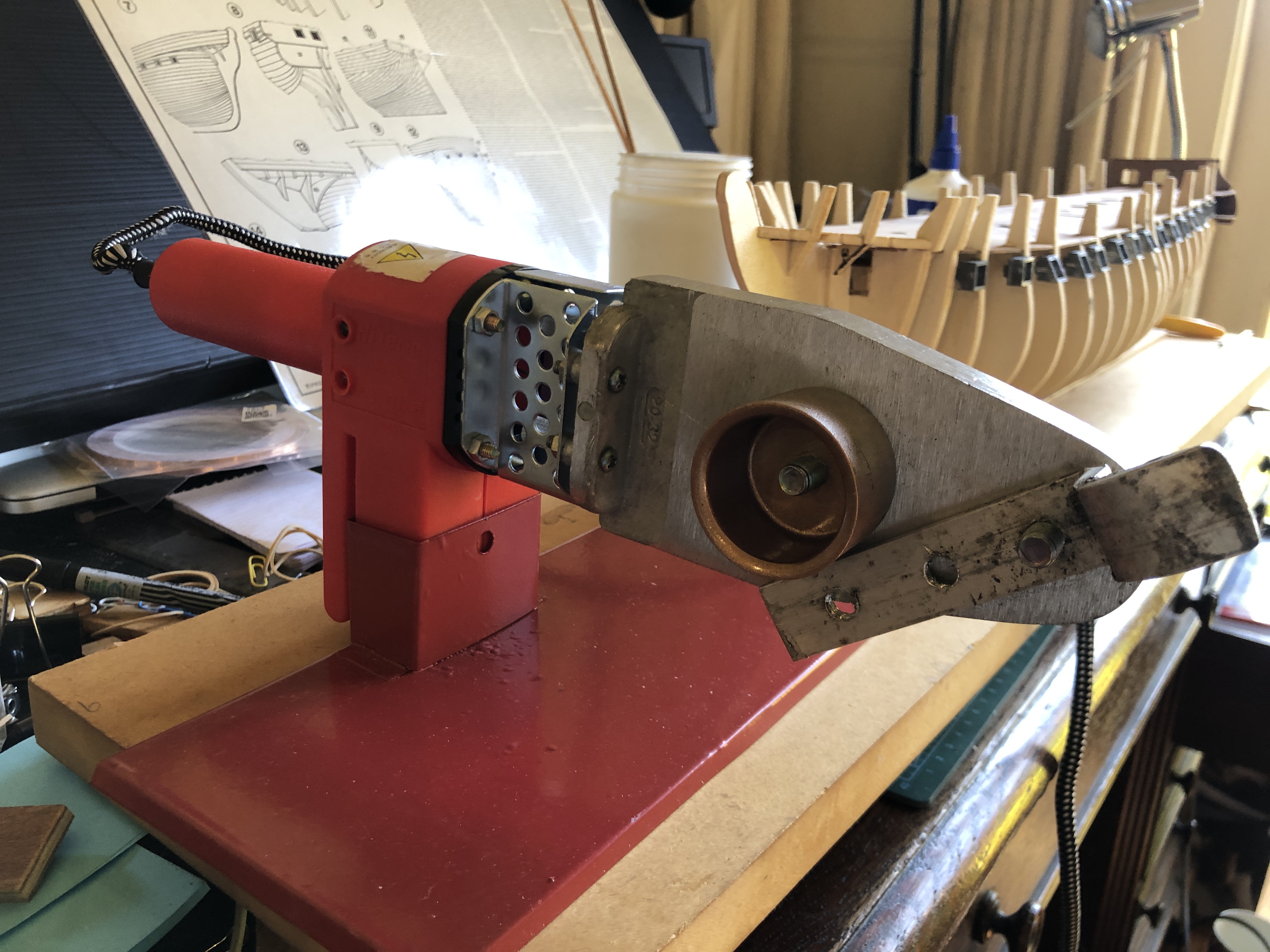
The distance between the bolt on cylinders was too large for my 1.5mm thick strips of wood, so I drilled some holes in 4mm thick aluminium bar, bolted on, and adjusted the gap to 1.5mm. Switched it on and within a very few minutes it was too hot to touch. I had soaked the first strip for 30 minutes, bent the wood around the cylinder, against the aluminium bolt on strip. Steam emitted. Gradually made the bend, checking frequently against the hull.
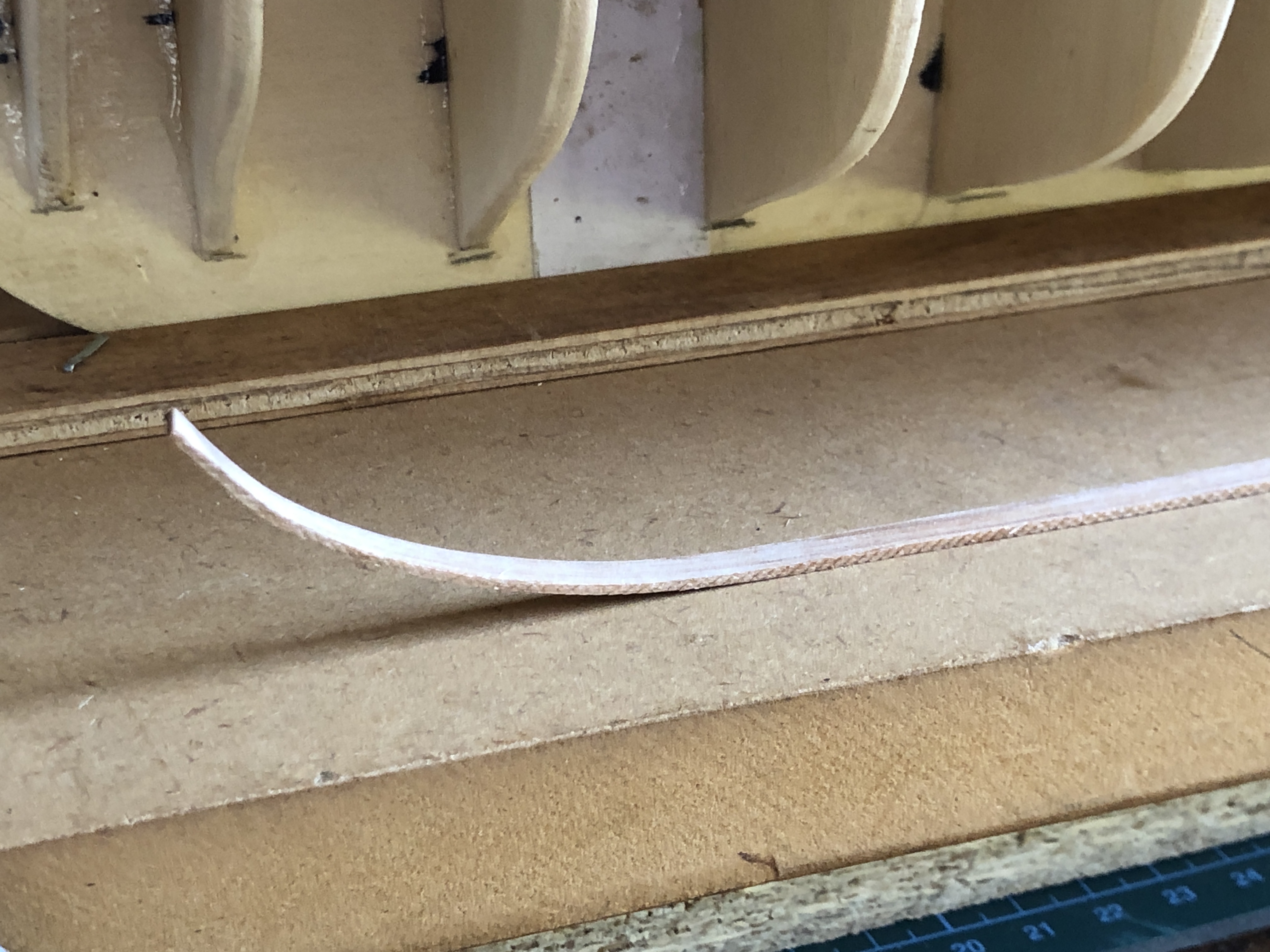
….and this is the result. The bend is perfect, and it does not try to spring back even after cooling.
Not yet glued into position. I prefer it to dry totally.
Made me feel much happier after my earlier mistakes. I can hardly believe the serendipity.
 johnsmachines
I’ve bent planks of wood using a steam box – which is relatively easy to make – to soften the wood. If you had one of those as well as your pipe heater to work with, the planking part might be a bit quicker. May be worth a try…
LikeLike
Hi Richard,
With some experimenting, I am quite happy with the results from the polypipe joining machine. I soak the “planks ” for 30″ and then bend them in the polypipe joiner. I t does produce a fair amount of steam, and the wood feels quite hot, so I think that I am getting the best of both worlds here, with heat and steam. And it is very controllable. The Constitution will be painted, so I am not concerned by a bit of scorching, and the dampness of the planks seems good for promoting setting of the CA glue. I am using a combination of CA glue and white glue, for immediate quick holding of the joins, and then permanent bonding with the white glue. Due to questionable instructions I have been forced to undo some of the CA joins, but that has been doable with some injection of acetone through a hypodermic syringe. A learning exercise!
Regards John.
LikeLike