johnsmachines

machines which I have made, am making, or intend to make, and some other stuff. If you find this site interesting, please leave a comment. I read every comment and respond to most. n.b. There is a list of my first 800 posts in my post of 17 June 2021, titled "800 Posts"

Category: carronade

Carronades and Long Guns

USS Constitution and the American heavy frigates outclassed British frigates in the 1812-1814 war between USA and Britain.

The British were in a very long and costly war with Napoleon’s France, had won every significant naval battle to date, and were probably feeling a little bit complacent about their naval superiority.

The British were therefore rather shocked out of their complacency when their ships lost almost every encounter with the American frigates in the 1812 -1814 war. There were several reasons for the losses.

American frigates (including USS Constitution) were newer, heavier, had thicker wooden sides made of “live” American oak, had larger crews, who were all volunteers, and they had more powerful guns, and more of them on each ship. To mention a few of the reasons.

In my model of the USS Constitution there are 54 guns. 32 long guns and 22 carronades. In older posts I have detailed making models of a 24 pounder long gun and a 32 pounder carronade. Photo below.

1:10 scale models of a 24 pounder long gun, and 32 pounder carronade . The long gun was more accurate, had longer range, and required more gunners to operate. The carronade was cheaper, smaller, lighter, and quicker to reload. The carronade was devastating at the close range of most naval battles of the era.

So last week I assembled the top deck (the “spar” deck), long guns (2 of them) and carronades (22 of them).

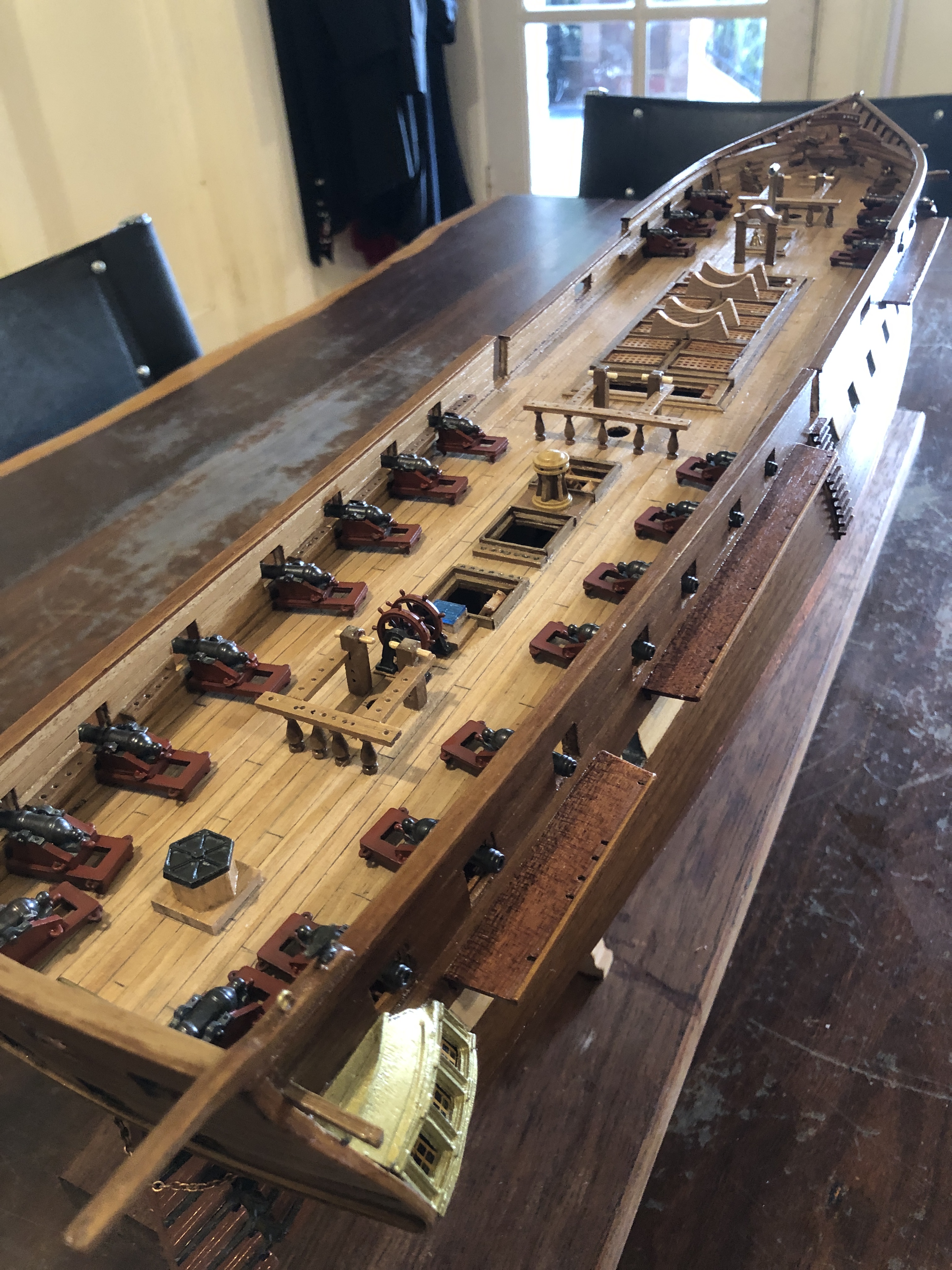
First the long guns on the spar deck…
then the carronades.

In 1797 all of the guns would have been mounted on wooden carriages. The guns in the Mamoli kit were cast metal, including the carriages. So I painted the carriages dark red, to look a bit more like wood, and because they were probably painted red in 1797.
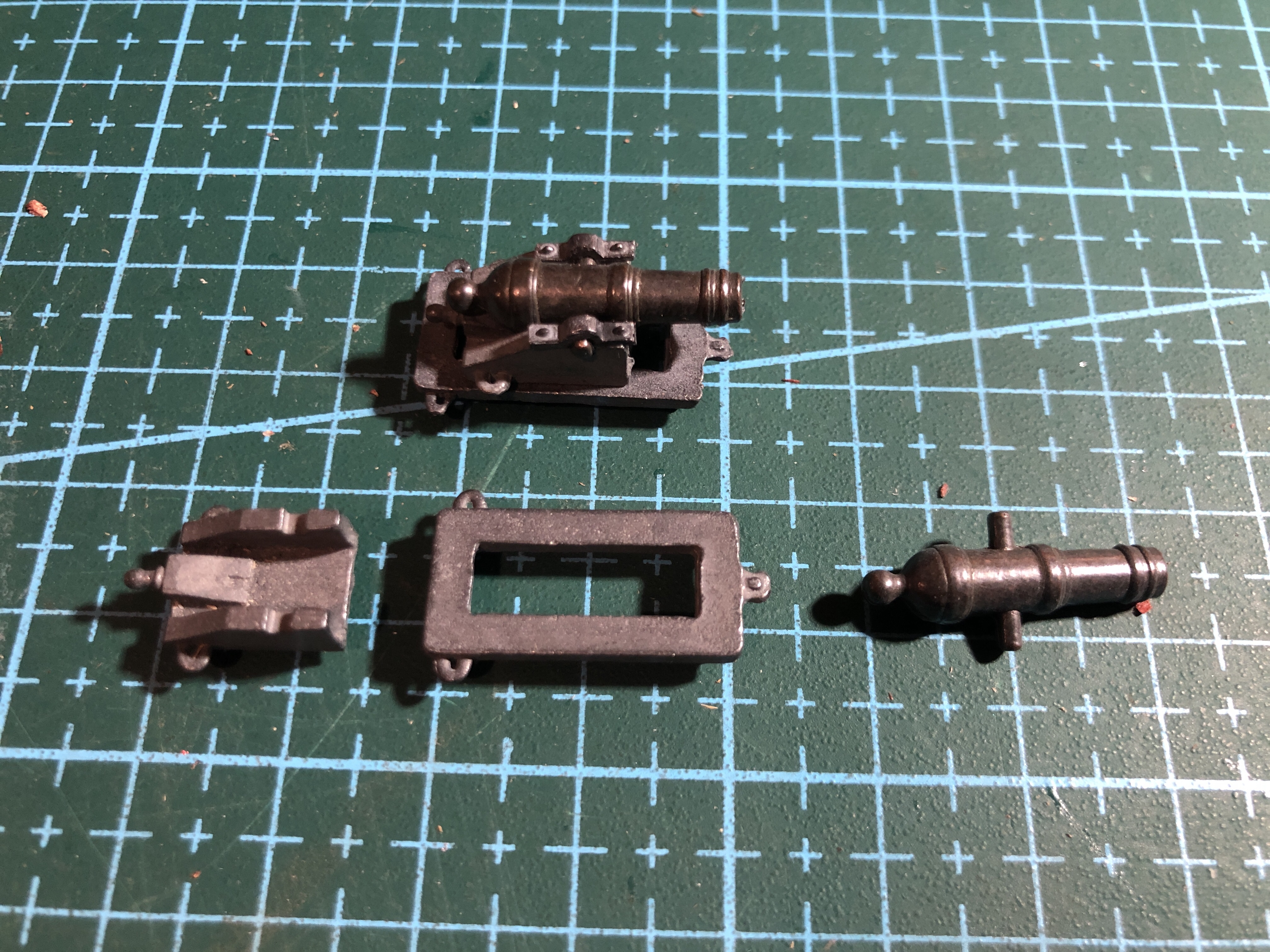
The carronade components were quite nice castings and required no finishing except for the carriage and slide painting. The assembled carronade is seen. The rectangular slide pivots at the front, and there are small wheels at the back for traversing. Ropes for traversing attach to the rear loops. Elevation was adjusted with the wooden quoin. Trunnion caps are glued in place .
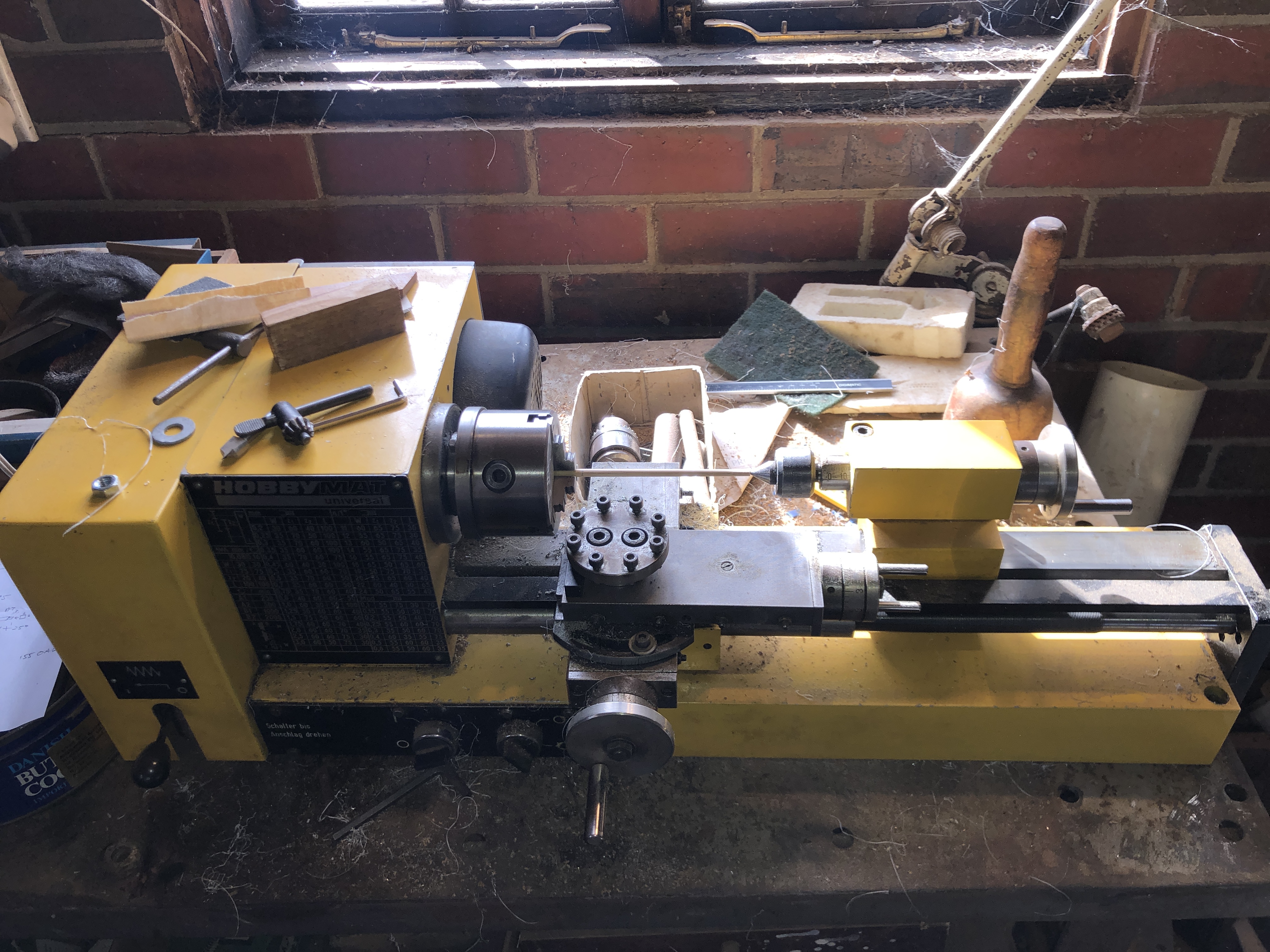
And this is my little Emco lathe which is a perfect size to drill the long gun bores. In this pic I am tapering the bowsprit. (ps. sorry, not an Emco. It is a Hobbymat MD65. Same design as a Proxxon. I do also have a tiny Emco. Just confused.)
2mm bore. 1:93 scale.

There are another 30 long guns on the gun deck below, but I have yet to deal with them.

Oh, and BTW, the guns in the above photo are not yet attached. Just sitting there for the shot.
Book Review. The Trafalgar Chronicle – 4

THE TRAFALGAR CHRONICLE

New Series 4

Edited by Peter Hore

Softcover.  £20 RRP.  Seaforth Publishing.


“Dedicated to Naval History in the Nelson Era”, the fourth volume in this series contains 21 essays, richly illustrated, and clearly reflecting the fact that the authors are enthusiastic, knowledgeable and articulate about their subjects.


This is a book to be read from cover to cover.  It has classy feel, the illustrations and maps are excellent, the topics interesting and eclectic within the period.


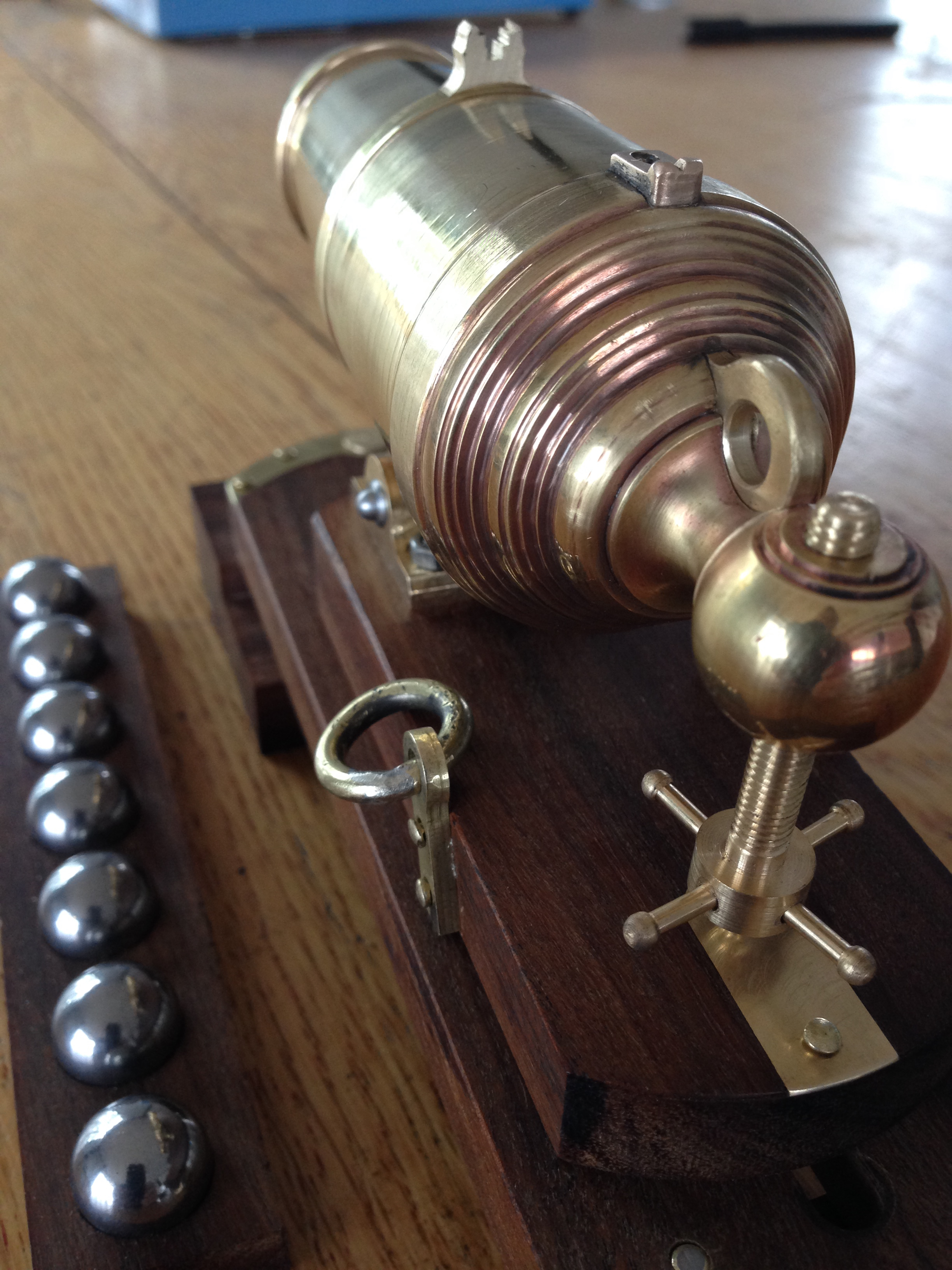
I particularly enjoyed the chapters “The Decaturs”,  “Nelson Was an Irishman”, “Russians on the Tagus”, “Captain John Perkins” (the first black officer in the Royal Navy) and “The Carronade”.  The last because this reviewer has a particular interest in carronades.  If I might take the liberty of showing a personal item….

carronade - 6

Photo 1  Model carronade made by the reviewer 2015

The essay by Anthony Bruce is the best description of the history of carronades which I have read.  Particularly the descriptions of naval actions where carronades made a significant contribution.


I eagerly look forward to further volumes in this series.


CARRONADE 1

It has been a while since I posted, but I have been busy.

Some of that has been in the workshop making a scale model carronade.

A carronade, in case you are wondering, was a muzzle loading cannon, made 1776-1852 in the Scottish town of Carron, by the Carron company.  And subsequently much copied elsewhere.

It is a cannon which is short, squat and ugly.

Weighs about 1/3 as much as an equivalent bore long gun, (see previous posts), requires only 3 men to operate (compared to 9-11 for a long gun), and can fire balls or other nasties at 3 times the rate as long guns.

2 carronades, 68 pounders,  were on the foredeck of Nelson’s “Victory”, and they caused huge damage  at Trafalgar.   Can you imagine loading a 68 pound cannon ball into the muzzle of a hot cannon?   Many actions proved the killing power of carronades, and the British Admiralty were so impressed that they replaced long guns with carronades on many of their ships.

The French, and Americans were less rapid to  access this new technology, although Napoleon, who was an artillery officer, was adamant that the French navy should have the carronades installed as quickly as possible.

The British equipped some of their ships almost exclusively with carronades, and at close quarters they were devastating and they won some notable victories.

Unfortunately, although they were devastating at close quarters, they did not have the accuracy or range of long guns beyond about 500 meters.

So in the war between the Brits and the Yanks in 1812, the Americans found that all they had to do to win at sea and on the Great Lakes, was for their frigates to remain beyond the carronade range, and shoot their long guns, with many victories, and great frustration of the Brits, who were not used to losing naval battles.

Carronades were commonly installed on merchant ships, privateers, pirate ships, and small naval vessels, due to their relatively light weight, and small gun crew. But the Royal Navy stopped using them from 1852, when breech loaders were the latest new technology being installed wherever possible.

I decided to make another 1:10 scale model cannon.  A 32 pounder carronade, the same scale as the previously blogged 24 pounder long gun, to put them side by side for comparison.

It is almost finished.  I will post some photos soon.  Look forward to squat and ugly.