machines which I have made, am making, or intend to make, and some other stuff. If you find this site interesting, please leave a comment. I read every comment and respond to most. n.b. There is a list of my first 800 posts in my post of 17 June 2021, titled "800 Posts"
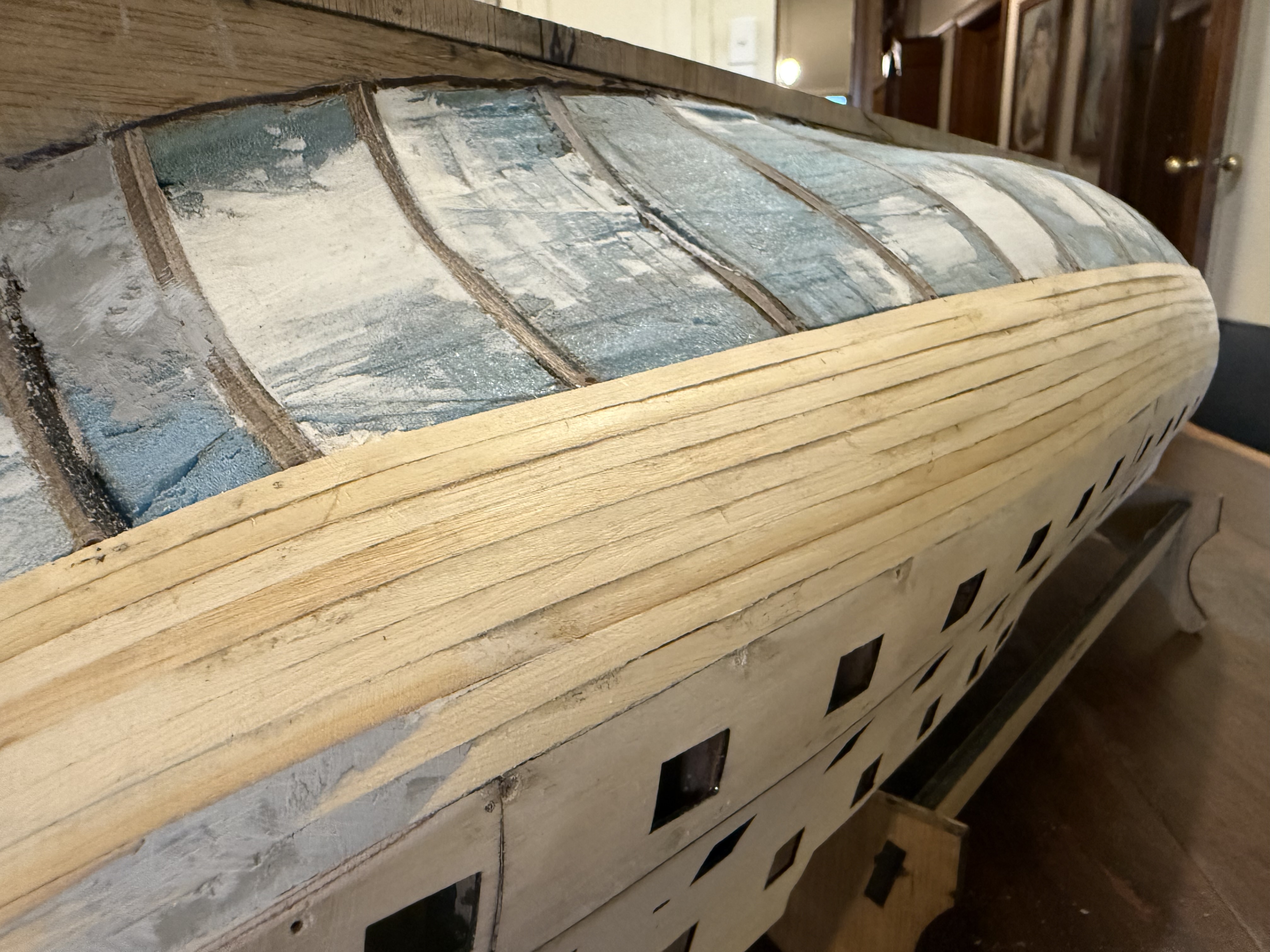
In the 2 layer method of model ship planking the purpose of the first layer is to create the final shape of the exterior of the hull, and to provide a base for attaching the very thin (0.5mm) final layer planks. The shape was initially determined in the model by the shapes of the bulkheads and keel, and refined as far as possible by judicious sanding, but as the planking progresses small depressions and bumps become more obvious and can be corrected to some degree.
As mentioned previously, I chose Huon pine for the first layer of planking, because the the thin strips (5mm x1.5mm) can be bent and twisted into fairly sharp bends without snapping. It is beautiful fine grained timber, and it is a shame that it will be finally covered by copper or paint or a second thin layer of darker planks such as walnut or jarrah.
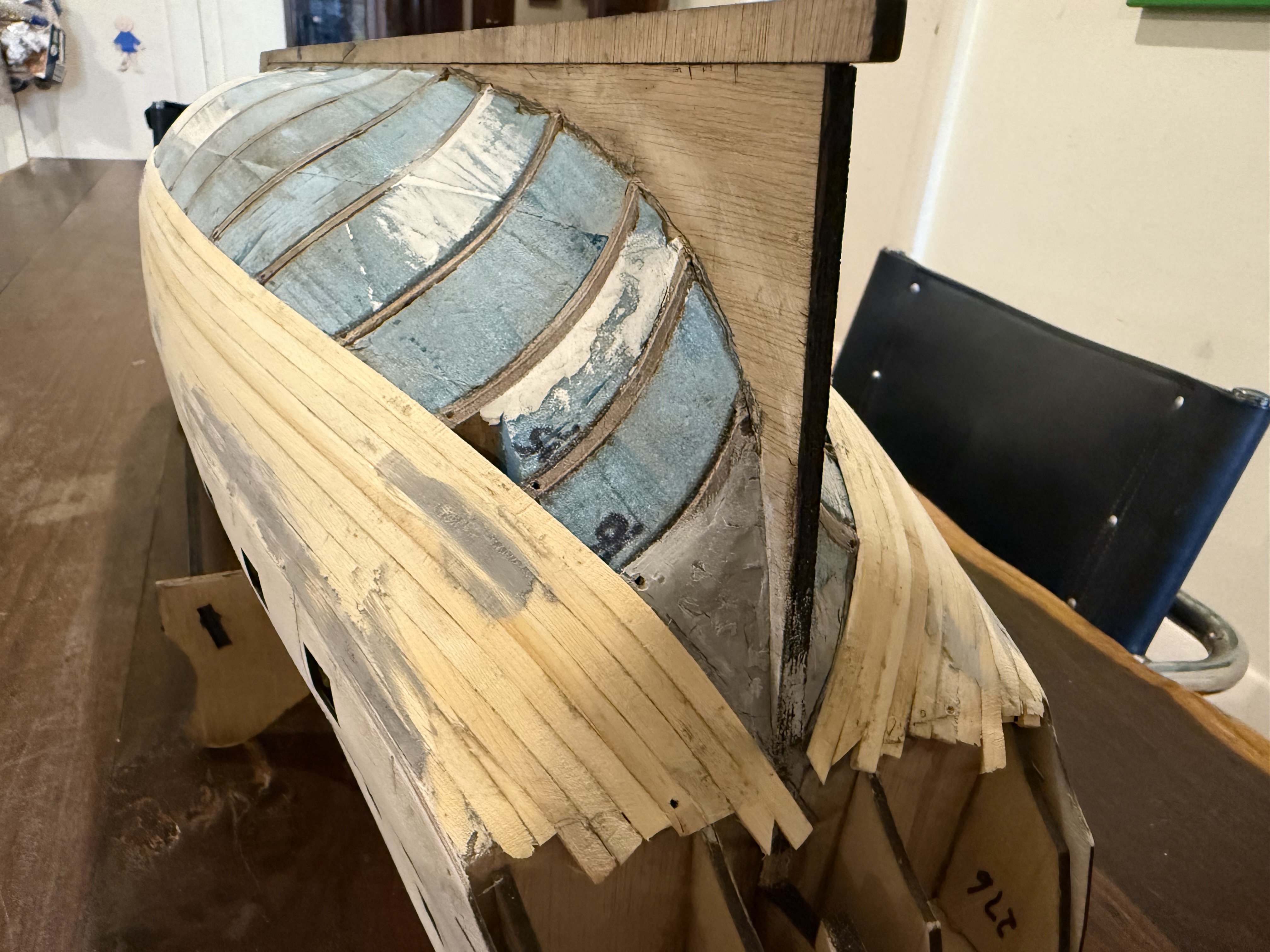
Each plank covers 5mm. It is glued to each bulkhead and edge glued to its neighbour. I manage about 1 plank per hour, so what you see is about 18 hours effort. If I see obvious hollows or bumps I fill or sand as I go. The plank filler is “Multifill”. It dries quickly and sands well.
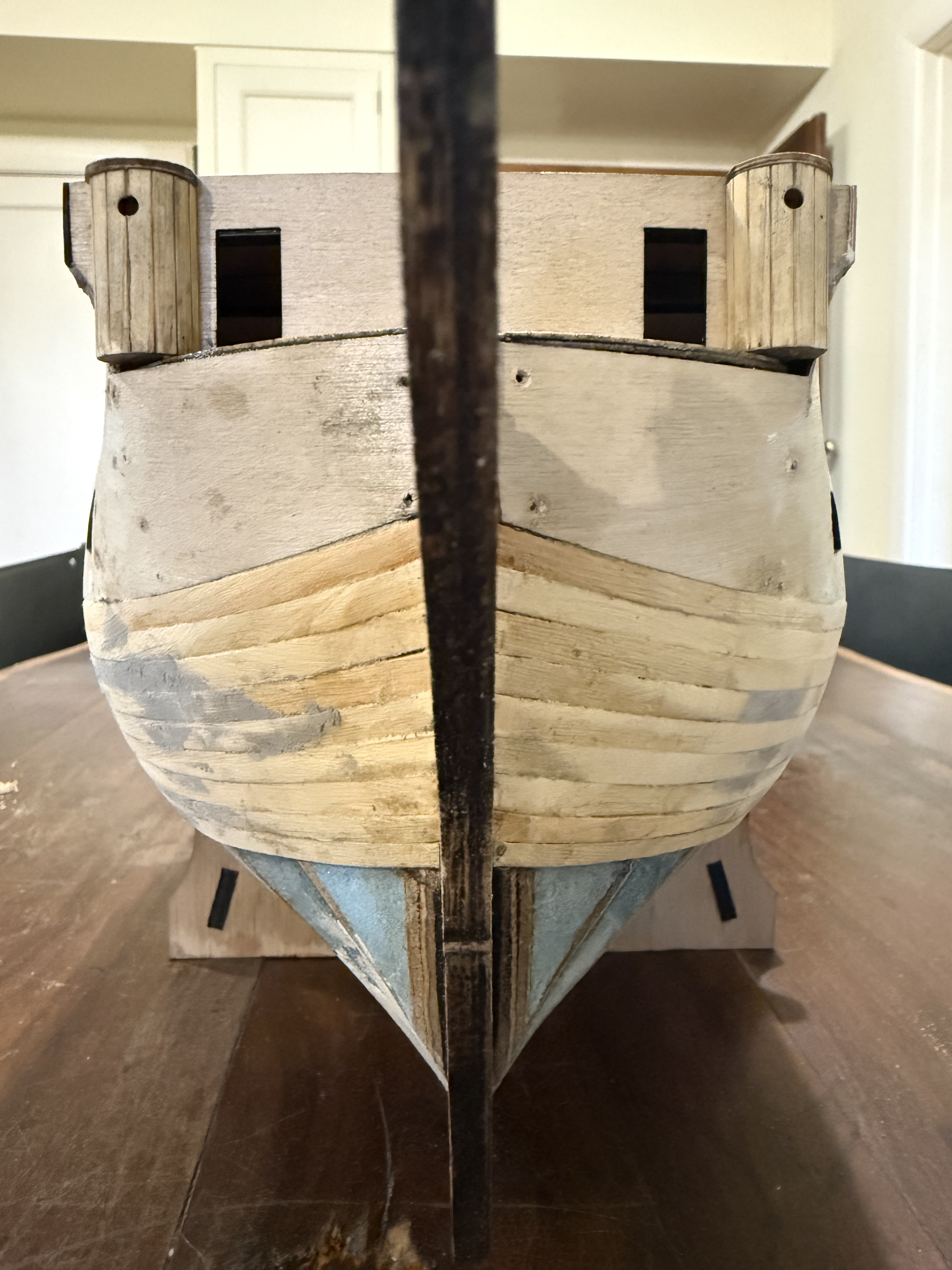
The severest bends are at the stern and the bow. So far I have needed only 2 “stealers”, the wedge shaped filler pieces, but more may be required as the planking progresses. The 3D printed clamps are working very well. The stern post will be attached when the planking is finished.
Each clamp requires a 1.5mm hole drilled into the bulkhead. It is filled with glue when the next plank is attached. The hole is angled and positioned so the plank is held flat against the bulkhead, and with as much length for the screw in the bulkhead as possible. Each plank has its opposite installed immediately after so the twisting force on the hull is balanced.
At the bow I have started to taper the planks so they sit flatter against the bulkheads. The lowermost 2 planks are tapered for about 100mm.
I am reasonably satisfied with how the planking is going. No major problems so far.
I knew that making a model of USS Constitution would be a learning exercise. And that mistakes would be made, new techniques learned, new tools purchased and made. And I did make many mistakes. But the end result was OK. Good enough that one of my daughters said that she would like to have it. And good enough for a prize at the local show.
Maybe the mistakes were not that bad. In any case, I have decided to make another model sailing ship, building on the experience obtained from Constitution.
The next model will be a ship “of the line”. That is, a battleship which was built to take the severe punishment of a fleet action, like Trafalgar 1805, or The Nile 1798. These ships were floating gun platforms, mounting guns up to 36 or even 42 pounders. Not as fast as frigates, but definitely more powerful.
In the British and French navies 1750-1800, the most commonly built ship of the line was the 74 gun ship. Both navies built almost 200 of these class 3 ships of the line. The French first produced them, but when their power and sailing qualities became obvious, the British followed. The British admired the design and build quality of the French ships, and produced their own version, after capturing and copying French versions.
The 74’s were large ships for their era, weighing 3000 tons fully gunned and provisioned. (c.f. Constitution – 2000 tons fully loaded). They mounted 74 guns, on 2 roofed gun decks and the exposed top deck.
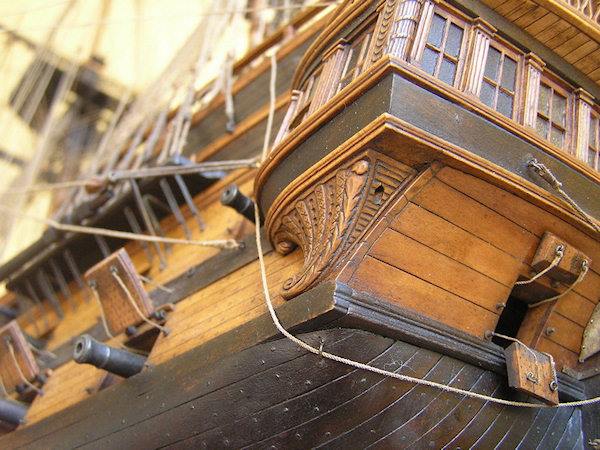
For the model I have a dilemma. Do I make a model with hull planking, masts and rigging (like my Constitution in the photo), or an “Admiralty” model, which is hull only, showing the curvaceous hull framing timbers, no or minimal planks, and no masts and rigging.
Example of an Admiralty model under construction. each one of those frames is made of 12-14 individual parts and this photo shows only the forward section. Only 2 of the frames are the same… the rest are all unique. And the decks and beams and internal details are yet to be added. A beautiful, organic shape to be sure.This brigantine is under construction by Australian master modeller Tim Gee.And this is a truly magnificent model of a French 74 made by Russian master modeller D. Shevelev.The detail is extraordinary. 6 years to complete. See Ships of Scale for many photos.
If only I had started this hobby 20 or 30 years ago!
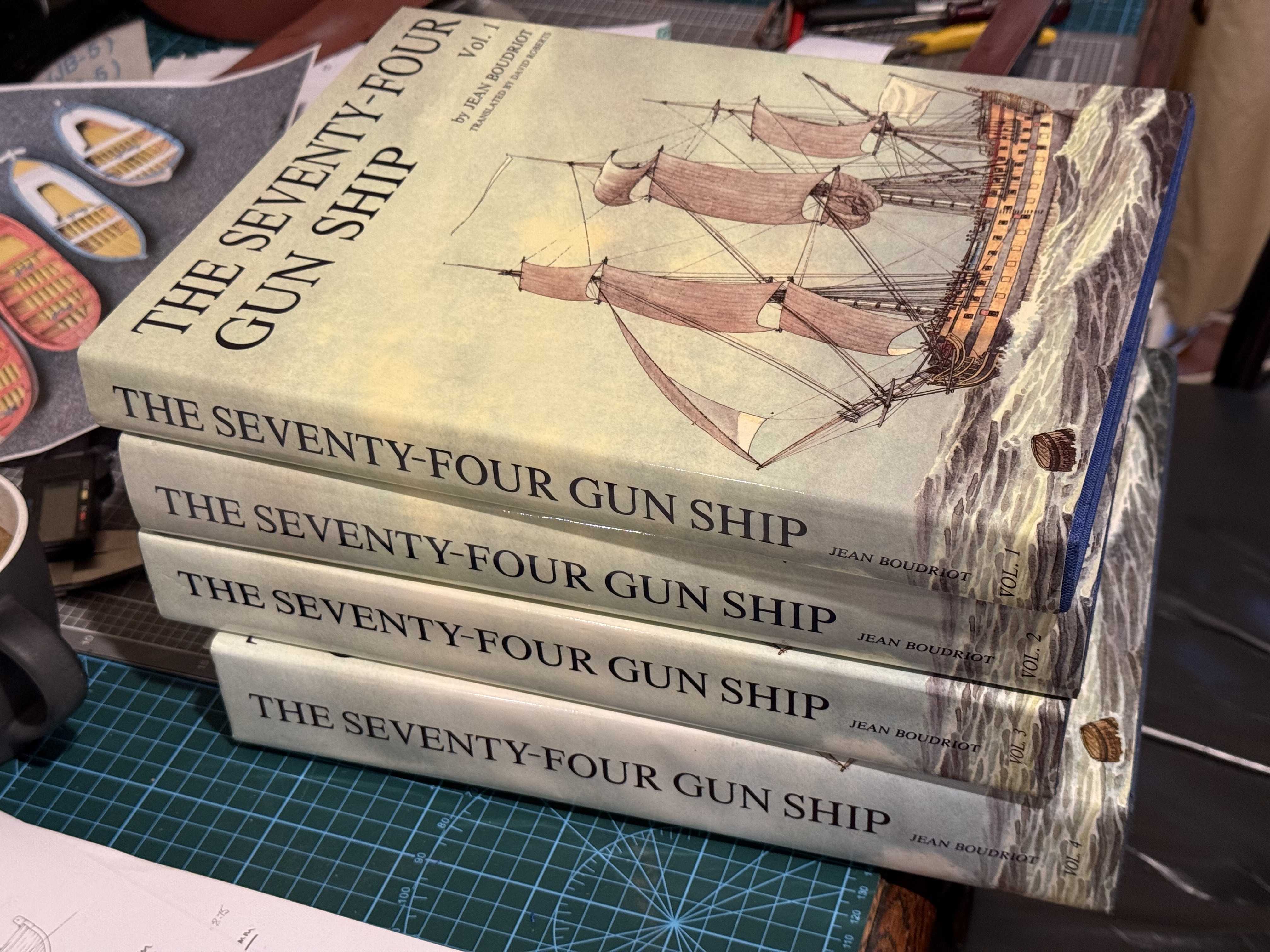
To help me with my dilemma, and for more information I borrowed some plans of a British 74, HMS Vanguard, and also purchased a set of 4 books from Ancre, France…
These books by Jean Boudriot (dec) are translated into English. Volume 1 is about the hull. Vol 2 is the hull fittings, Vol 3 is the masts, sails and rigging, and Vol 4 is about the seamanship and sailing of the 74. They were listed as second hand, but in fact were all brand new, but slightly damaged. They had all been dropped at at some time, and the covers corners were crumpled. I spent some time repairing or minimising the damage by dampening the crumpled corners then squeezing them with woodworking cramps until dry. That worked pretty well. Postage from France ($aud200 !!), was covered by the price reduction. Expensive books, but they are lovely to read and beautiful to hold and behold. Very detailed, and will be read and re-read many times. The author, Jean Boudriot, was an architect, and his diagrams and drawings are superb. The text is conversational and entertaining. There are many and detailed plans of the un-named ship, but they are about the full size ship, and not ideal for the modeller. So the publisher (Ancre) also has plans drawn by an expert modeller, at extra cost. I ordered those extra plans separately and paid more extortionate postage to get them. They are very detailed. Should have added them to my initial books order. Would have saved $aud100.
The HMS Vanguard plans also apply to HMS Elephant, and HMS Bellerophon, which had variations mainly in the stern decorations. If I use those plans, it would be a bulkhead, keel, and planking construction, with masts, rigging and possibly sails, but no interior or hull framing detail. A scratch build. And I would use the Bellerophon name and details because of the association with Napoleon Bonaparte. The Boudriot books would doubtless be used to confirm details.
If I do plunge into the Admiralty model….. 1. It might never be finished (I am 75 years old). 2. It might be beyond my abilities.
If I use the Vanguard plans …. 1. It might never be finished 2. It might be beyond my abilities. But at least I would get to use my rope making tools again.
In either case, it would be a challenge, and fun, at times. Maybe I should build 2 models…
Any opinions or feedback from readers?
p.s. Vale Les Madden, fellow modeller, razor sharp intellect, and friend. An inspiration to all who knew him.



 johnsmachines