johnsmachines

machines which I have made, am making, or intend to make, and some other stuff. If you find this site interesting, please leave a comment. I read every comment and respond to most. n.b. There is a list of my first 800 posts in my post of 17 June 2021, titled "800 Posts"

Tag: carronade

Constitution Fun Day. Installing the GUNS.

The Americans redefined the concept of frigates.

Until Constitutions et al,. frigates were fast, moderately well armed, and could sail away from better armed but slower, ships of “the line”.

USS Constitution redefined the concept of a frigate. It was not quite as fast, but was more heavily armed and armoured (with thick living oak), and had a lot of guns, and personnel. The guns were bigger, and more of them, than previously seen. And that blew the Brits away in almost every frigate action in the 1812 war. Of course they never faced ships of the line, like Victory. That would have been like a WW2 destroyer facing an Iowa class battleship. No contest.

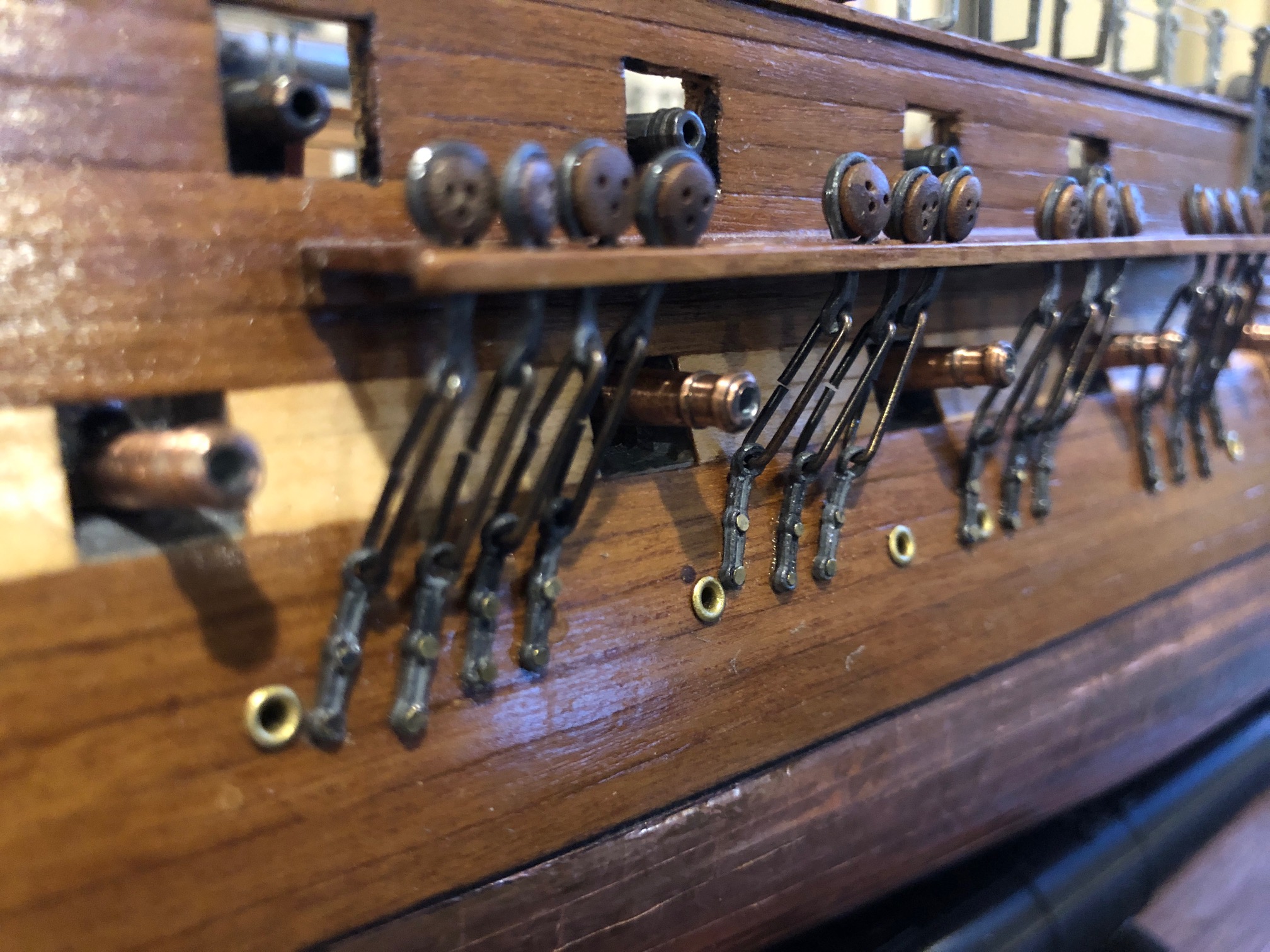
Today was hot again in southern Oz. 37 Celsius 98 Fahrenheit, so I had another day with my Mamoli Constitution. I finished the channel deadeyes on the mizzen mast, Then glued the spar deck carronades in place, all 20 of them. The wheels of the carronade carriages did not rotate, so I gave them a flat bottom with a few sanding strokes, and glued them to the top (spar) deck. I had previously painted them and they look really cool IMO. The short carronade barrels barely protrude beyond the Constitution bulwarks, as in the original. It was not uncommon for the carronade gunports to catch fire during a battle due to the carronade fire, but I guess that the gun crew were prepared to douse that.

Then I installed the 24 pr long guns on the gun deck, below. Mamoli, like most kit manufacturers, provides only a half barrel, not providing the breech or the carriage since they will not be visible. So I glued the half barrels into their positions, using CA glue. The barrels seemed to protrude further outside the hull than I was expecting, so I did a scale drawing of the 24pr gun, and the 23″ thick gun deck walls, and measured the amount of barrel protrusion. Sure enough, the Mamoli guys had their model almost exactly correct! Unfortunately, I did not save that drawing to show you.

Since most ship battles of the era were fought at less than 500m, I gave the guns only 0-1 degree elevation.

USS Constitution defeating HMS Guerriere. Not an evenly matched fight. The better ship won.

Then I installed the model hammock rail stanchions. These sit above the bulwarks, and consist of metal frames and netting. If a battle was imminent, the crew would roll up their hammocks and stuff them into the hammock rails. This provided the spar deck gun crews with a degree of protection against sharp shooters and splinters.

SWMBO commented that the model Constitution was looking a lot more interesting!

The gun deck long guns as supplied by Mamoli
The half barrels do look OK when installed
The carronades and long guns installed. Oh, and the channel deadeyes. And the hammock stanchions and ropes. Netting yet to come.

George the Third.

In 2015 or thereabouts I was persuaded by Stuart Tankard to get into CNC machining. So I bought a second hand Seig lathe which had been converted to CNC. The Seig was really a waste of money. Too small, too inaccurate, too flimsy. And the conversion, I gradually realised, had been done with the cheapest possible components. But it did awaken a world of possibilities. I made some simple shapes…. spheres, tapers,etc, and I started searching for a better machine.

I had offered to buy Stuart’s Boxford TCL127. Not suprisingly he declined. But he did know where there was an identical one which might be for sale. Long story short, it was available and I bought it.

Now, what to make first?

Hmm…. what about a cannon? I had no interest in cannons, but the shape seemed suitable, so I did turn a long gun barrel, and that was fine, but the Boxford has one major limitation. The maximum size object it will handle is 127mm long, and 127mm diameter. So my cannon barrel was a bit pathetically small.

I showed the barrel to my model engineering club, and Bob, a senior member, offered me the use of his CNC lathe. So in 2016, I made a 24 pounder 1779 naval long gun, scale model about 300mm long. It turned out quite nicely, and I became very interested in the history of cannons as well as the machining aspects. Then I made a 32 pounder carronade circa 1805, at the same scale. And then an1866 rifled muzzle loader 80 pounder, and a 110 pounder rifled breech loader, and a1465 Ottoman bombard, and possibly more to come. None of these, I must mention, are capable of being fired.

But back to the long gun and the carronade. They were finished, as far as I was concerned, except for the cyphers on the barrels. Royal Navy guns which were made for HM ships always had (as far as I know), a moulded or carved cypher of the reigning monarch. The British monarch in 1779 and 1805 was George the third.

Summer has finally arrived in Southern Australia. 33 centigrade yesterday, and 40+ today. Too hot for the workshop, but not for Stuart T’s 30 watt fiber laser.

The 24pr 1779 naval long gun, with King George 3 cypher, expertly lasered by Stuart T.
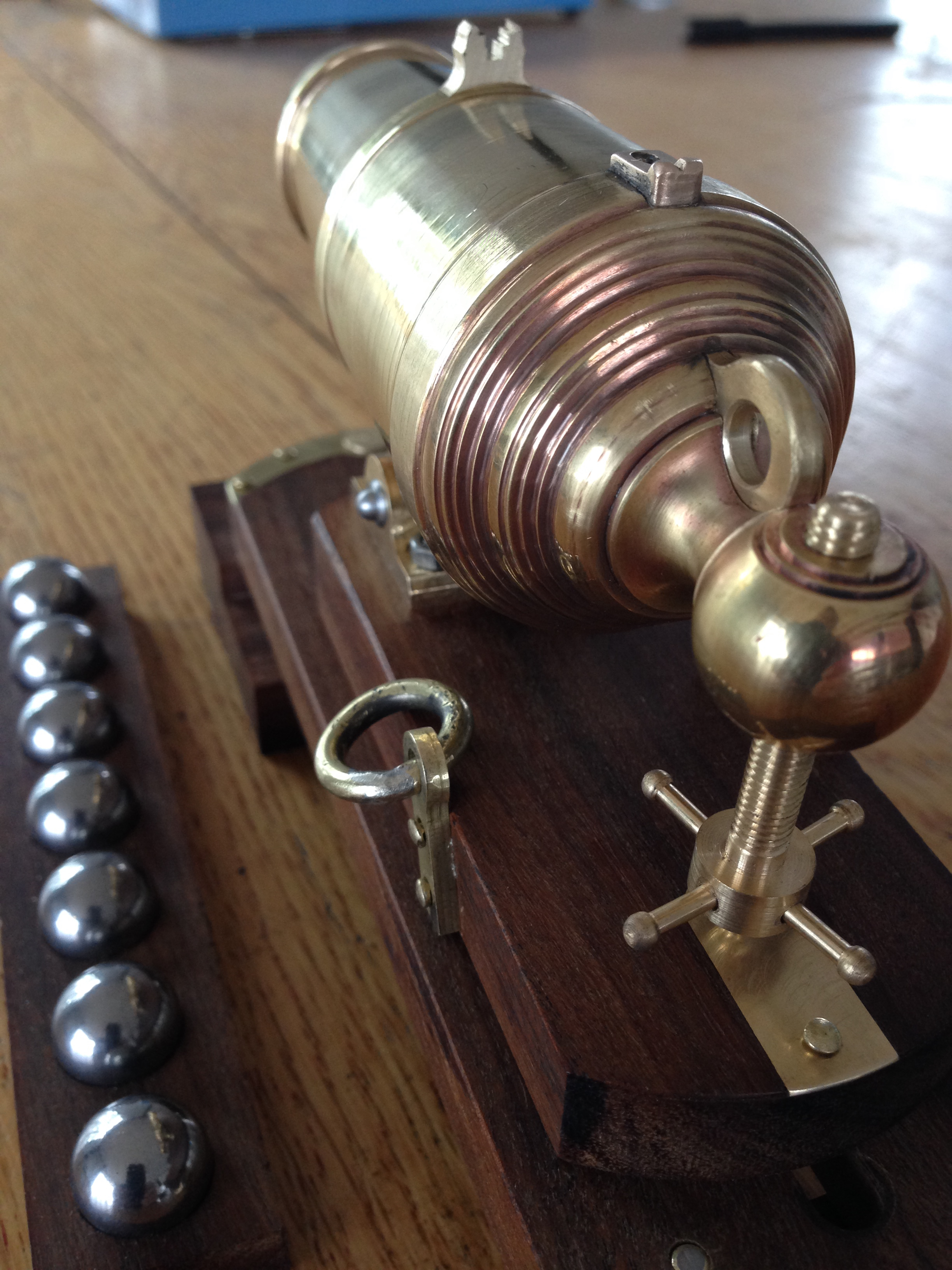
The 1805 Carronade with its George 3 cypher.
The cypher is 22mm x 10mm. The lasering took about 2 minutes, after fiddling with the positioning and focusing and settings, and a test run on some scrap. Can’t remember where I found the image. The close up photo shows my substandard finish turning, as well as the superb result from Stuart’s lasering. After lasering, the lasered cypher is blown with compressed air to clear dust from the grooves, then a rub with 1200 grit emery paper, then some Brasso.

“GR” George Rex.

“HONI SOIT QUI MAL Y PENSE”

Description

Honi soit qui mal y pense is a maxim in the Anglo-Norman language, a dialect of Old Norman French spoken by the medieval ruling class in England, meaning “shamed be whoever thinks ill of it”, usually translated as “shame on anyone who thinks evil of it”. Wikipedia

Book Review. The Trafalgar Chronicle – 4

THE TRAFALGAR CHRONICLE

New Series 4

Edited by Peter Hore

Softcover.  £20 RRP.  Seaforth Publishing.


“Dedicated to Naval History in the Nelson Era”, the fourth volume in this series contains 21 essays, richly illustrated, and clearly reflecting the fact that the authors are enthusiastic, knowledgeable and articulate about their subjects.


This is a book to be read from cover to cover.  It has classy feel, the illustrations and maps are excellent, the topics interesting and eclectic within the period.


I particularly enjoyed the chapters “The Decaturs”,  “Nelson Was an Irishman”, “Russians on the Tagus”, “Captain John Perkins” (the first black officer in the Royal Navy) and “The Carronade”.  The last because this reviewer has a particular interest in carronades.  If I might take the liberty of showing a personal item….

carronade - 6

Photo 1  Model carronade made by the reviewer 2015

The essay by Anthony Bruce is the best description of the history of carronades which I have read.  Particularly the descriptions of naval actions where carronades made a significant contribution.


I eagerly look forward to further volumes in this series.


More Scale Stuff

IMG_4482.JPG

There is the 1464 Turkish bombard (black), 17 tons, 307kg granite ball;  the 1779 long naval gun off USS Constitution or HMS Victory 24lb balls; and a 32lb carronade.  All 1:10 scale.  Interesting to see them together on my kitchen table?

CARRONADE VS LONG GUN


carronade - 1.jpg

Models 24lb long gun and 32 lb carronade.  1:10 scale.

In a shoot out, which would win?

Doubtless, at this range, there would be no winner.

But there were quite a few battles between ships equipped with these weapons in the Napoleonic wars, the first American civil war (the War of Independence), the 1812 war between Great Britain and the US, and many others.

The long gun, manned by 9-11 highly trained gun crew, fired a ball of 24lbs weight, up to 2000 yards, with some accuracy.  The largest long guns mounted on the biggest battleships (like “Victory”) fired  balls up to 42 lbs.

The carronade was operated by 4-6 men, and fired a ball in this case of 32 lbs, at three times the rate of a long gun, but with dismal accuracy beyond 500 yards.  They were much less expensive to buy and operate, and very popular with the bean counters.  Carronades fired balls up to 68 lbs.

Since most sea battles were fought at ranges much less than 500 yards, carronades were credited with many spectacular victories.  The British were so impressed that they installed carronades in addition to the usual long gun armament, to increase the overall firepower of their ships, but later they replaced the long guns with carronades in some ships.

carronade - 2.jpg

In the war of 1812 between the Brits and the US, while the Brits were simultaneously engaged in a life and death struggle with the Napoleon, they were often beaten by the newer and more powerful frigates of the small US navy.  One factor cited is that the British ships had fewer and less powerful long guns, and partly because they had changed over to carronades.   The US ships remained out of effective range of the British carronades while causing huge damage with their long guns.


carronade - 4.jpg

Short squat and ugly vs long and elegant and expensive.  Note: no SWMBO comments.


The carronade was used by the British navy for only half a century, vs 3 centuries for long guns.

They were both replaced by guns which were rifled, fired explosive shells, and were breech loaded.

For a very detailed analysis of these weapons, including original results of British Admiralty trials and summaries of many sea battles, see Adrian Caruana’s book, “The History of English Sea Ordnance” Vol 2, 1997.  If you can locate a copy.  I found one at the State Library of Victoria.


POLISHING TINY BRASS PARTS

My model carronade has quite a few very small metal (mostly brass) components.  They are fiddly and a bit difficult to hold while finishing (filing and sanding and polishing).

So I bought a tumbler which is designed for polishing metal jewelry and gemstones, and gave it a go.


carronade - 15.jpg

Enter a caption

It cost just under $300, including a kilo of stainless steel bits, and some polishing compound.  It is designed to run for weeks at a time when polishing rocks, but I find that 30-90 minutes is enough for my brass parts.


carronade - 14.jpg

The drum will hold 4lbs of parts.  Shown here are the stainless steel polishing bits.  The drum revolves quite slowly, about 30rpm.  Water is added so that the drum is just under 1/2 full.


carronade - 13

The before


carronade - 16

after 30 minutes.  It could use another 30-60 minutes of tumbling.  Not all of these bits are for the carronade.


carronade - 1.jpg

This is the sight for the carronade.  Complex and tiny and has sharp edges.  Ideal for the tumbler.  The CNC program diagram on the screen.

I am still experimenting with the tumbler.  So far I have used only the stainless steel shapes to do the polishing.  I will try some abrasive compounds soon.  Garnet dust seems to be the commonest abrasive.


carronade - 1.jpg

More bits for the tumbler


carronade - 7.jpg

A preview.  Almost finished.


CARRONADE 1

It has been a while since I posted, but I have been busy.

Some of that has been in the workshop making a scale model carronade.

A carronade, in case you are wondering, was a muzzle loading cannon, made 1776-1852 in the Scottish town of Carron, by the Carron company.  And subsequently much copied elsewhere.

It is a cannon which is short, squat and ugly.

Weighs about 1/3 as much as an equivalent bore long gun, (see previous posts), requires only 3 men to operate (compared to 9-11 for a long gun), and can fire balls or other nasties at 3 times the rate as long guns.

2 carronades, 68 pounders,  were on the foredeck of Nelson’s “Victory”, and they caused huge damage  at Trafalgar.   Can you imagine loading a 68 pound cannon ball into the muzzle of a hot cannon?   Many actions proved the killing power of carronades, and the British Admiralty were so impressed that they replaced long guns with carronades on many of their ships.

The French, and Americans were less rapid to  access this new technology, although Napoleon, who was an artillery officer, was adamant that the French navy should have the carronades installed as quickly as possible.

The British equipped some of their ships almost exclusively with carronades, and at close quarters they were devastating and they won some notable victories.

Unfortunately, although they were devastating at close quarters, they did not have the accuracy or range of long guns beyond about 500 meters.

So in the war between the Brits and the Yanks in 1812, the Americans found that all they had to do to win at sea and on the Great Lakes, was for their frigates to remain beyond the carronade range, and shoot their long guns, with many victories, and great frustration of the Brits, who were not used to losing naval battles.

Carronades were commonly installed on merchant ships, privateers, pirate ships, and small naval vessels, due to their relatively light weight, and small gun crew. But the Royal Navy stopped using them from 1852, when breech loaders were the latest new technology being installed wherever possible.

I decided to make another 1:10 scale model cannon.  A 32 pounder carronade, the same scale as the previously blogged 24 pounder long gun, to put them side by side for comparison.

It is almost finished.  I will post some photos soon.  Look forward to squat and ugly.