johnsmachines

machines which I have made, am making, or intend to make, and some other stuff. If you find this site interesting, please leave a comment. I read every comment and respond to most. n.b. There is a list of my first 800 posts in my post of 17 June 2021, titled "800 Posts"

Tag: CNC drilling

91 x 4 drilled holes. Yes, counting.

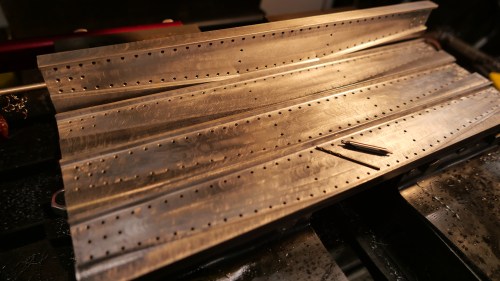
Today I drilled the girders of the chassis under the Armstrong cannon.  Each girder has 91 rivet holes.  Later I will need to drill more for the gear shafts, and for the center pivot bar.

The holes are 2mm diameter.
PANA3767

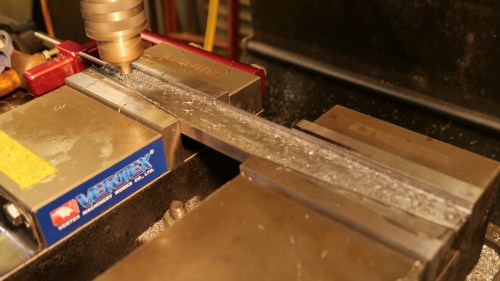
The mill drill setup. Re- indicating the vices again took me about 45″.
PANA3769

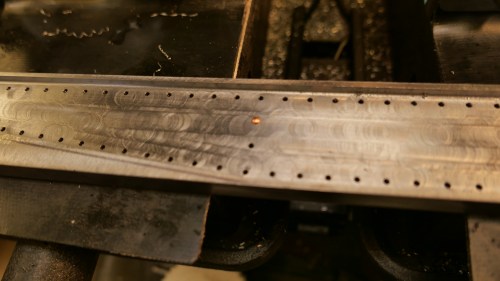
Firstly all of the holes were center drilled, then drilled through.  The rivet confirmed a nice sliding fit.
PANA3770

364 holes, through 5mm of steel done with one center drill, and one 2mm drill.  That is pretty impressive IMO.  More than 1.8 meters of steel with 2 drill bits.  And using my olive oil and kerosene lubricant-coolant.   And the bits still seem to be sharp.

Each girder took about 28″ to drill the 91 holes.   CNC of course.  It has been a while since I said it….. “I love CNC”.
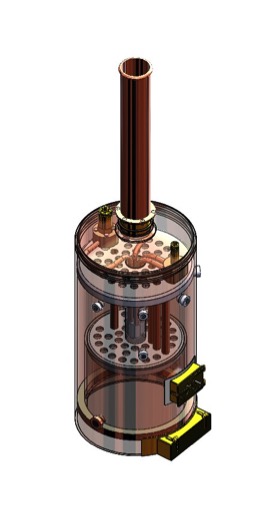
 

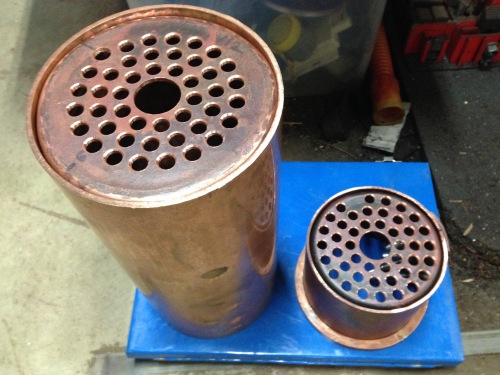
6″ Vertical Boiler. CNC Drilling Firetube Holes

Boiler6 transparent

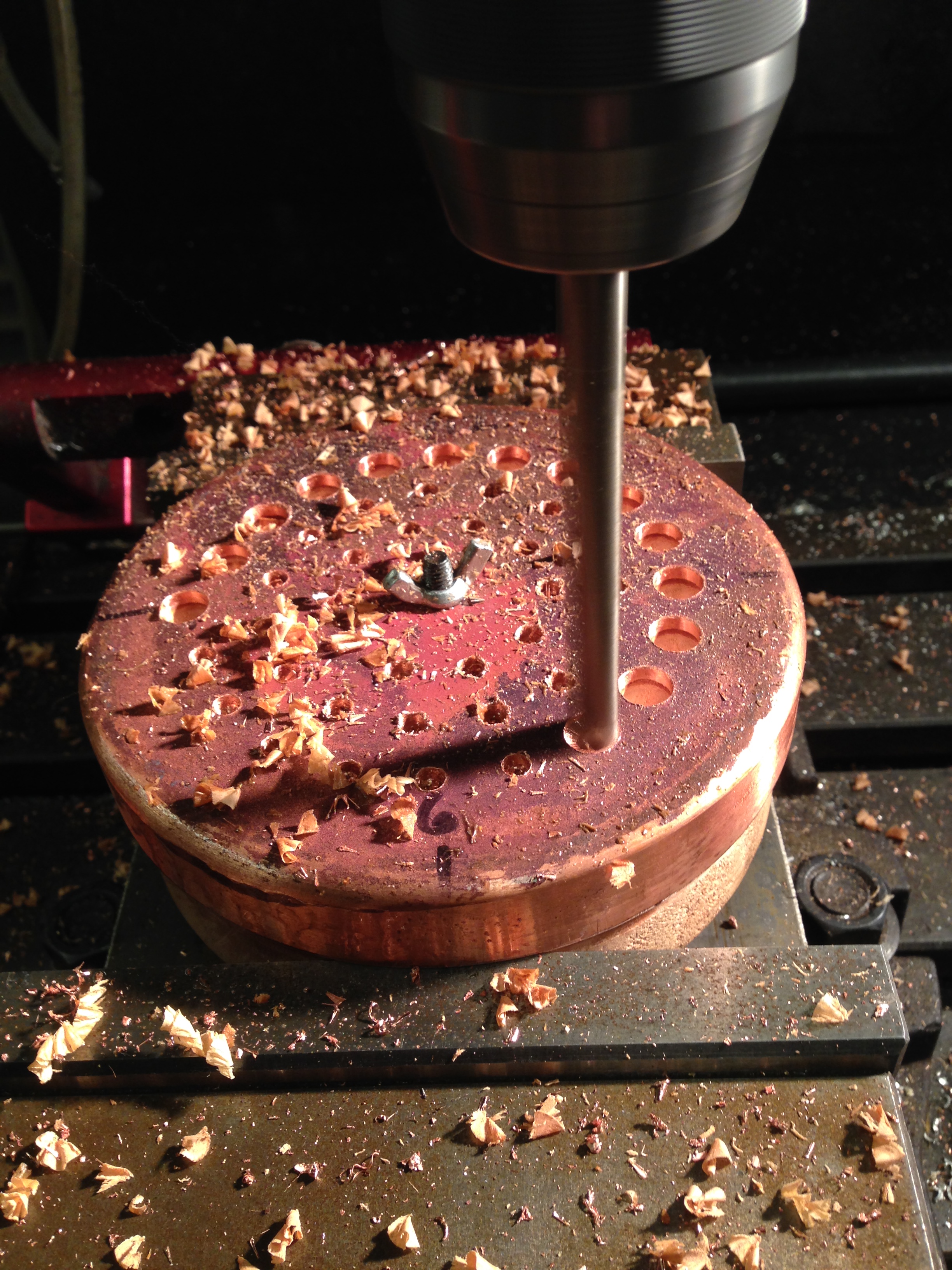
After all of the careful flange forming I was careful to not screw up the firetube perforations in the boiler end plates.  At times like this it is great to have a CNC mill/drill.

IMG_6480.JPG

The wooden form is useful as a clamping aid.

IMG_6484.JPG

No major stuff ups (or should it be “stuffs up”?).   And I am not pointing out the small ones.  I was unsure in the firebox plate which side to chamfer.  Will I silver solder the top side or the bottom side?  Eventually I decided that I would solder between the firetubes rather than the underside.  Still unsure whether that was the best decision.

The “ligaments” (the metal between the holes) must not be less than 3mm.  The minimum in these plates is 3.5mm.  The holes are chamfered to make the silver soldering process easier.  The extra hole in the top plate is to install the bronze bush for the attachment of the wet header.

A Base for the triple, and some oil holes…

Thinking about the options for a base for the triple expansion marine steam engine..

I looked at every photo I could find on the net, and thinking about whether I want to be historically accurate, or just really solid, or a bit interesting with an historical flavour.

At this stage, the decision is not set in concrete, but I am going with the last option.  Photos later in this post.

But first, I have pulled all of the major components apart, and I am spending time doing a few of those jobs which I had been avoiding because they are difficult and imprecise, and if they go badly it will be a major disaster at this stage.  Like drilling the oil holes and wells for the big ends.

Nothing precise about this.  The con rods and big end shells and bearings have been painstakingly machined, and I do not want to think about remaking them if I stuff up.  And drilling into curved surfaces, with a 1.5mm drill bit…

IMG_5183.JPG

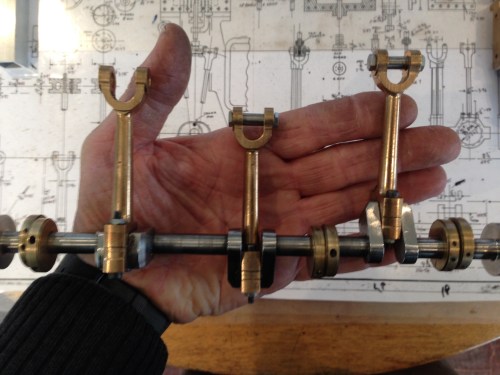
That thread is 3mm dia.  The hole above the nut is the oil way, 1.5mm dia.  Very tricky and too anxiety provoking to be thinking about a video.   Amazingly, it all went well!   I now have 2 oil holes for each of the 3 big ends.  I will need to fill the well with oil with a medical syringe and fine needle, but.

IMG_5172

The crankshaft, turned from stainless steel a year or two ago, and the conrods.  The big ends now with lubrication points.

And here are the major engine components, after partial disassembly.

IMG_5170.JPG

At top left is the condensor, then the cylinder block in 2 parts, then the steam supply valve.  The square section tube is going to become the base.  And so on.  You get the picture.  I will count the bits at some stage.

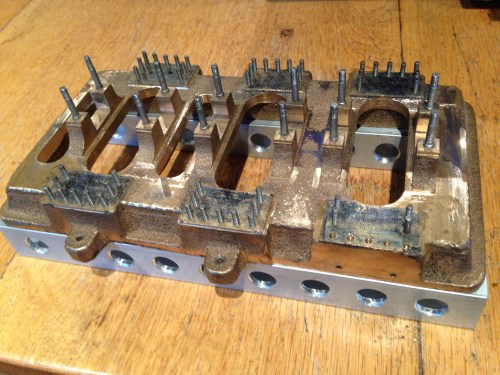
Then I cut and drilled the square section aluminium tube for the base.

IMG_5182.JPG

The cast base of the triple, with main bearing studs and column studs in place.  All sitting on the square section alu.  Have not decided whether to bolt it together, or just Loctite it. 

Those holes in the square section were drilled and chamfered on the CNC mill.