johnsmachines

machines which I have made, am making, or intend to make, and some other stuff. If you find this site interesting, please leave a comment. I read every comment and respond to most. n.b. There is a list of my first 800 posts in my post of 17 June 2021, titled "800 Posts"

Tag: GSMEE

USS Constitution Scrimshaw

At our Wed morning model engineering meeting today I gave a short talk on meshy.ai

I came across this AI software a couple of days ago, on Ships of Scale, and immediately downloaded it and played around with it for 2 days. Frankly, it will change the hobby of modelling. Ships or scarey monsters or whatever. I will add another post about it in a day or two.

But the highlight of today’s GSMEE meeting occurred when a member showed us an example of scrimshaw which he had acquired at least 4 decades ago.
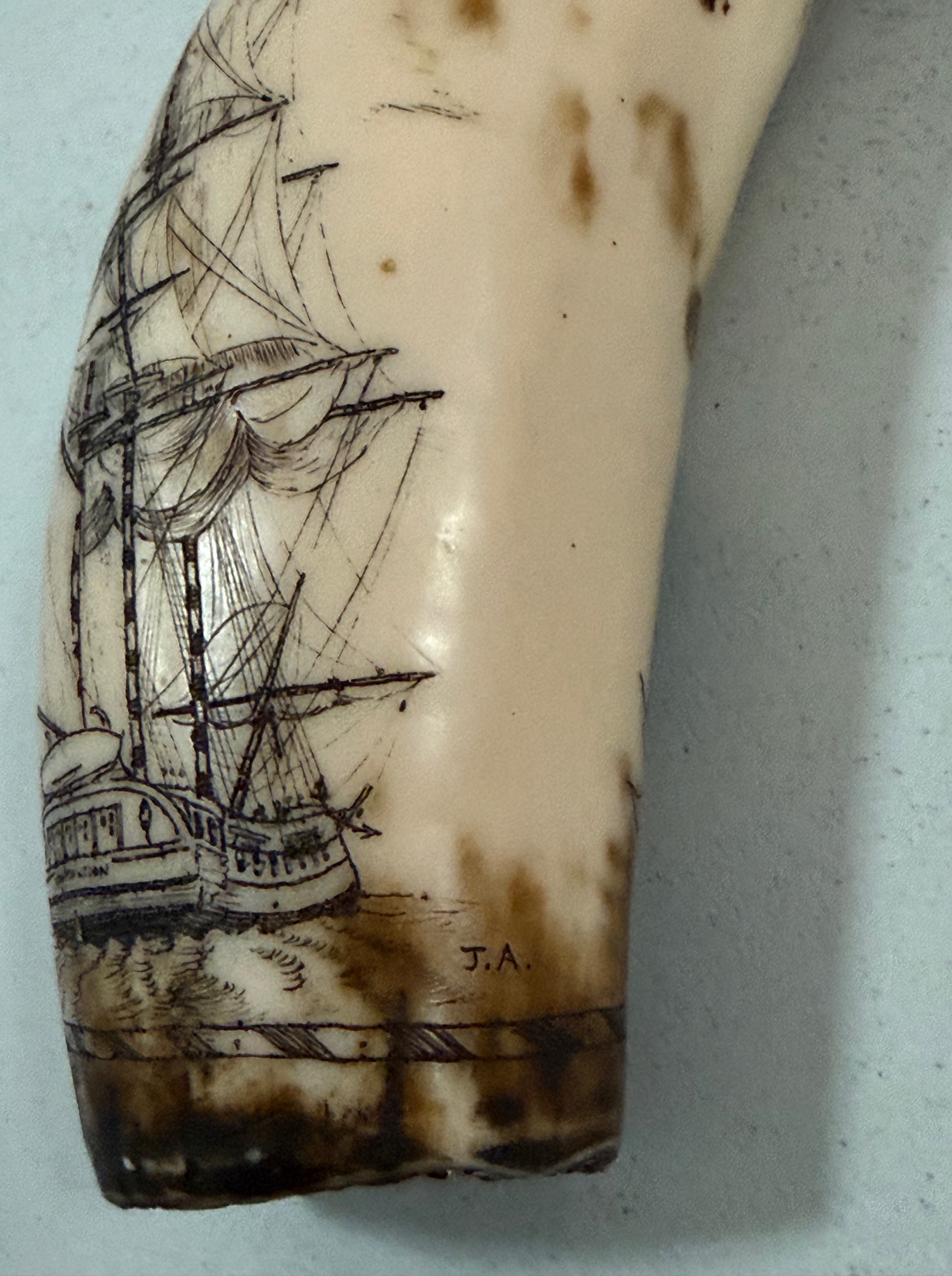
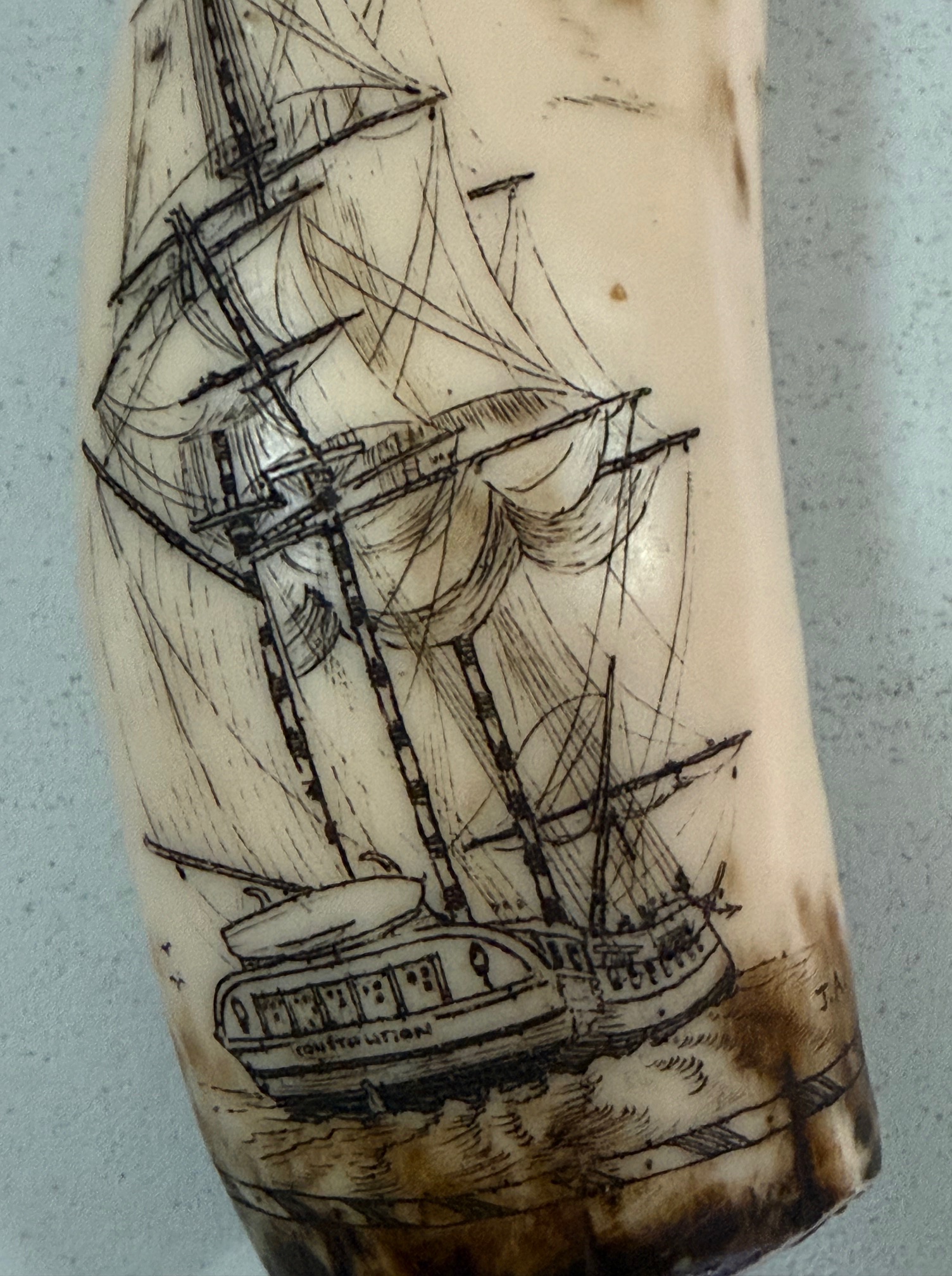
The sailing ship looked familiar to me. I could not read the name on the transom, so took a photo and enlarged it. Sure enough, and to my absolute delight it read CONSTITUTION.

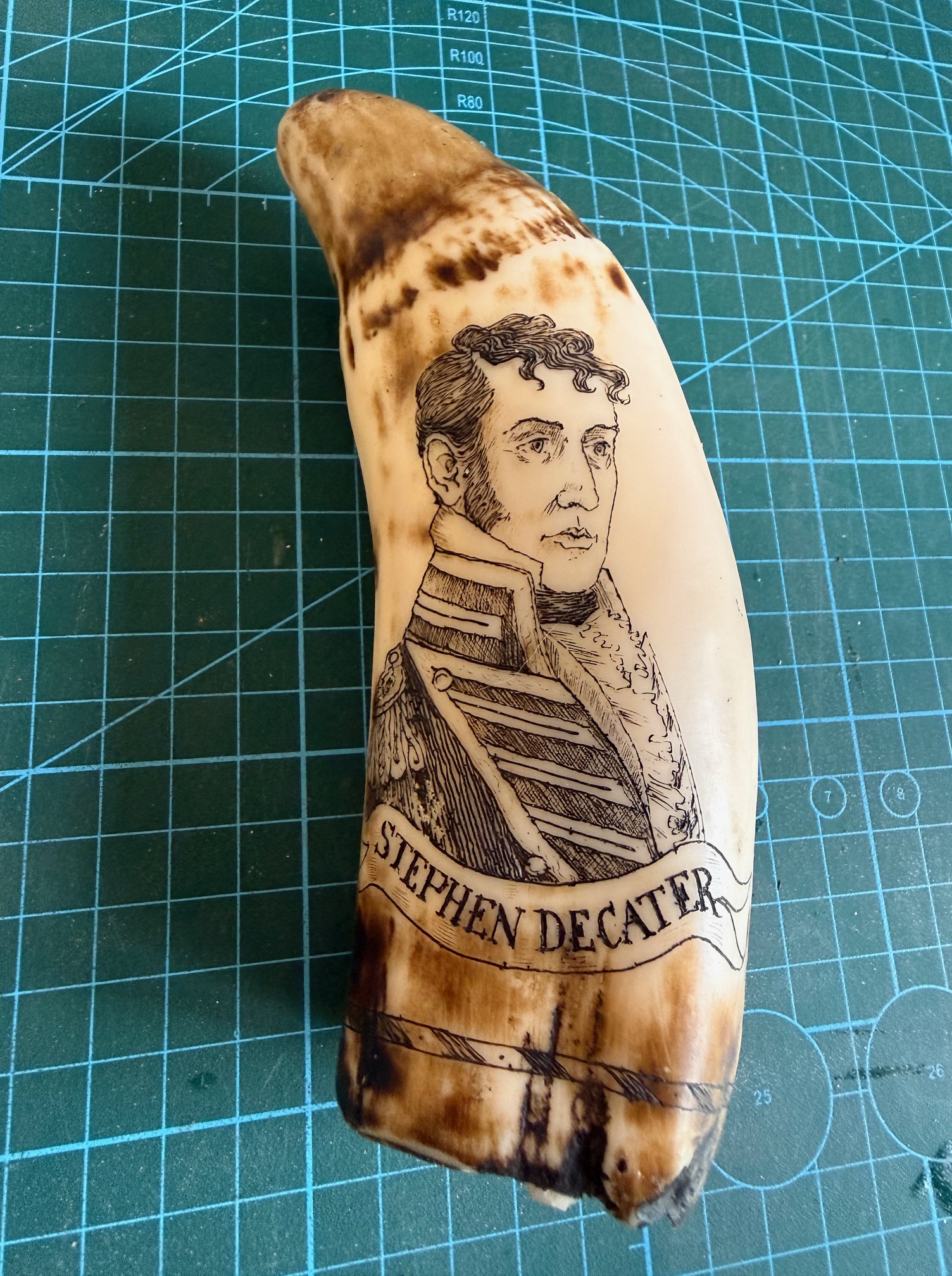
Of course I immediately recognised the name “Stephen Decater” having recently read the 580 page “Six Frigates, the epic history of the founding of the S Navy” by Ian Toll. Although the accepted spelling of” Decater” is actually “Decatur”. He is almost as famous in the USA as Nelson is in Britain.

Another member took some photos and asked for an opinion from his AI. It reported that it was a cheap epoxy tourist trinket, not bone or marine tooth. But even so, I was thrilled to inspect the detailed Constitution rigging, and the very clear portrait of Stephen Decatur.

The owner offered me the item to inspect more closely, which I did at home. I took better photos and submitted them to Chat GPT.

The ChatGPT report was that it IS genuine scrimshaw carved into marine bone or tooth, and probably late 19th or early 20th century scrimshaw. The fine detail, name on the ship, and carver’s initials indicate that it was made on shore rather than on a whaler or sailing ship. And it suggested a value of $800-$2500 !!

Another one of our GSMEE members has a brother who collects scrimshaw, and has several hundred pieces. We will wait his opinion with great interest.

Meanwhile I have the item for the next week, and am enjoying gazing at it.

p.s. I had uploded this post to WordPress before my notification that my storage limit had been reduced to 13gB. So this will actually be the last post.

p.p.s. 5 Feb 26 The expert opinion on the scrimshaw in the photos come from the brother of one of our model engineering club members. He has a personal collection of hundreds of pieces of scrimshaw, and is an acknowledged expert on the subject. His verdict is that the black filling on the inside of the piece confirms that it is not genuine scrimshaw. i.e. not carved on marine bone/tooth, and not carved on a 19th century whaling ship. The black filling was commonly used on the fake scrimshaw to conceal the inside of the piece, which would have immediately confirmed that it is not marine bone/tooth. The expert valuation is $aud30-$70.

How disappointing.

However, it is a nice representation of USS Constitution, in which I have a personal interest, and I have offered the owner $70. Negotiations might follow.

USS Constitution Scrimshaw

At our Wed morning model engineering meeting today I gave a short talk on meshy.ai

I came across this AI software a couple of days ago, on Ships of Scale, and immediately downloaded it and played around with it for 2 days. Frankly, it will change the hobby of modelling. Ships or scarey monsters or whatever. I will add another post about it in a day or two.

But the highlight of today’s GSMEE meeting occurred when a member showed us an example of scrimshaw which he had acquired at least 4 decades ago.
The sailing ship looked familiar to me. I could not read the name on the transom, so took a photo and enlarged it. Sure enough, and to my absolute delight it read CONSTITUTION.

Of course I immediately recognised the name “Stephen Decater” having recently read the 580 page “Six Frigates, the epic history of the founding of the S Navy” by Ian Toll. Although the accepted spelling of” Decater” is actually “Decatur”. He is as famous in the USA as Nelson is in Britain.

Another member took some photos and asked for an opinion from his AI. It reported that it was a cheap epoxy tourist trinket, not bone or marine tooth. But even so, I was thrilled to inspect the detailed Constitution rigging, and the very clear portrait of Stephen Decatur.

The owner offered me the item to inspect more closely, which I did at home. I took better photos and submitted them to Chat GPT.

The ChatGPT report was that it IS genuine scrimshaw carved into marine bone or tooth, and probably late 19th or early 20th century scrimshaw. The fine detail, name on the ship, and carver’s initials indicate that it was made on shore rather than on a whaler or sailing ship. And it suggested a value of $800-$2500 !!

Another one of our GSMEE members has a brother who collects scrimshaw, and has several hundred pieces. We will wait his opinion with great interest.

Meanwhile I have the item for the next week, and am enjoying gazing at it.

GSMEE Meeting 23 June 2021

I made them promise to not make me laugh or cough or do any heavy lifting. And it was a pleasure to attend another face to face GSMEE meeting after a few weeks of Zooming.

John Bernoth has made his Kant Twist clamps from the laser cut arms. He used countersunk screws to hold the pins, instead of peening the ends, so he could easily disassemble the tool if required, and because he had the screws already. Used aluminium jaws. These are the small clamp version.

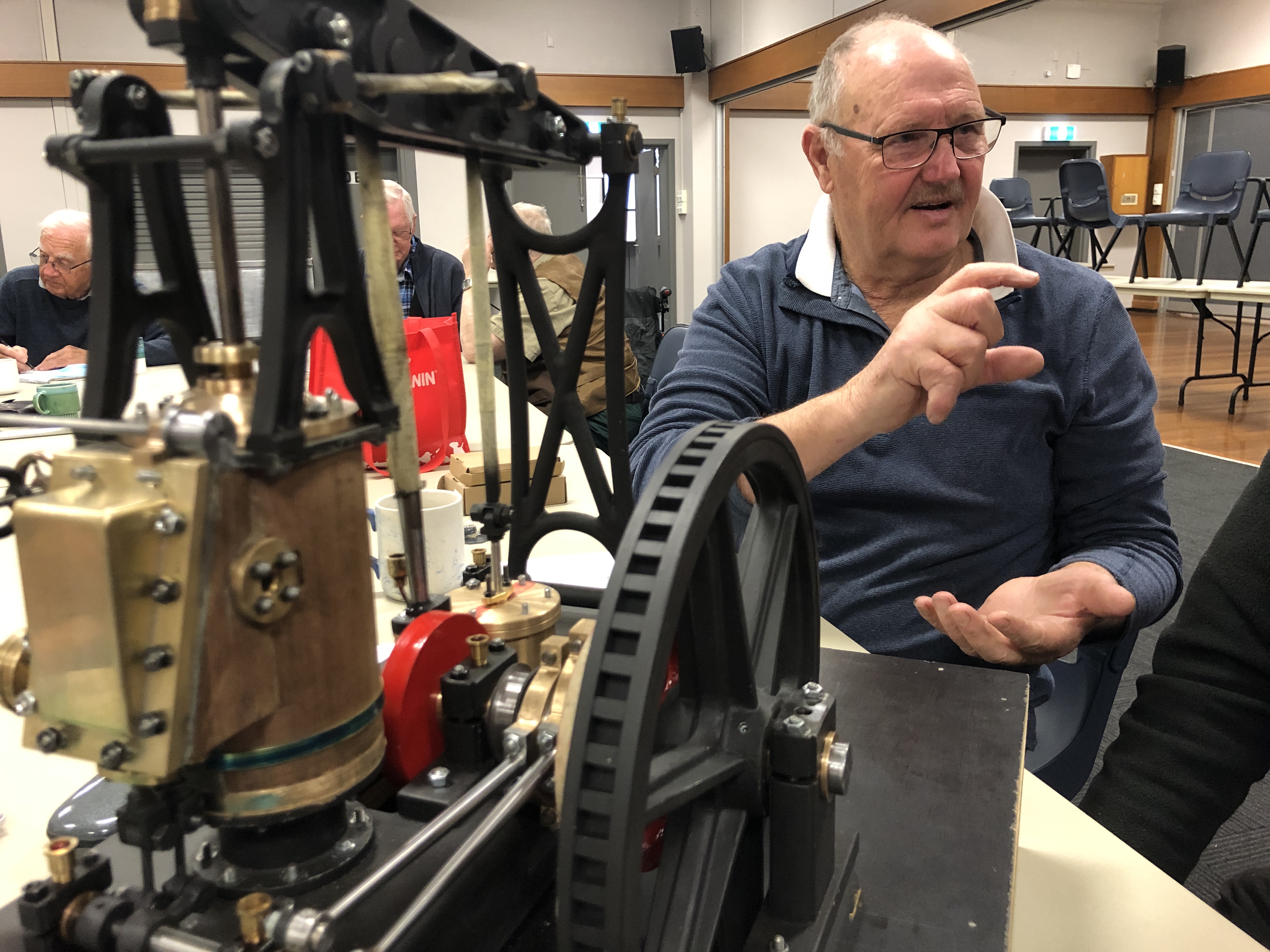
And Swen Pettig brought along his Grasshopper beam engine for a progress assessment.

It is looking very interesting. Not finished, but is apparently running on compressed air. The flywheel is made from assembled machined pieces which are screwed and silver soldered and peened together. Double acting cylinder has 3″ stroke 1.5″ bore. I am really looking forward to seeing it running on steam.

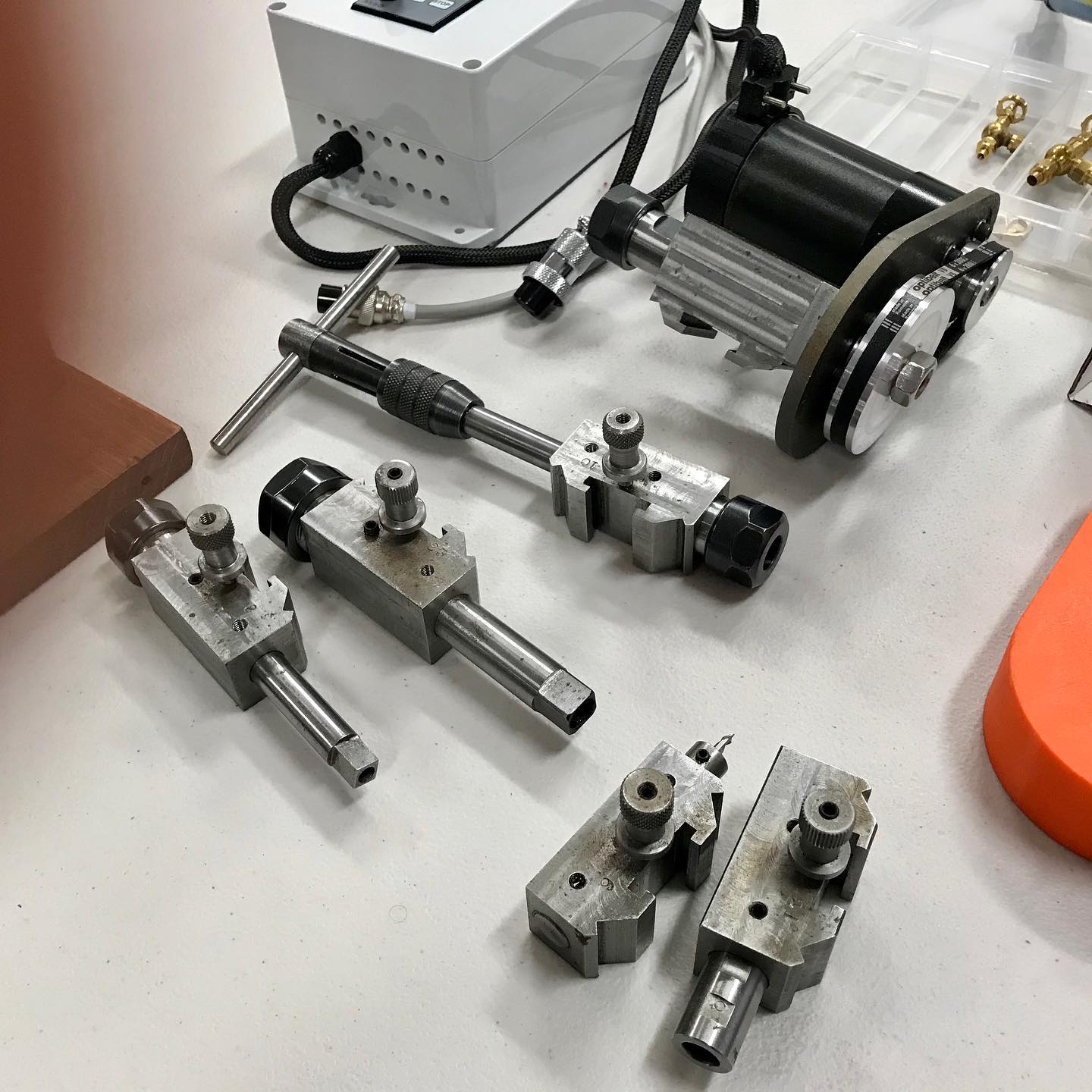
Swen has also recently made this sphere making lathe attachment. The cutter is a 6mm diameter TC disk. He showed us an example of a job, which has a lovely finish and excellent shape, but a rather thick neck. Swen plans to make another cutting tool with a sharper point to make thinner necks on the spheres. Chatter has not been a problem with this tool.

I am not quite ready to show the Armstrong RML gun, because it is still waiting for me to get back into the workshop for some finishing touches, so I brought some goodies to show which I recently bought from Banggood.

A pair of hold downs for the mill or mill drill. These are really nicely made and finished. $aud25 each.
A smallish square with an extra face, which should be useful for set ups on the mill. I had previously bought the smallest size, so adding to the set. Cost was around $aud15 from memory. Again, well made and seems accurate.

And this one is a woodworking tool, which I have wanted for some time, but the US version is about x4 the cost , and postage is an extra deal killer. The costs mentioned all included postage.

It is a marking gauge, 0-200mm, with 0.2mm divisions. About $aud20.
Made in You Know Where, but the fact is, that this stuff from Banggood is really nice. Whatever we think of their government, the goods are usually excellent.

Today I picked up the laser cut metal plate which will become the small drill sharpening jig. For drills bits up to 3mm. You might ask why bother? Well, I can see the jig being used where I want a really sharp tiny drill, on a critical job. I would touch up the cutting edges on even a new bit.

The crosses at the drilling points are a bit of a nuisance. I had asked for a mark only. The full thickness crosses will have to be drilled very carefully to avoid breaking the drill bit. If they prove to be a big problem I will have to get the parts remade.

The drill bits to be resharpened will be held in a small collet chuck, purchased commercially for about $10, including 3 collets. The lasering cost about $5 each.

GSMEE Annual BBQ

Today is the 40th successive day that Victoria has had NO new covid cases. It seems worth the prolongued horrendous lockdowns experienced earlier this year. Full marks to our public health officials, health workers in hospitals, and politicians. (yes, even the politicians. They had a steep learning curve, and made mistakes, but I believe that they tried very hard to make correct decisions.)

The result is that we had our first face to face GSMEE meeting since January. And with Christmas just a couple of weeks away, it was our annual Xmas BBQ. I hasten to add that the vegetarians in our group were well catered, as well as the omnivores.

There were 5 entries in the club competition for making a small engine, and it was convincingly won by Neil McMeekin. Neil’s engine was beautifully finished and it ran smoothly without any mechanical noises. Frank Mullins 2 entries both ran well, and he was awarded the second prize.

Judging the competition engines. checking the finish, and running on compressed air. To the right is Rudi vanderelst’s “Britannia” which is taking shape with Rudi’s expert attention and knowledge. Rudi was a marine engineer, originally on steam ships, and what he does not know about triple expansion engines ………… Hanging on the staircase rail is a one meter micrometer, brought in by Chris Tywonek, our resident gun expert.

The “models on the table” included my still not finished scale model Armstrong cannon. It is now painted, and clear lacquered.

In the foreground is Stuart Tankard’s model of an Otto D2 gas engine, originally made in 1895. As usual with Stuart’s work it is perfection in motion. Not quite finished, but when it is, I will post a more detailed description and photos.

To the right of that is a bronze cannon cypher off an Ottoman cannon which was captured in Mesopotamia in WW1. The wooden mounting plaque is from a British Spitfire propellor. Owned by Laurie Braybrook, at 95 our most senior member, and raconteur extraordinaire. Laurie fought in WW2 in the Pacific islands, and he has many wonderful stories.

Ottoman cannon cypher. I love the Arabic (I think) calligraphy, and the symbol of the horn of plenty. It is quite a thick and heavy object.

Behind Stuart’s Otto is a Bolton 7 horizontal mill engine, made by Neil Ellis. Again, not quite finished, but it is displaying an incredibly high standard of machining and finish. This is Neil’s FIRST model engine. Again, I will feature it in a future post with more details. Neil comes from a boatbuilding occupation, so he is no stranger to precision and machining, but this level of model engineering in a metal working beginner is amazing.

Then my cannon, which is probably suffering from some overexposure in this blog, so I will add just one more photo, since it has now been painted and laquered.

Still a few pieces to be added to the Armstrong. Our member Neville, who used to fire the original full size Armstrong at Port Fairy, saw the model for the first time today, and he was interested to see the hand wheels and other bits, which are missing from the Port Fairy original. I think that he was a bit disgusted that I have not made a vent/touch hole.

At the rear are Swen Pettig’s “Minnie” 1″ traction engine which is looking great, and his therapeutic Grasshopper Beam engine. I say “therapeutic”, because the Grasshopper is Swen’s escape from working on the Minnie. His size 13 hands have been a serious handicap to assembling the Minnie, and I gather that there has been much stress and frustration. (But he is talking about making a triple expansion engine like mine, so he is clearly a glutton for punishment. The barring slots in the flywheel of the grasshopper are an interesting feature, and I hope to get post from talking to Swen about those.

I think that everyone was excited and delighted to be face to face again, and looking forward to normal GSMEE meetings in 2021. Zooming has been a good “stop gap” but I think we are all ready to resume normality. Hopefully with no further lock downs.

Gears. Modularity Counts!

Making the big spur gear which pushes the gun carriage up and down the inclined chassis has been a bit of a saga.

For a start, I decided that fabricating it with lathe and mill was going to be very difficult, and it was an obvious candidate for casting. In bronze. After making a model with 3D printing in PLA.

So, I drew up a 3D model, saved it as an STL file, and printed it. But did not take into account shrinkage of the PLA part. Or shrinkage of the cast bronze part. So instead of 58mm diameter, the blank gear was only 57.4mm diameter. By reducing the number of module 1 teeth to 57, I could get a reasonable gear, and the teeth were duly cut.

But, module 1 teeth looked skinny and pointy and not correct. Plus, 3 of the cast gears were total casting failures and were discarded (remelted).

So, I machined off the module 1 teeth, made some bronze disks, and silver soldered them onto the cast central hubs and spokes, and machined the blanks to 60mm diameter. By this stage I had decided that the big gear teeth should be module 1.25. Chunkier. Looked the part.

But I did not have 1.25 module gear cutters. And no-one in our club had them for loan. So I ordered a set from China. Delivery any time up to the end of November!! Then I found 2 of the set from an Australian dealer, but they were priced almost as much as the full set of 8 cutters from China. But, thinking that they would arrive more quickly I bought them. They were Chinese. It is a seller’s market.

Then today, at our GSMEE meeting Swen P said that he had a set! And I could borrow them! So, gratefully, I did. And I cut the teeth this afternoon.

The module 1.25 gears at bottom. The module 1 gear top. Please tell me that you can see a difference.

While the teeth were being cut, I tidied up another bronze T rex.

Two of them now face off on my Trevithick engine. They should amuse the kids.

Next to cut the M1.25 rack. Should be straightforward.

Melbourne Society of Model and Experimental Engineers. Xmas meeting.

The December meeting includes the competition for best model, best workshop tooling, and best engine.  The 3 happy winners were all from Geelong.

78947095_10218922337503859_5458110964505247744_o

Stuart Tankard, John Viggers, Swen Pettig

79025950_2448598021904988_6639730611655278592_o

Trevithick dredger engine model by John

78899194_2448597938571663_1550976217446875136_o.jpg

79084789_2448598095238314_3887537897913450496_o

CNC lathe tools, toolholders and toolpost milling attachment by Stuart.

Following is a video of Stuart’s toolpost milling attachment in action.  It has been posted before, but is worth watching again.  It is quite remarkable.

(Photo of the flame gulper to be added.)

But, the best part of the meeting was this demo of a model aeroplane which was made by Don.  The plane weighs 2.5 grams!!!   The wing material is mylar which is 1 micron thick!!!  The flight was cut short by hitting a ceiling projector, but apparently the world record for a flight by a similar plane lasted for over an hour!  This YouTube video has had 360,000+ views in 5 days!


Model Engines on Steam

It is Geelong Show time again.  It is actually titled the Royal Geelong Show, but having had more than a gutful of royal non-entities visitors being adored by unthinking cringers, flocking around Harry and Meaghan Kardashian, Windsor, and being a committed republican, I refuse to bother with the “Royal” handle.  (they are probably very nice people, I just cannot stomach the hoo-ha).

More importantly, it gives us steam junkies a chance to run our small engines on real hot steam.

For a treat, I am sharing four short clips taken today.

The first is a small beam engine, made by Swen Pettig.

Error
This video doesn’t exist

The next two engines you have probably seen before.  My beam engine, and the triple expansion engine.

The small engine to the right is a Stirling engine which is running on the heat from the exhausted steam from the beam engine.

The triple is leaking a bit more than it should, although it is running amazingly smoothly on 25-30 psi.  The valve glands need repacking.

And finally, a model IC engine, the really odd Atkinson.  A 100+ year old design.  2 stroke. Made by Rudi vanderElst


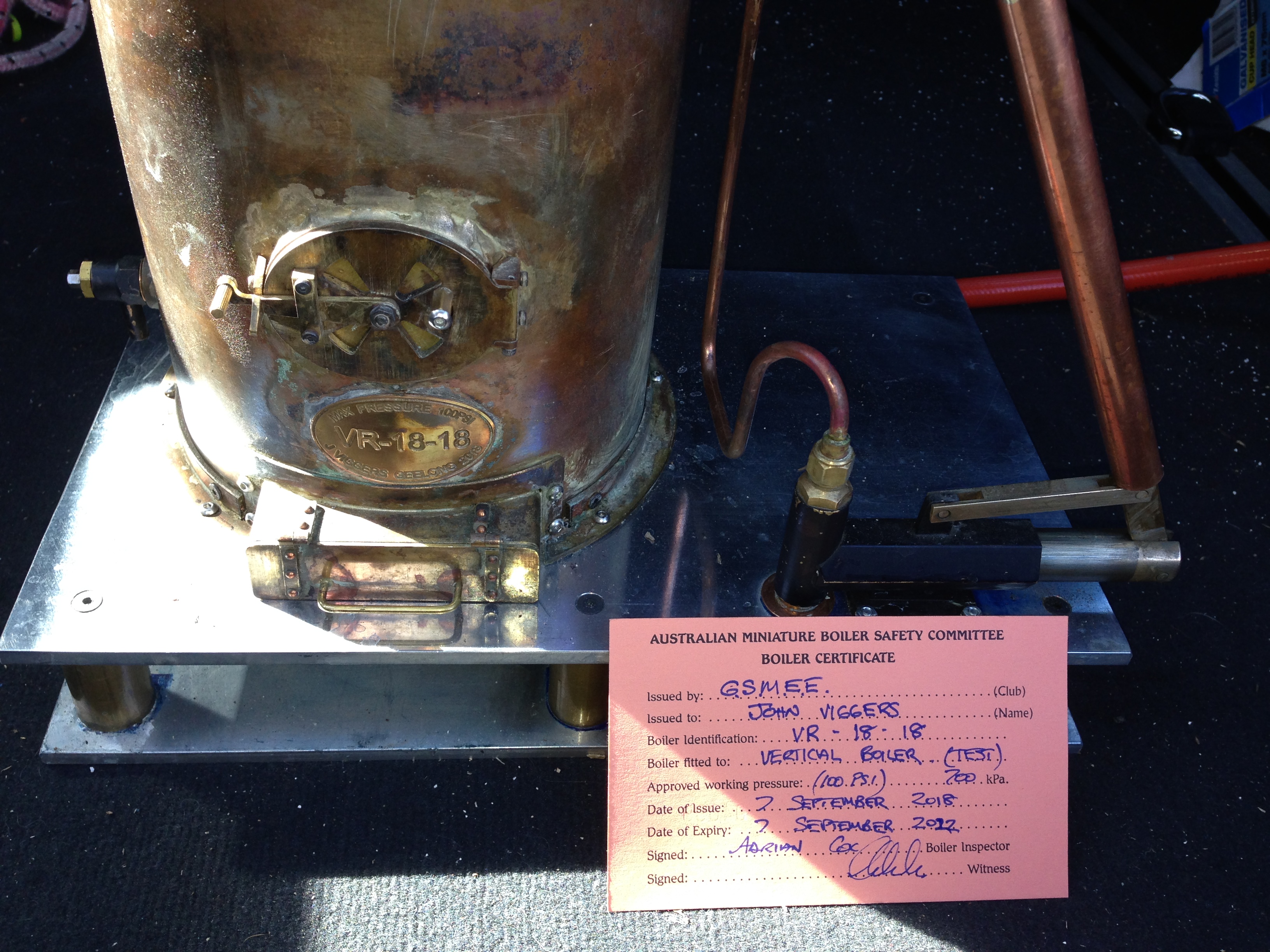
VR-18-18

VR-18-18 Stands for Victoria, Geelong Society of Model and Experimental Engineers, 2018, 18th registered boiler for the club.

So this morning I fired up the boiler with the boiler inspector closely watching.  The gas was turned to maximum, and the water was showing full.

Steam appeared about 10 minutes later and the Sandberg safety valve started popping at 100 psi. Every couple of minutes the safety valve released and the pressure remained in the 97-100 psi range.  This went on for about 20-30 minutes.  All to the satisfaction of the inspector.

He was happy with the standard of the build, the pressure test, the accumulation test, and that all requirements had been met.

The boiler is now certified for 4 years.  There has been a change in protocol about which I was unaware.  The previous certification rule was for 12 months only, and retesting was required for a further 3 years.  So this new rule is much less time consuming for me and the inspector.  He is happy that before the next testing I will have a steam pump and a steam injector installed.

IMG_6817.JPG

I was so delighted with the result that I treated myself to a trip to the non ferrous metal supplier, and bought a selection of hex brass stock for the workshop.  When I returned to the workshop there were still a few hours of daylight, so I spent the time making the new inspection hatch for the Trevithick dredger engine.  Not quite finished, so no pics yet.

The next step for the boiler is to make and attach the wood lagging and to put on some paint.

A steam driven water pump, and a whistle.

Boilers, whether full size or model, get through substantial volumes of water.  When my 6″ vertical boiler is working hard, so is the water pump, to replenish the water which is turned to steam.

At present, the water pump is a manual pump, and it needs to be operated almost continually when the boiler is steaming hard.

IMG_6791

I am not sure whether operating the hand pump (lower right), or the propane burner, consumes more energy.

So it was with great interest that I viewed the steam pump in operation which was built by Stuart Tankard, at last night’s meeting of GSMEE.  I have plans and castings for the same unit, and expect to make it later this year.  It is a Worthington type pump, and the castings and plans were supplied by Southworth Engines.

IMG_6664

Stuart’s latest.


In this video, for the demonstration, the pump is running on very low pressure compressed air.  The larger cylinders are the steam powered driving cylinders, and the smaller ones are the water pumps.  So whatever the pressure of the steam, the water pressure will be greater, and able to be pumped into the boiler.

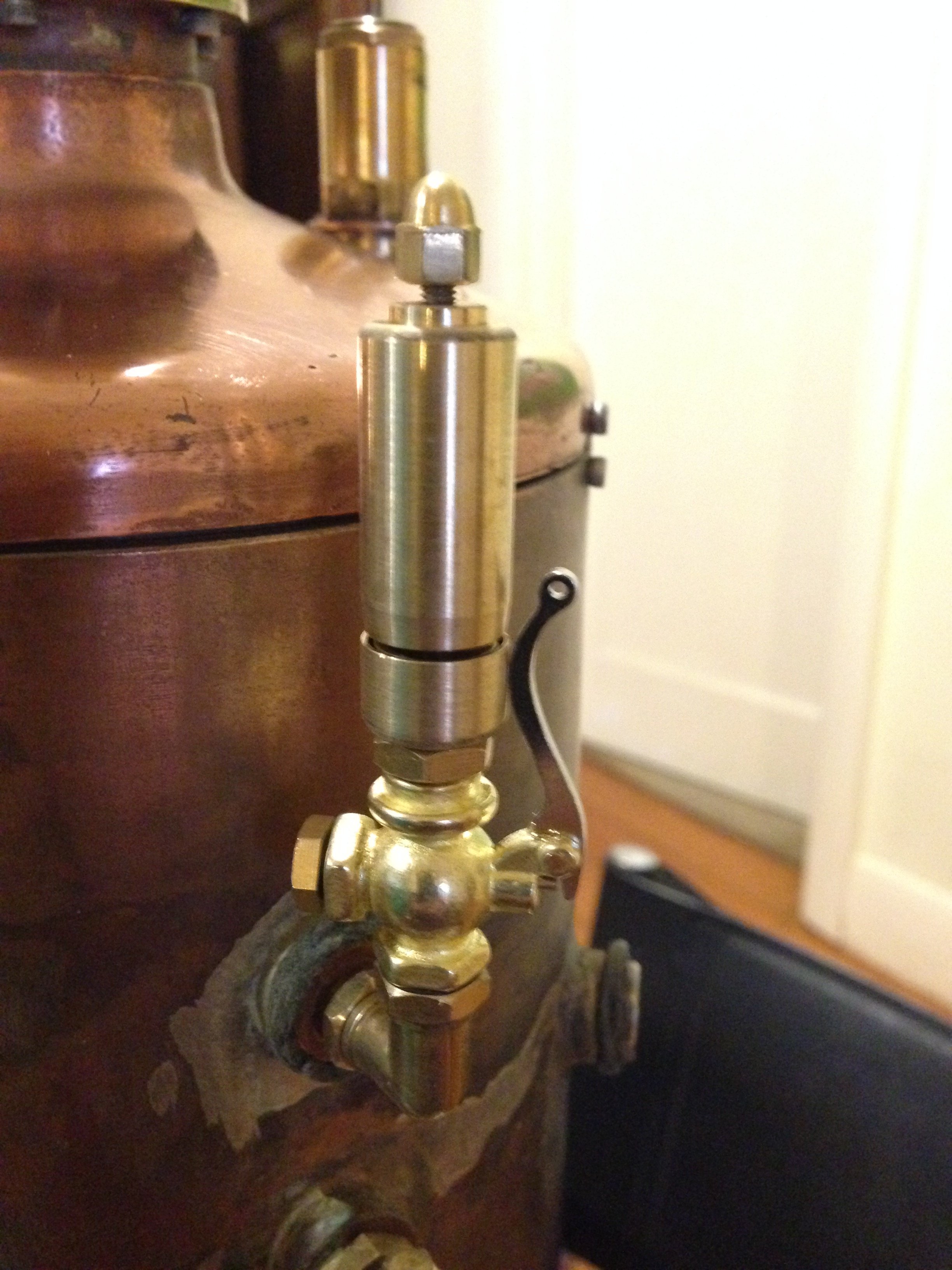
And finally, I bought a steam whistle.  It was supplied by Microcosm.engine from China and it was very reasonably priced. ($US39).  I have not tested it yet, but it came highly recommended by Keith Appleton.  It is certainly very nicely made.  I screwed it onto the boiler as a bit of bling because I showed my boiler progress at last night’s meeting of GSMEE.

IMG_6790.JPG

Steam Driven Water Pump for Vertical Boiler

Unfortunately I did not make this pump.  It was made by Stuart Tankard.  I have the castings and plans, and intend to make one for my 6″ vertical boiler but I have too much on the go at present and will finish the vertical boiler and the Trevithick engine first.

Enjoy the pics.  Stuart sets the machining standard for the rest of us to aspire to.

IMG_6663.JPG

IMG_6664.JPG

IMG_6665.JPGIMG_6666.JPG

IMG_6667.JPG

IMG_6668.JPGIMG_6669.JPG

We did not see it running today, but it does work.

It is a 6” Duplex pump from Southworth Engines.

A New (to me) Tool

One aspect of our weekly GSMEE meetings (Geelong Society of Model and Experimental Engineers) is that I learn something new at every meeeting.  The exposure to new information is not too surprising considering that our group has members who are or were a machinery designer, mechanical engineer, CNC operator, marine engineer, aircraft mechanic, a quarry operator, gun enthusiasts, a fireman and various other areas of expertise.  Even a bee keeper.  And even a retired gynaecologist.

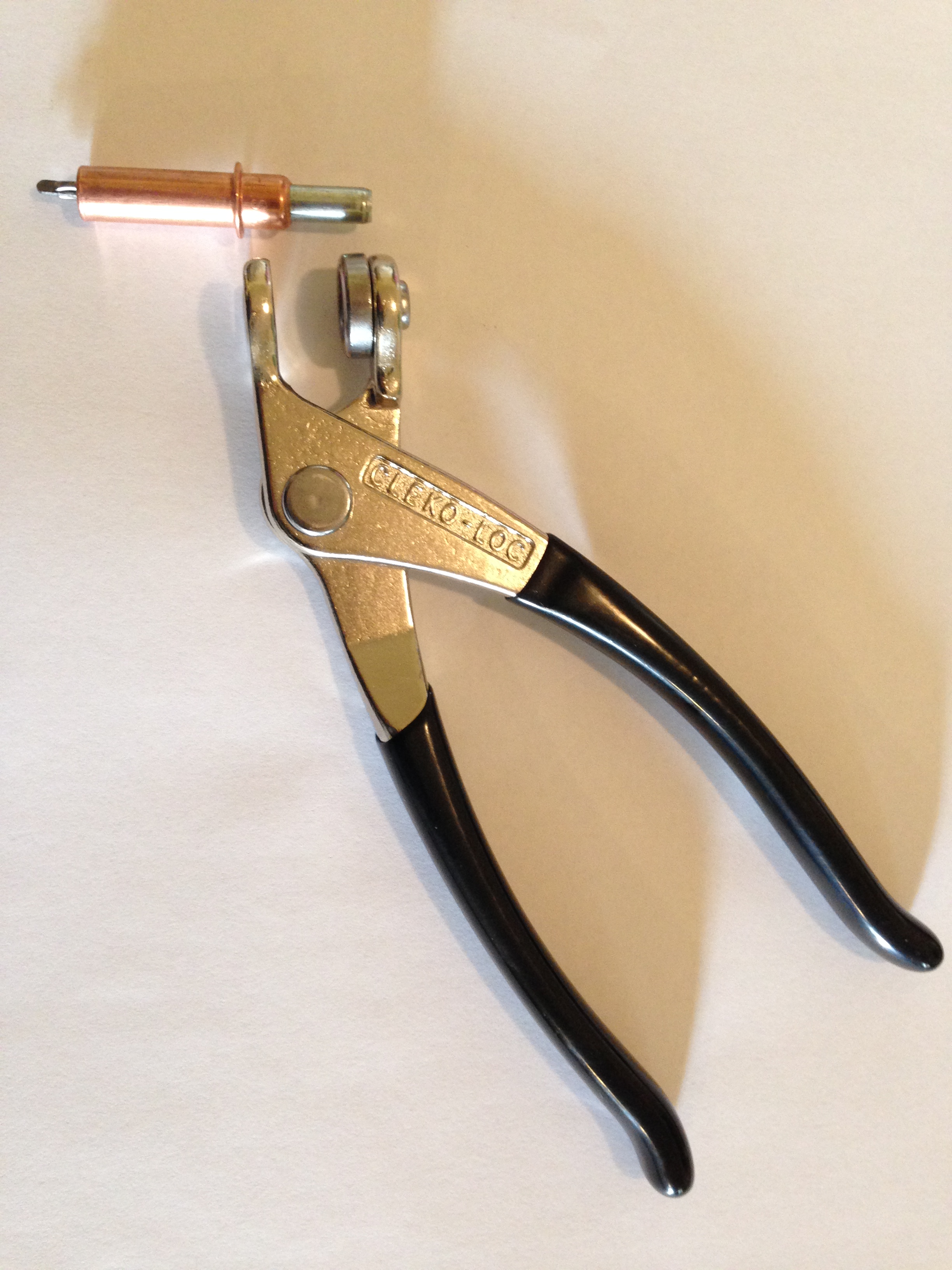
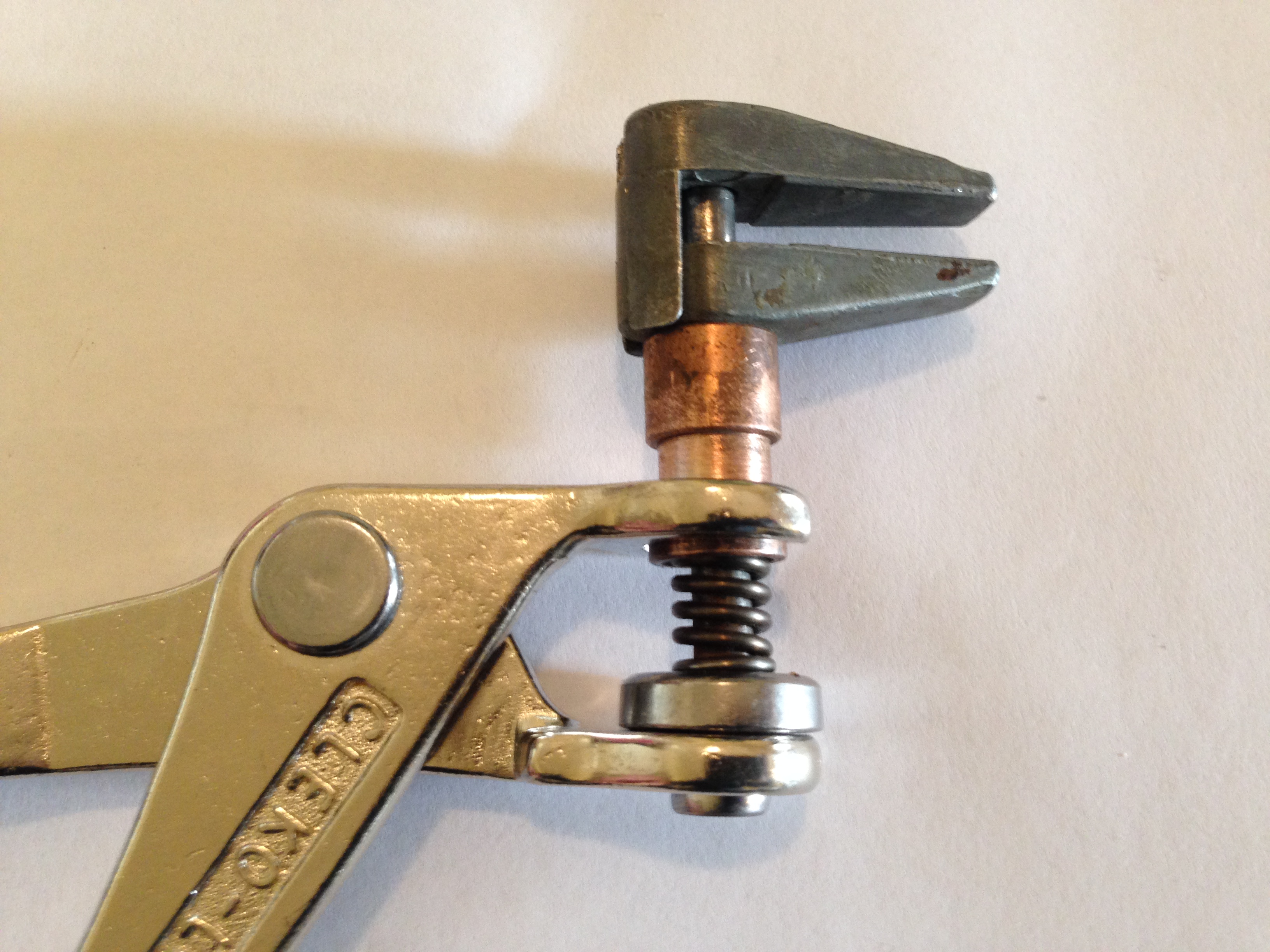
Recently Neil brought in a boiler which was assembled but not yet soldered.  And it was held together with spring loaded clamps the like of which I had never before seen.  Some other members were also very interested in the clamps, which are, apparently, extensively used in aircraft panel assembly and repair, and also in car body work repairs.

boiler clecos

31856056_10216930893251437_4083847603039502336_n.jpg

Neil’s boiler end plates, clamped together.

The clamps are called CLEKOS or CLECOS.  They are easily applied and removed and are reusable.  They are used for temporary joining of materials to facilitate marking, drilling, riveting, soldering, welding or gluing.  Exciting to me because I can see many applications in model engineering and wooden toy making.

The Clecos come in a variety of sizes and configurations.

IMG_6311

This Cleco requires a 1/8″ hole, and will join materials up to 1/2″ total thickness.  This type joins 2 or more pieces of material which have a hole drilled as small as 2.5mm up to 5mm.  The range of hole sizes may be larger than I am aware.   Only one face of the materials needs to be accessible, so the Cleco can be used to fasten material to a closed container such as a boiler.   It is spring loaded and requires a tool to apply and remove it.  Application and removal is very quick.  Any materials which will accept a drilled hole can be used-  metal, wood, cardboard.  It would not work with easily compressed material such as foam rubber.  The application pliers are available on Ebay and are inexpensive.

IMG_6315

This spring loaded Cleco looks particularly interesting.  The clamps are small, have clamping thickness of 20mm and a reach of 1/2″ to 1″.  Again, they are not expensive ($AUD7-11), and very quick to apply and remove.  Surprisingly powerful grip would be quite adequate for gluing or riveting or soldering.

IMG_6317

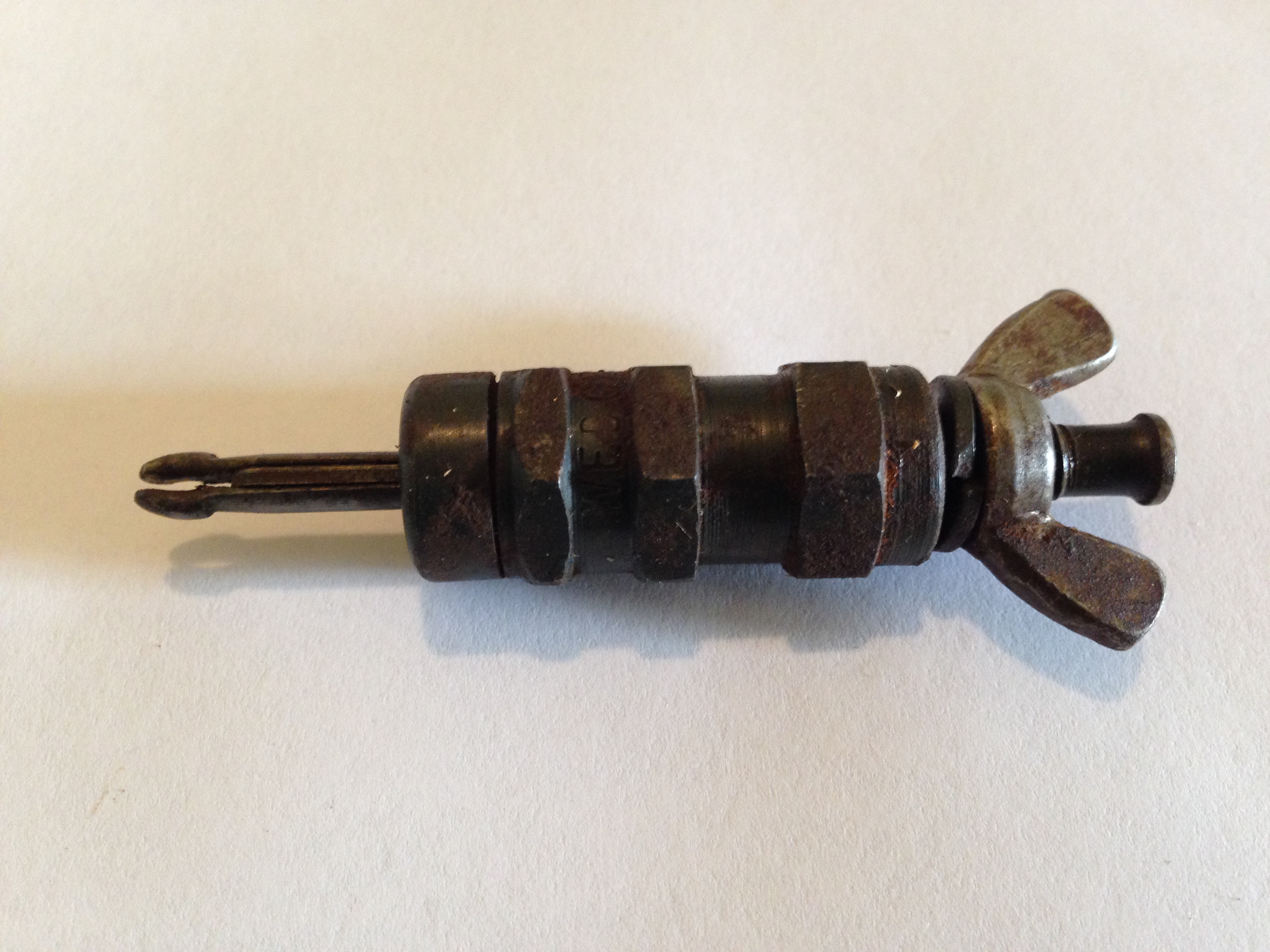
Some Clecos do not require the application pliers but use a wing nut.

IMG_6316

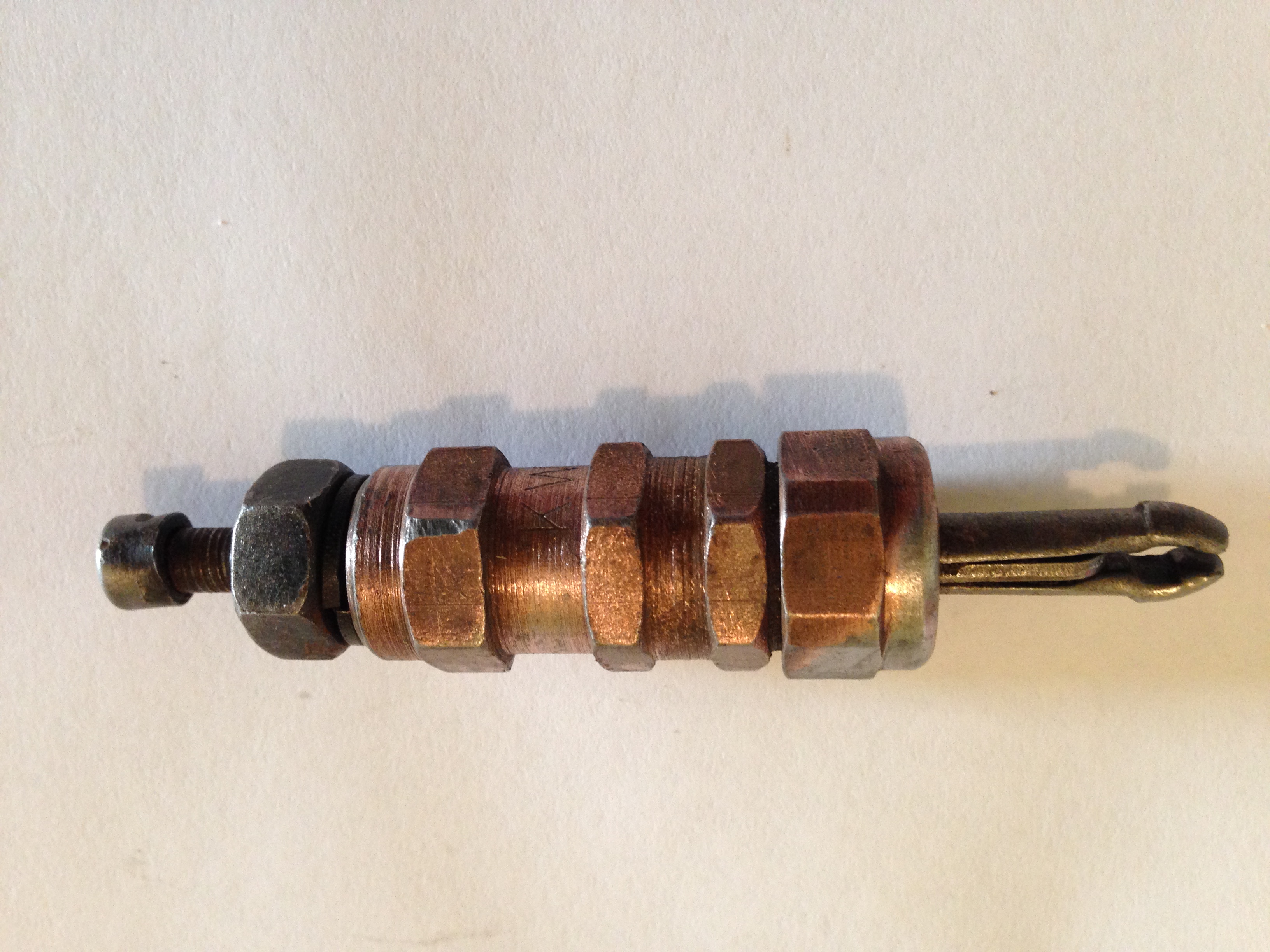
And others use a hex nut.  Anyone know why there is a copper surface coating?

The Clecos are surpisingly inexpensive.  On Ebay I have seen the spring loaded fasteners as cheap as $AUD1 each, and the pliers at $AUD15.    I bought a kit comprising pliers and 20 fasteners for $AUD49.  Ebay UK has the best selection and many have free postage.  The range on US sites is good, but postage costs assigned by Ebay are astronomical.

(A reader has commented……

The Clecos and other skin pins are colour coded, silver 3/32, copper colour 1/8; Black 5/32′ gold 3/16 brown 1/4…..     thankyou “someone”.)


MODEL ENGINES in the cage at the GEELONG SHOW

The following short videos show some of the engines on display by GSMEE in the Vintage Machinery Shed at the recent Geelong Show.  GSMEE is Geelong Society of Model and Experimental Engineers.  All engines are running on steam, except of course the Stirling engine,  the Farmboy, and the Atkinson engine.
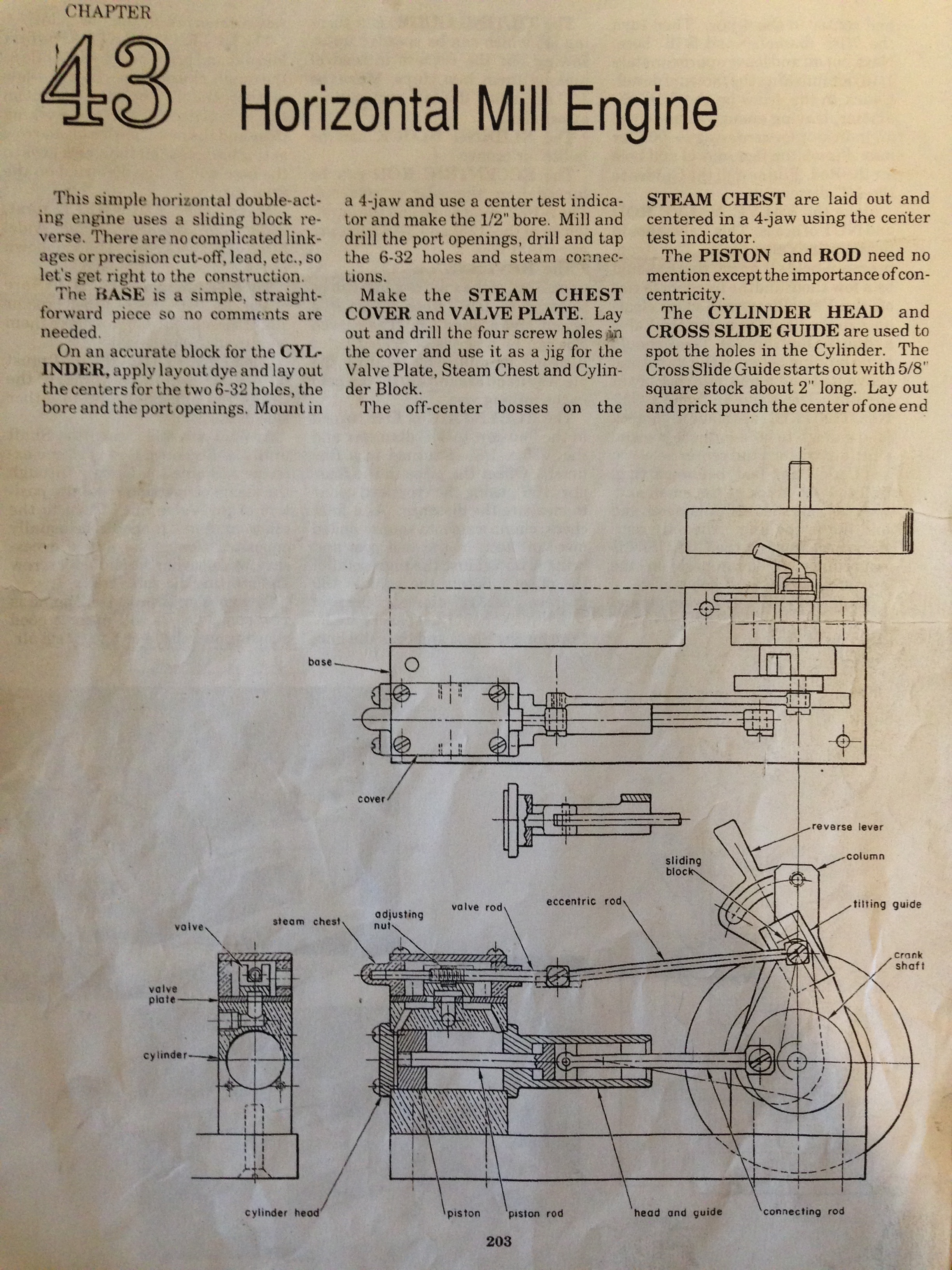
These engines will be running again at the GSMEE exhibition 25-26 Nov 2017, at The Lifestyle Pavillion, The Geelong Showgrounds.  Several scale model traction engines, trade exhibits, outside entries, and the engines in the Vintage Machinery Shed will also be on show.  The Hatherly Challenge competition will be judged.  This year the challenge is to make a reversing horizontal mill engine.  Entry is free (gold coin donation accepted with gratitude).
Stirling Engine, running on heat from exhausted steam,  spinning a CD with spiral image, made by John V.


Stuart Victoria Twin, made by Malcom W


Bolton12 Beam Engine made by John V


Farmboy internal combustion engine, running on propane, made by Stuart T


Error
This video doesn’t exist


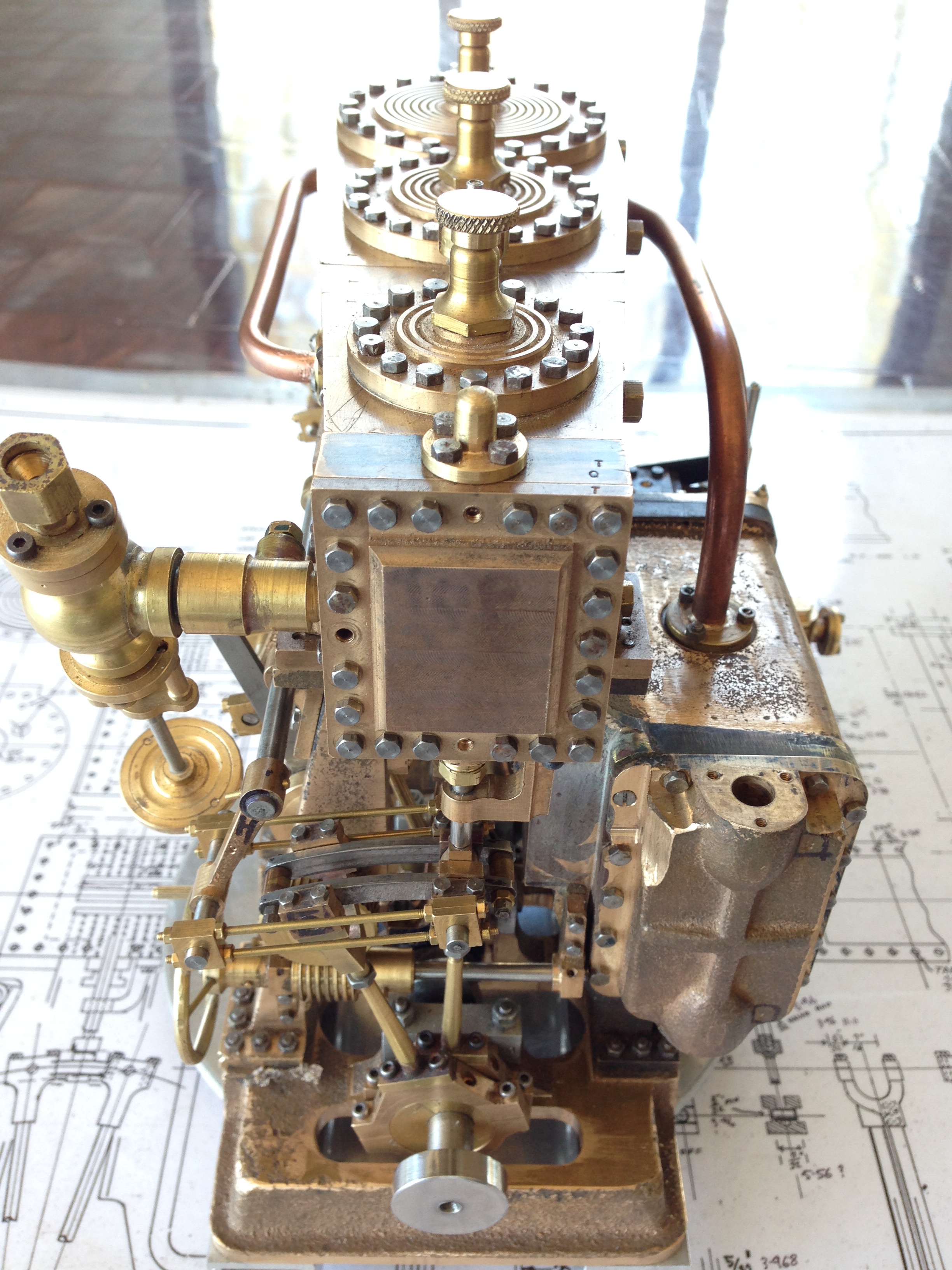
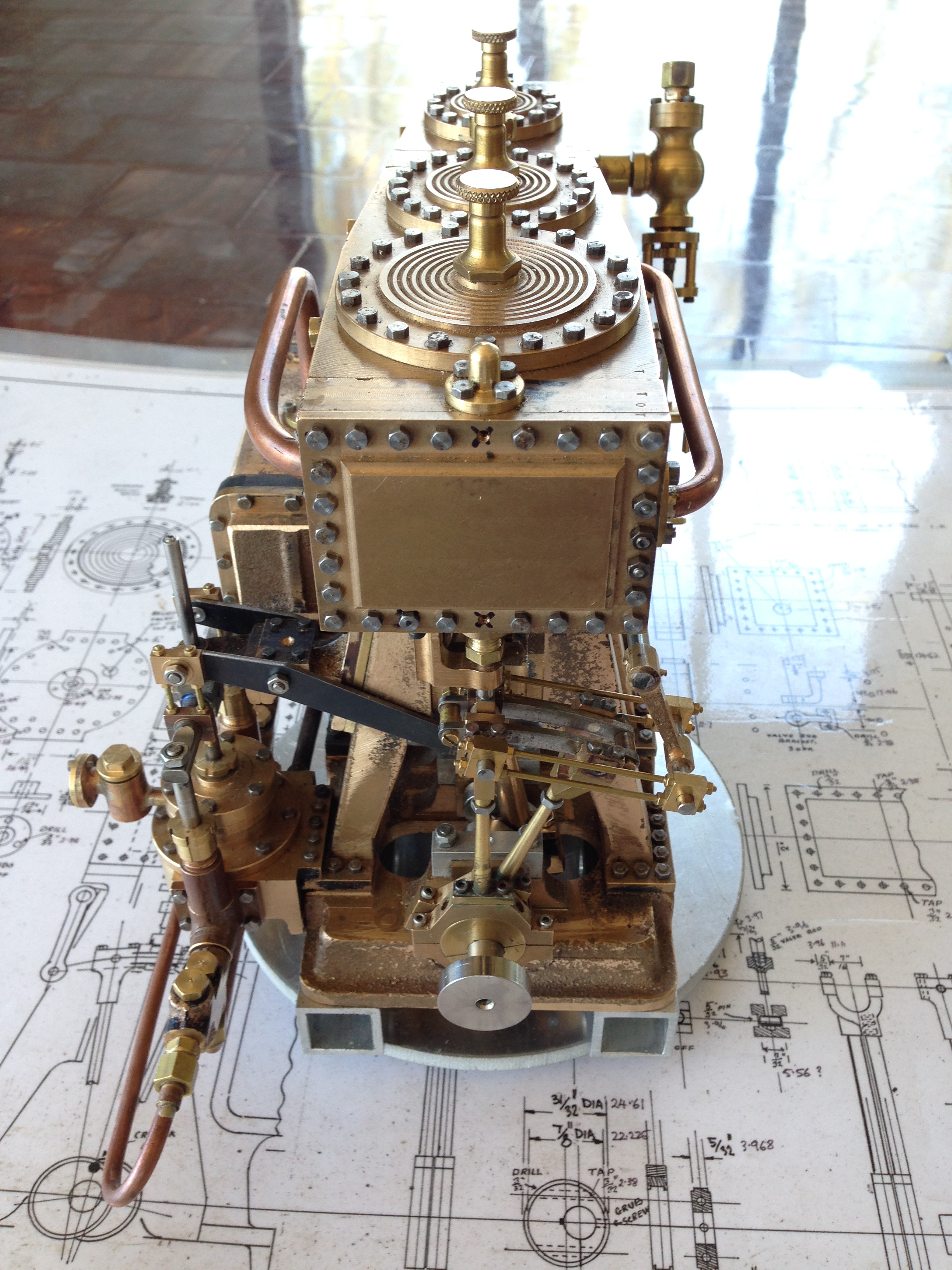
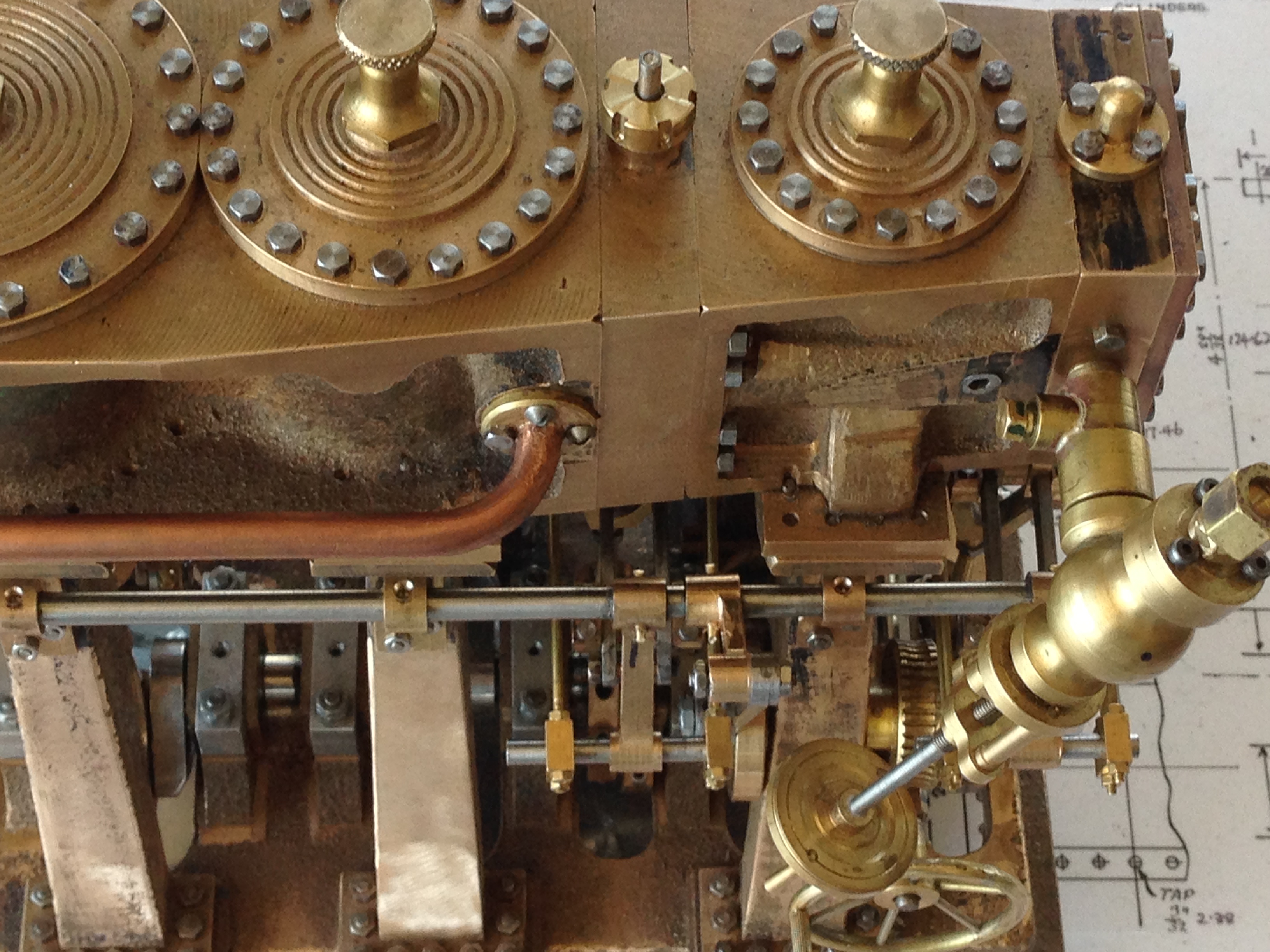
Horizontal Mill Engine running on steam, reconditioned by John V,  (GSMEE exhibit)


Atkinson Engine, running on petrol, made by Rudi V.  FIRST PRIZE.


Error
This video doesn’t exist


Stuart 5, running on steam.  Reconditioned by Rudi V.  GSMEE exhibit.


Error
This video doesn’t exist


Beam Engine “Mary”, completed by Stuart T.  THIRD PRIZE.


Mill Engine, running on steam GSMEE exhibit.


Error
This video doesn’t exist


Mill Engine running on steam.  GSMEE exhibit.


Error
This video doesn’t exist


Mill Engine, running on steam, made by Malcolm W.


Error
This video doesn’t exist


Triple expansion marine steam engine by John V.  Almost completed.  SECOND PRIZE.

IMG_5659

Triple Expansion Engine Update

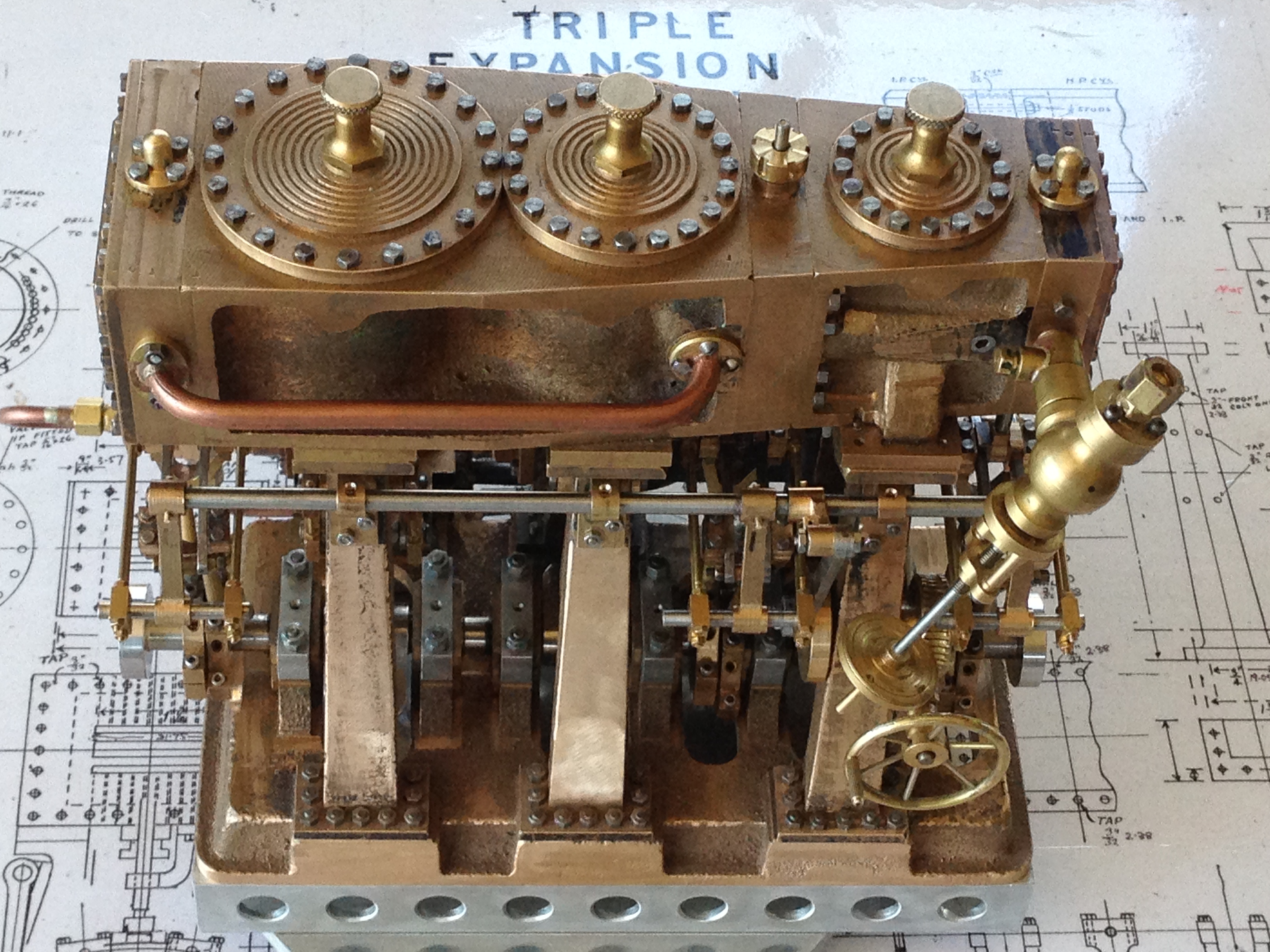
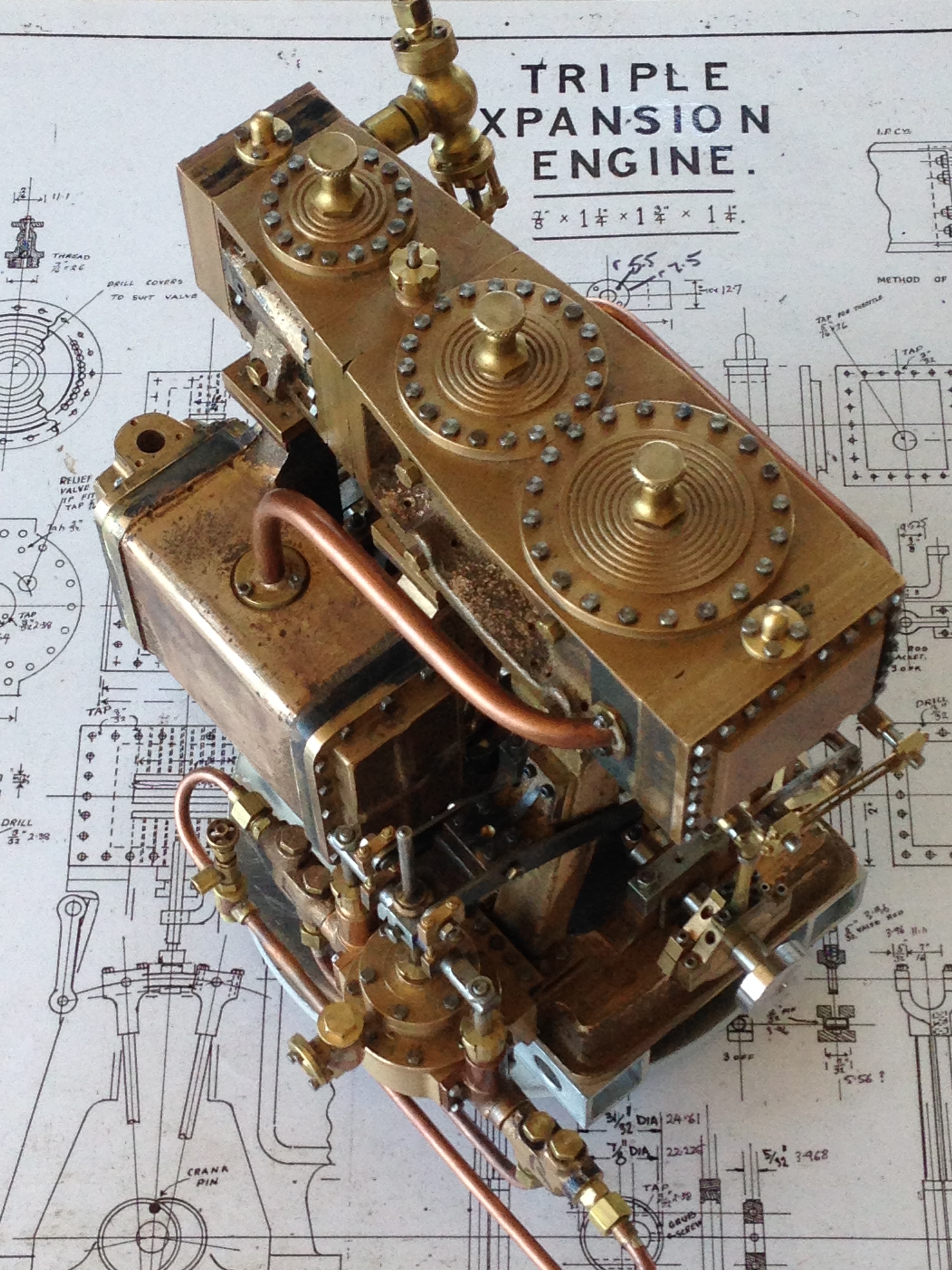
Well, almost another whole year has elapsed, and still the triple is not finished.  Come December, and that will be 3 years that this project has occupied my thoughts and workbench.  With a few other projects in between.

Last week I assembled the components, in preparation for the Geelong Show.  GSMEE is a bit light on for new models, and it was suggested that the triple might fill some shelf space, despite being unfinished.

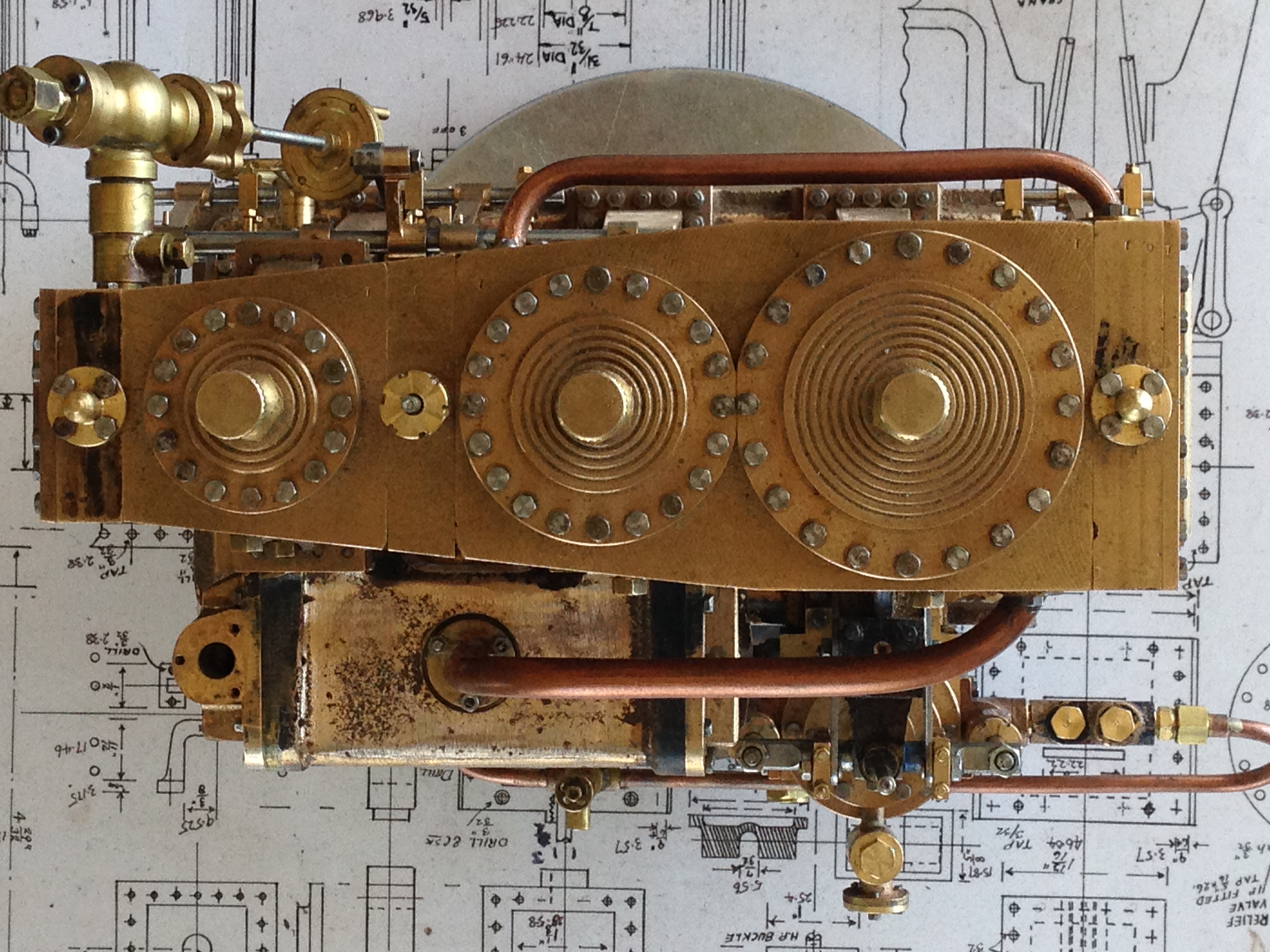
So I bolted it together.  All 429 fasteners!  And stood back and admired it.  It really is quite impressive, complex, and interesting.  So I took some pics.

IMG_5657.JPG

This is the condenser side, and the Edwards pump

IMG_5659.JPG

The other side is a bit lessy fussy, showing the steam inlet valve, the Stephenson’s links, weigh shaft  and controls.

IMG_5662.JPG

And the top, showing some of those 429 fasteners,

IMG_5665.JPG

The high pressure valve chest cover.  I will fill those holes where bolts cannot go.

IMG_5664.JPG

And the low pressure end, and links for the pump.

IMG_5660.JPG

And a close up of the steam valve and weigh shaft.

Not quite ready to run it yet.

It needs side covers for the cylinder block, drain cocks for the cylinders, and general freeing up.  It is still very tight.

Not to mention painting.  I expect that I will paint this one.   No idea of colours yet.

Another Diversion from The Triple

My model engineering club (GSMEE) has an annual competition build.  This year it is a small horizontal reversing steam engine.

IMG_5210.JPG

So I have taken another break from the triple to build the HME.  I have redrawn the plans to make my model 40% bigger, and also to accept metric fasteners.

IMG_5197.JPG

The HME blanks for the base, the cylinder block, the flywheel pillar and the flywheel.  The only stainless steel I had in my junkbox, er storage facility, had a  big hole in the middle, so I filled that with brass.

All was going well, and I spent almost a day making the piston head guide. Then finished off by making the guide rod and block.   I decided to take another thou off the guide block, and set the lathe going.

And heard an ominous bang.

IMG_5209

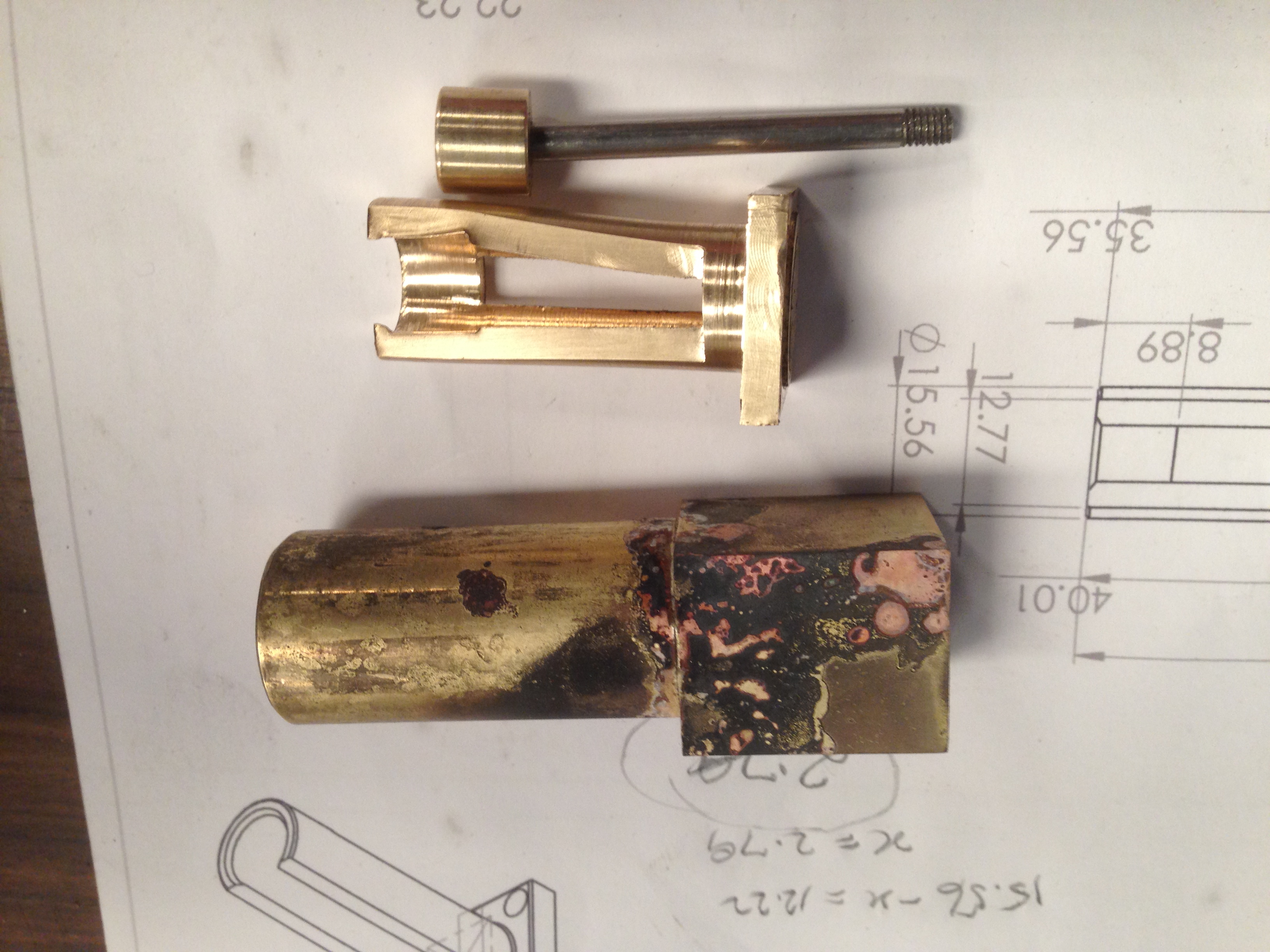
I had forgotten to remove the piston head guide from the from the piston before I restarted the lathe.  Destruction.  The lump at the bottom is another piece of brass, ready to be turned into another head guide.  I had run out of suitably sized brass, so I silver soldered a length of rod to some square section.  A day later and the new piston head guide is now made.  

At least I know from this (and other crashes), that the second part is always made much faster than the first.

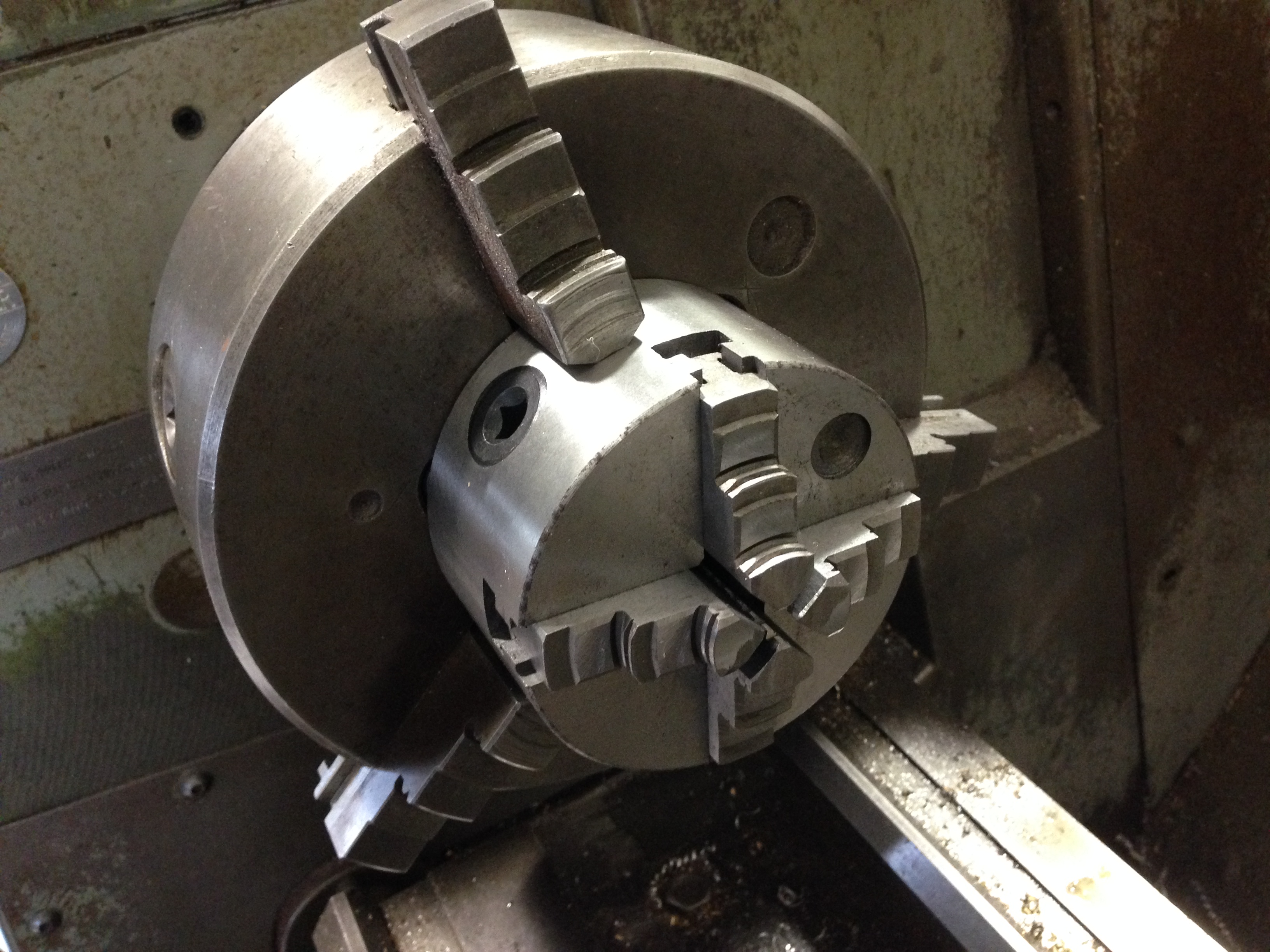
And on a different subject, I recently bought on Fleabay a self centering 4 jaw chuck.

IMG_5201.JPG

It does not replace the independent jaw 4 jaw chuck for accurate work, but will be useful for turning small square stock.  Also, I plan to make a backing plate for it to fit into the tailstock, so it will hold taps.

Metalworking for a cabinet maker

Our model engineering club has been locked out of our club rooms because MOULD has been detected in the building.   Apparently a lengthy process to reduce the mould to acceptable levels.  (note to self…. make sure that the inspectors never set foot in our house).

So our meetings have been held in various locations, including a sports centre and a basketball building.   I feel quite virtuous when I enter these buildings, but for some reason I do not feel any fitter when I exit.

A recent day meeting was held at my farm workshop.  Not my farm anymore, just the buildings.

walls-of-constantinople

Not that one….   the other one.

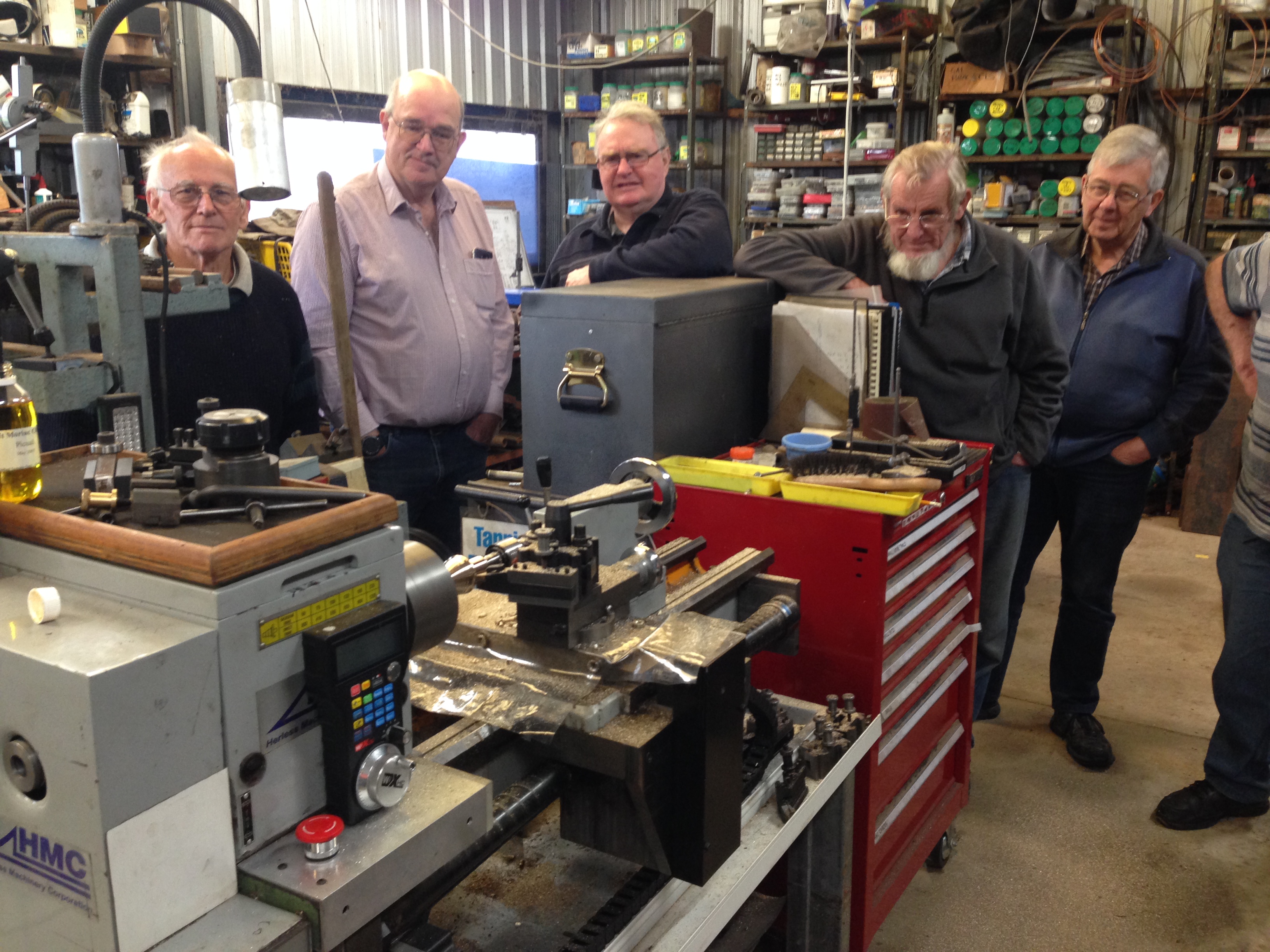
And one of our more senior members requested a display of CNC machining, from design to product.

So, I drew up a finial which was required to complete a bookcase which I had built 30 years ago.  Then imported the DXF drawing file into “Ezilathe”.

Ezilathe on screen.JPG

Showing Stuart Tankard, the author of Ezilathe, scrutinizing my drawing ….  and offering excellent suggestions for improvement using Ezilathe.

Then used Ezilathe to generate the G codes…..

Then to the CNC lathe…..

turning the finial.JPG

CNC turning the finial in 51mm brass rod.  1600rpm, 100mm/min.  Controlled by Mach 3 Turn.  I removed the tailstock shortly after this photo was taken, to permit completion of the ball.

GSMEE CNC close.JPG

Some GSMEE members watching the CNC turning.  I spent 3 days clearing up the workshop so the 16 members could fit in.   Amazing how much space was revealed in the workshop.   This is the Taiwanese lathe which I converted to CNC.  See old posts for details of the conversion.

I watched anxiously as the part was gradually revealed.  Admittedly, I had had a test run in wood to check the parameters, but this was the first run in metal.

finial in hand.JPG

The finial.  The bar stock was parted later.

finial on bookcase

Bookcase finally finished, after 30 years.

If you are interested in CNC lathe work, you should take a look at “Ezilathe”.  It is superb.

If you are on Facebook, (of course you are if you are reading this), you might like to take a look at the GSMEE Facebook site.