
Constitution Fun Day. Installing the GUNS.
The Americans redefined the concept of frigates.
Until Constitutions et al,. frigates were fast, moderately well armed, and could sail away from better armed but slower, ships of “the line”.
USS Constitution redefined the concept of a frigate. It was not quite as fast, but was more heavily armed and armoured (with thick living oak), and had a lot of guns, and personnel. The guns were bigger, and more of them, than previously seen. And that blew the Brits away in almost every frigate action in the 1812 war. Of course they never faced ships of the line, like Victory. That would have been like a WW2 destroyer facing an Iowa class battleship. No contest.
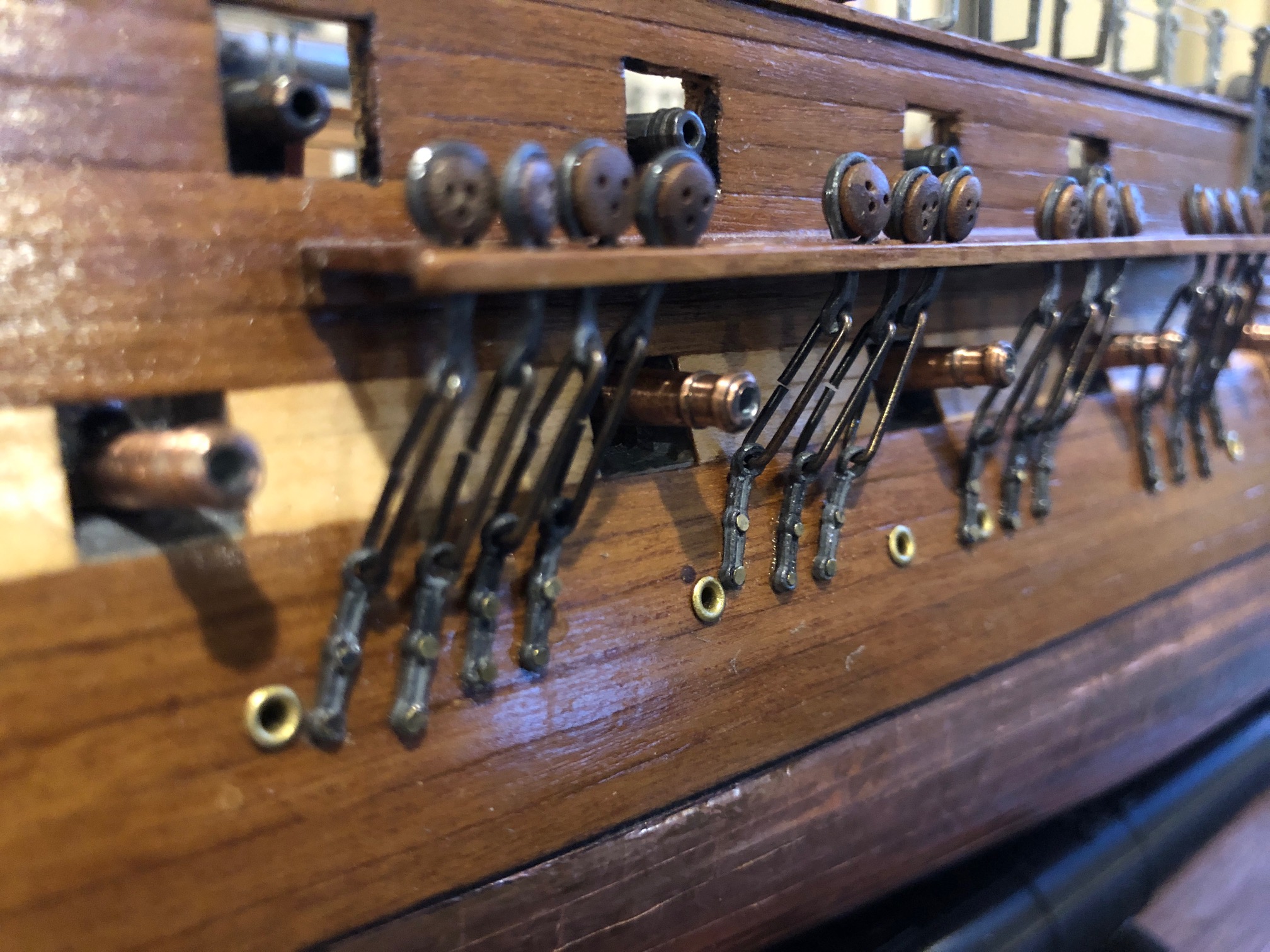
Today was hot again in southern Oz. 37 Celsius 98 Fahrenheit, so I had another day with my Mamoli Constitution. I finished the channel deadeyes on the mizzen mast, Then glued the spar deck carronades in place, all 20 of them. The wheels of the carronade carriages did not rotate, so I gave them a flat bottom with a few sanding strokes, and glued them to the top (spar) deck. I had previously painted them and they look really cool IMO. The short carronade barrels barely protrude beyond the Constitution bulwarks, as in the original. It was not uncommon for the carronade gunports to catch fire during a battle due to the carronade fire, but I guess that the gun crew were prepared to douse that.
Then I installed the 24 pr long guns on the gun deck, below. Mamoli, like most kit manufacturers, provides only a half barrel, not providing the breech or the carriage since they will not be visible. So I glued the half barrels into their positions, using CA glue. The barrels seemed to protrude further outside the hull than I was expecting, so I did a scale drawing of the 24pr gun, and the 23″ thick gun deck walls, and measured the amount of barrel protrusion. Sure enough, the Mamoli guys had their model almost exactly correct! Unfortunately, I did not save that drawing to show you.
Since most ship battles of the era were fought at less than 500m, I gave the guns only 0-1 degree elevation.

Then I installed the model hammock rail stanchions. These sit above the bulwarks, and consist of metal frames and netting. If a battle was imminent, the crew would roll up their hammocks and stuff them into the hammock rails. This provided the spar deck gun crews with a degree of protection against sharp shooters and splinters.
SWMBO commented that the model Constitution was looking a lot more interesting!


 johnsmachines