machines which I have made, am making, or intend to make, and some other stuff. If you find this site interesting, please leave a comment. I read every comment and respond to most. n.b. There is a list of my first 800 posts in my post of 17 June 2021, titled "800 Posts"
I have been using my laser cutter for a couple of weeks.
And I feel that the early frustrations and mistakes of using a new technology are settling down into a more productive stage.
Thankfully, I have some experience with G coding, and while not essential for using the Lightburn software, it has been an advantage. Lightburn automatically generates the G codes which control the Falcon2 cutter, but when things go wrong the solution for me has been to examine the G codes. Invariably the mistakes have been of my own making, due to misusing the Lightburn software. (RTFM you idiot!).
I have now made several hundred parts for my HMS Bellerophon build, with quite a few more yet to come.
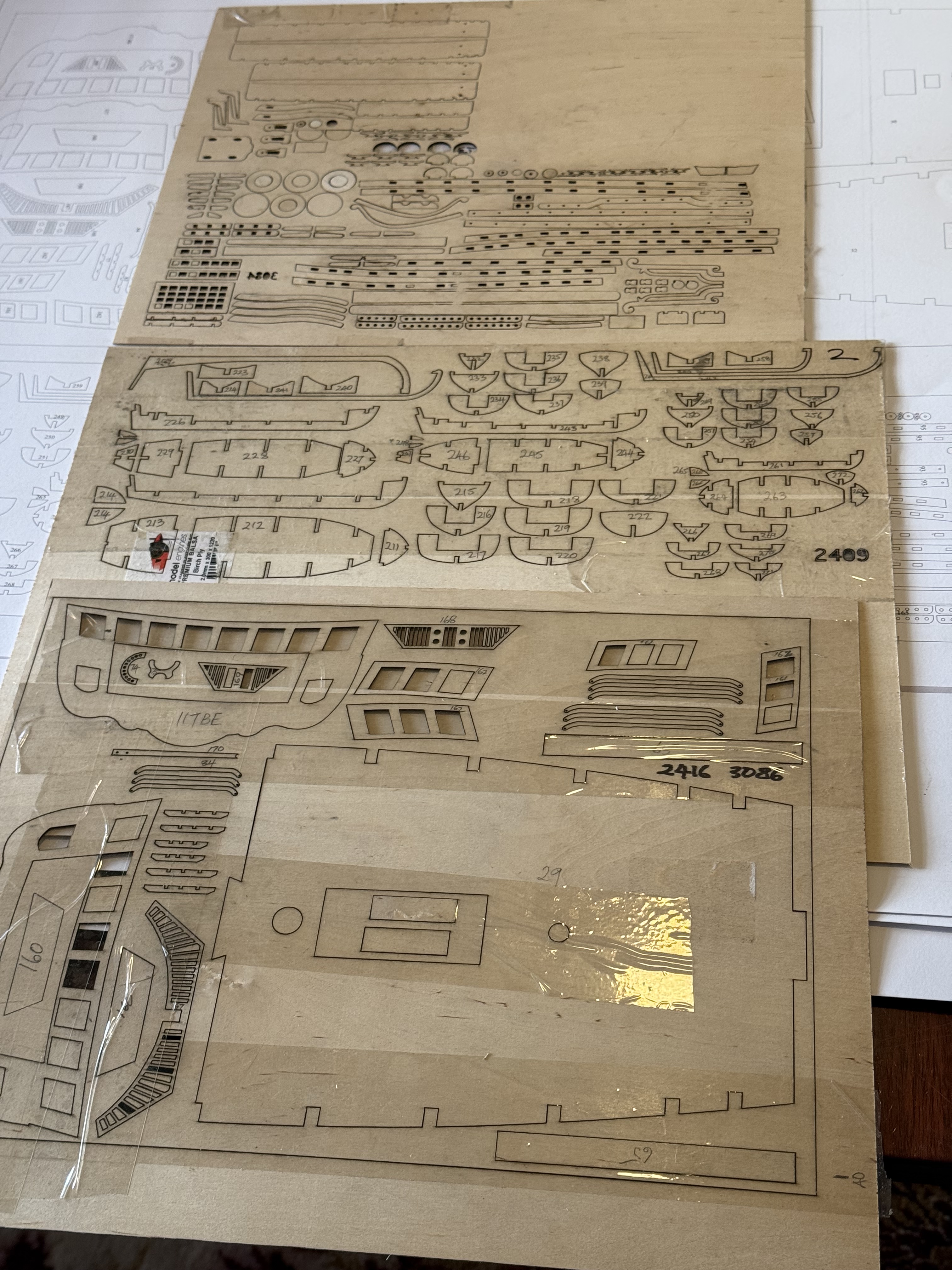
Some of the parts made so far. The sticky tape is to stop the parts falling out of the parent sheet during storage. At that stage I had not learned how to add tabs.This lot, in 1.5mm plywood, took about 15″ to cut after several hours of computer preparation of the drawing files. By this stage I had learned about tabs, and sticky tape not required.
Then I tried a combination of partial depth cutting, plus full depth cutting….
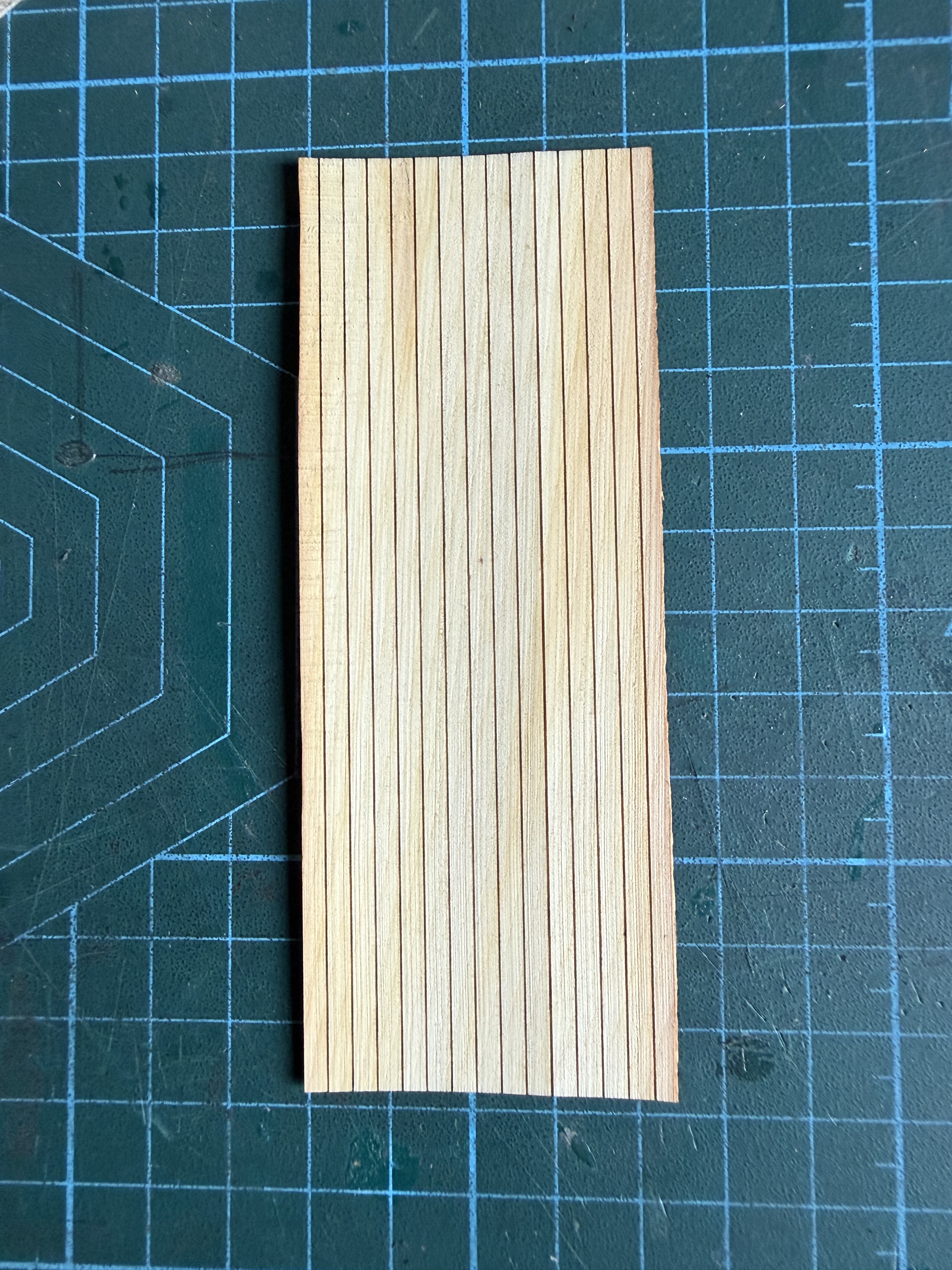
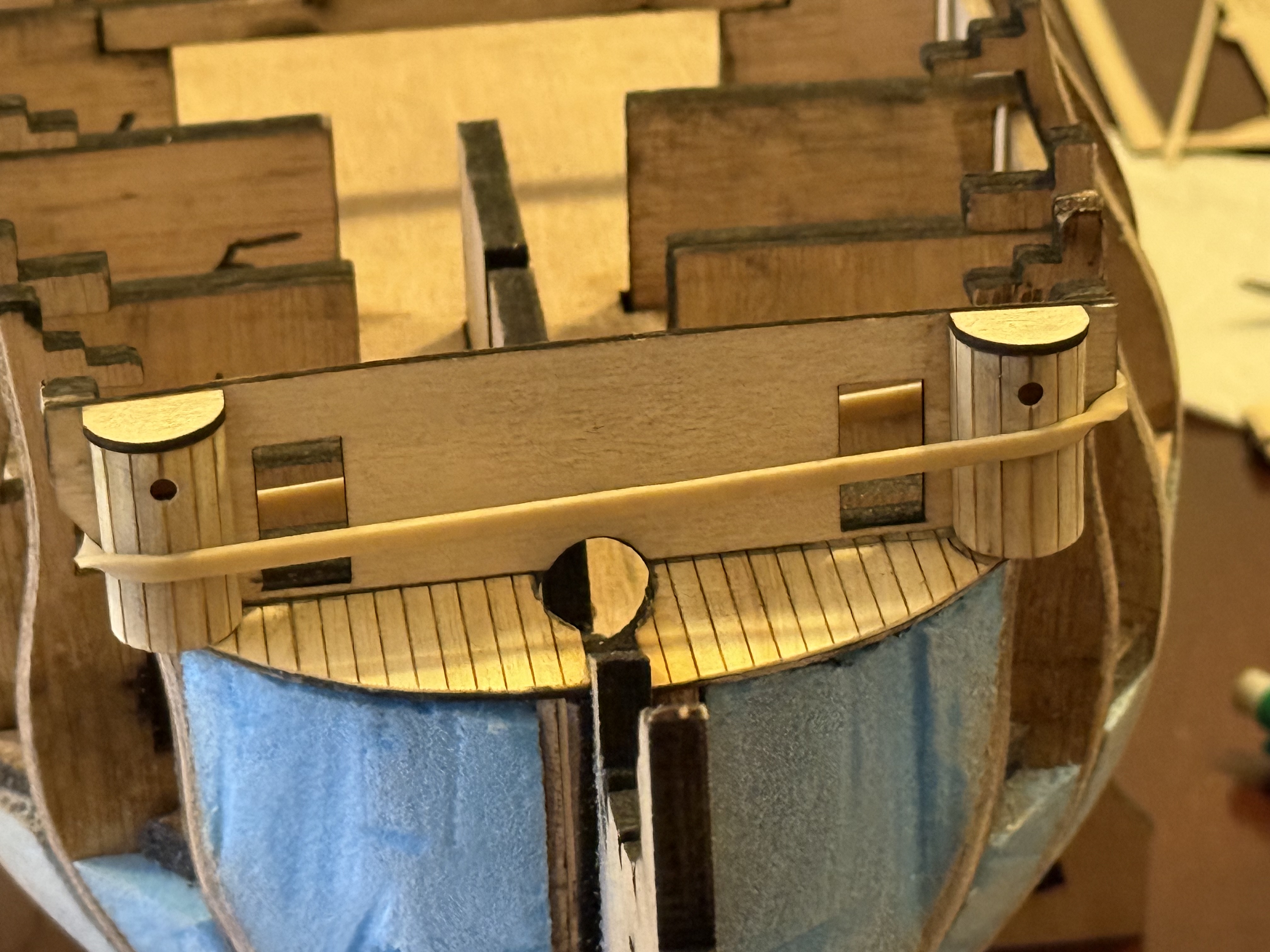
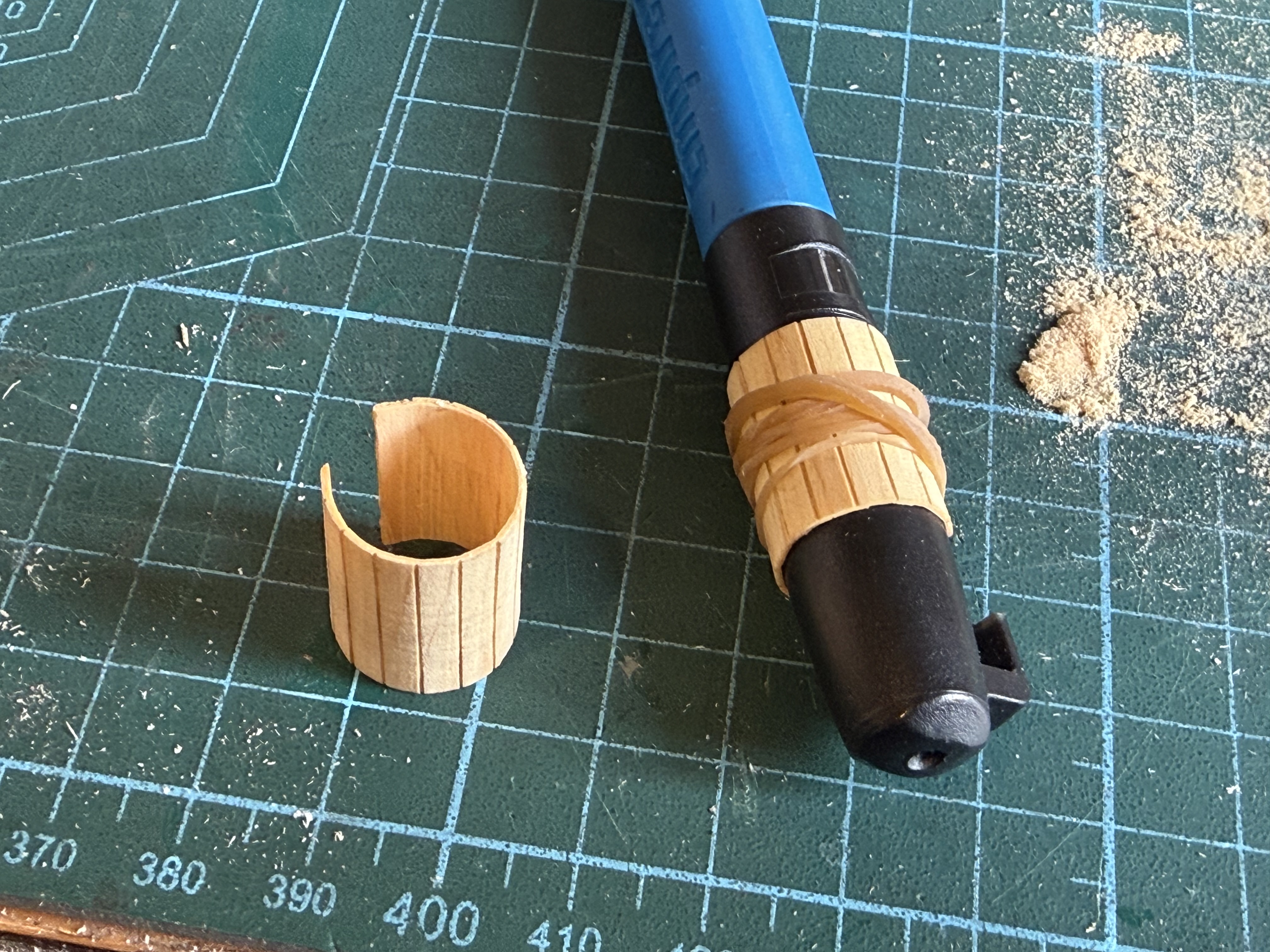
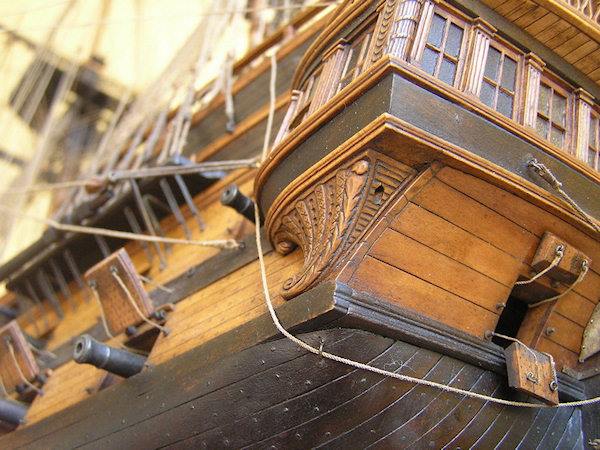
These are 3mm wide ships planks, cut about half way through 0.6mm Huon pine. The 120mm x 45mmslab of planks was then fully cut. In future I will add marks to resemble the top of trenails, and to mark staggered ends of planks. But one thing at a time!The little semi cylindrical structures sitting on the prow of the Bellerophon are actually dunnies for the crew. They overhang the sides presumably so the products drop straight into the ocean. The plans call for the planks to be glued individually, but I thought that I would try a quicker neater method using the slab of planks pictured above.So I cut off a piece of the planks, soaked it in warm water for a few minutes, then bent it around an appropriately sized cylinder and let it dry overnight. It retained its cylindrical shape. I had tried to bend it without soaking, but it just snapped along the cuts. Later I made 2 more of these, cut to the correct length, and used them as pictured in the photo before this one.
I just love how new technology opens up a myriad of possibilities.
At last, the motor arrived. A few days longer than their longest estimate, and it has an foreign, non-Australian plug, but that is trivial.
These permanent rare earth magnet motors are excellent. Soft start, electric braking, speed and direction controlled, rpm’s 200-4500/min. And compact, quiet, powerful. These are rated at 750w/1 hp. Price now around $aud 130.
In the meantime I have machined the underside of the saw table. Previously I had machined the top of the table while it was attached to the base, but later realized that I should have done the underside as well.
I had to attach the table top directly to the milling machine table, and I puzzled for a while how to secure it to the mill. Then I remembered buying some neat little T slot cam clamps some years ago (see pic) and they worked perfectly.
Low profile (8mm above the bed) T slot cam clamps held the workpiece perfectly with a 50mm cutter. I can’t remember what they are called or what I paid. But I think that this has been their first use.And I also machined the blocks which slide along the 8mm rods, and hold the fence. I do usually mark the waste clearly… guess why!
And, back to Bellerophon, I needed some 1mm and 3mm thick parts cut. I could have used a coping saw or an electric version, but I must be getting lazy. I spent a day or two on the computer to produce some dxf files and asked a friend to use his new laser cutter.
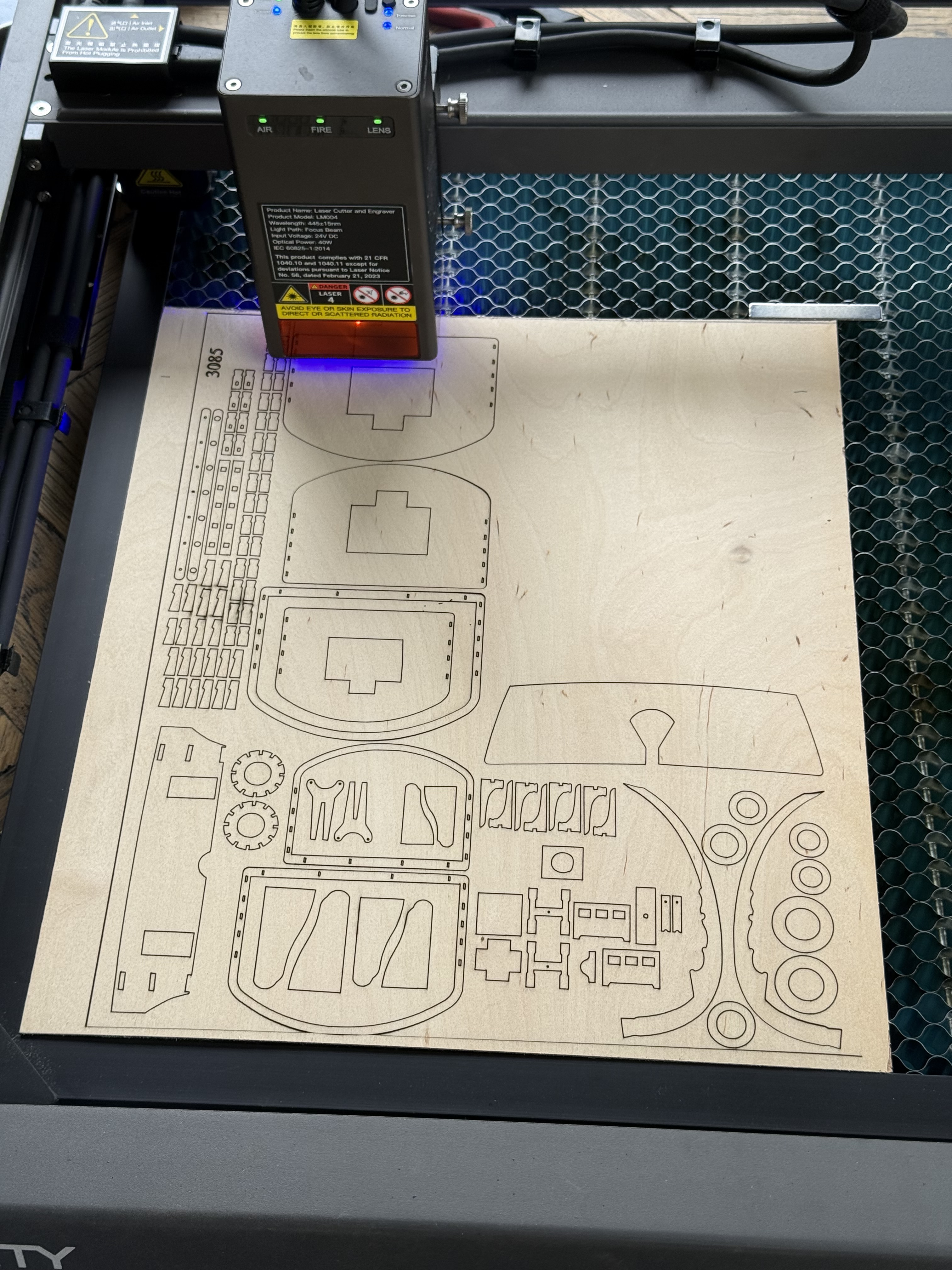
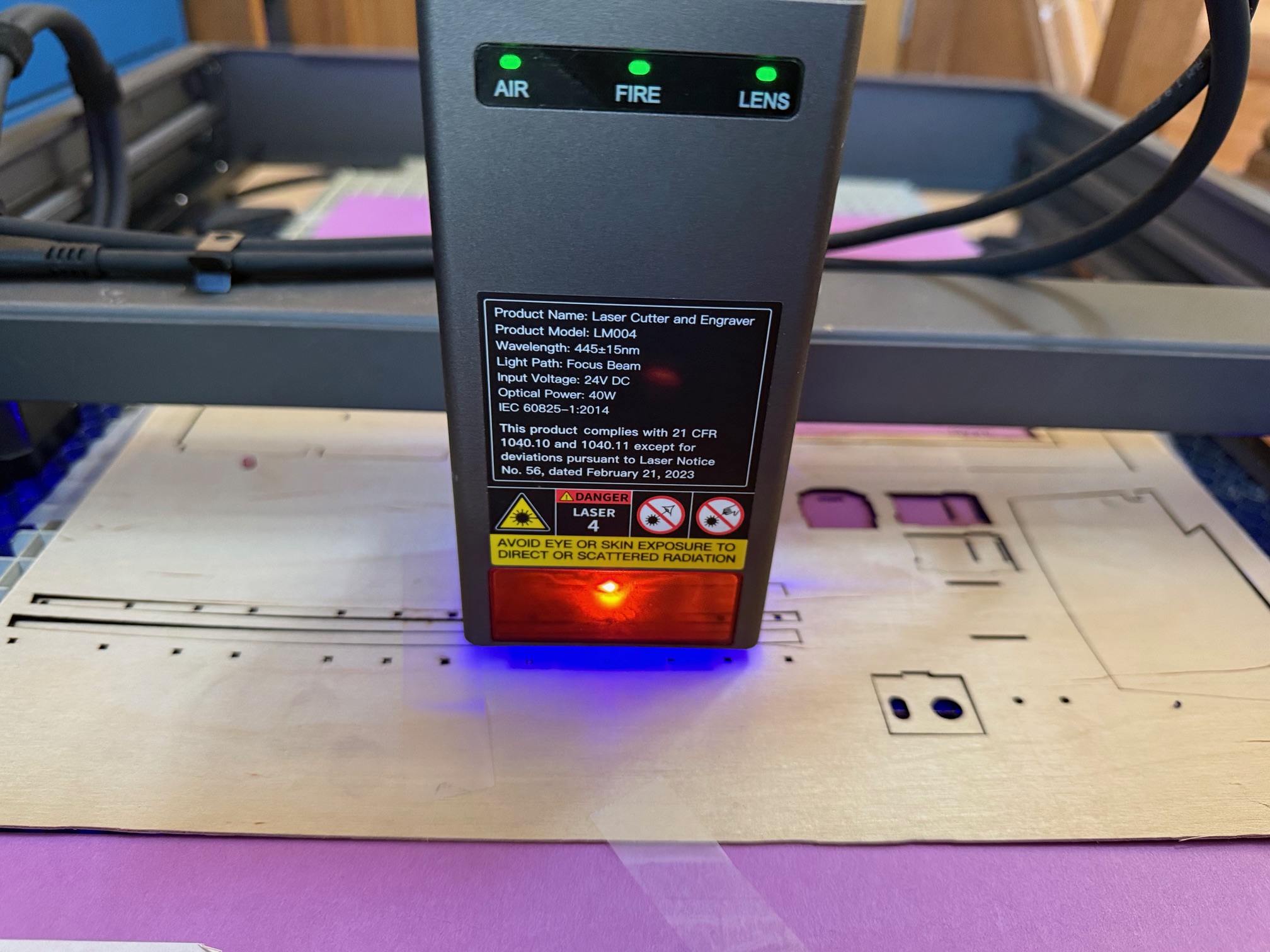
It is a Creality Falcon2 diode laser cutter. Cuts ply up to 20mm thick, and a working area of 400 x 400mm. We even experimented with cutting brass, and it did a creditable job on 0.25mm thick brass. In the pic it is doing a test board 9.5mm thick ply, to test for the best settings for that material. It is listed only as an engraving tool, but its main use in current hands I believe will be as a cutter of ply, solid wood, acrylic, paper, cardboard, etc etc.It has an air assist to blow out dust and vaporised debris away from the laser beam. But the light workpieces need to be fastened securely! The light cut pieces can be partly dislodged if no tabs are used, and can cause the moving head to move the workpiece. This machine impressed me so much that I have ordered one for myself.
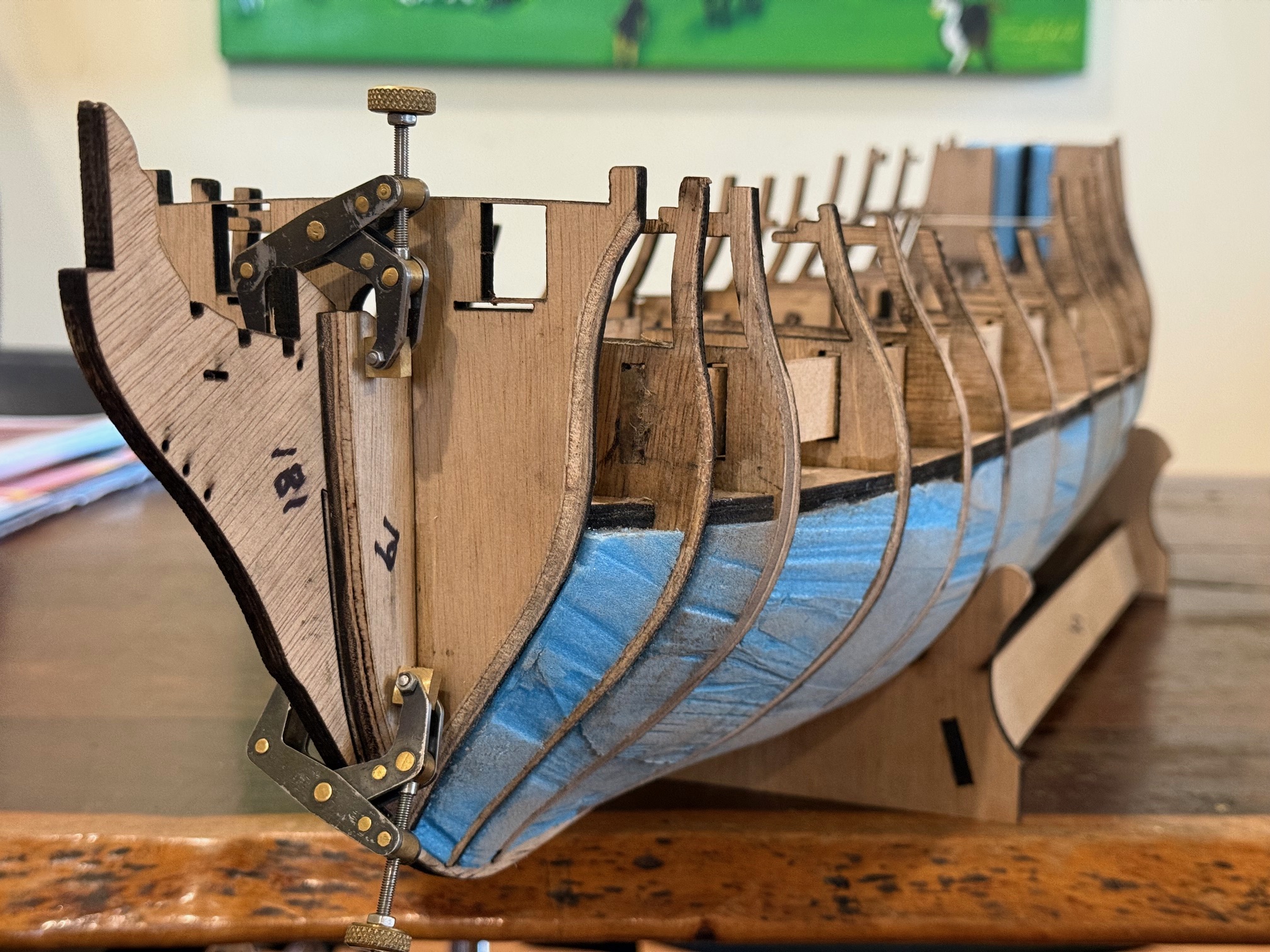
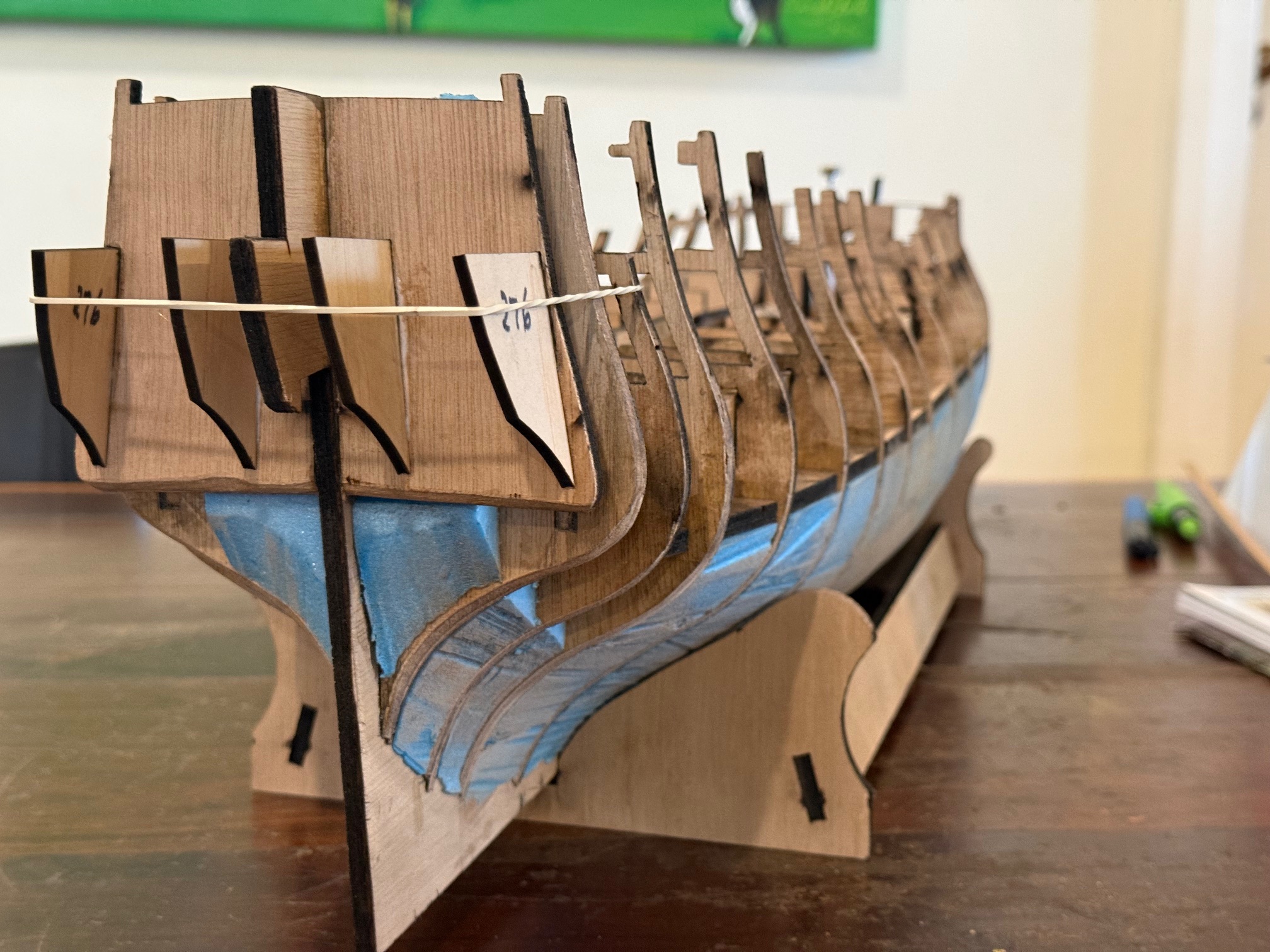
And I used the pieces on my Bellerophon.Well, actually these were cut by the Commercial laser business. But the tiny “Kant Twist” type clamps were made by me a few years ago and I find them very useful on my model ship builds. These are the 3mm thick parts which were cut by my friend Brendan. And the high tech clamping method worked perfectly, keeping the parts angled inwards a few degrees as intended.
Can’t wait to install the motor on the saw, and finally use it!
Finally found some time to return to HMS Bellerophon, having paid for and picked up the laser cut marine ply keel and bulkheads.
Today I cut out some supports for the keel from workshop scrap.
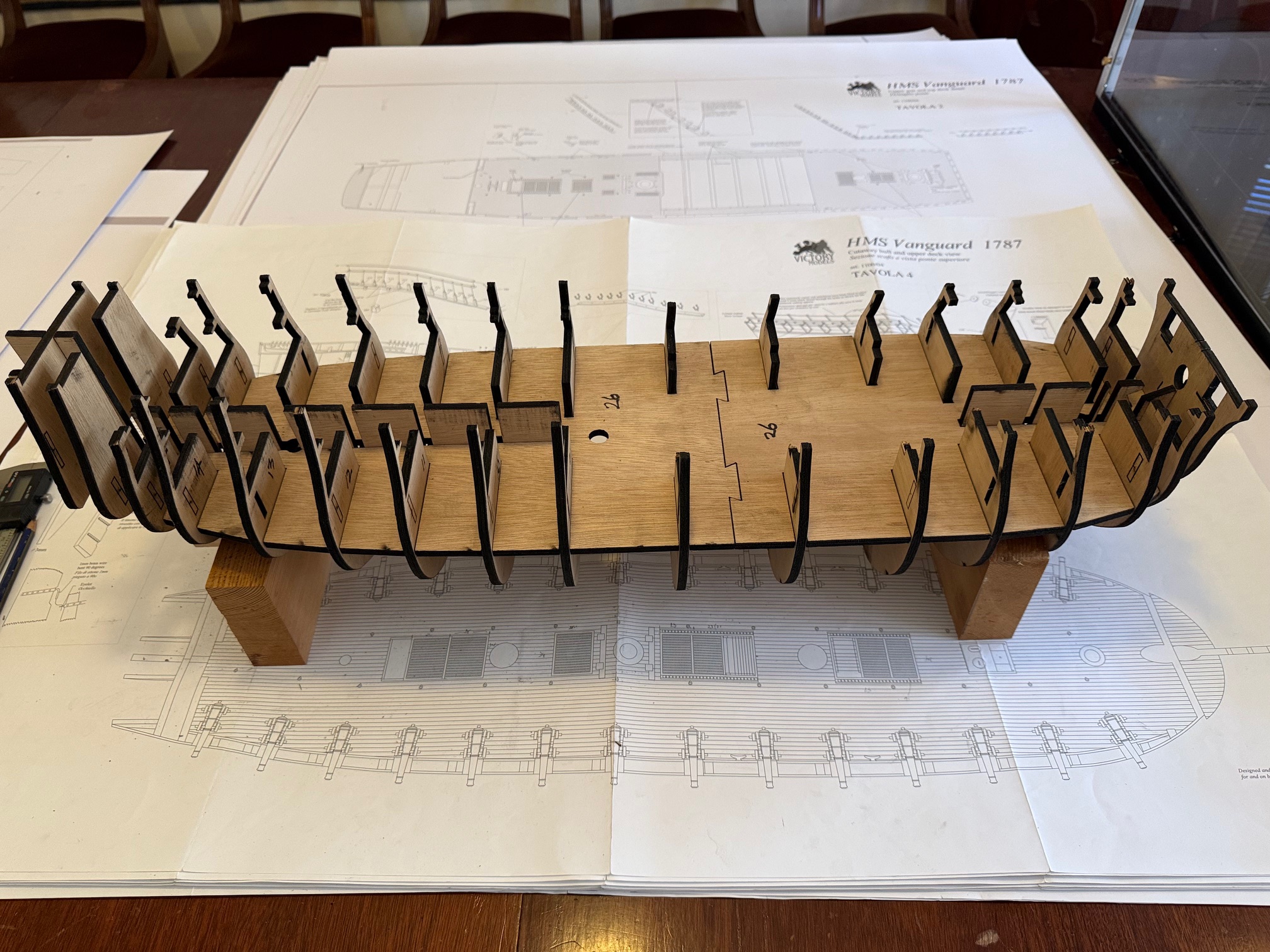
Then roughly put together the laser cut parts. Only gluing so far is to join together the 2 parts which form the “longitudinal frame” using Gorilla Glue..
Here are the bulkheads sitting in the slots in the longitudinal frame, which is sitting in the blocks fore and aft supporting the lot. And behind a familiar ship model to some of you. Destined to decorate the legal chambers of one of my daughters.
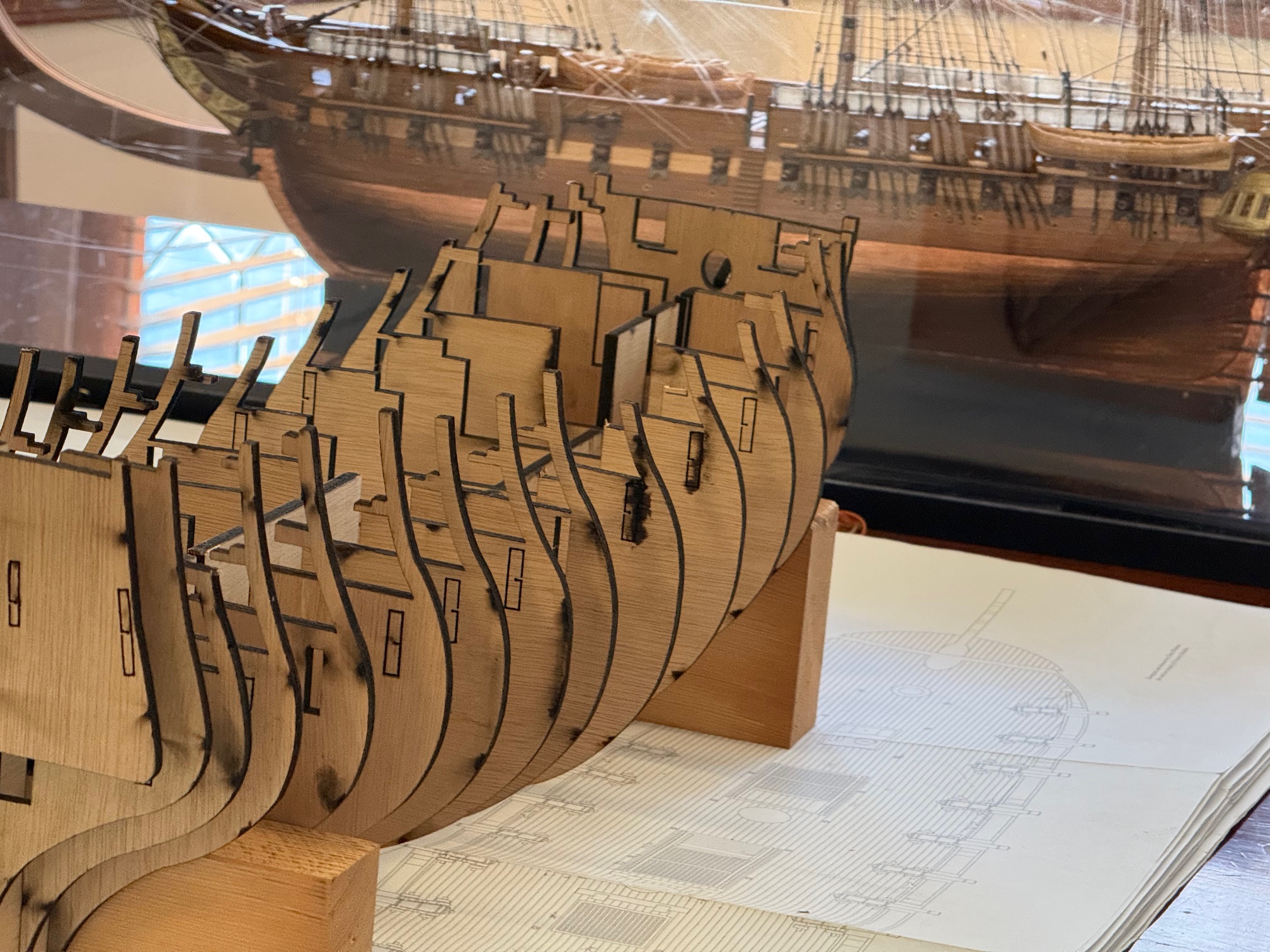
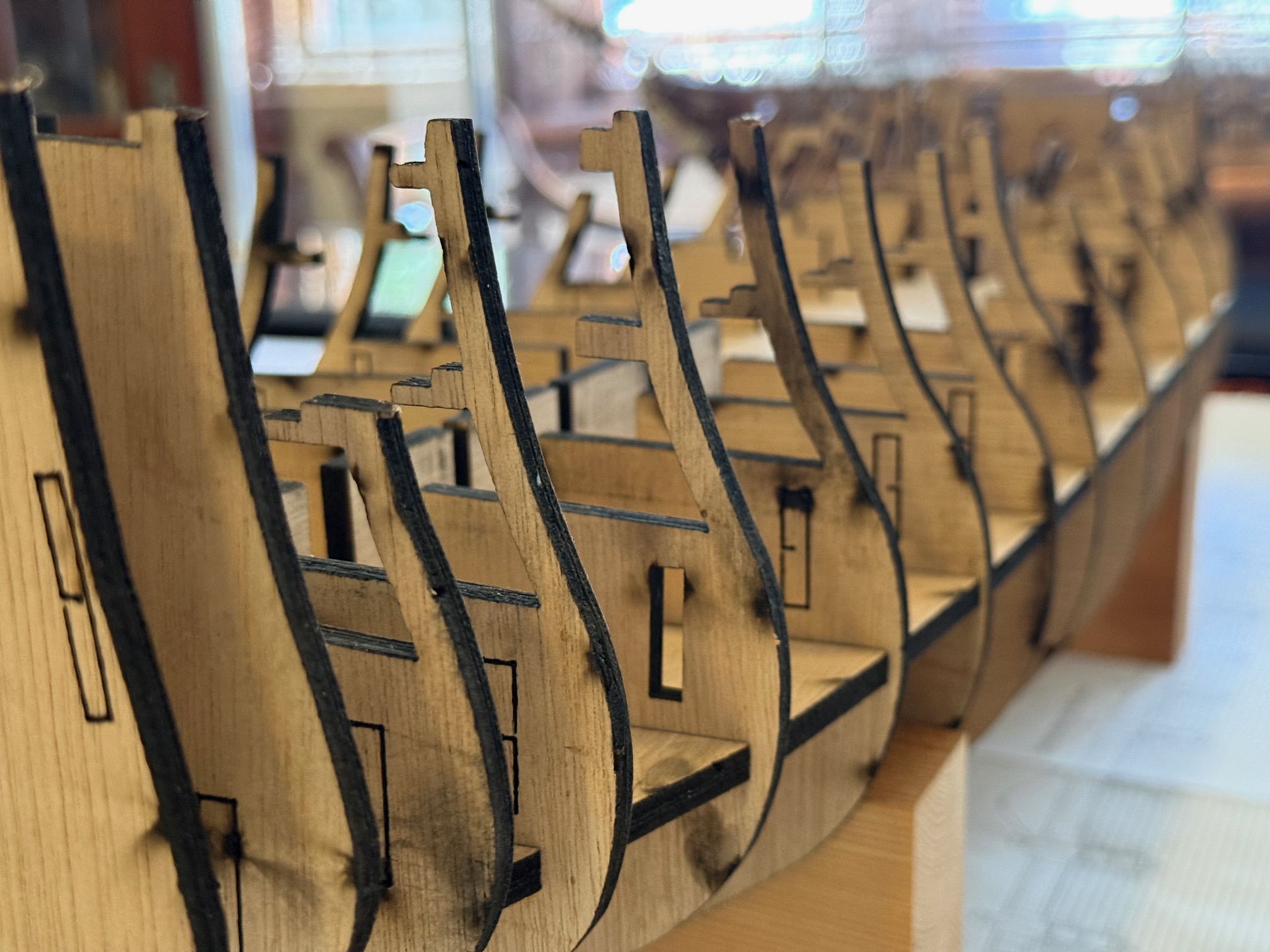
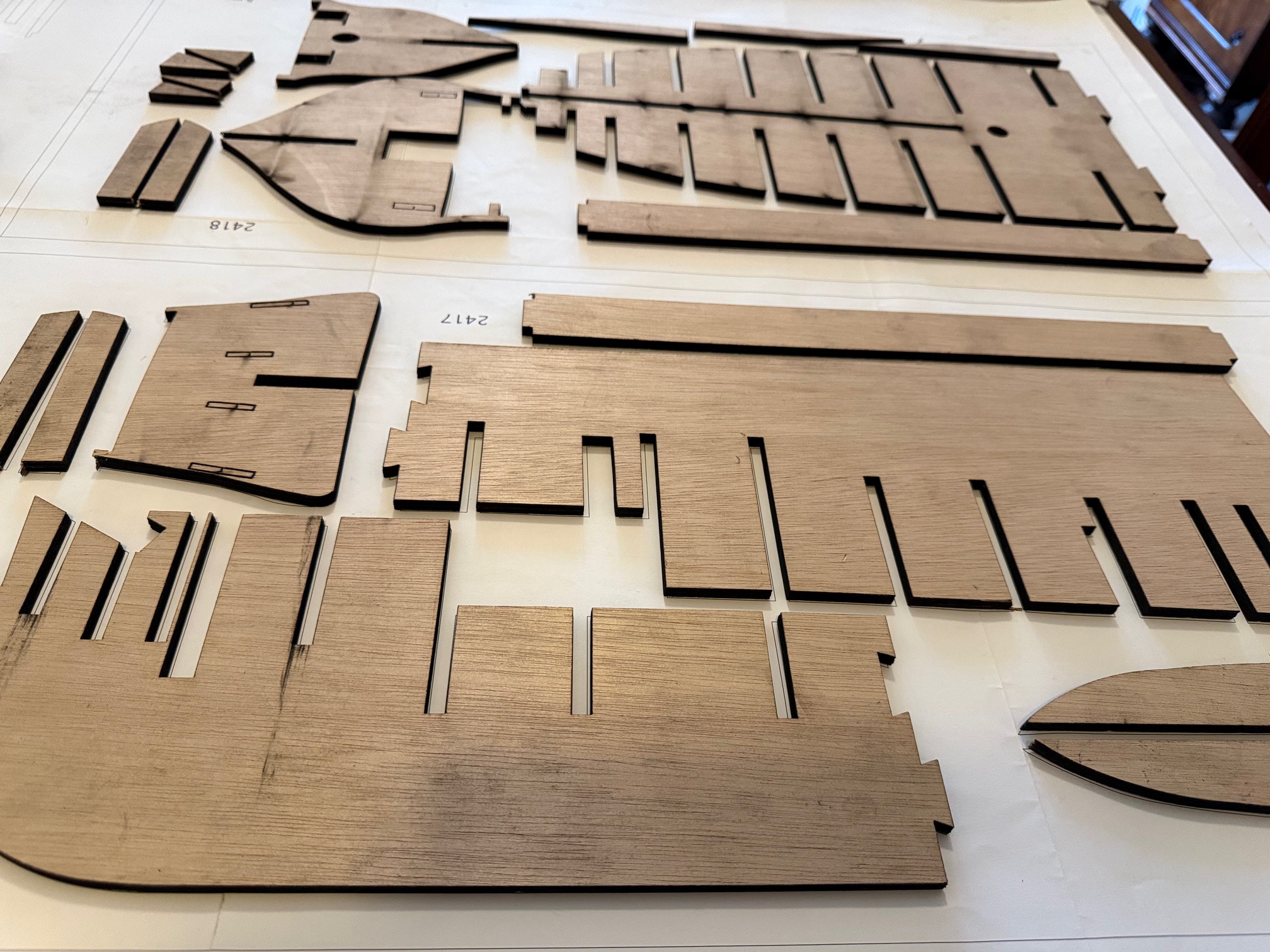
You can see some of the evidence of overexuberant laser cutting.
I was pleasantly surprised how well all of those parts fitted together. Only one joint required any trimming persuasion.
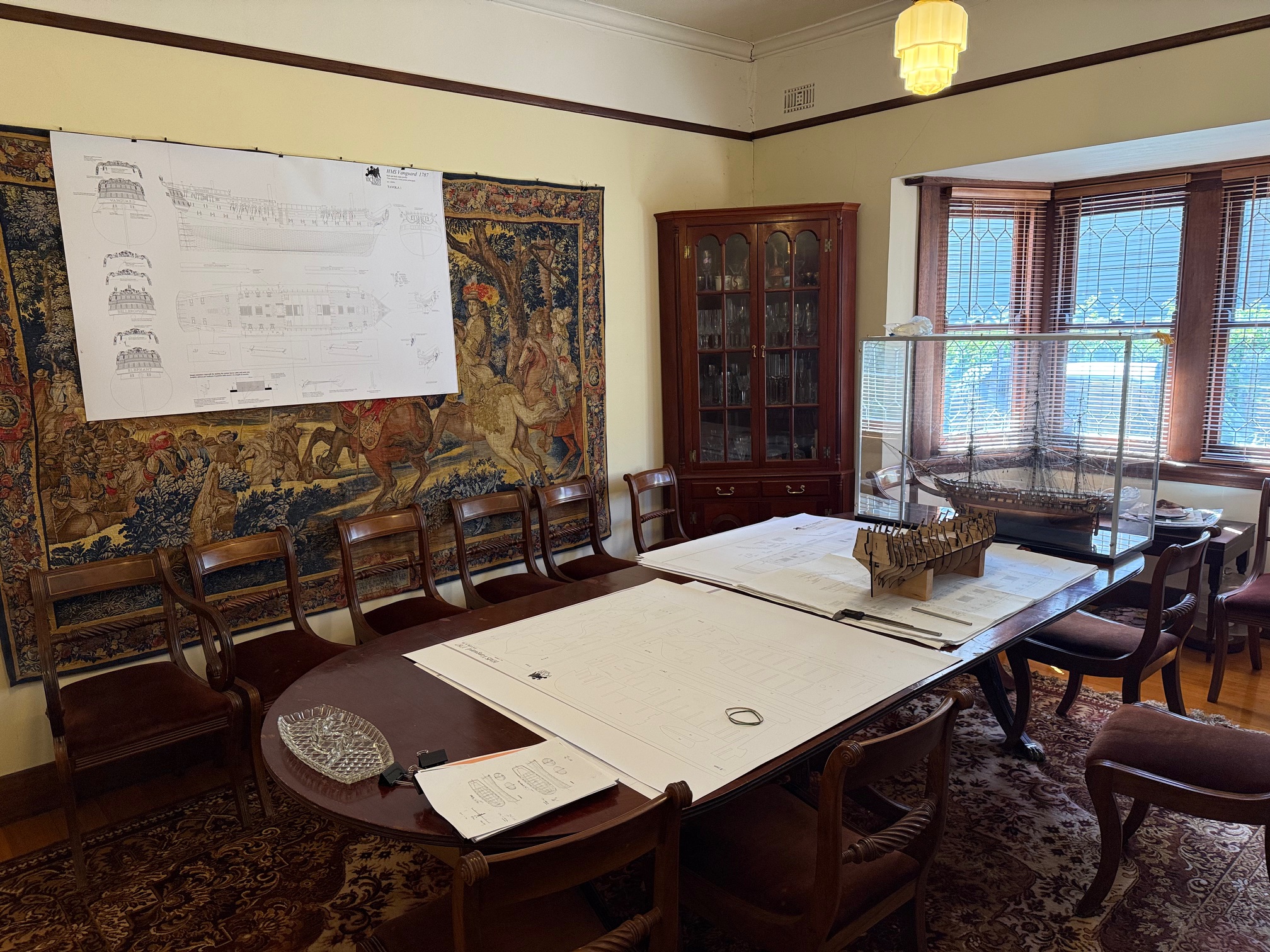
The deck (?orlop deck, no, lower gun deck) holds the bulkheads in good position. Gluing yet to occur. I am pretty happy with how it all fits together, despite my alterations to cope with the increased ply thickness from 5 to 6mm. At this stage it could still be Vanguard, but it will not remain so.And a close up. some voids to be cut and pushed out. And a lot of bulkhead shaping to accept the planking later. Also suggestion of some small spot fires during the lasering.Our dining room table is rarely used for its original purpose, but suits very well for assembling my current model. I made that corner cupboard and table from Honduras mahogany almost 50 years ago, and the 12 chairs from American black walnut about 45 years ago.
I feel quite excited to see the skeleton of the hull in this form, even though it is waiting for some glue.
ps. The “tapestry” on the wall is actually a painting of “The Battle of Brugues” with Louis XIV on horesback. The original,I believe is in the Louvre. Makes a handy place to locate the main lateral plan of the Vanguard/Bellerophon for quick reference. Louis XIV will reappear eventually.
I flagged this next project a few posts before I ran out of storage space on my WordPress johnsmachines.com site.
Since I have now created 1gB of storage space by deleting 2.5 years of posts and media 2014-2016 I am able to recommence posting current stuff. I have saved those posts on my own computer, but regrettably they are not able to be shared.
I plan to make the model ship from scratch, i.e. not using a kit or bought parts,as far as possible. However I will be using plans of HMS Vanguard, which was almost identical to Bellerophon, except for decorations, figurehead and name. Both ships had distinguished careers which I will address in a future post.
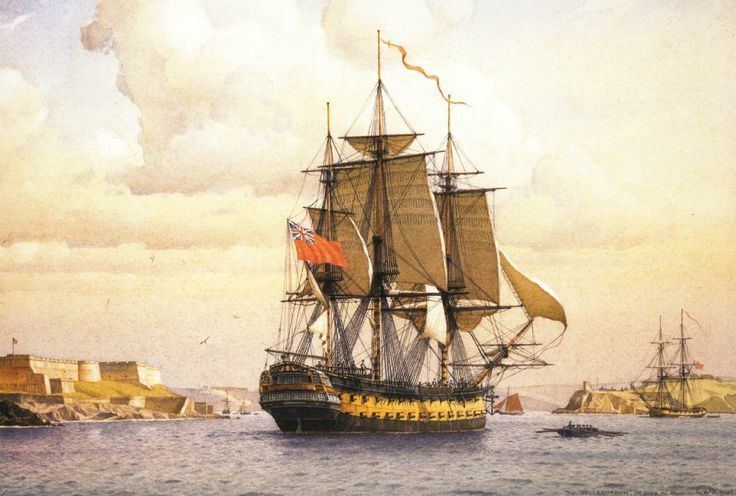
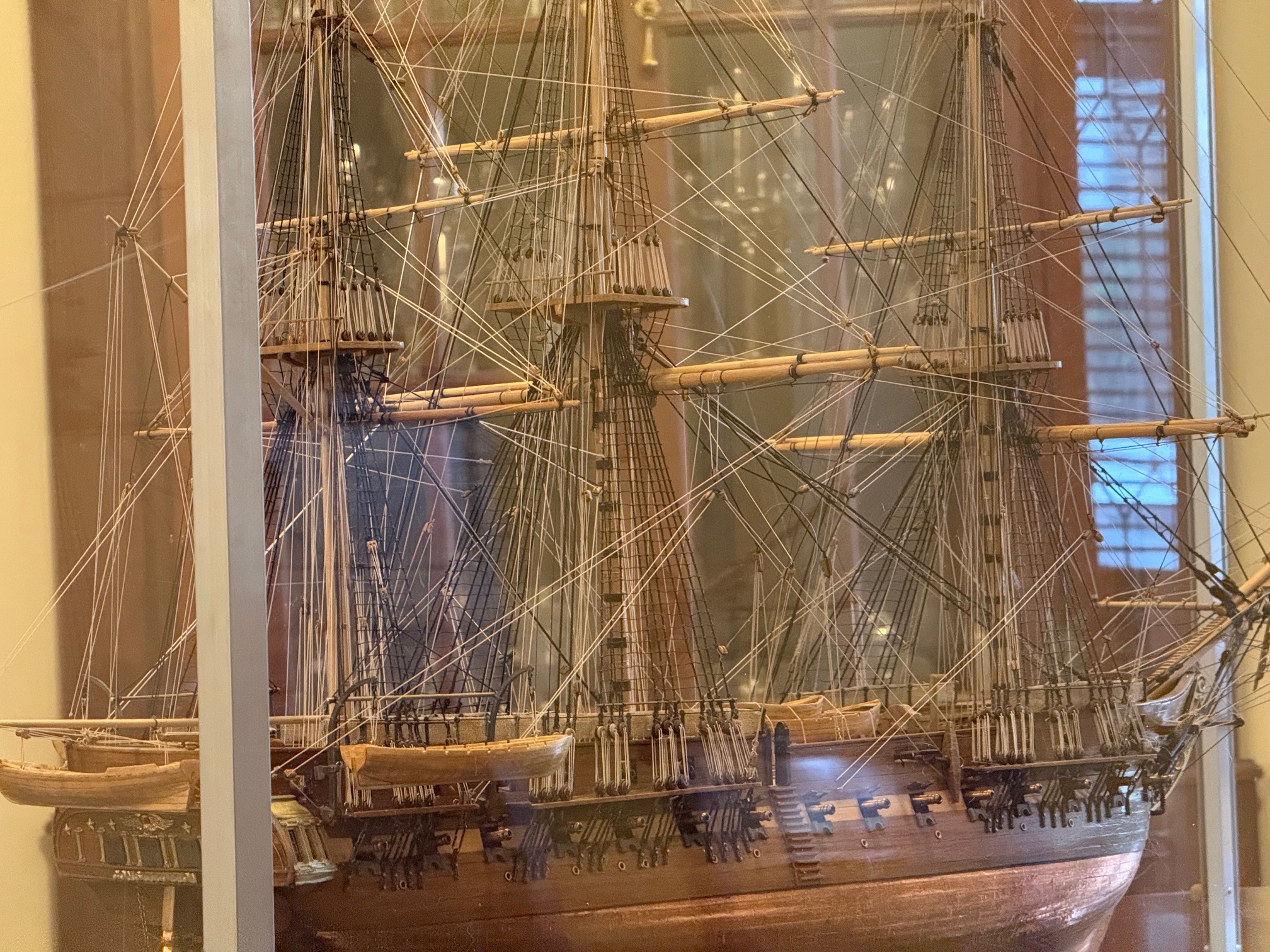
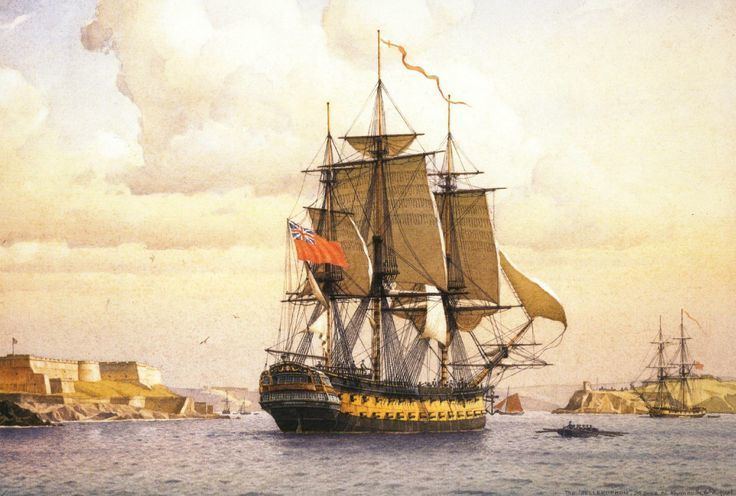
Bellerophon was a 3rd rate Ship of the Line. It had 74 guns, a crew of 550, and being a ship of the line was considered suitable for fleet actions, such as the Battle of the Nile and Trafalgar. It was a very effective battle ship, heavily armed, very strongly built, and reasonably fast. A frigate, even a heavy frigate such as Constitution, would probably have come off second best against a ship like Bellerophon. The 74’s were the commonest naval ship produced by Britain and Framce because of their effectiveness, and reasonable cost of building and operation.
The plans were loaned to me by a friend who had built Vanguard. I had the plans scanned and copied, and decided to get the structural parts of the hull commercially cut using a laser. Unfortunately there was a complication.
The plans were centered around those structural parts being 5mm thick. Despite extensive searching I could find NO suppliers of reasonable quality 5mm plywood.
So I spent quite a few days modifying the plans to use 6mm plywood. That involved widening the slots to 6mm, and trying to forsee any consequences. Undoubtedly there will be unforeseen consequences, which I will detail as I progress. I did consider building an “Admiralty” style model but wanted a planked model, with masts, rigging etc, so settled for a bulkhead/keel type model.
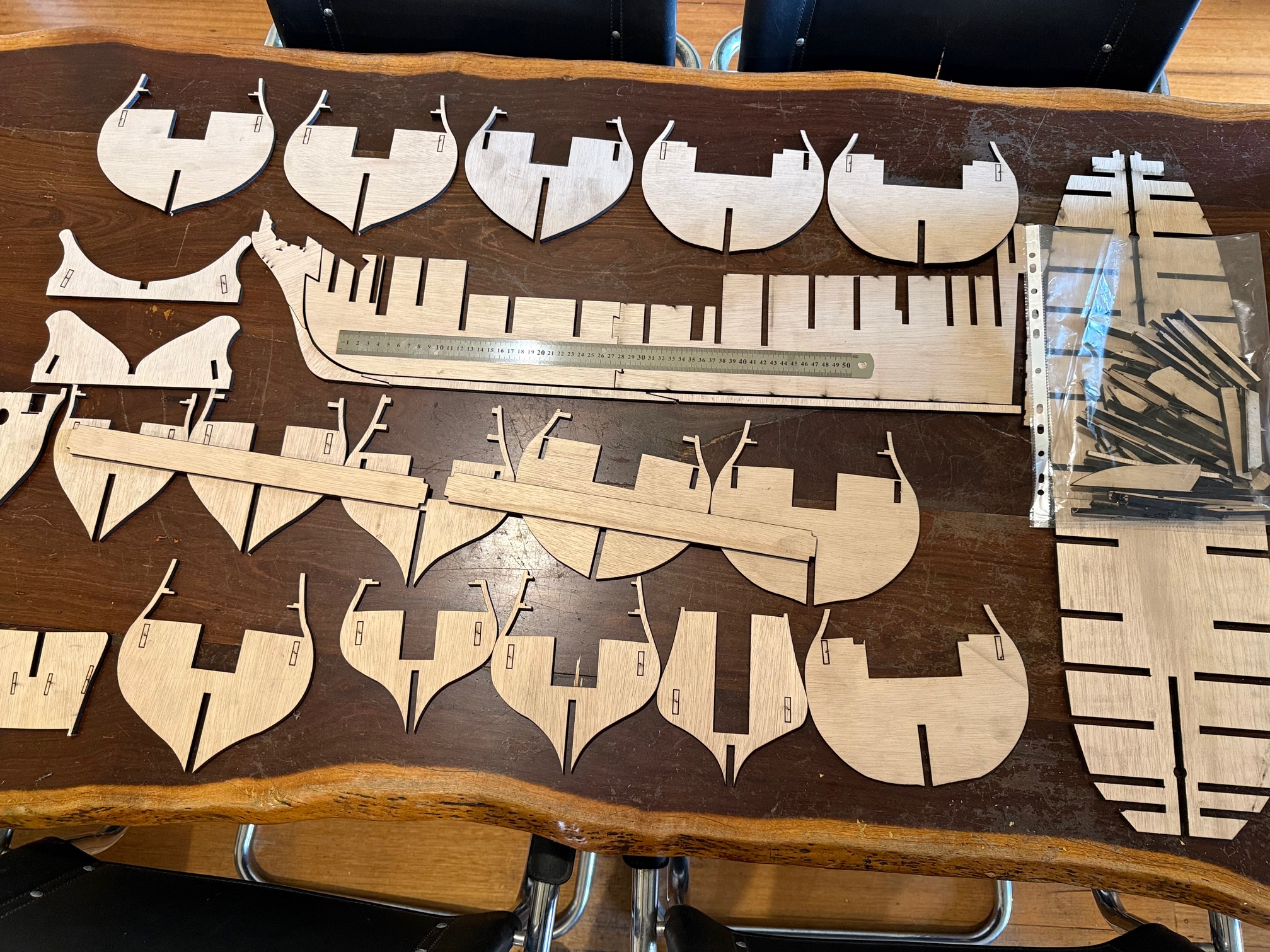
Then a few days ago I collected the laser cut parts from JR Laser, North Geelong.
This is about half of the parts. The quality of the laser cutting is only fair. The shapes are good but there is a lot of charring in the cuts, and it extends onto the ply surface. Fortunately none of the plywood will be visible on the finished model. But I am concerned that the charcoal might interfere with the gluing process. I will experiment with some non critical glue joins before deciding which glue method to use. At this stage I am thinking PVA.
The steel ruler is 500mm long which gives an indication of the model size.
I specified marine ply as the ply type.
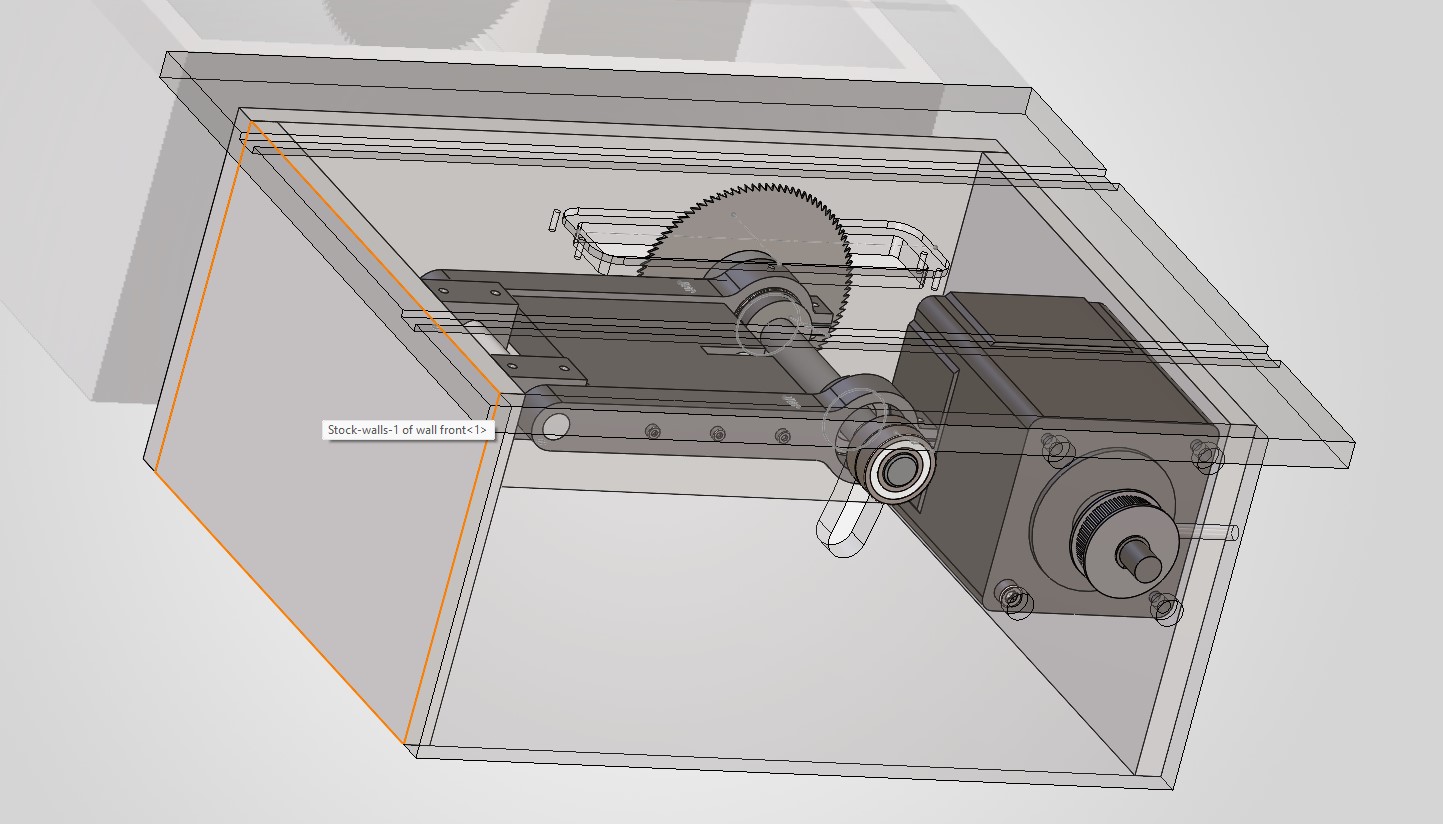
Also, I am currently building a Byrnes style bench saw. It is progressing well, but awaiting parts from OS. I am using some elements of the Byrnes saw, but have made the table longer, and situated the motor in the box instead of behind it. The box is made from 16mm thick alu, and the table is 12mm thick alu. The motor is a 750w AC servo, with speed and direction control.
This is a simplified drawing. Not shown are the blade height adjustment, drive belt, and control unit. Accessories will be designed later. It is built to this stage at this time.
I intend to make a model 74 gun ship, and I have decided to take a risk, and do a scratch build. i.e. to not make the 74 from a kit.
My first experience of using a wooden kit, was USS Constitution, from Mamoli. As a beginner, it was not the best choice. Many parts were not accurately cut. In fact they were obviously hand cut, with all of the inaccuracies that method entails. A later kit, for the Khufu pyramid ship, was much more accurate, and was a pleasure to assemble. It was laser cut.
And, as result of my own reading and “research”, I made various modifications to the Constitution plans. For example I made the ships boats from another supplier (Shicheng). And I made all of the model ropes instead of using those supplied.
For a first effort, the result was OK.
USS Constitution in its case.
But there were mistakes, and misinterpretations of the instructions and plans.
The most satisfying parts of the build were the bits where I made parts from scratch.
So, my next build will be from scratch.
But, I want to work from plans.
So I have bought books (The Seventy Four Gun Ship by Jean Boudriot, Building The Wooden Fighting Ship by Doods and Moore, and quite a few other books); and plans (from Ancre, for an admiralty style hull, and HMS Vanguard from Victory Models).
Eventually I settled on the Victory Models plans. They are simpler and more suitable for my skill level, and will probably take a fraction of the time to complete vis a vis the Ancre/Boudriot plans. Even so, I expect that the build will take at least a year, despite my habit of working quickly.
The first step was to get the plans scanned, a copy printed, and electronic copies on my computer. I chose to have the printed copy on heavy duty paper, almost cardboard, so I could make cutout templates if required. That was not cheap. 20 x A1 prints plus the electronic pdf’s was $aud275. When I felt the weight of the printed versions, I felt better about the price. They are quite substantially heavy.
Then I decided to have the keel, bulkheads, decks etc laser cut. I do have a scroll saw, and considerable wood working experience, but the speed and accuracy of laser cutting was persuasive.
My electronic version of the Victory Models plans was in the form of pdf’s. The laser cutting service requires dxf’s. I do not have sophisticated software to convert pdf’s to dxf’s, but I do have a simple free program called “Print2Cad”.
So I converted one page of the plans as an experiment.
Print2cad processed the plan quickly, and I saved the converted plan as a dxf.
AutoCAD 2024 opened the dxf. (Hobbiest version of AutoCAD).
It opened normally and superficially looked good. But when I zoomed into the parts there were multiple problems. Many sharp corners had converted to arcs. And many straight lines were converted to arcs.
So I was committed to spending many hours to tidying up the converted dxf.
Then a bigger problem surfaced. The bulkheads, keel, decks and beams were to be cut from 5mm ply. The slots and joins were planned around 5mm ply. So off I went to my local ply supplier, calipers in hand, to measure the exact thickness of their ply. 3mm, 4.5mm, 6mm, no problem. BUT NO 5mm!!
I went home and searched the net for other suppliers. No-one supplies 5mm ply. Except some packaging ply is said to be 5mm, but it looked rough and knotty, and the one which I measured was actually 4.5mm anyway, and not very rigid.
I mulled over this for a week or two. Revisited the idea of making an admiralty model from solid wood. Wondered about changing the Victory Model plans to use 6mm ply. That was going to take a lot of hours, and no doubt there would be unintended consequences from the changes.
I did consider getting the laser cut pieces as planned for 5mm slots, and widening the slots to 6mm as required, one by one.
However, at this point of time, I have spent most of the past 3 days redrawing the plans to use 6mm marine ply, widening the slots, and fixing the unwanted arcs into straight lines.
I realise that there will be unintended consequences of these changes, and I have tried to anticipate them as far as possible. Since all of these plywood parts are buried out of sight, I should be able to cut and fill where necessary, and even remake parts totally. With wood, one can use glue to add extra wood, pack with chips/sawdust or builders bog, or chisel and saw unwanted bits. There is always a solution.
Meanwhile I am waiting for a cost estimate from the laser service. (JR Laser, North Geelong).
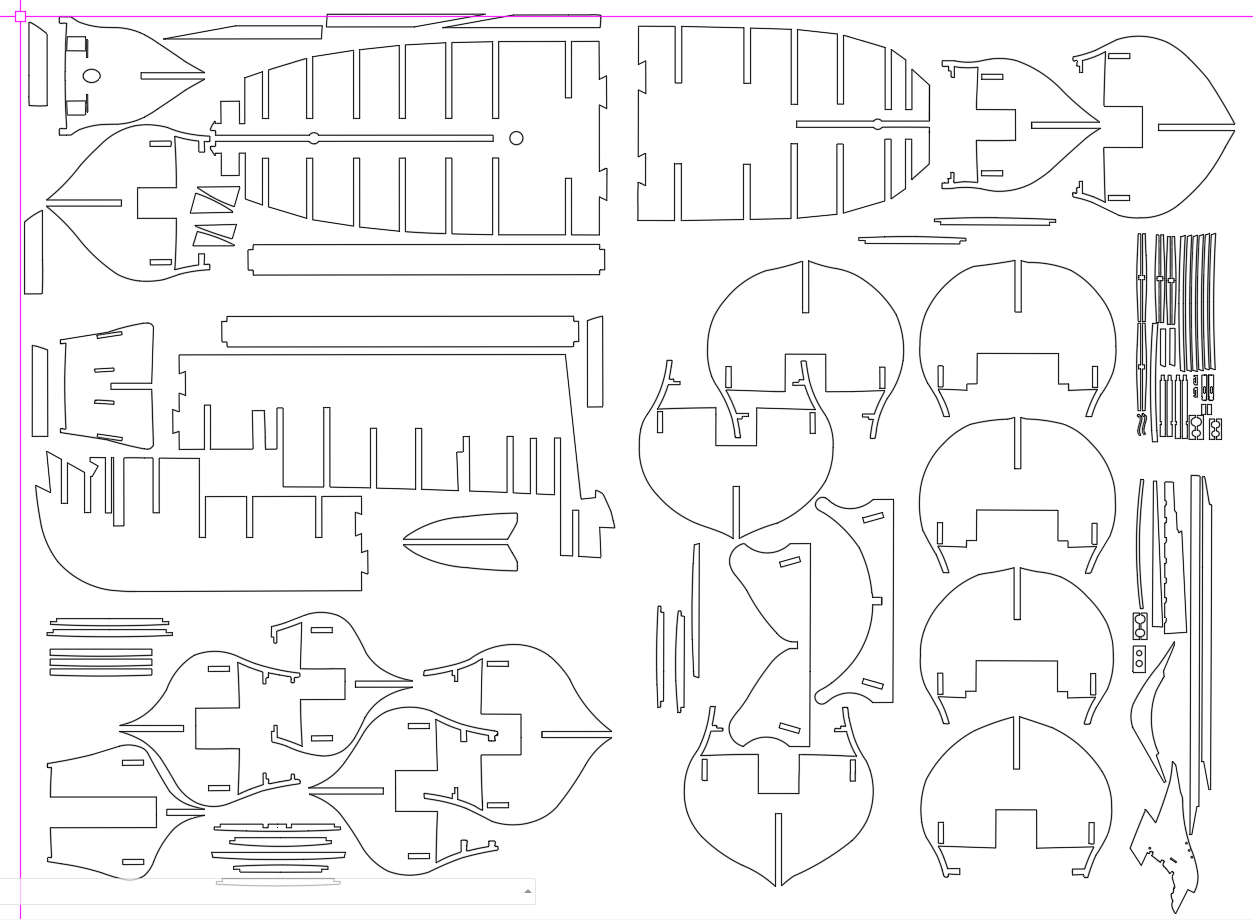
This is 1200mm x 900mm. I have not counted the parts. Approx 100. Since every line will be cut, I have had to remove all identifying names and numbers. It is 2 of the 20 original plan pages, modified and combined. Many parts are similar, varying only in small dimensions. I do hope that I will be able to identify the parts.
Incidentally, the plans are actually for HMS Vanguard. I am intending to make HMS Bellerophon, which was almost identical in all aspects, except for decorations, figurehead etc. Both were Ardent class, ships of the line, 3rd rates. They were heavily armed, strongly built, reasonably fast ships. Complement 550.
I knew that making a model of USS Constitution would be a learning exercise. And that mistakes would be made, new techniques learned, new tools purchased and made. And I did make many mistakes. But the end result was OK. Good enough that one of my daughters said that she would like to have it. And good enough for a prize at the local show.
Maybe the mistakes were not that bad. In any case, I have decided to make another model sailing ship, building on the experience obtained from Constitution.
The next model will be a ship “of the line”. That is, a battleship which was built to take the severe punishment of a fleet action, like Trafalgar 1805, or The Nile 1798. These ships were floating gun platforms, mounting guns up to 36 or even 42 pounders. Not as fast as frigates, but definitely more powerful.
In the British and French navies 1750-1800, the most commonly built ship of the line was the 74 gun ship. Both navies built almost 200 of these class 3 ships of the line. The French first produced them, but when their power and sailing qualities became obvious, the British followed. The British admired the design and build quality of the French ships, and produced their own version, after capturing and copying French versions.
The 74’s were large ships for their era, weighing 3000 tons fully gunned and provisioned. (c.f. Constitution – 2000 tons fully loaded). They mounted 74 guns, on 2 roofed gun decks and the exposed top deck.
For the model I have a dilemma. Do I make a model with hull planking, masts and rigging (like my Constitution in the photo), or an “Admiralty” model, which is hull only, showing the curvaceous hull framing timbers, no or minimal planks, and no masts and rigging.
Example of an Admiralty model under construction. each one of those frames is made of 12-14 individual parts and this photo shows only the forward section. Only 2 of the frames are the same… the rest are all unique. And the decks and beams and internal details are yet to be added. A beautiful, organic shape to be sure.This brigantine is under construction by Australian master modeller Tim Gee.And this is a truly magnificent model of a French 74 made by Russian master modeller D. Shevelev.The detail is extraordinary. 6 years to complete. See Ships of Scale for many photos.
If only I had started this hobby 20 or 30 years ago!
To help me with my dilemma, and for more information I borrowed some plans of a British 74, HMS Vanguard, and also purchased a set of 4 books from Ancre, France…
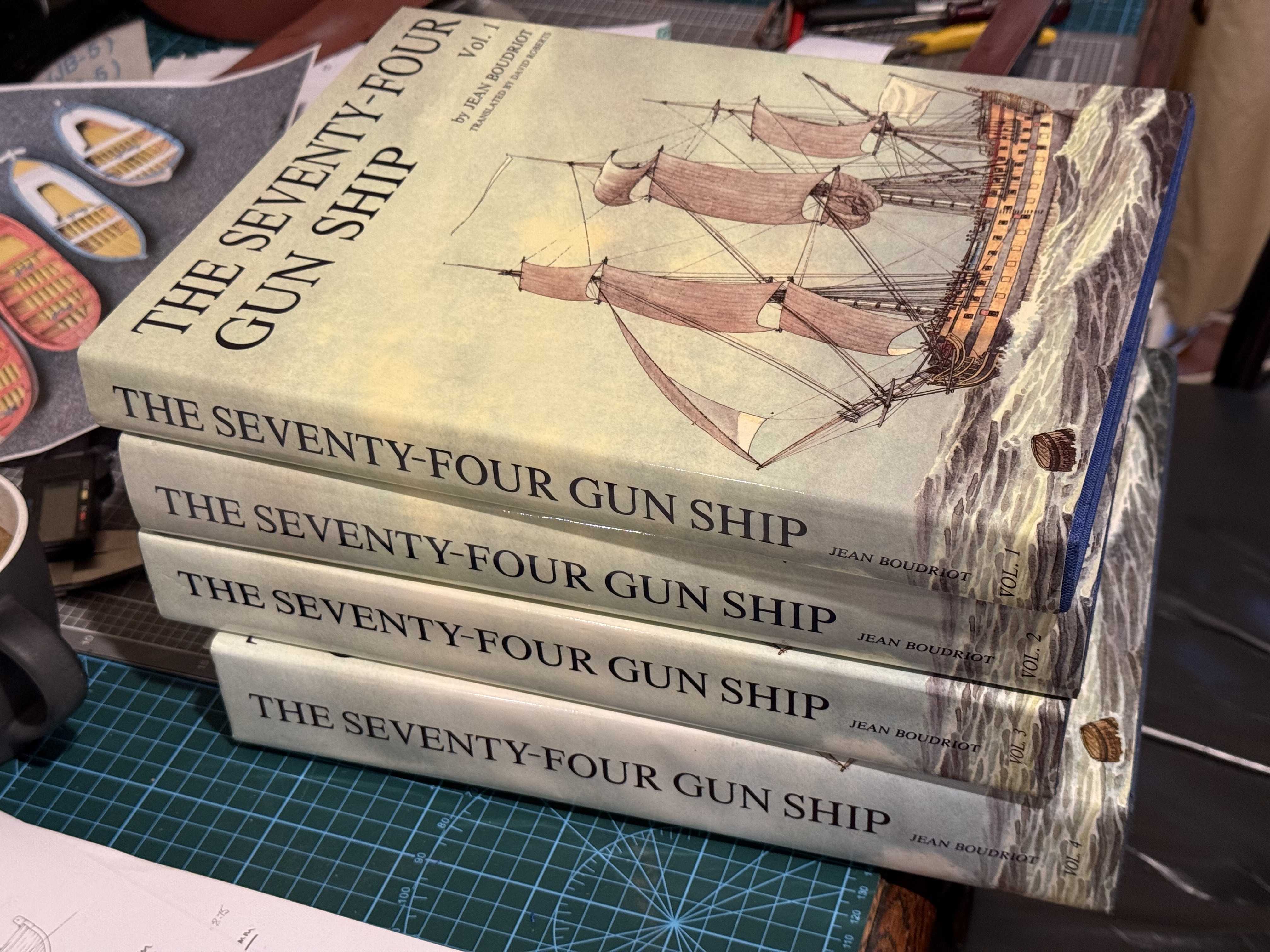
These books by Jean Boudriot (dec) are translated into English. Volume 1 is about the hull. Vol 2 is the hull fittings, Vol 3 is the masts, sails and rigging, and Vol 4 is about the seamanship and sailing of the 74. They were listed as second hand, but in fact were all brand new, but slightly damaged. They had all been dropped at at some time, and the covers corners were crumpled. I spent some time repairing or minimising the damage by dampening the crumpled corners then squeezing them with woodworking cramps until dry. That worked pretty well. Postage from France ($aud200 !!), was covered by the price reduction. Expensive books, but they are lovely to read and beautiful to hold and behold. Very detailed, and will be read and re-read many times. The author, Jean Boudriot, was an architect, and his diagrams and drawings are superb. The text is conversational and entertaining. There are many and detailed plans of the un-named ship, but they are about the full size ship, and not ideal for the modeller. So the publisher (Ancre) also has plans drawn by an expert modeller, at extra cost. I ordered those extra plans separately and paid more extortionate postage to get them. They are very detailed. Should have added them to my initial books order. Would have saved $aud100.
The HMS Vanguard plans also apply to HMS Elephant, and HMS Bellerophon, which had variations mainly in the stern decorations. If I use those plans, it would be a bulkhead, keel, and planking construction, with masts, rigging and possibly sails, but no interior or hull framing detail. A scratch build. And I would use the Bellerophon name and details because of the association with Napoleon Bonaparte. The Boudriot books would doubtless be used to confirm details.
If I do plunge into the Admiralty model….. 1. It might never be finished (I am 75 years old). 2. It might be beyond my abilities.
If I use the Vanguard plans …. 1. It might never be finished 2. It might be beyond my abilities. But at least I would get to use my rope making tools again.
In either case, it would be a challenge, and fun, at times. Maybe I should build 2 models…
Any opinions or feedback from readers?
p.s. Vale Les Madden, fellow modeller, razor sharp intellect, and friend. An inspiration to all who knew him.





 johnsmachines