johnsmachines

machines which I have made, am making, or intend to make, and some other stuff. If you find this site interesting, please leave a comment. I read every comment and respond to most. n.b. There is a list of my first 800 posts in my post of 17 June 2021, titled "800 Posts"

Tag: serving

Frigging the Rigging

Since the previous post I have been tying ratlines to the shrouds. The ratlines were the horizontal ropes which were tied to the shrouds, forming rope ladders.

In the full size Constitution, the ratlines were spaced 13-14″ apart. Each ratline was tied to 7 or 8 shrouds with a clove hitch knot to each shroud. In the 1:93 scale model, I placed the ratlines 5mm apart. Theoretically, in the model, the ratlines should have been spaced 3.8mm apart, but I cheated slightly, placing the ratlines at what would have equated to 18″ in the full size ship. If I had followed the Mamoli plans, the ratlines would have been even further apart.

Even with that cheat, it took me 3 full days to place the ratlines on the lowermost section of the foremast, working at my limits of eyesight, patience and dexterity. And using some of my microsurgical instruments, which I had retained after retirement for just such a use.

It was not an easy task.

I could not do this after sundown. I did try, but the results were so horrible that I restricted this job to daylight hours. And I used magnification, a headlight, and superglue to secure each knot.

It is more than 10 years since I performed my final surgical operation. And it was quite a shock to realise that I had forgotten how to tie surgical knots. It did not take long to reaquire the skill, performing hand ties, instrument ties, left handed, right handed, two handed and single handed ties. Keeping tensions applied during the tying. Routine stuff for an active surgeon. And it felt good to be doing them again, even though the patient was a non complaining model ship.

When I was a surgeon I was proud of my surgical skills, particularly my suturing. I taught many medical students and junior doctors how to suture and how to tie knots. It was not a part of the medical curriculum to learn suturing. Med students are just expected to make the effort to learn how to suture and tie knots from books. With the result that many doctors never learned these skills properly. And even some experienced surgeons never understood the difference between a “granny knot” and a properly performed surgical knot. They got by using multiple throws, rather than properly performed knots with just 3 throws.

Anyway, I reminisce and digress.

Each row of the ratlines involved 7 or 8 knots, and took about 10 minutes. There were 25 ratlines per side, say about 200 knots per side for just the lowermost section of the foremast, per side. Plus the futtock shrouds and their ratlines… another 25 knots per side. Say around 450 knots altogether, for the lowermost section of the foremast. And each knot has to be formed without distorting the shroud, remaining horizontal with the waterline, (not with the keel. Most sailing ships of the period were “stern draggers” where the keel was deeper at the stern than the bow).

And I secured each knot with a drop of CA glue. Just to be sure to be sure.

I was not totally happy with the end result. It was just OK. But it will have to do.

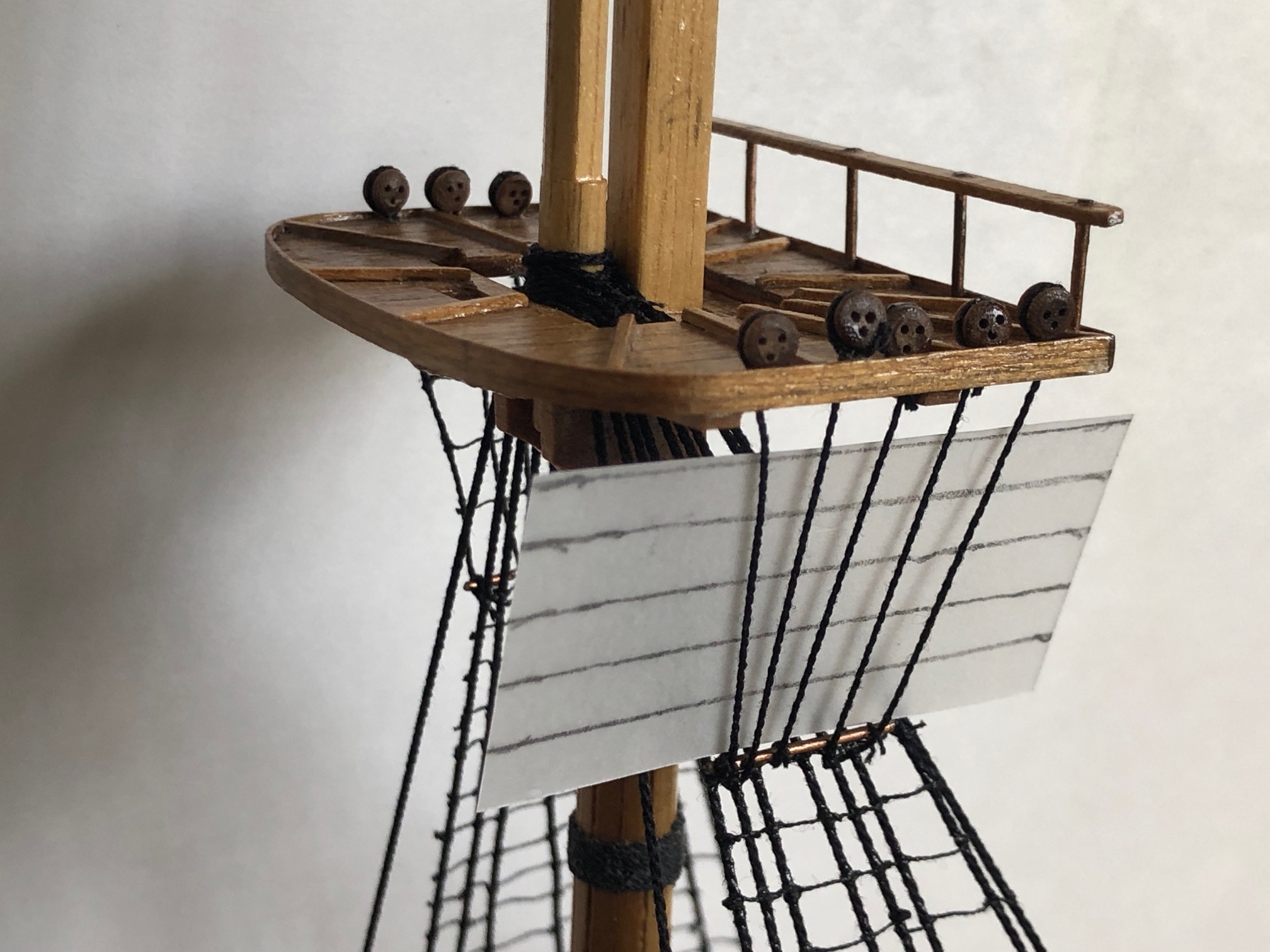
The first 13 rows of ratlines for one side of the foremast, lowermost section. The tracing paper with ruled lines 5mm apart helps to keep the ratlines parallel, and level, reasonably.
The small shrouds between the fighting top and the foremast shrouds are called futtock shrouds. They hold the deadeyes above the fighting top. And they have their own ratlines. The loop above the fighting top is about to snare another deadeye,
Another ruled piece of tracing paper indicates the position of the futtock shroud ratlines. Far side completed. About to commence the near side. The shrouds are 0.8mm diameter, the futtock shrouds are 0.4mm diameter, and the ratlines are 0.2mm diameter. I just assumed that you would want to know. Later ratlines were positioned using graph paper glued to cardboard, instead of my fairly inaccurate ruled lines.

p.s. about 3 weeks later. I did not post this for some reason. But here it is, a bit late.

Actually, the truth is that the photos reveal a major mistake in the rigging which I probably should not reveal. Experienced ship modelers will see it no doubt. But the recipient of this model will almost certainly not, and is not a reader of johnsmachines.com.

Anyway, the rigging has made further progress since then….
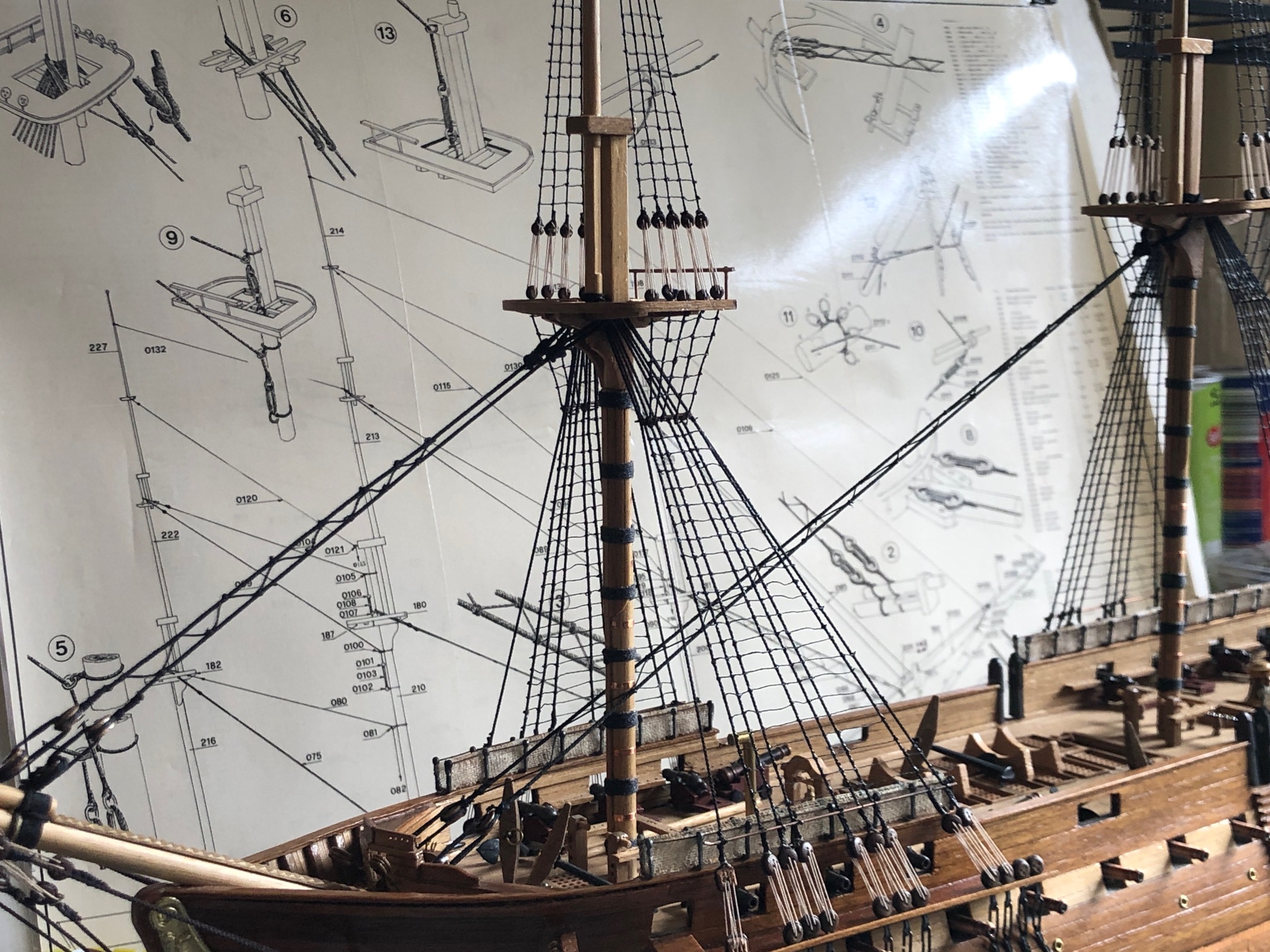
The shrouds and ratlines are finished on the 3 masts. About 2000 knots. All ropes made at home. No more major mistakes but quite a few small ones. Notice the snaking in the fore stays? After I attached the snaking on the foremast forestay I discovered that it is too heavy. The snaking on the mainmast forestay is correct. That is fixable without too much bother, just a couple of hours extra.
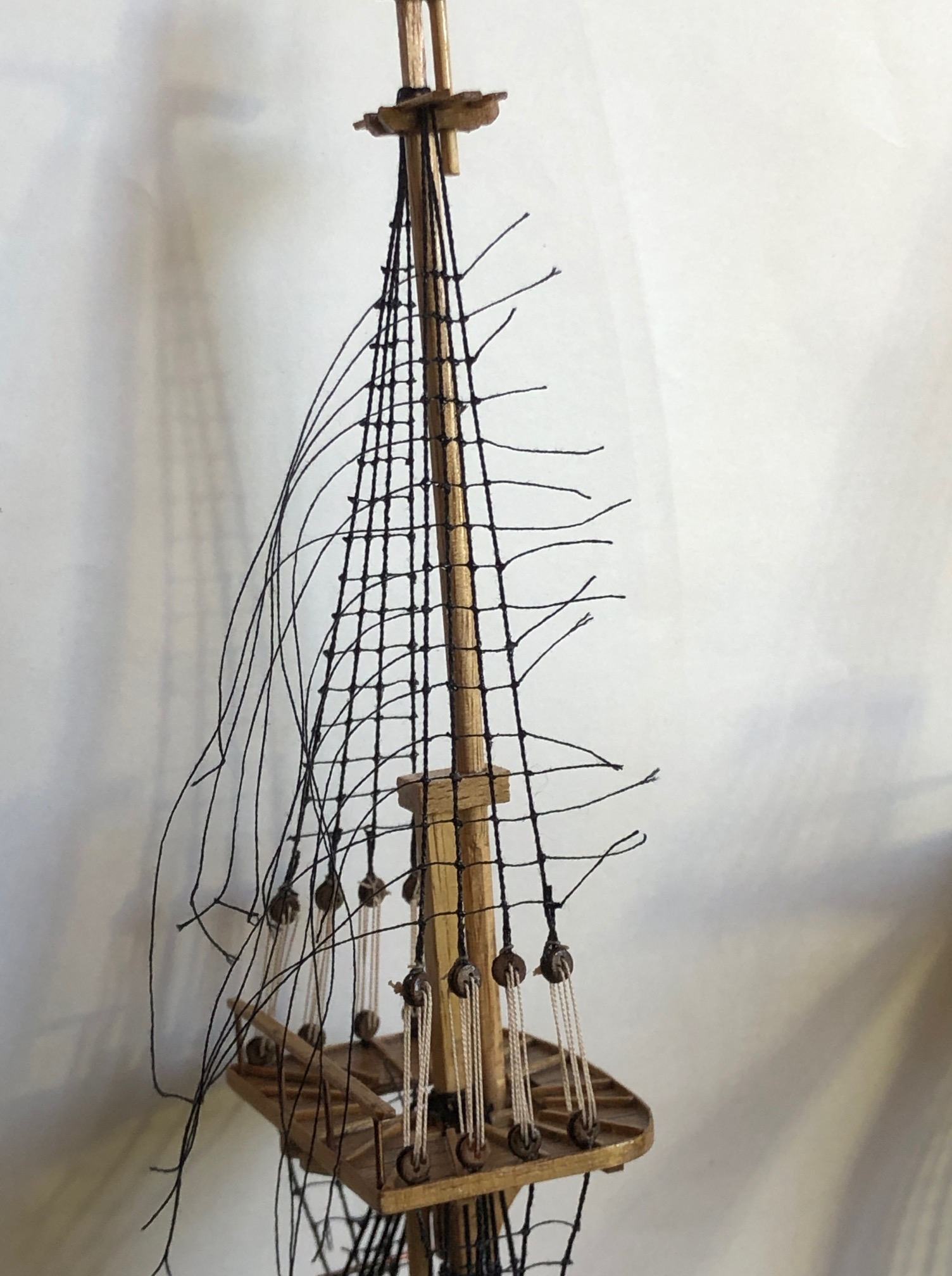
Mizzen mast ratlines. Progress shot. I learned that it is best to let the CA glue set totally before trimming the ends.
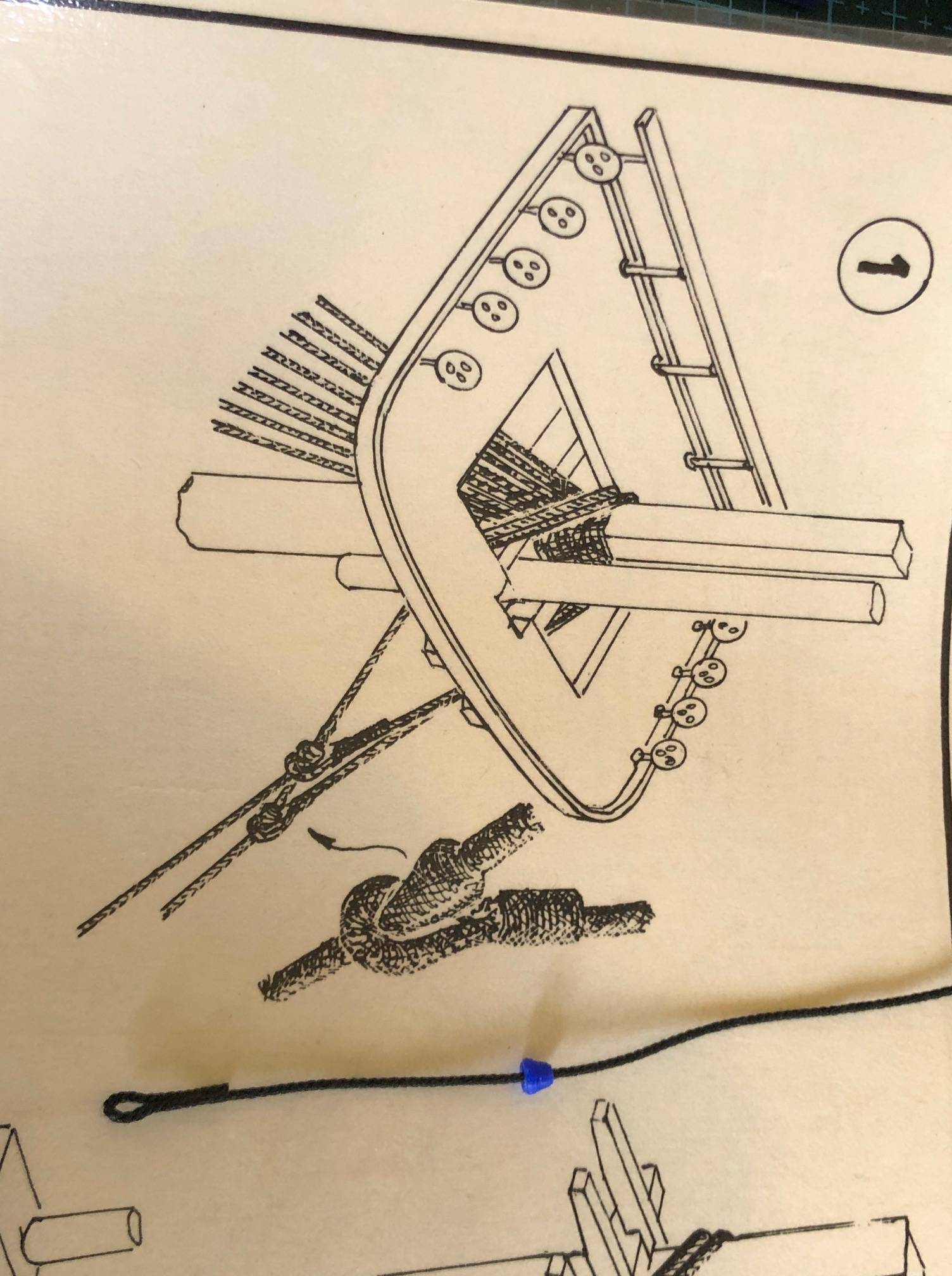
The forestays are the biggest cables in the rigging. This one is for the foremast. It is 1.1mm diameter. The “mouse” was originally a complicated rope structure, but I chose to 3D print it and glue it to the forestay, and paint it black. No one will ever know. Except you and me.
The part of the forestays which wrap around the mast were served, so I used my homemade seizing-serving machine to serve about 100mm of each forestay. The photo shows the bare cable (top) and the served cable (bottom). The cable is 1.1mm diameter. The original was almost 100mm diameter! You can tell that it is a cable by the left hand twist.
Then the loop which is restrained by the mouse, is SEIZED. It is a VERY strong. I could not budge it using all of my strength. Seizing was also made on my machine.

Just to remind you what my seizing-serving machine looks like…..

CNC controlled machine, designed and made by yours truly.

And the frigging of the rigging continues….
CNC Mini Mill -7

A few subjects to update, including the mini mill build, the USS Constitution, the 110pr Armstrong gun model, and plans for another ship modelling machine.

The CNC Mini Mill. The mill itself is finished. I had to replace all of the linear bearings and 8mm hardened steel rods because the play was excessive. I knew that the first shipment of 8mm rods from AliExpress were undersized (7.97mm) and all had a detectable bend. AliE offered to refund if I returned them, but I decided to just try a different AliE supplier. The next lot of 6 x400 x8mm were again a bit undersized at 7.98mm, and were not bent, but still the play was excessive. Slow learner, I tried again with another order and called it quits when they came in at 7.99mm (new Mitutoyo micrometer). But there was still excessive play, so I wondered about the linear bearings. Stuart T came to the rescue with some leftovers from his build of the mini mill, and they solved the problem. No detectable play at all. So it was both the steel rods AND the bearings at fault. Anyway, all fixed. And now I have 20 dodgy spare linear bearings, and 12 dodgy steel rods. Stuart said to bin the lot. But I can’t quite do that, so into the workshop supplies for the time being.

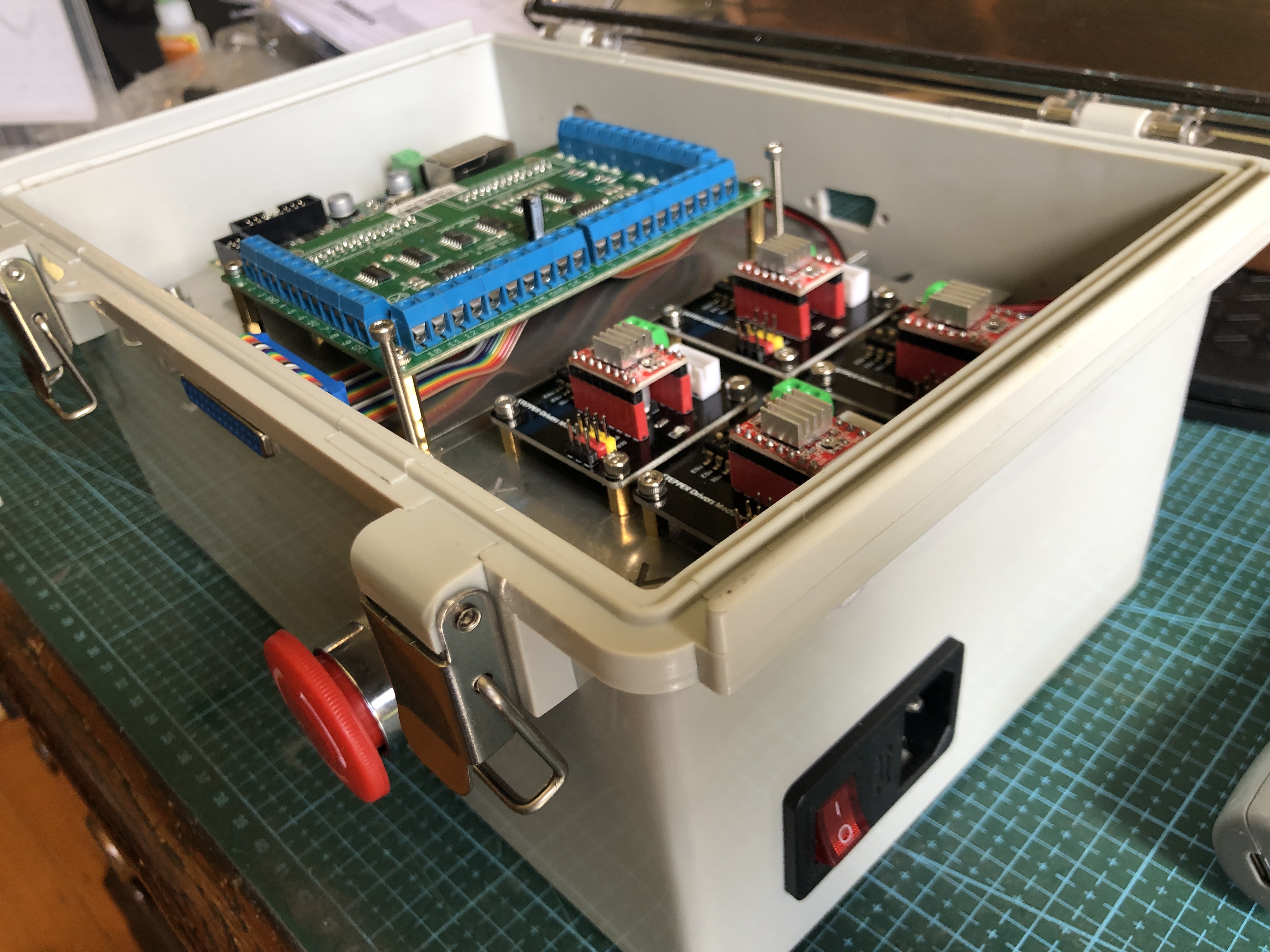
Also, I have now copied Stuart’s design for the electronic controls, and set them up in a nice plastic box with a transparent lid. SO many exciting coloured lights that I want to be able to see them at a glance.

There is a power transformer under the alu shelf, and on top are 4 stepper motor modules (foreground), the CNC controller and breakout board, rear. Also a computer fan, power switch and fuse, E stop panic button, 25db connector for the pendant control, and Ethernet port to connect to the computer.

The only things missing are the bits to transport the electrons around the place. Will happen soon! Then have to decide just what this machine is going to be used for. Yeah yeah. Another tool looking for something to do.

Constitution has had a rest while I have working on the mini mill. But in the past week I have been busy making masts and fighting tops, and trying to decide on the order of glueing bits together. Bowsprit and 3 more vertical masts almost finished. But no stays yet in place. The instructions say to totally finish the hull and fittings before commencing the rigging. Oh, have I mentioned that I made a ropewalk for making the models fixed and running rigging, as well as the cables? I forget. Well, the fixed rigging gets installed first, and some of those big ropes are totally served (are totally covered with thin rope to increase their resistance to water ingress, and rotting, and increase longevity. Did you know that a ship of Constitution’s size had approx 50km of rope, and the average life of a rope of the era was only 5 years!

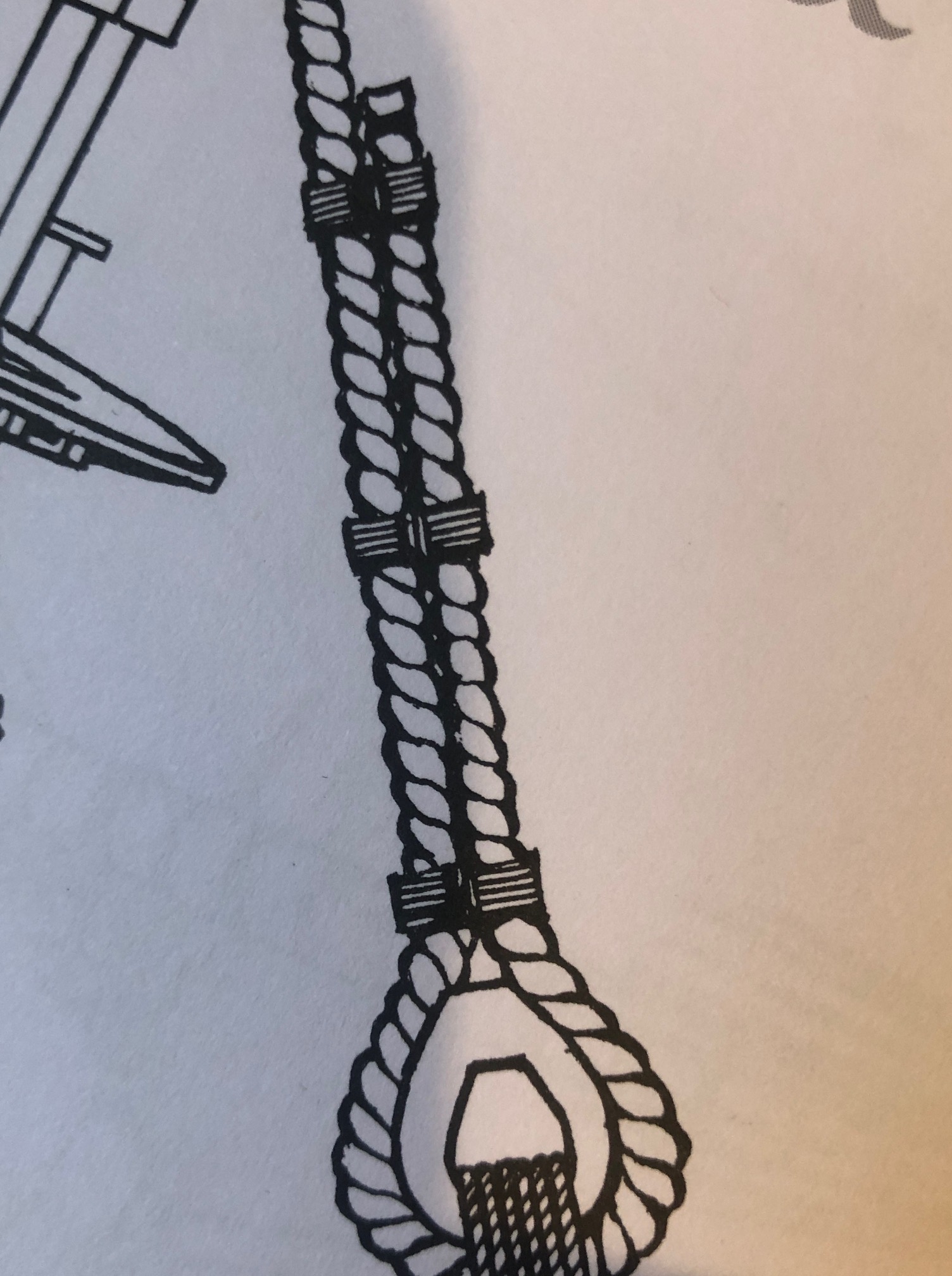
As well as serving the ship’s ropes, there is a process called seizing. Best to look at a picture…

Securing a rope end by doubling it back on itself, and binding the 2 parts together with smaller rope is called seizing.

I tried my hand at seizing, but was totally dissatisfied with the result.

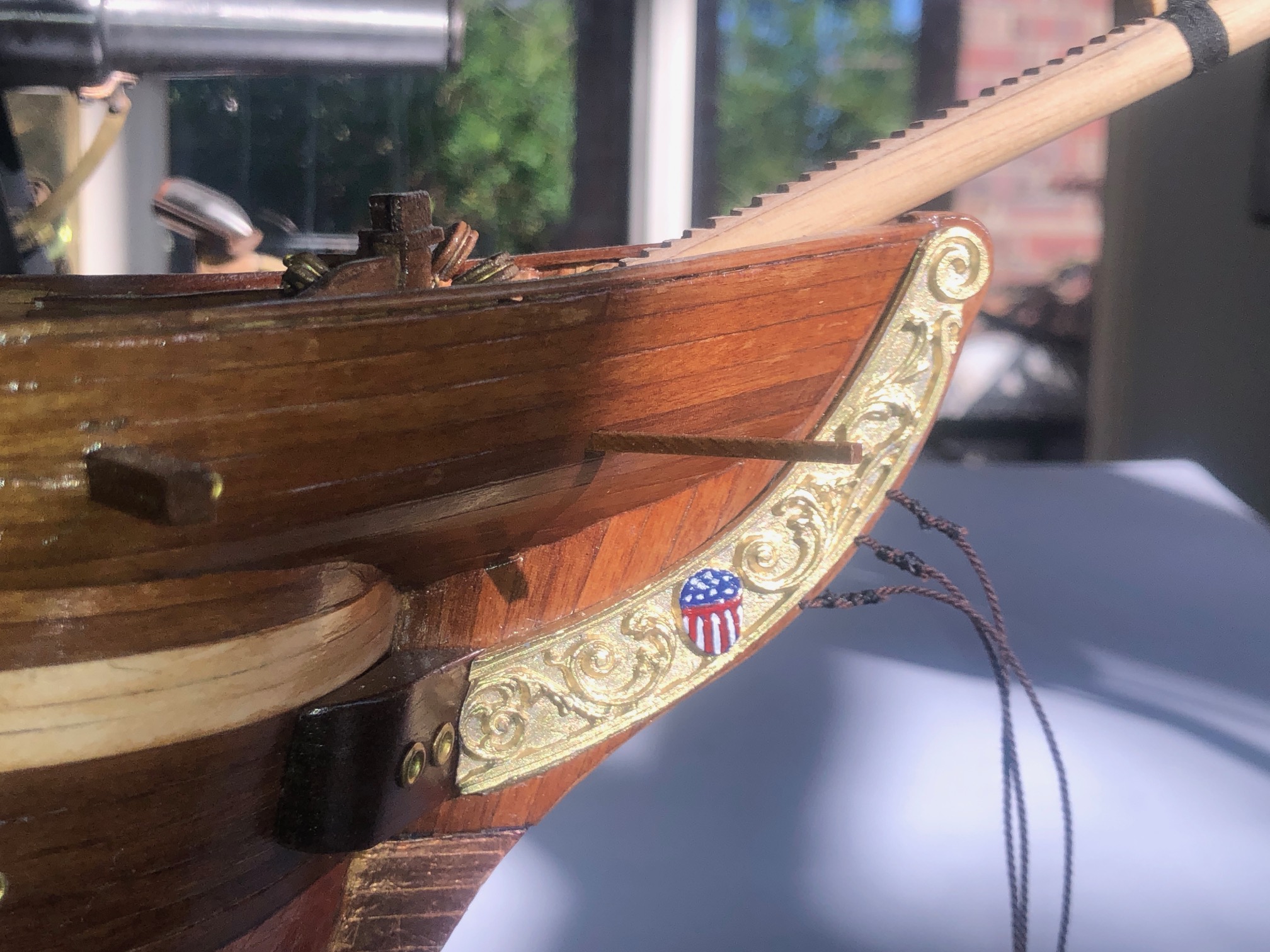
Seizing on the 3 bowsprit stays. Pretty lumpy and crappy. Got to be a better method. Also my effort at micro painting. That stars and stripes is about 10x7mm. A bit sad considering that these hands used to do microsurgery.

So, a machine to do seizing and serving (and worming or snaking and parcelling, but more about those later), is in my plans. Another machine is being planned. CNC again. And the control box listed above will control the seizing/ serving machine. More about that in a future post.

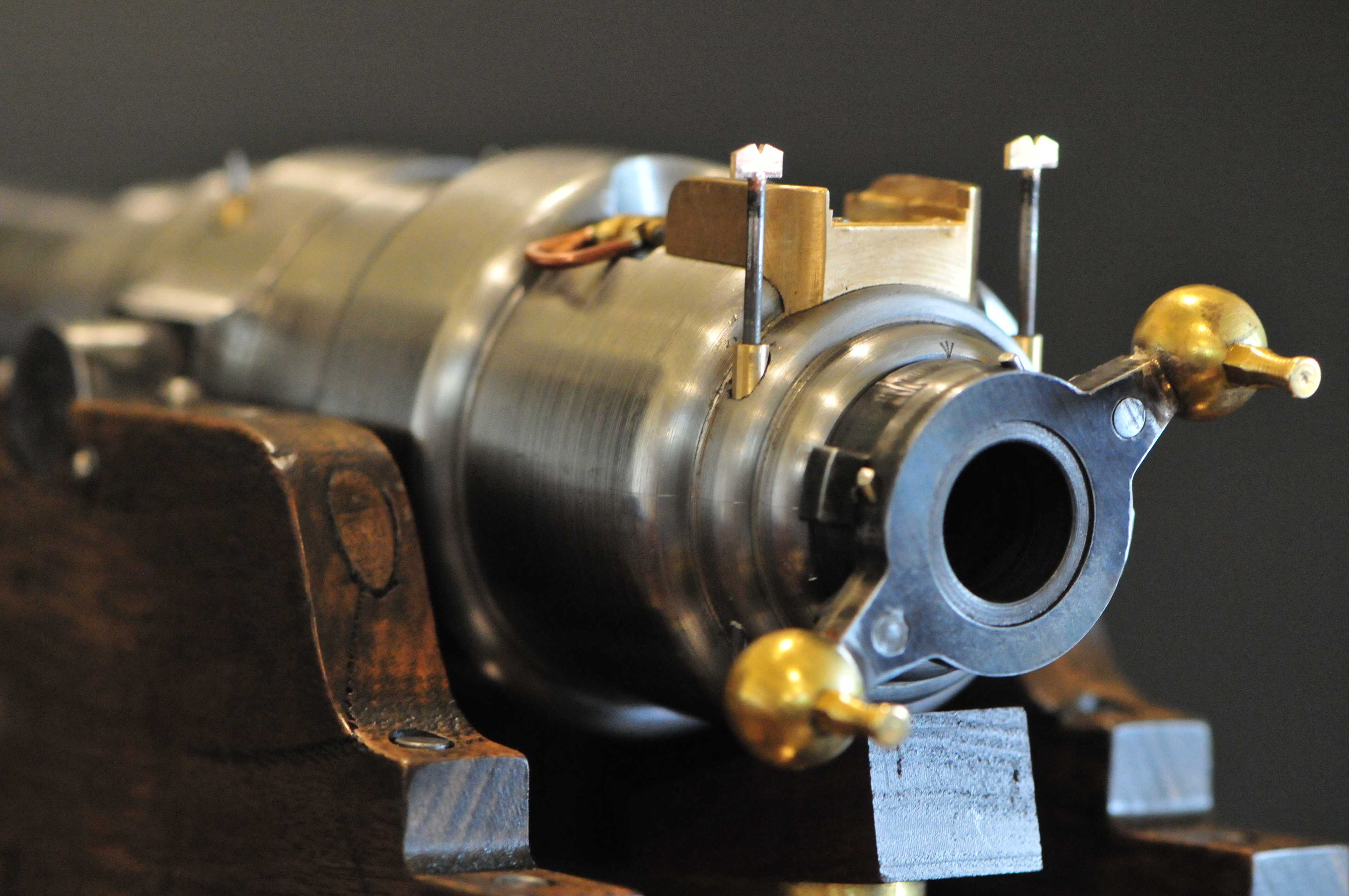
Finally, and incredibly exciting, is that my post about modelling the sights on my 110pr Armstrong cannon in 2022 https://johnsmachines.com/2022/10/25/model-armstrong-110pr-sights/ has prompted a response from a UK reader who has recently purchased a tangent sight from an online auction, and he has identified it as coming from an 1867 Armstrong 110pr cannon. In researching the sight Daryl came across my modelling posts, and he has contacted me, forwarding some photographs. Just to remind you, this is what I modelled, from line drawings published in the 19th century…

Yes, the left hand tangent sight does cant slightly more than the right. As intended.

And here are some photographs taken by and reproduced here with permission by Daryl Pendlebury-Jones of his purchase…..

The rear tangent sight, approx 500mm long. Gunmetal. Daryl notes that the notched top (top left) slides nicely and freely. And the markings are still clear.
Lateral view, notched top at bottom right.

I might have to remake the sights on my model now that I have seen these pics.

Seizing/Serving Machine for Model Rope

First some terminology…

“Whipping” is winding a string or thin rope around a rope end to stop it from fraying. Not a nautical term as far as I know, except as a disciplinary measure, hopefully now not often used.

“Seizing” is securing a rope end which has been doubled back on itself often around a block, using string or thin rope.

“Serving” is covering a rope or shroud with string or thin rope to prevent chafing or rubbing wear, or preventing water entry into the rope. Sometimes over the entire length of the rope.

The model ropes attached to the prow have been seized to secure them, not particularly neatly.
From Lennarth Petersson’s excellent book “Rigging Period Ship Models”. Showing seizing.
Also from Petersson’s book, showing several methods of waterproofing a stay by “serving”, “parcelling”, and “worming”. The average life of hemp ropes was only about 5 years, so waterproofing was cost effective. Standing rigging was also usually painted with tar for the same reason. Waterproofing was particularly necessary on the anchor cables, which were made by twisting multiple ropes to make a cable on Constitution over 7″ diameter.

I am planning to make a machine to do the serving and seizing more neatly. The ropes to be seized or served on my 1:93 scale Constitution are mostly under 1mm diameter, so the thread used for seizing will be only 0.23mm diameter, or even thinner.

There are several machines available commercially, but, 1. I like to make my own machines and 2. I think that I can make a better machine.

I am considering 2 possibilities. Both involve holding lengths of rope (model rope), up to 400-500mm long, using ER collets. The rope is rotated at both ends, using a small electric motor. The serving thread (0.23mm dia) is moved along the rope, delivering one turn of serving per 0.25mm movement, of the main rope. It is a bit like making a thread in metal, which uses either gearing or CNC control. And that is the question which I am pondering. To use gears or CNC. Gears would be simpler, and fairly cheap. CNC would require input from my expert friend Stuart T, but would also be relatively inexpensive if I connect to the CNC output from my CNC lathe. CNC would also give me much finer control of the pitch of the serving/seizing. The gears method would be easier for other modelers/friends to use. I might end up by trying both methods.

So, watch this space.