machines which I have made, am making, or intend to make, and some other stuff. If you find this site interesting, please leave a comment. I read every comment and respond to most. n.b. There is a list of my first 800 posts in my post of 17 June 2021, titled "800 Posts"
Armstrong RBL 110pr at Bandiana
by John
This is the model which I made of the 1861 Armstrong rifled breech loading cannon. It was made from drawings obtained from several 19th century books, internet photos, and a detailed Fusion 360 drawing purchased from ETSY. It is mounted on a “garrison” (land based) carriage and slide.
As you can see, it is very detailed, down to the square nuts and bolts, Smith’s elevating screw, and Queen Victoria’s cypher. But there was one detail which I had not been able to find anywhere. And that was whether or not there was any information stamped or engraved onto the muzzle of the barrel, like on the 80 pr RML which I modelled several years ago.
The model 80pr muzzle loader.Not a good photo, unfortunately. Very magnified. The text reads “Marshall’s Iron” and refers to the innermost cylinder which was made of a higher grade of iron than the outer layers, and could even be removed and replaced if worn out. This tiny detail was lasered onto the model 80pr bore by Stuart T, and if I could confirm that there was a similar inscription on the 110pr, would have asked him to do likewise again.
I had never actually seen an original of a 110pr RBL, so was quite excited when I read that one existed 400km away, at Wodonga, Victoria. So off we drove (SWMBO and I), after contacting the Australian Army Museum at Bandiana, Wodonga and obtaining permission to take some photographs.
The museum itself will be the subject of a separate post. Suffice it to say here that it was excellent!
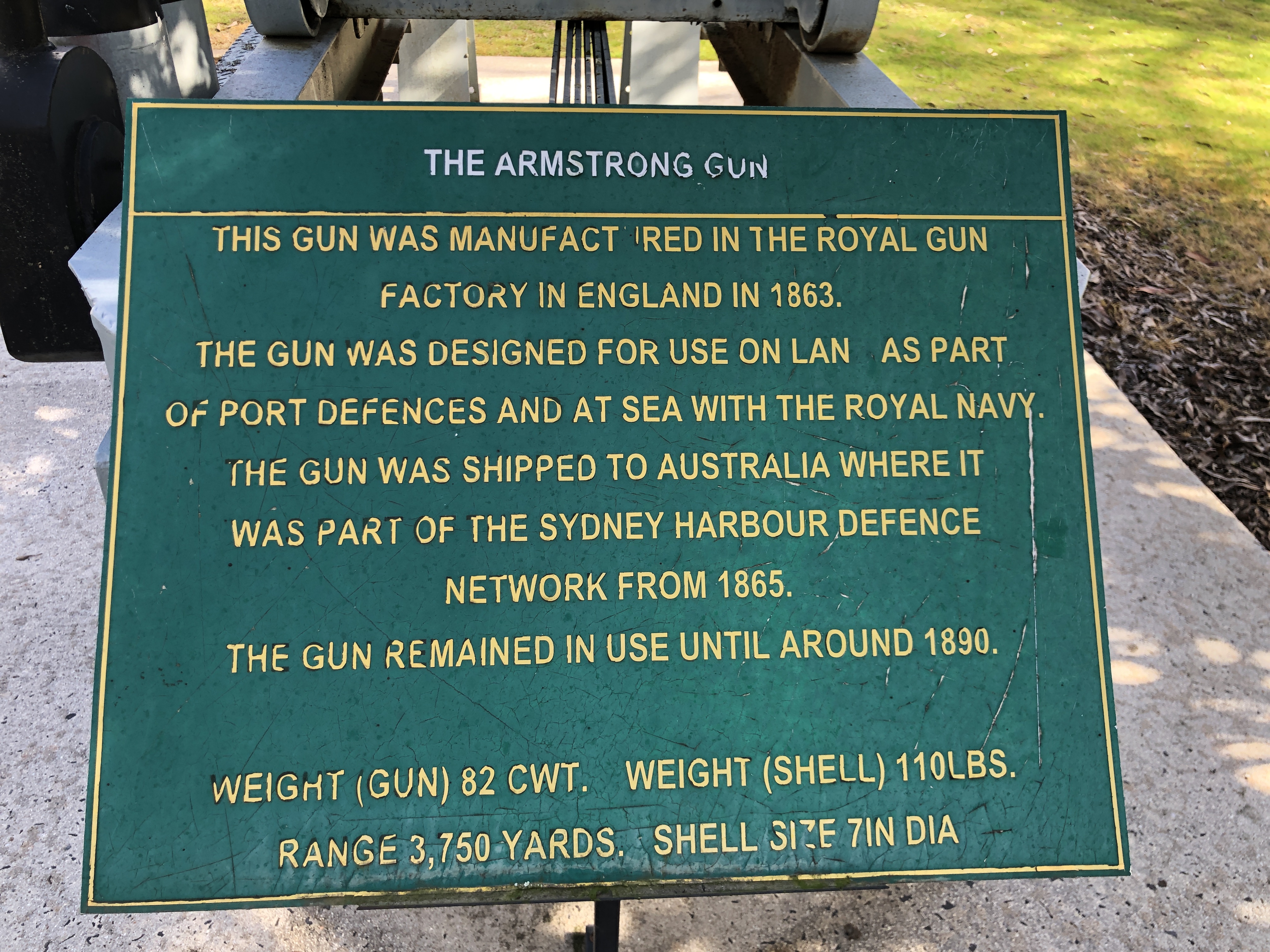
The 1863 Rifled Breech Loader, black powder naval cannon was a different story.
Me, feeling a bit disappointed, but not too surprised. The carriage has the shape of a naval mounting, and there is a cap on the trunnion which would not have been fitted to a garrison (land based) gun. The carriage has signs of torch cutting and arc welding. The traversing platform could be an original naval version. All bronze fittings and many iron ones are missing.Breech block in situ. I am pretty sure that this is a modern reproduction. The handles are not hinged, and arc welding was not used in 1863. And there is no flash pan/vent. There is a statement that all weapons in the museum have been rendered incapable of being fired.This breech block is welded to the slide, probably to prevent a careless tourist from dropping 136lbs onto his foot. Pretty sure that the projectiles are reproductions too.I did not bother with a photo of the muzzle. The gun has so much thick paint that all markings are hidden, even the big ones on the trunnions. Oh well. The museum itself was great. And the 800km drive was lovely.
Hello John, Unfortunately the treatment of the RBL is typical; “a bit of old iron”… seems to be the attitude; “mount it on a concrete block, they’ll never know the difference”. I guess we can’t expect historic sensitivity from the average bureaucrat so tragedies will continue, like Cerberus, Australia’s first iron clad turret warship rusting in the tidal zone.
Robert




 johnsmachines
Hello John, Unfortunately the treatment of the RBL is typical; “a bit of old iron”… seems to be the attitude; “mount it on a concrete block, they’ll never know the difference”. I guess we can’t expect historic sensitivity from the average bureaucrat so tragedies will continue, like Cerberus, Australia’s first iron clad turret warship rusting in the tidal zone.
Robert
LikeLike
That is beautiful work John.
LikeLike
Thankyou John!
LikeLike
The tank museum in Cairns has a German 88mm flak gun , but I couldnt find any pictures.
Sent from my iPhone
LikeLike
Ahh. I asked Bandiana if they had one. Trip to cairns coming up.
LikeLike