machines which I have made, am making, or intend to make, and some other stuff. If you find this site interesting, please leave a comment. I read every comment and respond to most. n.b. There is a list of my first 800 posts in my post of 17 June 2021, titled "800 Posts"
Constitution – 6 Planking
by John
So, having worked out how to bend the planks, using the plastic pipe welding machine, I have been busy applying the top 7-8 rows.
Here are some progress photos..
The gunports were glued into place as per the instructions. Then I started with the first layer of planks at deck level, on both sides, to avoid any distortion of the hull. Although, having pre-bent the sharp curve at the bow, there was very little side pressure from the planks on the hull. Just a little because I had noticed that the curve was nicer if the planks were not totally pre-formed. First the ends of the plank were glued into place with cyano-acrylate, held in place for a minute or so with finger pressure, then the other parts were glued with white glue. And all the joins were “clamped” with multiple rubber bands. That is when I discovered that the gunports were a bit wonky. Some were so out of position, despite being placed according to the instructions, that I had to remove them, enlarge the positioning slots, and reglue them. The CA glue was too hard to cut the joins, but after a soaking with acetone, and a fair amount of force, then some more acetone, they did eventually let go. Still not perfectly positioned, but just acceptable. For some reason which might become clearer later, there are two shapes of gunports. Mostly they have a sloped outer face to fit with the inward slope of the hull at the top (the “tumblehome”), but the 2 ports at each end have square faces. One of those was missing, but I managed to fabricate one from some square tube of approximately the correct size, and glued it into place. … And this is the current state of the planking. I realised that I had used some walnut in places, rather than the intended white wood. Fortunately, the hull will be painted so it should not matter. The wood has all faded with age and it was hard to distinguish the 2 woods from each other, and when I was aware what I had done, I moistened the unused planks, which made identifying them easier. But I was concerned that I might run short of the walnut later, so I looked up local suppliers to order some more. The white posts are extensions of the bulkheads. They are all sawn off at deck level later, so the planks which form the bulwarks are not glued to them. Just edge glued, with the glue applied with a tooth pick.
I found only one supplier in Australia who had stock of walnut in the size needed. 5mm x 1.5mm x 600mm. Maybe there are other suppliers, but I ended up at “Float a Boat” in Ringwood, Melbourne. Their stocks were low, and I had other reasons to visit Melbourne, so I drove to Ringwood to pick up the strips. Another customer was talking to the proprietor, Adrian, so I had an interesting look around while waiting.
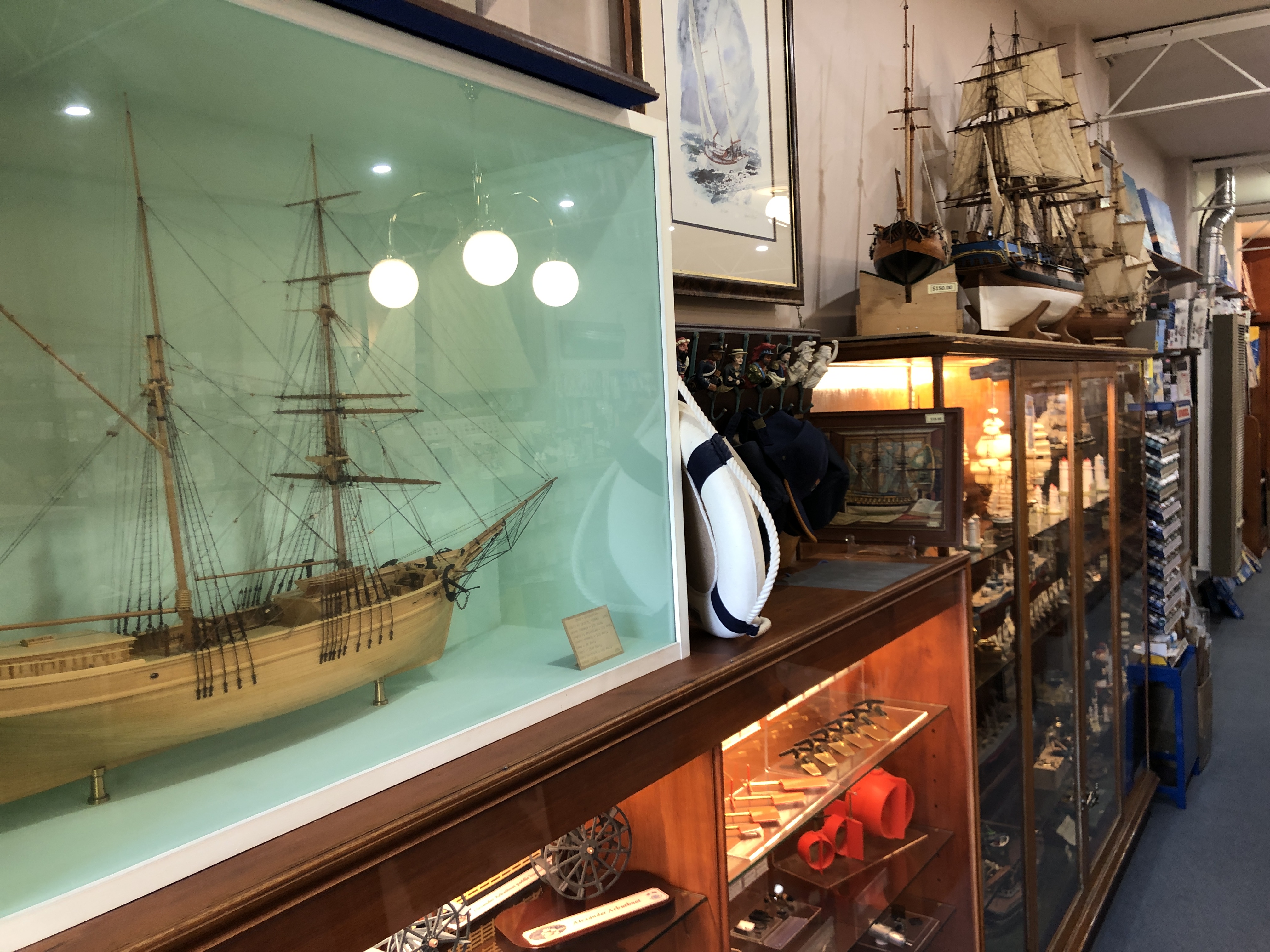
Float a Boat is a small, set back shop, crammed with model boat kits, parts, materials, books, magazines, so I happily spent time looking around. Adrian gave me permission to take some photos, and here he is packing my strips of walnut. He used to be an expert modeler, making exhibits on commission for museums and collectors. The gaff rigged yacht in the foreground is one of his. Some of the ships on display are for display only, but others are for sale at prices which were incredibly low, IMO. So, if you want a model ship or yacht, or a kit, or a propellor, or a scale cannon, or an RC system, I suggest that you check the “Float a Boat” website or email them at info@floataboat.com.au. They also have a good selection of modelers tools, and I took the opportunity to stock up.
(Upside down photo which will not rotate, of my purchases). Float a Boat’s stocks of small dimension wood is running low, despite orders to the suppliers. I have a fairly well tooled wood workshop from my days of making furniture, guitars, a staircase, etc. but not the equipment for machining tiny dimensioned long strips. Apparently, the stocks come from the United Kingdom!
So far the planking has been relatively straight forward, using regular straight sided strips. As I progress down towards the keel, many of the planks will need to be tapered. That will be challenging.




Hi John, what a fantastic shop! I will be checking out their online store.
The hull of the USS… is looking good, I loved your modification to the, bulldog clip’ simple but very effective.
LikeLiked by 1 person