
Another Machine for Ship Modeling- A DRUM SANDER
by John
Actually, it will probably be useful for any wood working, such as furniture making. But the impetus for making the drum sander is that I have decided to make another model sailing ship. And at the age of 75 I am aware that my modeling days might be uncertain. And my aim is to do a scratch ship build as far as possible, including machining and cutting out all of the planks etc.
So, I could have purchased a commercially available drum sander, but the cheapest one available was $aud1000 second hand, and it would not make planks at the sub millimeter thickness which my ship model would require.
Various ship modelers have made their own drum sanders, and looking at all of the photos I could find on “Ships of Scale”, and Google Images, I settled on this one…

You will see that mine ends up very similar to this one. I used plate aluminium and a sloped feed plate in the same way.
But I decided to use a more powerful motor with a dedicated controller, from ebay au……

It is a 750 watt AC servo motor (1 hp), which is about 4 times as powerful as required for model ship planks, but will be useful if I use it for other woodworking projects later. It has a soft start, reversible, and speed control up to about 4000rpm. Plus all connections, Au plug, and rpm display. A very nice unit, and cost quite reasonable at $aud160.
The construction details were pretty basic, so I did not photograph them. This is the almost finished result…..

You can see that I have virtually copied the other design. The dust extraction on top is an old vacuum cleaner nozzle. The bearings are from my workshop stock, as is all of the aluminium plate. The unit will handle stock up to 50mm thick, 180mm wide, and I have thicknessed planks down to 0.5mm.
The feed is manual push and pull against the drum rotation, at about 1500rpm.
There is almost no vibration, and the unit does not require clamping or fixation of the base to the bench. I did not include powered feed rollers as originally planned, and now I consider that they are not required.
The dust extraction was added after an initial trial without it. Clouds of fine dust convinced me that it is indeed required. And it is very effective.
The drum is 110mm diameter, and is aluminium tube about 5-6 mm thick. Actually, it is hydraulic cylinder material which I acquired somewhere sometime, and it required NO machining of the interior or exterior surfaces. I did have to make internal ends for the cylinder to fit the 25mm shaft. I 3D printed those.
It took 3-4 workshop sessions to make, and evening time to design the machine on AutoCAD.
Yesterday a ship modeling friend gave me a lump of old Huon Pine, after I mentioned that I was considering using HP for the planking.
Here is a photo of a 44mm wide strip of Huon Pine being sander thicknessed down to 1.6mm. The machine gave a perfect surface, and the thickness dimensions at various points on the piece did not vary by more than 0.02mm!

The sandpaper strip is 50mm wide and about 1.8m long. It is secured by countersunk screws at the ends, plus a dab of superglue at the tips. I only had 240 grit, which is lovely for finishing but a bit too fine for thicknessing, so I have ordered some 80 and 120 grit.
My brother has used a drum sander many times, and he told me that they are fine, except that changing the sandpaper is a pain. So I made the end and top panels easily removable with thumb screws for plenty of access to the drum, and my one sandpaper change so far was easy and quick.
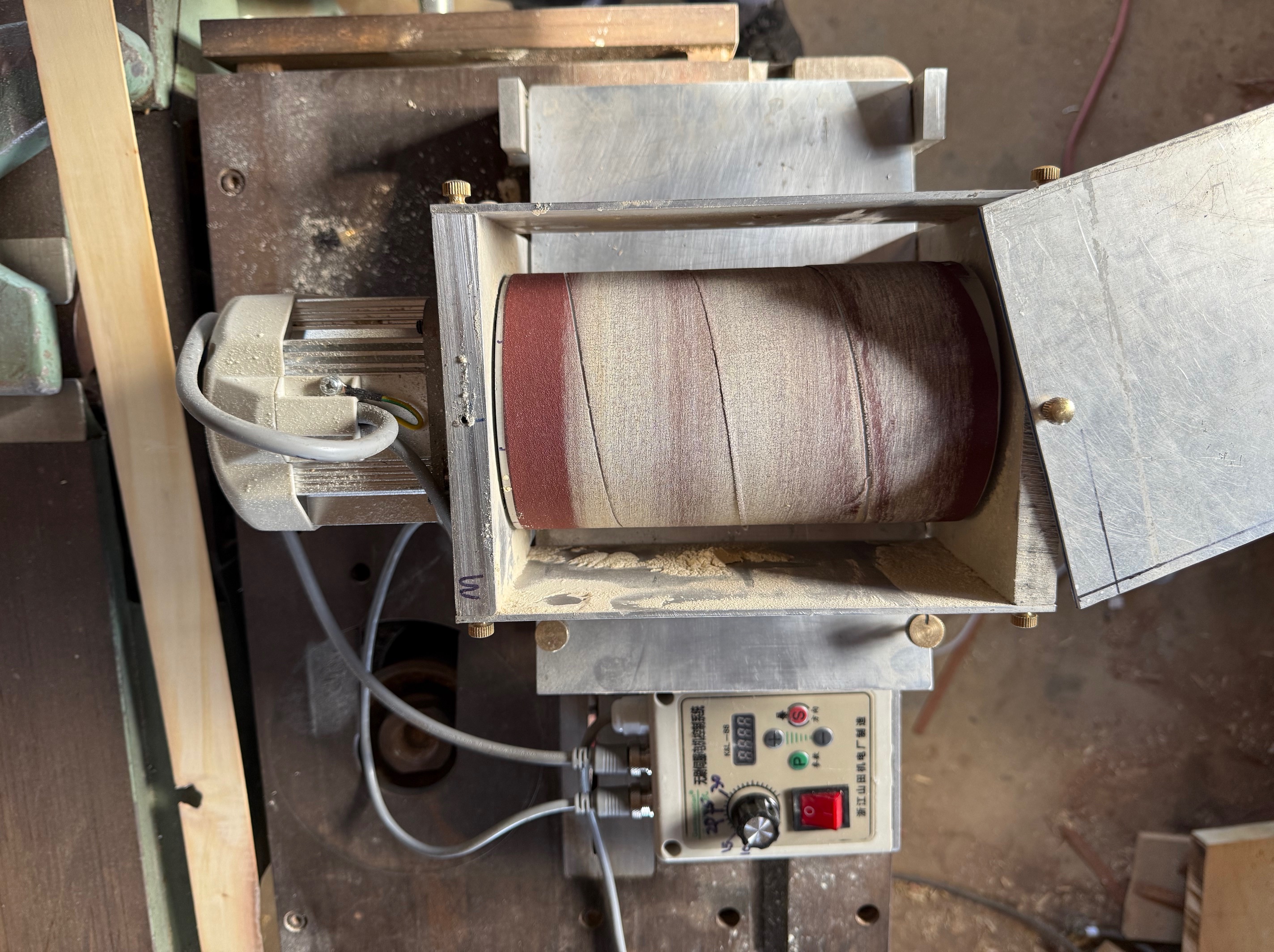
It is a very nice feeling to have a prototype machine work so well so quickly!
I do intend to replace the alu top with a piece of acrylic perspex so I can make sure that I insert the wood strip AGAINST the rotation, and not with the rotation. If it is inserted with the rotation it is grabbed violently and shot out like a spear. Quite impressive! Guess how I know.
Another refinement will be to the height adjusting mechanism. The 4mm all thread thumb screws work OK but are a bit daggy. So I will make a moving wedge like the one pictured below, again copied from “Ships of Scale”. SOS is a great site incidentally…. I refer to it every day.

Not exactly like this, but similar. The downside is that it limits the maximum thickness that can be sanded, but the advantage is that thicknesses could be repeated with a scale on the wheel. I will post pictures of my mod when I have made it. (this picture from Steef66, Ships of Scale).

Another mod… the perspex top.

And a shot to show the countersunk screws holding down the end of the sandpaper. The screws are still a little bit proud, but as long as they don’t foul on the inclined plate they are OK.
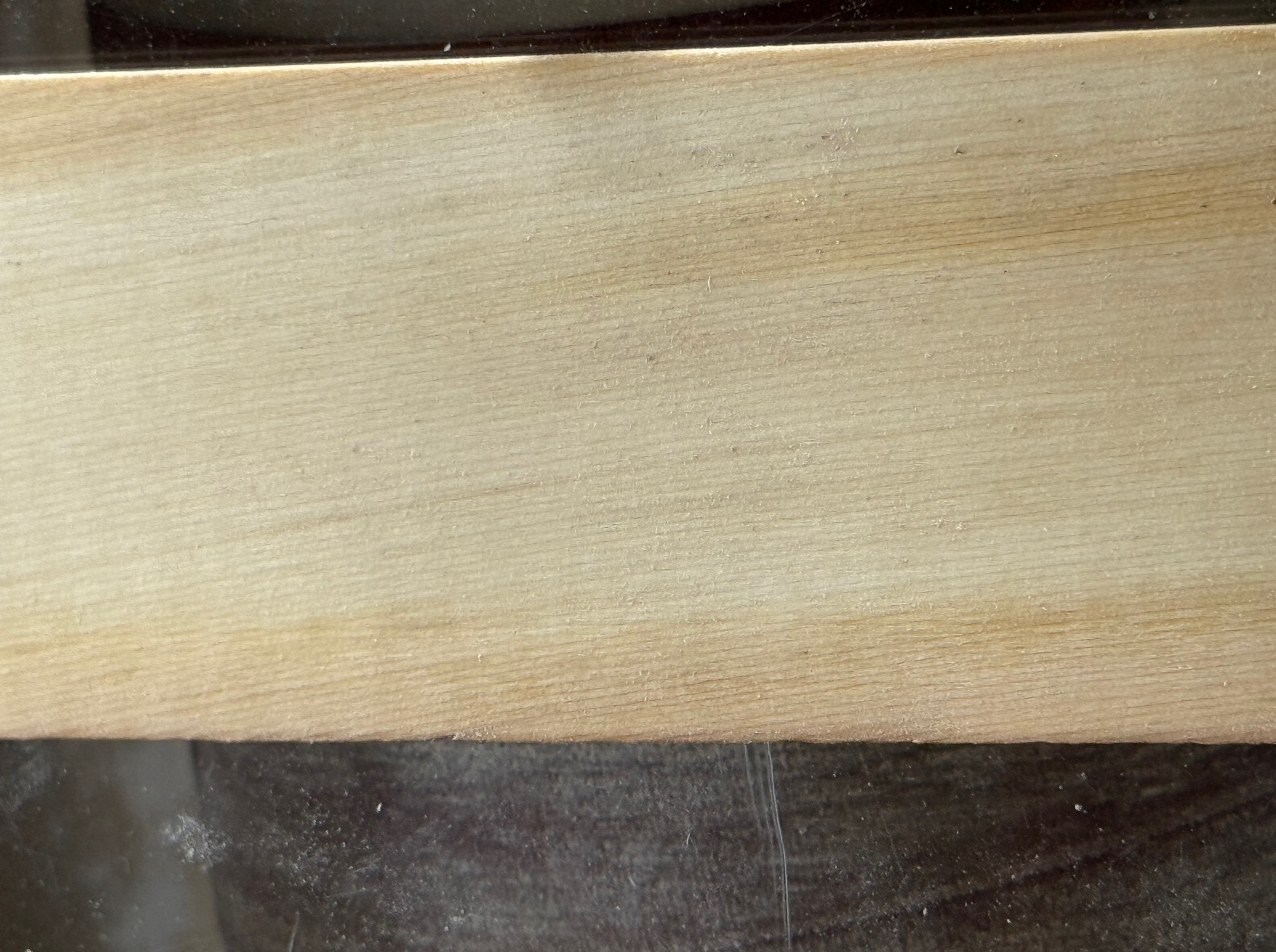
…and a close up of the 44mm wide Huon pine board showing the quality of the finish sanding.
 johnsmachines
John what an incredible added device you’ve just created to your workshop. It continues to amaze me how you come up with all these required devices to enable your to create the works of art that you make.
LikeLiked by 1 person
Thankyou. Actually I get as much enjoyment from making the tools and machines as I do from the articles which they make.
LikeLike
that looks cool!
i’m looking forward to retiring and focusing on workshop projects
R
Get Outlook for iOShttps://aka.ms/o0ukef
LikeLike
That was my thoughts exactly.
LikeLike