johnsmachines

machines which I have made, am making, or intend to make, and some other stuff. If you find this site interesting, please leave a comment. I read every comment and respond to most. n.b. There is a list of my first 800 posts in my post of 17 June 2021, titled "800 Posts"

Tag: EJ Winter

Book Review… “Making a MARINE TRIPLE EXPANSION STEAM ENGINE OB BOLTON No9 “

I made a Bolton 9 triple expansion steam engine 2014 – 2017. It took 3 years from opening the parcel of gunmetal and cast iron castings, to running it on compressed air and later on steam. It still runs on steam once or twice each year at our model engineering club’s exhibitions.

The triple was the third steam engine I made. The first was a Bolton 7 single cylinder mill engine, then a Bolton 12 beam engine, and after seeing them run I felt that I was ready for the more difficult build.

Someone estimated that making a triple expansion steam engine takes 3000 hours. I did not count the hours for mine, but I know that many days in those 3 years I spent between 4 and 12 hours each day. It was the first model which I made after retiring from my occupation. Over those years (and subsequently) I was getting to grips with CNC machining on a lathe and mill, so the time was not exclusively on the triple.

A lot of the triple build is documented on johnsmachines.com, including difficulties, mistakes, and unresolved issues. I used the OB Bolton plans, and the Bertinat articles from Model engineer. And advice from from experienced model steam engineers in my club.

I have looked through the new book listed in the blog title, and read some sections in detail.

Oh HOW I WISH THAT I HAD THIS AVAILABLE 2014-2017!!!

The 2nd edition of the book was published in 2025. It is available from Ben deGabriel at EJ Winter. Costs $AUD39.95 + p&p. There is a separately bound 28 A4 pages of updated CAD drawn metric plans by Ron Collins for $44.95. The 86 page book has a soft cover, A4 format, with many excellent colour photographs and line drawings. It includes a brief history of the Sydney Harbor ferry “SS Kuttabul”, the engine of which was the inspiration for the original Bolton 9 design.

Chapter 3 is a sensible, thoughtful, short summary of “Defining the desired outcome”.

Chapter 4 is 6 pages explaining “Valve events and timing”. I had gradually understood how the triple worked as I progressed with my build, or at least I thought that I gradually understood. I did eventually get the engine working. Having now read chapter four I can see that my 2014-17 understanding was limited. As result of his considerations the author modified the design, particularly the valve timing and he gives a lengthy, clear rationale for the changes.

Chapter 5 “Other Design Considerations” is short discussion on suggesting an increase in rotational inertia by adding a propellor, and choosing the direction of rotation of the crankshaft. I confess that my choice in 2014-17 was random, not rational, and I have now added a propellor, which adds interest from onlookers, and smoothness of engine rotation.
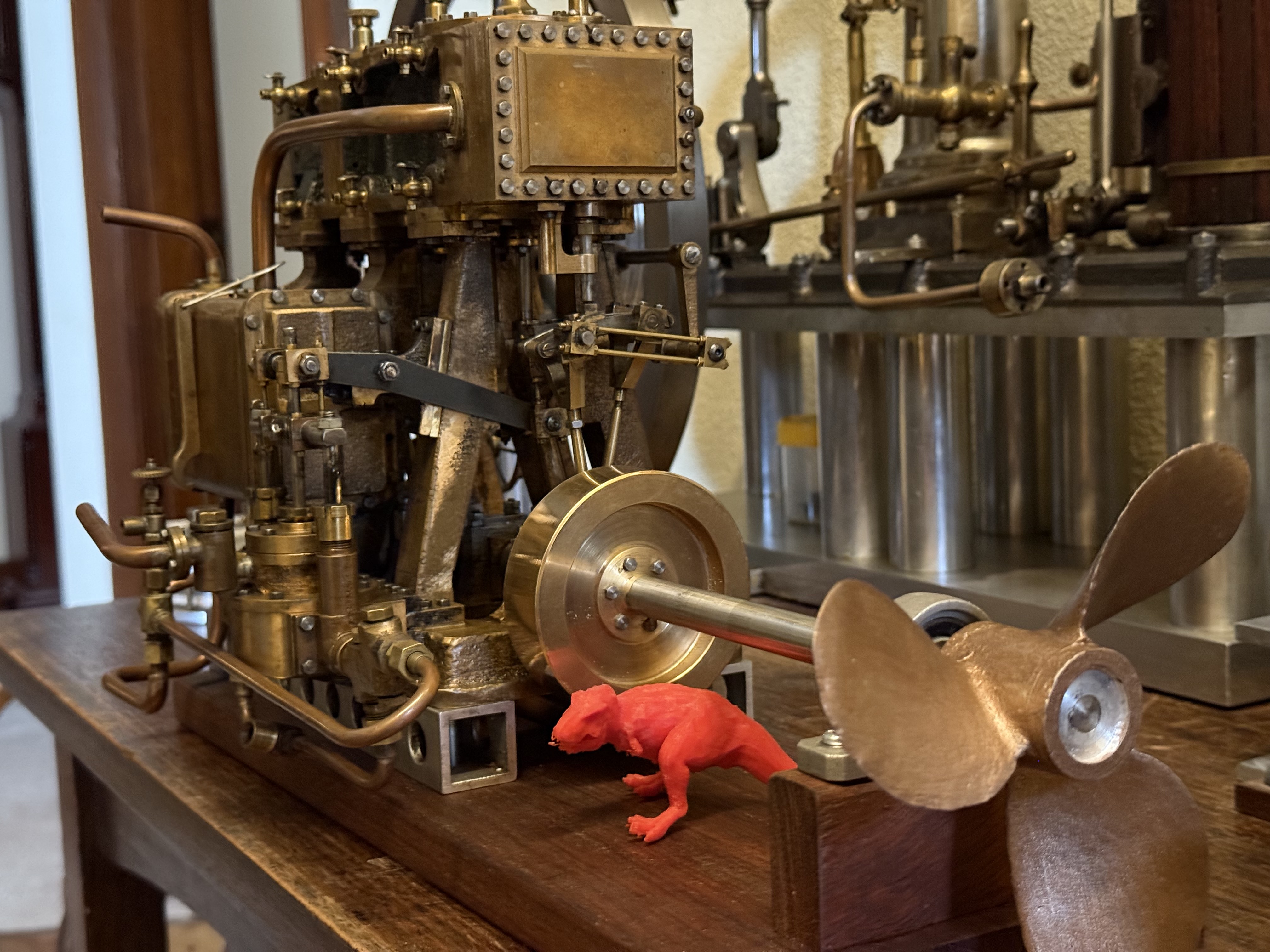
My Bolton 9 Triple Expansion Engine with family pet.

Chapter 6 is another short and useful discussion about the levels of accuracy and precision which should be the builders’ aim. And the use of Imperial and metric measures. Even mixing them for best effect.

Chapter 7 “Painting and Finishing Considerations”. Helpful advice about when to paint components (early), use of stainless steel where possible, and more.

Chapter 8 “General Notes for Other Builders” including jigs and fixtures, Build Sequence, and other Important Notes. For an “intermediate” level builder such as myself, these would have been incredibly useful.

Chapters 9-24 are the bulk of the book, comprising detailed advice on how to make and assemble the various components. Again, how I wish that I had this advice available instead of trying to work out from first principles how to hold and machine the irregular shapes. I did make my crankshaft from one piece of steel instead of the built up method used by Clark, but I have no doubt that his method would be more efficient, and easier than the method I used.

Chapter 24 “Finishing Off. Drains, Gauges and Lubricator.” The OB Bolton and Bertinat plans and text have nothing about these items, so the Clark information is invaluable.

Chapters 25 and 26 “First Test Runs” and “Analysing the Test Results”. Clark suggested different valve settings than specified by Bolton, and gave reasoned justification for his suggested changes. If/when I get around to another tear down of my triple, I will institute his suggestions, and if I am ever crazy enough to build another one, I will build them in.

Chapter 27 “A Display Base”

Chapter 28 “Some Display Loads for the Engine”. Including a propellor, a pretend thrust bearing which is actually a large flywheel, and a generating set. Very good and interesting suggestions. Also some thoughts about a suitable boiler. I might add that at exhibitions I run my triple on supplied steam at only 25psi, and somewhat to my surprise, it runs fairly smoothly. I suspect that it is working principally on the high pressure cylinder, with a small contribution from the intermediate cylinder, and only load from the low pressure. When I use my own 6″ boiler I run it at 80-100psi. To operate the engine using all 3 cylinders the condenser should be working, and using cold water.

Chapter 29 “Thoughts for Future Developments” and Finally “Conclusions” “Bibliography” and a very nice “Acknowledgments” page.

The accompanying booklet “Detailed Construction Drawing Set” is accurate, clear, metric, and more detailed than the original OB Bolton plans. And in workshop useful A4 size in a foldback spiral binder, and blank alternate pages for notes and calculations.

So, my conclusion is that anyone contemplating building the Bolton 9 Triple Expansion Steam Engine should definitely spend the extra on top of the castings expense, and get these books. You can thank me (and James Clark and Ron Collins) later for this strong recommendation.

p.s. Ben deGabriel informed me that one of his customers built the Bolton9 triple IN 9 MONTHS, using the Clark book and Collins plans. And that he intends to make another one!!
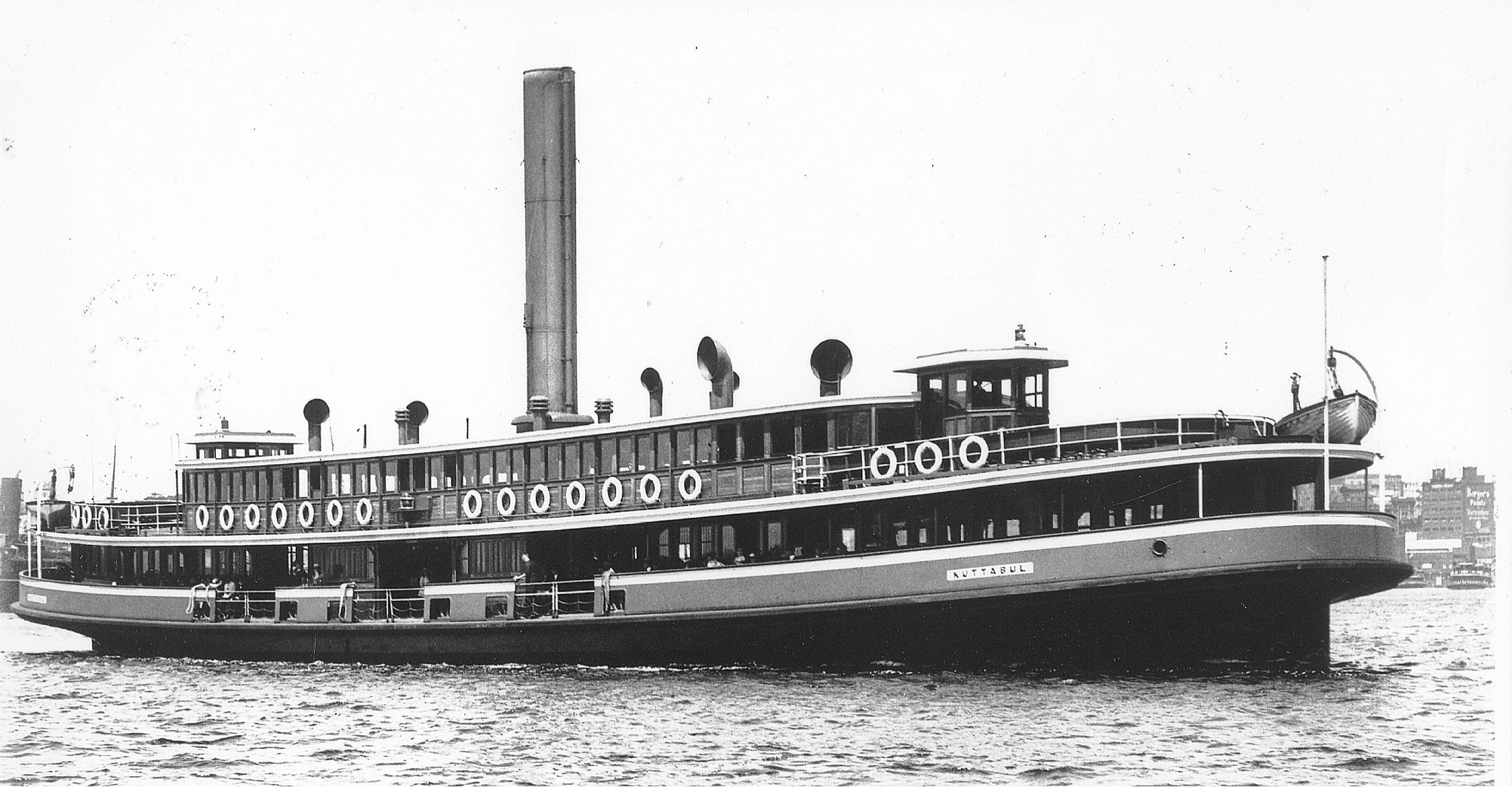
Australian Ship Sunk by US Navy

OK. Click bait title. But probably correct.

A few year years ago I made a model triple expansion steam engine with plans and castings supplied by EJ Winter P/L of Sydney. The details of the build were detailed on this blog. I found it to be a difficult build, but eventually got it running on steam, as shown in the following video…

Today I rang Ben deGabriel, the owner of EJ Winter P/L, the supplier of the plans and castings of the engine, to order some 10BA nuts and screws for my model Armstrong RML cannon. It is always a pleasure to chat with Ben. He is so passionate about model engineering, and a very knowledgable and reliable supplier. The chat turned to the triple, and he told me that he had found references on the original model engine plans, to SS Kuttabul, the engine of which was the basis for the model engine.

The SS Kuttabul was built as the largest K class ferry for Sydney Harbour, and first in service in 1922. Kuttabul is an aboriginal word meaning “wonderful”. The Kuttabul had a passenger capacity 0f 2250, which is the largest of any ferry ever in service on Sydney Harbour. It was 183′ long, beam 36′, and gross weight 448 tonnes. Steel construction, and with 18 water tight compartments was regarded as unsinkable. It had a 113hp triple expansion steam engine.

After the outbreak of WW2, the Kuttabul was requisitioned by the Royal Australian Navy, and was moored at Garden Island in Sydney Harbour, and used as accomodation for naval personnel pending transfer to their ships.

Three Ko-hyotkei class Japanese midget submarines entered Sydney Harbour 31 May 1942, with the intention of sinking Allied warships. M-24 fired 2 torpedoes at USS Chicago, a heavy cruiser, but both missed. One torpedo ran aground harmlessly, but the other hit the breakwater against which HMAS Kuttabul, and a Dutch submarine were moored. An alternative conclusion is that shells from the USS Chicago which were mistakenly aimed at the Dutch submarine, hit the Kuttabul. In either case, the Kuttabul broke in two and sank, killing 21 sailors, and wounding another 10.

The engine of the SS and HMAS Kuttabul, was a 113hp triple expansion steam engine.

This history, whatever the exact cause of the sinking, makes me particularly glad that I modelled this particular steam engine.

If I find more information about the Kuttabul or her engines I will add to this post.

6″ Boiler Lagging -3, and back to the Dredger Engine.

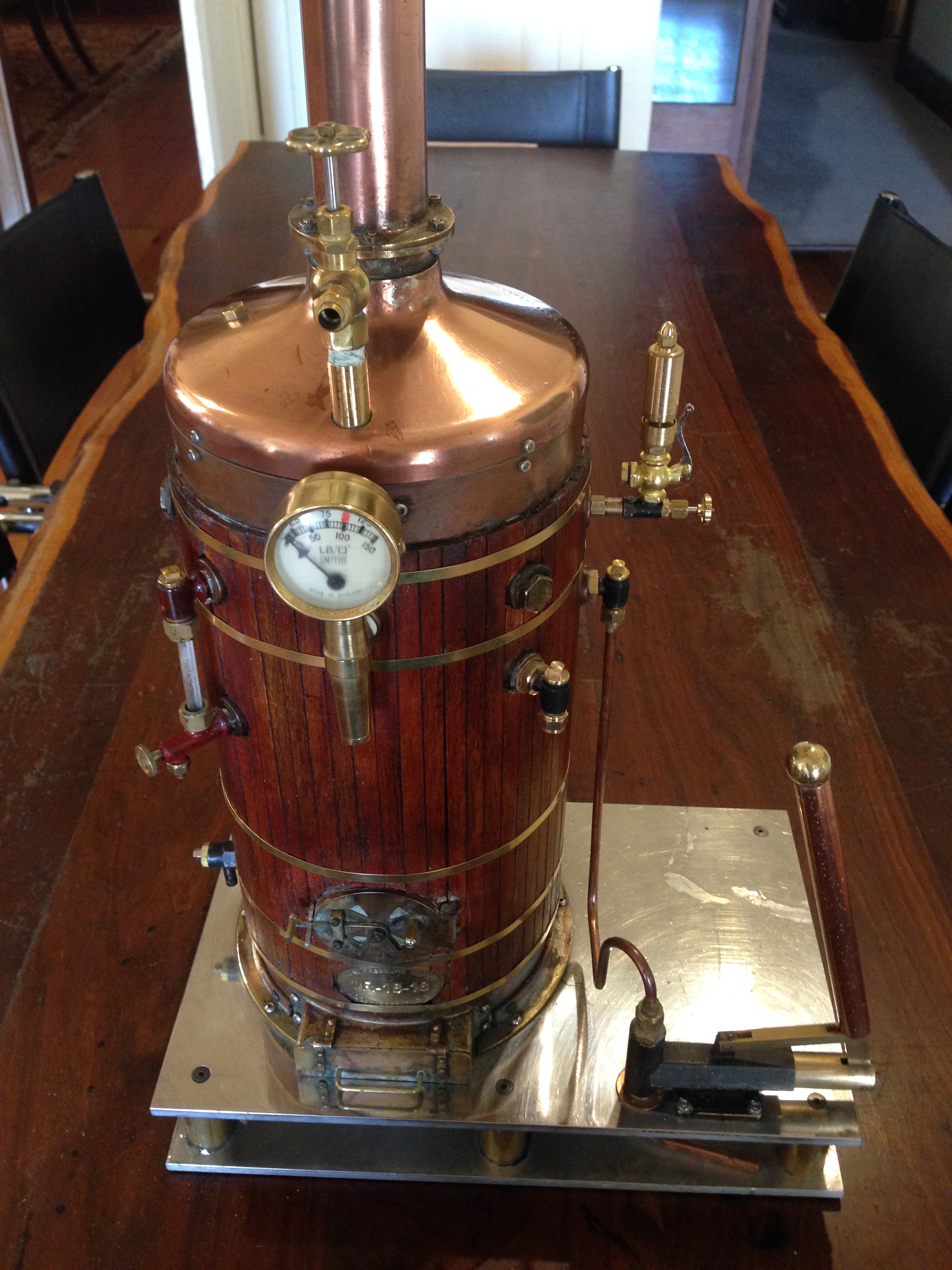
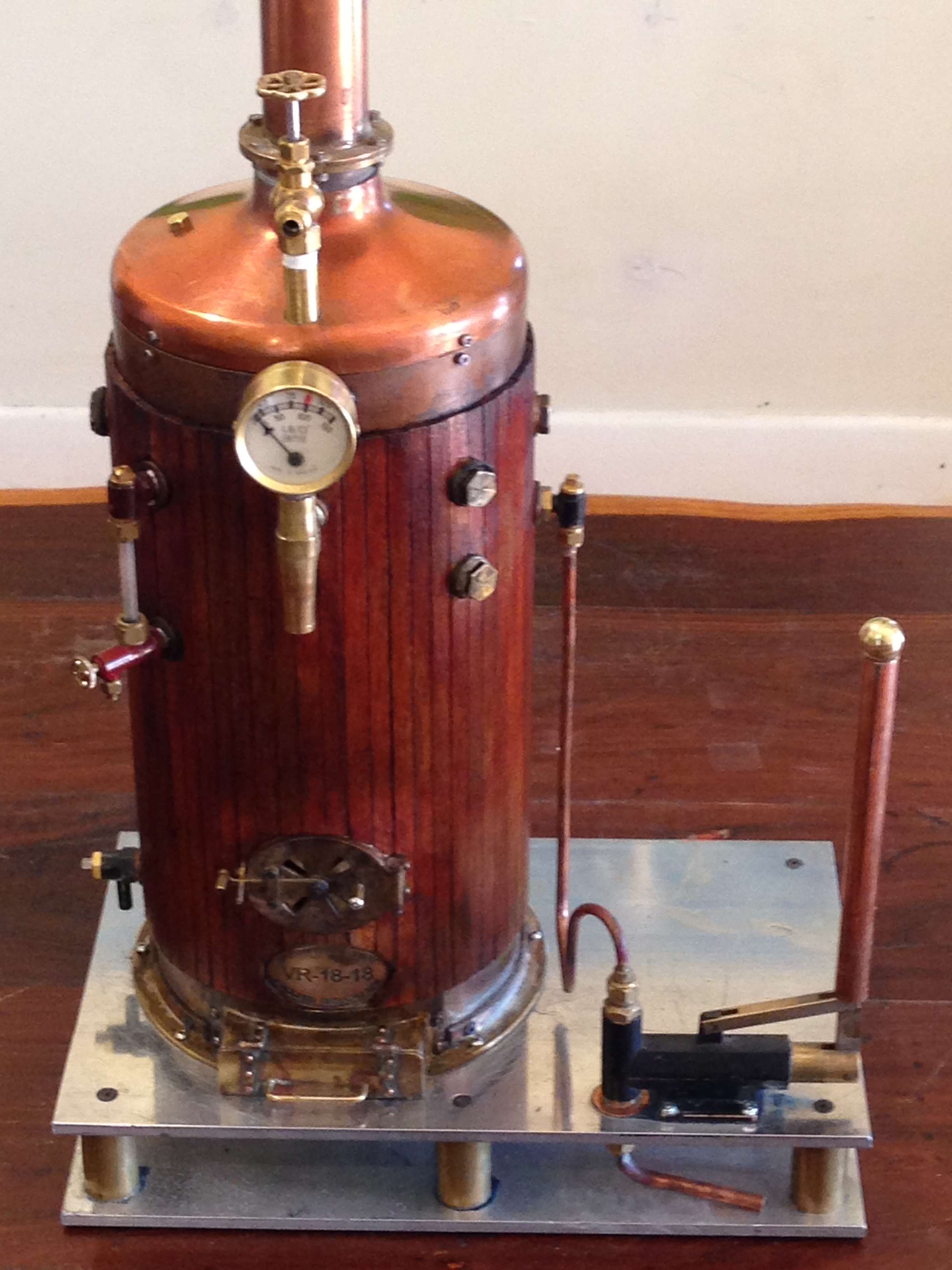
The brass bands which secure the wooden lagging strips were installed.  5 bands were required to make sure that every piece of wood is held once the glue lets go.  The bands are only 4.75mm wide.   The bolts which apply the tension pass through small brass blocks which are silver soldered onto the ends of the strips.  (thanks Ben De Gabriel of EJ Winter for that tip!  And for the band material!)


IMG_6860.JPG

The boiler sitting on our kitchen table.  I will eventually paint the ashpit door assembly and angle plate at the base.


IMG_6859.JPG


IMG_6857.JPG

The setup for holding the small blocks in position during silver soldering.  In order to not close up the gap between the small block and the brass strap, I centre punched the blocks, raising small dimples, which produced a thou or two of separation between the parts, allowing the molten silver solder to flow.  That silver solder wire is 0.5mm diameter. 


And back to the Trevithick Dredger Engine….


IMG_6855.JPG

The redesigned inspection hatch.  The bronze rectangular bit plugs the hole in the end plate.   I have plugged the unwanted 14 holes in the end plate, using stainless steel threaded rod.   And metal worker’s hands, cut, dirty, dry thick skin (SWMBO “don’t come near me!”).


FullSizeRender 10.jpg

Four of the plugged holes around the firebox opening, 10 more under the inspection hatch (hidden), and the inspection hatch.  I will make the inspection hatch a little bit smaller.  It will be decorative, permanently attached and unable to be opened.  The dredger engine in the London Science Museum has the manufacturer’s name cast into the plate.  I am contemplating just inserting Richard Trevithick’s name and the date the first high pressure engine was made (1806).  There will need to be a separate area on the boiler wrapper the AMBSC identification.


Boiler Lagging -2

The Tasmanian Oak lagging looked too pale white to my eyes.  With use, steam, oil, dust, water, workshop grime and sunlight, it would have gradually acquired a well-used patina, but I prefer instant gratification.

IMG_6842

So after consulting my resident wood finish, artist, architect, expert, (SWMBO), I applied some wood-stain.


IMG_6846.JPG

Too orange, too patchy, she said.   And the white in the joins looked wrong.

Too orange, too patchy, and too much white showing.  “Put on some black boot polish” she directed.

So I did as I was told.


IMG_6848.JPG

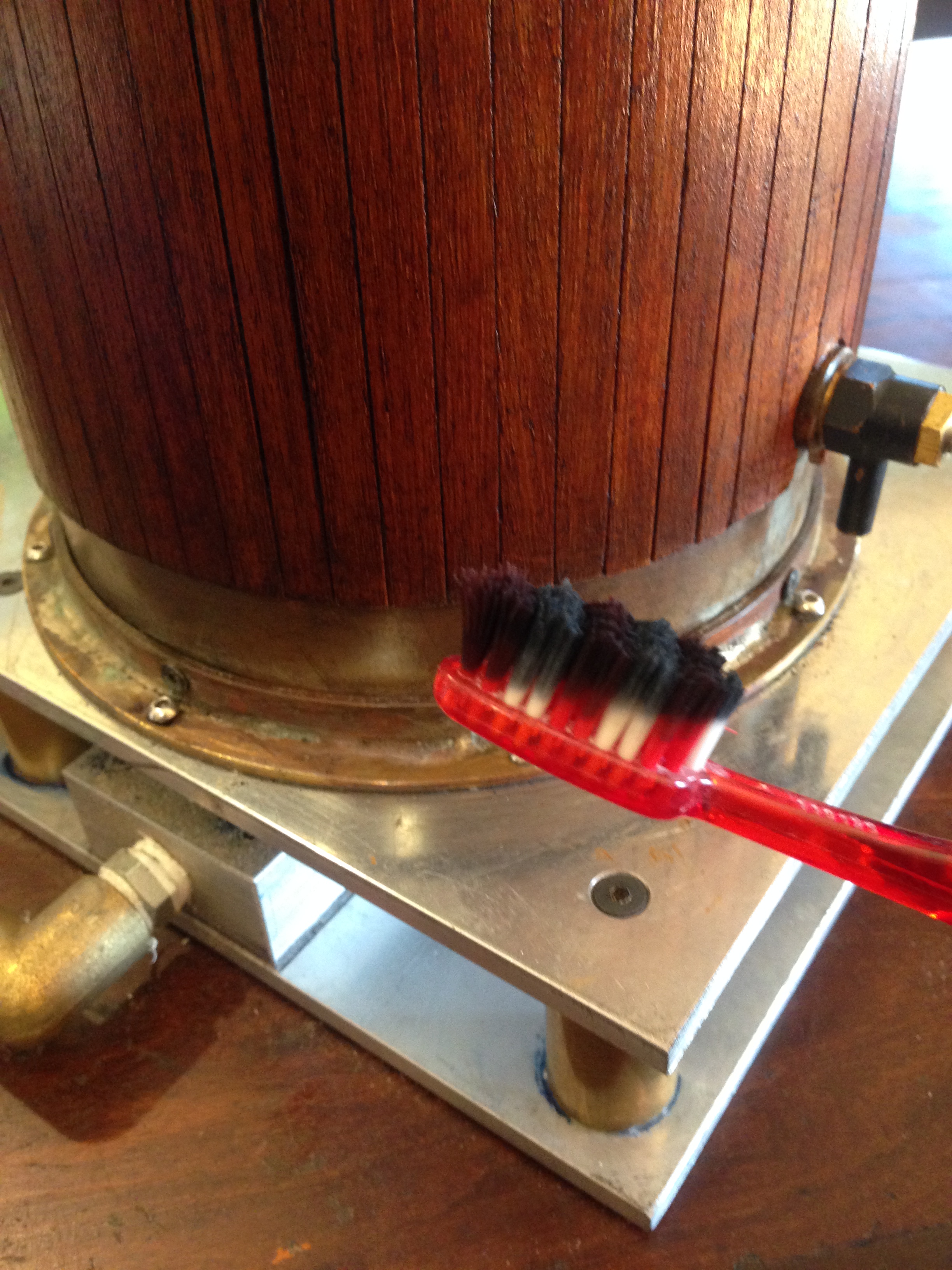
With a boot polish brush…


IMG_6851.JPG

—and a toothbrush…


IMG_6852.JPG

… hmmmm.   I better clean her toothbrush before putting it back….

…(acknowledgments to Tubal Cain for using his old gag…)


IMG_6853.JPG

That’s the look I was wanting.

Now just waiting for the brass bands to arrive.

Ben De Gabriel from EJ Winter, Sydney, had sent me a remnant piece of banding to try, in my last consignment of parts from him.  It was perfect, but not enough for the 5 bands which I require.  So I rang him.  He thought that was the last of his stock of that particular size but he would check and let me know.  Sure enough, he returned the call, and he had found a couple more bits, and they would be just enough.  Old stock, a bit shop-soiled he said.  So I could have it for nothing!

Readers who have been with me for some time will know that I have bought 3 sets of engine castings and plans from EJ Winter.  The Bolton 7 horizontal Mill engine, the Bolton 12 Beam engine, and the Bolton 9 triple expansion engine.  A bit of very interesting news is that Ben is planning a new set of castings for the triple, using the lost wax casting technique, which gives a finish which should require machining on the mating surfaces only.  That sounds so good that I am almost tempted to make another triple.   Almost.   Some months until availability though.  (Hope that you don’t mind my premature announcement Ben.)