
Coppering Bellerophon -6
by John
A reader responded to one of my posts on another site with this photo of a copper plate spiking machine from early in the 19th century.
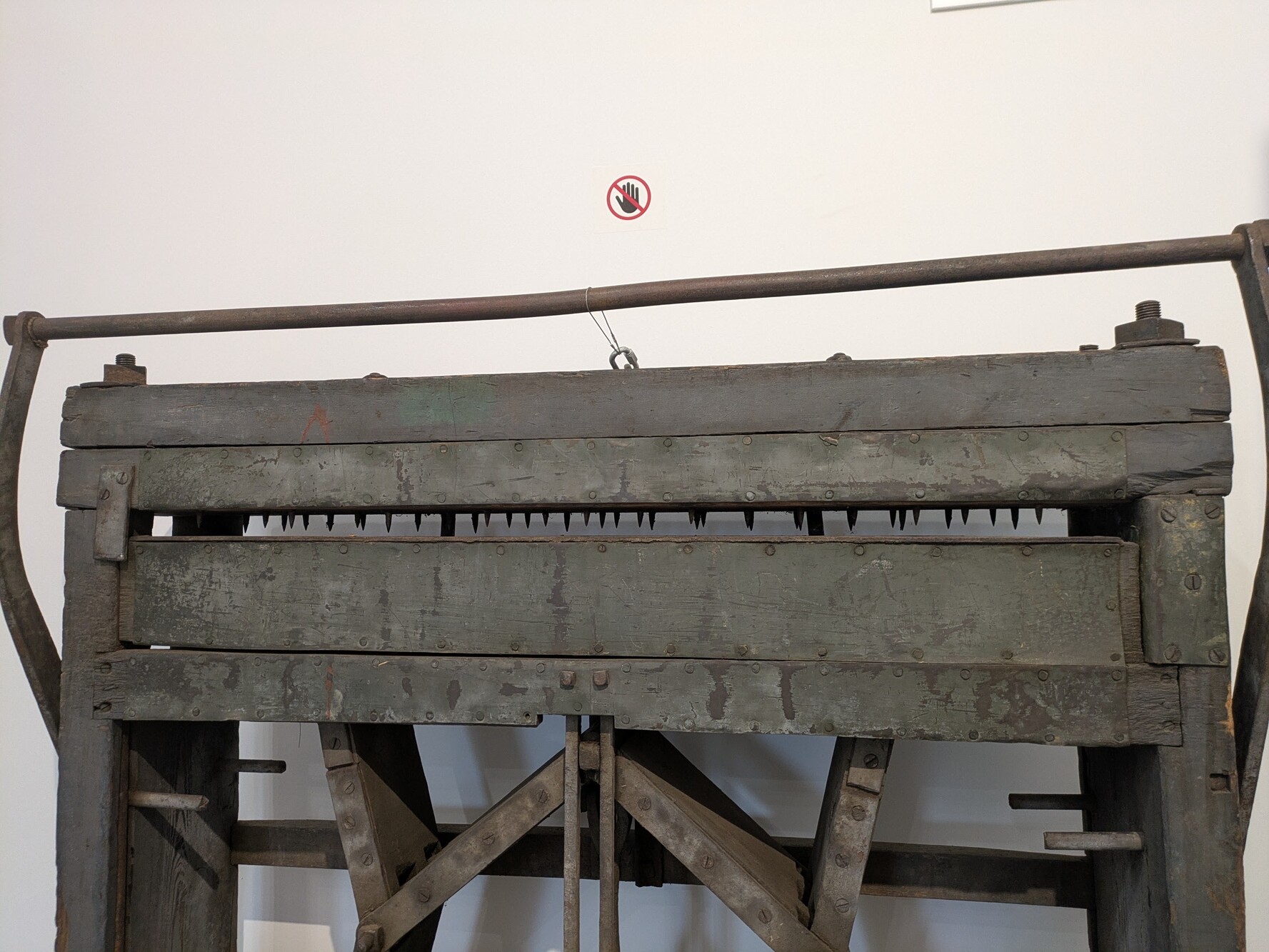
Thankyou Tony Hunt for sharing this very interesting photo which he took in the Maine Maritime Museum, Bath, Maine, USA. (another entry on my bucket list. Bath is a bit north of Boston )
The perforator appears to be man powered, by pushing down on the bar. I suspect that it was used on merchant marine ships where the copper plate was not as thick as on the navy ships. My references to the coppering process in the Napoleonic era state that the nail holes in the copper were made with a spike which was hammered through one or two layers of the ~6mm thick copper sheet.
Another titbit from one of my readers is that in the Napoleonic era most of the copper on British warships came from a mine on the isle of Anglesea, off the coast of north Wales. Prior to that the copper was mined mostly in Cornish mines, but the Anglesea lode was so rich that it replaced Cornwall as the main supplier.
And another thing…. this time about my copper tape impressor.
I decided to add extra slots in the base of my jig design, so it can accomodate tape of 4mm and 5mm widths, as well as the 6mm which I am intending to use on HMS Bellerophon. Extra impression wheels will have to be made (3D printed) for the 4 and 5mm tapes, but the same 6mm stl files can be used just by scaling them down in size, and reaming the shaft holes in the wheels to 6mm. Those narrower tapes will be useful for smaller scale models such as 1:96
Now. I must make a start on actually coppering my Bellerophon…


Hi John,
[I’ve been a bit delirious over the past week from RSV and a fever that throttled up to 102.8º F. I didn’t even finish my last post because I couldn’t think of anywhere else in Maine that you might find historical shipbuilding tools, but my fever broke this morning.]
Thanks so much for the photo of the spiking machine at Maine Maritime Museum in Bath, ME. A little story: Back in 1983/84 I researched and edited photos and illustrations for an educational booklet about Massachusetts’ maritime history that I designed. It was written by a dozen different writers and edited by George Perry and Helen Richmond, who worked for MA Department of Education. I spent many enjoyable weeks perusing the Peabody Essex Museum archives and others for original materials. When the job was done we went our own ways and I lost track of them. 
Spring sauntered in and my partner Robin and I decided to move our boat up to Maine, take a little detour for a couple of days to the Kennebec River and the Maine Maritime Museum. We knew the director, so he was happy to let us keep our classic old wooden sloop tied up at the dock for the night. To top it off, George and Helen were now married and employed as curators at the museum! We had a lovely evening eating, drinking and singing sea shantys. It had been a long haul that day so we retired early.
When I sleep, I sleep like the dead. Somewhere in the wee hours I groggily semi-awoke. Something seemed to have softly banged against the hull a few times. I went on deck to pee but couldn’t see anything in the moonless dark. I went back to bed thinking it was probably a loose fender.
When I woke that morning I immediately went on deck to check it out. What I saw was shocking! What we’d been hearing that night were dead fish, many in the 24 – 36”range, floating downriver and banging into the boat. Hundreds, nay, thousands of them scattered across the wide waters. It was a sight I’ll never forget.
Upriver from the museum one can see Bath Iron Works, further up are huge paper mills, both major sources of pollution. My wife’s uncle Norman worked at BIW for over 40 years and several of my friends spent stints there in engineering. The huge fish kill was never explained, probably on purpose.
Anyway, I got out some copper foil that I’ve had boxed for ~40 years:  Look pretty good, but have lost their stickum.
Aloha, Richard 🌴🌺🌞
The cool reason of A.I. comprehends, but the seething imagination of art apprehends. – Drew Lichtenberg
LikeLike