
Coppering Bellerophon-5
by John
Another quickie.
I have made some changes to the structure of the copper tape impressing jig, and think that it is now quite good.
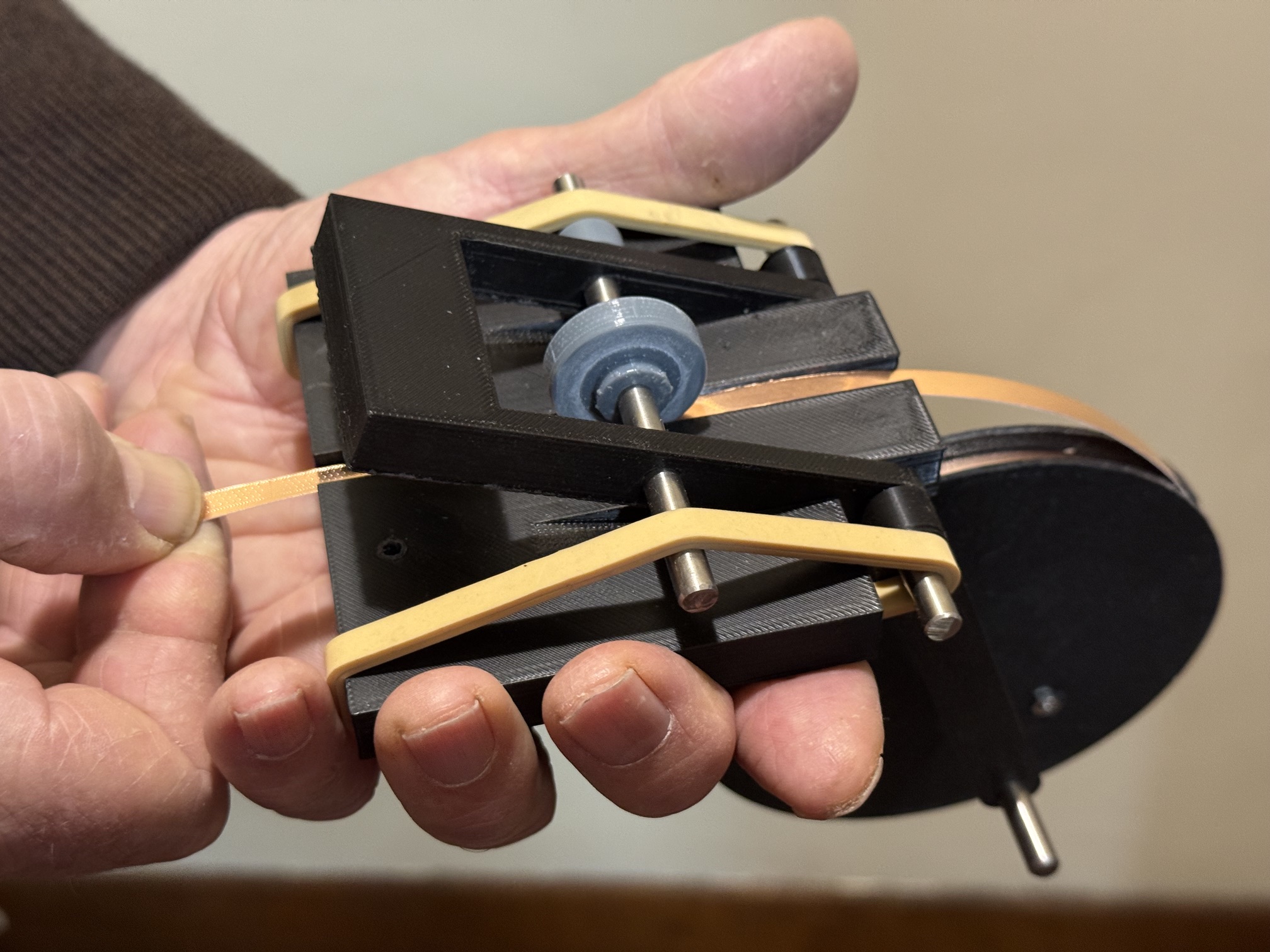
The arms supporting the feed wheel have been beefed up; the feed wheel itself now has 2 bolts with nuts squeezing the sides together, and the impression wheel gantry has been stiffened with a bigger flange. The collars are not necessary and have been removed.
You will also notice that I am holding it in my hands, rather than using a bench top or vice to support it. The control is better in my hands, and I can use my underneath finger to put put a little bit of pressure on the feed wheel to stop the tape from unravelling.
And I have had a little practice session, applying the tape to a piece of scrap wood…
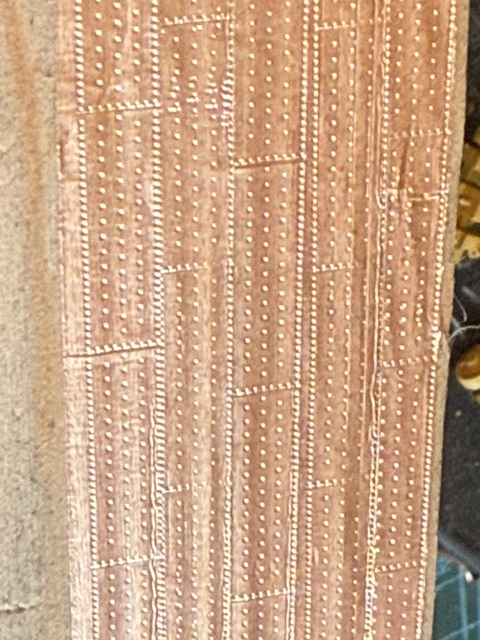
Hmmm. Might need a bit more practice with controlling the overlap? Some of the crinkles are due to the rough wood surface.
And maybe those nail heads are too big? The impression wheel protrusions were deliberately made twice as big as the 1:72 scale dictated for reasons of strength… I dont want the protrusions to break during use. But the spacing is correct and the peripheral heads do look crowded?
Another resin print run of some smaller impression sizes impending.
I think that I am a day or two away from coppering my Bellerophon.


Looks good John;
If the sheets were tightly hammered home in real scale, wouldn’t they also show any shape in the wood beneath ? You may have accidentally created a feature.
LikeLike
Thankyou for the feedback. The photo of HMS Trincomalee which I showed a few posts ago would agree with your assessment. John
LikeLike
Hi John,
Your precise embosser makes great impressions!
I didn’t know what electrician’s copper tape is, but do now. I can vouch that the adhesive-backed copper foil used for glass window construction will eventually fall apart due to adhesive failure and is really intended to hold the tape in place until soldered together. I see the electricians foil tape has choice when it comes to adhesive layer and conductivity. Very interesting!
Are you going to sand and seal the wood planking before you apply the foil? Any additional adhesive you might use?
I’ve looked at the photos of USS Constitution and HMS Trincomilee a number of times, especially the copper sheathing details. I figure the sheathing strips were heated and annealed and the nails hardened by hammering or rolling or adding an alloying metal like tin. Got to pierce that copperplate…and pounding the nails made them harder.
No boot stripe is painted on the Constitution. But on HMS Trincomilee you can see that the top three copper strips are the stripe and they appear to be coated with durable red lead paint. I can easily imagine starting at the keel and working upward as the ship took shape. As it rose above the waterline boottop lines were scribed in the hull.
As you look at the plating you can see various odd pieces that have been added while the top three strips define the waterline across the hull and overlap the bootstripe from above. Some military ships had no stripe and were painted with grey or black lead over the copper plating.
Bellerophon is looking beautiful. Have you considered patinating the copper instead of that bright shiny finish? Did you coat the copper on USS Constitution with a clear spray to thwart oxidation?
Aloha and a hui hou, Richard
LikeLike
Hi Richard, and thankyou for the most interesting feedback.
1. Your comment about the copper tape adhesive failure is very disconcerting! But in a window situation it is exposed to sunlight and weathering, so I am hoping that it will stay put on my Constitution and Bellerophon! Time will tell.
2. My information about the nails is that they tried iron nails which were a disaster due to electolysis. Pure copper was tried, presumably with pre made holes in the copper and the planking, but the copper was too soft. Then they used a copper – zinc alloy (brass) which worked well.
I am quite sure that the plates were spiked on the job prior to nailing. Later developments included mechanical spiking machines which pre-spiked the holes. Another reader sent me a photo of one of these machines in a museum in Maine.
3. The odd pieces added were normal practice to fill odd gaps. Similar to “stealers” in the hull planking.
4. Re the copper finish in Bellerophon… It will go on in its slightly shiny state, (call it bling, but I quite like it) and I imagine that it will eventually tarnish. Constitution’s coppering is still shiny. after a year.
5. And a very friendly hui hou to youi tooi. John
3. The hull planks have been filled and sanded very smooth. I have not decided whether to use a sealer. I didn’t use a sealer for Constitution and so far the copper tape is quite intact.
LikeLike
Richard, in answer to your final question, there is no extra coating on top of the copper tape on Constitution.
LikeLike
My concern about the copperfoil tape is more about how it will look in a few decades. I did a lot of experimenting with copper wire, foil, plate, powder, screen, rod, etc. while I was at school. The foil was adhesive-conductive which I taped to the wall to conduct high frequency power to neon tubes among many other things. I used the foil for both aesthetic and practical purposes, learning that 50m of the tape would easily come off the gallery wall in a month without creating any damage and requiring no touch ups. I’ll have to dig up some pics, you may find them interesting.
My advice is to seal the wood to fill the grain and create a hard smooth surface such that the foil makes close contact with the hull. Then it needs to be secured in place with pressure applied by burnisher, or brayer or some suhttps://www.youtube.com/watch?v=itN1Sh1TvAk&list=OLAK5uy_nMynXWaK9cR9JJ8WUVTS0xGMDiT00ZymU&index=1ch device.
I didn’t wish to diss your choice of
LikeLike
My concern about the copperfoil tape is more about how it will look and if its attachment is good in a few decades. I did a lot of experimenting with copper wire, foil, plate, powder, screen, rod, etc. while I was at school. The foil was adhesive-conductive which I taped to the wall to conduct high frequency power to neon tubes among many other things. I used the foil for both aesthetic and practical purposes, learning that 50m of the tape would easily come off the gallery wall in a month without creating any damage and requiring no touch ups. I’ll have to dig up some pics, you may find them interesting.
My advice is to seal the wood to fill the grain and create a hard smooth surface such that the foil makes close contact with the hull. Then it needs to be secured in place with pressure applied by burnisher, or brayer or some such device.
I didn’t wish to diss your choice of coppering finish on Constitution, my apology for the poor choice of words. I’m sure it will eventually turn darker as it oxidizes. I cannot imagine
Thank you for that info about the alloy, nails, and spiking machine. I wonder if the machine is up in Brooklin, ME. I’m going to find out!
Aloha, Richard
LikeLike