johnsmachines

machines which I have made, am making, or intend to make, and some other stuff. If you find this site interesting, please leave a comment. I read every comment and respond to most. n.b. There is a list of my first 800 posts in my post of 17 June 2021, titled "800 Posts"

Category: Triple Expansion Miniature Steam Engine

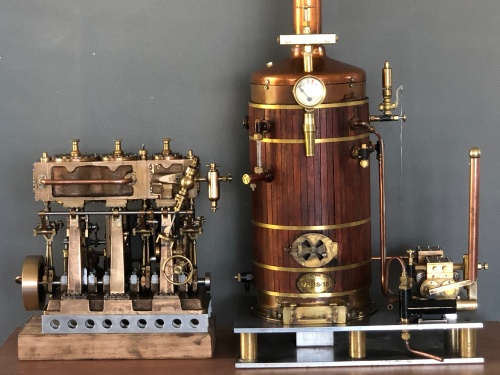
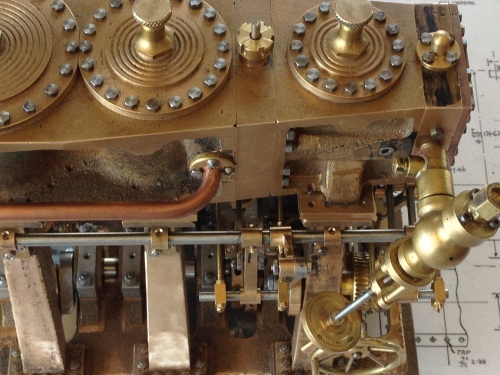
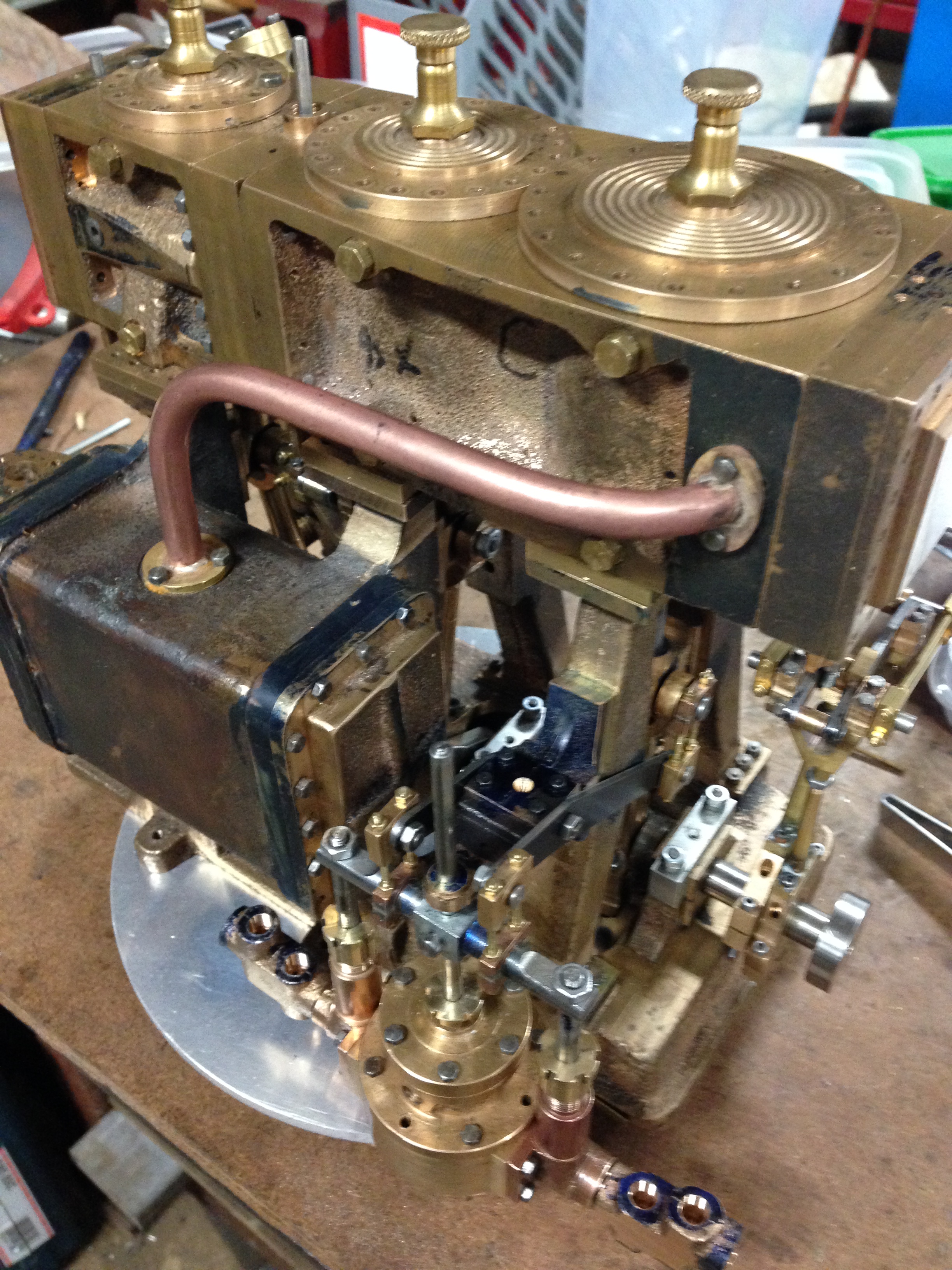
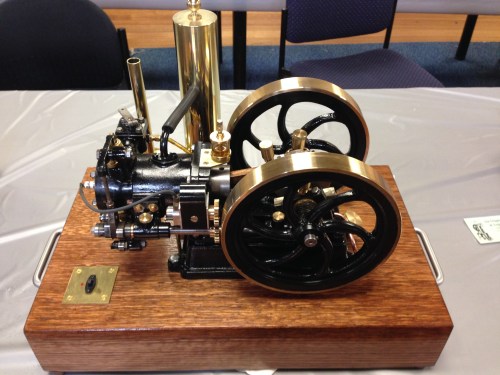
6″ Vertical Boiler, Triple Expansion Steam Engine and Southworth Pump, all working together. Fairly well.

2 videos of the triple and the vertical boiler and the Southworth boiler feed pump working together for the first time.  Not perfectly yet, but working.


34 degrees. Is it summer already?

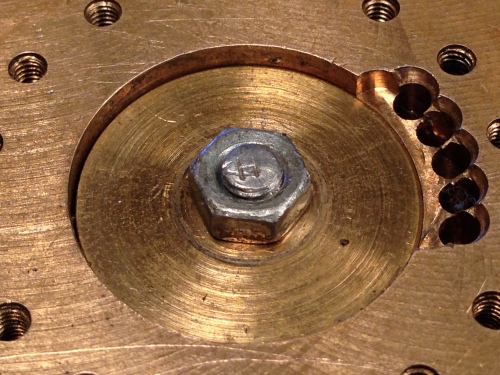
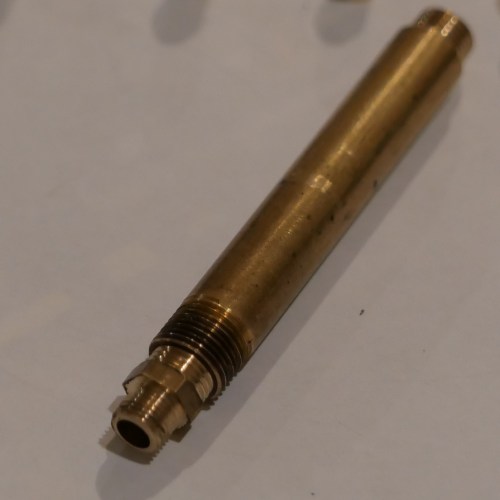
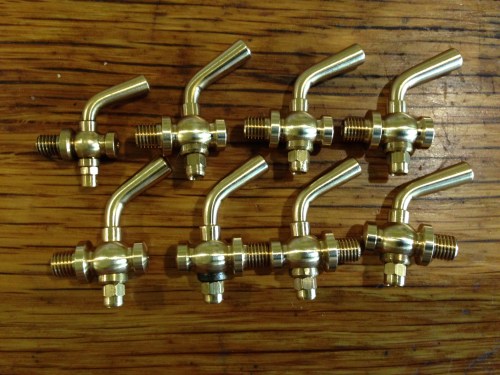
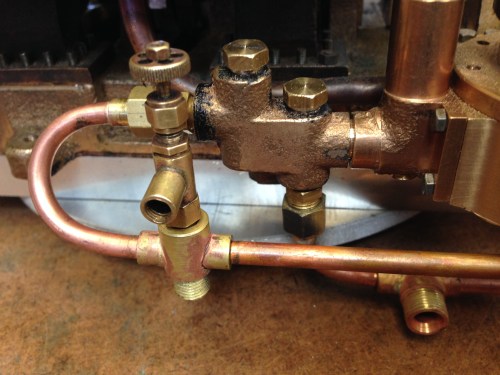
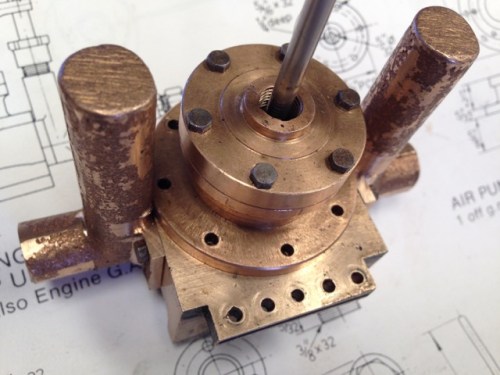
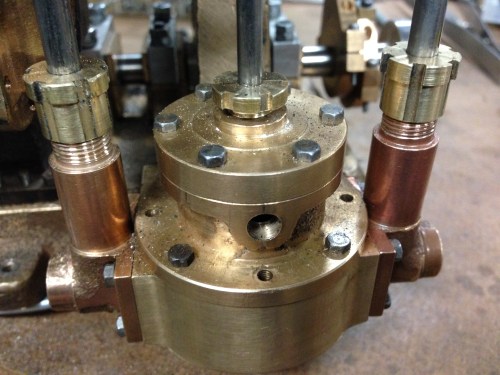
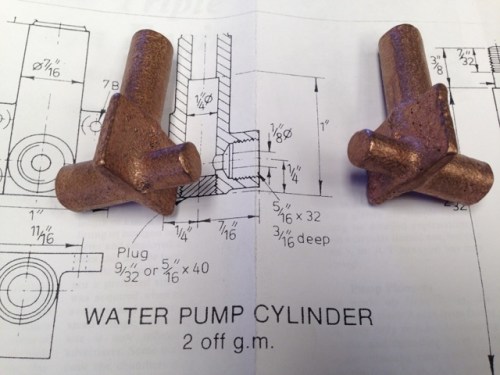
A beautiful spring morning became blustery, windy, hot yesterday.  But I hardly noticed.  I was in the workshop making these small steam pipe connectors.

Normally I would buy these fittings, because they are fiddly to make and not very expensive, but I have fitted new rings to the triple expansion engine, and I want to try it out on the vertical boiler.  (see the previous post)

P1033045.jpeg

one of the tails was not drilled deep enough.

P1033050.jpeg

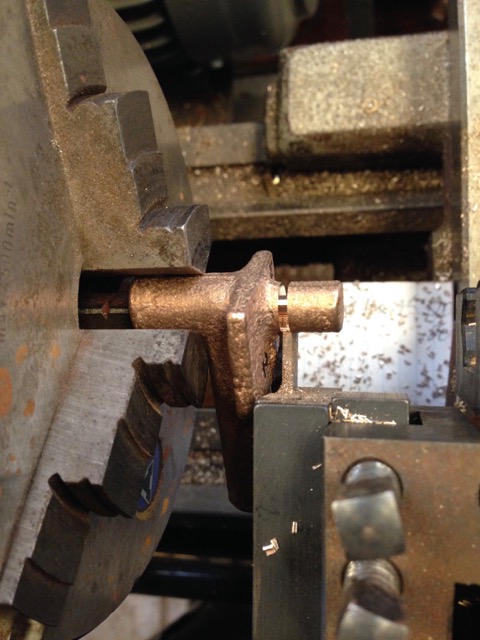
I needed only 2 of these nipple-tail-nut assemblies, but having made a jig to fit the collet chuck it was just as easy to make some extras for future use.

P1033049.jpeg

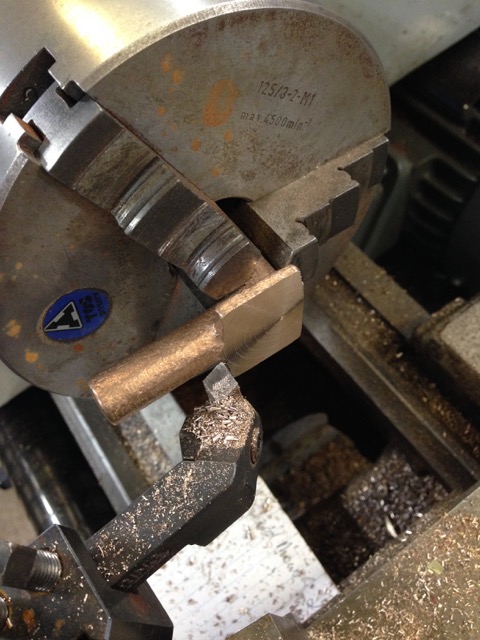
The jig is required because having made one end of the nipple, it must be turned around to make the other end and there is not enough material to hold in the 3 jaw chuck.  So the jig holds the workpiece by the first made thread, and the piece is finished by holding it in the collet chuck.   The jig will be saved for future use.  It has external threads for  5/16″x32 and 3/8″x32, and internal threads for 1/4″x40 and 5/16″x32.

The tiny tails were drilled in 2 stages because there is an internal step, and the outer shape was CNC’d.


Thinking about future exhibitions….

Still recovering from The Royal Geelong Show, where my beam engine and the Trevithick      dredger engine ran for ~8 hours per day for 4 days, and required almost constant supervision. I was very pleased that they did so without a problem.

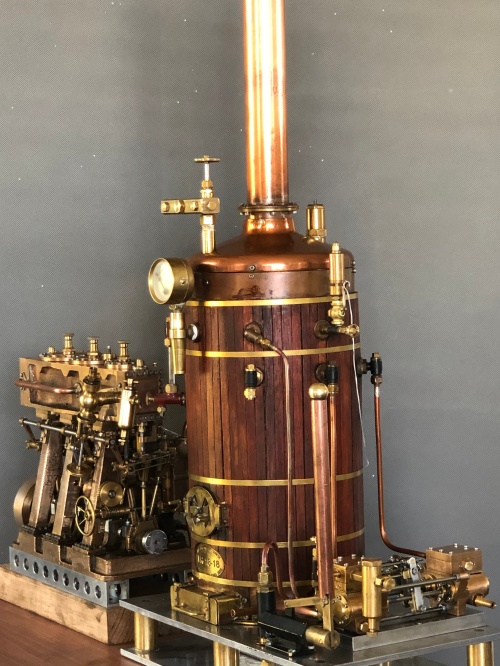
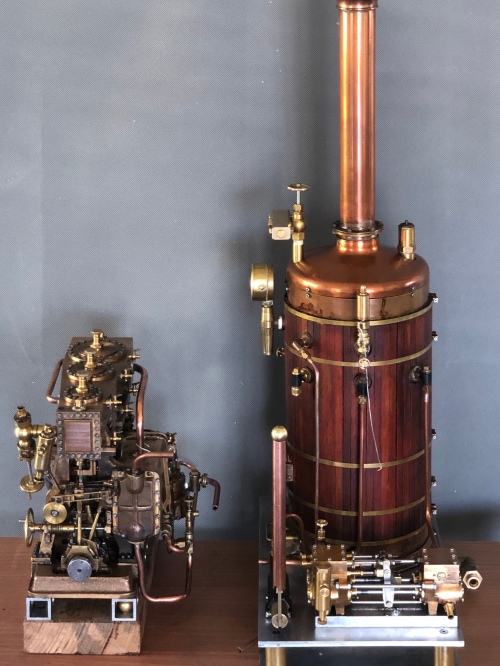
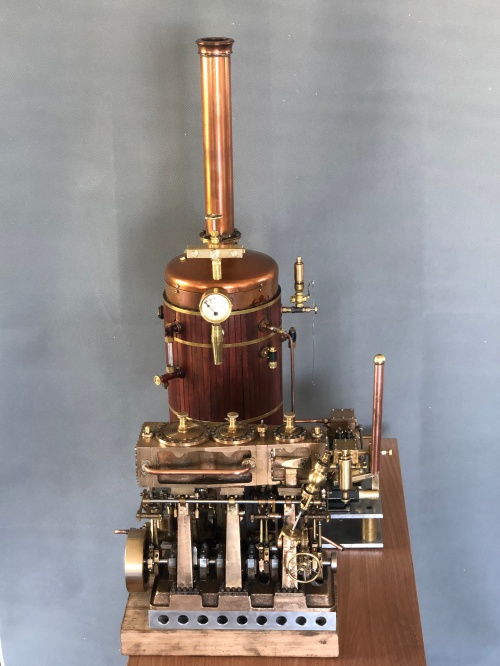
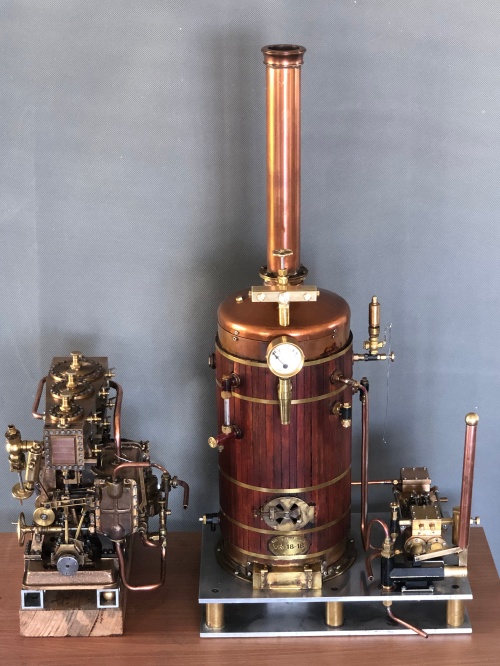
For future exhibitions I would like to also run the triple expansion steam engine using the vertical boiler, for which I recently made the Southworth boiler feed pump.  And there are occasions where I might run the triple and the beam engine together from the vertical boiler.  That arrangement will occupy a fair bit of bench space, and in this post I am considering options for the arrangement.

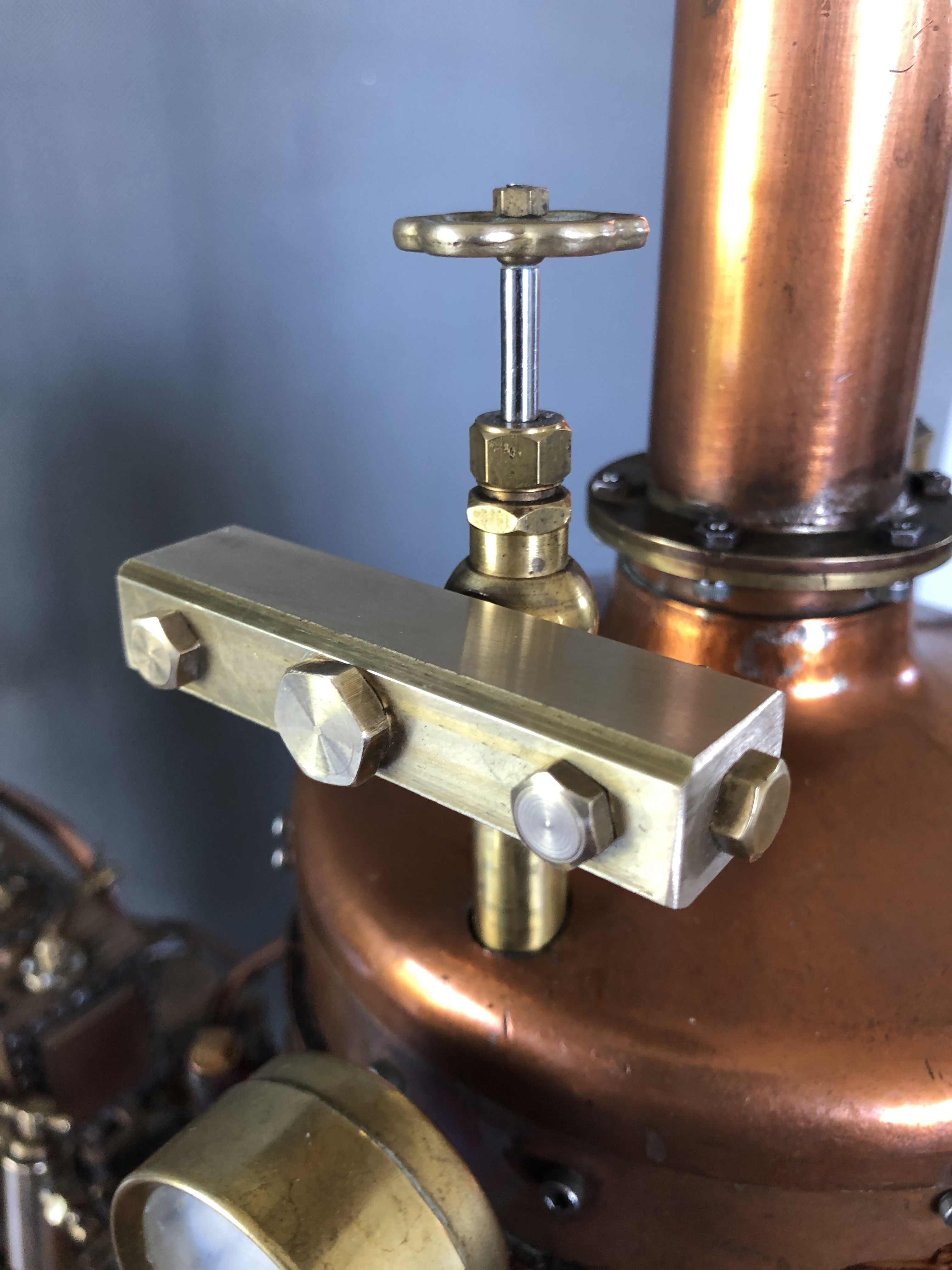
But first, I needed a steam outlet manifold to handle multiple engines, simultaneously, and hopefully to avoid a big tangle of pipes.  Here is the manifold.

IMG_8246.JPG

The manifold has 6 x ¼” outlets and one 3/8″  outlet.    

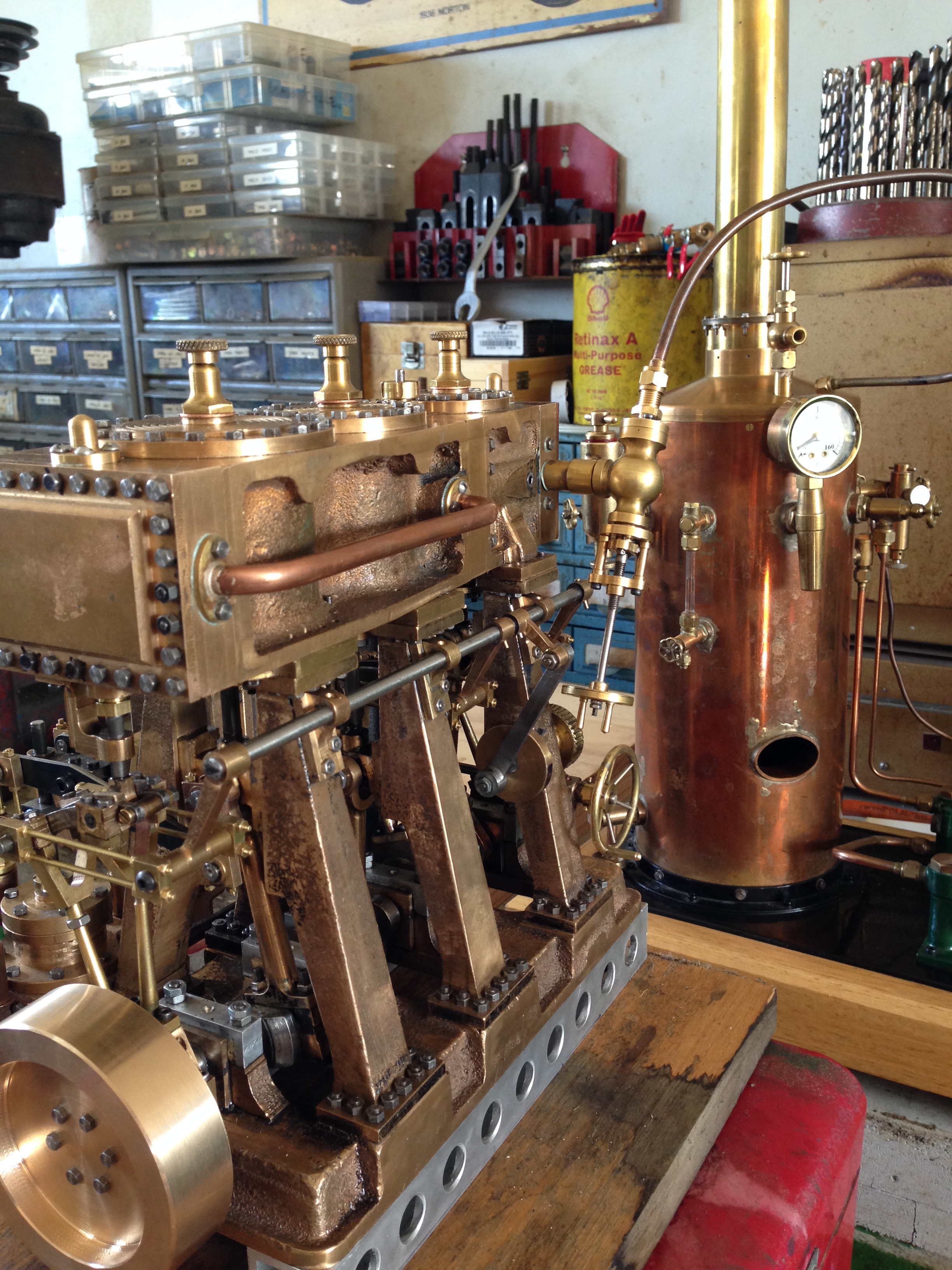
Option one lines up the boiler and engine like this….

IMG_8243IMG_8244

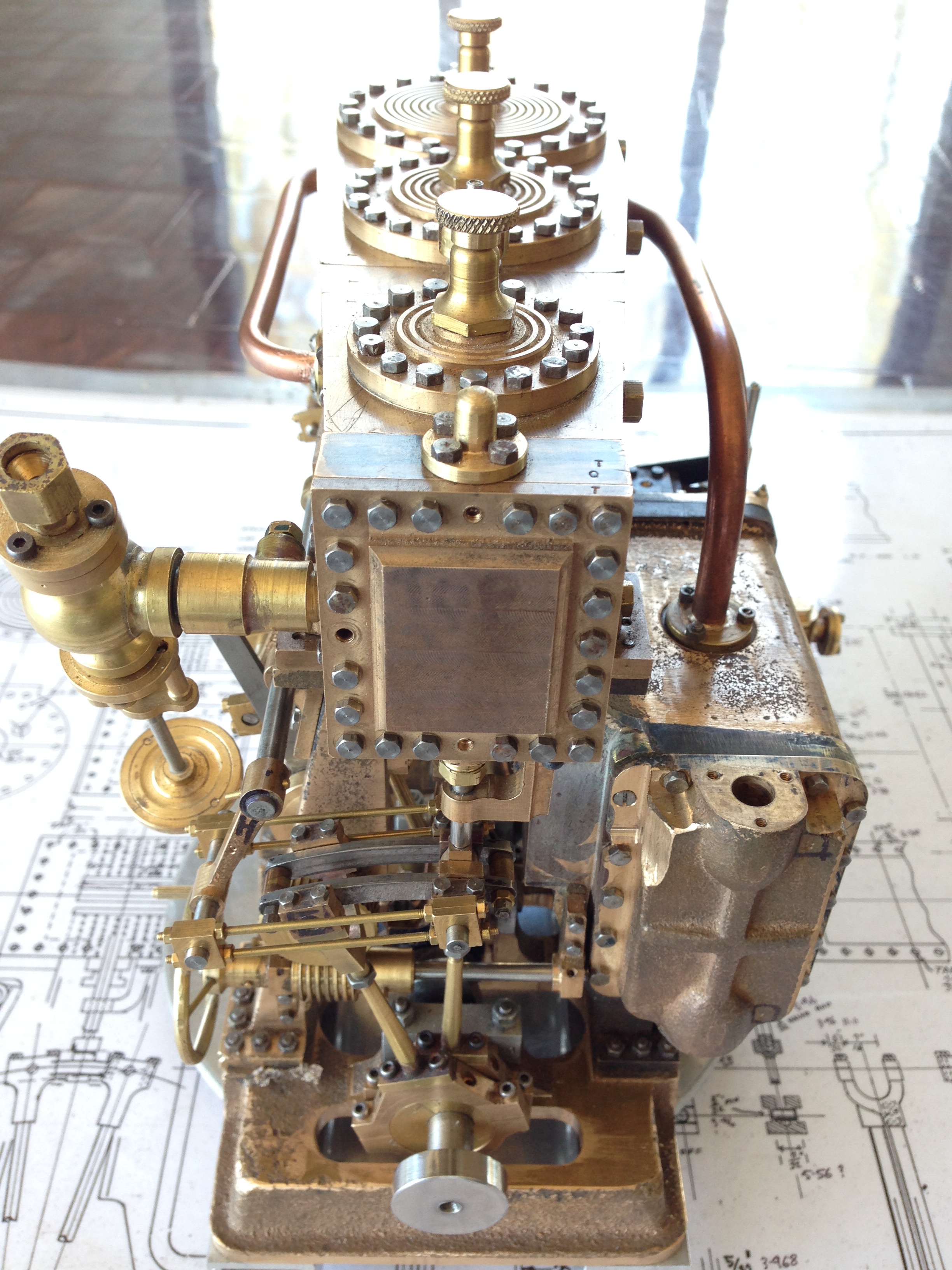
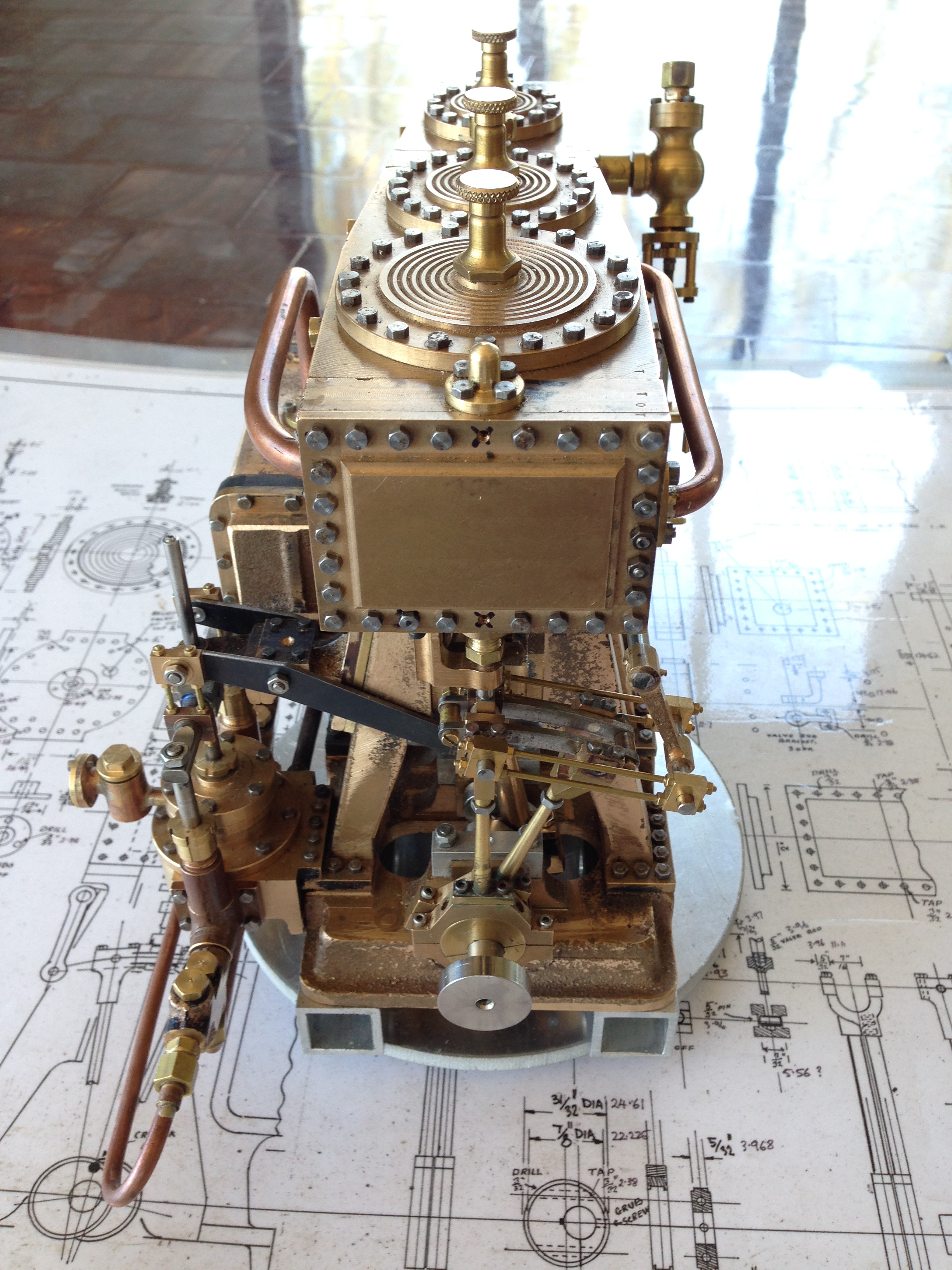
Option two is more compact, but ?less appealing.  Pics following..

IMG_8237IMG_8238

IMG_8239

The lump of wood under the engine is temporary,  just to give an idea of the heights.

OK, this post is just an excuse to show some pics.  I have decided to go with option one.  It is closer to the appearance if the boiler and engine were actually in a boat, and also will make it easier to add the beam engine to the right of the boiler if/when I run the two engines simultaneously.

And I doubt that I will be able to avoid a jumble of pipework.  The triple has 6 pipes attached, the boiler has more, then there is the beam engine.  And, I will need a water container from which to feed the boiler.  That will be located behind the boiler.  Still considering whether it should be a squarish box on a stand like the railway water towers, or a cylinder on a low stand.   Any thoughts?


Model Engines on Steam

It is Geelong Show time again.  It is actually titled the Royal Geelong Show, but having had more than a gutful of royal non-entities visitors being adored by unthinking cringers, flocking around Harry and Meaghan Kardashian, Windsor, and being a committed republican, I refuse to bother with the “Royal” handle.  (they are probably very nice people, I just cannot stomach the hoo-ha).

More importantly, it gives us steam junkies a chance to run our small engines on real hot steam.

For a treat, I am sharing four short clips taken today.

The first is a small beam engine, made by Swen Pettig.

Error
This video doesn’t exist

The next two engines you have probably seen before.  My beam engine, and the triple expansion engine.

The small engine to the right is a Stirling engine which is running on the heat from the exhausted steam from the beam engine.

The triple is leaking a bit more than it should, although it is running amazingly smoothly on 25-30 psi.  The valve glands need repacking.

And finally, a model IC engine, the really odd Atkinson.  A 100+ year old design.  2 stroke. Made by Rudi vanderElst


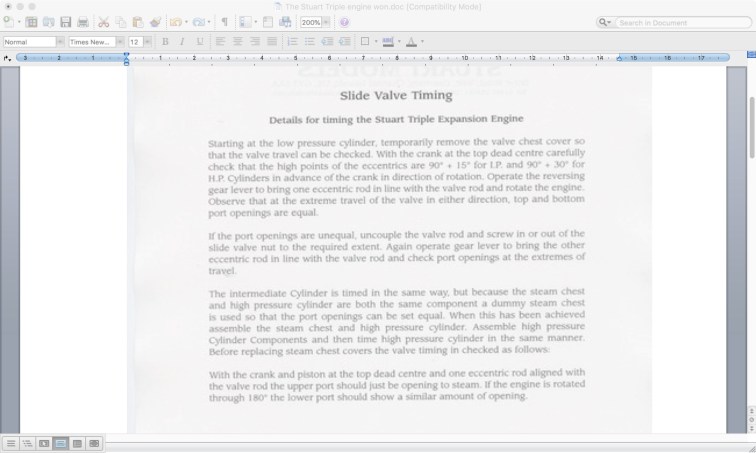
Timing a Stuart Triple Expansion Steam Engine

Reader Steve kindly sent me these notes which detail how to time a Stuart model Triple Expansion Steam Engine.   The notes are quite clearly written, and I recall that a few readers had an interest in the subject.  Thanks Steve.

Easier to read if you enlarge the picture of the text.

Triple Timing

Triple retrospective

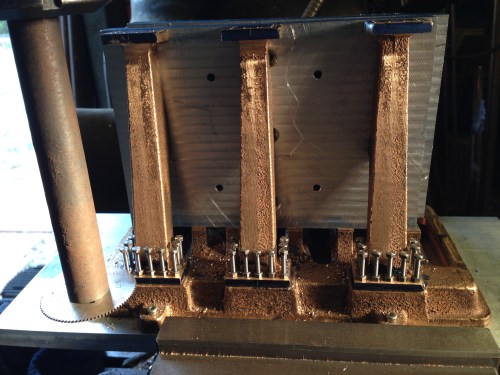
This post is for reader Roy, who asked how the triple expansion engine columns and base and cylinder blocks were aligned, and also about joint sealants.

To be honest, I did not really remember the details, but the posts on or close to Feb 2015 include the following photos.  The aluminium plates were precisely machined keep the column faces exactly separated by the final width.  The plates were bolted to the columns, then to each other.   I lined up the join in the plates with the center of the main bearing housings in the base plate.

The longitudinal alignment with the cylinder bores was determined by the precise drilling in the tops of the columns, and the cylinder base covers.  And a little longitudinal movement in the crankshaft allowed for a few thou discepancy.

IMG_2495


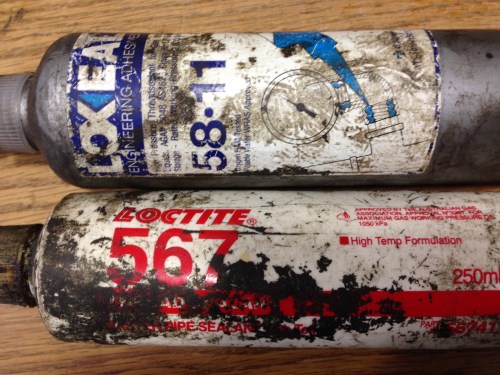
And this is what I used to steam proof the joins.  I used no gaskets.  The Loctite 567.  It was recommended by an expert friend who uses it on full size steam engines (thanks Tom!).  The Loxeal 58.11 is also excellent but it sets very hard, and is very difficult to separate later.


FullSizeRender 17.jpg

Small Tube Bender


I have recently been busy installing a steam powered water injector on the 3″ Fowler traction engine.  Involved quite a few bends in 1/4″ copper pipe.

IMG_6205

Some of the new pipework on the traction engine.  Since this photo, I have also made the winch functional.  (pics of that in future post)

FullSizeRender 8.jpg

Hand pipe benders.

I was not totally satisfied with the regularity in the bends, or the straightness of the runs in the pipe.  That provoked some discussion at our model engineering group, and one member (Stuart T) showed us the pipe bender which he had made some years ago.

IMG_6209.JPG

Pipe bender designed and made by Stuart Tankard.


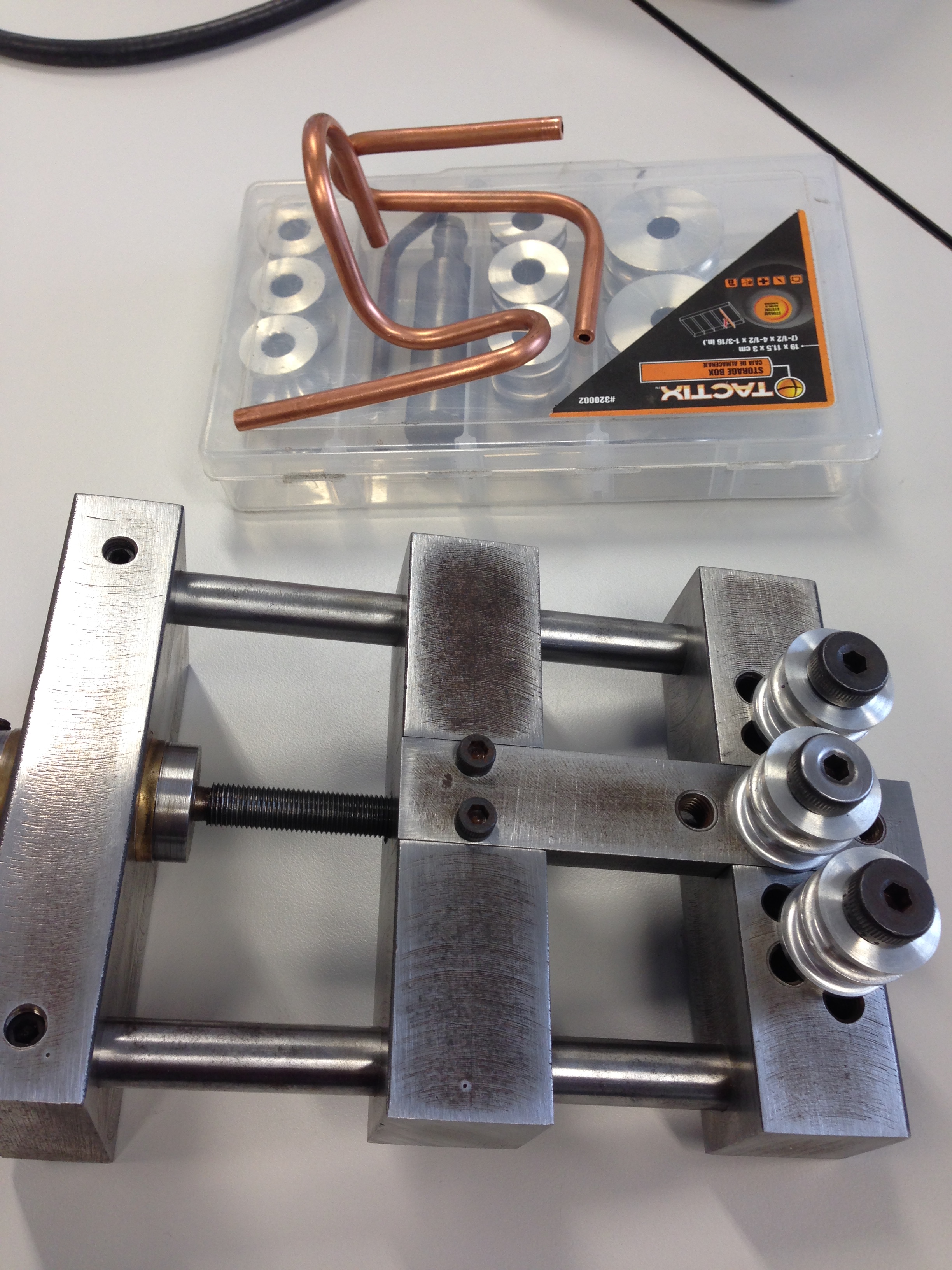
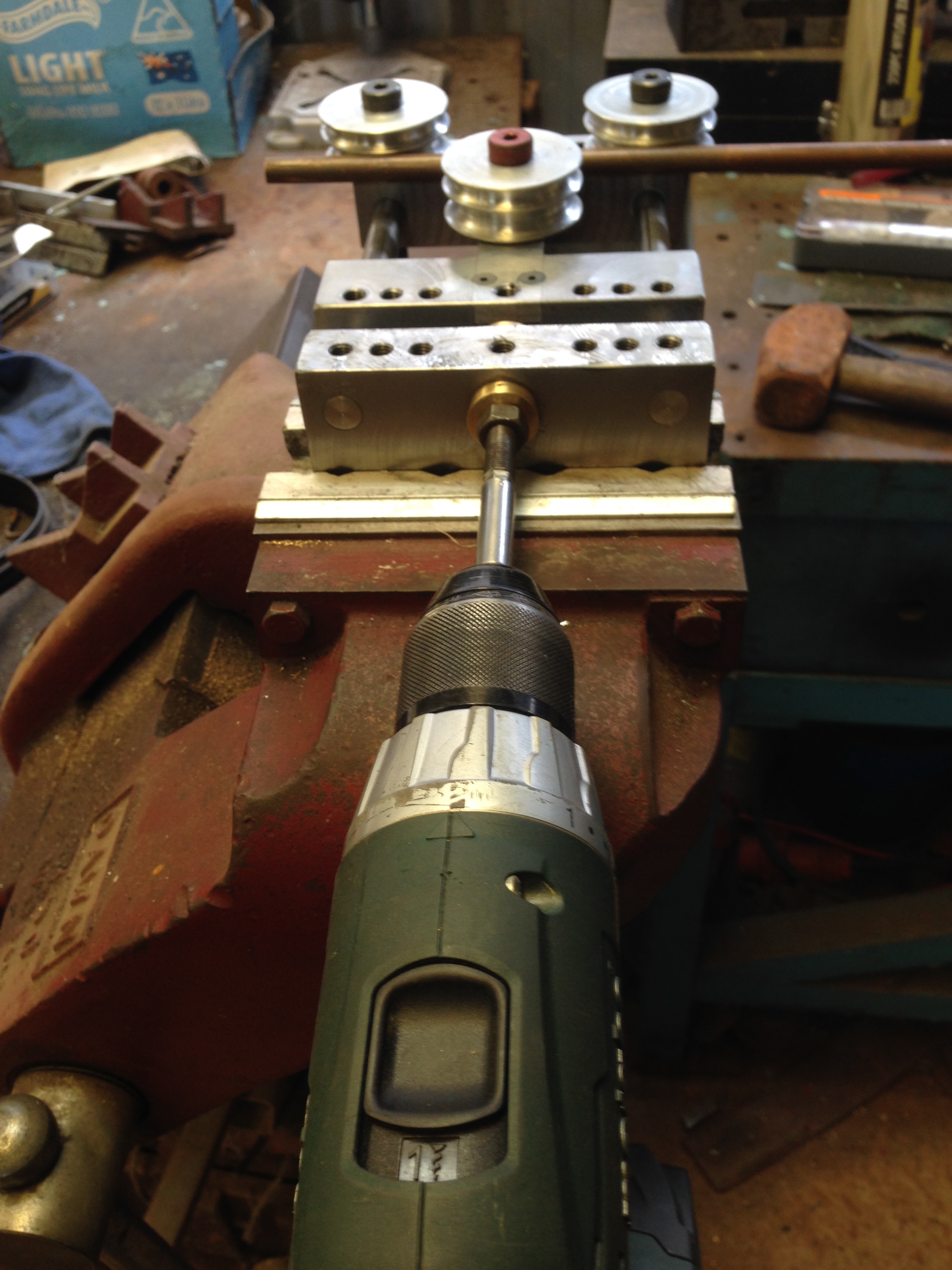
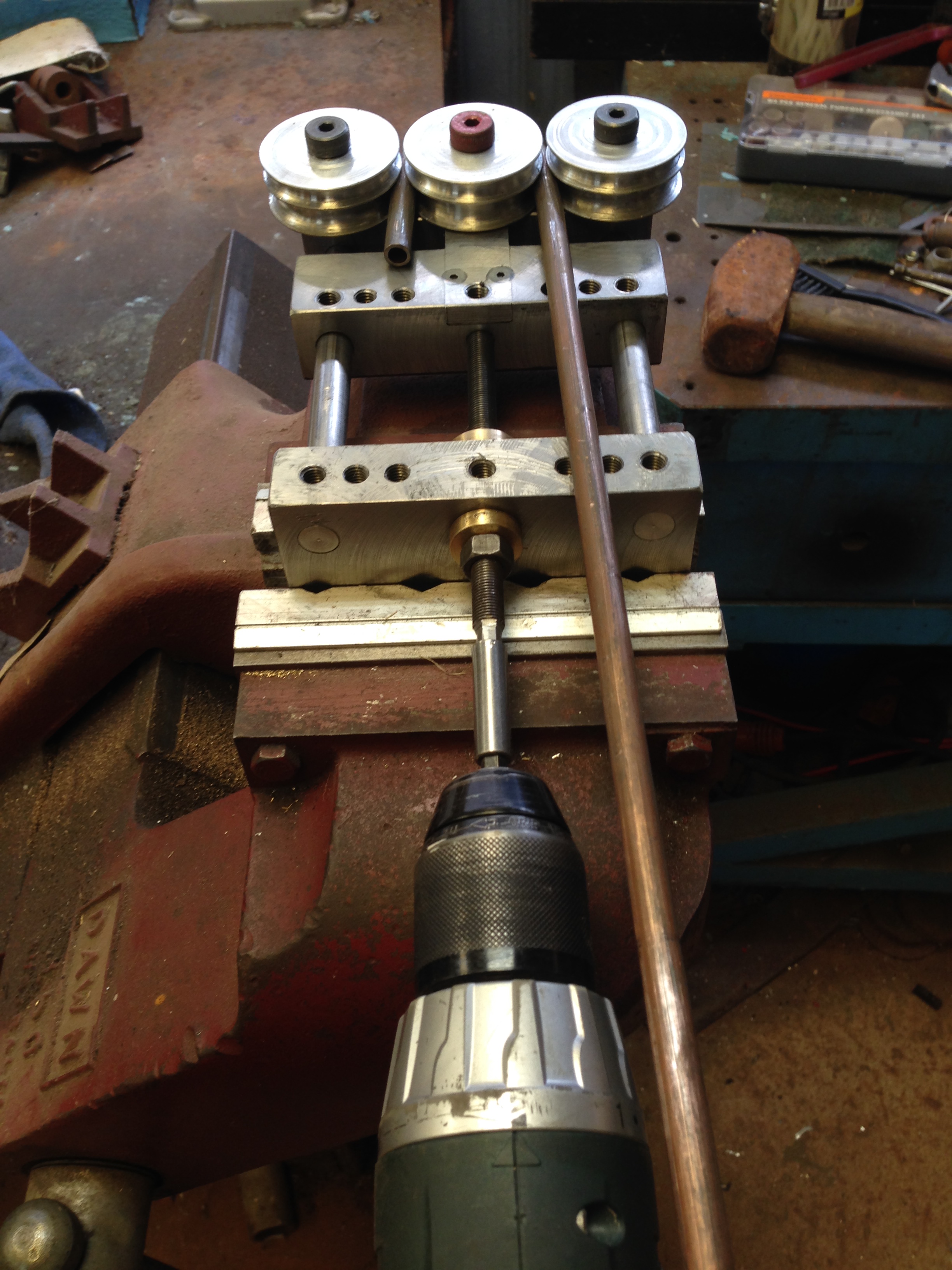
As you can see it has a  heavy duty frame,  shoulder bolts holding the rolls with machined slots for various sized pipe, and a 19mm hex connector for the driving battery drill.  A demonstration of pipe bending on this machine convinced me of its superiority to the hand held benders

Fortunately for me Stuart still had the plans which he had drawn up, so I made my own bender.  I made a couple of changes to Stuart’s design.  I made a 1/4″ hex on the driving screw, to accept the commonly used connector for battery drills.  And I did not have any suitable bronze for the main bush, so I made a brass bush, which incororated  a thrust ball bearing which engages during the bending procedure.  Probably unecessary but it was there in my junk drawer so I used it.

IMG_6231

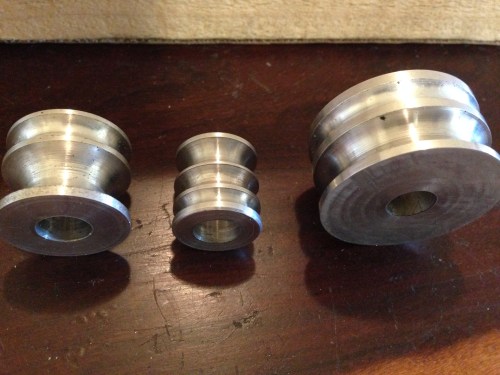
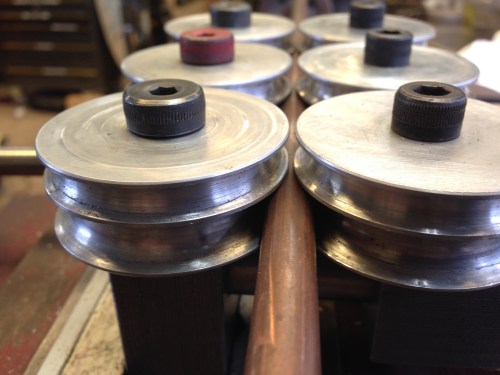
The radius of the bend in the tube is determined by the radius of the roll.  1″, 3/4″ and 1.5″.  Each radius has grooves for 1/8″ 3/16″ 1/4″ 5/16″ 3/8″ and 1/2″ tube.  Since then I have also made 2″ rolls.

FullSizeRender 14.jpg

Aluminium rod for the rolls.  

FullSizeRender 16.jpg

Using a bearing to centralise the tailstock end before center drilling.

Groovetools

The lathe tools used to make the grooves.

IMG_6243 3

3 rolls turned from each length, with an allowance for parting.  Then drilled and reamed, and parted in a lathe big enough for the 2″ bar to be securely held.


IMG_6232

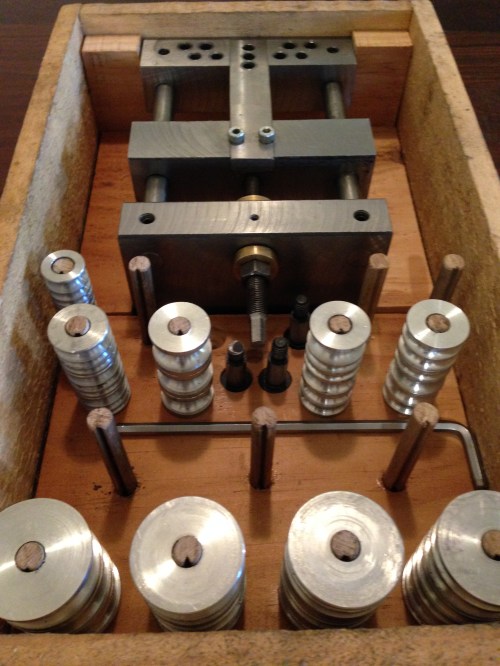
Completed bender.  The wooden box keeps the components organised.  Not a tribute to the craft of wood working but it will do.   The vacant pegs are for 2″ rolls which are yet to be made.

IMG_6221

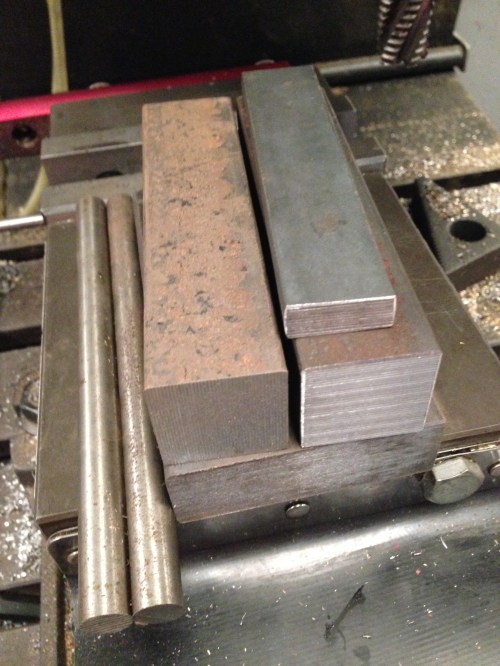
The raw materials for the tool.  1″ X 3″ and 1″ square mild steel, and 1/2″ silver steel.

The bender is held in a bench vice.  The bending process is quick and controllable using a variable speed battery drill.

The symmetry of the rolls (as opposed to the asymmetry of the hand held tools) means that the centre and the mid point of the bend is totally predictable.

Since then, I have made some further changes in the design of the pipe bender.

  1. I have added some feet so it sits squarely on the bench and does not require a vice for support, although it can be held in a vice if preferred.  The tool is quite heavy, so small jobs can be managed without a vise.
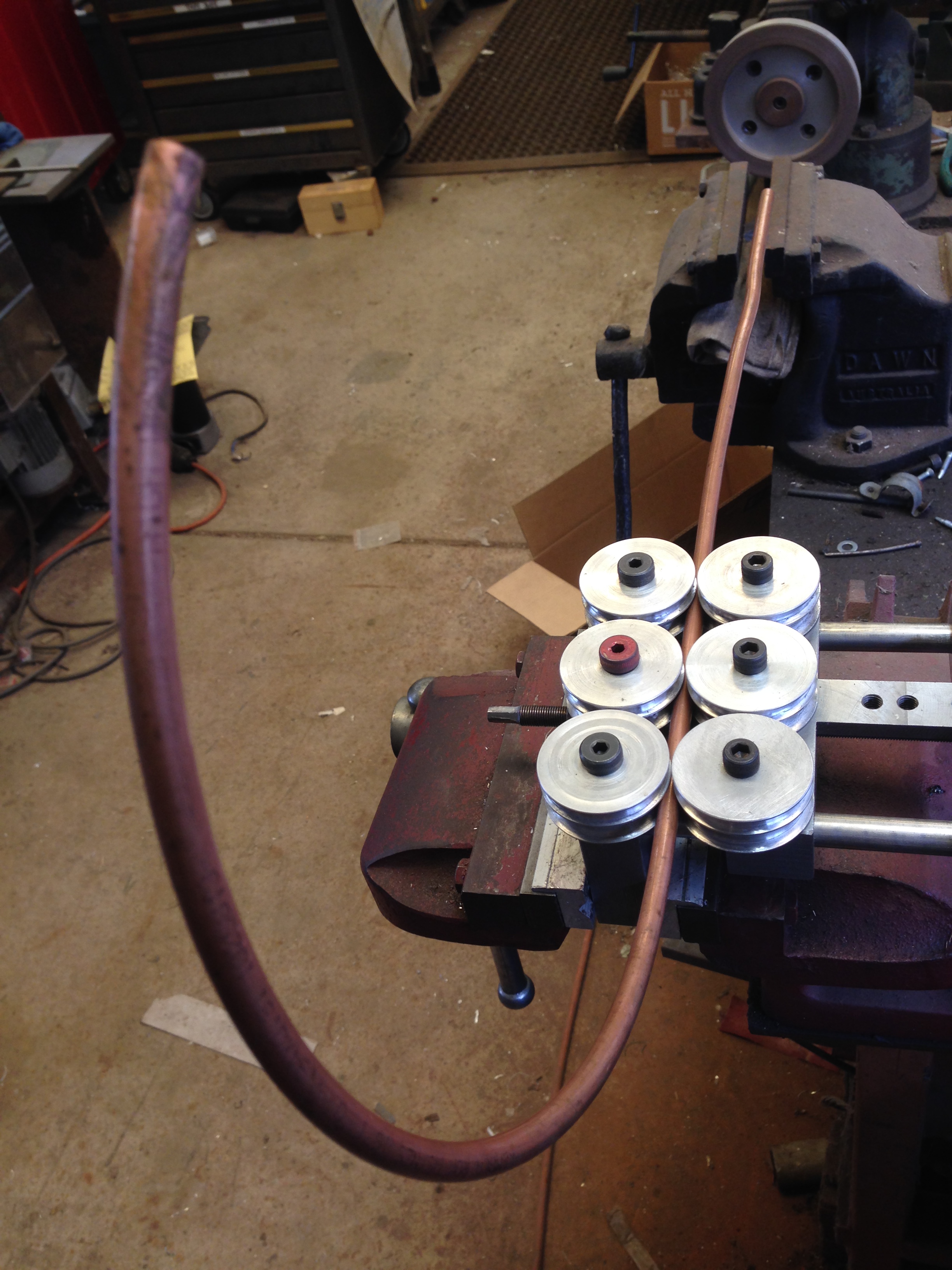
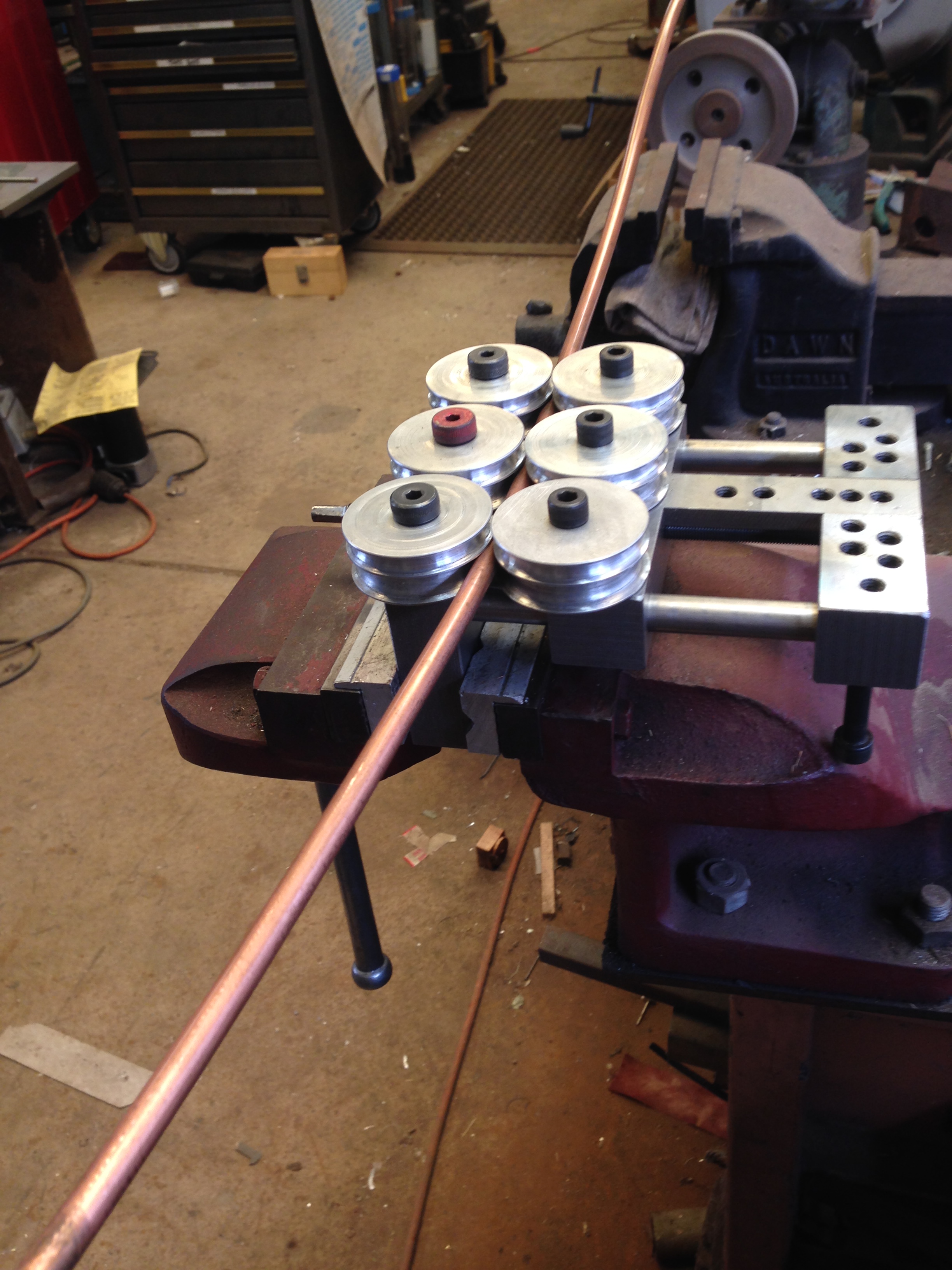
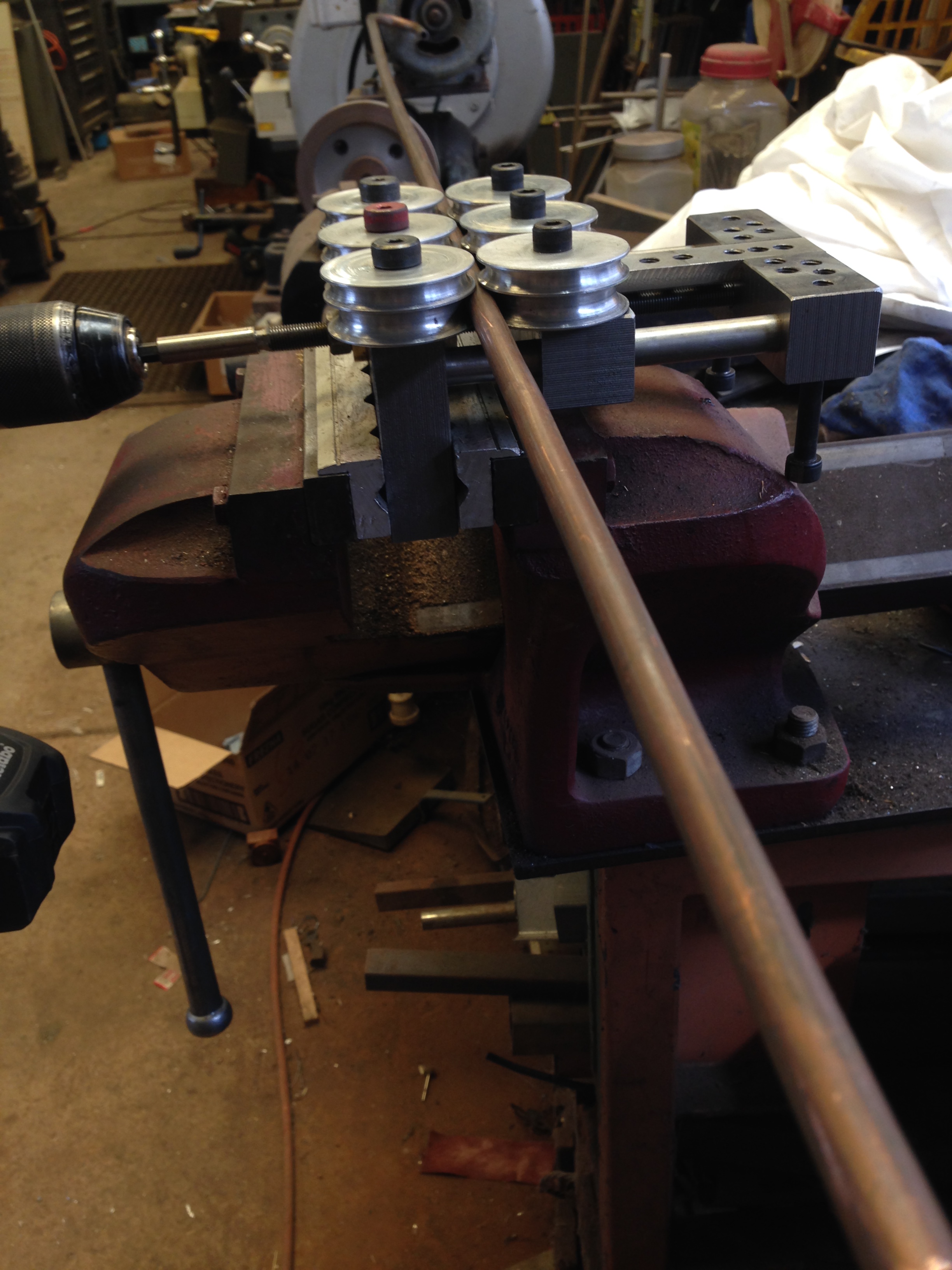
  2. I drilled and threaded some extra holes, to accept 2 rows of 3 rolls.  See the photo below.  That pipe bender has now become a pipe straightener.  I made some extra rolls, so now there are 6 rolls of the 2″ size.  As long as the 3 rolls in each row are identical, the rolls in the 2 rows can be different for the straightening process, but ideally there should be 6 rolls for each pipe diameter.  Straightening copper pipe is easy, as long as there are no kinks or very sharp bends, and the copper must be annealed.  The pipe should be approximately hand straightened, cut to length plus about 2″, then pulled through the rolls which have been adjusted so the rows  are almost touching.  3 or 4 passes, with some rotation of the pipe each time results in a near perfect straight pipe.   Any slight residual bend can be eliminated by rolling the pipe on a flat surface.
in box.JPG

Some extra threaded holes added pipe straightening to the tools functionality.

straightening 1.JPG

Two rows of rolls are needed to straighten bent pipe.  So I made 3 extra wheels in 1/4″ and 3/16″ sizes.  Later I realised that the extra three rolls do not have to be identical diameter to the first three, as long as each triple are identical.  The tool straightened this bend quite nicely, although with some experience, I would now probably hand straighten it a bit before putting in the tool. 

straightening 2.JPG

After 2 or 3 passages.

straightening 3.JPG

And some rotation with each pull through

straightening4.JPG

The copper does have to be annealed to get a good result.

bend start.JPG

And to put a bend in that nice straight tube…  some shuffling of the roll positions….attach the drill (slow speed setting)

bend end.JPG

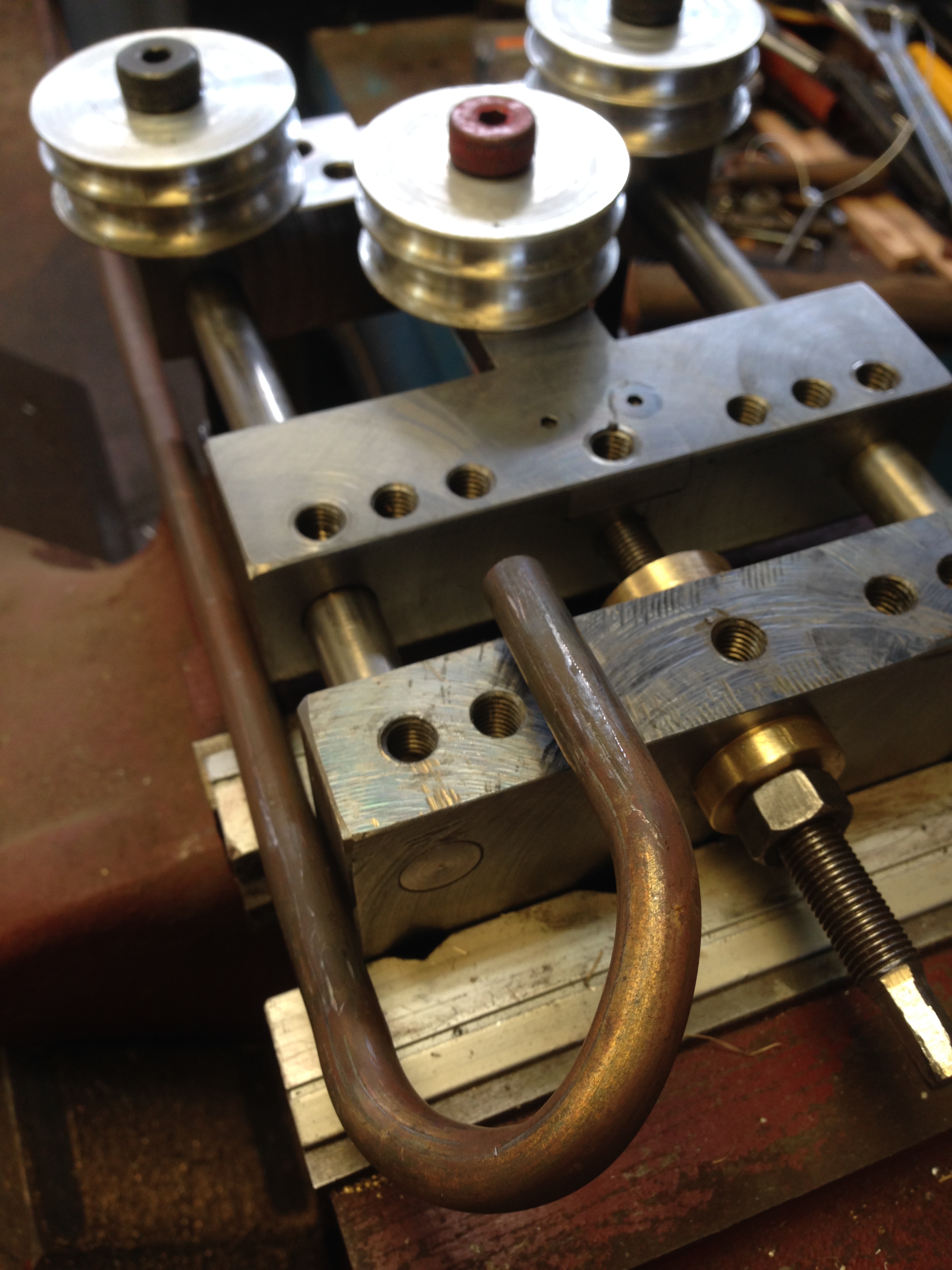
And a quick and easy bend. 

Bent copper.JPG

Pretty good


underside.JPG
The underside.  Substituted cap screws for grubscrews, so the tool sits flat on the benchtop.  quite adequate for light bending jobs, but straightening needs a vise.


How to time a Model Triple Expansion Steam Engine

The daunting aspect of timing the triple delayed the completion of mine by at least 6 months.  In the event, it was not difficult.

If timing a steam engine is not a particular concern of yours, I suggest that you turn off now.   Otherwise this will be particularly boring.  This post is in response to a request by a reader.

The engine needs to be pretty much completed and assembled.   Everything fitting.  Crankshaft rotating.  Valve rods tightened.  Stephenson’s reversing mechanism assembled and working. Cylinder drains installed.

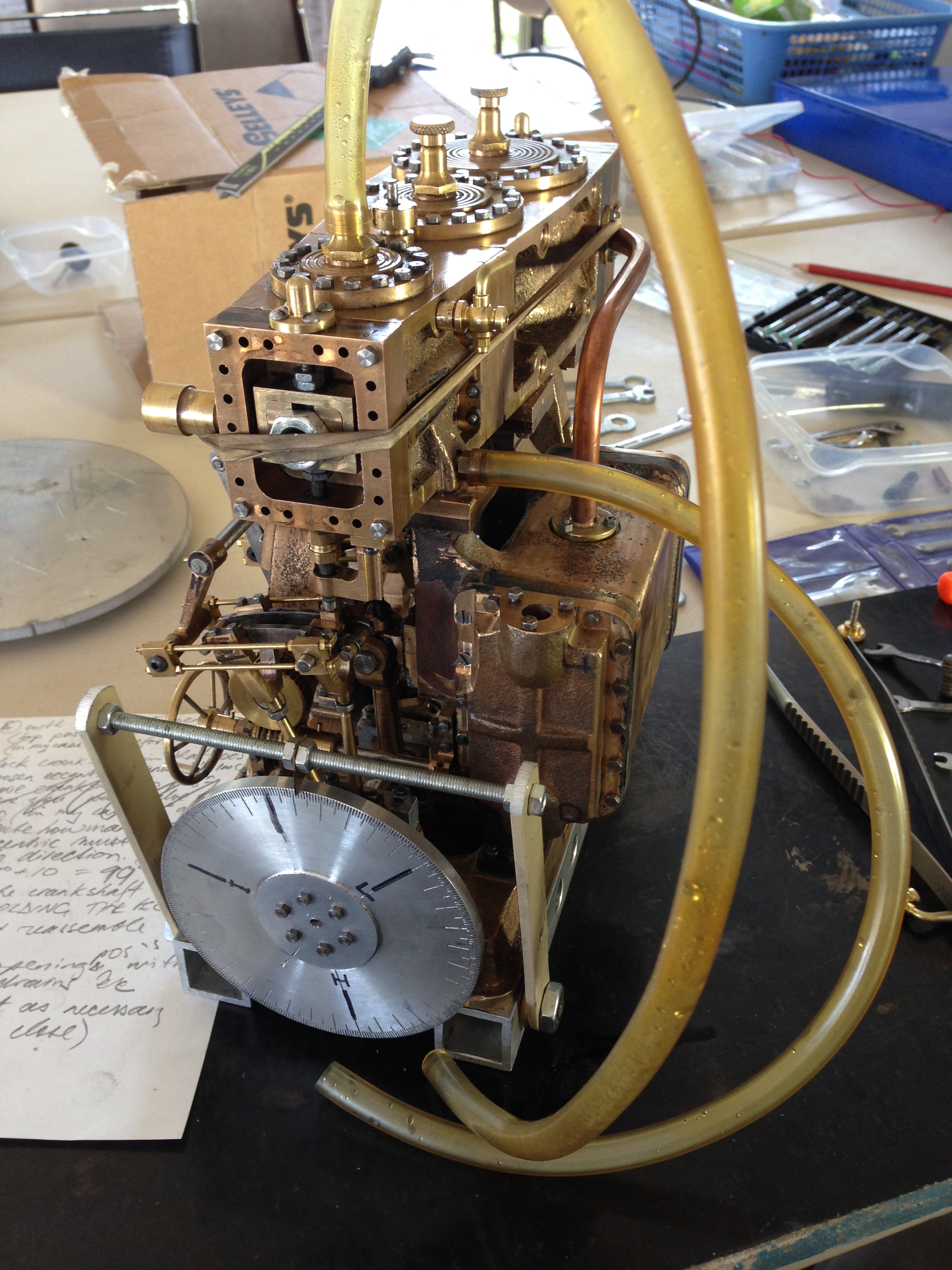
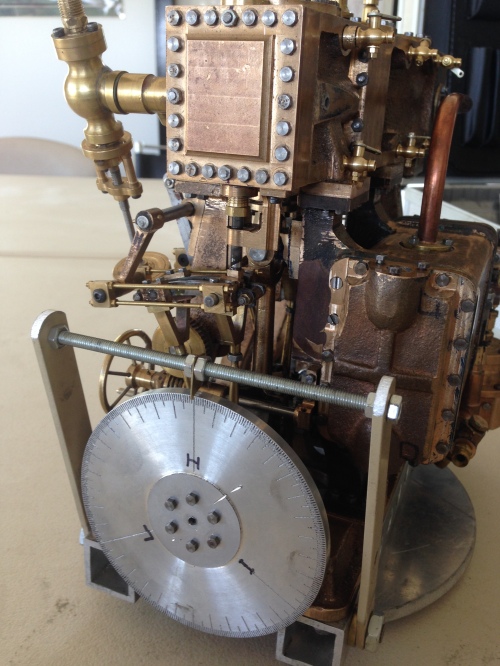
Next I suggest that you make or buy a 360 degree protractor, and attach it to the crankshaft at the high pressure end.  Like this.
IMG_6079

Note that top dead centre (TDC) of each piston is marked (H,I,L), there is a pointer, big marks at 120 degree intervals, and identifiable marks at 10 and 5 degree intervals.  I added a rotation arrow later, because it is easy to mistake clockwise and anticlockwise directions when making adjustments.

Next, decide where in the cycle you want steam to be admitted.  On expert advice from a marine engineer who is also a model engineer, I decided to admit steam at 10 degrees after TDC. (thanks Rudi!).  I also decided to cut off admission of steam at about 70% of the  power stroke. (pretty standard).

The easiest valve to time is the low pressure valve.  It is on the end of the engine.  It is the biggest, and there is not much engine stuff getting physically in the way.  Despite that, I decided to start with the high pressure valve.  It also is on the outside end of the engine.  The reason is that I wanted to follow the passage of the steam flow, in order to understand what was happening.  Each cylinder is timed separately, independently.  So the order is, high pressure, intermediate pressure, low pressure.  Forward direction first, then reverse, for high, then F & R for IP, then F&R for LP.

The timing is adjusted by 1. changing the distance between the crankshaft and the valve, usually by adjusting the length of the valve rod and 2. by changing the position of the eccentric on the crankshaft.

Firstly, the valve must move equally over the steam inlet slots. (the top and bottom ports). The point at which the inlet slot starts to open is noted on the protractor for both steam inlet ports.  The number of degrees before or after TDC is noted for the top port, and the procedure is repeated for the bottom port.   For the bottom port Bottom Dead Centre (BDC) is the reference point on the protractor.  The angle should be identical for TDC and BDC.  If it not identical the length of the valve rod needs to be adjusted.  On my machine, that was done by adjusting the nuts holding the valve rod to the valve bracket, but it could be the valve rod to the eccentric strap.

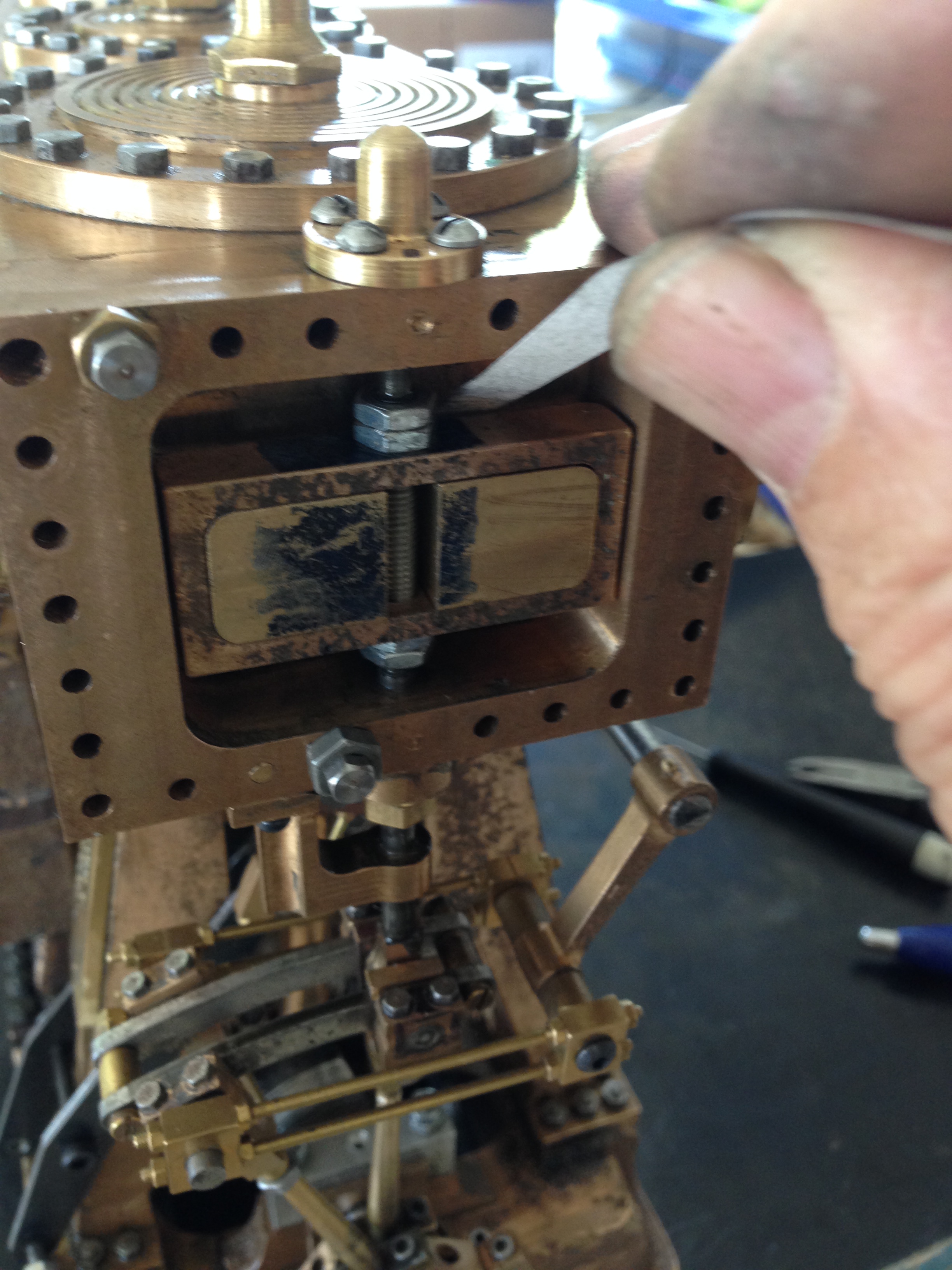
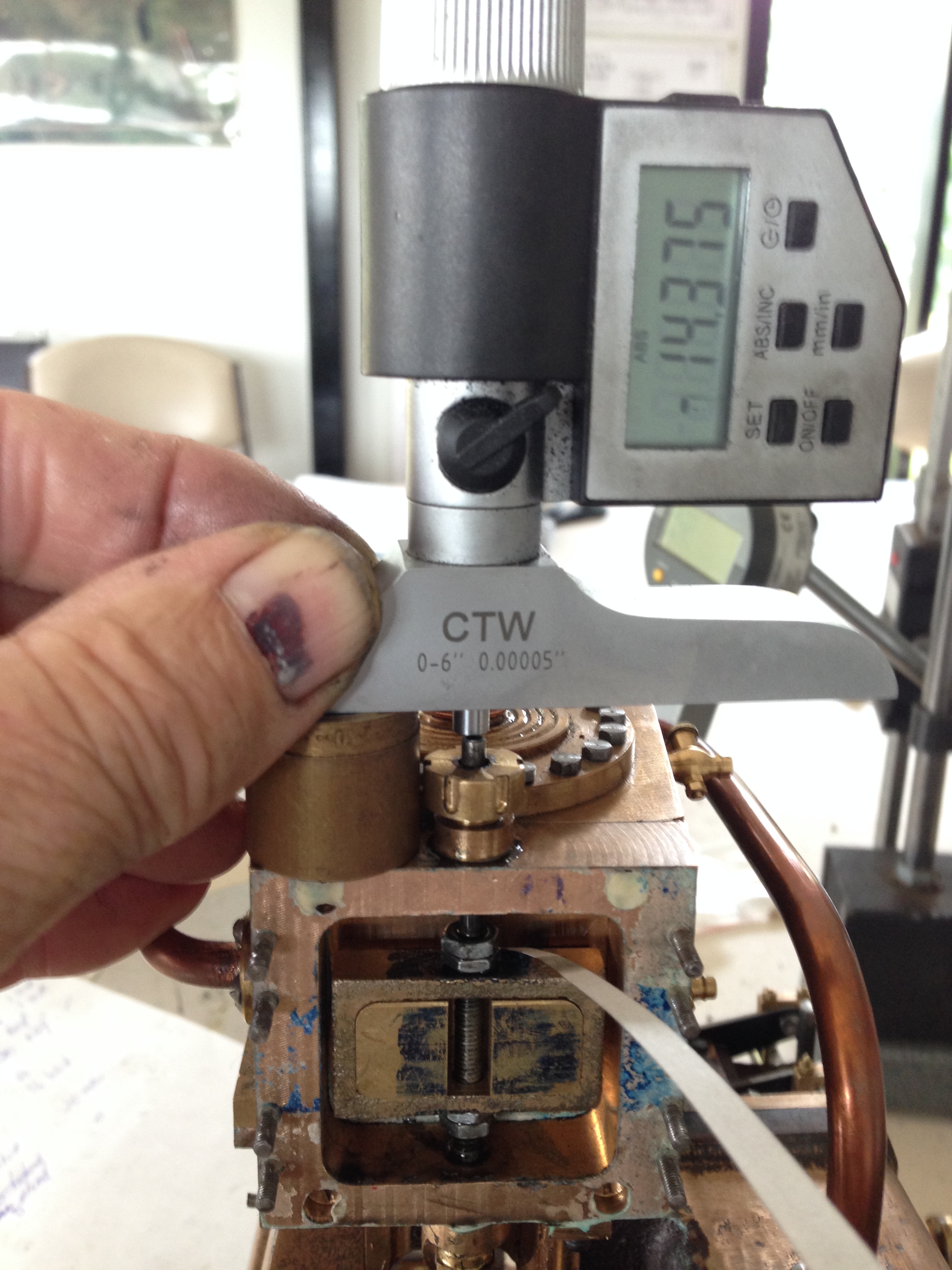
Determining the point at which the steam inlet port starts to open is easy.  Remove the valve chest cover, bolt the valve chest to the cylinder block, and rotate the crankshaft by hand until the port is obviously visually open.  Cut a sliver of paper 5-10mm wide, (I used copy paper), measure the thickness of the paper (0.1mm in my case), insert the paper into the open port, rotate the crankshaft to close the port until the paper is jammed, then while applying tension to the paper, slowly rotate the crankshaft to open the port, until the paper just starts to move.  At that point the port will be open by the thickness of the paper.

IMG_6139.JPG

The valve cover is off, a sliver of paper is pushed a centimeter or so into the port, the crankshaft is rotated to jam the paper then the crankshaft is rotated in the direction that is being adjusted until the paper is just released.   At that point the port is open by the thickness of the paper.  I calculated that 0.1mm was equivalent approximately to 3 degrees of crankshaft rotation.  So whatever was displayed on the protractor, I subtracted 3 degrees to get to the exact point of port opening.

when the valve moves exactly equally up and down over the steam entry ports, the point of opening is noted on the protractor relative to TDC of BDC, depending on which is being measured.

The eccentric grubscrew needs to be loosened, and  rotated on the crankshaft to bring the point of port opening to 10 degrees past TDC.  Then the grubscew is tightened.  BDC will automatically be correct if the centering process has been done accurately.

I had bored a hole in the eccentric strap to allow access to the grubscrew from underneath the engine.  That meant that the crankshaft had to be in a certain position to allow access to the grubscrew, not necessarily TDC or BDC or whatever.  That does not matter.  What matters is that the eccentric is rotated a certain number of degrees on the crankshaft.  I did this by using the Allen key to loosen the grubscrew, then using the Allen key to hold the eccentric fast, while rotating the crankshaft.  Then tighten the grubscrew, being careful to not move the eccentric.   The measurements need to be rechecked of course.   With practice, it is not difficult, and can be accomplished first go in most cases.

If this all sounds complicated and difficult, it really is not.  But I did need to make a record of every step and measurement and direction.

For the intermediate cylinder, the HP cylinder block needs to be removed.  The HP valve chest can be retained, just swung out of the way, retaining the previous settings..  You have to be careful, but this method does save a heap of bother.
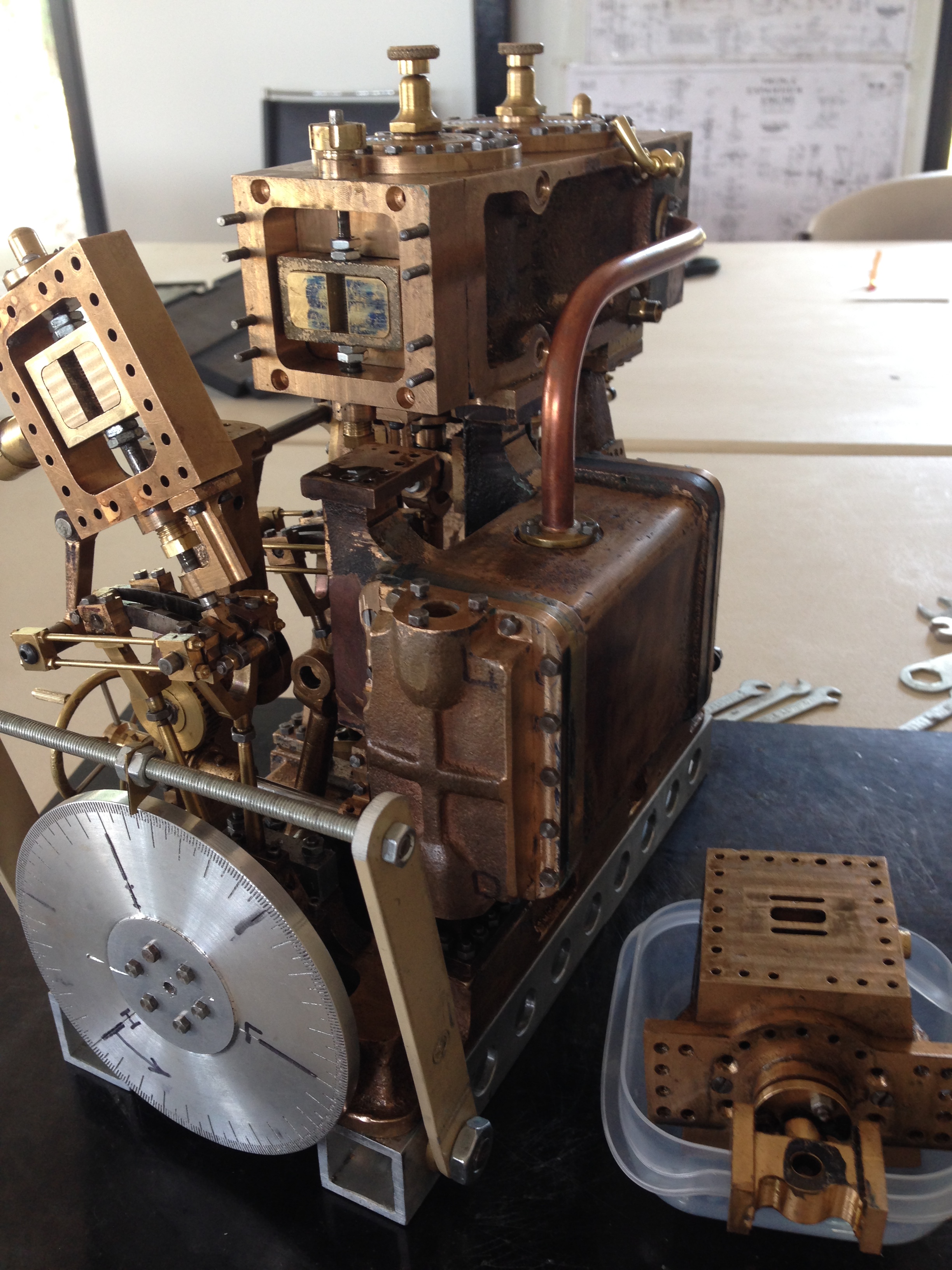
IMG_6140.JPG

One thing I would suggest.  When the opening points of both IP inlet ports are determined and set, I suggest that before the HP cylinder block is reassembled, that the IP valve rod is measured above the IP valve chest.  And that the measurements are recorded and placed in a secure vault.  Those measurements can be used for any future adjustments of the IP valve, without the time consuming and very fiddly necessity of removing the HP cylinder block.

IMG_6165.JPG

I have determined the opening points for the intermediate cylinder using the paper method.  With the depth micometer on the valve rod above the valve chest, I am measuring and recording those positions, for possible future use.

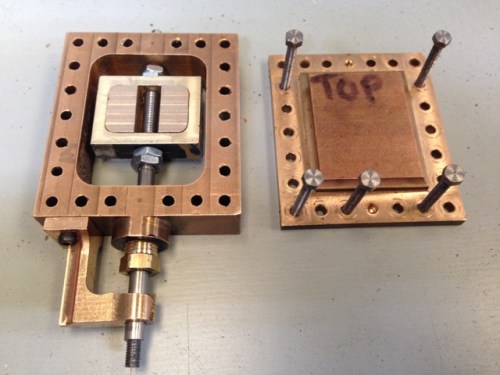
And I have a confession.  The next photo shows the HP upper cylinder drain, and the same view at top dead centre.  As you can see, at TDC the piston blocks the drain.)!*!)  Read on.
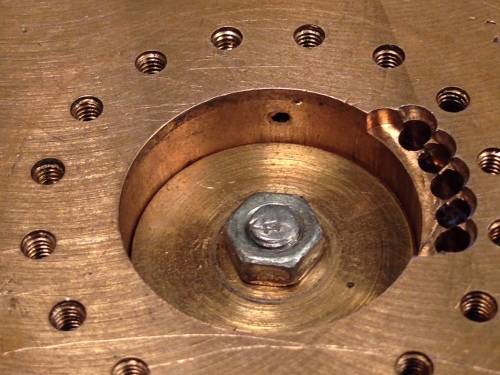
IMG_6203.JPG


IMG_6204 2.JPG

There is another method for determining the opening point of the valves.

IMG_6133.JPG

Plastic tubes are pushed on suitable points for the cylinder to be set, in this case the HP. The valve is pushed against the valve face, in this case with rubber bands.  One blows into the appropriate tube while rotating the crankshaft.  When the port starts to open, you can hear your exhaled breath coming through (if your hearing is OK, which mine is not).  The protractor reading is recorded, and used as before.   Note:  the drain cock passages MUST NOT be occluded by the piston at TDC or BDC.  In my case, this proved to be a problem, hence the use of the strip of paper method.

So, I hope that this is of some use.  If my description is jaberwocky, please send a message and I will try to help.    John.

First taste of steam for the MODEL TRIPLE EXPANSION ENGINE

I made a video of this first run, but I am experiencing great frustration uploading it, due to our totally pathetic Internet speeds here in Australia.  I will include it later in this post, but the resolution is way down.  I will upload a higher res version next weekend.

1 setup.JPG

Stuart Tankard’s superb gas fired vertical boiler, was also getting its first run powering a steam engine.

2 setup.JPG

We did not connect the condenser until later.

OK, so here is the video.  Again, apologies for the low res quality.

Model Triple Expansion Steam Engine. First taste of steam tomorrow!

I was very excited to see my triple running reasonably well on air recently.  But it was tight, and required a decent gutful of air pressure to turn it over.  But it did go!

Then it seized.

The cause was the intermediate cylinder valve rod seizing in its guide.  Probably a bit tight,and not getting any oil.

So I have loosened the gland, installed a displacement oiler, and made and installed a flywheel.  I also finished the pipework around the condenser.

IMG_6173.JPG

Displacement oiler top left, brass flywheel, and pipework.  The condenser on a marine engine would have been cooled with seawater, pumped with a separate pump, but I have used the 2 pumps on either side of the Edwards air pump.  In future I might install another pump.  The book “Marine Steam Engines and Turbines” has been been very useful.  

IMG_6179.JPG

I just like all of the brass and copper and components in this picture.

IMG_6170.JPG

The flywheel is too big for the scale, but my model does not have the weight and momentum of a propeller shaft and propeller, so a sizeable flywheel seemed appropriate.  Later I will add some gear teeth on the flywheel and a cranking handle on a removeable pinion, which some medium size engines had to assist with cranking to a starting position.  

So, tomorrow I will hook my triple up to Stuart Tankard’s vertical boiler, and see what happens.  I am sure that steam leaks will be revealed.  Hopefully there will be a video worth posting!
TRIPLE EXPANSION MODEL ENGINE- FIRST RUN (air)

This is a short video of the first run of the Bolton9 Model Triple Expansion Steam Engine, which I have been building on and off over the past 3 years.

The video is a bit shakey, because it is taken on my hand held phone while I am using he other hand to operate the controls.  I really did not expect the engine to work!

It runs a bit roughly, and is still quite tight, but settles down in the final few seconds.

It is not running very smoothly, because it is on air rather than steam, and because it is probably only powered on the high pressure cylinder, and maybe a bit on the intermediate, and not at all on the low pressure cylinder.

The next day it would not run.  Very frustrating.  I suspect that one of the eccentrics slipped on the crankshaft, and threw the timing out.  Not the easily accessible low or high pressure valve, but the intermediate one, which needs another teardown to get to it.

But Hey!  It will work.  I can see the light at the end of the tunnel.

One of my readers has requested a description of the triple engine timing procedure, so that will appear on this blog soon.  Unless you have a particular need for the timing info I suggest that you give that post a miss.

Back to the Triple Expansion Steam Engine

IMG_6013

I installed these cylinder drains on the triple, but was not satisfied with their appearance because they looked too big.   So I bought some of a different pattern from Reeves UK.

IMG_6077.JPG

The new cylinder drains are smaller, and have a handle which is suitable for joining all 6 drains to one control handle.

IMG_6071.JPG

The new cylinder drains are a more realistic scale.  I suppose that I should have made them myself.  

IMG_6080.JPG

From above.  Getting them to line up was a fiddle.


IMG_6079.JPG

The crankshaft protractor now has a (temporary) pointer.  When the timing is finally adjusted, the protractor and pointer will be removed.  I am planning to make and install a crank positioning gear and pinion and lever.

IMG_5680.JPG

The crank positioning gear and pinion shaft on the full size, ship’s triple expansion steam engine at The Geelong Showgrounds.  It is on the low pressure end of the engine.  I will make something like this to act as a flywheel on my model triple.

More Wierd Stuff

Since my “Strange Lights over Geelong” experience I have been looking at all sorts of weird posts on YouTube.  UFO’s, crop circles, megalith structures, evidence of buildings on the moon and on Mars.  There is a mountain of information out there, and while a lot of it is lies and rubbish, some is harder to dismiss.   It is not inconceiveable that Governments have information which they are witholding from the general populace, about aliens, UFO’s, ancient civilisations and so on.  Indeed, there are YouTube interviews with ex astronauts about UFO’s on the moon, and ex government ministers and officials about UFO’s and aliens, and Rothwell.  It may well be that the current increased talkativeness is due to a recognition by governments that they can no longer keep a lid on the previously secret information, so they are gradually allowing people to talk.

One line of posts which I have followed is evidence that something is going on in Antarctica.

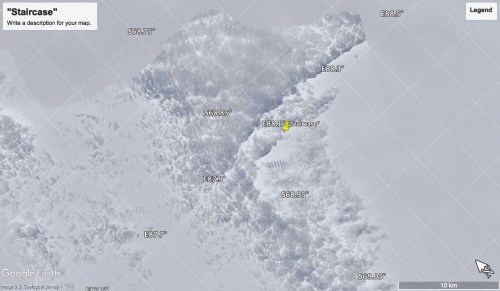
And one source of information is Google Earth.  One post related to a strange set of giant “steps”.  I checked on the post information by checking the coordinates in Google Earth.

staircase.jpg

Look at the middle of the photo.  That series of “steps” does look unusual.  You can check on this yourself by entering the coordinates on the photo into Google Earth.   The “staircase is about 2.5km long, with each step about 250 meters.

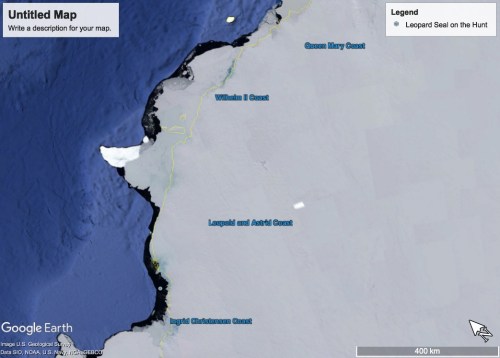
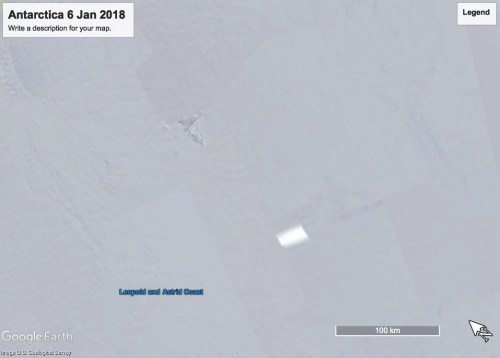
Anyway, to continue with my story, as I was zooming out from this point, I noticed a bright shape about 138km towards the south.

Antarctica #4.jpg

The object which caught my eye was the white rectangle above the word “Coast”.  This section of Antarctica is directly south of Western Australia.  The rectangle is about 380 km from the coast.

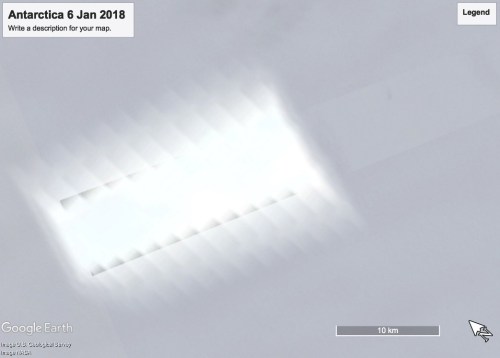
And this is what shows up on Google Earth as I zoomed in.

Antarctica 6 Jan 2018 #2.jpg

The image is from 1999.  The black rectangle is 21 x 7km…  Quite a size!   I am unsure what the bright white is.  Possibly sunlight reflecting off a shiny surface.  Or a rough attempt at concealing the rectangular area?    This is at latitude 70.2 S, longitude  87.2 E.

Antarctica 6 Jan 2018.jpg

Also, there is a faint streak from the rectangle heading about 100km to the east.  It is also 7km wide.     The staircase area is also visible to the north.

So that is it.  I can find no reference to this structure, but if anyone knows anything about it, please enlighten me.   If you have any interest in this weird stuff, you might the posts on YouTube by SecureTeam10 worth watching.

I am heading back into the workshop tomorrow.  Installing a steam powered boiler water injector on the Fowler traction engine, and bit by bit, finishing the triple expansion engine.

I have installed the new AC Servo motor to replace the spindle motor on the Boxford 125TCL CNC lathe, my expert friend Stuart Tankard has wired it up and reconfigured Mach3.  I am delighted to report that it has vastly improved the CNC lathe.  Will post some pics in a day or two.

Triple Expansion Steam Engine Cylinder Cocks

Some further progress on the triple.

I bought cylinder cocks from Reeves UK, and the picture shows them fitted.  In case I eventually install a mechanism to open all of the cocks simultaneously, they are in straight line, which necessitated making extension peices for the high pressure cylinder cocks.

The handles required bending to clear the pipework.

The cocks look a bit strange to me.  Too big, and the handles are wrong.   I am thinking about making a set from scratch.  But that can wait.

IMG_6013.JPG

Drain pipes from the cocks will be installed at some stage.  Still deciding where to run them. And whether to join them into a common trunk.

FullSizeRender 7.jpg

The engine turns over by hand, but it is still a bit stiff.  There was a tight spot which took many hours to locate.  It turned out to be a valve rod thread which was about 0.5mm too long, touching the inside of the high pressure valve chest.   Fixed in a jiffy.

I hooked up the engine to a small compressor at 30psi, but general stiffness prevented the engine from rotating.  So I gave it an hour being rotated in the lathe at 200 rpm.  It is noticeably more free, and getting very close to working.  The valve timing is approximately correct (checked by my expert friends Thomas L, and Rudi V), but will need fine tuning at some stage.

Running in the Triple Expansion Engine

The Bolton 9 engine is assembled, almost completely.  The valves are approximately correctly timed.  I can turn it over by hand, just.  There are a few tight spots.

So today I mounted the entire engine in a lathe, oiled all bearings and slides, and tentatively ran it for a few minutes.   The lathe was set at 60rpm, in back gear.

All seemed OK, so I ran it for about 30 minutes.   Then increased the rpm to 90 for another 30 minutes.  After that the tight spots still exist, but much less pronounced.

IMG_5932.JPG


I kept a check on bearing temperatures with a laser thermometer, and none were running more than a degree or two different from any others.

The test did show that a low pressure cylinder drag link is touching the condenser, and will need some relief.  Also the high pressure cylinder eccentrics need to be repositioned a little on the crankshaft.  But nothing major.  And it was very nice to see everything moving in quite an impressive manner.

I will upload a video when the upload speeds are reasonable.


2 Triple expansion steam engines.

More Triple Photos

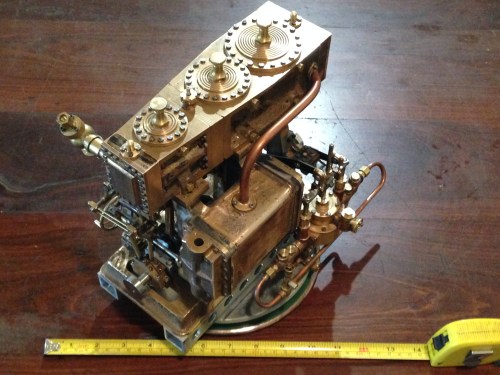
Reader Richard suggested that I include a ruler in some of the triple photos, for a sense of scale, so here it is.

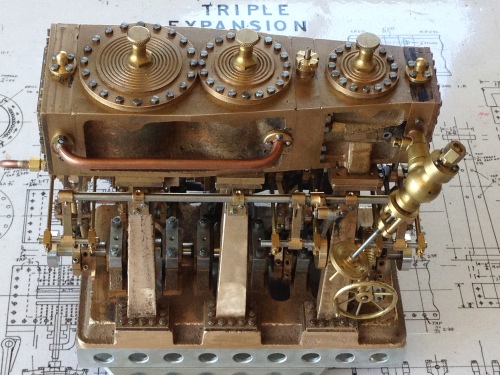
It is approx 300mm long 200mm wide and 270mm high.  Weighs 12.4 kg.

IMG_5669.JPG

Triple Expansion Engine Update

Well, almost another whole year has elapsed, and still the triple is not finished.  Come December, and that will be 3 years that this project has occupied my thoughts and workbench.  With a few other projects in between.

Last week I assembled the components, in preparation for the Geelong Show.  GSMEE is a bit light on for new models, and it was suggested that the triple might fill some shelf space, despite being unfinished.

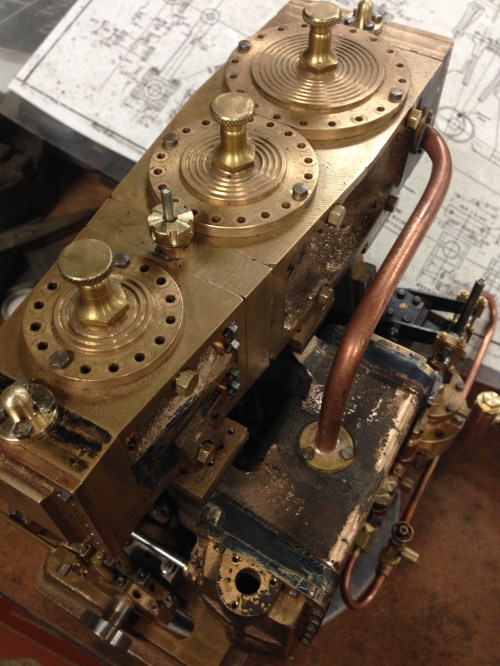
So I bolted it together.  All 429 fasteners!  And stood back and admired it.  It really is quite impressive, complex, and interesting.  So I took some pics.

IMG_5657.JPG

This is the condenser side, and the Edwards pump

IMG_5659.JPG

The other side is a bit lessy fussy, showing the steam inlet valve, the Stephenson’s links, weigh shaft  and controls.

IMG_5662.JPG

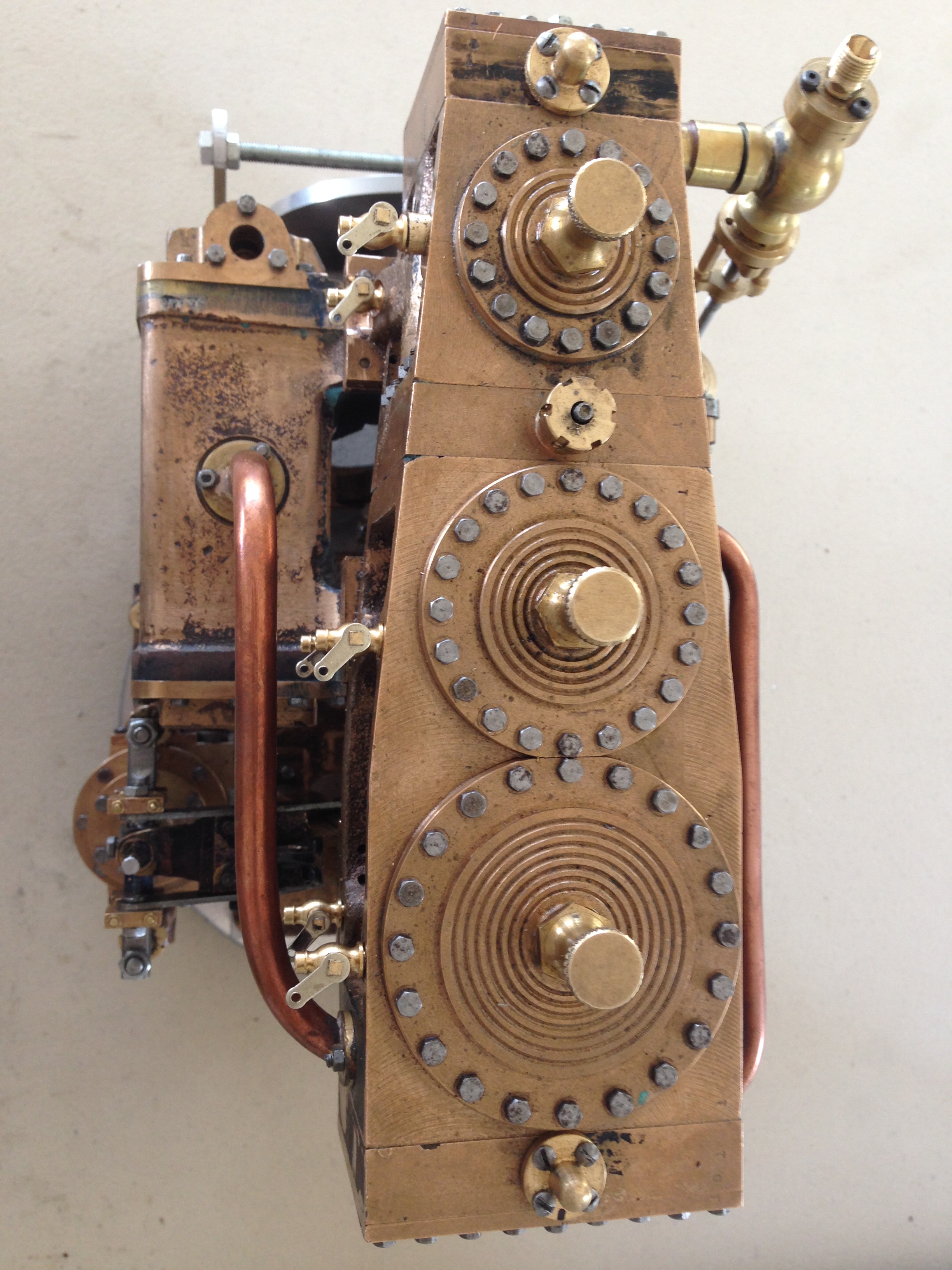
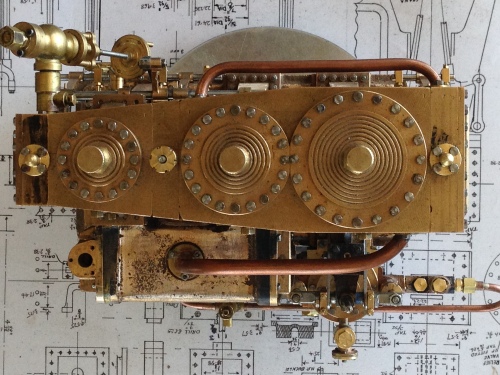
And the top, showing some of those 429 fasteners,

IMG_5665.JPG

The high pressure valve chest cover.  I will fill those holes where bolts cannot go.

IMG_5664.JPG

And the low pressure end, and links for the pump.

IMG_5660.JPG

And a close up of the steam valve and weigh shaft.

Not quite ready to run it yet.

It needs side covers for the cylinder block, drain cocks for the cylinders, and general freeing up.  It is still very tight.

Not to mention painting.  I expect that I will paint this one.   No idea of colours yet.

TRIPLE FINAL(?) ASSEMBLY

Just one photo to show that I have not totally ignored the triple expansion marine engine.   I have started to re-assemble it, having made almost all of the components.  But there were quite a few finishing tasks put aside until later, which I am now tackling.  eg lubrication points.  I suspect that this will not be the final teardown and assembly.

IMG_5233.JPG

The gunmetal base, with main bearings and crankshaft installed.  The eccentrics are not finally positioned.  

And some reminder photos from 2 years ago, of making the crankshaft.

IMG_2608

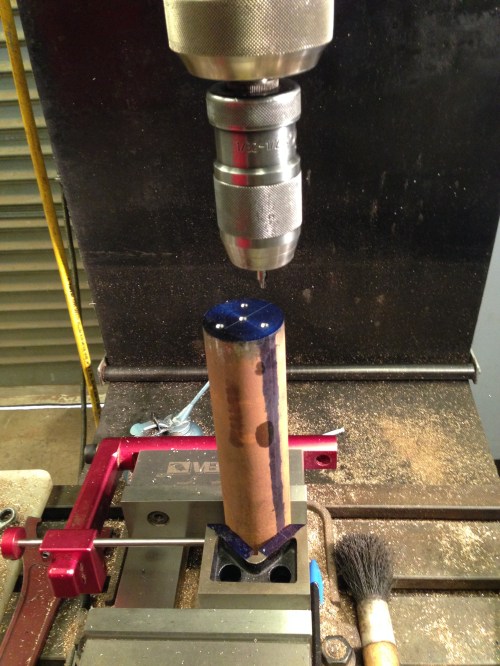
The centres were drilled on the CNC milling machine, after the locating the top of the bar

IMG_2638

Turning the second big end bearing.  Note the packing to support the crankshaft after the first big end had been turned.   The main bearings were turned last.

IMG_2641

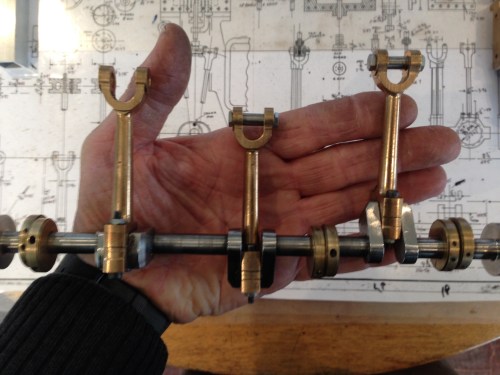
The finished crankshaft.  Not much remains of the 51mm stainless rod.

A Base for the triple, and some oil holes…

Thinking about the options for a base for the triple expansion marine steam engine..

I looked at every photo I could find on the net, and thinking about whether I want to be historically accurate, or just really solid, or a bit interesting with an historical flavour.

At this stage, the decision is not set in concrete, but I am going with the last option.  Photos later in this post.

But first, I have pulled all of the major components apart, and I am spending time doing a few of those jobs which I had been avoiding because they are difficult and imprecise, and if they go badly it will be a major disaster at this stage.  Like drilling the oil holes and wells for the big ends.

Nothing precise about this.  The con rods and big end shells and bearings have been painstakingly machined, and I do not want to think about remaking them if I stuff up.  And drilling into curved surfaces, with a 1.5mm drill bit…

IMG_5183.JPG

That thread is 3mm dia.  The hole above the nut is the oil way, 1.5mm dia.  Very tricky and too anxiety provoking to be thinking about a video.   Amazingly, it all went well!   I now have 2 oil holes for each of the 3 big ends.  I will need to fill the well with oil with a medical syringe and fine needle, but.

IMG_5172

The crankshaft, turned from stainless steel a year or two ago, and the conrods.  The big ends now with lubrication points.

And here are the major engine components, after partial disassembly.

IMG_5170.JPG

At top left is the condensor, then the cylinder block in 2 parts, then the steam supply valve.  The square section tube is going to become the base.  And so on.  You get the picture.  I will count the bits at some stage.

Then I cut and drilled the square section aluminium tube for the base.

IMG_5182.JPG

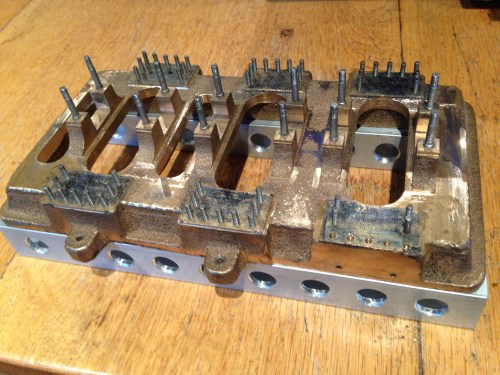
The cast base of the triple, with main bearing studs and column studs in place.  All sitting on the square section alu.  Have not decided whether to bolt it together, or just Loctite it. 

Those holes in the square section were drilled and chamfered on the CNC mill.


Triple Expansion Steam Engine Pipework.

I am close to disassembling the Bolton 9, before gradually reassembling it in preparation for running it on air then steam.  Most of the components have now been made.  Most recently I completed the pipework associated with the Edwards air pump and the twin water pumps.

IMG_4997

This is the combined air and water pumps, and new pipework.  Most joins are silver soldered, but a couple are Loctited.  Loctite should be adequate.  These components will not get super hot.

IMG_4999

This valve is one of the few components on this engine which I have not personally made.  This one came from the effects of the late Harry Close, who was a valued member of our Model Engineering Club.

IMG_5002

The pipework adds to the overall interest , yes?  It will look good when polished.

IMG_5001

And the “tails” for the valve rods, which are attached to their respective steam chests.  The BA7 bolts are a bit oversized for the job.  The intermediate cylinder tail screws into place.  I am not sure why it is different from the other two.

So now I am making a list of tasks which need to be completed when the engine is taken apart, hopefully for the last time before it is run.  The list is not complete, and so far it runs to 3 pages.  Mostly like fixing parts which interfere with each other, and freeing up tight bearings.

I will take some pics of the components.

Cutting a thread up to a shoulder

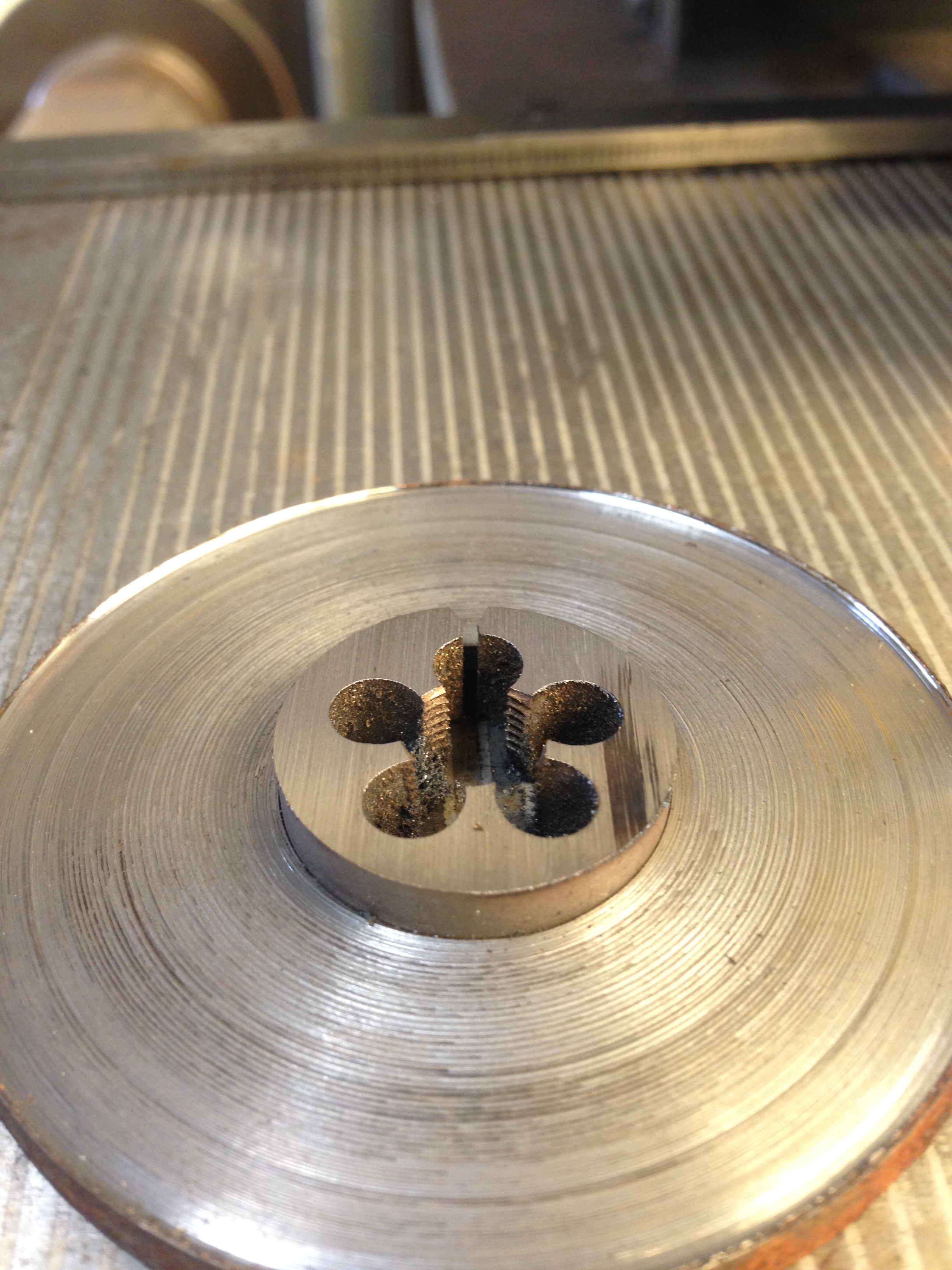
A problem with some thread dies is that they have such a large “lead in” that they are unable to cut a thread up to a shoulder.

fullsizeoutput_19d9.jpeg

A 3/8″ x 32tpi die.  Note the large lead in taper.

This results in the thread stopping a long way from the shoulder… undesireable in some situations.

IMG_4984.JPG

This is a thread made with the die in the previous photo.  I wanted it to go right up to the shoulder, but this is as close as it gets.  About 2mm gap.

IMG_4987.JPG

The screw in this upsidedown photo does not allow the shoulder to seat properly.

The solution?  Modify the tool.

IMG_4988

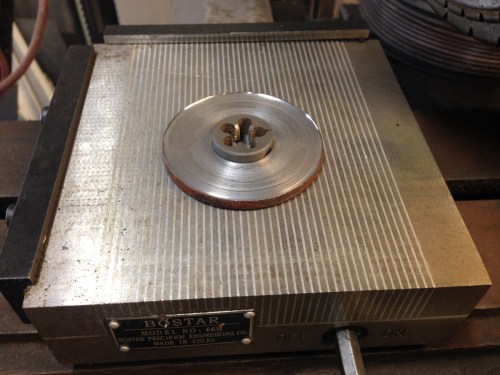
Here is the tapping die, held onto a magnetic chuck, within a machined steel disc to increase the magnetic attachment force.

IMG_4991

So I ground off the top 1-2mm of the die.  My surface grinder is out of action, so I used the tool and cutter grinder.   A bit rough but it worked.

IMG_4993.JPG

This is the die after grinding the surface.  Note that there is no lead in.  I ground the unlabelled face so I did not lose the specs of the die.

IMG_4994 3.JPG

And the screw after using the modified die.  The thread  now goes right up to the shoulder.  Incidentally, this is a zoomed photo using an iphone.  Not bad?

So that does the job.

The downside is that in future the thread must be started with the unmodified side of the die, and finished with the modified side.  Adds some time.  And the die is thinner and a bit weaker.

A pity that the dies are not manufactured with one “no lead in” face.

The particular set of ME dies will now all be modified in the same way.


A Turntable for the Triple Expansion Engine.

I have not weighed the Bolton 9 triple expansion steam engine, but I would guess that it is 20-25lb.  (weighed it.  25.5lb)

Access to the various bolt on bits and pieces has become increasingly difficult and tricky, and involves frequent repositioning of the engine.

I removed the bolt on base and that has improved the situation a bit.

Then I had a brainwave, thought bubble, inspiration  whatever, and I tried a ball bearing turntable….   you know….. one of those Chinese restaurant middle of the table gadjets.

It is incredibly useful!

Here are some pics and a video showing it in place;  just a demo of the engine at its current (unfinished) stage.  I think that the turntable might  become a frequently used tool for heavier models.

triple apr7.JPG

The Bolton 9 on the turntable

triple water pump valve.JPG

And the latest additional bits…   non return valves on the water pumps.

Edwards Pump for the Triple Expansion Steam Engine

The triple expansion steam engine has been progressing, again.  I started this project over 2 years ago, but I have taken many breaks, some prolongued.  One break lasted over 6 months while I made some cannons.

I cannot remember when I made the Edwards pump for the triple, but it must be over a year ago.   In the past few days I have returned to it, finalising the mounting to the engine, and joining the driving levers to the pump and the engine.

The Edwards pump creates the vacuum in the condenser chest.  It is an air pump.

Attached to the Edwards pump are 2 water pumps, which return condensed steam as water, to the boiler.  At least that is what I understand from the descriptions.  It feels a bit odd, making these components before understanding what they really do.

triple-expansion-engine-1-22

The Edwards pump is the central cylinder and rod.  The water pumps, bolted to the sides, are just lumps of semi machined cast gunmetal at the stage this photo was taken.

triple-expansion-engine-1-17

The step before the above picture, where the base of one water pump is machined.


IMG_4918.JPG

The Edwards pump, and the 2 water pumps, almost finished, attached to the engine.

pump spanner.JPG

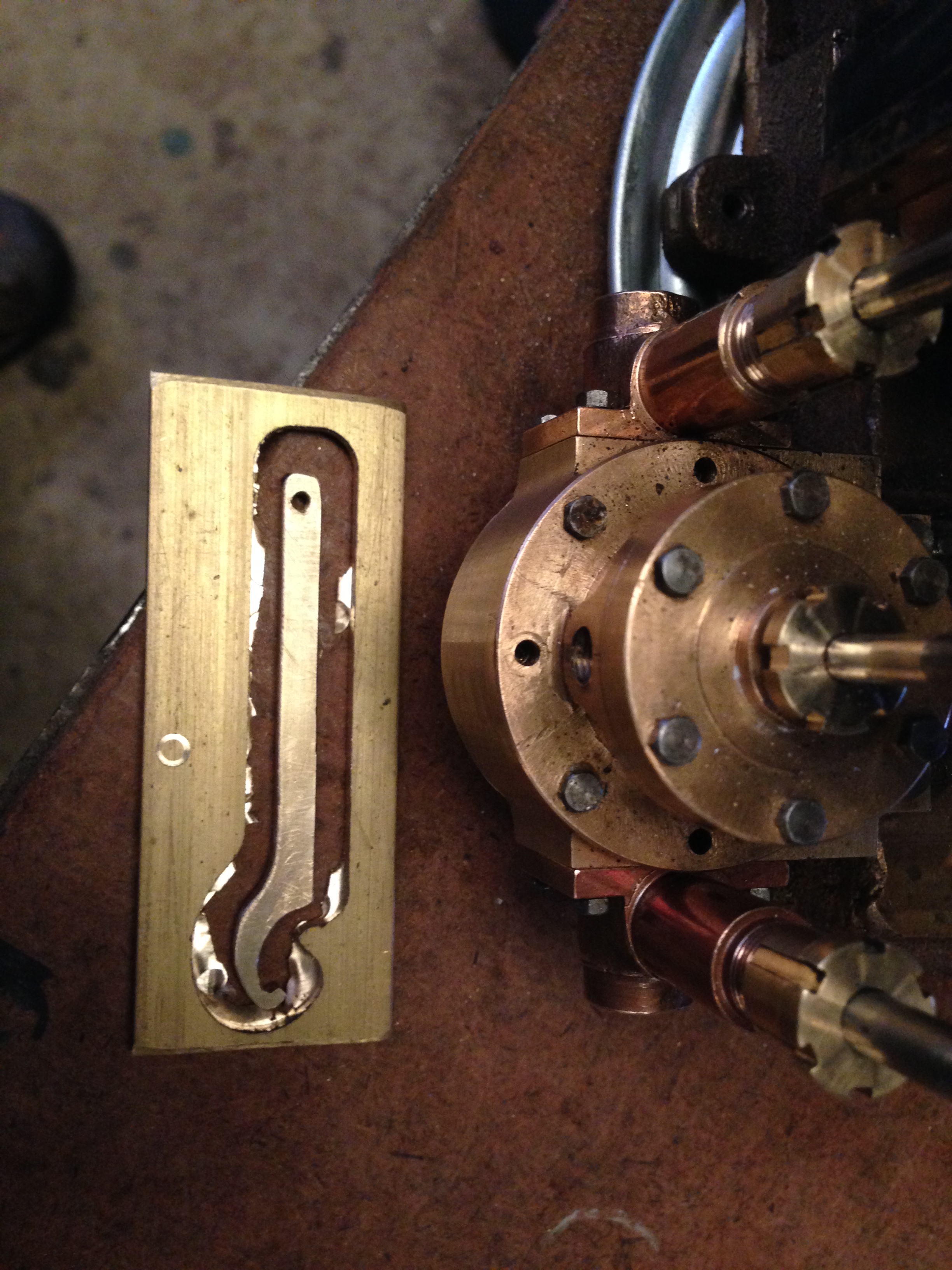
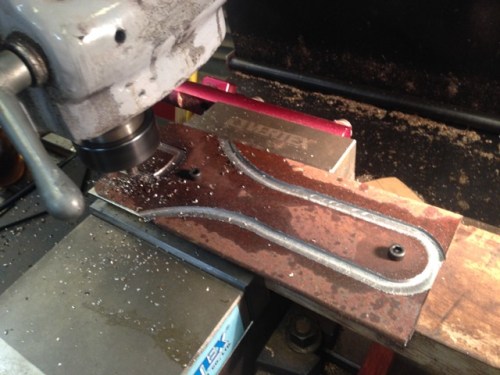
There is no clearance between the pump gland and the condensor, so the intitial hexagonal glands which I made (not shown) were unuseable.  So I made these cylindrical glands which required a tiny hook  spanner to tighten.  The hook spanner was made on the CNC mill from 1/8″ brass plate.  A little filing was required to shape the hooked tooth.  Works nicely.


IMG_4917

The pump unit, lower left, attached to the engine.  Actuating levers driven off the low pressure cylinder (not yet connected).

IMG_4915.JPG

The pump unit viewed from the side.

So I am at the stage where I would like this project to be finished, so I can get on with other projects.  It feels like it is close because there are very few castings remaining in the box.  But I know that the entire engine has to be disassembled, and painstakingly reassembled, freeing up some of the tight parts so it will turn over more easily.  Then the steam pipe hookups and valve timing.  Then hopefully, a video of it running!

Harold Hall Grinder Rest – modification; and triple expansion update.

Harold Hall has written many articles and several very useful books about metalworking, using a lathe, using a mill, and much more.

Recently he has been posting videos on YouTube.

He is a very knowlegable, dignified, elderly gentleman.  His books are precisely, beautifully written, and the plans and projects are excellent.  I have made quite a few of the project pieces in my quest to learn as much as I can about machining metal.

I came across his Youtube videos quite recently, and have been enjoying them.  One of them was about his grinding rest.

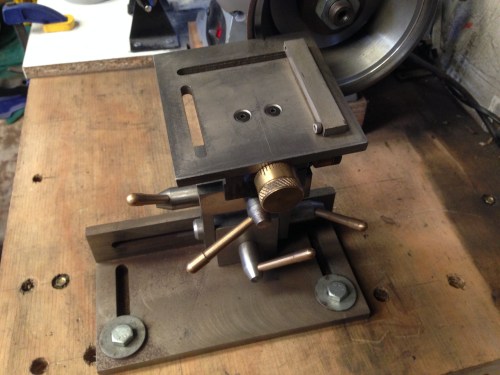
I made 2 of the HH grinding rests from plans in his book, and they have proved to be useful, reliable, and compact.  Here is a photo of one of them.

IMG_4883.JPG

The original HH plans specify that the footprint of the base is much smaller than I made it.  This one is 200 x 100mm.   The larger footprint adds some extra stability (IMO), and the slots permit the grinder to rest distance being easily adjusted.  It is a bit grimy because it is used frequently.  Polishes up quite nicely.

In HH’s video he mounts the rest on a metal plate, joined with a couple of switchable magnet bases.  Here is a link to HH’s Youtube video.

And in case you are wondering what has happened to the triple expansion engine, I have been working on the reversing mechanism.  The intermediate cylinder reversing curved slide would not fit into the available space, so I removed it, silver soldered in a new end, and ground it several millimeters shorter.  Then reinstalled it.   It is still a mm or so too long but I think that it will do.

IMG_4878.JPG

The high pressure reversing mechanism on the right, and the intermediate hiding behind, on the left of the pic.

IMG_4880.JPG

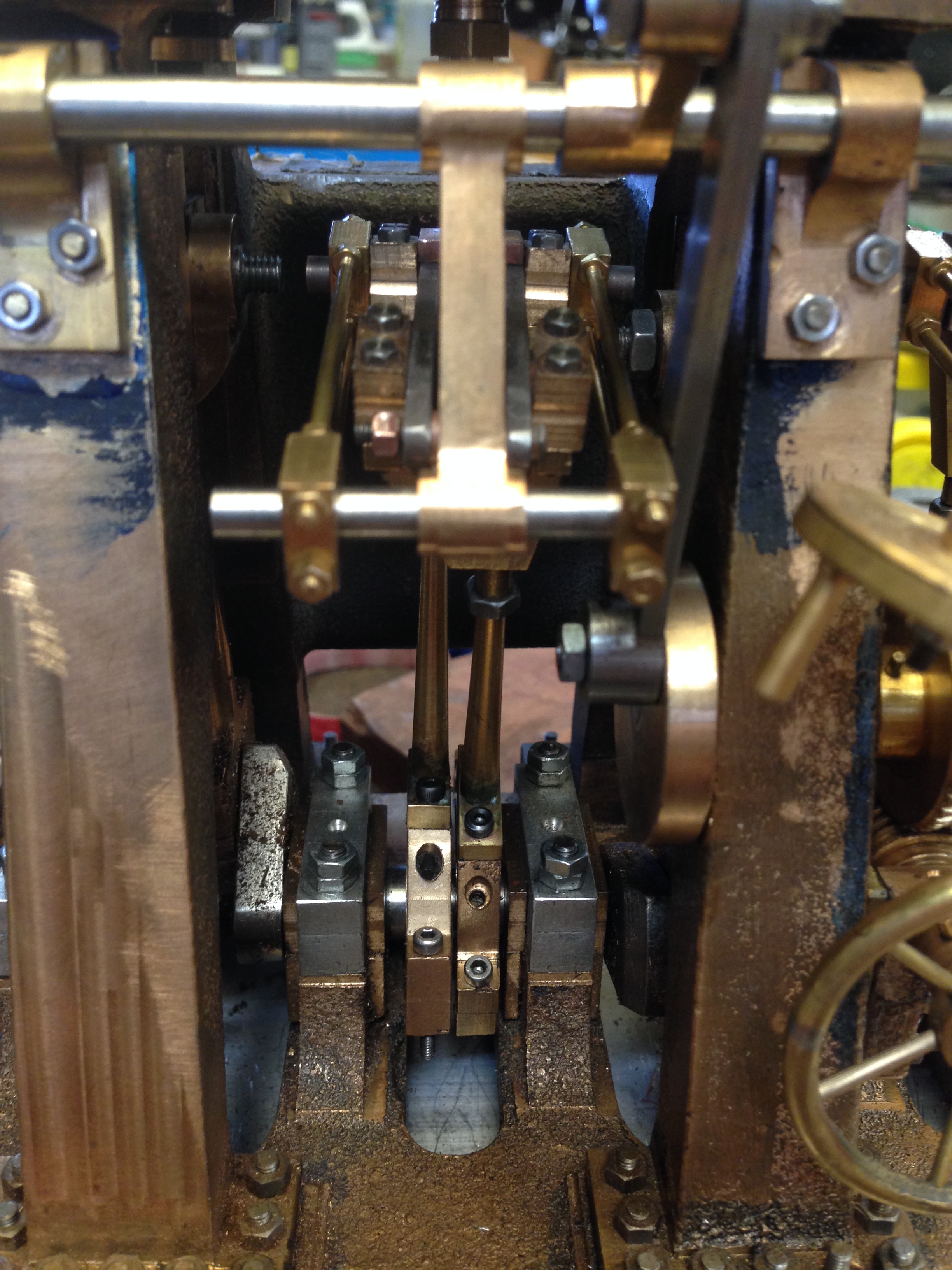
The intermediate cylinder valve rods and eccentrics.   Rather difficult access.

Assembling the Triple

img_4705

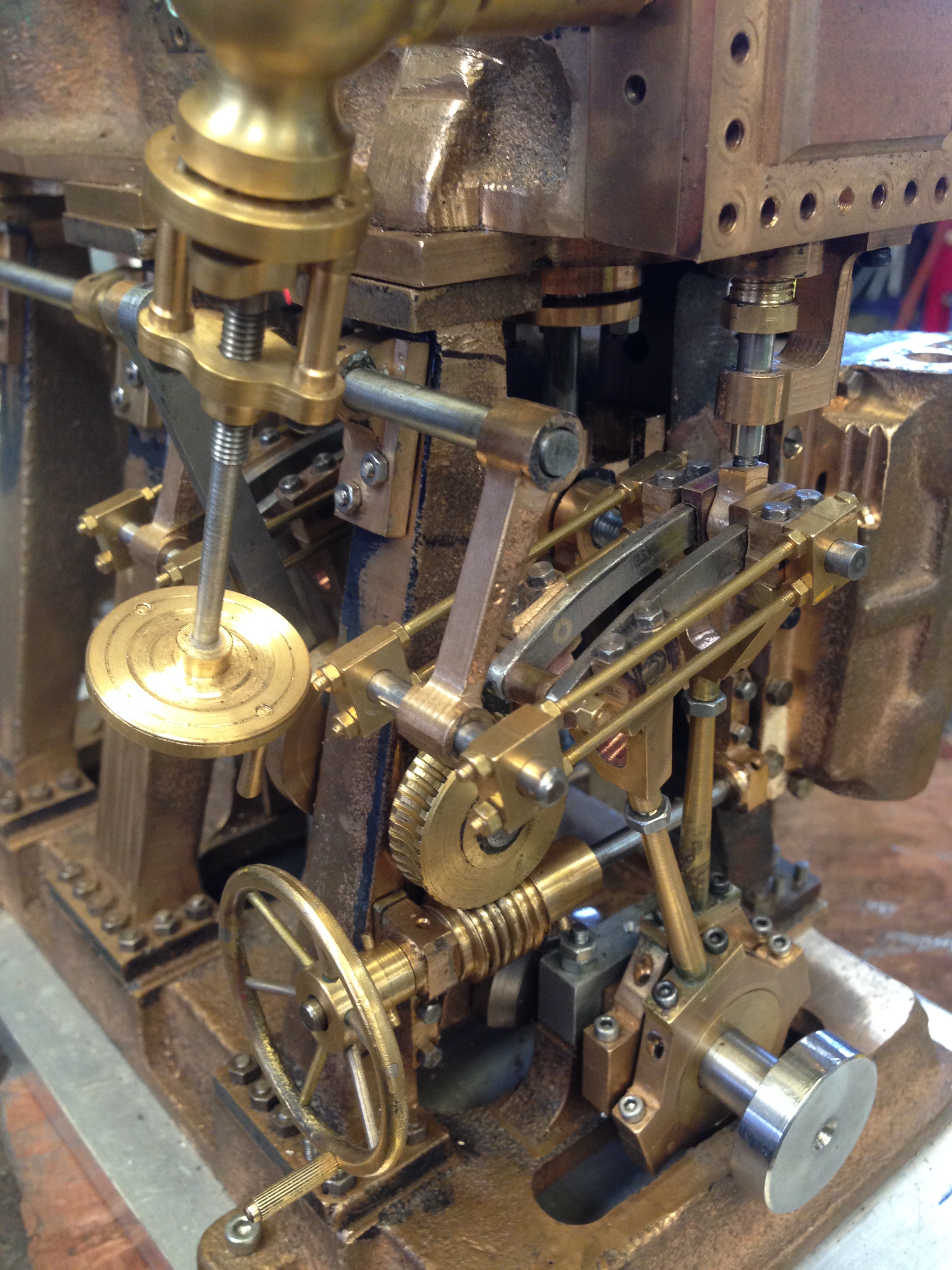
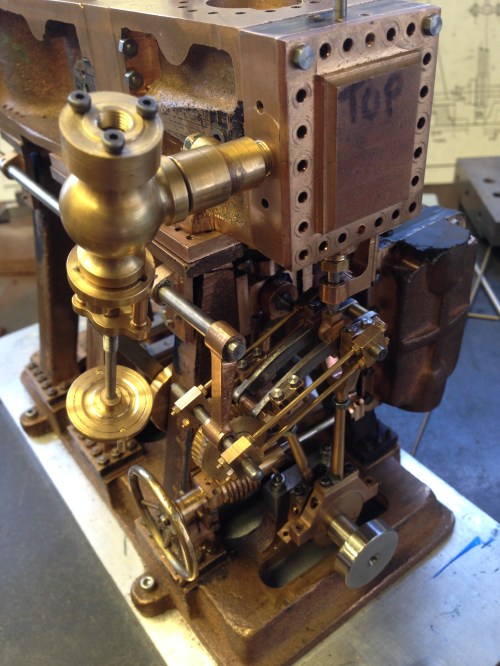
I got this far in assembling the model triple expansion steam engine, then lost courage and put it aside (again).  You can see the high pressure steam chest labelled “top”, the steam valve and handle, the drag links and levers for the reversing mechanism for the high pressure cylinder, and the worm and gear and control wheel for the reversing mechanism.   The reversing levers will need pinning with taper pins when the correct positions are finalised.  The short rod in the middle of the pic is temporary.  I need to make those properly.  The drag links clash with the condenser cover.  That was predicted in Bertinat’s notes.  The cover will need some material removed.  Slowly progressing, but taking frequent breathers.

The high pressure mechanisms are the most exposed, and easiest to access, and they were very tricky, and not yet compeletely installed.  I dread to consider what the intermediate pressure ones will be like, buried in the middle of the engine.   Then there is the valve timing.  Help!

A Full Size Weighshaft

The crowds were down at this year’s Truck Show at the Geelong Showgrounds.  Maybe the  38c weather prediction had something to do with that.

But those hardy souls who did turn up were treated to a feast of steam engines working on steam, and other antique engines popping away, as well as the magnificent trucks, tactors, and military vehicles.  There was a superb display of radio controlled trucks and excavators, and unbelievable machinery created with Meccano.

My interest was mainly focussed, for some reason, on the full sized triple expansion steam engine, which is the prize display in the vintage machinery shed.  it once powered a tug boat, and later a dredge on Port Phillip Bay.   And the following photos and video, if it will upload, show the bits which were of particular interest.

triple-expansion-engine-1-37

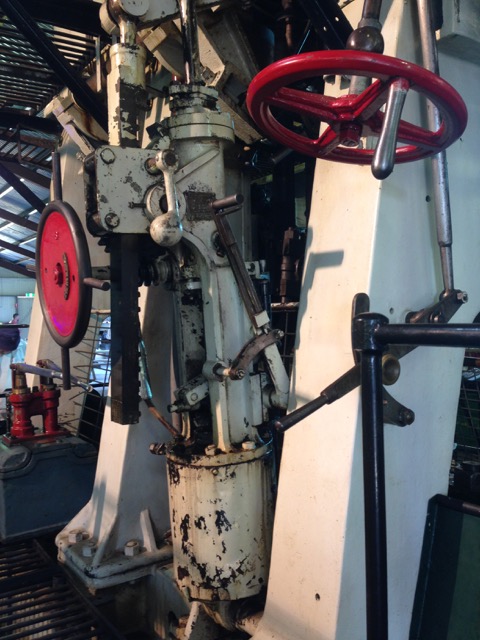
The red control handle top right is the main steam control valve.  The one on the left is the reversing control handle.  Note the big steam piston centre bottom.  It is a steam powered reversing control piston.   This engine was made in 1951, so is just about the last gasp in triple expansion steam engine development.

triple-expansion-engine-2-8

and the rod at top is about 5″ diameter.  It is the weighshaft, which carries the reversing levers for each cylinder.  On my model it is 5mm diameter.

triple-expansion-engine-3-6

Another view of the weighshaft and the levers.   Massive.

triple-expansion-engine-4-5

And note the drag links in the adjustable block.   That would have been set at intitial installation, and probably never altered since then.

Video of the big triple expansion engine working.  Maybe not.

For those following my triple expansion steam model engine build, I have put it aside again.  It is at the final assembly stage now.

Meanwhile, I am making some extra tool holders for the CNC lathe, and another ER40 chuck for the CNC lathe.

The ER40 chuck which I am currently using has an M5 shaft which is held with a drawbar, so I cannot feed work through the lathe spindle.  Plus it sticks out of the headstock a bit excessively.  So I have drawn up plans for a new chuck which I will fit to the lathe spindle and use the CNC to make the ER40 taper and threads.  Pics will follow.

And I really need some extra tool holders for the CNC lathe.  I have 5, but have material to make another 10.   The material is high quality cast iron off a scrapped T&C grinder.  I bought the grinder table cheaply (($AUD20 from memory) and have been gradually canibalising it over the last couple of years.   I have cut up the remains into rectangular 30x80x40mm chunks and will make the tool holders in the next couple of days, SWMBO and weather permitting.  Unfortunately there was insufficient material to make a long section, machine it, then cut it up, so each tool holder will have to be made separately.

Anyone for a swim?

High summer.

Hot workshop, wearing only shorts and boots.

triple-expansion-engine-1-36

I think that I will stay in the workshop.

Today was my deadline to have the triple expansion steam engine assembled and working, ready to be hooked up to steam at the Geelong Truck show.

GSMEE (Geelong Society of Model and Experimental Engineers) has a display in the Vintage Machinery Shed at the show, with many small working steam engines and the odd IC engine running.  Plus the Vintage Engine group has many full size engines running….  always a really interesting place to visit.

Another full day in the workshop would have just about had the triple in the display.  Unfortunately, I lost a day having to get a dental root canal abcess reamed out.

Then the day before yesterday, I could not find the drag links for my triple.   I had made them in early December,  and I was sure that I had put them in the multi- compartmented box where I store all such bits.  Despite thoroughly searching the box, at least 20 times, they were not there.  Could I have put them down somewhere else in the workshop?  So I searched the workshop.  No luck.  So I tidied the workshop, putting tools away, sweeping up rubbish, all the while searching.  Still no luck.   So I cleaned and searched my car, my bedroom, the living room, every where that I could concievably have left them.  (OK, I did not actually clean the bedroom and living room, but I did search).   I grilled my wife.  Had she seen them?  No.

So I slept on the problem.  Next day was going to be hot, so at 7am I drove to the workshop (it is about 15km from home), and searched again.   Still no luck.

So I searched the multi compartmented box for the 21st time.  I knew that it was a waste of time, but I was seriously considering making a new lot of drag links and bearings, probably a 2 day task.

There were some tiny containers with tiny fasteners in the compartmented box.  The drag links could not be them because they are too big, aren’t they…..??

The first tiny container, contained, you guessed it, the drag links.!!  They were smaller than I remembered.

Relief!

Self disgust!

Age related loss of short term memory…..

I had to get that one off my chest.

The other thing that I wanted to mention, is a superb machining blog site.  Actually, 2 superb machining blog sites.

The first is by Joe Pieczynski, who is a Texan who makes his living from machining.  His techniques and teaching are really, very, excellent.  Aimed mainly at an audience who are beyond absolute beginners.  Do a Youtube search on “Joe Pieczynski”.  Look at his video on machining ultrathin materials.

The second, I have probably mentioned before.  An Australian  machinist, whose videos and machining techniques have to be seen to be believed.  Mainly with a clock making interest, but the techniques can be used by all of us.  For some reason I cannot cut and paste his Youtube connection, but you will find it by doing a search on “Clickspring”.  What is particularly exciting in Chris’s “Clicksping” is that he is soon to embark on remaking an Antikythera calculator.  Watch it!  You will be hooked.


SS Valve Rods

Making the new valve rods, as predicted, took me an entire day.  They required a high degree of precision, and being in stainless steel, not an easy material to machine, and quite thin and delicate, multiple stages in the machining.

But before I started on the valve rods I made myself a new spanner for the collet chuck on the CNC lathe.  I had been using an adjusting spanner, which was continually  going out of adjustment and causing angst.  The tool merchants did not have anything suitable (46mm opening, and thin profile), so I made my own.

triple expansion engine - 1 (34).jpg

The 46mm spanner being cut from 6mm steel plate.

triple expansion engine - 9.jpg

It is a bit prettier after this photo and being painted.  The rounded jaws facilitate easy application to the collet chuck.

triple expansion engine - 8 (1).jpg

Tightening the ER40 collet chuck with the new spanner.  It works very well.

So then I got on with the new valve rods.  Some end of day photos follow.

triple expansion engine - 2 (6).jpg

The valve rod is the silver coloured rod.  Actually stainless steel.  This photo shows the high pressure cylinder valve and valve chest.  There are 2 other valves, one for each cylinder.  All different sizes.

triple expansion engine - 4 (4).jpg

The high pressure valve chest and valve, the valve rod and guide.  On the right is the Stevenson’s link, yokes and eccentrics which control forward and reverse.  This setup is repeated for each of the 3 cylinders.  This is hooked upto the worm and gear which was shown a blog or two ago.  There are 22 components for each, not counting fasteners.

triple expansion engine - 7 (1).jpg

The low pressure setup.

And thank you to those readers who responded to my whinge about likes and comments.  I will continue this blog until the triple expansion steam engine is finished, and hopefully running.  Not sure after that.

Triple Underbelly

“Underbelly” has a particular resonance for readers who know what the Yarra is and that Collingwood is a place and not a British admiral.

In the instance of my triple expansion steam engine, it refers to the bits and pieces underneath the cylinder block.  The glands which prevent steam leaks from the con rods and steam valve rods, the and valve rod guides.  These unsung heroes of the steam engine have taken 2 entire days to make.   And here they are….

triple expansion engine - 1 (32).jpg

This is the cylinder block, upside down.   You can see the valve rods. the valve rod guides, the valve rod glands, the piston rods, the cross heads (unfinished), the piston rod glands,  and the cylinder bases.   Give yourself 2 marks for each correctly identified item.  The 6 hex plugs on the side are temporary, until I get around to making some cylinder drain valves.

I started to count the number of holes drilled and tapped in this view, but gave up at 100 and still not half way.  This engine better bloody work!

triple expansion engine - 2 (4).jpg

Note the letter stamped into the cylinder base.  Many parts are similarly stamped.   The studs in the intermediate piston gland are temporary.

triple expansion engine - 4 (3).jpg

Just a different view.

I have decided to replace the valve rods which are made of brass, with stainless steel ones. That will take an extra day, which might exceed my second, self imposed, deadline.  But if it does, well too bad.

By the way….   I am considering whether or not to continue this blog.   It does take time, and is not free.  If you read this and are not totally bored, the odd “like” would not go un-noticed.  A comment would be even better.

Broken Tap Removal

In a previous post I admitted to breaking a BA7 tap in the Edwards air pump of the Triple Expansion Engine, and being unable to remove it.

The hole being threaded was one of 4 to be used to hold a water pump to the air pump. It was 2.5mm diameter (i.e. pretty tiny)

I tried to grasp with pliers the fragment still protruding but it then broke below the surface.

I tried to break up the embedded tap, using a HSS punch, with partial but inadequate success.

I briefly considered drilling a hole from the other end, and punching in the reverse direction, but that would really have compromised the pump.

So I decided that the three remaining bolts would have to be enough.

A night sleeping on the problem.

Next day, with a fresh determination, I decided to attack the problem again.

I had some used carbide milling cutters 2mm diameter, and I was prepared to sacrifice one or two of them.   So I carefully set up the Edwards pump in the milling machine.

triple-expansion-engine-1-23

You can see the three good tapped holes.  The carbide milling cutter chomped away at the broken tap, and using gentle pressure, and ignoring the metallic screeches, the tap was broken up and most of the fragments came out.  I was prepared to sacrifice the milling bit, but it seems to have survived this insult.  The harder metal always wins.   It was probably fortunate that the tap was carbon steel and not HSS.

Somewhat surprisingly, the tapped hole was in reasonable condition, and it accepted a BA7 bolt, although I will not be aggressively tightening this one.

Triple Expansion Steam Engine -The water pump

john and audrey - 5.jpg

The triple will not be finished by Xmas.  No chance of getting into the workshop while we are looking after 2 grandchildren.  So the new aiming completion date is Jan 6, in time to run the triple on steam at the Geelong truck show.   If I don’t meet that deadline, the next access to steam will be the end of 2017.  I really do not want to wait that long.

So the next component to produce out of a chunk of gunmetal is the water pump.

triple-expansion-engine-1-18

There are two cylinders in the water pump.  The gunmetal castings appear to be good quality.

Most of the machining will be done on the mill.  But I need a datum surface, and have decided that the attachment plate is the most appropriate.

triple expansion engine - 1 (20).jpg

I do not need the small cylindrical protruberance, but that chunk of gunmetal might be handy for something else (eg as a bushing), so I parted it off and saved it.  Lovely parting tool is from Eccentric Engineering.

triple-expansion-engine-1-17

Then turned a flat surface.  On the mill I machined it to a rectangle.   Diamond tool is also from Eccentric Engineering.

triple expansion engine - 1 (21).jpg

The two water pump cylinders are bolted to the air pump.  BA7.  A broken tap is entombed in the air pump forever.

triple-expansion-engine-1-22

When I get back into the workshop I will machine the rest of the pump parts.

MAKING SMALL SPLIT BEARINGS FOR THE TRIPLE EXPANSION STEAM ENGINE

triple-expansion-engine-1-15

The bearings in the drag link are not split, because they can be slid onto the shaft.  But if there are obstructions to sliding, (such as big ends on a crankshaft), the bearings must be split, and assembled when in position on the shaft.  The bore in the intact bearings in the photo is 4mm.  The split bearings have a 5mm bore.  They are all bronze, but the split bearings have been heated then dipped in sulphuric acid so the colour has changed.

triple-expansion-engine-1-7

The first step in making split bearings is to machine 2 strips of metal, of identical dimensions.

triple expansion engine - 1 (8).jpg

Next the strips are soldered together.

triple-expansion-engine-1-9

The bearing holes are drilled and reamed exactly to finished size.

triple-expansion-engine-1-10

The strip of soldered metals is attached to a sacrificial base plate and the outside of the bearings are machined to final size and shape.

triple expansion engine - 1 (11).jpg

Holes are drilled to take the bolts which will eventually hold the halves of the bearings together.  (1.6mm holes in this case).  The bearings are then heated to melt the solder and separate the halves of the bearings.  Sulphuric acid was used to remove the carbonised crap left on the surface of the bronze by the heating torch.

triple-expansion-engine-1-15

The bosses around the holes was an extra machining step.

Drag Links for Reversing Mechanism on Triple Expansion Steam Engine

A bit more progress today.

I spent the whole day making these drag links, and I was pretty happy with the result.

Then I realised that I need 6, and I had made only 3.  (well there are 3 cylinders you see).

So you know what I will be doing tomorrow….

triple expansion engine - 1 (4).jpg

The drag links are the 3 items with the bearings at the ends, and the connecting rods.  Those rods are 1.6mm diameter (1/16″ inch), and the nuts are BA 10

triple expansion engine - 2 (3).jpg

I dropped 2 of the nuts.  Gone forever.

The final 20% takes 80% of the time

IMG_4623.JPG

The weighshaft, supported on its brackets.  It will be pinned with taper pins to the shaft.  Also finished the reversing lever and reversing arm.  The reversing arm has gunmetal bushes.  About 2 x 8 hour days in the workshop to make these bits.  Just as well it is a fun hobby.

Triple Expansion Steam Engine resumes

Busy at this time of the year.

Making some wooden toys for the grandchildren for Xmas.

IMG_4589.JPG

Not sure whether these are ducks or chooks.  My talented wife brings them to life with colours.  When pushed by 1-2 year olds they waddle with an entertaining flap flap walk.  

Preparing the surgery building for sale.  Removing and storing 34+ years of medical records, moving furniture, arranging repairs and painting etc etc.  Feels strange to be no longer a registered medical practitioner, but I know that it was the correct decision to retire.  It has taken 2 years to totally burn the bridges by dropping my medical registration, and selling the surgery etc.

Model Engineering Club annual exhibition.


IMG_4580.JPG

This model quartz crusher at the exhibition was driven by a hit and miss engine.

IMG_4574.JPG

Another superb engine at our exhibition.

Plus ongoing military history book reading and reviews.

Slashing long grass, to reduce the summer fire risk.

Assembling and installing a kitchen into a rental property.

So it was a treat to get some time in the workshop today.  I had previously made the layshaft brackets for the triple expansion steam engine, so I spent a happy few hours setting up an angle jig on the milling machine to drill and tap holes to attach the brackets.

IMG_4583.JPG

This is the setup.  An adjustable angle plate was bolted to the milling table, and the angle was set so the columns were horizontal.  The layshaft brackets were Super glued to the columns with the shaft in place after filing to get the brackets quite level.  The holes were spotted through, then drilled (1.6mm) and tapped (2mm).

IMG_4586.JPG

The layshaft bolted in position with M2 nuts and studs.  M2 is very similar to BA7, and a lot less expensive, and is stainless steel.  Way to go!


After the triple

I am back onto the triple expansion steam engine, after putting it aside for most of 2016.  I am guessing that it is about 75% completed.  I have been struggling with this project due to poor plans, no instructions and some lack of skill and knowledge.

When I was well into the project, a colleague pointed out that detailed instructions existed in some articles published in 1985 (Model Engineer, Bertinat).  I obtained the articles, and subsequent progress has been greatly assisted, but unfortunately some errors had already crept into my work, and these have not been easily or completely rectified.

So now I am back into it.  And I would hope to have it finished and working by the end of the year.  Watch for pictures when there is something to show.

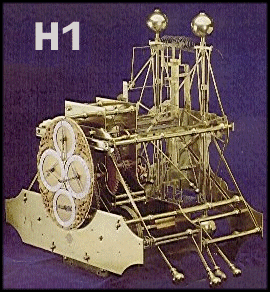
I am already thinking about what will follow the triple.  Maybe a Harrison 1 clock? (of “Longitude” fame.)  Looking for some plans.

h1

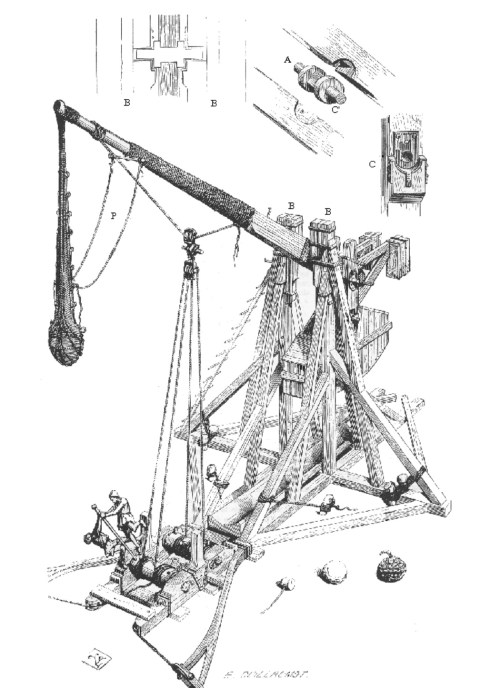
Or maybe some more artillery?  How about a working  model  trebuchet?  Now that does have some appeal.  There are some plans on the Net, but they look over simplistic.  I am thinking of a more historically accurate model.  The following picture is from an old French encyclopaedia.  But I might have to abandon my preferred scale of 1:10 because the original was about 12 meters long.  But on the other hand……

trebuchet1.jpg


It does have some interesting features.  The ratcheted windlass, the travelling pulley, the trigger mechanism (“pulling the pin”), and the projectile release mechanism (trying to avoid the projectile going up vertically).