johnsmachines

machines which I have made, am making, or intend to make, and some other stuff. If you find this site interesting, please leave a comment. I read every comment and respond to most. n.b. There is a list of my first 800 posts in my post of 17 June 2021, titled "800 Posts"

The Steam Supply Valve

This valve is the one which opens the steam supply from the boiler to the engine.  Triple expansion sgeam engines require a minimum of 100 psi, and preferably 120-200psi.  But amteur built boilers are rarely certified above 100 psi.

But compressed air gets to 120 psi with no drama.  So guess what will power this engine until I get around to making a high pressure boiler.

So the on-off valve needs to be pretty solid, so it does not explode and send hot fragments of metal in all directions.
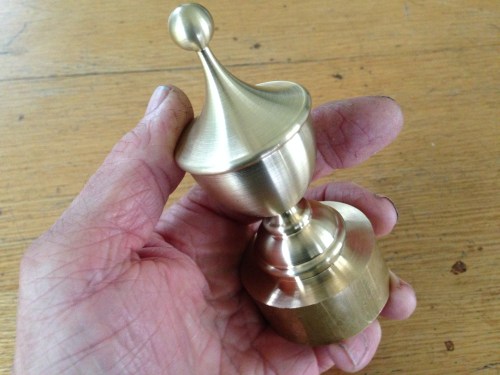
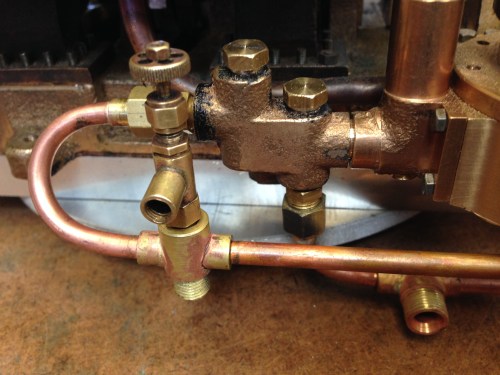
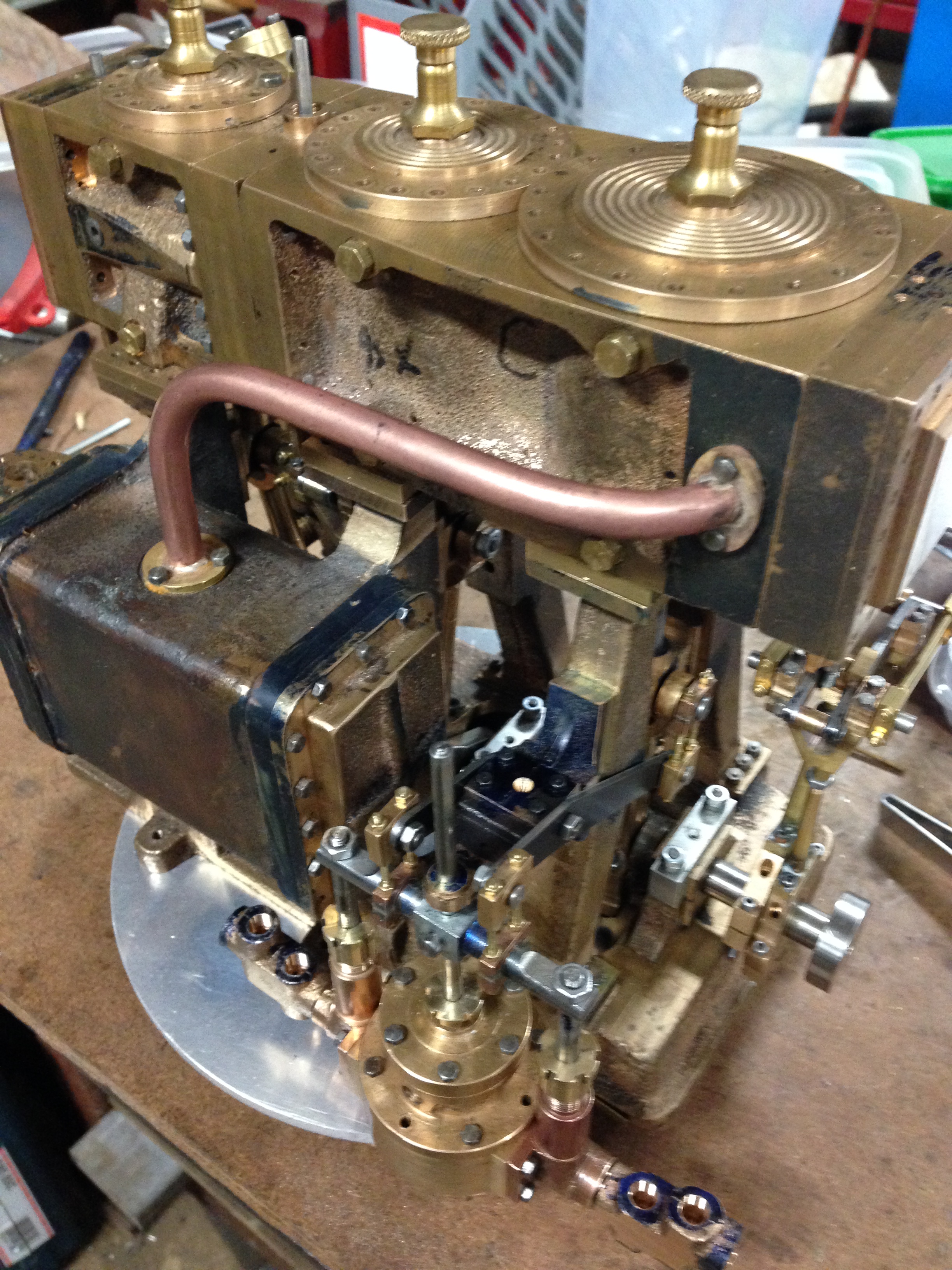
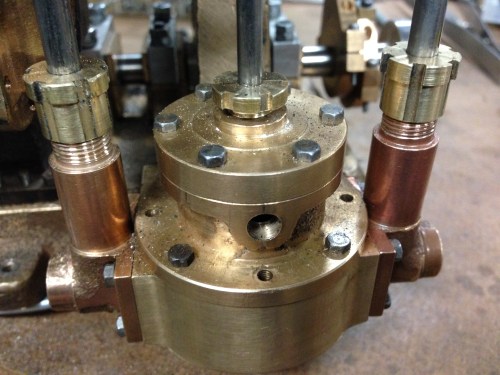
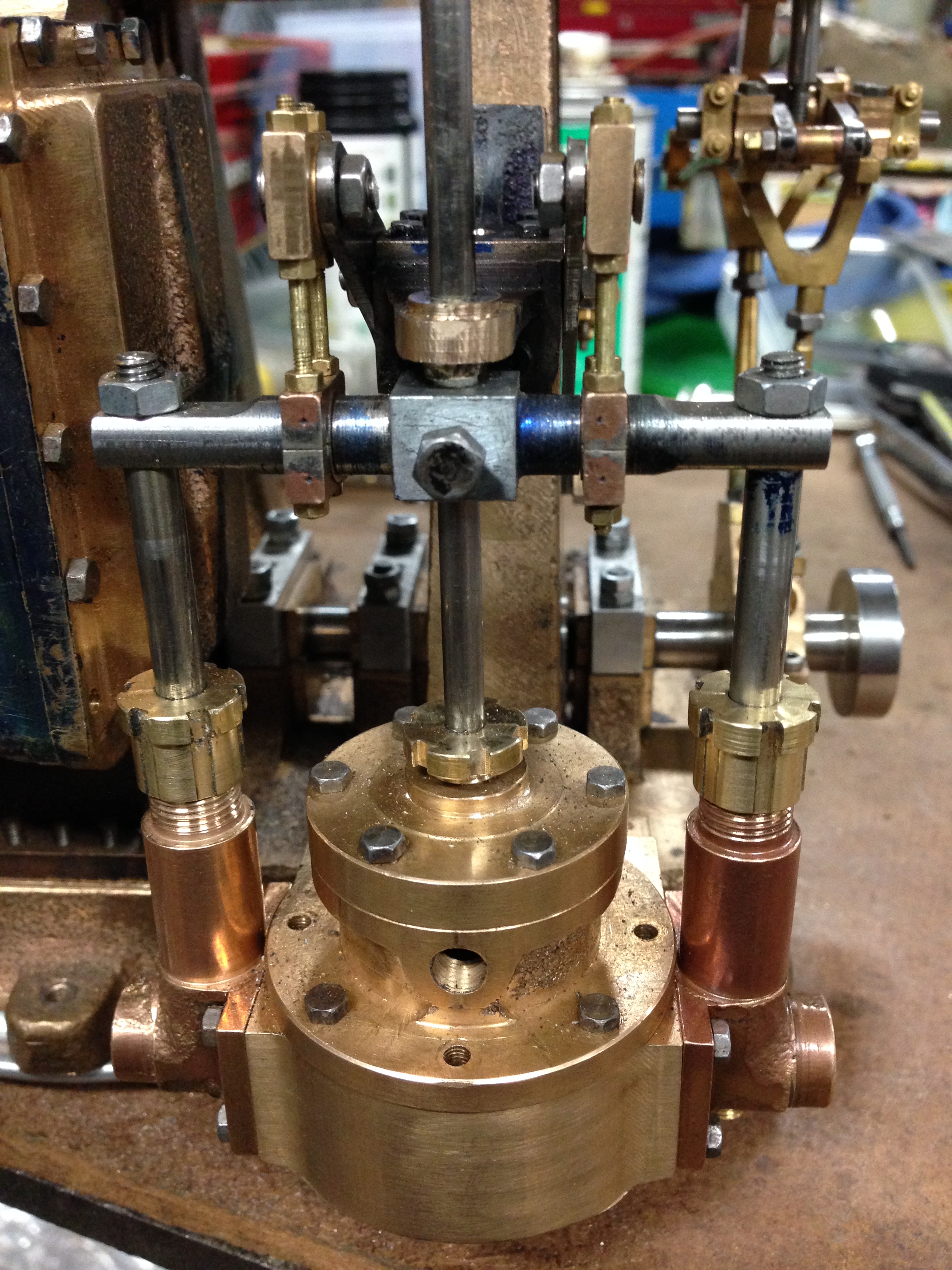
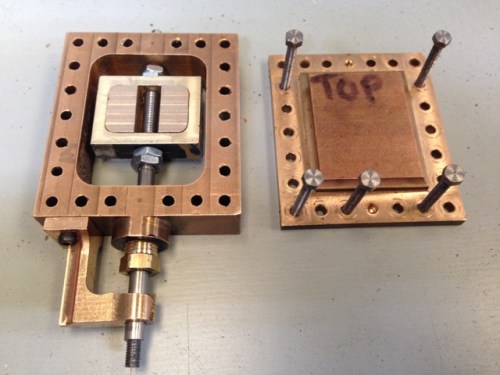
Here is the main supply valve as specified and built for my triple expansion steam engine.

triple-expansion-engine-2-7

The lines in the background are a ruled exercise book, just to give a sense of the scale.  There are 9 components of precision machined components in this picture.  And about 2-3,  8-12 hr very happy days in the workshop to make.  This is all made from bar stock.

triple-expansion-engine-3-5

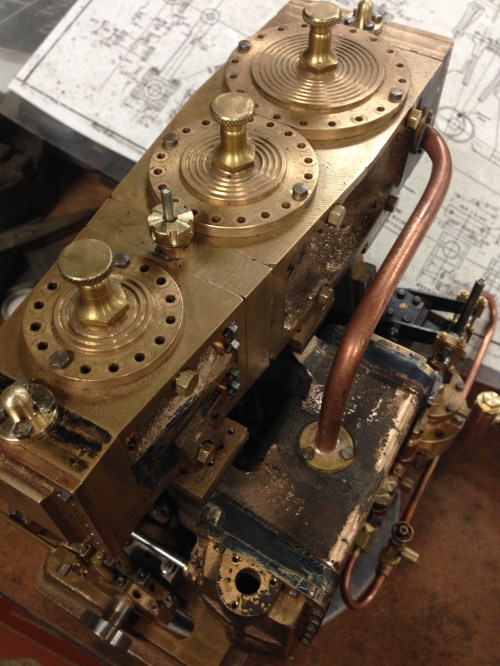
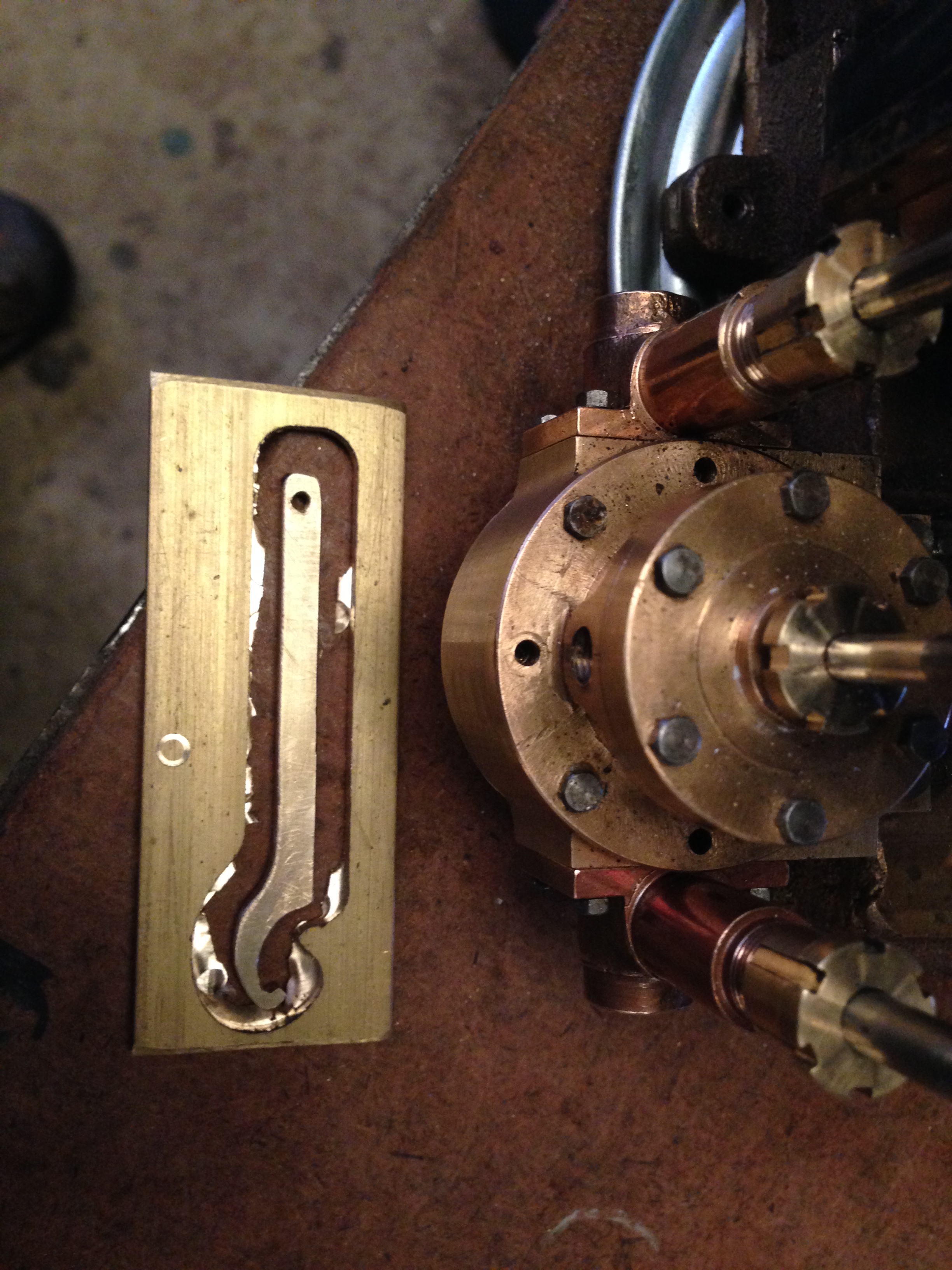
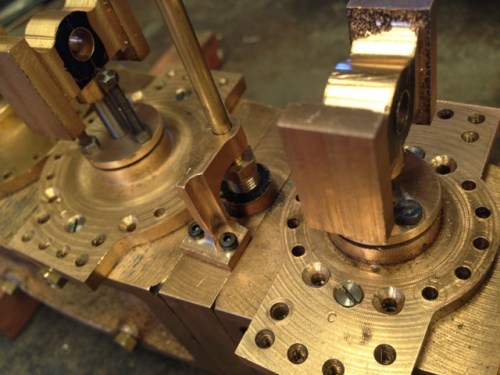
And this is the handle which controls the on – off steam supply.  Pretty sexy hey?

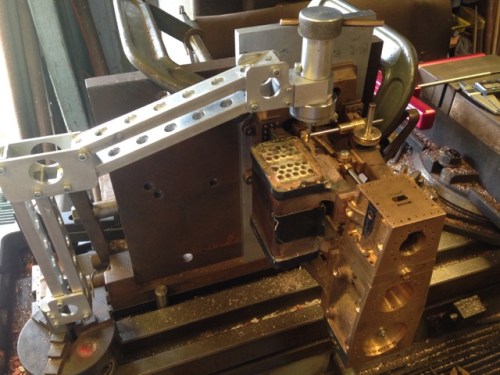
It all attaches to the high pressure steam chest and cylinder.

triple-expansion-engine-1-35

Hey!  I like this shit stuff .  Even if most of the rest of humanity is yawning.


SS Valve Rods

Making the new valve rods, as predicted, took me an entire day.  They required a high degree of precision, and being in stainless steel, not an easy material to machine, and quite thin and delicate, multiple stages in the machining.

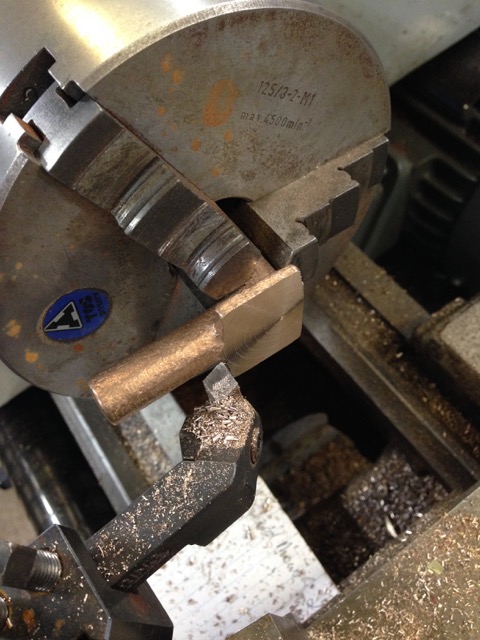
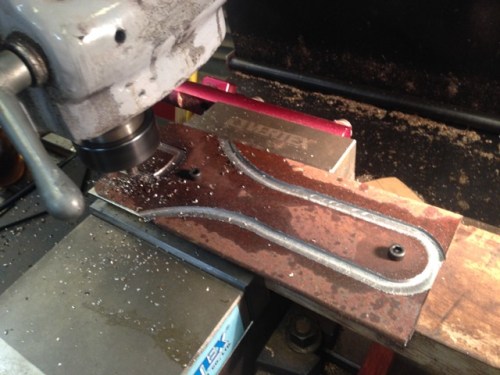
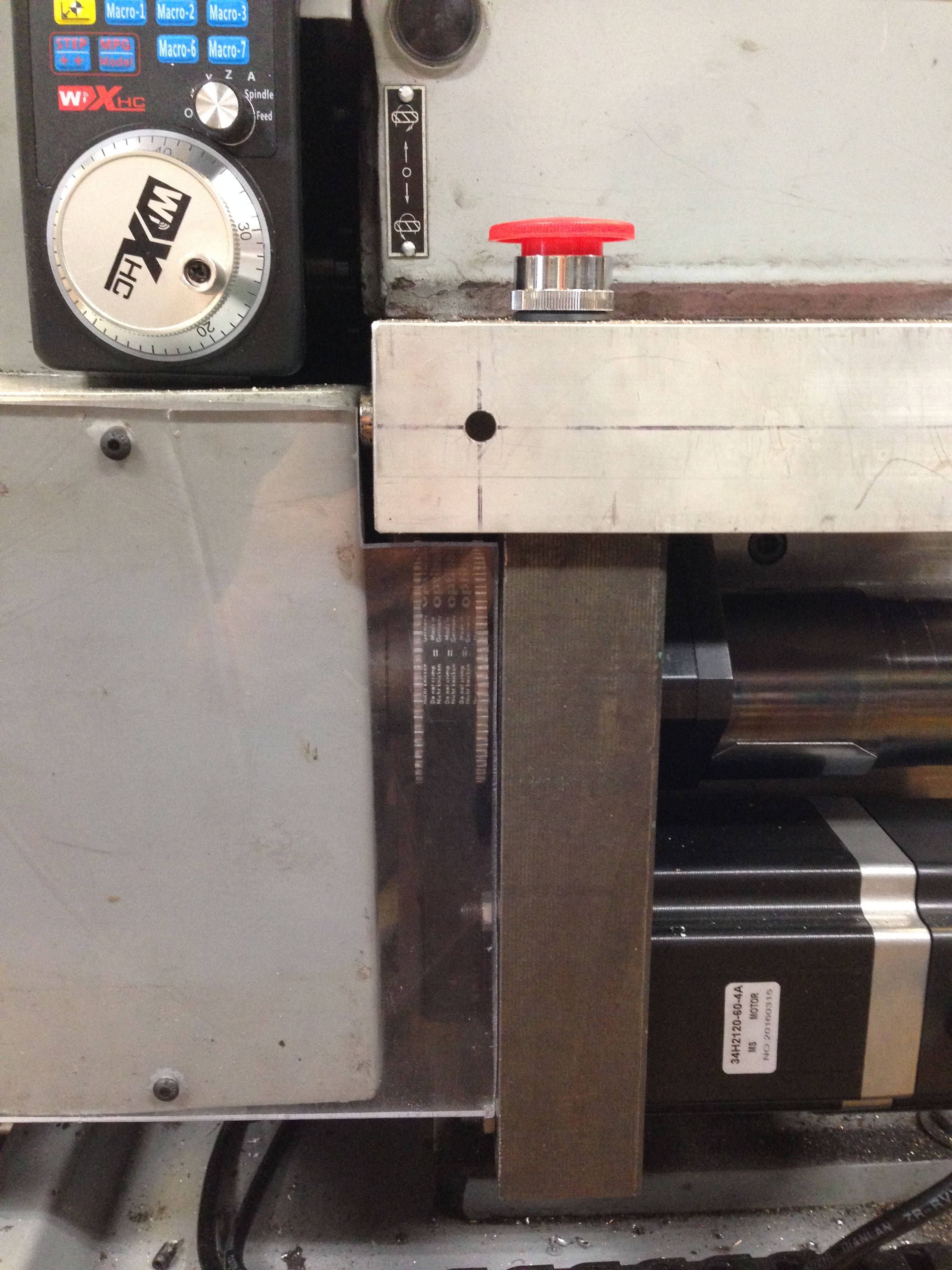
But before I started on the valve rods I made myself a new spanner for the collet chuck on the CNC lathe.  I had been using an adjusting spanner, which was continually  going out of adjustment and causing angst.  The tool merchants did not have anything suitable (46mm opening, and thin profile), so I made my own.

triple expansion engine - 1 (34).jpg

The 46mm spanner being cut from 6mm steel plate.

triple expansion engine - 9.jpg

It is a bit prettier after this photo and being painted.  The rounded jaws facilitate easy application to the collet chuck.

triple expansion engine - 8 (1).jpg

Tightening the ER40 collet chuck with the new spanner.  It works very well.

So then I got on with the new valve rods.  Some end of day photos follow.

triple expansion engine - 2 (6).jpg

The valve rod is the silver coloured rod.  Actually stainless steel.  This photo shows the high pressure cylinder valve and valve chest.  There are 2 other valves, one for each cylinder.  All different sizes.

triple expansion engine - 4 (4).jpg

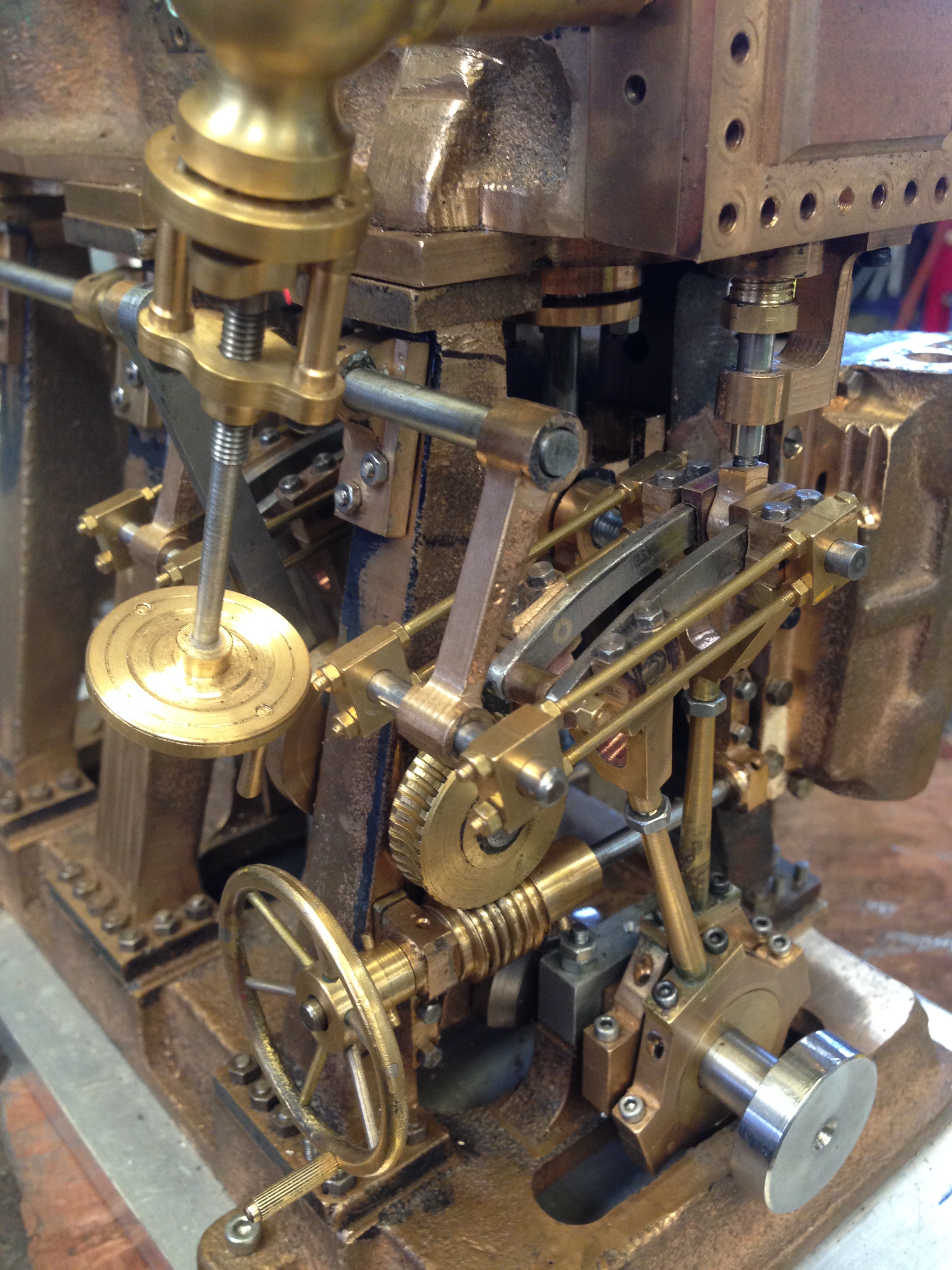
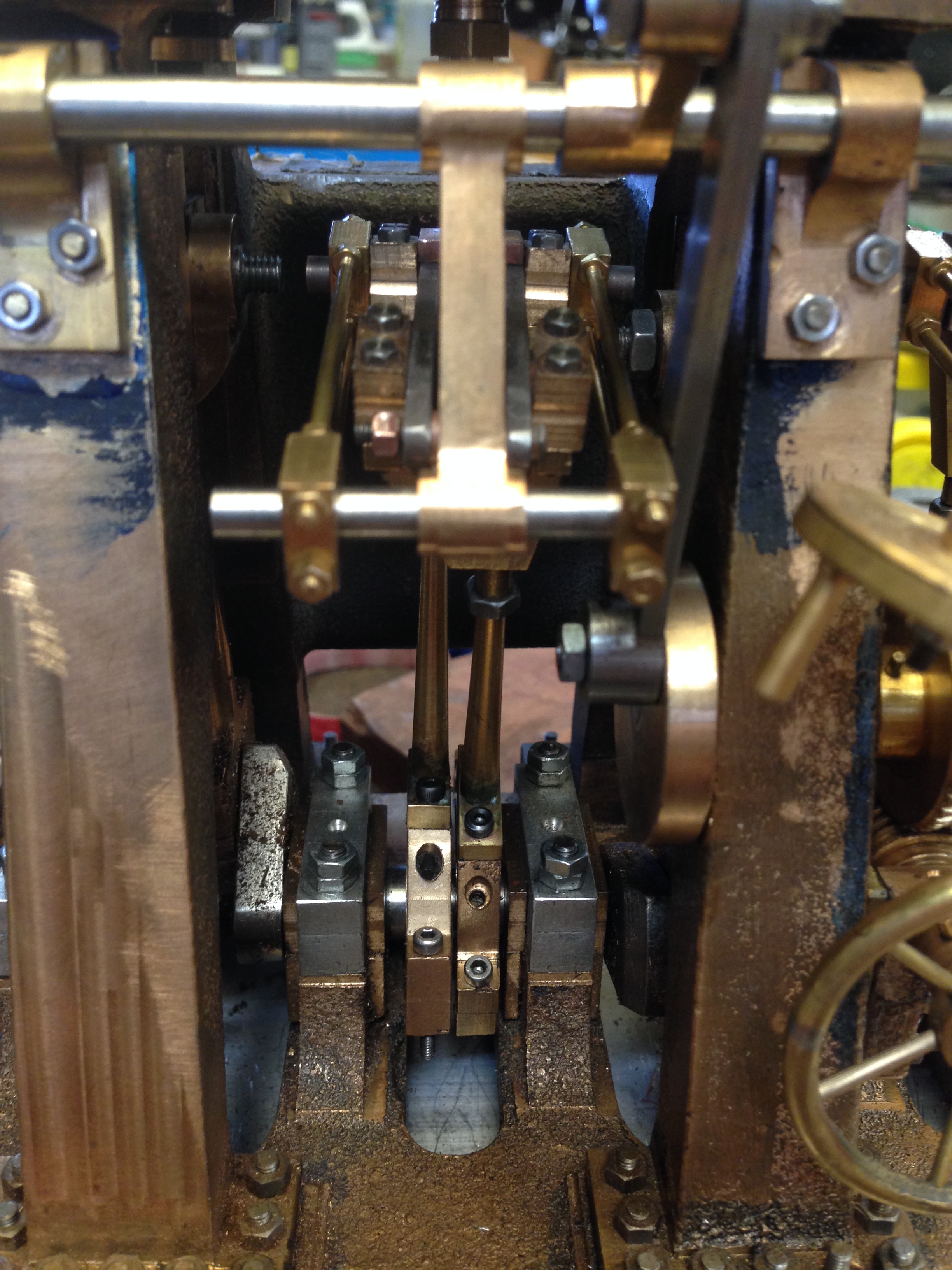
The high pressure valve chest and valve, the valve rod and guide.  On the right is the Stevenson’s link, yokes and eccentrics which control forward and reverse.  This setup is repeated for each of the 3 cylinders.  This is hooked upto the worm and gear which was shown a blog or two ago.  There are 22 components for each, not counting fasteners.

triple expansion engine - 7 (1).jpg

The low pressure setup.

And thank you to those readers who responded to my whinge about likes and comments.  I will continue this blog until the triple expansion steam engine is finished, and hopefully running.  Not sure after that.

Triple Underbelly

“Underbelly” has a particular resonance for readers who know what the Yarra is and that Collingwood is a place and not a British admiral.

In the instance of my triple expansion steam engine, it refers to the bits and pieces underneath the cylinder block.  The glands which prevent steam leaks from the con rods and steam valve rods, the and valve rod guides.  These unsung heroes of the steam engine have taken 2 entire days to make.   And here they are….

triple expansion engine - 1 (32).jpg

This is the cylinder block, upside down.   You can see the valve rods. the valve rod guides, the valve rod glands, the piston rods, the cross heads (unfinished), the piston rod glands,  and the cylinder bases.   Give yourself 2 marks for each correctly identified item.  The 6 hex plugs on the side are temporary, until I get around to making some cylinder drain valves.

I started to count the number of holes drilled and tapped in this view, but gave up at 100 and still not half way.  This engine better bloody work!

triple expansion engine - 2 (4).jpg

Note the letter stamped into the cylinder base.  Many parts are similarly stamped.   The studs in the intermediate piston gland are temporary.

triple expansion engine - 4 (3).jpg

Just a different view.

I have decided to replace the valve rods which are made of brass, with stainless steel ones. That will take an extra day, which might exceed my second, self imposed, deadline.  But if it does, well too bad.

By the way….   I am considering whether or not to continue this blog.   It does take time, and is not free.  If you read this and are not totally bored, the odd “like” would not go un-noticed.  A comment would be even better.

Reversing Gears and Handwheel

Another 2 days in the workshop.  Heaven.

I had made a worm drive and gear using an M14 x 2 tap, but it did not look the part, despite being functional.   The problem was that the threads were sharp triangular and they did not look correct.

So I made a worm drive and gear using Acme specifications.  The teeth have a chunkier squarish look.  More authentic.

I ground a lathe cutter and used it to make the worm drive in gunmetal, and another identical thread in 14mm silver steel (drill rod).   The steel thread had cutting edges formed, and when finished it was hardened by heating red hot and quenching.  After hardening, a file would not mark it.  I did not bother to anneal it, since it would be used only to cut cut brass or gunmetal.  The hardened tool was used to make a gear in gunmetal.  Unfortunately I did not take pictures of those steps.

triple-expansion-engine-1-29

Showing the handwheel, worm drive and gear.  the shaft is mounted in gunmetal bearings which are bolted to the columns with BA8 bolts.    The thread is Acme. 2mm pitch.  The handwheel will control forward-reverse of the triple expansion steam engine.

triple expansion engine - 1 (25).jpg

In order to determine the position of the bearing bolt holes for the worm drive, I used SuperGlue to tempararily join the worm and gear.  

triple expansion engine - 1 (27).jpg

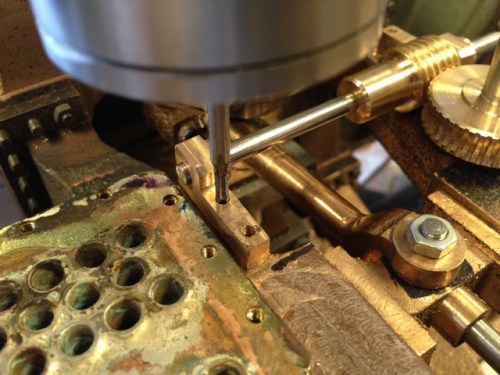
When the position of the bearings was determined, the holes were drilled 1.8mm and tapped.  the taps were BA8, about 2mm diameter.  The engine is held vertically on the milling table, being cramped to a large angle plate.  The holes were drilled accurately on the mill.  The threads were made using a tapping head made by me from plans published in “Model Engineer” by Mogens Kilde.   The double parallelogram of the tapping tool keeps the tap vertical.  The tap did not break.

triple-expansion-engine-1-28

Close up photo of tapping the BA8 threads.  Showing the bearing, shaft, worm drive and gear.  Note the Acme thread.  The bearing is Super Glued into position to facilitate the drilling and tapping procedure.  The Super Glue will be removed later.

triple expansion engine - 1 (31).jpg

The final step for today was to make the handwheel.  It is 1.5″ diameter.  The rim is 1/8″ brass and the spokes are 1/16″ brass.  I made 4 of these, with each being better than the last.  I softened the 1/8th brass before winding it around a 32mm pipe to form the rim.  The join in the rim was silver soldered.  Then the rim and the hub were drilled using a tilting indexing head on the mill.  I soft soldered the spokes on intital handwheels, but the final (and best) examples were glued with Loctite.  Loctite allows a few minutes for adjustment of the spoke lengths, whereas there is only one go with the soldering.

It is looking interesting, Yes?  And there are 3 spare handwheels.  The rest of the reversing mechanism components were made several months ago.  Almost ready to install them.

Broken Tap Removal

In a previous post I admitted to breaking a BA7 tap in the Edwards air pump of the Triple Expansion Engine, and being unable to remove it.

The hole being threaded was one of 4 to be used to hold a water pump to the air pump. It was 2.5mm diameter (i.e. pretty tiny)

I tried to grasp with pliers the fragment still protruding but it then broke below the surface.

I tried to break up the embedded tap, using a HSS punch, with partial but inadequate success.

I briefly considered drilling a hole from the other end, and punching in the reverse direction, but that would really have compromised the pump.

So I decided that the three remaining bolts would have to be enough.

A night sleeping on the problem.

Next day, with a fresh determination, I decided to attack the problem again.

I had some used carbide milling cutters 2mm diameter, and I was prepared to sacrifice one or two of them.   So I carefully set up the Edwards pump in the milling machine.

triple-expansion-engine-1-23

You can see the three good tapped holes.  The carbide milling cutter chomped away at the broken tap, and using gentle pressure, and ignoring the metallic screeches, the tap was broken up and most of the fragments came out.  I was prepared to sacrifice the milling bit, but it seems to have survived this insult.  The harder metal always wins.   It was probably fortunate that the tap was carbon steel and not HSS.

Somewhat surprisingly, the tapped hole was in reasonable condition, and it accepted a BA7 bolt, although I will not be aggressively tightening this one.

Triple Expansion Steam Engine -The water pump

john and audrey - 5.jpg

The triple will not be finished by Xmas.  No chance of getting into the workshop while we are looking after 2 grandchildren.  So the new aiming completion date is Jan 6, in time to run the triple on steam at the Geelong truck show.   If I don’t meet that deadline, the next access to steam will be the end of 2017.  I really do not want to wait that long.

So the next component to produce out of a chunk of gunmetal is the water pump.

triple-expansion-engine-1-18

There are two cylinders in the water pump.  The gunmetal castings appear to be good quality.

Most of the machining will be done on the mill.  But I need a datum surface, and have decided that the attachment plate is the most appropriate.

triple expansion engine - 1 (20).jpg

I do not need the small cylindrical protruberance, but that chunk of gunmetal might be handy for something else (eg as a bushing), so I parted it off and saved it.  Lovely parting tool is from Eccentric Engineering.

triple-expansion-engine-1-17

Then turned a flat surface.  On the mill I machined it to a rectangle.   Diamond tool is also from Eccentric Engineering.

triple expansion engine - 1 (21).jpg

The two water pump cylinders are bolted to the air pump.  BA7.  A broken tap is entombed in the air pump forever.

triple-expansion-engine-1-22

When I get back into the workshop I will machine the rest of the pump parts.

MAKING SMALL SPLIT BEARINGS FOR THE TRIPLE EXPANSION STEAM ENGINE

triple-expansion-engine-1-15

The bearings in the drag link are not split, because they can be slid onto the shaft.  But if there are obstructions to sliding, (such as big ends on a crankshaft), the bearings must be split, and assembled when in position on the shaft.  The bore in the intact bearings in the photo is 4mm.  The split bearings have a 5mm bore.  They are all bronze, but the split bearings have been heated then dipped in sulphuric acid so the colour has changed.

triple-expansion-engine-1-7

The first step in making split bearings is to machine 2 strips of metal, of identical dimensions.

triple expansion engine - 1 (8).jpg

Next the strips are soldered together.

triple-expansion-engine-1-9

The bearing holes are drilled and reamed exactly to finished size.

triple-expansion-engine-1-10

The strip of soldered metals is attached to a sacrificial base plate and the outside of the bearings are machined to final size and shape.

triple expansion engine - 1 (11).jpg

Holes are drilled to take the bolts which will eventually hold the halves of the bearings together.  (1.6mm holes in this case).  The bearings are then heated to melt the solder and separate the halves of the bearings.  Sulphuric acid was used to remove the carbonised crap left on the surface of the bronze by the heating torch.

triple-expansion-engine-1-15

The bosses around the holes was an extra machining step.

Drag

Not what you thought.

Today I made the rest of the drag links for the triple expansion steam engine, and just for fun I made one spare.

I ran out of BA10 nuts.  Ordered more.  1.6mm thread, 3mm overall diameter, 200 of them weighs nothing.  But if I drop one, that is another 25 cents down the drain, because individually they are invisible.

triple-expansion-engine-1-5

Drag Links for Reversing Mechanism on Triple Expansion Steam Engine

A bit more progress today.

I spent the whole day making these drag links, and I was pretty happy with the result.

Then I realised that I need 6, and I had made only 3.  (well there are 3 cylinders you see).

So you know what I will be doing tomorrow….

triple expansion engine - 1 (4).jpg

The drag links are the 3 items with the bearings at the ends, and the connecting rods.  Those rods are 1.6mm diameter (1/16″ inch), and the nuts are BA 10

triple expansion engine - 2 (3).jpg

I dropped 2 of the nuts.  Gone forever.

The final 20% takes 80% of the time

IMG_4623.JPG

The weighshaft, supported on its brackets.  It will be pinned with taper pins to the shaft.  Also finished the reversing lever and reversing arm.  The reversing arm has gunmetal bushes.  About 2 x 8 hour days in the workshop to make these bits.  Just as well it is a fun hobby.

Triple Expansion Steam Engine resumes

Busy at this time of the year.

Making some wooden toys for the grandchildren for Xmas.

IMG_4589.JPG

Not sure whether these are ducks or chooks.  My talented wife brings them to life with colours.  When pushed by 1-2 year olds they waddle with an entertaining flap flap walk.  

Preparing the surgery building for sale.  Removing and storing 34+ years of medical records, moving furniture, arranging repairs and painting etc etc.  Feels strange to be no longer a registered medical practitioner, but I know that it was the correct decision to retire.  It has taken 2 years to totally burn the bridges by dropping my medical registration, and selling the surgery etc.

Model Engineering Club annual exhibition.


IMG_4580.JPG

This model quartz crusher at the exhibition was driven by a hit and miss engine.

IMG_4574.JPG

Another superb engine at our exhibition.

Plus ongoing military history book reading and reviews.

Slashing long grass, to reduce the summer fire risk.

Assembling and installing a kitchen into a rental property.

So it was a treat to get some time in the workshop today.  I had previously made the layshaft brackets for the triple expansion steam engine, so I spent a happy few hours setting up an angle jig on the milling machine to drill and tap holes to attach the brackets.

IMG_4583.JPG

This is the setup.  An adjustable angle plate was bolted to the milling table, and the angle was set so the columns were horizontal.  The layshaft brackets were Super glued to the columns with the shaft in place after filing to get the brackets quite level.  The holes were spotted through, then drilled (1.6mm) and tapped (2mm).

IMG_4586.JPG

The layshaft bolted in position with M2 nuts and studs.  M2 is very similar to BA7, and a lot less expensive, and is stainless steel.  Way to go!


Turkish Bombard – the barrel mouth

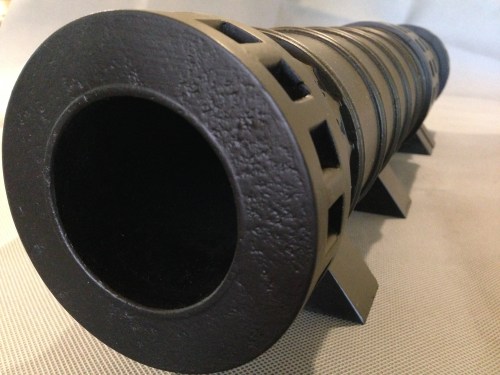
IMG_4572.JPG

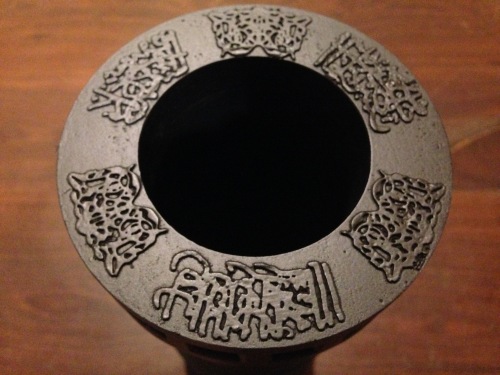
Except for a name plate I have finshed the bombard.  The floral design at 12, 4 and 8 is not as clear as I wished, and the Arabic script at 2, 6 and 10 is even worse.  But it is cut in wood, and it is a first effort at such work, and it is not easily seen in a model only 106mm 4.2″ diameter, so I am reasonably satisfied.

Also, this was always a prototype, in wood, and I have not totally dismissed the idea of making it in cast iron or brass.  In metal I am sure that the detail work would be a lot finer.

Turkish Bombard. The Barrel Script

Well, I bought a pair of NSK bearings for the Z axis of my CNC mill, and removed the old ones and inserted the new ones.  Cost $AUD 200.  Plus 2 or 3 half  days of  dirty heavy work.    And the problem persisted!!@!@

OK.  Time to get an expert opinion.  Here comes the cavalry.  Thank goodness for my expert friend Stuart T.

Very puzzling.  Even for Stuart.  There was some unwanted movement in the Z axis (about 2mm), despite being apparently properly installed.  Not a problem with the ballscrew or ballnut.  Even Stuart was puzzled.

“have you got any left over bits and pieces?  Is it all installed the way it was before?”

To cut the story short, we installed a thicker washer below the locknuts, and it seemed the problem was fixed.  Or was it?

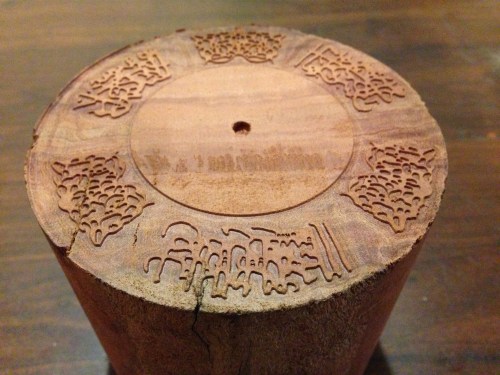
Today I did another test run of the bombard mouth Arabic script.  Worked fine.  OK.  Time to finish the bombard.

IMG_4559.JPG

Here is the finished result, ready for painting.  I have used a 20 degree engraving carbide bit with a 0.2mm flat end.  There is some loss of fine detail but it is I think, adequate.  When it is painted, the filling putty above the pin screws (the white circles) will be invisible.  The engraving took a total of about 60 minutes, at 500mm/minute, 15,000 rpm.

IMG_4554.JPG

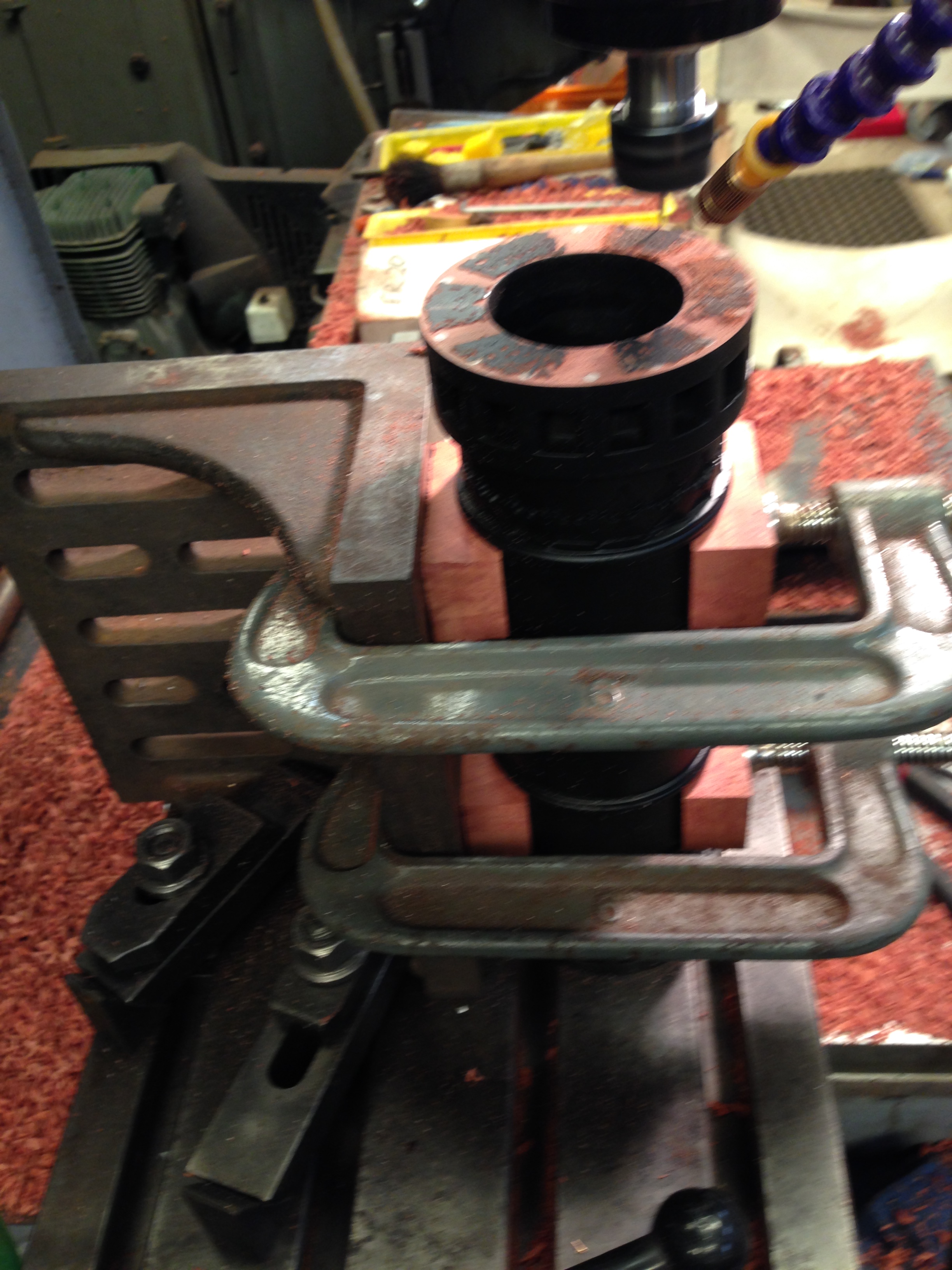
The setup.   A large angle plate clamped to the table.  The work clamped to the angle plate.

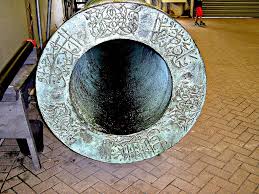
The translation of the Arabic script is “Help O God the Sultan Mehmet Khan son of Murad. The work of Munir Ali in the month of Rejeb. In the year 868.”

Turkish Bombard. The Arabic Script.

A little unfinished business on my model bombard is the Arabic script and floral decoration around the barrel mouth.

bombard-mouth

XIX.164 / 19-00164 Detail of muzzle of a great bronze gun. Turkish, dated 1464 Royal Armouries Museum, Leeds LS10 1LT Transparency tr-1185 Imacon Flextight Precision II

This is what I have managed so far….

IMG_4529.JPG

It is a practice run in scrap wood.

Some of the detail has disappeared because I used a milling cutter with an end width of 0.5mm.  Next time I will add another step using a cutter with a sharp point, and a lot more of the fine detail will appear.

That pattern took a total of 80 minutes to CNC mill, with the feed rate set at 500 mm/min.

Unfortunately my CNC mill developed a problem with the Z axis, probably due to a worn out end bearing.  I am hoping that it is not the ball screw nut.  Now in the process of removing the bearing. A heavy, awkward, dirty job.

When the mill is working again I will mill the actual bombard model and post some pics.

Computer graphics is not my strong point.  To get the CNC mill to cut that pattern I did the following..

IMG_4531.JPG

  1. Enlarged the photo, outlined the tracery and the script, then traced the outline onto tracing paper.  That 550 year old pattern is worn and hard to define in many places.  Quite a bit of guess work.  Lucky that almost no-one can read ancient Arabic script these days.
  2. Scanned the tracing and loaded the scan into Corel Draw
  3. Used Corel Draw to smooth the curves, and make 3 copies in an array of the floral design
  4. Converted the drawing to bitmap file (bmp)
  5. Used V Carve Pro to convert the bmp file to vectors
  6. Used V Carve Pro to generate the CNC G codes
  7. CNC milled the scrap wood at 16000rpm, using a 3.2mm carbide cutter

After the triple

I am back onto the triple expansion steam engine, after putting it aside for most of 2016.  I am guessing that it is about 75% completed.  I have been struggling with this project due to poor plans, no instructions and some lack of skill and knowledge.

When I was well into the project, a colleague pointed out that detailed instructions existed in some articles published in 1985 (Model Engineer, Bertinat).  I obtained the articles, and subsequent progress has been greatly assisted, but unfortunately some errors had already crept into my work, and these have not been easily or completely rectified.

So now I am back into it.  And I would hope to have it finished and working by the end of the year.  Watch for pictures when there is something to show.

I am already thinking about what will follow the triple.  Maybe a Harrison 1 clock? (of “Longitude” fame.)  Looking for some plans.

h1

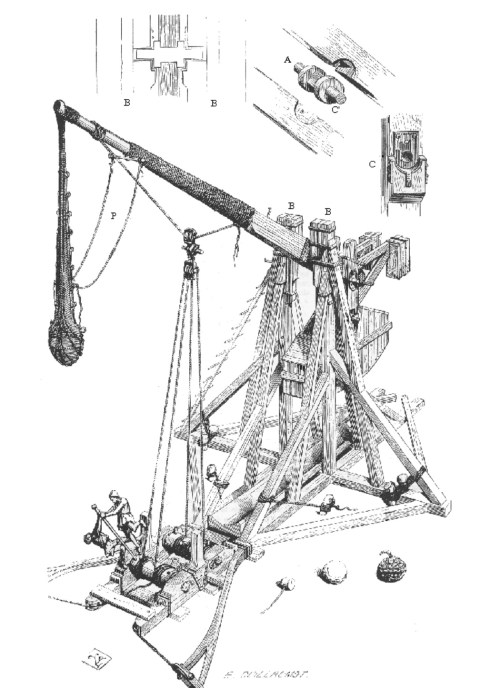
Or maybe some more artillery?  How about a working  model  trebuchet?  Now that does have some appeal.  There are some plans on the Net, but they look over simplistic.  I am thinking of a more historically accurate model.  The following picture is from an old French encyclopaedia.  But I might have to abandon my preferred scale of 1:10 because the original was about 12 meters long.  But on the other hand……

trebuchet1.jpg


It does have some interesting features.  The ratcheted windlass, the travelling pulley, the trigger mechanism (“pulling the pin”), and the projectile release mechanism (trying to avoid the projectile going up vertically).


img_4485

More Scale Stuff

IMG_4482.JPG

There is the 1464 Turkish bombard (black), 17 tons, 307kg granite ball;  the 1779 long naval gun off USS Constitution or HMS Victory 24lb balls; and a 32lb carronade.  All 1:10 scale.  Interesting to see them together on my kitchen table?

Model Ottoman Bombard – Painting

I would have preferred that the title of this blog was “Finishing the Ottoman Bombard”, but I am still waiting for the vectors of the barrel mouth decorations and Arabic (?) writing, and the touch hole.

But I have at least painted the bombard, and the pictures follow.  You will notice that I have not attempted to reproduce the bronze or copper colours of the orginal in Fort Nelson.  Partly because I doubted my ability to make painting such variegated patterns realistic, and partly because the cannon would not have looked like that in its heyday of 1464.  It would probably have been either black, like most SBML cannons (smooth bore muzzle loading), or possibly gaudy golds and reds and blues like other medieval items.  So I painted it black.  I like it.  If I get evidence that it should be more colourful I can change it later.

IMG_4429.JPG

First coat – Primer.  Hmmm… interesting colour.

IMG_4434.JPG

Next coat – matt black brushed on, to fill the hairline wood cracks.  Incidentally, the (dirty) parquetry floor is also made from the red gum house stumps from which the cannon is made.

IMG_4447.JPG

final two coats –  matt black, from a spray can. 

IMG_4458.JPG

So there it is, finished except for the barrel mouth engraving, and the touch hole.  Now what to do with it…   SWMBO says it might be useful as an umbrella stand.

IMG_4460.JPG

The breech.  25mm diameter explosion chamber.  1:10 scale

IMG_4461.JPG

The barrel, 63mm bore.

IMG_4462.JPG

Assembled.  The model is 520mm long.

IMG_4464.JPG

It does need some decoration

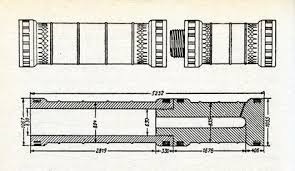
turkish-bombard-plan

Ottoman Bombard Photo to Vector

Bombard mouth.jpg

This is the low res photo from Fort Nelson.  High res photo on its way.

In the meantime, I have contracted with a US firm to convert the picture to vectors.  More $US.  ($US50 to be exact).

I am not sure that this is going to work.  But I will report to you.

I do wonder what that the Arabic/Turkish writing means.  Does anyone know?  I am pretty sure  that it is not complimentary to Christians/Westerners/Non Muslims.  Maybe it is just an instruction not to look before the touch hole is touched.  Or “do not stand here”.

PS.  Note added 17 Oct 2016.    The translation is   “Help O God the Sultan Mehmet Khan son of Murad.  The work of Munir Ali in the month of Rejeb.  In the year 868.”

868 = 1464 ce.


TURKISH BOMBARD- HELP!

Does anyone have a decent photograph of the writing on the muzzle?

I have repeatedly hunted through every picture which I can find on the net, but they are either taken at an angle, or too poor quality to be useable.

Does anyone have a photograph which I could beg buy or borrow?

I also need a photo of the touch hole.

I have contacted the Fort Nelson Armoury Museum, but not too surprisingly there was no response.

Is there someone in the Portsmouth UK area who could pop in and take some pics for me?

POSTSCRIPT:  October 5.   I have had 2 excellent and positive responses to my appeal.

First, reader Richard sent me a connection to a Turkish Dr/Professor, who has made a 1:25 model of the bombard using 3D printing.  (at least that is how I think he has done it.  My Turkish is non existent).  I am following this lead.

Secondly I have had a response from Fort Nelson Armoury, with a good photo of the barrel mouth, and a high res photo on the way, after payment of a significant, but not unreasonable fee.  Isn’t the Internet wonderful!!


TURKISH BOMBARD – the real thing

I have found this video to be particularly useful in my modelling of the Ottoman bombard. The subject of this video is the gun that the Turkish sultan gifted to Queen Victoria when the Brits and the Turks were allies.  It might be one of the guns which fired on the British fleet in 1807, when it (the gun) was 343 years old!

Notice the colour.  It is aged bronze.  I am thinking about how to reproduce that colour on my model.


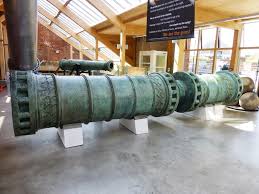
Length of the assembled gun 5.2m (17′)

Bore 635mm

Breech weight 8942kg

Barrel weight 8128kg

Average weight of shot 307kg

the model is at a scale of 1:10.  photos soon.  being painted.


Modelling A Turkish Bombard- The Pins

b281d1ba4455df20d7b832411bb00443

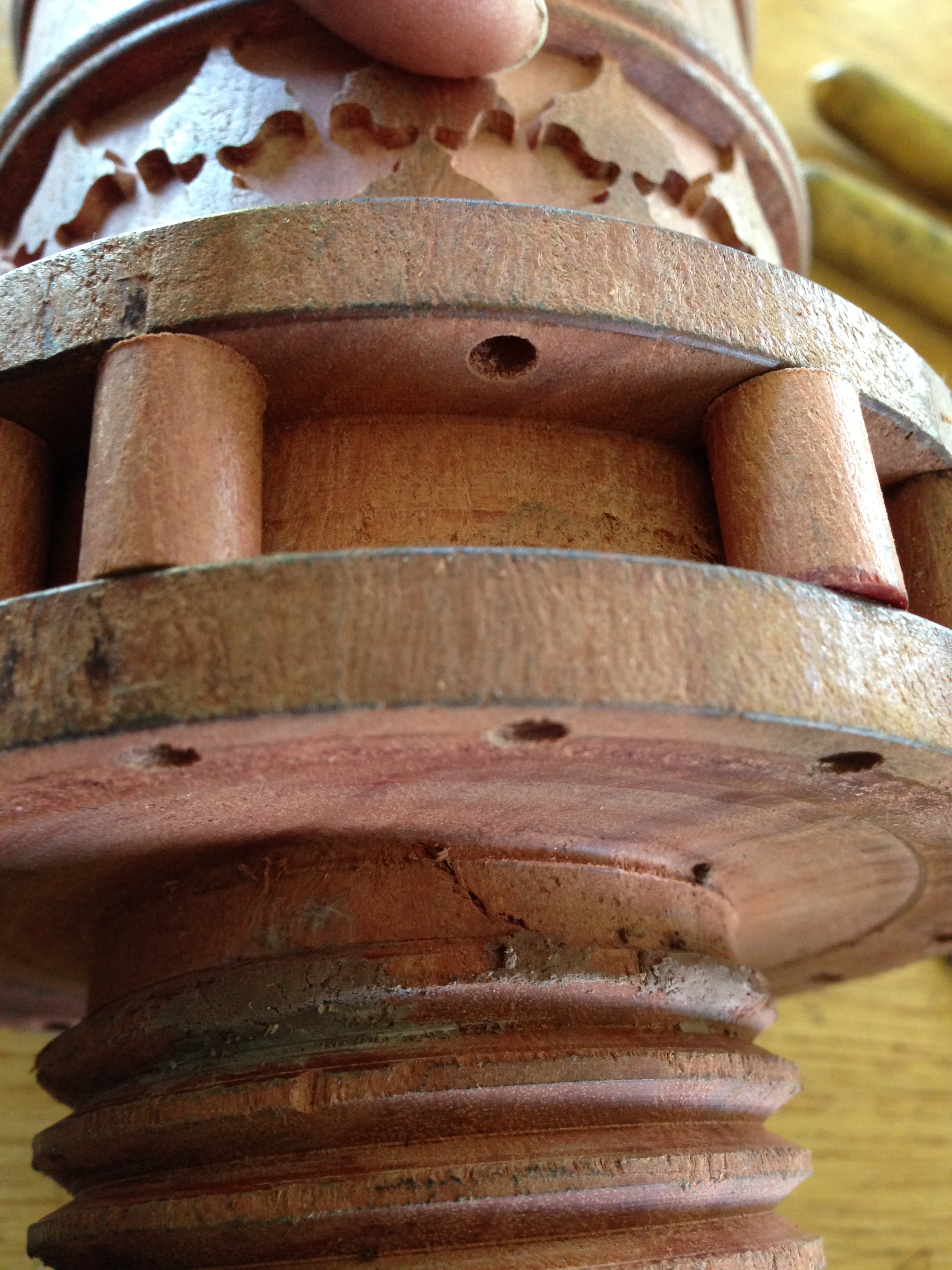
There are 16 pins at each end of each section of the cannon.

These were certainly used as leverage points, for very strong men with large levers to rotate the 8-9  tonne segments against each other to engage and tighten the screw.

I cannot see how the pins would have been cast with the breech and barrel.  For my model I decided to make separate pins and fit them into the gap between the big rings, then insert a grub screw through both rings and the pin.  The holes are then filled.

I wonder if a similar method was used in 1464.  I would love to have a close look at the original cannon to figure this out.  From the photographs, I can see no evidence of later insertion of pins, but neither can I see how it would have been done any other way.

IMG_4373.JPG

Drilling the holes for the grub screws

IMG_4395.JPG

In order to continue with red gum, I made my own pins.  This is the setup.  The blank is held approximately centre in a 4 jaw….

IMG_4396.JPG

…and the pins are turned, centre drilled, drilled, cut to length,  and tapped M4.  64 altogether.

IMG_4421.JPG

The M4 x 25mm grubscrew is screwed into the pin.  The wood join is super glued.  Also, I am attempting to patch the worst of the thread tearouts.

IMG_4423.JPG

Using a battery screwdriver to insert the grub screws.  The pins protrude above the ring surface for a reason..


IMG_4424.JPG

Sanding the pins flush with the rings.  Check the photo of the original 1464 model.  There is also some wood filler in other splits.  Not surprising after holding up a house for 70 years.

The holes are now filled with wood filler, and will be sanded flush.  They should be invisible after painting.

Next the painting, the stands, and some cannon balls.  How to reproduce that aged copper colour…


Modelling a Turkish Bombard -4 Decoration

The decoration around the barrel is formed by a repeating pattern, which when milled, very cleverly forms 2 identical patterns.  One is excavated and one is the original barrel surface.  You will see what I mean if you look at the pictures in the earlier blog, and the video below.

It took me an evening of experimenting on the computer to work out the system and draw it.

bombard-pattern3

Then I measured the diameters of the 2 gun components, calculated the circumference, (OK it is not rocket science.   3.142 times diameter), then working out the number of identical shapes which would fit around the 2 different diameters, at the same size and spacing.   Amazingly, it took 18 shapes to fit almost exactly around the barrel, and 16 of identical size almost exactly around the breech.  the angular spacing was 20 degrees and 22.5 degrees.

Then the shape was imported into V-Carve Pro, and G codes were generated.

My CNC mill does not have a 4th axis, so I used a dividing head to move the workpiece at the precise angles.  See the setup in the video.  That meant that the pattern was engraved into 16 and 18 flat surfaces, rather than a continuous cylinder as on the original.

It worked very well.  There were minor compromises due to the shapes being milled with a fine end mill but when you look at the pics I hope that you will agree that it is effective.

I calculated that the milling had to be at a maximum depth of 2mm in order to cope with the curvature, but if I do it again,  I would reduce the depth by 25%.

The first part of the video is a shot of CNC drilling.  Then the CNC routing of the repeating patterns.  Each angular setting of the pattern took 4 minutes to complete.  136 minutes altogether.  In reality, it took a whole day, most of which was spent doing the setups.


Bombard Model-3 turning the barrel

Another session or two, and this project is complete.

Now how do I make a cannon ball 62-63 mm diameter?  In wood will be ok?  Does not have to be granite.  I could make a mould and cast it in aluminium or lead, but stone would be authentic…..   thinking.

ps.  Re cannon balls.  I will cast them, in cement!   Now, how to make a mould.

Bombard Model -2. Big Thread

The breech and the barrel are joined with a very large thread.  On my 1:10 scale model it is 60mm diameter, and has a pitch of 6 mm.  These dimensions are measured off Internet photos of the original bombard, so they might not be faithfully accurate to the original bombard.  If anyone has accurate plans of the bombard I would be very interested to hear from them.

I experimented with various spindle speeds, feed rates, depth of cut, and finally decided that red gum wood is not the ideal material to be cutting a thread with sharp points.  However, at 200rpm, and taking 50 cuts to reach the full depth, and using a very sharp tool, the end result was OK.  I will fill the tearouts.

In order to make a functional join in the wooden cannon, I truncated the apex of the thread.  In the gunmetal version I will attempt a more faithful to the original, sharp look.

For some reason, the wood held together better during the internal thread cutting than the external.


The male thread was cut on my newly CNC converted lathe,  between centres, but the fixed steady on that lathe was just too small to hold the barrel, so the internal thread was cut on my bigger Chinese lathe.

Next I will bore the barrel to 63mm, then turn the exterior of the barrel.


Bombard Model. Turning the Breech


So if you watched the video, you can see that I have a problem with the big thread between the breech and the barrel, at least in the wooden prototype.  It might work better in brass or gunmetal.

The thread has a pitch of 6mm and a diameter of 60mm.   It is big.

My plan at this time, is to make a brass male threaded section, and glue or screw it into the breech.  Then to make a steel tap using the same G code, and cut a thread into the wood of the barrel.  (p.s.  note 30 Sep…  I continued to experiment with feeds, speeds, and cutter shapes in the wood.  The final result was OK so I did not make  metal threads.  That will have to wait until I do this project entirely in gunmetal or brass…  maybe never)

Turkish Bombard 1:10 scale

Just for fun I will use my newly converted CNC lathe to make a 1:10 bombard.  The original was cast in 1464 and was thought to be a close copy of the bombards which Mehmet 2 (“the conqueror”) used to breach the walls of Constantinople in 1453.  There are several of these bombards still in existence, including one in UK, which was given to Queen Victoria by the then Turkish Sultan.

These bombards were last used, against the British, in 1807, when a British warship was holed with substantial loss of life.  Pretty amazing for a 340 year old weapon.

images

5.2 meters long, 1.060 meter diameter. 16.8 tonnes.

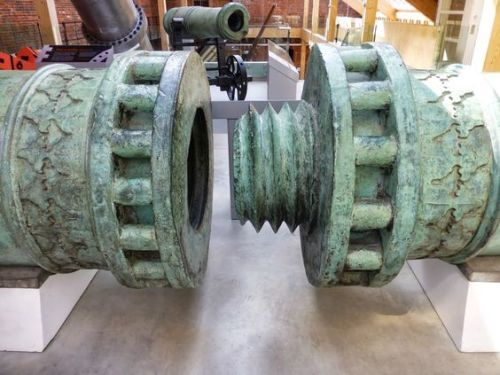
b281d1ba4455df20d7b832411bb00443

The large thread connected the halves.  Easier transportation, and casting.


images

Is this Turkish or Arabic?

images

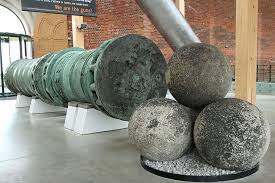
Granite balls are 630mm diameter.


tembokkotakonstantinopel

A reconstruction of the walls of Constantinople, with moat.  Almost 1000 years old in 1453  

walls-of-constantinople

And as they are today.  Massive.  High.

29962555-Huge-siege-the-final-assault-and-fall-of-Constantinople.jpg

Huge siege cannon used in the final assault and fall of Constantinople in 1453. Diorama in Askeri Museum, Istanbul, Turkey.  The bombards were probably dug in, to manage the massive recoil, and concentrate the aim at a particular wall section.  There is a wooden structure built around the cannon in the background of this modern picture.  As far as I know there are no surviving  wooden structures like this.  Nor have I come across any old pictures, but if anyone knows of any I would be very interested.  The bombards took about 3 hours to cool, cleanout and reload.  

p1090990.jpg

My model will be about 520mm long.  I would like to make it from bronze, or gunmetal as in the original.  Any mistakes will be costly.

So I have decided to make a prototype in wood.  That will test my drawing, the machining procedure, and the final appearance.  Not to mention how the CNC lathe will handle the task.

I will use a very dense, tight grained Australian hardwood (red gum).  The wood was salvaged when my house stumps were replaced with concrete.  Some was used to make parquetry, and the rest was put aside for possible future use.  Such as this.

IMG_4313.JPG

About to cut off the below ground section of a 70 year old house stump.

IMG_4320.JPG

A 5hp metal lathe with a tungsten bit chomps through the hard dry wood.

IMG_4322.JPG

I turned 6 lengths before I found 2 that were satisfactory.  The rest had sap holes or splits.

I have used Ezilathe to generate the G codes.

to be continued….


CNC Lathe Conversion- final

Before I am hung, drawn and quartered, for operating a lathe without guards, here is the proof that I have been sensible.

IMG_4292.JPG

Guard over the X axis pulleys.  I like to watch the wheels going round and round, hence the transparent top.   Also note the cover over the exposed ball screw.

IMG_4293.JPG

Cover over the Z axis pulleys and belt, again transparent.  If I wore a watch it would be transparent.

IMG_4295.JPG

I also installed an ER40 collet chuck.   I will be using this for all work with diameters under 26mm.

A Matter of Scale

Before I get onto a brief reflection about scale, the photo below shows 2 cannon barrels.

The big one was what impelled me to converting a manual lathe into a CNC lathe.  That time consuming, costly, and ultimately very satisfying project, started because the CNC lathe which I used to turn the big barrel could only handle the job by doing it in two stages…. doing the breech first then the muzzle.  That was due to the big barrel being too long for the lathe, at 300mm (12″).

The small barrel was a test for the CNC converted lathe just finished, being the first complicated shape which I have made.   To save on material, I made it at exactly half the scale of the big one, ie 150mm long (6″).

IMG_4291.JPG

Comparing the two barrels reminded me, that if an object is twice as big as another, in all 3 dimensions (height, width, depth), it is 8 times as heavy.   And any projectile, and weight of black powder, would also be 8 times the weight.  But the wall thickness of the explosion chamber is only TWICE as thick.

My point is, that if scale is maintained, the smaller the cannon, steam engine, boiler, whatever…..  the less likely it is to explode.

Not that these cannons will ever be fired.  Just hypothetically.

CNC Lathe Conversion – 17

First Test Run

After some test runs without tool or material, I performed some measurements.

500mm movements along the Z axis were reproduced multiple times with a deviation of 0.00mm!  (the Z axis has a ground ball screw)

100mm movements along the X axis deviated 0.02mm.  (the X axis has a rolled ball screw).

I was delighted to note that the lathe is extremely quiet and smooth.  The only noise is some belt slap from the very old belts, and from the stepper motors.

The video below was taken from my iphone, while I was operating the lathe controls, so please excuse the erratic movements.

The steel is 27mm diameter.  750rpm, 50mm/min feeds.

And the guards will be made next step, without fail.

The G code was generated using Mach3 for these very simple shapes.  For more complex items I use Ezilathe.


The lathe is 600mm between centres.  38mm spindle bore.  Swing about 300mm.

Steam Engine Oilers

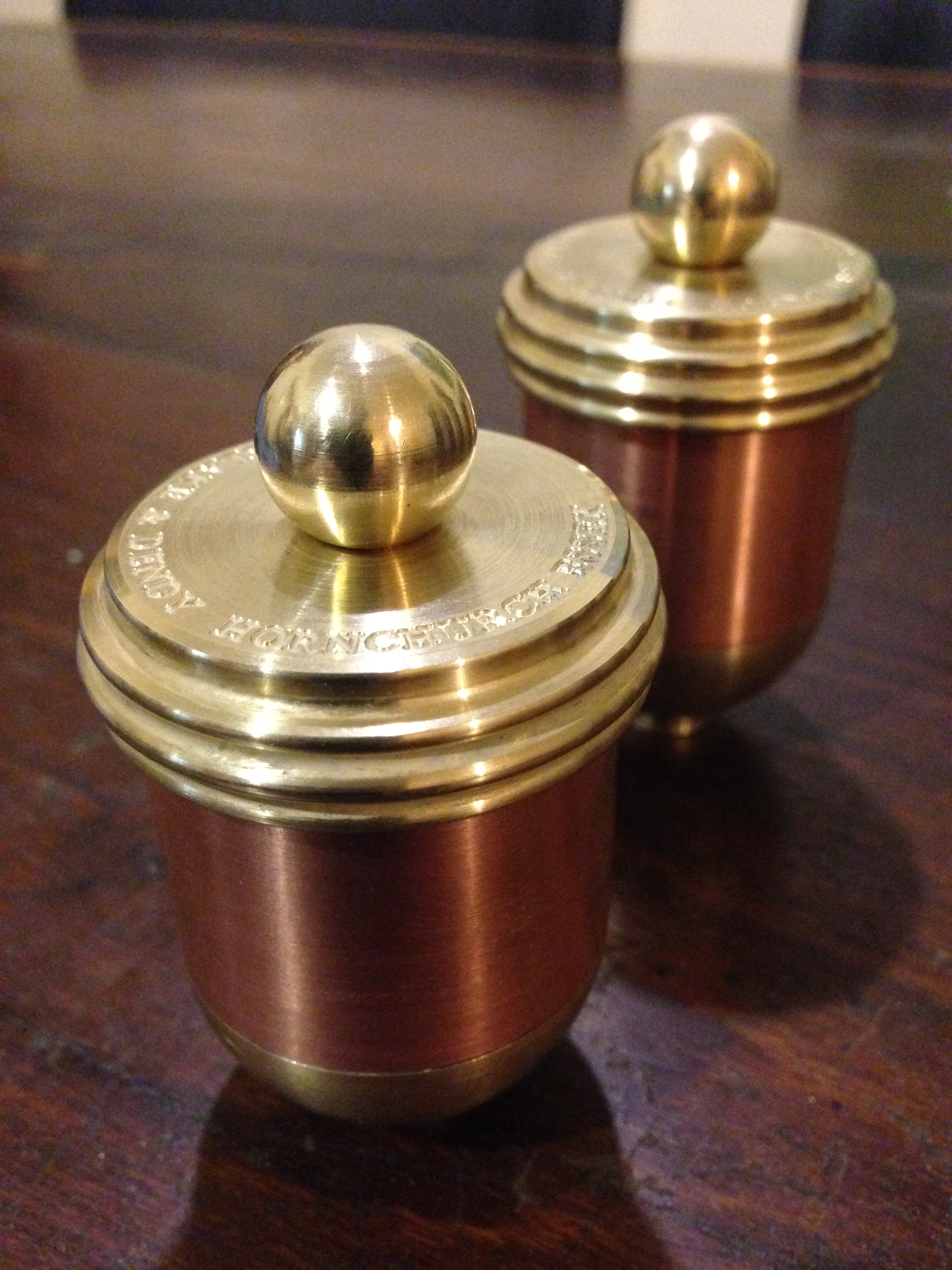
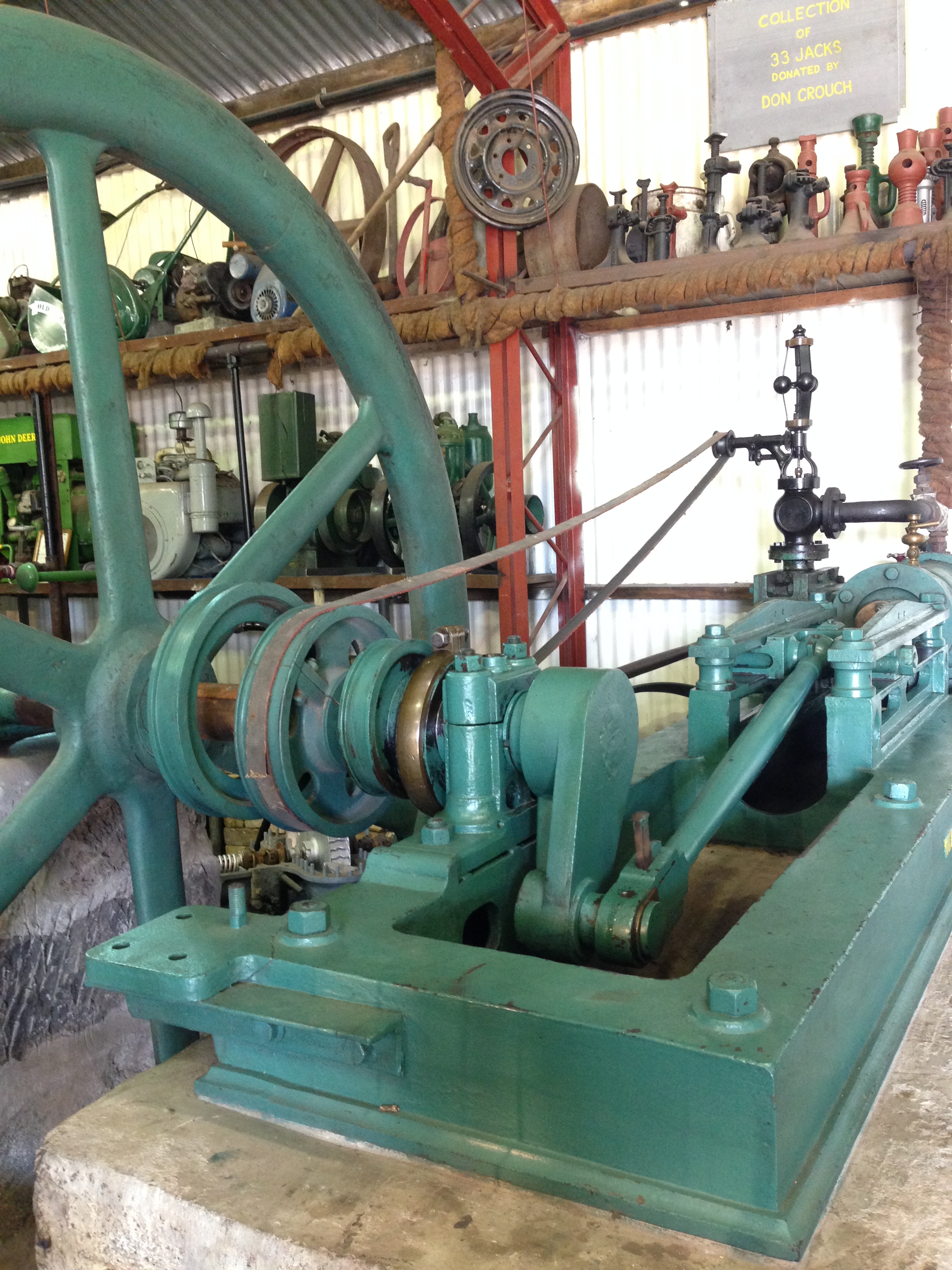
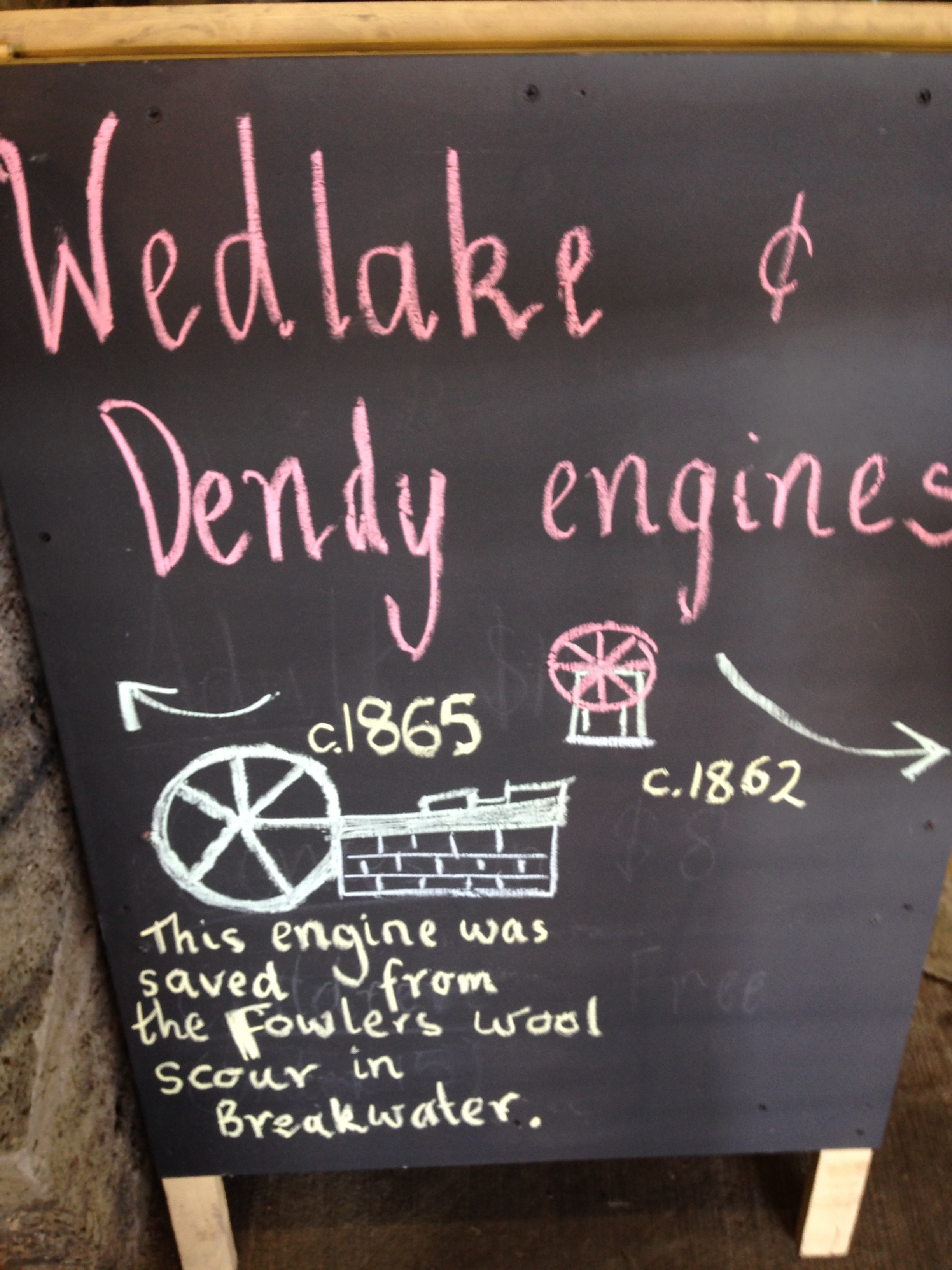
Knowing that I have an interest in CNC machining, Tom, from the Vintage Machinery Club in Geelong asked me to make a pair of oilers for a very old Wedlake and Dendy steam engine.  The engine is a large (to me anyway) stationary engine, which is run on steam several times each year.  The oilers for the cross slides were missing.

We searched the Internet for pictures of W&D steam engines, but could find no pictures or diagrams of the oilers.  So Tom sketched a design, and I drew a CAD diagram.  The dimensions were finally determined by the materials which I had available…  some 1.5″ brass rod and some 1.5″ copper tube.

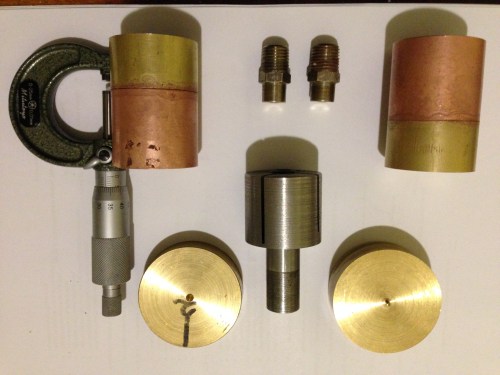
This is the almost finished product.

IMG_4250.JPG

Just needs 1/4″ BSPT fittings and and oil wick tube so they can be fitted to the engine.

IMG_4222.JPG

The copper tube silver soldered to the brass cylinders (top), the brass blanks for the lids (bottom) and the mandrel to hold the assembly (bottom centre) during CNC turning and drilling.

IMG_4246.JPG

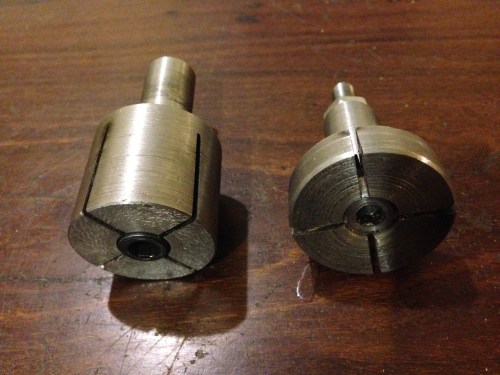
The mandrel to hold the body (left) and the mandrel for the lid (right).  The cap screw head and hole in the mandrel have a 2 degree taper.  The slits were cut with a 1mm thick friction blade.

IMG_4243.JPG

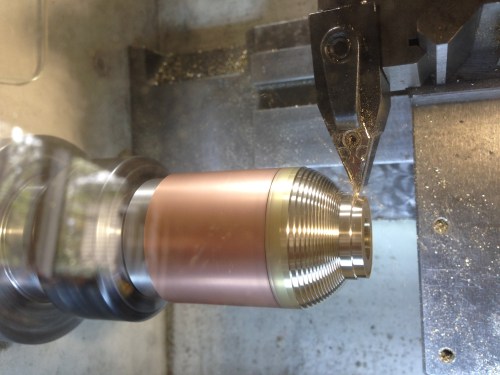
Rough turning the base.

IMG_4231.JPG

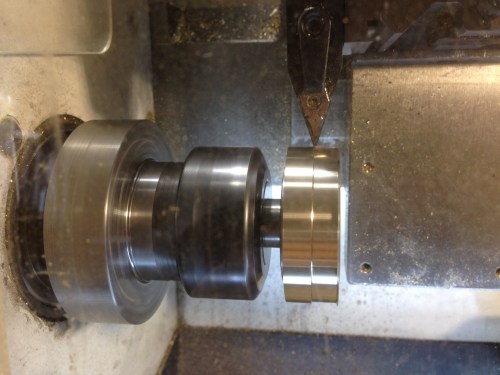
Turning the lid.  The mandrel is held in an ER32 collet chuck

IMG_4245.JPG

Engraving the lid.  Using a mister for cooling and lubrication.  16000rpm, 200mm/min, 90 degree TC engraving cutter.

IMG_4251.JPG

The oilers work by wicking the oil from the reservoir into a tube which drains through the base onto the engine slide.  When the wick tubes are fitted the oilers can be fitted to the engine.

IMG_3196.JPG

The 1865 Wedlake and Dendy

IMG_3195.JPG

1865

My lathe is a Boxford TCL125, using Mach3.  The G code is generated using Ezilathe.

Below is a link to an oil cup from “USS Monitor”, of American civil war fame.   One of the first ironclads, powered only by steam.

http://www.marinersmuseum.org/blog/2010/04/one-oil-cup-down/

(ps. The  lathe which I was converting to CNC was the subject of previous posts and is now working, but needs some guards fitted and a bit of fine tuning.)

OK, so guess the purpose

IMG_7699IMG_7704

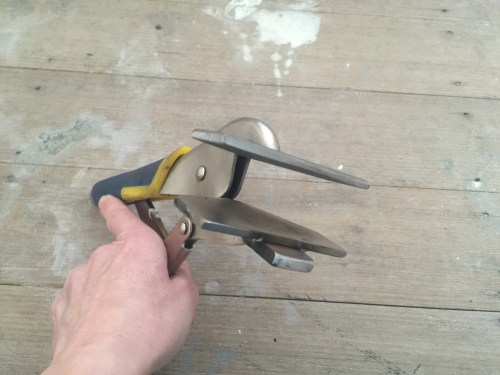
A pair of sheet metal pliers, to which I welded a steel tab.   Why?

For the answer click on the link.

https://Youtu.be/40NigiSpuEl

For some reason the auto link is not working.  You will have to type the link manually.

Later update…   I dont get this.  Even the manually typed link to the explanation does not appear.

OK.   The explanation is that these sheet metal pliers have been converted into canvas stretching pliers for my daughter who likes to make her own canvases for oil painting.  Youtube sucks sometimes.

Try searching “Thomas Baker’s canvas stretching tutorial” to see how the pliers are used.


MORE ANCIENT GREEK TECHNOLOGY, THE ANTIKYTHERA MECHANISM

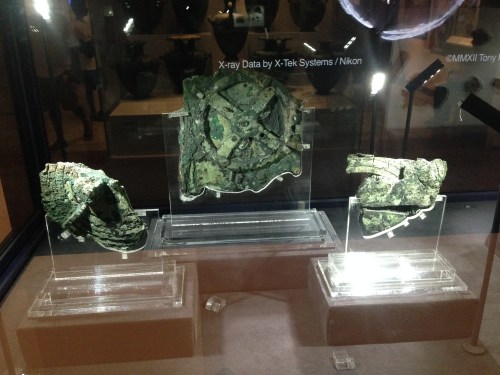
This mechanism was discovered in 1901, in a Roman era shipwreck, off the Greek island of Antikythera, which is a bit north of Crete.

It has been dated to between 100BCE and 205BCE, with the older date considered the best estimate.  ie, about 2200 years old.  Experts believe that its makers were Greek.

It is currently housed in the Greek National Archeological Museum in Athens.

IMG_4180.JPG

Not much at first glance, but when it was examined with modern scanning and X ray techniques…

Look it up on Wikipedia..

https://en.wikipedia.org/wiki/Antikythera_mechanism

According to the Wikipedia entry the gear teeth are too irregular to have been machine cut,

but watch the computer reconstruction.   Could you make this machine without a lathe and gear cutters?

How much more technology did the ancients have that has not survived the ravages of time?   A lathe for example.

ANCIENT GREEK MACHINING

I recently had a light globe switched on in my brain.

I was holidaying in Athens (the one in Greece), and was gobsmacked by the huge, fabulous collection of statues, mosaics, ceramics, gold jewellery and masks, bronze and iron weapons in the National Archeological Museum.   I took many photos, and might post some in later blogs.

Three items sent shivers down my spine.

  1. The gold death mask of Agamemnon (probably not Agamemnon’s but that is another story).
  2. The Antikythera machine.   More about that in a future post.
  3. A gynaecological speculum.

There was a display with many surgical instruments.  These have been found at various archeological digs in Greece, and while not precisely dated (at least not labelled) they are mostly from 500-200 BCE.

My eye was immediately drawn to an instrument which looked very familiar.  I was a gynaecologist in my previous life, and this could have come from my instruments. (except that the dark bronze surface might not have been acceptable to patients).

DSC_0570.JPG

Not a great photo, through a glass cover, and ISO cranked up to several thousand.

The instrument is labelled a vaginal dilator, but I am quite certain that it is a vaginal speculum.  A speculum is used to inspect the vaginal walls and uterine cervix.  (That might be too much information my metal working/ engine making/ machinery minded readers.  If so, too bad.)

It is said to be made of bronze.  The Ancient Greeks were highly skilled at metal casting, as evidenced by the many complex and beautiful bronze statues and weapons and implements on display.

It interested me for several reasons.  Bear in mind that not many archeology museum visitors are gynaecologists who know about making threads in metal.

It looks quite functional, and if cleaned up, given a shiny surface and sterilized it could be used today.

The threaded section is very regular and smooth.  I would loved to have taken some measurements of the thread with a micrometer, but had to be content with a prolonged inspection through the glass case.  The thread appears to me to be so regular, that it could not have been hand filed.  It must have been machine made.  I have seen hand made threads on medieval machines, and they are crude compared with this one.

Either this is not an ancient Greek instrument but a more modern instrument accidentally included in the display (pretty unlikely, considering the professionalism of the people involved).  (ps.  If you Google Pompeii speculum, you will see that similar instruments have been unearthed at Pompeii…  buried since 79ce.)

Or…..  the ancient Greeks had screw cutting lathes.

Ridiculous you say?

Wait until my next post about the Antikythera machine.  If if you just cannot wait, look it up.   It is mind blowing.


CNC Lathe conversion -16

The wiring of the lathe is complete.  (Except for limit switches.  They can be added at any time).

Mach 3 is configured.  The wireless hand control is installed and working.  Ezilathe installed and waiting for input.

Some covers to be made.

IMG_4154

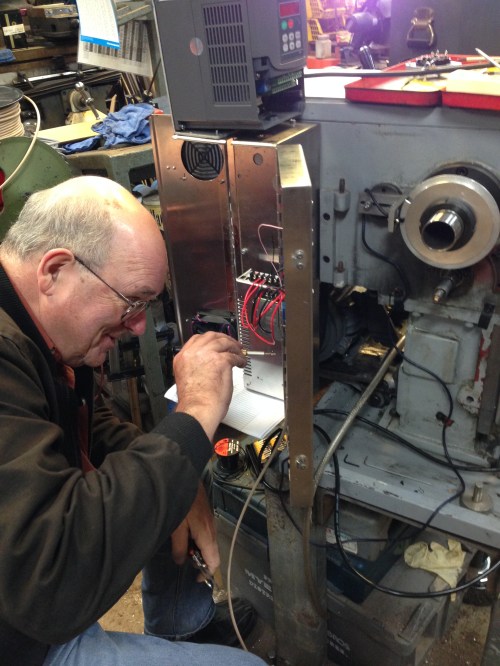
Hook ups in progress.  That’s the faulty VSD on top of the electronics enclosure.  The CNC engineer lost his hair trying to figure out the problem.

Still some testing and fine tuning required.

But nothing much will happen in the workshop for the next  3 weeks.


CNC lathe conversion -15

Another couple of advances in the conversion.  Today I installed the lead screw cover and the cable protector to the cross slide stepper motor.

The cable protector was easy and straightforward. It flexes in one direction only, and is fixed at the ends after the cable is threaded through it.  The length is adjusted by adding or removing links.  It was placed so that coolant liquid will drain out of it, and to minimise the accumulation of swarf.   The cables themselves have a thick covering and are well protected.  The link protector will not kink, further protecting the cable.

It was cheap.  About $AUD20 for 2 meters, posted from China.  I used about 1.1m.

cnc lathe - 2.jpg

Showing the stepper motor cable protector, and the lead screw protector (one half of it.  The other half is on the other side of the carriage.)

The lead screw protector was another story.  It is a spring steel coil, about 50mm wide, and as it is compressed the coils fit inside each other.  I made a big mistake in allowing it to spring open before I had installed it (there were no instructions).  It immediately opened to a length of over a meter, in coils about 50-60mm diameter.   No big deal, I thought.  I will just compress it back to its original configuration.    Big mistake.

It was what I imagine coiling a live, oily, biting, boa constrictor would be like.  (OK, boas constrict rather than bite.  How about an anaconda, or a big eel.)

I fought it for about an hour.  And eventually succeeded.  Minus a few bits of my skin.

So I did not allow the protectors to expand again until after I had them on the lead screw.

This is what they look like.   Pretty cool IMO.  They just expanded into position when I removed the restraining clips.

cnc lathe - 3.jpg

The lead screw stepper motor and protector.  The Estop box above will get some ends to exclude swarf.

It was not cheap.  The best price that I could find was from South Korea.  $AUD200 inc postage.  But it is excellent Japanese quality.

The wiring is happening, but the variable speed drive seems to be dead.  It has been sitting unused on a shelf for 2 years, so no point asking about warranty.  Took it apart to check for broken wires, fuses, burnt out components etc, but nothing visible.  Will order another one.  About $AUD200.  An unexpected expense.


CNC lathe conversion -14

These lathe CNC conversion posts are probably becoming a bit tiresome, but just in case there is someone out there who is interested, I will continue until the job is finished.

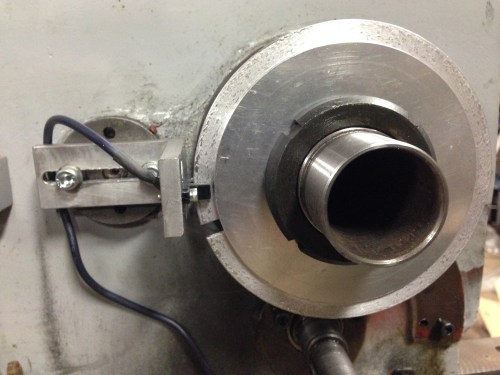
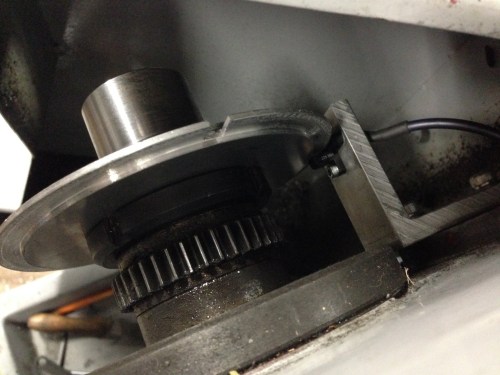
The latest was to make and install a spindle speed (and position – thanks David M) sensor.  It consists of a disk with a slot cut in the periphery, attached to the main spindle.  And an opto-electronic sensor which is connected to its own electronic board, thence to the breakout board and VSD.

cnc lathe - 1.jpg

The disc with the slot at 8:30 and the sensor at 9:00.  I must have chosen the wrong cutter or turning speed for that disc aluminium…  looks a bit rough.  (note added 13/7    Stuart T says that I should have used coolant-lubricant).

cnc lathe - 4.jpg

View from above.  Any clearer?   That gear is now superfluous except as a spacer.

So there is one electronic impulse per spindle revolution.  That is enough to measure the RPM’s.   Essential for cutting threads.

The beauty of this system is that there is no gear selection or changing, and ANY thread pitch can be selected…  metric, imperial, BA  etc…  any odd ball thread that your heart desires.

cnc lathe - 2

cnc lathe - 3

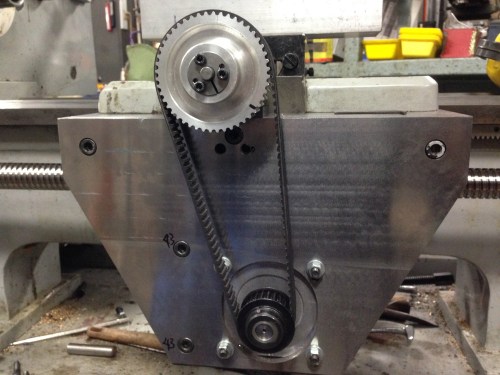
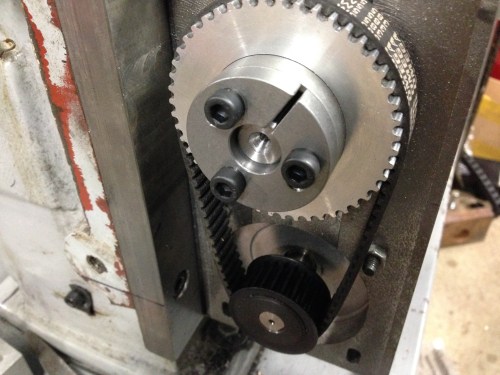
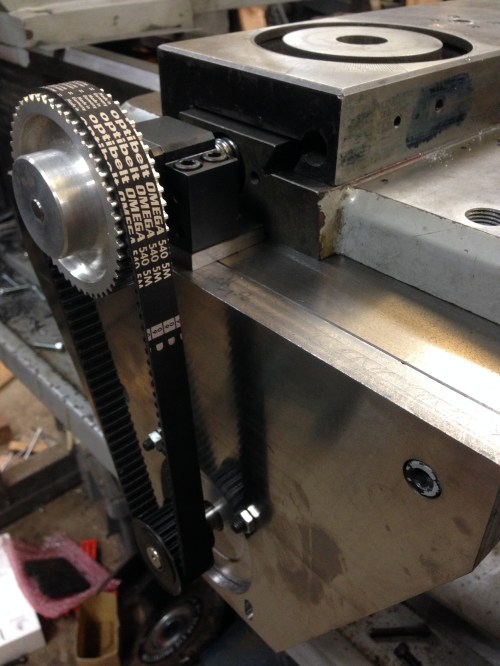
The HTD (high torque drive, I am informed by many readers) pulleys and belts and taper lock fittings.  Unfortunately I could not find a taper lock to fit the small pulleys, so when it is all finally, definitely, absolutely, correctly,  positioned, I will Loctite them in position.  Protective covers yet to be made.  I quite like to see the mechanicals in action, so I am intending to make the covers from clear polycarbonate.(Lexan) .

CNC Lathe conversion -13

IMG_4125

Adjusting the lead screw.

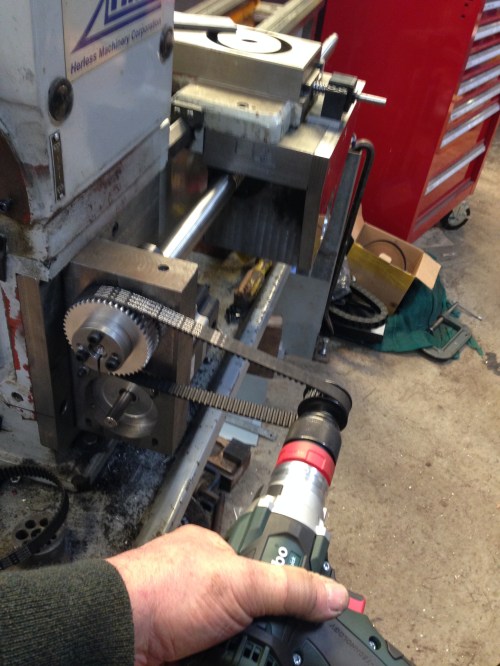
The 48 tooth HTD pulley has been installed using a taper lock.

Then some time was spent adjusting the parallelism of the lead screw.  That requires quite a few movements of the carriage along the 600mm thread.  Each 360 degree turn of the lead screw advances the carriage 6mm, so you can understand that I became a bit impatient with all of the repetitive hand actions to move the carriage from one end to the other.

So this was a solution to that issue.  That HTD belt is the one that was too long, so I was happy to find a use for it.    The variable speed battery drill shot the carriage end to end in a couple of seconds.

All is now adjusted parallel.

A few more little installation issues, then for the wiring.

CNC Lathe conversion -12

Today I fitted the lead screw.

No big deal, I sense that you are thinking.  After all, the ends are machined, the bearings fitted, and all waits in readiness.

True, but there is a strict sequence of events.  And since it has been 3 or more weeks since it has been together, I had to rediscover the sequence, by trial and error.  And each bit of the fitting is very heavy, very delicate, very tricky.  So it took me several hours to get to the  final photo in this blog.

But first a view of the inside of the newly machined apron.

IMG_4122.jpg


IMG_4123.JPG

The lead screw fitted.  The cross slide screw is also fitted.  Note the red E Stop panic button fitted to the left.    Next job is to fit a support bearing at the right hand end of the screw.  Then to check and adjust parallelism of the screws.  A rough check showed that they are within 0.25mm

CNC Lathe conversion -11. Ball screw machining.

Hooray!

Today I collected the lead screw after the ends were machined by Statewide Linear Bearings.

I decided to drive the 100km each way to pick it up, in preference to using a courier.  I wanted to ensure that all of the small bits were there, and also just to make sure it was handled properly.  Mostly freeway, listening to Dan Carlin on the Persian-Greek wars, so it was a pleasant way  to have 3-4 hours to myself.  (If you do not know about Dan Carlin, Google him and download an episode.  If history at school had been like this, we would all be history addicts.)

IMG_4117.JPG

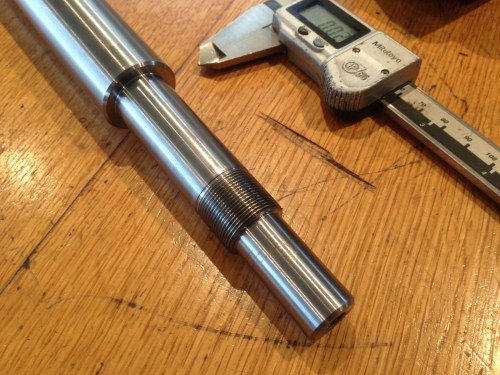
This is the lead screw, ends machined, and support bearings fitted.  1100mm long. 28mm dia

All good, except that the nut was back to front.  That nut is pre-tensioned, which means that the 2 halves are separated by a precisely machined washer.  I was nervous about removing it and replacing it the correct way around.  However I had previously asked the ball screw expert about that aspect, so armed with the technique I made up a sleeve of the correct size, removed the nut and replaced it.   No balls fell out.   So all good!  The above picture shows the nut in its correct position.

IMG_4118.JPG

The nut.  Looks expensive?  Is expensive.  And beautiful.

IMG_4120.JPG

The machined driven end.   $AUD250 machining there.  But it is perfectly done.

IMG_4119.JPG

And with the support bearing installed.  A pulley for the HTD belt goes on the distal bit of shaft.


IMG_4112

The CNC lathe has 3 belts. There is a V belt from the 3 phase motor to the main lathe spindle.  Although I changed the motor and the pulleys, the old belt fitted, which was good.  No hassle. But the stepper motors driving the lead screw and cross slide screw, and their pulleys were all […]

CNC Lathe conversion – 9

The CNC lathe conversion has been happening, despite no posts on the blog.

I have mounted the electronics enclosure, and mounted the various components inside.  No wiring yet.

IMG_4110

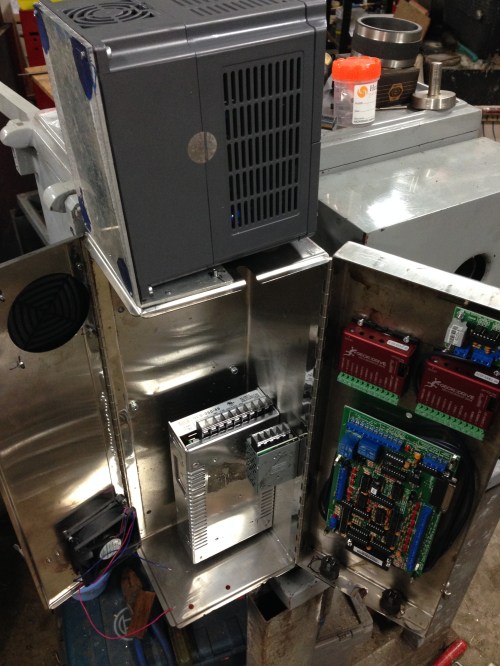
This stainless steel tool box is the electronics enclosure.  It fits the space quite nicely, and is adequately big.  The back gear cover to the right will be retained, although the back gears have been discarded.  The main switch and emergency stop will be mounted somewhere on this cover.

IMG_4109

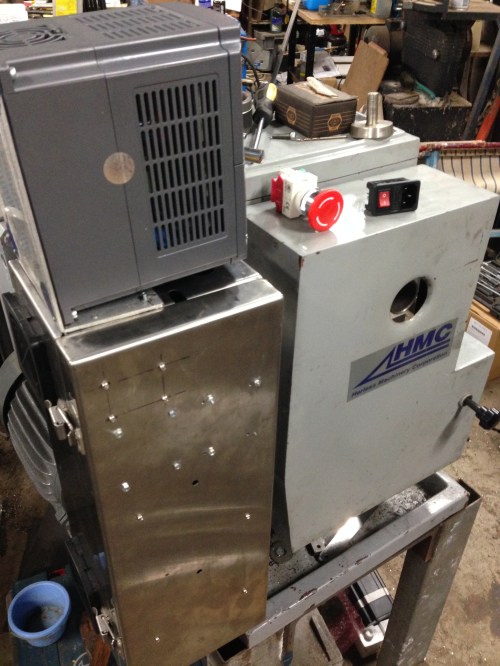
The Variable speed drive (VSD) sits on top.  That will control the spindle speed.  The transformers, stepper motor drives, and Breakout board (the heart of the system) are positioned inside.  Plus cooling fan and filters.  Ready for wiring.

IMG_4107

Drilling the apron to attach the cross slide ball screw bearing.  One chance only at this one, so the setting up took a couple of hours.  The apron is clamped to a large angle bracket on the milling table.   M6 threading followed.

IMG_4108

The end result.  The bearing as attached to the apron and the ball screw is in place.  I machined the end of this ball screw to fit the bearing, cut a thread (M10x1), and machined the end to accept the pulley.  All good.  There is 0.25mm adjustment available if required, but it all seems pretty correct.  The bearing sits on a carefully machined block which is 7.85mm thick.   Still waiting the lead screw machining.(!!)

NOT MUCH GOING ON TODAY

IMG_4092

This is my workbench after I had almost finished tidying it.  Really.  


Then I thought about machining the ends of the cross slide ball screw.

IMG_4095

So I mounted the collet chuck and checked the runout.   0 to o.01mm.  Then I did a test cut in the ball screw.   Hard hard hard.  But it did cut.  Then I chickened out and decided to finish it another day.

So, looking around the workshop for something else to do, I decided to pretty up the new CNC lathe apron.

IMG_4087

Before (milled surface).

IMG_4093

During


And I forgot to take a photo of the after, but it did look nice and smooth and shiny (look at the mirror finish behind the wheel).

Being retired is great!

Workshop Tidy

I sometimes feel a bit ashamed when I have visitors at my workshop.

The reason is that when I am in the middle of a project, I really concentrate my energy on the decisions, the machining, working out how to fix the mistakes…

…. and tidying up as I go, is near the end of the list of must do’s.

Consequently, tools tend to be put aside at the spot where I have been using them.  And off cuts of steel or brass or wood or whatever, lay where they fall.

And as mentioned in a previous post, I have a policy of leaving swarf on the floor, to discourage wildlife from slithering into my workspace.  (see the old post about the tiger snake between the lathe and the milling machine).   And if you are not Australian, look up tiger snakes.   They are just about the most dangerous reptile on the planet.

So my workshop is not the tidy, organised sort of workspace which you might expect from a retired gynaecological surgeon.

But occasionally, the mess becomes so extreme, that I cannot find tools, I trip over stuff on the floor, everything is really dirty, and it is dangerous and embarrassing when visitors call in.  And some of those visitors have workshops where you could eat off the floor.

So yesterday I spent a whole day tidying, sorting, putting away tools, throwing out rubbish, and sweeping the floors.

What about the tiger snakes I sense you asking.

Well, here in the antipodes, we are in the depths of winter, and it is bloody cold.  And all sensible cold blooded reptiles are asleep in their homes. So for a few months it should be safe to sweep up the swarf.   Here’s hoping anyway.

CNC Lathe Conversion – 8

Continuing the installation of the ball screws, and stepper motors.

I have completely removed the digital read out module and glass slides, and they will not be reinstalled.  Not sure what I will do with them.   They are only a year or two old, and in good condition.  I will probably put them on Ebay.  Same with the old gearbox, carriage apron, and electric controls.

Here are some pics of the plates and blocks which support the ball screws and steppers.

IMG_4089.JPG

This is the steel plate at the headstock end, bolted to the bed.  And the block with the holes is cast iron 42mm thick, to support the leadscrew and leadscrew stepper motor.  It was machined out of an old piece of machinery, hence some unintended holes.   Being cast iron it was fairly easy to machine, but incredibly dirty. Turned everything in the workshop black, including me.  (whoops.   Unintended not PC)

IMG_4087.JPG

This is the block which replaces the gears and controls of the apron under the carriage.  The thick block is cast iron, and the stepper motor support is 20mm thick steel.  Very heavy.

IMG_4086.JPG

This plate is hidden under the carriage.  It secures the lead screw nut.

IMG_4085.JPG

The slot in the carriage had to be widened and deepened a bit, in order to accomodate the slightly fatter and taller cross slide nut.  See the next photo to see the setup for milling the hole through the carriage.

IMG_4084.JPG

A rather confusing photo.  The carriage is clamped to a large angle plate on the mill, and I am enlarging the hole which accommodates the cross slide ball screw.  It was at the limit of what my mill could manage.  An intermittent cut, with a lot of tool stick out.   Not the best way of doing the job, but it worked OK.

IMG_4088.JPG

Plastic covers attached to the stepper motors, and toothed belt pulleys fitted.

IMG_4075.JPG

Checking the centres between the pulleys, using 2 wooden wedges to push the pulleys apart.

IMG_4083.JPG

The underside of the carriage.  The hole and channel at the left side of the picture was machined to accept the larger cross slide screw

So you can see that I have been busy since the last post.

At present the lead screw is at Linear Bearings in Melbourne, having the ends machined to accept the driving pulley, and support bearings.  I did consider doing this machining myself, but decided to leave it to the professionals because of the high cost of the item and the hardness of the material.

CNC Lathe conversion-7

I am still waiting for the replacement ball nut for the lathe cross slide to arrive.

Meanwhile, I have been busy machining the supports for the lead screw.

IMG_4054.JPG

Drilling the holes for the support bolts for the lead screw nut

IMG_4055.JPG

And gradually drilling the hole to 49mm!

IMG_4059.JPG

That is a 49mm drill!  First time that I have used it!  Thank goodness for the  FS Wizard app, to give me some idea about feeds and speeds.  Following this I used a boring head to enlarge the hole to 55mm.

IMG_4063.JPG

Gradually enlarged the hole in 20mm steel to 55mm diameter.  and here is the lead ball screw, sitting roughly in its proper position.

IMG_4064.JPG

So this is where I am at.  The lead ball screw is sitting approximately in its correct position.  Considerable adjustment required.  And I am yet to turn the ball screw ends to their correct dimensions.

CNC lathe conversion-6. EBay problem

My first hitch occurred today.

I was very excited to receive the nut for the cross slide ball screw.  If you have been following these posts you might recall that the ground ball screw for the cross slide came from Taiwan, and arrived in 3 days.  But I had to order the nut from a seller in USA.  The nut was advertised as new old stock, but with no packaging.  That was OK, but the postage cost for such a tiny item was ferocious.

It was the last item to arrive from overseas.   However when I looked at it, it was obviously NOT new.

IMG_4043.JPG

The cap screws holding the ball recirculating tube were different from each other, and the washers underneath were too big for the screws.  Obviously not the way that TNK made it.  Somebody has had the nut apart.  And the ball retaining tube was very scratched  and loose.  Again, not TNK standard.

But no biggie.  If it works — fine.

So I turned up a retaining tube to remove the previous nut from the ballscrew, and it came off without any drama.

cnc lathe - 1

But when I tried to fit the “new” nut, it just would not go on.  Tried reversing the direction.  No go.  Bugger bugger.

Somebody has altered or changed the “new” nut.  Maybe installed balls which are too big, or maybe damaged the entry thread.  I do not know.

What to do.  I have been waiting 2 weeks for this to arrive.

First, Ebay email to the seller.  See what the response is.  Ask for a refund.  The postage was almost as expensive as the nut. If unsatisfactory response, they will get the worst Ebay feedback ever.

There is one other seller of these nuts on Ebay, also in USA, and 50% more expensive, and the postage is also 50% more expensive. (how DOES ebay come up with the postage charges.  It seems more related to the cost of the item rather than the weight-size etc.)  But the nuts are in original packaging.  And I want to get going with this, so fuck it.  Pay up and get it.

I will report in a later post.  (if the bad language in this post seems to reflect my state of mind, well, yes it does.)


PS.  Next day.  After sending photos of the issue, the seller accepted responsibility, and I am getting a full refund.  That restores my faith in Ebay/Paypal.   I hope that the next one is in better condition, and comes a bit more quickly.  Sorry for the bad language.

CNC Lathe conversion -5

This is a list of the components which I have accumulated to convert a manual lathe to a CNC lathe.  It is not quite complete, but close.

  1.  Lead ball screw and cross slide ball screw.  Both with nuts and end bearings.  (no pic yet)
  2. The electronic components.
IMG_4021.jpg

The electronic components, not including computer and parallel cable and manual pulse generator.

IMG_4023.JPG

Two stepper motors.  Nema 34, 1200 inch – oz.  With rear covers.

IMG_4024.jpg

A Gecko microstep drive for each stepper motor

IMG_4022.JPG

Cable and connectors for the stepper motors

IMG_4026.JPG

A transformer-power supply (48 volt)

IMG_4025.jpg

Another transformer-power supply (5 volt).

IMG_4034.jpg

3 phase 1.5kw motor (top) to replace the single phase motor (bottom)

IMG_4031.JPG

Timing belt gears 24 and 48 tooth, 5M.  Order belts when size is definitely established.

IMG_4032.JPG

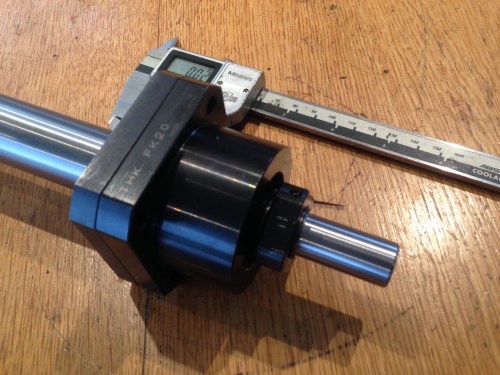
FK20 lead screw bearing and Ball screw covers

IMG_4028

The electronic heart of the system- the breakout board.  A C11R9

IMG_4029.JPG

The index pulse board and sensor.  A C3.

IMG_3342

Manual pulse generator, wireless.

IMG_2718

Variable speed drive, identical to this one on the mill

IMG_4035.JPG

An electrical enclosure, to hold the various components.  This stainless steel box was originally an item of medical kit.  Here I am checking out one possible location.  Not yet definitely decided to use this.

Finally in the electronics section, I will need a computer, loaded with Mach3 and Ezilathe.  Surprisingly, it does not need to be a particularly powerful PC.  And there are advantages in using an older operating system such as  XPpro.  I think there are a couple of those in the attic.  If not, I should be able to pick one up for under $100.

3. Various structural items.  Most of these will be 20mm thick x 200mm wide steel, cut to size and shaped and drilled.  I will take pics of these as I make them.  I was planning to have them water jet cut, but the shapes a fairly simple so I will cut and machine them myself as I go.

So, that is most of the items for the job.  I have spent about $AUD1100 on the ball screws and nuts, about $AUD1500 on the electronics and electrics, and maybe another $AUD500 on pulleys, belts, steel, taper locks, fasteners etc. I will add it all up accurately at the completion.  The lathe was cheap, bought sight unseen a few years ago.   So all up, I should have a CNC lathe for under $AUD4000.  And many pleasant hours of design and machining.  And a great learning exercise.  Stay tuned!

CNC Lathe conversion -4

I am in the process of collecting all of the components for the conversion.  Parcels are arriving from South Korea, Taiwan, China, USA and Australia.  Next post I will take a photo of the bits, before I commence assembly.  I have spent a lot of hours on the computer drawing up the positioning of the new components, deciding which components to get, then communicating with the sellers and making the purchases.  Not to mention hanging around home when parcels are due.  If I duck out for 10 minutes, that’s when the delivery van arrives.  And of course he leaves his little card “sorry we missed you”.

This post I will show you some of the drawings of the proposed conversion.  Of course the first step is to strip the lathe of all of the old manual controls, gears, motor, Digital read out, carriage apron, lead and cross slide screw, electric control box and contents.  (taking photos of every component insitu in case of a change of mind, and restoration required later).

Then measuring the bed and carriage in minute and accurate detail, and drawing it in CAD.

cnc lathe - 1.jpg

This is the lathe side on and end views, showing the new lead ball screw in red and green.  The cross slide ball screw is also there, but not well seen at this scale.  The 4 ball screws at top left are the possible combinations for eventual installation.  The second red one is the position eventually decided.  The green ones are with the nut re-installed in reverse direction.   I really did not want to remove and re-install the nut, because it is pre-loaded, and I do not want to risk disturbing the setup.

Many drawing versions are required, and as the components arrive, I find myself making changes.  This is definitely not the final version.   The two carriages show the carriage in its extreme positions on the lathe bed.

cnc lathe - 1 (2).jpg

This was an early sketch of how I thought I would arrange the cross slide motor and lead screw nut.

cnc lathe - 1 (1).jpg

This is a fairly accurate drawing of a cross section through the cross slide.  Black is existing.  Red is the new nut and ball screw.  You can see that removal of some of the cross slide bed iron will be required.  After looking at this I decided to move the nut and screw up a couple of millimeters.

cnc lathe - 1 (3).jpg

The Internet has been very useful in showing what fittings are available.  These are a few of the catalogues and tables which I have downloaded.  Some sites even provide CAD drawings so their components can be inserted into my CAD drawing to see if they will work together.

Ball Screws -2

This is a brief post to give a 10/10 rating to an Ebay seller with whom I have had dealings recently.

I have bought 2 ball screws and ball screw covers and ball screw bearings in 3 separate transactions from a supplier in South Korea.

Postage was included in the “buy it now” price.  In one case I offered a lower price, which was accepted within minutes.

After paying by Paypal, I received confirmation within an hour in each case, that the item had been shipped (actually air freight by Fed Ex).

In each case the items were delivered to my door in Australia within 3 days!  (it takes 5 days to get a parcel posted from Melbourne to Geelong, a distance of 65km).

And in each parcel there was a very nicely handwritten card thanking me for the purchase, and promising support if there were any issues with the items.

One ball screw was brand new, repackaged as advertised.  The other was used, salvaged from used machinery, but in “as new” condition.   Both were C5 grade, which is normally stratospherically expensive and has to be specially ordered.  They were priced only slightly higher than new rolled (lower grade) ball screws.

They were very carefully packaged in heavy duty cardboard rolls with metal ends, and multiple layers of heavy plastic and foam sheeting.

I made a later purchase which involved the seller removing a part from a machine.  He added it to a parcel which I had also ordered and wrote that I could pay later for the part if I was satisfied with it.  The price for the part (a THK bearing) was $UAUD32.  The same part new here would cost $AUD400.

In every case, communications have been  answered within a few hours, polite, personalised and in excellent English.

My only complaint, and it probably relates to the shipping arrangements, is that there appears to be a size restriction on shipping to Australia, of about 1200mm.  (p.s.  apparently the “do not ship to Australia” are old adverts, and there are no restrictions now.  A message to dy-global is all that is required to get any item shipped).

I hope to deal again with this company.  The name is dy-global.  To find them you need to search Ebay USA, or use the international settings on Ebay Australia.

THROAT CUTTER WALL SMASHER

Some pics which we snapped a few years ago of a large bombard, sitting outside the wall of the “Throatcutter” castle (RumeliHisari), a few miles from Istanbul-Constantinople, overlooking the Bosphorus.  This castle was built by the Turks in order to control the Bosphorus waterway, just before they besieged Constantinople in 1453.

The cannon was clearly placed in this current position just for display.

Could this have been the one which breached the Theodosian walls in 1453?  It seems to be an  appropriate size and style.


large cannon2.jpg

That’s a younger me.  No name plate  about the cannon.


large cannon bore.jpg

The bore is about 600mm.  The narrow part near the breach is the powder explosion chamber, with an enormously thick wall.  The original cannon was recorded as requiring 60 oxen and 400 men to drag it from its casting place.  And a gun crew of 200 men.  Cast in one piece.  (later note:  not sure about cast in one piece.  I will be in Istanbul soon.  I will try to determine construction.)

This could well be the original Orban cannon.

Updated Notes :

The Orban cannon was recorded 8.2 metres (27 feet) long, so the one in the photos cannot be it, unless the recorded figures are exaggerated.  Orban did cast additional smaller cannons for Mehmet 2 for the seige.

The biggest Orban cannon at the seige was named “Basilica”.  It fired  stone balls weighing 272kg (600lbs) over 1.6km (1 mile).   Reload took 3 hours.  The stone balls were in short supply.  Not surprising, considering the labour which must have been involved in making them.

Orban is thought to have been Hungarian or possibly German.


COMPRESSED AIR ON THE CNC MILL

Compressed air is very, very useful on the milling machine.  The tool changer uses air for fast tightening and release.  And I often use air to clear the field of swarf, and shavings (yes, I use my mill for wood  too).

Recently, at the suggestion of Stuart L  of stusshed.com fame, I installed 2 semipermanent nozzles on the mill, with adjustable direction and pressure adjustments.  It has been a quantum leap improvement.

carronade - 1.jpg

The pic shows the jets aimed during CNC end milling of wood.  The wood shavings are blown away which makes it easier to see how the milling is progressing; blows them away from me which is safer and cleaner; and stops the chips being machined into the work, which leads to a cleaner cut.  It also improves any video or photo of the progress.  It must also cool the cutter, although not as effectively as a liquid coolant.  I have not tried using the misting attachment, which would improve the cooling, but at the cost of dampening the area and the work.

I particularly like the improvement experienced when machining brass or steel.  The swarf is removed from the advancing cutter, preventing it being re-machined and squashed into the workpiece.  I am noticing better surface finishes.  I also adjust the air direction to keep the swarf away from me;  particularly valuable when brass needles otherwise would be flying at me.

When cutting pockets, the air keeps the pocket free of swarf, and when using tiny endmills at high speeds I am experiencing fewer tool breakages.

This gadget was inexpensive ($AUD12) from China.  It does not work the compressor too hard when the volume is turned back as far as possible, but still adequate.  Although there are 2 jets, I find that only one at a time is adequate.

Recommended.

As an afterthought.   I rarely use coolant on my lathes, but an air stream on the cutter and workpiece would probably have similar advantages to those listed above.  I particularly wonder if it would assist during deep parting…   always a tense procedure.  I suspect that the cutter becomes hotter and expands more than the workpiece parting slot if there is no coolant.  I will mention the result of air cooling and chip clearing on the lathe in a later blog.

Lathe conversion to CNC -3 Ball Screws

I have learnt a lot about ball screws in the past few days.  And I have purchased 2 ball screws and nuts on Ebay.  For those relatives and friends who follow this post, who have no idea what I am talking about, the “ballscrews” are what determines where the cutting tool on the lathe is positioned.  Very crucial.  (can something be “very” crucial?  It looks a bit like “very unique”. )

1

Ball screws are the usual positioning screws  for CNC machines these days.  The alternative is Acme or square thread screws, but the few manufacturers who used to use these have all switched to ball screws (as far as I know).  Even Wabeco, the respected German lathe manufacturer no longer specifies any threads except ball screws.

Ball screws require less power to turn due to friction being a fraction of the alternatives.  Ball screws are silent.  If they are noisy there is something wrong.  They are generally more accurate than square or Acme threads.  They used to be many times more expensive than the older types, but since China/Taiwan has taken over most of the manufacturing, often using equipment sourced from US/Europe/Japan, the costs have plummeted.

And the backlash is minimal or zero.   Another name for ballscrews is “antibacklash screws”.

Backlash is annoying on a manual lathe, but it is very important on the cross slide of a CNC lathe.  Interestingly, it is less important on the CNC lathe lead screw, because most CNC lathe machining  on the leadscrew occurs in one direction only, towards the headstock.  However,  the cross slide is machining in both directions, in and out,  so the absence of backlash is necessary to maintain workpiece accuracy.

Ballscrews have grades of accuracy varying from C0 -C20.  The bigger the number, the less accurate the screw.   In general, it is recommended that industrial lathes should be C3-C5,  which means zero backlash, and accuracy of about 0.001mm.  That degree of accuracy is quite expensive, costing thousands of dollars per screw, and only attainable in ball screws which have been finished with precision grinding.  The alternative is ball screws which have been “rolled”.  These are much less expensive, costing hundreds of dollars per screw, depending on the degree of accuracy.  The best rolled screws can attain an accuracy of 0.01-0.02mm (C7), down to 0.1mm (C20).  These are approximate figures which I have gleaned from several manufacturers’ specifications.

So from scale drawings of the lathe bed and carriage and cross slide, I worked out that I needed the following…


IMG_3978.JPG

This is a photo of a ball nut and screw very similar to what I have bought for the cross slide.  THK brand, 14mm diameter screw, 4mm pitch, and BNT nut style.  Note the rounded channels that the balls occupy.


  1. Cross slide screw 14mm diameter, 400mm long with at least 200mm of thread, and a thread pitch of no more than 5mm.  The cross slide nut needed to be a THK BNT pattern in order to fit into the cross slide with a minimum of space making machining.  THK is a large manufacturer, with intermediate prices, and a very good reputation.  The screw needs to be a specific length, and one end needs to be machined to go through a bearing/ bearing housing and have a tooth belt pulley attached.  I contacted a ball screw supplier, to enquire about ground ball screws, but discovered that these were rarely specified due to their cost, and delay of 3-6 months.  A C7 rolled screw with the BNT nut was going to cost about $AUD400-450.  So I searched Ebay Australia, Ebay USA, and Ebay UK.  Eventually, I found and bought a used ground screw with end bearings and housings from Taiwan for $AUD250.  The nut was the wrong type, but I found a new correct style nut on Ebay USA for $AUD100.  I know that sounds like I have not saved much money, but that gives me a super-accurate ground ball screw!  Of the correct size and type.  I am keeping my fingers crossed that the pieces sourced from different countries will go together.  Theoretically, they should.  (same manufacturer, same size, “ground” specification, etc etc.  but finger tightly crossed).
  2. The lead screw approximately 1000-1100mm long, 25-32mm diameter, and 5-6mm lead.  Super accuracy not required in the lead screw, and I could have bought a new rolled one from China for about $AUD300-400.  But then I spotted one in South Korea, new old stock, 28mm diameter, 6mm lead, with unmachined ends.  THK brand.   Asking price just within budget.    And this was a C5, ground screw, possibly more accurate than I expected for the price, and unused, but hey, it sounded like a bargain.   So I offered about 15% less and was somewhat surprised to have the offer accepted.   So that one is arriving in a week or two.  Then to buy mounts and arrange end machining of the screw.  Although not crucial it will have zero backlash, due to the C5 designation, and the fact that it has two ballnuts bolted together in a “pre-loaded” fashion.  I expect that it will be the most accurate component on the lathe!  No decent photo to post.

(ps.  see the comments section for discussion about axial accuracy and backlash.  A super accurate C5 ballscrew has axial play (backlash) specification of 0.020mm, but the double ballnut configuration will reduce that number substantially.  “zero backlash” apparently does not really mean zero.)


Lathe Conversion to CNC -2 and Wall Smashers

After removing most of the lathe gear which will not be required after the CNC conversion, the lathe is looking a bit naked.

The carriage apron, the lead screw, the back gears, the drive rod and control rods have all been removed.  Also the cross slide screw and handle.  The cross slide itself is temporarily removed, but available for measuring for fitting a ball screw.

I have now made accurate measurements and drawings of the lathe bed and carriage, in order to choose ball screws and nuts for the lead screw and cross slide.

The lead ball screw is easy.  There is plenty of room and machined surfaces for attachment.  I see no particular problems there.  Just time, careful machining and expense.  Chinese or Euro-American?  As usual, there is a big price difference and maybe not such a big quality difference as previously.   Looking at 25 or 32mm diameter, with 550-600mm of thread.

The cross slide ball screw is another matter.  The current cross slide square thread screw is 14mm diameter, and I would like to use a ball screw about the same size.  The problem is that a ball screw nut is considerably bulkier than the existing square thread nut, so some machining of the cross slide will be required to make space.  The cross slide dimensions are already fairly tight, to maximise the swing over the carriage.  I do not want to weaken the cross slide too much.  So it is all a bit tricky.  Time to consider options. And to get another opinion.

No lathe pics, so here are some of Turkish wall smashers.


Turkish cannon

This one was given to Queen Victoria by the Turkish sultan.  It was made about a decade after the fall of Constantinople.  It was cast in 2 halves.  There is a giant thread connecting the halves.  I imagine that the strange square holes are to allow levers to be inserted for the screwing by many strong men.  No double entendre  intended.


Turkish wall smasher


Turkish cannon and ball

This one could have been used to make the breach in the wall at the fall of Constantinople 1453.  That stone ball is 600mm diameter.  With no trunnions or other supporting mechanism the barrel was probably dug into the ground for support.  That would allow repeated shots at exactly the same point in the walls.  8-11 shots per day.  It was made for the invading Turks by Orban, a christian who had previously offered his services to the defending Byzantines.  The Byzantines whose empire by this time had been reduced to a tiny fraction plus the city itself, could not afford his services.  The rest is history.


Lathe conversion to CNC

The carronade is finished, as far as I intend to take it.  At some future date I might make pulleys and ropes etc, but at this stage I am putting it on the mantlepiece.  (mantelpiece groans).   Some detailed pics in a future post.

I have commenced my next project.

I have a CNC lathe but it will accept work up to only 125mm diameter and 125mm long.  It was not big enough for the long gun, and barely fitted the carronade.   And I have some ideas of further larger projects (field artillery pieces, and possibly a model of a Turkish wall smasher like the ones which allow the Turks to conquer Constantinople.  That one was almost 6 meters long, and fired stone balls of 600mm diameter!!!   So even at 1:10 I need a bigger lathe.

OK, so I could use a manual lathe, but that is not the point.  A bigger CNC lathe would be fun.  And I have a Taiwanese one which I think would be suitable for conversion.  It is 600mm between centres, (just big enough for my Turkish smasher), and about 300mm swing.  It is not pleasant to use as a manual lathe due to very noisy spur gears.  So I have decided to convert it to CNC.

The steps are:

  1.  Remove the existing lead screw, cross slide screw, apron, back gears, gear box and more.
  2. Measure for ball screws and buy them.
  3. Buy the electronics.   Stepper motors (7amp NEMA34), break out board, Gecko stepper drivers, limit switches, power supply, 3 phase 2hp spindle motor, etc etc
  4. Fit the ball screws and motors.
  5. Fit the electronic components and hook them up (Stuart, I hope that you are reading this)
  6. Configure Mach3 and Ezylathe on an old computer
  7. Make a Turkish smasher

I have made a start.  Removed most of the unwanted manual components from the lathe today.  It felt very threatening and unnatural to be wrecking a perfectly good lathe.  See the photos.  At this stage I am taking lots of photos in case I have a change of heart and restore it to its original state.  But I will press on.  Watch this blog.  I expect that the conversion will take a couple of months, by the time components arrive from overseas.


IMG_2362.jpg

The lathe prior to CNC conversion


CNC conversion - 1

After removing the lead screw, apron, gear box, cross slide back gears etc etc.  Looks a bit naked.  Not much remaining.


CARRONADE VS LONG GUN


carronade - 1.jpg

Models 24lb long gun and 32 lb carronade.  1:10 scale.

In a shoot out, which would win?

Doubtless, at this range, there would be no winner.

But there were quite a few battles between ships equipped with these weapons in the Napoleonic wars, the first American civil war (the War of Independence), the 1812 war between Great Britain and the US, and many others.

The long gun, manned by 9-11 highly trained gun crew, fired a ball of 24lbs weight, up to 2000 yards, with some accuracy.  The largest long guns mounted on the biggest battleships (like “Victory”) fired  balls up to 42 lbs.

The carronade was operated by 4-6 men, and fired a ball in this case of 32 lbs, at three times the rate of a long gun, but with dismal accuracy beyond 500 yards.  They were much less expensive to buy and operate, and very popular with the bean counters.  Carronades fired balls up to 68 lbs.

Since most sea battles were fought at ranges much less than 500 yards, carronades were credited with many spectacular victories.  The British were so impressed that they installed carronades in addition to the usual long gun armament, to increase the overall firepower of their ships, but later they replaced the long guns with carronades in some ships.

carronade - 2.jpg

In the war of 1812 between the Brits and the US, while the Brits were simultaneously engaged in a life and death struggle with the Napoleon, they were often beaten by the newer and more powerful frigates of the small US navy.  One factor cited is that the British ships had fewer and less powerful long guns, and partly because they had changed over to carronades.   The US ships remained out of effective range of the British carronades while causing huge damage with their long guns.


carronade - 4.jpg

Short squat and ugly vs long and elegant and expensive.  Note: no SWMBO comments.


The carronade was used by the British navy for only half a century, vs 3 centuries for long guns.

They were both replaced by guns which were rifled, fired explosive shells, and were breech loaded.

For a very detailed analysis of these weapons, including original results of British Admiralty trials and summaries of many sea battles, see Adrian Caruana’s book, “The History of English Sea Ordnance” Vol 2, 1997.  If you can locate a copy.  I found one at the State Library of Victoria.


POLISHING TINY BRASS PARTS

My model carronade has quite a few very small metal (mostly brass) components.  They are fiddly and a bit difficult to hold while finishing (filing and sanding and polishing).

So I bought a tumbler which is designed for polishing metal jewelry and gemstones, and gave it a go.


carronade - 15.jpg

Enter a caption

It cost just under $300, including a kilo of stainless steel bits, and some polishing compound.  It is designed to run for weeks at a time when polishing rocks, but I find that 30-90 minutes is enough for my brass parts.


carronade - 14.jpg

The drum will hold 4lbs of parts.  Shown here are the stainless steel polishing bits.  The drum revolves quite slowly, about 30rpm.  Water is added so that the drum is just under 1/2 full.


carronade - 13

The before


carronade - 16

after 30 minutes.  It could use another 30-60 minutes of tumbling.  Not all of these bits are for the carronade.


carronade - 1.jpg

This is the sight for the carronade.  Complex and tiny and has sharp edges.  Ideal for the tumbler.  The CNC program diagram on the screen.

I am still experimenting with the tumbler.  So far I have used only the stainless steel shapes to do the polishing.  I will try some abrasive compounds soon.  Garnet dust seems to be the commonest abrasive.


carronade - 1.jpg

More bits for the tumbler


carronade - 7.jpg

A preview.  Almost finished.


CANNON BALLS FLOAT IN THIS LIQUID

OK,  so I am not quite ready to post my pics of the scale model carronade, and the number of hits and likes on this site is plummeting, so I am re-posting someone else’s video to retain your interest.  This is interesting!


Mercury has a melting point of -38 celsius, and a boiling point of 356 celsius.  It is 13.6  times as dense as water.  It is the only metal which is liquid at room temperature.

Mercury is very poisonous.  However it is a component of dental amalgam, used in tooth fillings, but it is calculated that you would need 490 fillings to reach toxic levels.  I hope so.

CARRONADE 1

It has been a while since I posted, but I have been busy.

Some of that has been in the workshop making a scale model carronade.

A carronade, in case you are wondering, was a muzzle loading cannon, made 1776-1852 in the Scottish town of Carron, by the Carron company.  And subsequently much copied elsewhere.

It is a cannon which is short, squat and ugly.

Weighs about 1/3 as much as an equivalent bore long gun, (see previous posts), requires only 3 men to operate (compared to 9-11 for a long gun), and can fire balls or other nasties at 3 times the rate as long guns.

2 carronades, 68 pounders,  were on the foredeck of Nelson’s “Victory”, and they caused huge damage  at Trafalgar.   Can you imagine loading a 68 pound cannon ball into the muzzle of a hot cannon?   Many actions proved the killing power of carronades, and the British Admiralty were so impressed that they replaced long guns with carronades on many of their ships.

The French, and Americans were less rapid to  access this new technology, although Napoleon, who was an artillery officer, was adamant that the French navy should have the carronades installed as quickly as possible.

The British equipped some of their ships almost exclusively with carronades, and at close quarters they were devastating and they won some notable victories.

Unfortunately, although they were devastating at close quarters, they did not have the accuracy or range of long guns beyond about 500 meters.

So in the war between the Brits and the Yanks in 1812, the Americans found that all they had to do to win at sea and on the Great Lakes, was for their frigates to remain beyond the carronade range, and shoot their long guns, with many victories, and great frustration of the Brits, who were not used to losing naval battles.

Carronades were commonly installed on merchant ships, privateers, pirate ships, and small naval vessels, due to their relatively light weight, and small gun crew. But the Royal Navy stopped using them from 1852, when breech loaders were the latest new technology being installed wherever possible.

I decided to make another 1:10 scale model cannon.  A 32 pounder carronade, the same scale as the previously blogged 24 pounder long gun, to put them side by side for comparison.

It is almost finished.  I will post some photos soon.  Look forward to squat and ugly.


MACRAME FOR MACHINISTS

This video proves that you cannot fold paper more than 7 times.

It also shows what happens if you try.

It also shows what machinists with too much time on their hands get up to.

Enjoy


So, where is the macrame?  I sense you are asking.   Maybe I meant to title this “Origami for machinists”.   But just in case you are disappointed about the absence of macrame, I add the following…

Picture of rather attractive woman in knotted string bikini would not paste….    sorry.


OLDEST STEAM ENGINE- Model

Hero of Alexandria, in Roman Egypt, described a steam engine 2000 years ago.  He is credited with inventing the first steam engine, although it is very likely that he was just describing something already in existence as previously described by another Roman, Vitellius, a hundred or so years earlier.

Today I saw a working example of a Hero type engine, and it was much more impressive than I expected.  One of our club members has built 2 Hero engines, and the following video  shows one of them working.

I think that I will have to make one to show the grandchildren.

Click on the arrow to see another grossly amateurish video.

Incidentally, Emperor Nero, who hated his mother, put her in a ship which, as planned, fell apart when afloat with mummy dearest on board.  Unfortunately for Nero she could swim.  What is really interesting is that the ship is described as having some sort of mechanical propulsion system.  Maybe steam??


Seismic Wave Generator

To continue the posts about making the seismic wave generator.  See the previous post about water jet cutting the steel plates.

From what I am told, the generator is positioned, pinned to the ground, and hit on the ends with a sledge hammer.    Instruments pick up and measure the seismic waves in order to analyse what is beneath.

Sound is not required.  In fact sound is annoying and a disadvantage.

The operator stands on the generator while swinging the hammer.

So here is the finished item, ready to be delivered.  It weighs 20kg.


Striker - 1.jpg

The seismic generator, ready to be delivered.  The brass plate is to remind the user to wear safety glasses, safety boots and ear protection.   The holes in the impact plates are to permit aluminium plates to be attached if the situation absolutely requires no sparks.


Striker - 3

There are 10 ground pins.  Each pin is slightly tapered to make removal from asphalt or clay easier.   The pins are machined from 16mm set screws.  I imagine that 6 or 8 pins will be adequate to hold the generator in most surfaces.   The pins are removed for transport of course.

It will be interesting to hear how it performs.


THE POWER OF WATER

In these clips, 10mm thick steel is cut with a water jet machine.

As a first timer it was amazing to see.

The water is pumped through a tungsten carbide jet, under enormous pressure.  The water carries garnet dust, which does the actual cutting.

The steel is 10mm thick, but this machine will cut through 200mm thick steel!  It will cut wood, carpet, granite, marble, any metal, in fact any material except diamond and some glass.

The cut is accurate to within 0.1mm.  The kerf is 1mm.  The angle of divergence away from the vertical is approx 1 degree.

Click the arrow below to watch the 8 minute video.


Video of Making the Model Naval Cannon

Click on the arrow in the screen link below to connect to the YouTube video of the making of the 1779 model cannon.  Probably of interest only to machine aficionados, but it does feature some very pleasant music composed and played by Lis Viggers.

The labels appear too briefly, so use the pause button to read them.

The segment on boring the barrel is really boring. (really)

And a few editing errors appeared.  I typed cascobels when it should have read astragals.  Not prepared to delete, re-edit and re-upload given my very slow Internet connection.

https://youtu.be/5sLM-Y6xOXo 


And this is a link to another YouTube video with an excellent description of how these type of cannons were made originally.  Definitely worth watching.

German Engineering

I am waiting for the water jet cutting so I can do the machining and welding on the seismic wave generator.

In the meantime, the washing machine at home had been sounding very noisy lately.  I say that with confidence, because my hearing is so poor I am told that I need hearing aids.  And the washing machine sounded like an overloaded cement mixer, even to me.

But despite the noise, the Miele front loading machine still worked fine.  But the noise when spin drying was painful.

Our Miele machines tend to be changed at 20+ year intervals, and this one was only 15 years old.

So I did the manly thing, and got SWMBO to point out which was the dryer and which was the washing machine, and I took the washing machine apart to diagnose the problem. My prediction was that the main bearings had disintegrated, because the inner drum seemed very loose.

I undid the cabinet torx screws, carefully disconnected wires after taking photographs to record positions, separated pipes and flanges.  And asked my neighbour to help me lift out the drum.  It took two of us because it is bloody heavy.

You might be wondering at this point how a retired gynaecologist knows about washing machine repairs.

Well, the truth is, that he doesn’t.

But the internet, and particularly YouTube has information about “How To Do Anything”.  Including repairing Miele washing machines.

So here we were.  I had found the source of the noise.

Miele - 1.jpg

This is the main shaft and aluminium casting which holds the washing machine drum.  It has broken into 4 pieces.

How, you might ask, as I did, did that washing machine work for several months with this?

I dont know.

Must be German engineering.


p.s.  I rather cheekily emailed Miele Australia to enquire about about spare parts.  Within 24 hours I had a polite reply that a replacement drum with attached casting and shaft was available, at a cost of $AUD750. (!!)

In the meantime, in fact before I had even started the teardown, SWMBO had gone out and bought a replacement washing machine.  She of little faith!

So the old machine sits there in bits.  I guess that it will go to the recycler.  But I am sort of hoping that a W828 Miele washing machine will turn up on Ebay, so I can use the parts to fix mine, just to see if I can put it all together again.


Shear Wave Seismic Source

You are probably wondering WTF this is about.

So was I, when I was asked to consider making one.

I gather that researchers and geologists use them to work out what is going on in a geological sense underneath our feet.

Seismic waves are generated from ground level, and instruments pick up frequency changes and time delays, providing information about what is happening below.

The seismic wave generator has the following requirements…

  1. it is anchored or spiked to the ground surface

2.  the spikes must be able to penetrate all types of ground surfaces, including asphalt, and be removable from the ground, and from the device.

3. it must be transportable by hand i.e. no more than 20-25kg

4. it must withstand thousands of impacts from a sledge hammer, in 2 directions

5. it must be  durable, repairable and not too expensive

6. the user must be able to stand safely on the device, while swinging the sledge hammer

7.  it must not generate sparks in some situations

So I have been thinking about these requirements, and I have produced a plan which has been accepted by the client.

Photos of the project next post.


1779 Naval Cannon Scale Model

It is almost 2 months ago that I started this model.

I thought that it would take 3 or 4 days!

Anyway, here it is.

It will look interesting on the mantelpiece.

cannon - 3.jpg

Note the hinge and square bolts and keys on the trunnion straps.

cannon - 4.jpg

A good view of the elevating apparatus, the quoin.

cannon - 6.jpg

A trunnion, trunnion band, trunnion bolts and key.

cannon - 7.jpg

Powder pan and touch hole.

cannon - 8.jpg

The underbelly

cannon - 2.jpg

It goes on display at the Geelong Wooden Boats Show next weekend.


Cannon, final parts.

The 1779 model naval cannon is complete, finished!

Photos of finished project in next blog.

The last task was to make the bolts, hinge and keys which hold the barrel to the carriage.

These small items took 2 days to make, demonstrating that the size of parts has no relation to the the time taken to make, except in an inverse relationship.  ie. the smaller the part, the harder and longer it takes to, make it.

The bolts which hold the barrel trunnion to the carriage have small rectangular holes which hold a key.  The holes are 2.4mm wide and 3.6mm high.  That is smaller than my smallest file.  My smallest endmill is 2.38mm diameter, so that determined the size of the rectangular holes.

I drilled the holes with the endmill, then elongated the round hole to a rectangle by filing.

The problem was that my smallest file was a square file 3x3mm.

Solution!  I ground the teeth off two surfaces of the file, leaving 2 faces 2.4mm apart, and 2 cutting faces 3mm apart.  (using a surface grinder).

filing the key.jpg

Finished rectangular hole on right.  FIling in progress on LHS.  The head of the bolt was silver soldered to the shaft.  Second soldering effort worked.

Then I had to make the keys. These are truly minute!

So I cheated.  I CNC’d the shape on the end of a piece of brass rod, then parted off the keys in the lathe.

parting the key.jpg

Parting the first key.

filing the key in toolmakers vice.jpg

That key is 9mm long and 6mm high.  It still needed some filing, which I accomplished in this tiny toolmakers’ Starrett vice.  That file is 3x3mm.


Cannon trunnion shoulders, flash pan and trunnion brackets.

Another couple of long and very enjoyable workshop days, making various bits for the 1779 24 pounder model naval cannon.

cannon - 23.jpg

cannon - 5.jpg

The trunnion shoulders were bored to a close fit on the trunnions, then the barrel curve was machined on the vertical mill.

cannon - 4.jpg

Using a boring head to make the barrel curve.

cannon - 6.jpg

Testing the barrel curve.  A good fit.

cannon - 16.jpg

The trunnion shoulders were glued into position with Loctite.

cannon - 18.jpg

The trunnion bands were difficult and fiddly.  The 3 components of each were joined with silver solder, then several hours was spent with tiny  files to achieve the shape pictured.

cannon - 20.jpg

The square cap trunnion bolts are yet to be made.

cannon - 8.jpg

Milling the powder pan enclosure with a 2.3mm end mill.

cannon - 14.jpg

The powder pan, sculptured from bar stock.  The base gets milled away.

cannon - 22.jpg

The powder pan is glued into place with Loctite.

As you can see, this cannon project is almost completed.  A few more hours to make some bolts and fittings.  I am considering adding some ropes and pulley blocks.

Cannon Trunnions

I am unsure whether the trunnions are the semi circular holes in the carriage, or the cylindrical bits of the metal barrel which support the barrel.   I am going to assume that the trunnions are the part of the barrel.  (I checked.  The trunnions are the cylindrical parts of the barrel which support the barrel.)

So, today I made some trunnions and silver soldered them to the barrel.  In the full size original version they would have been part of the barrel casting.

But before that, I polished the barrel with a Scotchbrite type pad, impregnated with some polishing compound.  And it made the barrel sparkle!

cannon - 1.jpg

Then I attached the knob at the breech end, M4 threaded rod attachment.

cannon - 2.jpg

cannon - 4.jpg

Looks OK, Yes?  This protrusion would also have been part of the cannon casting.  It was used to attach the huge ropes which limited the recoil movement when the cannon was fired.  


cannon - 3.jpg

Turned some brass for the trunnion.  It was later cut into two pieces.

cannon - 7.jpg

Drilled the holes with an endmill in the barrel for the trunnions.  Stopped short of the bore by 3mm.  Jerry Howell specified threaded trunnions, but I decided to silver solder them in place.

cannon - 8.jpg

This is my silver soldering forge, for this project. (actually a hearth).   The barrel is still a hefty lump of brass, and I predicted that a lot of heat would be required to raise it to a suitable temperature.  The base is steel, and the bricks are fire bricks.  I used oxyacetylene as my heat source.

cannon - 9.jpg

After the silver soldering.  Not quite so pretty now.  I waited an hour before I could handle the hot item.  Note that the spigot in the bore which was Loctited in place, has come out.  Eventually, I became impatient, and applied wet rags to speed up the cooling process.

cannon - 10.jpg

Then a soak in dilute sulphuric acid for 15-30 minutes, to remove the flux.

Turning a cannon barrel

Today the exterior surface of the model 1779 naval cannon barrel was turned.

The piece of brass material weighed 5.1kg, was 300mm long and 50.8mm diameter.

I had used Loctite to glue a spigott in the bore, to provide a center and a driving diameter which the small CNC lathe would accept.

Although the lathe was nominally 300m between centres, the toolpost would move only about 200mm.  So the turning had to be accomplished by turning the cannon mouth end first, and then reversing the workpiece to turn the breech end.

The CNC lathe, owned by Bob Julian,  is about 30 years old, and it came out of a school.  In the course of this  job, it seemed to progressively free up, making us suspect that this is possibly the first time it has ever been seriously used.

The lathe electronics had been replaced by Stuart Tankard to use Mach3.  The G codes were generated by Stuart’s program “Ezilathe”, which is available as a free download on “CNC Zone”.   It is an excellent CNC lathe program, and I thoroughly recommend it.

I will eventually post some videos of the turning progress, but my Oz internet connection is so slow, that for the moment I will post photos only.

I started by turning a piece of rubbishy pine as a test.

cannon - 1.jpg

That’s me, watching carefully.  Later we installed the swarf cover.

cannon - 3.jpg

The metal turning lathe does not miss a beat chomping through wood.  These are the roughing cuts.  F300mm/min, S800/min.

cannon - 6.jpg

The Mach3 picture of progress.

cannon - 1.jpg

The finished distal half of the cannon barrel in pine.  If I stuff up the brass version at least I can have a wooden barrel. 

cannon - 10.jpg

Roughing the barrel in brass.  1mm cuts, feed 100mm/min.  It took almost 50 minutes for this section, and about 15 minutes for the breech section.

cannon - 11.jpg

The barrel mouth.  No gouging resulting from the 22 degree HSS cutter.

cannon - 14.jpg

Finish was quite good.  Will require minimal polishing with ScotchBrite.

cannon - 19.jpg

The workpiece was reversed in the lathe, the Z zero carefully set, the X unchanged, and the breech end turned.

The starting weight was 5.1kg.  The end weight, including the spigott was 2.9kg.  So at least 2kg of brass swarf, most of which I swept up and saved for possible future use.

Next to machine the trunions and some silver soldering.


New Gates

I decided (well, to be truthful, SWMBO decided) that I needed to fix the gates which divided our front and back yards.  They were about 80 years old, and I had rebuilt them soon after we moved in 40 years ago.  About a decade ago I installed tensioning wires on a turnbuckle to counteract the sagging, but wear and tear and lack of maintenance painting had resulted in the main joints rotting, and so I decided not to fix them again, but to replace them.

341 gates - 1.jpg

They are actually falling apart.

I have been progressively getting all of the iron railings around the house stripped, dipped in molten zinc, and powder coat painted.  For some reason the molten zinc dip is termed “galvanizing” here.

So the new gates would be made with steel SHS (square hollow section) frames, and aluminium slats.  I would happily have just copied the old wooden frame design, but SWMBO, who is an architect, decided that would not be “right” in steel, and that the steel frame would have to be the same shape as the surrounding brickwork, which is a sort of Tudor arch.  Why we have Tudor arches in Oz is a mystery.  Except that back in the 20th century, there was a “British to the boot straps” cultural cringe, and lots of the aspirational class houses tried to look as British as possible.  Paradoxically, although I am a confirmed  republican, I quite like the “mock Tudor” design.  And the house remains cool even in stinking hot weather…. but I diverge.

There has been some ground movement over the years, with the result that the arch is no longer symmetrical, so each gate is different.  So I used thin MDF to trace the arch shape for each gate.

With the MDF pattern, I attempted to roll the arch shape in the 50×50 SHS (2″ x 2″), but that was a failure.  The SHS did eventually eventually develop a curve, but at the cost of so much lateral distortion, bulging at the sides, that it looked terrible.

So I used a technique that I had used years ago when I made classical guitars, that is to make multiple cuts in the material leaving a thin intact edge, and then making the bends.  Each gate required 13  cuts.

341 gates - 2.jpg

The steel SHS, roughly bent after making the multiple cuts.

341 gates - 4.jpg

Then a wire bowstring and turnbuckle were used to hold the shape, while tack welding.  The turnbuckle was adjusted after each cut was welded, to get the curve as close as possible to the line on the MDF.  Earth clamp at bottom, turnbuckle at top.

The curve is not absolutely smooth, but it satisfied SWMBO.  Lucky that her eyesight is not so sharp these days.

341 gates - 6.jpg

After welding the frames, the the frames and hinges were G clamped into position.  I used the original blacksmithed hinges.  The hinges were welded, and the frames were finish welded.  My eyesight is not too good either, and my welding shows it.

gates - 1.jpg

The aluminium slats were drilled, temporarily screwed on, and shaped.  The catches and bolts were temporarily attached, then the whole lot was disassembled. 

The steel was hot zinc dipped, then after some finishing with a file, the steel and aluminium parts were powder coated.

The whole process took about 2 weeks.

gates - 1.jpg

Almost finished.  SWMBO is satisfied.  Phew.

Now back to the cannon.

Making a Cannon Barrel is boring

The bore in my 1779 naval cannon is 14mm diameter, 270mm deep.

I made a D bit from silver steel, as per the Jerry Howell plans.  I tried it without heat treating, but it blunted after  boring a couple of centimeters  so I heated it red hot and quenched it in water, then annealed it  and resharpened it. There were  no further issues with edge holding.

I then tried it without, then with, a preliminary drilled hole in some scrap.   I have decided that it is better to give it a starting hole of the correct diameter.

cannon - 2.jpg

This is the setup.  The 50mm brass rod is held in a 3 jaw chuck, and the tailstock end held in a centre while the chuck jaws are tightened.  The bore is then started with a drill which is accurately sharpened.    Then the D bit is fitted, and the deep boring job starts.  I used an accurate 3 jaw chuck in the tailstock to hold the D bit.  The headstock does not accept 50mm stock, but the 3 jaw chuck does, albeit with some stick out.  Once the D bit enters the workpiece, it acts to stabilise the workpiece.  The whole process was easier than I had anticipated.


cannon - 3.jpg

Each peck of the  bit advances 2-2.5mm.   The D bit is withdrawn and the chips are cleared.  Initially I used  a small brush, but as the hole deepened, the brush was replaced with a compressed air blast, delivered through a small bore copper pipe.

The 270mm bore took 2 hours to complete.  It was not a boring job.  I was anxious not to muck up the hefty lump of brass.

Next to drill the trunion holes in the barrel stock.  That will be straight through all layers of the barrel.  (retrospective note added later…  The trunnion holes were stopped short of the bore, and I was just very careful to keep the holes at 180 degrees and in line)

Then to turn the exterior of the barrel.  There will be a video if that is successful.

Then to silver solder the trunnions to the barrel in one piece.  Then to use the D bit to rebore the barrel, removing the trunnion rod which is obstructing the bore.  Some readers will not agree with this method, and it is not according to the Jerry Howell plans, but it does ensure that the trunnions are exactly in line with each other.  Silver solder, if properly used, is said to be as strong as the parent metal, so I believe that I will not be compromising the integrity of the barrel.   The main disadvantage is that the finished exterior of the barrel will need to be held in the 3 jaw chuck during that final D bit reboring.  I have not quite worked out how to do that, while avoiding marking the finished brass surface.


1779 Scale Model Naval Cannon

cannon - 4.jpg

That bit of brass is 300mm long, 50.8mm diameter.

cannon - 1.jpg

And it weighs 5.1kg  (11.24lb).  Watch this space for progress.

More Australian Wildlife

No, this is not about venomous snakes, sharks, spiders or crocodiles.

In common with a lot of Australian households we have uninvited guests in our house.

cannon - 3

Our broom cupboard.

cannon - 2

Brushtail possums.  Harmless.  A bit noisy at times, especially if there is a turf war caused by an intruder.  My wife feeds them with tidbits of apple.  And they love grapes.  The baby in the first photo is quite tame, totally trusting my Dr Doolittle wife, but not so sure about anyone else.  We don’t allow them access into the human areas of the house, and we are puzzled about how they access the broom cupboard, because there is a storey above.

They are a protected species, and it is illegal to trap them or harm them.  We (SWMBO really) decided that we might as well encourage one family of possums and hope that they would fend off newcomers.  After a few years of this family we are quite comfortable to have them living in our roof space and between floors.  But we do need to fore warn human visitors about the occasional noisy screeching.


A short Dan Gelbart video for machine lovers.


If you have not already done so, I thoroughly recommend a visit to Dan Gelbart’s You Tube videos.  Take a look at his series on prototyping.  And at his unusual steam engine, which uses modern electronics for valve timing, carbon fibre and ceramics in the construction.   Maybe we need to take another look at steam generally…


1779 Cannon Bling

cannon - 3.jpg

Rings for attachment of ropes & pulleys, nuts and bolts, wheel pins and ferules, all made of brass in my workshop.  Note the square nuts.  Since this is a scale model, the originals would have been 50 x 50mm(2″x2″).

cannon - 7.jpg

The round bits are flat head bolts which secure the rear axles.

cannon - 1.jpg

Making the rings.  2.4mm (3/32″) brass wire is annealed by heating red hot, then wound tightly around a 3mm bolt.  The resulting helix is slit to form individual rings.


cannon - 2.jpg

The rings are flattened and adjusted using heavy pliers, then silver soldered to the threaded rods.  The hole in the smallest ring is only 3mm diameter.

cannon - 4.jpg

I intend to allow the brass to tarnish and darken.  The bright new brass is, I think, a bit glitzy.

More Naval Cannon

Some temporary bolts inserted until I get around to making the permanent brass fixtures.  And the quoin and bed finished.  And the wheel halves joined with brass pins.

cannon - 1.jpg

The quoin is the wedge which is used to set the elevation of the barrel.  It has a dovetail connection to the bed underneath.    The brass pins which connect the wheel halves are also seen here.

cannon - 2.jpg

The dovetail groove was smaller than any commercially available router cutter.  That top opening is only 3mm (1/8″) across.  After considering options I elected to cut the bed in half and then machine a 60 degree groove into each half, then superglue the halves together.   The tongue in the quoin was similarly machined, but in one piece.   That handle hole in the quoin is not centered, despite careful positioning.  The wood grain must have pushed the drill bit laterally.  I will use an end mill to get a bigger, centered hole and glue in a patch.


The barrel is 300mm-12″ long.  It has straight sections, a taper section and several curved sections.  Plus several types of bands called astrogals.  It would be ideally suited to turning on a CNC lathe, but is much too long for my Boxford.  So I am asking around, to locate a larger CNC lathe for hire/loan.  If all else fails I will use my manual lathe, but I expect that the finish would be better on a CNC.
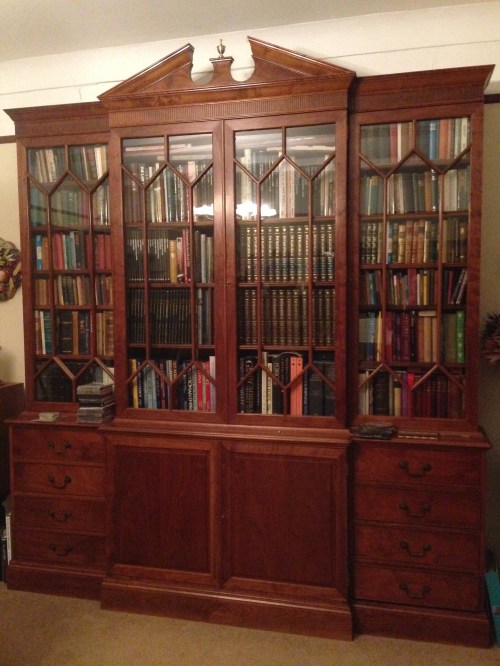
I will drill the bore first, and after considering the options, will use the Jerry Howell recommended method, which is to use a D-bit.

24 Pounder Naval Cannon

A half day in the workshop today, and the naval cannon carriage is taking shape.

cannon - 1.jpg

The pieces at this stage, just push together.  A few more bits of ironwood to be machined, then for the fun time… machining the cannon barrel.

cannon - 2.jpg

Ironwood cannon carriage, sitting on an ironwood kitchen table.  SWMBO is impressed! “it is looking interesting!”  Wait until she sees the brass bling.

DESERT IRONWOOD

Some decades ago I made a table for our kitchen.  (cannot find  photo just now, will add one later)

I bought the wood from a wood recycler.  He removed trees from Melbourne suburban gardens, then cut them into slabs and air dried them.

I recall that I paid about $AUD 1000 for the 6-8 planks.  They were about 40mm thick and 300mm wide and about 2.5m long.  They were so heavy that I could barely lift them.

I have since learned that they weigh 1.1 to 1.4 tonnes per cubic metre, which is at the high limit of wood densities.

The tree must have been 400mm diameter, because some slabs still had the bark attached to both sides.

The wood has a beautiful dark brown colour, with almost white sapwood solidly attached. It is unbelievably hard, and I struggled to machine it with my thicknesser/buzzer.  Also, it was the most reactive wood I have ever worked.  When planed or thicknessed it would bend and react totally unpredictably.   My 40-45mm thick planks ended up 25-28mm thick and even then they were not totally flat.

But SWMBO liked the table, and it still is the main meal table in out house.  One of my daughters requested a similar table, which I made from Gippsland Blue gum, another spectacular dense hard Australian wood.

The ironwood has survived kids dancing on it, steam engine demonstrations, being used as a work bench, not to mention many meals with never a table cloth.   And the wood itself is unmarked!  The polish has disappeared in places, but the wood itself seems impervious to damage.

To get to the point of this post, I am currently making a 1779, 24 pounder, 1:10 scale naval cannon.  Jerry Howell design.  About 300mm (one foot) long.

When I was looking in my shed I considered various woods for the carriage-base.  I considered some black walnut, which was recommended, but it seemed a bit light in weight and colour.  I considered some Australian redgum, which polishes beautifully, and is dense and tough, but it is a bit too red.  Some African Odum looked possible, but the figuring is a bit plain.  Then I found some ironwood offcuts from the table job, and the decision was made.  Ironwood it is.

So here are the initial photos of the carriage parts.  They were machined on my metalworking mill, using HSS cutters.   I CNC’d where possible.

cannon - 2.jpg

Ironwood after conventional thicknessing.  Tearouts are a problem.

cannon - 3.jpg

Ironwood after surfacing with a 1″ endmill.  Here I am CNCing the profile of the carriage.  3000rpm, 500mm/minute.

cannon - 1.jpg

After milling, I am tempted to just oil the surface.  The edges are sharp, like milled metal.

cannon - 1 (1).jpg

CNCing the wheels.

cannon - 2.jpg

A little deburring or with wood is it called defuzzing? required

Watch this space for progress on the cannon.

There are some technical challenges, including deep boring 14mm diameter 275mm deep, making a tiny dovetail in the ironwood,  and turning the barrel from 50mm diameter brass.

Homemade lathe with ONE MICRON accuracy.

Watch the video.  It is inspirational.

Moving a biggish lathe

My friend Jason asked me to help him move his lathe out of the shipping container which had housed it for 10 years, unused, into his newly constructed workshop.

I suspect that he was less impressed by my moving qualifications than my Landcruiser ute with its 8000lb Warn winch.

The lathe was an old English behemoth, with 2 meters between centers and weighing 2 tonnes.  It was bolted to 2 bits of U channel, which were to act as skids.

The lathe had to be pulled out of the container, turn 90 degrees, then down a gravel slope for about 15 meters, then another 90 degree turn and up into the shed.  Once inside the shed with its smooth concrete floor we figured the final positioning would be easier.

The winch pulled the lathe out of of the container without too much fuss.  But when the lathe encountered the gravel and ploughed in, the winch really struggled.  I had stupidly forgotten to bring a snatch block, which would have doubled the pulling power and halved the speed.

So, I used the 4WD’s engine, in low ratio reverse, to pull the lathe around and down to the shed door.  Even with that power , and downhill, it was a struggle.  And it really made a mess of Jason’s nice gravel paving.

Then a repositioning of the 4WD into the shed, to pull the lathe up a bit of a slope and onto the shed concrete slab.  Some judicious jacking with a very large crowbar, and insertion of wooden slides and steel rollers, and serious pulling by the cruiser, and the lathe was almost in the shed.  Fortunately there was enough room to drive past it and outside.  Then I repositioned the 4WD into a pushing position, using a large piece of wood between the lathe and the bullbar and pushed it inside.

Some more heaving with the crowbar, and use of steel pipe rollers, and 3 adults and 2 teenagers pushing, and the lathe was in position.

Jasons lathe - 1.jpg

Jason, John and lathe.  All smiles with the lathe running after 10 years of storage.

After a quick check to make sure that the chuck was attached, and nothing loose ready to fly off, Jason switched on his lathe….. and it ran!   As smooth and sweet as the day it was made.  Very satisfying.

The day was already hot, so we cracked a few beers to celebrate the move.

TAPPING GUIDE

I took another break from the triple to make this tapping guide…

tapping guide - 5

The tapping guide in use.  BA7. (staged photo)


tapping guide - 1

CNC drilling and reaming

tapping guide - 3

CNC milling the flanges

tapping guide - 4

The completed arms and flanges

tapping guide - 1 (1)

Milling the jaws manually

tapping guide - 2

The jaws in position

tapping guide - 3

Showing the jaws holding a tap. The jaw cover is removed.  The  hole in the side of the chuck is for the M5 grub screw which opens and closes the jaws.

tapping guide - 4

Showing the jaws cover in place.

tapping guide - 7

The 3 jaw chuck provides a convenient and accurate base. Alternatively, the guide could be supported in a hole in the bench.

tapping guide - 8

Very handy for tapping threads in items not readily held in a vise.

The biggest problem with tapping threaded holes is taps which break in a job.  Sometimes after many, many hours making a part.   Sometimes the broken tap is able to be removed, and sometimes it cannot, resulting in a ruined part, wasted time and much wailing and gnashing of dentures.

Keeping the tap vertical at all times during the tapping procedure, and using a sharp tap, suitable lubricant, and appropriate torque, are the keys to not breaking taps and saving teeth.

Usually I do my tapping with the tap held under a spring loaded guide in the chuck of the drill press or mill, and the workpiece in the vise.  This method prevents any inadvertent bending of the tap, which avoids one of the major causes of breakages.

But sometimes it is just not possible to hold the workpiece in the mill or drill press and the tapping has to be done freehand, aligning the tap by eye.  I am rarely satisfied that the tap is vertical after using this method.  Lack of accuracy, and higher chance of a broken tap is the consequence.

So when I saw this tapping guide in “Model Engineer”, and saw the possibilities for its accuracy and versatility, I decided to make one.  The fact that much of the machining could be CNC’d was an added attraction.   Also the 4 jaw chuck was intriguing.  I had seen one made by a colleague in the Melbourne Model Engineering Club, and I was keen to see if I could manage it.

The design was by Mogens Kilde and the plans were published in the August 2015 “Model Engineer”.    I made a few minor changes to the design, mainly using thicker aluminium in the arms and flanges.  I used stainless steel for the chuck body because that was the only free machining steel which I had in the size.  I used key steel for the chuck jaws, again because that was what I had available in my workshop.

The double parallelogram arms keep the tap vertical within the limits of the arm movements.  Using a 3 jaw chuck as the base of the unit provides a lot of flexibility in positioning the guide.

I will not comment on the actual building, because that is clearly explained in detail in the original ME articles.

Boxford CNC lathe (5)

The following pictures and video were supplied to me by Stuart Tankard.

They show the rarely used tailstock in use, supporting a relatively long thin workpiece.

The lathe is Stuart’s, and his control panel is fixed to the lathe cabinet.  (Mine is an identical machine except that I use a  wireless MPG).

The tailstock is the part coloured bright yellow, and it normally sits unused in a drawer, or hinged down and out of the way.  As you can see however, it occasionally is useful.

20160102_160913.jpg

Stuart’s lathe.  Note that the G code for the part was generated by a program called EZILATHE.   I also use this very handy program.  Ezilathe is a free download.


20160102_155138

The part is the first step in making a link for the beam engine which Stuart is completing.  The headstock end is held in an ER collet.  The tailstock contains a small roller bearing held in a shop made fitting.  After turning, the tear drop ends will have flats milled onto the sides, then holes drilled and reamed for shafts.

Check out the following Youtube video to see Stuarts lathe in action.

BACK TO THE TRIPLE

It seems months since I made any progress on the triple expansion steam engine.  It is such a complicated build, at the limits of my abilities (or maybe beyond the limits), and many  components have been partly made and put aside to be completed later, that I was unsure just where I needed to resume.

But, Xmas/Saturnalia, New year, several exhibitions, several competitions, and an intervening Stirling engine build all conspired to “force” me to put aside the difficult triple build.  Then it was just too bloody hot to venture into the workshop.  But we now have some milder weather, and I have some free time, so back into the workshop to inspect the triple and see where to resume.

I decided to do some easier components, to ease back into the build.  So I started by making some of the steam pipes,  CNC’d the flanges, and silver soldered them.  Only to discover that there was inadequate access to tighten some of the flange bolts.   So a quick redesign of the flanges to use only 2 bolts per flange, CNC’s some more flanges, removed the bad’uns, and silver soldered the new ones.   All good now, except that I need to fill some unused threaded holes in the cylinder castings, and drill and tap some new ones.

IMG_3426.JPG

Checking the fit of the copper pipe, prior to machining and soldering the flanges

IMG_3429.JPG

The pipes with flanges all made and ready to be fitted.  Except that these 4 hole flanges had to be replaced with 2 and 3 holers.

IMG_3428.JPG

Inadequate clearance to fit the bolts.  So the flange was replaced with a 2 holer.


Today I made the bearings for the yokes on the Stephenson’s reversing mechanism.  These are made of gunmetal, quite small (9.5x8x4.7mm), need some precision drilling and reaming, and there are 12 of them.

After considering the “how to” options, I decided to use the recently installed 5C collet chuck on the lathe, having machined the gunmetal to fit neatly into a 3/8″ square collet.

The following pics were uploaded and the order was totally mixed up in the process.  From previous experience I know that trying to re-sort them will result in chaos and losses, so I will leave them as is.

Bolton 9 - 5

This is the final photo.   The 14 bearings (including 2 spares) are threaded onto a bright steel rod and the side decorative waist is milled.

Bolton 9 - 8

Showing one of the reversing mechanisms, with 4 new gunmetal bearings bolted into position.

Bolton 9 - 3

The square 3/8 x 3/8 lathe collet, about to accept the bar which has been accurately sized, drilled and reamed.   I used a parting tool to cut off the bearing at the correct thickness.

Bolton 9 - 4

Parting.  The blade is only 1.5mm wide.

Bolton 9 - 6

One of the yokes, with bearings bolted in place, and 2 loose bearings about to be fitted to the other yoke.

Bolton 9 - 2

precision drilling the bolt holes (1.8mm diameter) using the high speed spindle on the mill, at 6000 rpm.

Bolton 9 - 7

The three pairs of valve eccentrics, and reversing mechanisms.

Bolton 9 - 1

This should be the first photo.  It shows the gunmetal bar machined to size, drilled and reamed, ready to be drilled for the bolts, then parted on the lathe.

2015 in review

The WordPress.com stats helper monkeys prepared a 2015 annual report for this blog.

Here’s an excerpt:

The concert hall at the Sydney Opera House holds 2,700 people. This blog was viewed about 14,000 times in 2015. If it were a concert at Sydney Opera House, it would take about 5 sold-out performances for that many people to see it.

Click here to see the complete report.

Milling a taper in thin steel

I was reading an article published by The Home Shop Machinist today, and I was very surprised to see my name as the author.

I had submitted it to HSM several  years ago, and had totally forgotten about it.

I had to read the article to remind myself how I achieved this neat little trick, of machining an exact 1.5 degree taper in a very thin workpiece.

Click on the link below to see the short article.


Milling a Taper in Thin Steel

December Heat

The temperature outside my workshop is 43 degrees centigrade in the shade.  For readers in our antipodes, ie the northern hemisphere, that is 109.4 degrees fahrenheit.

I remember working on a farm when it was 45.5/114 degrees.  I was hoeing vegetables.  And coping quite well, with frequent and copious water intakes.   But I was age 17.  I could do a lot of things at age 17 that I would not consider now at age 65.  My workshop is not heated or cooled, so when the temp exceeds 35/95 I give it a miss.

We have had a very dry spring, so the grass and the undergrowth in the bush is tinder dry.  There is a hot gusty wind.  I can smell smoke in the air.  There are bushfires somewhere.   We  have had the warnings from the authorities about dehydration, and fire plans.  Those who live in fire risk areas were advised to activate their fire plans yesterday, and leave homes, farms, and go to safe areas.  No longer are residents advised to fight fires and protect their homes on days like this.  It is just too dangerous.

I live in a city (Geelong) about an hour drive from Melbourne, and today I am babysitting in Melbourne.  When we go home this evening, we drive on a 6 lane freeway to get to Geelong.  I remember some years ago,  a grass fire swept across that road, incinerating cars and motorists, with many deaths.   On the freeway!  

So add bushfires to that lovely list of Australian nasties.  Along with venomous snakes, spiders, great white sharks.  But hey, only the police and crooks carry guns here.  If your neighbour gets cross with you, it is very unlikely that he will be back with an automatic weapon to take out you and your family.

Hopefully it will be a bit cooler tomorrow, so I can do something interesting in the workshop to write about.


Centering the Mill using Video Camera

My expert friend Stuart Tankard suggested that I try a digital video camera to locate work on my milling machine.

I have various gadgets  for finding edges and tool heights, and I find that the electronic edge and height finders are the most accurate.  But, I have never been satisfied with accurately locating other points in workpieces.

So I purchased this small video camera which is attached to a shaft for attachment to a collet or chuck which is held in the spindle.

Mill Camera - 7

The camera on the left is as supplied.  It needs to be adjusted so that the camera is pointing exactly to the centre under the spindle.  The adjustment is made to the 3 grub screws in the metal disk shown.  When the unit is inserted into the collet, the screws are inaccessible unless only a fraction of the shaft engages in the collet.  Also, the setting which is eventually determined seems quite precarious and liable to be altered with a slight bump.  A very unsatisfactory arrangement.

So Stuart came up with the modification on the right.  A CNC’d perspex disk replaces the back of the camera case.   The new camera back is attached to  a larger, more solid, steel disk.   The screws are now accessible when the shaft is fully engaged in the milling machine spindle collet.  Altogether, a superior setup.

Mill Camera - 4.jpg

This is the computer screen view on Mach 3 showing the magnified scribed lines (thick white lines), the “smooth” workpiece surface, and the centered crosshairs.  I have not worked out the degree of magnification. (note added 1/1/16:  the centre circle is 1mm diameter so the scribed lines are about 0.2mm thick)

Lining up cross hairs with the centre of the spindle is still fiddly and time consuming, but with the new, more solid setup, it should need to be done only once.  It is done by loosening the cap screws and nudging the camera laterally.

Any slight angulation in the camera lens, or the chip, or the steel backing plate or shaft is compensated by fixing the focal distance.  This is accomplished by making a small sleeve to fit between the lens and the camera body.  It is the brass bit in the photo.

The following photos show some of the steps in making the modifications.
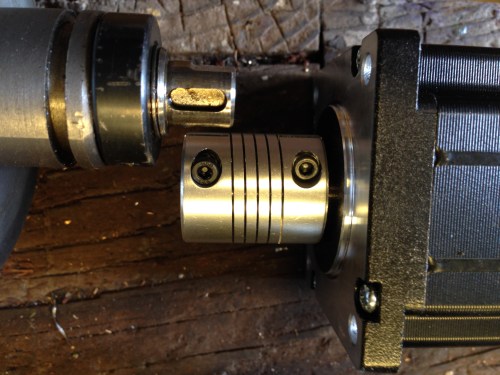
Mill Camera - 1.jpg

Opening the original camera case.  The security label needs to be removed.

Mill Camera - 2.jpg

Freeing the camera cable from the case without damaging the cable, using a Dremel.

Mill Camera - 6.jpg

The new camera back was CNC’d from perspex (thanks Stuart!)

Mill Camera - 3.jpg

Turning the backing plate.  I chose to use a silver steel shaft 12mm dia, silver soldered to a disk, which I then turned in a collet chuck.

Mill Camera - 5.jpg

Testing the altered unit.  Those scribed lines are probably 0.25 of a millimeter wide.  They are shown on the pic of the computer screen earlier.  The camera has LED’s which are not well aimed for close distances.  In use the camera lens is only 5mm above the workpiece.


The camera is a TP-03 Machining Camera, purchased from Homann Designs.  It cost $AUD88 plus postage plus GST.

The software to put the fine cross hairs on the screen was downloaded from http://www.kd-dietz.de and it is version 3.02 of “WebcamPlugin”   for Mach3.

Check out the following link suggested by reader Hamish.  It is a more complete discussion of the process and the technology.    It is in the comments section below.


A Matter of Scale

One picture tells a thousand words.

My daughter’s twins were born prematurely a few days ago.  The baby boys and my daughter are doing fine.

Colchester  - 1.jpg

The finger belongs to my son in law.  The little fella weighs 3 lbs.

COLCHESTER LATHE BADGE REPAIR

Colchester  - 1.jpg

The corners had broken off and were lost.  The plastic badge was quite bent and distorted.  There were traces of silver paint on the surface of the lettering.

The two plastic badges on my Master 2500 were in a sorry state.

the Master 2500 label had corners broken off at the attaching screws, and the “World Turns On Colchester Lathes” round emblem had broken into multiple pieces, with some of the pieces missing.  The plastic material of both badges was quite crumbly.

I removed the badges, retrieved the larger pieces and wrapped them in packaging tape until I could deal with them.

Colchester  - 3.jpg

When I removed the disc it fell apart into multiple fragments

I considered my options…

  1.  Buy new badges.  None available from Colchester suppliers.  I have never seen any on Ebay.
  2. Scan the badges and print new ones with a 3D printer.  No one that I know has a scanner which would do this.  Also, the round badge is in pretty bad condition even for scanning.
  3. Draw up new badges and CNC them in aluminium or MDF.  I might end up doing this.  I have drawn up the round badge, but I cannot exactly reproduce the graphics.  I will keep this method in reserve.
  4. Patch the existing badges.   This is what I did.  It might not be the permanent solution, but it will do for the time being.  Read on.

Firstly   I glued the round badge together as accurately as possible.  This was difficult because the plastic was crumbly, and the plastic was distorted, not flat.

Then I cut some 3mm aluminium sheet slightly larger than the existing badges.

Then I used 5 minute Araldite to glue the original badges to the aluminium sheet.  I do not know what the plastic type is, so I am not sure that the plastic will adhere with the Araldite to the aluminium, but I did score both surfaces.

Colchester  - 4.jpg

Gluing the badges to the aluminium backing plates.  I used a generous volume of Araldite to fill the gaps.

After the Araldite set, I used a linisher to reduce the aluminium edges level with the plastic edges.

I used epoxy metal repair to fill the gaps.

Colchester  - 6.jpg

I used a sharp knife to trim to shape, before the epoxy set hard.  After it set hard, I used a file to shape it further.

Colchester  - 8.jpg

Epoxy filler.  The aluminium backing adds to the security of the repair.

colchester - 7.jpg

Some of the letters were missing.  I used a sharp knife to shape the replacement letters.  Not perfect, but not bad?

colchester - 10.jpg

After a couple of hours of delicate work, it is not looking too bad?

I decided to paint the entire badges.  I had found some traces of silver colouring on the letters, so I suspect that the originals were painted.  Maybe just the raised surfaces were painted.  However I decided to paint the entire surface, thinking that the paint would add some integrity to the patches.  ie…  held together with paint.   Hey, if it doesn’t last I will go to plan B,   OK?

colchester - 11.jpg

The badges with some primer.   I quite like this colour.  It does go quite well with the lathe.    Some of the cracks still show, but it is not too bad. Yes??

I will post some pics of the badges on the lathe next time.

SOFT JAWS FOR LATHE

I have recently made two sets of soft jaws, and tested them.  One set was successful and the other set was not.  Read on to see what made the difference.

The purpose of soft jaws is that the jaws themselves are turned to the exact size and shape of the workpiece,  and the workpiece should therefore be held perfectly concentrically.  It should be possible to remove the workpiece from the lathe, and to replace it accurately.  It should also be possible to hold very thin disks, which was what I aimed to do in this exercise.

The first set of soft jaws was made for a 200mm 3 jaw chuck.  The aluminium cylinders were bored to fit snugly over the last step of the jaws, and held in position with cap screws.   I cannot remember where the idea originated.

IMG_3360

These soft jaws fit onto existing jaws, and are held in place with cap screws.  Here shown clamped onto a brass cylinder, ready to have the rebates turned.

IMG_3361

Showing the turned rebates in the soft jaws, ready to accept the workpiece.

IMG_3362

The workpiece is a 3mm disk, 38mm diameter.  The rebate is only 0.5mm deep.

The method was successful, allowing the workpiece to be faced, but during a second pass, one of the soft jaws came loose, and the workpiece dropped out.

I suspect that the cap screws did not allow enough purchase on the hardened jaws of the chuck.  Also, the workpiece was positioned beyond the end of the chuck jaws, and it acted as a lever on the soft jaws, working them loose.

I think that this method would work if the workpiece was held closer to the face of the chuck.

The second set of soft jaws was made for an 80mm 3 jaw chuck on my Boxford CNC lathe.

IMG_3367

The aluminium soft jaws are bolted to purchased, non hardened, jaw bases which fit the chuck grooves and have teeth to engage the chuck scroll.  Here shown after turning the rebates ready to accept the workpiece.  The rebates were turned while the jaws were tightened against an appropriately sized cylinder.

IMG_3364

The workpiece held securely.  The face has been skimmed, and the edge bevelled.  The engraving was CNC’d on the mill, earlier.  Subsequent turning produces a very clean, sharply defined engraving.   The workpiece is held in a 1mm rebate.

It can argued that aluminium is not ideal for soft jaws, because it is too soft.   I do intend to make another set of soft jaws from mild steel, for use with steel workpieces, but I will continue using the aluminium soft jaws when machining soft metals such as brass.

And here is another idea which I spotted on you tube.  Not soft jaws, but soft covers.  Click on the arrow to watch the video.

BOXFORD CNC LATHE (4)

Some videos and pics of some stuff made on the Boxford.

IMG_1389.jpg

CNC is great for multiples.  These are oil cups with ME threads.

IMG_1354.jpg

Steam engine link

IMG_2438.jpg

Ball end handle for a small lathe

IMG_2444.jpg

The finish on the distal end was suboptimal.

IMG_0991.jpg

First step in making Watts parallel motion links for the beam engine. 

IMG_1990

Base for a Jan Ridders Stirling engine

Error
This video doesn’t exist
Error
This video doesn’t exist
IMG_1534

The steam control cock and butterfly valve.  The body of the top valve and both handles were CNC’d.

If you have found this little series of blogs about the lathe CNC conversion interesting, and would like to see a similar blog about how I got an ancient CNC mill working, let me know.  Leave some feedback.

BOXFORD CNC LATHE (3)

Some more photos of the Boxford, after the conversion.  Sounds like the Damascus Road doesn’t it.  Going CNC is almost an epiphany.

IMG_3342

This is the wireless MPG controller.  The lathe can be controlled from across the room, using the MPG and the wireless mouse and keyboard.  The MPG even has an Estop kill button, along with the one on the lathe.

IMG_3341

The new setup.  Normally the keyboard and mouse sit under the screen to avoid swarf.  Note the multitude of LED and halogen lights.  I need those these days.

IMG_3343.jpg

The old Dell sits underneath, along with other bits and pieces.  The trolley has been very useful, as the lathe is progressively expelled from different rooms by SWMBO.

IMG_3338.jpg

One drawer of tool holders, collets, inserts etc.  The other drawer is not so tidy.

IMG_3339.jpg

The Dickson toolpost, and Diamond tangential tool.

IMG_3340.jpg

The ER32 collet chuck.  Much more accurate than the Burnerd 3 jaw chuck.  The mounting plate and backing plate were made by me to a design by Stuart Tankard.

If this conversion is of interest to you, look out for a technical description of the process in an article by Stuart Tankard to be published next year in Australian Model Engineer.

BOXFORD CNC LATHE (2)

This is the list of components and prices (AUD 2013) which was required to update the electronics so the Boxford 125 TCL would run on Mach3 and Windows.

Breakout board  C11  $129

Index pulse board  C3  $26

Gecko stepper drivers G251  $68 x2

Relays, relay bases, parallel port cable, Estop button   ~$80

Power supply  $30

Wireless MPG   from China  Ebay  $129

Heat sinks and adhesive   $20

Other cables, connectors, power sockets  ~$100

PC (an old Dell, running XP Pro, perfectly adequate for Mach 3)   free

Flat screen     free,  wireless keyboard and mouse  free.

Support arm for Screen  $60

Trolley  $200

It all adds up to $AUD910.   Plus the original $1500 for the lathe.  That is pretty inexpensive for a quality CNC lathe.  I am told that the Boxford retailed for about $30,000 in 1985!

Some before and after photos of the conversion…


IMG_0985.jpg

The back of the lathe opened, showing the old electricals  The spindle motor is top right.


The electricals after the conversion.

The electricals after the conversion.  Some of the old components were retained.  The lights are on the breakout board. 

BOXFORD CNC LATHE

About 3 years ago I decided that I wanted to see what CNC was about.  I had read some beginners guides to CNC, and CNC programming, but it was obvious that I would need to buy a CNC machine and actually start machining if I was to make any real progress.

Initially I bought a second hand lathe which had been converted to CNC.  It was a Seig C3, and stepper motors had been installed on the lead screw and cross slide screw.  Some low end electronics connected to a PC, and the setup was controlled with Mach3.

Needless to say, this machine gave poor results.  Poor finish, and poor reproducibility of dimensions.  The lathe was low quality to start with, and the CNC components were low end.  I was inclined to blame the lack of ball screws, but in retrospect, that was only one of the many problems.  It did however give me a taste of the process of CNC programming, and finishing with a CNC turned item.  I also developed some familiarity with Mach 3, and became a licensed user of the excellent software.
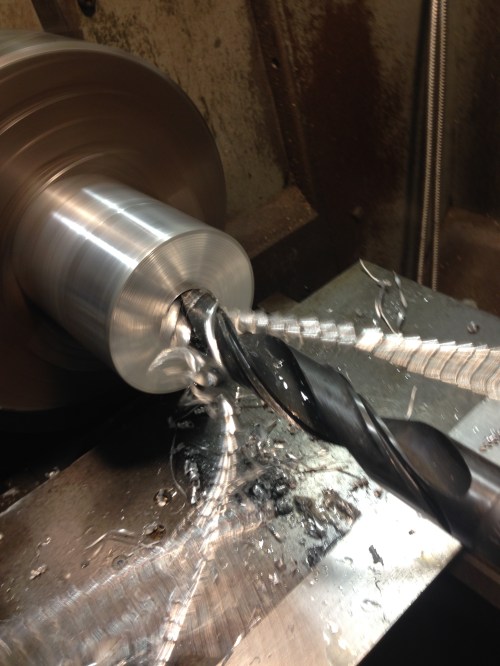
IMG_1009

Seig C3 converted to CNC. Not up to scratch.


IMG_1011

Then I saw a Boxford CNC lathe, owned by a friend in my engineering club (GSMEE).  It was 30 years old, and had started life as a technical school teaching lathe.  The original electronics and operating system were based on a CPM computer, pre-dating Windows, even pre-dating DOS.  It ran on software which was loaded each session from a 5.25″ floppy disk, with a capacity of 180 kilobytes.

My friend had changed the operating system to  Windows and Mach 3.  That involved changing many of the electronic components in the lathe, and hooking up a PC.

The lathe was an English Boxford TCL 125.  The swing is only 125mm (62.5mm above the bed), and the maximum length which can be machined is also 125mm. The spindle is belt driven, and spindle speeds range up to 3000 rpm.  The tool post is a very nice quick change Dickson.  The spindle bore is 19mm.  The whole machine has a quality appearance and feel.   My friend was producing work with fine finishes, and consistent dimensions.
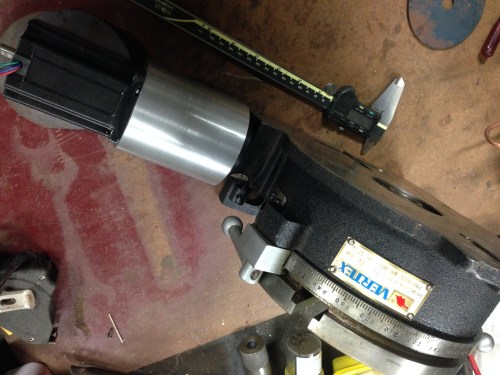
It was clearly a quality lathe, and I asked him if he was willing to sell.  The answer, not surprisingly, was no.  However, he did know of an identical machine which might be for sale.  To get on with this story, I did buy the second machine.  It had also been a training lathe in a technical school, and was 30 years old.  It was not running, but the owner said that it had been in use until recently.  Since I planned to replace most of the electronics I was not too concerned that it was not working.  My friend, Stuart, had indicated a willingness to manage the upgrade-conversion, which was just as well, because it really did require a level of expertise with electronics which I do not possess.  Stuart had been through the process, knew exactly what was required, and is indeed, an expert.

IMG_0990

Boxford 125 TCL.  The yellow item is the tailstock which swings up into position. 80mm Pratt Burnerd chuck.  The control panel lower right was removed and replaced with a wireless pendant control.

IMG_0989

It cost $AUD1500, which was a bit much, but the seller probably realised that I really wanted it, and priced it accordingly.  I took the lathe, and the computer, and the 5.25″ floppy drive, and 6 tool holders home.  I immediately put the computer and floppy drive on Ebay, and amazingly they sold for $AUD150 (to a  collector of obsolete computers I presume).

IMG_1053

This old CPM computer with a tiny memory originally ran the Boxford CNC lathe.

We collected the various new electronic components over the next few weeks.  I will list the components in the next post for your interest.  Total cost of these was approximately $AUD800.

Under Stuart’s direction I removed the obsolete electronics, then in two half day sessions he installed the new ones. After some adjustments in the electronics, and in Mach 3, it was up and running.

In the subsequent 2-3 years I have replaced the ball screws (probably unnecessarily), and increased the number of tool holders to 30, and installed an ER32 collet chuck, and soft jaws on the 3 jaw Pratt Burnerd.

I have made many items and become increasingly comfortable with Mach3.  I also use a very useful program called Ezilathe, which I will describe in a later post.


A Collet Chuck for the Colchester Lathe

I recently bought a blank chuck backing plate on Ebay, hoping that it would fit my Colchester lathe.  It was $AUD110 plus postage, which, if suitable, would be an excellent price, but it was a gamble.  It was old new stock.

When it arrived I cleaned off the old, hard grease, and nervously presented the backing blank  to the lathe headstock.  It fitted perfectly!  The seller had another identical blank backing plate, so I bought that one too.  Components for the Colchester are not readily available, so I was very happy with this find.

I had a use in mind for both of the backing plates, and a few days ago I machined up the first one as per the following photos.


IMG_3330.jpg

The cast iron backing plate blank had a tough skin which a high speed steel cutter would not penetrate. So I use a carbide insert tool cutting 1mm deep to break through the skin. I finished the contact surface with a HSS tangential tool. (A diamond cutter from Eccentric Engineering)


IMG_3331.jpg

The C5 collet chuck.  I have had this chuck for a few years, purchased from CDCO Machinery (USA), but rarely used it because I was not satisfied with the accuracy.  I was very interested to see whether a very careful installation on the Colchester lathe might be more satisfactory than on the previous lathe (a Chinese lathe).  


IMG_3332

Checking the runout off the newly installed collet chuck. With a piece of 10mm diameter silver steel, the total measured runout was about 0.005mm. Good enough.  The backing plate is larger than required, but I will leave it as is in case I ever use it for another, larger chuck.   C5 collets will hold round stock 2-26mm diameter, and some common square and hexagonal sizes.   Very useful.

ACUTE TOOL SHARPENING at GEELONG MODEL ENGINEERS’ EXHIBITION

One of the tool displays at our exhibition last weekend (see previous post) was by ECCENTRIC ENGINEERING.  Eccentric Engineering is well known for the Diamond Tool Holder, which is a favourite lathe tool holder for most of us who use metal working lathes.

However I was more interested in Gary Sneezby’s (Owner-engineer of Eccentric) new tool, which is a tool sharpening system for use with a bench grinder, named “The Acute Tool Sharpening System”.

IMG_3305

Gary demonstrating the Acute Tool Sharpening System at the GSMEE exhibition.


IMG_3319

The Plans and assembly diagrams, in a bound booklet.

The system is available as a complete working unit, or a kit of semi machined parts and plans, or plans only.

See the Eccentric Engineering Website for a complete description of the system and prices.  eccentricengineering.com.au

I bought the kit of semi machined parts, and the booklet of plans.  Cost (show price, no postage) $AUD250.  This is an excellent price for the 50 or so laser cut parts, quality die cast handles, all fasteners, Allen keys, detailed plans.
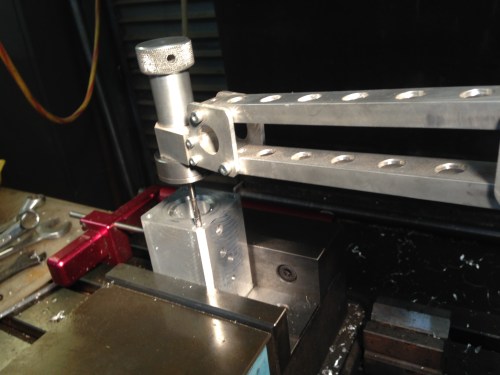
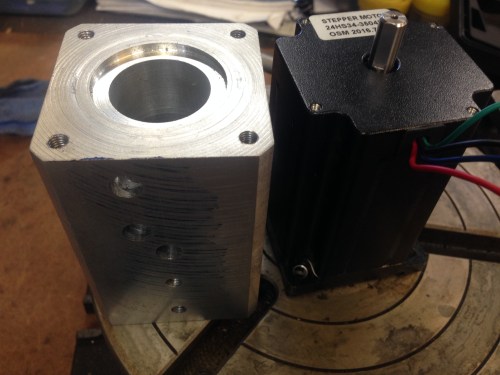
 

IMG_3321

2 of the 33 pages of plans and diagrams.
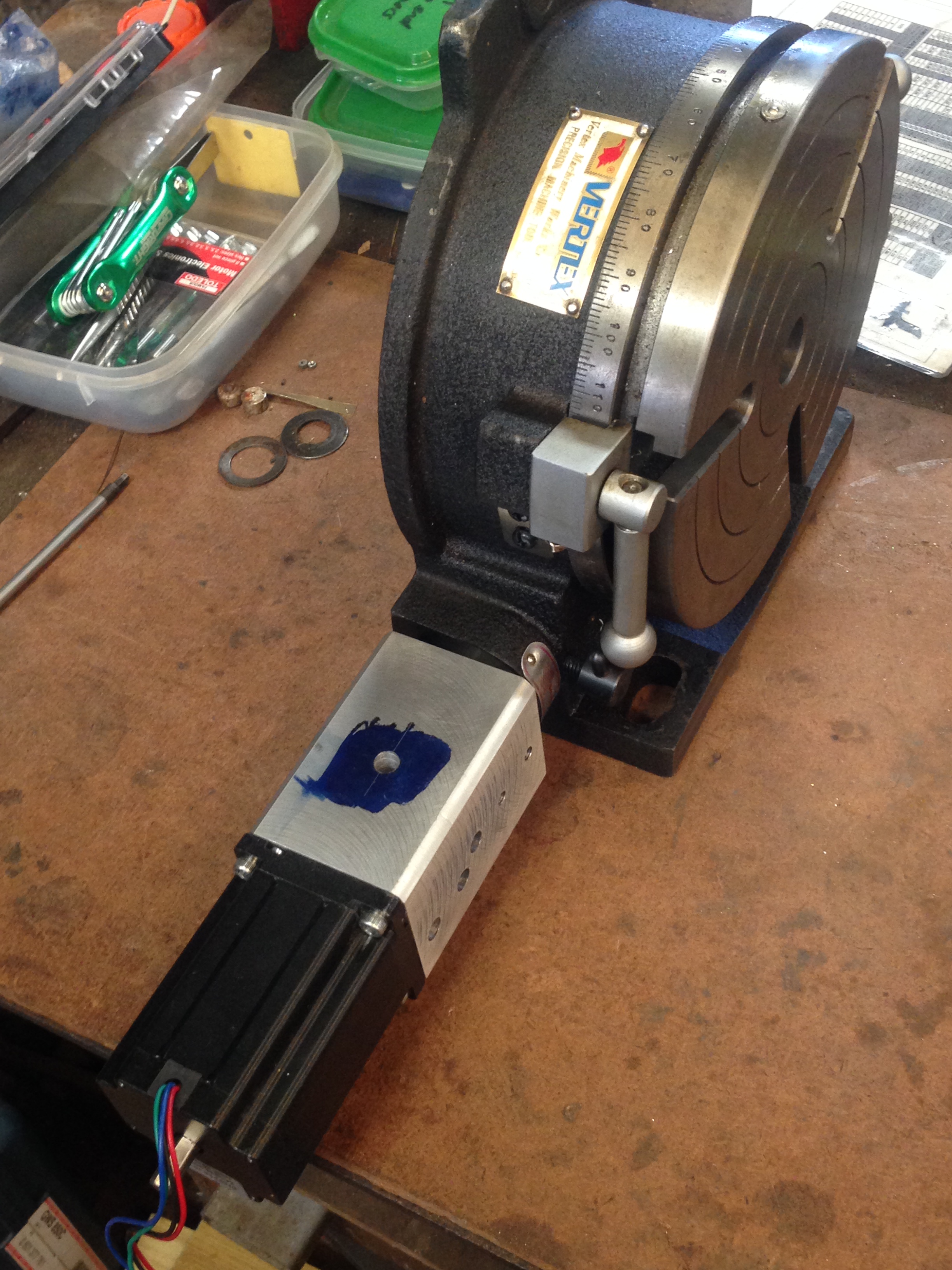
The plans are excellent.  They are clear, easily read, and large.  There are no instructions, but a DVD is planned.  Gary is contactable by phone for construction advice, if needed.

After 4 half day workshop sessions I am well into the construction.  The laser cut parts are accurate within 1mm, and drilling points are accurately centre drilled.  Gary pointed out that the drilling points are more accurately positioned than the laser cut part perimeters.  That necessitates drilling centre holes (and the other holes) and using a mandrel to enable accurate turning of circular components.  He also advised that HSS cutters be used in preference to carbide tipped tools.

I found the parts to be very closely dimensioned to the finished parts.  The table top measures 150x150mm, and I found the flat hardened steel to be mildly bowed, to the extent of 0.38mm.  That is probably due to heat distortion from the laser cutter.      Some attention on the press straightened out the plate to less than 0.05mm bowing.   I might touch it up on the surface grinder, but that is probably unnecessary, given the way the system functions.

I had a machining accident with one part.  It is useable, but will need to be replaced.  I rang Gary, and the new part is in the mail.  Now that is service.

Progress to date….

IMG_3326

The sharpening system is starting to look serious.  It consists of a base, top plate which is adjustable for tilt and height, parallelogram arm, slide and toolholder.


IMG_3323

It looks interesting. Not sure how it works yet (Much clearer since watching the YouTube video at the end of this blog). Still some parts to be made-machined. The notch at the top is where the grinding wheel fits.


IMG_3322

The underside. Nice use of O rings to lock the adjustments into position. The cast handles are good quality.


Another session or two in the workshop should see this project completed.  I will report on how it performs  in a week or two.  I expect that it will be a lot quicker and simpler to use than the Quorn.

Watch the YouTube video by Gary to see how it works.

Der Tiger at Geelong Model Engineers

GSMEE (Geelong Society of Model and Experimental Engineers) had its annual exhibition at Osborne House, North Geelong last weekend.

Osborne House used to be Australia’s submarine headquarters, and it still houses a superb maritime museum.  It is also home to the Vietnam Veteran’s Association.  And other clubs such as GSMEE and The Camera Club.

We could not have asked for better weather.  Two glorious spring days.  With Corio Bay sparkling in the background.

And guarding the entrance of our exhibition was a WW2 German Tiger Tank.

IMG_3302

At 1/5 scale, weighing 1/4 tonne, powered by a 12 cylinder gasoline engine.

I have featured this machine before (see Bendigo exhibition).  It is still fascinating and awesome.

IMG_3303

Gerard Dean operating the controls, which are a close copy of the original, even down to the warning in German that “the enemy is listening”.

Gerard explained that the original was prone to engine overheating, gearbox grenading, transmission failure and track jamming.  His demonstration on Sunday was terminated by sudden graunching in the gearbox.  An authentic demonstration indeed.

Normally Gerard drives the tank up ramps onto his ute.   On this occasion we pushed it up.

IMG_3316

Do you imagine that he would get the odd double take as he drives home on the freeway?

Another outstanding exhibitor was John Ramm, with his scale Merlin engine, Volkswagen engine, and 7 cylinder radial aero engine.

IMG_3307

John Ramm’s Spitfire Merlin engine.  1/4 scale, 75cc.  Unfortunately I missed seeing it running.

IMG_3309

John Ramm’s 7 cylinder radial aero engine.

IMG_3312

John Ramms scale VW engine.  Said to be 75cc, but with VW who knows?

There were many other wonderful engines, model ships, planes, and workshop tools.  And an excellent trade display (thanks Ausee Tools).

IMG_3315

Peter Bodman’s self made 3D printer was busy making parts all weekend.  Many of the components of this printer were made on his previous Mark 1 printer.

IMG_3314

Willi Van Leeuwen had a lovely display of model ships and boats including this steam powered boat.

Last, and least, the Norm Hatherly Stirling Engine prize was won by yours Truly.

Broken Cold Saw Blades are a good source of Tool Steel!

I needed to make a form tool to make the base for the air pump on my triple expansion steam engine.

It required a 1/4″ radius section and a 15 degree straight section.

IMG_3289

The dimensions for the cavity in the air pump, and the cutter to produce the cavity.  And the piece of cold saw blade which I used to make the form tool.

I considered machining the arc and the straight sections separately, but I did not have suitable tools, so I made a form tool.

A friend had previously suggested using steel from a broken cold saw blade to make form tools, and on this occasion I used his suggestion.  (Thanks Manuel!).

The blade was 1.6mm thick which was ideal.  I had some trepidation about cutting it.

The broken cold saw blade. The steel is superb.

The broken cold saw blade. The steel is superb.  Painted with layout dye.  The air pump base is visible lower right of photo, bolted to the engine base.


Using an angle grinder with a 1mm cutting disk. It cuts through the cold saw b

Using an angle grinder with a 1mm cutting disk. It cuts through the cold saw blade easily.  Like a hot knife through butter …  almost.

IMG_3290

Grinding the cutter to shape on an aluminium oxide wheel.

IMG_3291

Grinding the 1/4 inch radius arc.

Marking the shape of the form tool cutter

Marking the shape of the form tool cutter

Curodtting a 1.6mm slit in 10mm mild steel

Cutting a 1.6mm slit in 10mm mild steel rod.

IMG_3294

Initially I fastened the cutter steel to the rod using 2 grub screws, then, after checking the dimensions and the 15 degree angle I cut it to size. In use, I found the grub screws would not hold the tool steel securely, and I eventually silver soldered the join.

IMG_3295

The tool, prior to soldering. I ground the relief angles on my Quorn T&C grinder. (See old post). Except for silver soldering the tool steel into the rod, this is the finished tool.


IMG_3296

Commencing the machining of the air pump base cavity.  I had planned to do the machining using a boring head on my milling machine, but quickly realised that would not work. So I used the recommended method of a 4 jaw chuck on the lathe.  The 45 year old 4 jaw is still in excellent condition.

The end result. The complex cavity was initially centre drilled, drilled then bored to size. Then the home made tool was used to machine the undercut cavity. It worked perfectly!

The end result.
The complex cavity was initially centre drilled, drilled then bored to size. Then the home made tool was used to machine the undercut cavity. It worked perfectly!

I learned about using cold saw blade steel as a source of tool steel from Manuel.  I am aware of a professional contract machinist who uses this method to turn complex shapes in brass and steel, in preference to using a CNC lathe.

The material can be heated to red heat, (during silver soldering) and it does not lose its superb ability to take and retain a sharp cutting edge.  Very impressive.

Copper and Brass Repair

I accidentally damaged a gunmetal casting (an end plate of the condenser unit) of my triple expansion engine.  I considered soldering a piece of brass or gunmetal and filing it to shape, but decided instead to try one of the 2 part epoxy repair kits.  There are plenty of these with iron/steel coloured material, but for a long time I could not find a copper coloured repair kit.

The damaged, machined casting.

The damaged, machined casting.  I have punched some indentations to increase the adhesion of the filler, then washed it in acetone to remove all traces of grease.

Then I spotted this epoxy repair kit at an Aldi supermarket.  So I decided to give it a try.  Cost $AUD5

IMG_3257

DYNASTEEL, Copper Repair. And this initial blob applied to the defect.

IMG_3258

An hour later, after some paring with a knife and filing.

Next day, after some more sanding.

Next day, after some more sanding.  Appearance not too bad.  More shaping of the casting is intended.  The epoxy repair is meant to tolerate temperatures up to   200 c.    If it proves unsatisfactory I will solder in a patch.

Prize Winning Hit and Miss Engine

This Hit and miss engine by Stuart won first prize at the Royal Geelong Show Model Engineering section.

Second prize to yours truly.

Model Bolton Beam Engine.

Model Bolton Beam Engine.

Steam Powered BBQ Rotisserie.

I want one of these on my back verandah to run the BBQ rotisserie.

Seen in the Vintage Machinery Shed, at The Geelong Show.

Click on the arrow to see the driving mechanism.


Steam Logging Winch at The Royal Geelong Show

How cool is this machine?

It is a winch which was used in logging in the Otway Ranges, Victoria, Australia.

These coastal hills were extensively logged in the last century, but logging has been significantly controlled in recent decades.

Some of the tallest trees in the world are still to be found in this area (Victorian Mountain Ash), growing in deep gullies which were inaccessible to the loggers.

The area is also periodically subject to ferocious bush fires. And with a severe El Nino weather pattern forming at present, we are facing such a threat this (southern hemisphere) summer.

Click on the arrow to see the winch working.  Judging by the steam leaks, it has seen better days.

The Royal Geelong Show- Vintage Machinery Shed

A few pictures of the Vintage Machinery Shed, at The Royal Geelong Show.   Don’t get me going about the “Royal”. It is a ridiculous anachronism.  But since our head of state is still a Brit (the much admired Queen Elizabeth 2), I suppose we are stuck with the “Royal”.  The engines photographed below are just the ones in the immediate vicinity of the models cage.  I will add some more in a later post.

The boiler used to power the steam engines.

The boiler used to power the steam engines.  wood fired, running at about 35 psi.

The triple expansion marine engine. It powered a tug boat originally. It is steam powered, but only the high and intermediate pressure cylinders are currently powered. The condenser is not fitted to the engine because of the large volume of water it consumes, so the low pressure cylinder is not powered. The rotation of the engine is slightly irregular because only 2 of the cylinders are powered, but it is still a mightily impressive sight.

The triple expansion marine engine. It powered a tug boat originally. It is steam powered, but only the high and intermediate pressure cylinders are currently powered. The condenser is not fitted to the engine because of the large volume of water it consumes, so the low pressure cylinder is not powered. The rotation of the engine is slightly irregular because only 2 of the cylinders are powered, but it is still a mightily impressive sight.  When the engineers learned that I am making a triple expansion model engine, they generously spent considerable time and patience explaining the various components and mechanisms, and involved me with the start up process.  That process is quite complicated, because the engine cannot rotate until the 3 cylinders are heated, and introducing steam heats only the first (high pressure) cylinder.  Separate steam lines heat the other 2 cylinders, and they are closed just before rotation commences.

The crankshaft

The crankshaft, con rods, eccentrics

The low pressure cylinder Stephenson's link

The low pressure cylinder Stephenson’s link

The main steam valve (right), the reversing valve (left front), and the intermediate cylinder start up supply line lever.

The main steam valve (right), the Stephenson’s link reversing valve (left front), and the intermediate cylinder start up supply line lever.

another shot of the valve eccentrics

another shot of the valve eccentrics

This oscillating single cylinder, double acting steam engine with very nice architectural details dates from 1862. It is probably the oldest working engine at the show

This Wedlake and Dendy oscillating single cylinder, double acting steam engine with very nice architectural details dates from 1862. It is probably the oldest working engine at the show.  The governor is not original.

This one is dated 1865.

This Wedlake and Dendy  single cylinder horizontal is dated 1865.  Despite its age, it runs beautifully.

Beam Engine, First Run on Live Steam

My Bolton 12 Beam engine is being exhibited at The Geelong Show in the next few days, along with other model engines from The Geelong Society of Experimental and Model Engineers (GSMEE), and many other full size antique engines.

I am particularly excited by this event, because it is an opportunity to run my beam engine for the first time on live steam.  Plus it is a really great event generally, (see blog from this time in 2014).

We set up our model engines today, in preparation.

The video below, is of my beam engine’s first run on steam.  The Vintage Machinery Society has a full size boiler to run a full size marine triple expansion marine engine, and many other steam engines, including the models in our “cage”.

IMG_3246

The Cage in the Vintage Machinery Shed.  Not sure whether it is to keep the hordes out or the old blokes in.  (Actually, the machines become very hot when running on steam, so the cage is to keep small hands out).

The steam is at 25-30psi.  Enough to turn over the engines, which are just ticking over, not under working loads.

Click on the arrow in the video box, to see the video.

Cheap Engine Turning

A few posts ago I posted some photos of the Koffiekop Stirling Engine, the top plate of which I had decorated with “engine turning”.  I had borrowed the engine turning tool and it worked well.  But I really wanted the circles to be bigger than the 5mm diameter which the Brownells kit produced.

Today I experimented with disks punched out of metal polishing material, glued to the end of same diameter dowel.  (1/2″ = 12.7mm diameter).    I used Super Glue, and no problems with adhesion.

The dowel was attached to a chuck in a drill press.  Running at about 200-300 rpm, and pressing firmly.  No extra cutting compound ( I imagine that these metal polishing pads already have an imbedded cutting compound).  If I was using washing up Scothbrite  type material, I would expect to have to add a cutting compound.

The steel I was testing had surface rust.

Very happy with the result.  Next time I will use CNC positioning to pattern the circles, and overlap the circles so the crappy rusty steel disappears.

I understand that if engine turned surfaces are oiled, they are relatively rust resistant.  Presumably some oil remains in the microscopic grooves.

IMG_3170

The top tool shows the tool after considerable use. It is a bit worn, but the thinning is mainly compression of the material. Compared with an unused tool below. And the surface rusted steel, which has had the tool applied in a semi random pattern, at the bottom of the snap.   (it is a home made tangential lathe tool sharpening jig).


Making Small Gaskets

My Bolton 12 Beam Engine is a steam engine, but to date, has run only on compressed air.

Compressed air, is invisible. Any leaks, might make some noise, and show up as a dirty oil leak, but are not visible to a casual observer.

In contrast, steam shows up every leak.

Our club is having its annual exhibition at The Geelong Show, in 2 weeks.  (See the post from 12 months ago about The Geelong Show)

Steam is available so I have decided to show my Bolton 12 beam engine, and to have it running on steam.

That has required making a steam connection and removing the compressed air connector, And more importantly, making every joint in the steam-air line,  steam proof.

So every join has been opened and a gasket inserted.  Some of the gaskets are oiled brown paper, and some are more permanent “liquid” gaskets.

Making the gaskets was a new and interesting experience, so I decided to make a photographic record.

I made the gaskets from brown paper.

I required 6 of these small gaskets, and 2 larger ones.

IMG_3158

More components ready to have gaskets installed

IMG_3159

Step 1. Make an impression of the surface in the paper using finger pressure.  Do not allow the paper to move.

IMG_3160

Step 2.  Continuing to hold the paper securely, locate the bolt and steam holes using a pin.  

IMG_3161

Step 3. Using an old centre drill, enlarge the pin holes. Rotate the centre drill anticlockwise to avoid tearing the paper. Push the the drill firmly while rotating it, and continue to hold the paper firmly against the surface.

IMG_3164

Step 4. Use the fine scissors to remove the dags. A delicate touch is required.  Use the ordinary scissors to cut the outline.

IMG_3165

It looks like it should do the job.


IMG_3167

The reassembled beam engine.  The displacement oiler, and rope driving pulley have been added since the last photos were posted.

Amazingly,  after reassembly, I had no left over bits.  If it works on steam as planned, I will post a video.  Watch this space.

Model Marine Boiler and another Koffiekop.

At the recent Geelong Society of Experimental and Model Engineers (GSMEE) meeting, several interesting models were presented, including my Koffiekop engine.   And another Koffiekop, this one by Stuart T.

IMG_3146

Stuart T is an expert engineer and machinist. He CNC’d most of the components in his engine, and has enough spare parts to make another 6 of them. He says each part takes a couple of hours to draw and program, then 5 minutes of machining to spit out half a dozen.

Another most interesting model is the marine boiler by Rudy pictured below.  Rudy was a marine engineer, and some of his ships were steam powered.  This model is made from his memory of one of those.  The odd external shape is to conform with the ship’s hull, starboard (right hand) side.

Model ship's boiler. it is approx 300-400mm high. The fire box is stainless steel. The copper boiler and water tank and superheater were TIG welded. The water tubes are silver soldered.

Model ship’s boiler. it is approx 300-400mm high. The fire box is stainless steel. The copper boiler and water tank and superheater were TIG welded. The water tubes are silver soldered.

The water tubes, super heater and boiler.

The water tank, water tubes, super heater and boiler.

The water gauge was scratch built by Rudy. The pressure gauge was bought.

The water gauge was scratch built by Rudy. The pressure gauge was bought.

Not sure what these attachment points are called, but they look interesting coming off the hemispherical ends of the boiler.

Not sure what these attachment points are called, but they look interesting coming off the almost hemispherical ends of the boiler.

Rudy made the nameplate on an engraving machine, then formed the domed shape.

Rudy made the nameplate on an engraving machine, then formed the domed shape.

Rudy has pressure tested the boiler to 100psi.  He reckons that it would be good for 200psi.  He tested it with compressed air, submerged in a barrel of water.  That would show any leaks.  And if it did happen to blow, the force would be diffused by the water.

Stirling Engine Failure. Now Successful!!

The Ridders “Bobber” Stirling engine which I made in 2014, and which defied all attempts to make it work, is now functioning beautifully!

After I completed the Koffiekop engine, and saw it working, I realised that I had not been adequately  particular with some of the machining aspects of the Bobber.

So I took the Bobber off the shelf, took it apart, and remachined the bore, made a new piston, and a new connecting rod bush.  Then I polished the bore using Gumption (see old post about Gumption) on a wooden dowel which was turned precisely to the correct diameter.  I was not concerned about some splits in the wood, as they acted as reservoirs for the Gumption.  After cleaning out the Gumption residue the bore was ultra smooth and shiny.   The piston slid easily on its own (miniscule) weight, and the sliding ceased when the top end was blocked with a finger tip.

I experimented with fuels (olive oil too much carbon deposition, but methylated spirits fine), number of ceramic ball bearings (three specified in the plans, but two seemed to work better), and most importantly, and serendipitously (that one’s for you John), reversed the direction of the flywheel.

See the video below for the result.

IMG_3148

Photo of the operating Bobber engine.  The white balls are ceramic bearings.  The piston is now made of graphite rather than the original steel, and I was particularly particular about the polish of the cylinder bore and the fit of the piston.

Video of the operating Bobber engine.

Flywheel and Sugru

Firstly the SUGRU update.

Sugru, if you have been following this blog, is the flexible black insulating repair compound which I used to repair some electric cables on my lathe.   The cables supply power to the stepper motors, so they are in constant flexing motion when the lathe is operating.  I wondered whether the Sugru would remain adherent and intact.

Well, I am pleased to report that after several weeks use, the Sugru looks as good as the day I applied it.  A winner!

The flywheel.

This is the flywheel after some sanding and polishing with a Dremel.

IMG_3139

The 100mm flywheel, with lubricant ready to be applied.

I might have to make another Stirling engine to use it.

KoffieKop Engine Working!

I assembled the engine today.  The flywheel was required to be balanced, but I decided to give the engine a run in its unbalanced state, and was quite amazed to see it start up, hesitatingly at first, but then got into its stride, and ran for 13 minutes.

Quite excited at this point, I spent some time balancing the system.  That required the base to be removed, then multiple holes, 7 in all, drilled in the flywheel, to balance the mechanical components.

Then another run.   14 minutes.  Then another, 19 minutes.  Then the best run at 21 minutes.  Very exciting.

So I took it home, and showed SWMBO.   Hmmm.   But what does it do???  She asks.

It just goes…..   It is like an architectural folly.   Just interesting in its own right.   OK?

So this is what you have been spending your spare time on for the last 2 weeks?   Yes.

A bit of a credibility gap here.

The engine, sitting on a cup of hot water, running at about 100rpm.

The engine, sitting on a cup of hot water, running at about 100rpm.

IMG_3138

Best run…. 21 minutes.

Koffiekop Engine

I have been busy for the past week or so making a Stirling cycle engine.  It is the Coffee Cup engine designed by Jan Ridders.  It is powered by the heat from a coffee cup of hot fluid.  Or an ice cube sitting on the top plate!


Page one of five of Jan Ridders excellent plans.

Page one of five of Jan Ridders’ excellent plans.

Most of the components of the coffee cup engine.

Most of the components of the coffee cup engine.

IMG_3127

100mm flywheel.

IMG_3131

Possible alternative flywheel, roughed out, I will see how it appears with a bit more finishing. Looks interesting?

IMG_3129

An experiment with engine turning on an aluminium surface, using a “Brownells Engine Turning Kit”, kindly loaned to me by Stuart.   The pattern is made with the spring loaded wire brush seen in the picture. I used this on the upper plate of the displacement cylinder.

Lots of tiny fiddly bits.

Lots of tiny fiddly bits.

The piston is made from graphite.  An interesting material to turn.  Surprisingly tough, accepting a 3mm internal thread.  And presumably self lubricating. Machining it produces black, pervasive dust.  SWMBO is not impressed, since my CNC lathe sits in our living room.   I might get marching orders for the lathe as a result of this one.

Triple Rest

I have put the triple expansion steam engine build to one side for a while.  There are many parts made over the past year, but still a few to go, and I am taking a rest from it.

My modelling club is conducting a competition to build a Stirling cycle engine, and I have decided to make an entry.  It is the coffee cup engine by Jan Ridders.  It is an annual Stirling cycle competition.  I made an entry last year, but I couldn’t get it to work.  So I am determined to make this one work.

I am also using the Koffiekop engine project to become more familiar with the CNC machining processes.  So I am making as many components as possible using CNC.  For simple parts this often takes longer than using a manual process, but my CNCing is definitely becoming faster and easier, and crashes and tooling breakages are now rare.

The Koffiekop is progressing well, and I will post some pics and maybe a video when I get it working.

Problem with Balls (Incarcerated ball bearing)

The X axis on my NC mill was always noisy in operation from the time I purchased the machine a year ago, and the seller told me that he thought the end bearing was the source of the noise.

In comparison, the Y and Z axes were almost silent in operation, swishing to their allocated positions.

But the machine worked well and accurately, so I did not fuss about the noise.

But a couple of weeks ago, the X axis low pitched rumble changed to a louder, more graunchy sound, which I did not like at all. However the accuracy was still not affected.  And the noise occurred only with rapid feeds.  On machining feeds, it was not noticeable.

So, with some trepidation, and only a vague notion of the construction of the machine, I disassembled the suspect bearing.  That involved unscrewing covers, unbolting the heavy servo motor and lifting it to the floor (not wise.  my back still aches.  next time I will use a supporting jack or platform), then trying to figure how to remove the toothed pulley.  A phone call and text message including photo to my expert friend (thanks Stuart) gave me the necessary information how to remove the tapered bush and pulley.  I made a simple gear puller which screwed into 2 threaded holes in the end of the tapered bush, and the whole lot magically came apart.

The bearing housing, toothed gear and tapered bush.

The bearing housing, toothed pulley and tapered bush.

Removed the toothed belt.

The bearing housing was next, secured by 5 large cap screws.  But it would not budge, despite removal of the screws.  The 2 locating pins were tightly ensconced, and persuasion was required with a series of slim wedges, hammered into the gap.

I took the cleaned up housing containing the bearing to Bob Hamilton’s Bearings and the expert there explained that there were actually 2 bearings pressed into the housing.  These were angular bearings, facing each other.   I thought that he would be able to tell me if they needed to be replaced, by the feel of them.  Unfortunately, he explained, the only way of knowing for sure, is to actually replace them, and see if the problem is fixed.

The replacement bearings would have to be ordered at a cost of $au100, but should be delivered within 24 hours.   Since my machine was out of action and of course I was in the middle of a job, I decided to insert the new bearings.

Sure enough, they arrived the next day.

A bit nervously, I pushed out the old bearings.  I made up a brass pusher to the size of the opening, and the bearings slid out fairly easily.  So far so good….

The reader should be mindful that a retired gynaecologist does not have a vast experience of changing machine bearings.

I carefully noted how the bearings were asymmetric, cleaned the cylindrical cavity and my hands, set up the press, and pushed the first bearing home.

No problem.

Except that the bearing was back to front!

Despite my careful noting of the configuration, I had managed to get it wrong.  Stupid stupid stupid.

And there was now no access to the outer race of the bearing to push it out!

What to do?

I have heard of using frozen carbon dioxide to shrink bearings and make removal easier.  But I have no idea how to access CO2.

The bearing slid in easily enough, so would it matter that much if I pushed on the inner race to get it out?

Oh well.   WTF.   If worse comes to worst I will fork out on another bearing.  But maybe with a separate supplier.  Just to save  much embarrassment.

So I pushed on the inner race.  It took more pressure than getting it inserted.   Then bang!

The inner race, the ball cage, and the balls, popped out.   I retrieved them all.  Fortunately the balls were sizeable and easily found.

But the outer race was still stuck in the housing, and what was worse, there was no edge to push it out.  Nor was there a gap at the housing base.  The race was still pushed firmly home.

F**k,  f**k, f**k.!!

CO2 option??   Same problem.  No idea how access it.

Drill some holes through the housing to allow access for a pin punch?   Ugly idea but might work.  Keep that one in reserve.  I really did not want to risk weakening the housing.  The machine is 18 years old and I am certain that such spare parts would not be available.

Maybe I could somehow lever the race to create a gap at the base and get it started.   But no access, and did not want to risk damaging the housing.

So, to cut this story short, I turned a steel disk about 5 mm thick, with a 25mm central hole,  and outside diameter just to fit into the housing through the race.  The disk had a knife edge.  I cut the disk, to enable it to be expanded.   Inserted it into the point of contact between the race and the housing, then expanded it using a pipe expander.  I could have used a tapered bolt, but the pipe expander worked.  As it expanded, it pushed into the slight groove between the race and the housing, then I felt the race move a little.  Some further expansion, and it moved some more.  Then, hallelujah, the race popped out. (I will insert some pics tomorrow).

The Pics.  (added 16 Sep 2015)

The pipe expander.

The tube expander.  Usually used for joining copper pipe.

The knife edge, split ring, used to dislodge the bearing race. (seen here in its expanded state.)

The knife edge, split ring, used to dislodge the bearing race. (seen here in its expanded state.)

Another view of the knife edge split ring, in its expanded state.

Another view of the knife edge split ring, in its expanded state.

On inspecting the angle contact bearing, I could see no marks or indentations on the bearing surfaces, or the balls.  So I cleaned the bits, reassembled the balls in the cage with clean grease, and pressed the assembly together in the press.  It all went together with a satisfying “click”.  It seemed to rotate smoothly, so I pushed the bearing back into the housing, then its partner, correctly this time.

After reassembly, I tested the machine.

It worked smoothly, and the X axis is now as silent as the other axes.

I feel stupid that I got the assembly wrong first time, but happy that it worked out in the end.  And a bit chuffed that the expanding, knife edged disk idea worked!  Probably reinventing the wheel.  Not happy about breaking apart then pressing together the bearing.  However if it becomes noisy again I will be more confident about replacing it.

I suspect that the original bearings were not actually worn, but just needed the securing nuts to be tightened.  If I had tightened the securing – compressing nuts, I might have solved the problem.  Oh well, live and learn.  I will keep the old bearings as spares.

Making the Lathe Spider

Drawing the chuck, the bore, and the 3 spider components.

Drawing the chuck, the bore, and the 3 spider components.

Using CAD to measure the dimensions.

Using CAD to measure the dimensions.  The main requirements are that the 3 components are identical, and the 30/120 degree angle.  (360/3).

Transfer the dimensions to Vcarve pro, to generate the G code. (not essential to use Vcarve pro. This simple shape could have been entered directly into the CNC mill)

Transfer the dimensions to Vcarve pro, to generate the G code. (not essential to use Vcarve pro. This simple shape could have been entered directly into the CNC mill)

Simulation of the process, using VCarve pro. Again, not essential, but it is fun. I use an iphone App called FS Wizard to calculate the feeds and speeds.

Simulation of the process, using VCarve pro. Again, not essential, but it is fun.
I use an iphone App called FS Wizard to calculate the feeds and speeds.

Milling the components.

Milling the components.

The sacrificial holding plate, and the components. I tried a wooden sacrificial holding plate, but it was just not adequately rigid, and the finish was poor.

The aluminium sacrificial holding plate, and the components. I tried a wooden sacrificial holding plate, but it was just not adequately rigid, and the finish was poor.  The aluminium plate worked well.  It will now join the growing pile of sacrificial plates from other CNC projects.  You can also see the result of an extra milling step which removed the rounded fillet, allowing the spider to sit snug against the chuck jaws.

Lathe Spider

What!  More dangerous wildlife in my workshop? (see the previous post  about the tiger snake).

No.  Not this time.  Thank goodness.  No more highly venomous snakes wriggling between the lathe and the milling machine.  Mind you, we have red back spiders and white tail spiders in abundance here.  (both very nasty, to explain to the non Australian readers).

But in this case, a lathe spider is a tool.  Used to repair worn lathe chuck jaws.

I wondered why my beautiful Colchester lathe would not part off thin brass rod.  Should have been a doddle.  Closer examination revealed that the jaws in the Colchester 3 jaw chuck, were “bell mouthed”.  That is, worn in their outer extremities.  That is where lathe chuck jaws wear initially.

Solutions?   Buy new jaws….   none available,. anywhere that I could find.   Buy a new chuck….  a new quality chuck of this size (200mm diameter) costs between $500 and $2000.  A second hand chuck might have the same problem.

Another solution, which I have used successfully previously, is to regrind the jaws with a tool post grinder.  I have a tool post grinder, not used with this lathe, but should be suitable.

So, I spent a half day fitting the tool post grinder to the Colchester lathe.  No big deal, but it needed 2 complex bush-washers and a new tool post bolt.    It also needed the internal grinding spindle to be fitted to the grinder, a first for this grinder.

I had made a lathe spider a few years ago, for a different lathe and chuck, and it fitted the Colchester!

IMG_3099

The 200mm Colchester lathe chuck, and the spider, made years ago, which fitted!

I spent another few hours fitting the spider, grinding the jaws, and the measuring the run out of the chuck.  The spider permits the jaws to be tightened inwards, against pressure, then the jaws can be reground using the tool post grinder.

Using the tool post grinder to resurface the jaws.

Using the tool post grinder to resurface the jaws.

A very frustrating few hours!!!

Despite multiple runs, grinds and measurements, I could not get the runout to acceptable levels.  The best was 0.1mm which is totally not acceptable.

I wondered whether the spider was just not accurate enough.

I also noted that the runout was better (0.05mm) if the jaws were not tightened heavily in the measuring phase.  I wondered if the chuck scroll was badly worn, which would mean a new chuck!

So, I searched the net.  And found a picture of another style of lathe spider,  and I determined to give it a try.

Today, I used the CNC mill to make the new spider. Actually, 3 parts which are fitted individually to the chuck, to give the same effect.

IMG_3095

CNC Milling the lathe chuck spider components.

The new version lathe spider bits, clamped to the lathe chuck

The new version lathe spider bits, clamped to the lathe chuck.  This spider is made from 6mm thick aluminium.  This photo was taken after the jaws were reground, as you can see.

I ran the grinder in and out a few times, re-measured the runout.   Zero, zilch, nada, niente.  No movement of the dial indicator.  So the indicator must not be touching the test piece, or pushed in so hard that it cannot move.

So I checked the positioning of the indicator, and ran the test again.

Again, NO MOVEMENT AT ALL!

So the runout, at least at this diameter, is zero!

So I tried a smaller test piece.  Same result.

So I tried really tightening the jaws hard.   Again no movement.

I must point out that when I tighten the jaws for measuring, I always tighten the jaw which is nominated by Colchester.  I tried tightening the other two jaws, and found 0.1mm runout.  So, the nominated jaw tightening really works.  It is not bull shit!

And this lathe chuck spider method really works!  It just needs to be made really accurately!  (did I say before that I really love CNC).

Next step.  Totally disassemble the chuck, and carefully and fastidiously clean every component, then reassemble it with new grease.  To rid it of every trace of grinding wheel dust, which could destroy it in no time at all.

I was delighted to see that the internals of the chuck looked perfect!   No signs of wear at all.  Very happy.

The disassembled lathe chuck

The disassembled lathe chuck 

Stephenson’s Link Rods

The rods for the Stephenson’s links have been turned, threaded, silver soldered to flanges, and bolted to the eccentrics.  Still more to go.  A lot of time and effort for such small parts!

IMG_3056

3 pairs of yokes and eccentric rods, threaded, ready for silver soldering.

IMG_3068

The eccentric, rod and yoke, all joined.

IMG_3067

3 pairs of eccentrics and rods, one pair for each cylinder. 7 machined parts each, so far….

IMG_3059

Stephenson’s Link Yokes

Several more sessions in the workshop, and the yokes for the Stephenson’s links have taken shape.

The following photos detail the steps.

IMG_3042

The finished yokes. 6 of them, each about the size of thumbnail. The time taken to make these tiny parts is not related to their size, except that the small size and delicate strength made the task more difficult. The time taken depends more on the number of setups and the number of machining processes. In this case, it took about 4-5 workshop sessions.


IMG_3036

Drawing of the yoke, to measure the angles.

IMG_3035

CNCing the end curves, 6mm end mill, 1mm cuts, 12000rpm, 600mm/min.

Marking out the angle cuts. These are straight cuts, in a different clamping position, so it was quicker to do them manually.

Marking out the angle cuts. 

IMG_3038

Milling the angles (not CNC)


Using angle plates to get as close to 12.6 degrees as possible. I used a 10, a 2, and a 1/2 degree plate to end up with 12.5 degrees. Close enough.

Using angle plates to get as close to 12.6 degrees as possible. I used a 10, a 2, and a 1/2 degree plate to end up with 12.5 degrees. Close enough.   The other side was 30 deg, easy with one angle plate.

SUGRU

Yet another acronym for my non responding brain to memorise?

No, Sugru is a new product,  a self-setting rubber compound, which I tried after seeing a description in “Model Engineers Workshop”.

It is described as being adherent to many materials, including metals, glass, wood, fabrics, plastics.

It remains tough and flexible after curing.

Cures at room temperature.

Mouldable by hand.  Waterproof.  Electrically insulating.  Temperature tolerant -50to +180 centigrade.  UV resistant.

Available in various colours.  I ordered black.  Got 3 small sealed packets of 5gm each.  Cost ~$au20 inc postage.

Once opened, the material should be used within 30 minutes.  Cures within 24 hours.

Shelf life about 1 year,  three times longer if kept in the fridge.  (seek medical advice if swallowed)

So I tried it, and it looks good.  Handles like slightly sticky PlayDoh.  Washes off the finger easily.

The before.  This the Z axis stepper motor on my Boxford CNC lathe.  The lathe is 30 years old, so it is not too surprising that the plastic cable coating is becoming stiff and peeling back.

The before. This the Z axis stepper motor on my Boxford CNC lathe. The lathe is 30 years old, so it is not too surprising that the plastic cable coating is becoming stiff and peeling back.

The product..  SUGRU.  Funny name.  Invented by Jane and "Made with love and science in the UK"

The product.. SUGRU. Funny name. Invented by Jane and “Made with love and science in the UK”

The after.  Looks good now.

The after. Looks good?. I will report how it stands up to constant movement and flexing in a few weeks.

IMG_3033

Another after. Once the sealed packet is opened, I presume that the Sugru sets. So I applied some to the X axis cable.

Stephenson’s Link (2)

The next step in making the Stephenson’s link reversing mechanism, is to make the yokes for the links.  See the previous blog. I decided to drill and tap the BA10 holes, while the bar stock was still rectangular, for ease and precision of clamping the pieces.

BA, in case you are not familiar, stands for British Association.  BA threads were standardised in 1884, using imperial measurements (fractions of an inch), but to metric specifications.  All very confusing.  BA threads are rarely used these days.  Model engineers, instrument makers, and restorers of ancient British cars and motor cycles being the exceptions.  Builders of model engines often use them, because the bolt heads and nuts are nicely scaled for the models.

BA10 bolts are only 1.7mm diameter.  If a BA10 nut falls on the floor, it is gone forever.  I can barely see the thread of a BA10 bolt.  I shudder to think of using the even smaller BA12’s.

The tapping drill is only 1.4mm diameter.  A bit thicker than a human hair, (OK, many times thicker), but very delicate.  And the holes needed to be at least 5mm deep.  I do not possess a drill press capable of drilling such fine holes.  Any run out of the chuck, or excessive pressure would just destroy the drill bit.  Also, on working out the feeds and speeds of the drilling, it was apparent that the optimal drilling rpm’s would be 12,000 .  Twelve thousand.

So, once again, CNC to the fore.

I reattached the high speed head to my CNC mill, worked out the XYZ co-ordinates, and did a practice run on some scrap.  No problems!   Worked like a charm. 12000 rpm and feed 100mm/min.   Then to the actual job.   Centre drilled all pieces.  Then using the Pro-stop by Edge Technology  vice stop, repositioned the work pieces and deep drilled them using the 1.4mm twist drill, using CNC peck drilling at 1.4mm intervals.

Then to tap the holes.  The BA10 tap seems even more delicate than the 1.4mm drill.

I attempted to hand tap the holes, in the belief that holding the tapping handle in one hand, and the work piece in the other, would be the most sensitive system.  But these hands, which once performed microsurgery, were not up to the job.  It was inevitable that the tap would break in the job, so I abandoned the method before disaster struck.

The work piece was repositioned on the mill, again using the vice stop, and I used the CNC positioning to centre the tap fairly precisely squarely above the holes.  I made a spring loaded point to apply light pressure to the tap, and to keep it centered. (see photo below).  24 holes and about 2 hours later the threading was completed.   No breakages!

Tapping the BA10 thread.  Note the Protech vice stop, and the spring loaded centering tool.

Tapping the BA10 thread. Note the Prostop vice stop, and the spring loaded centering tool.

BA10 bolts OK.  Now to shape the yokes.

BA10 bolts OK. Now to shape the yokes.  (seen in the background.)


I had made a video of the CNC drilling, but the broadband downloading speeds here are so slow, that you will just have to imagine the excitement of the drilling.

OK, the video finally uploaded.  It is pretty crappy.  To see it, click on the link which follows.

Making a Stephenson’s Link for a triple expansion steam engine

Progress on the triple has slowed lately, partly because I am spending spare time on the Colchester lathe commissioning, but mainly because the plans for the Bolton 9 triple expansion steam engine are fairly vague and hard to interpret with respect to the Stephenson’s link reversing mechanism.  I think that I have finally got my brain around the workings of the mechanism, partly thanks to the many Youtube demonstrations, but mainly thanks to a series of articles in “Model Engineer” in 1985 -6, to which a colleague directed me. (thanks David).

The author of those articles has taken the trouble to document improvements to the original OB Bolton plans, and the improvements are much more comprehensible. (unlike this blog.)

My uncertainty was compounded by finding castings missing from the kit of parts which I had purchased.  I had taken the precaution of taking photographs of all of the castings when they were originally unwrapped, so I know that they were never there.  The supplier was not interested in rectifying the problem, so I am making the parts out of brass bar stock.

The following photos are the situation to date.

The eccentrics.  These are all split, and joined with M2 bolts.

The eccentrics. These are all split, and joined with M2 bolts.

The components of each eccentric.  The brass "halves", the bolts and the grub screw.

The components of each eccentric. The brass “halves”, the bolts and the grub screw.

The eccentric straps, also made in 2 pieces, joined with M2 bolts.  A groove is turned in each circle, and a corresponding ridge is turned in each eccentric.  All very precise and fiddly.

The eccentric straps, also made in 2 pieces, joined with M2 bolts. A groove is turned in each circle, and a corresponding ridge is turned in each eccentric. All very precise and fiddly.

Six valve rod "yokes" need to be made, but there was only one casting, so I have decided to make them all from bar stock.  The dimensioned bar stock (10x16x55mm) is seen here, with the "Model Engineer" article on the subject underneath.

Six valve rod “yokes” need to be made, but there was only one casting, so I have decided to make them all from bar stock. The dimensioned bar stock (10x16x55mm) is seen here, with the “Model Engineer” article on the subject underneath.

I will machine the yokes next week some time.   Space ships found in the Kazakhstan desert much more interesting, no?

AMAZING FIND IN KAZAKHSTAN

I do not relblog other stories very often.

This one is so amazing, that you must check it out.  Look at all of the pictures.  Click on the following link

http://www.telegraph.co.uk/news/science/picture-galleries/11691839/Russias-abandoned-space-shuttles-at-the-Baikonur-Cosmodrome-in-pictures.html?frame=3349828

What a great tourist attraction this would be, if they can make it safe.

On being a grandparent

Forget steam engines, Teslas, CNC, lathes.

At 65 times around Sol, the best thing in life is being a grandparent.  If you are a grandparent, you will understand.

Currently grandfather to John, my future apprentice, I am soon to become grandparent to a baby girl, whose name I know because little John told me, but I am not yet at liberty to disclose.

And…..   I have permission to disclose…..    also soon to become grandparent to identical twin boys.    More baby Johns!  Maybe with different names..

Identical twins!   I was an obstetrician/gynaecologist in my former life.   Identical twins! Pretty scarey.  But fascinating.  And wonderful.  One of my unfulfilled wishes was to be father to twins.  So I am to be a grandfather to twins.   Be careful what you wish for….   do I hear….  watch this space.  excited +++.

IMG_3002

STUSSHED at GSMEE

Stuart of stusshed.com gave a most interesting talk at last nights GSMEE meeting.

GSMEE, in case you are not familiar, stands for Geelong Society of Model and Experimental Engineers.  A select group of people who are interested in things mechanical, electrical, steam, internal combustion, boats, etc.   Mainly metal working, but sometimes involving woodworking.

Stuart generously gave his time, and drove several hours to show us some of his projects, and tools which were new and unusual to most of us.

He explained how when he was a very small boy, an uncle disappeared into his workshop, and a short time later reappeared with a simple wooden puppet toy which he had quickly made, and presented to Stuart.  Stuart says that event made a lasting impression, and was influential in his decision to make things for himself, have his own workshop, and eventually to study mechanical engineering and have a career in engineering.  And ultimately to start the hugely successful blog, stusshed, which to date has had 2.6 million hits!

He showed the puppet, which he keeps as a memento in his workshop.

IMG_2824

To be honest, I had totally forgotten that I had made this, almost 40 years ago. The controlling strings did not survive.

Stuart then spoke briefly about his time in the navy, as an engine room engineer, running diesels, steam turbines, and gas turbines on frigates.  All too brief, and hopefully the subject of a more detailed presentation in future.

IMG_2987

He then showed some of his recent projects, some of which I snapped.  Especially noteworthy was the Sopwith Camel, with a discussion about the origin of the roundels, the through propellor firing machine guns, and the huge torque which the radial engine produced causing the plane turn more easily to the right than the left (or vice versa- I cannot remember)..

IMG_3001

Stuart recently acquired a CNC router, which he used to produce the inlayed roundels, and the engine details.

Quite a few other woodworking projects, mainly toys, but also some interesting furniture, including a chair made of interlocking strips of wood in the form of a tambour, as in a roll top desk tambour.  No photo unfortunately.

Then a small selection of tools from his incredibly well equipped workshop.  A few photos following.  I dont remember many of the brands and details, but most of these tools have been reviewed on Stuart’s blog, so check out stusshed.com if you need more info.

The Incra guides and measuring devices were particularly attractive

IMG_2989

Saw guide, with one degree stops, and microadjustment within the saw bench slot.

IMG_2992

An Incra ruler. Flexible enough to measure around a cylinder. The tiny holes accurately accept a 0.5mm pencil.

IMG_2990

I really liked this Incra protractor. 150mm wide, and also accepts a 0.5mm pencil for accurate angular marking out.

IMG_2991

Yet another Incra ruler. Sells for $22 in the USA. More like $50-60 here.

IMG_2994

One of Stuarts favourites.. a dovetailing jig, made in Australia, compares more than favourably with a Leigh jig he says.

IMG_2995

A really intriguing device for measuring saw blade kerf very accurately. Costs about $100.

IMG_2997

Another of Stuart’s favourites, and an Australian invention, Superjaws. I think that this one will go onto quite a few buying lists after this demo.

IMG_2998

Another Australian invention. This one for carrying panels.

IMG_2999

A really neat device for supporting cables, and small round garments.

IMG_2996

Another view of the kerf measuring device.

These are just a few of the many tools which Stuart had to show us.  2 hours went very quickly.  Thanks Stuart!

Beam Pump

Check out the pictures and description of the steam driven beam pump, and the really nice pics of wainwrighting.

Stuart's avatarStu's Shed

The beam pump is one of those really simple mechanisms that have been around for donkey’s years.  They are in heavy use in the American South.sxo0redqpl_oil_and_gas5a9b9-wideopenoil

The beam engine takes the rotary motion from the prime mover, and transfers it into a linear motion.

mediumThinking about it, a piston in a combustion engine is just a beam engine in reverse.

In the goldfields, a beam engine is one way that was used to pump water out of the mines (one of the disadvantages for mining below the water table).  A steam engine makes a good prime mover, and a counterweighted beam engine can have a significant stroke to draw water up from the deep.

At Sovereign Hill there is a working beam engine which you could almost miss, given how big it is!

SH-47SH-64

Should have gotten some video of the beam engine itself in operation – slowly shunting back and…

View original post 28 more words

The Future of Motoring

Last Friday I drove a Tesla.   I was gobsmacked.

Faster 0-100 than a Ferrari.

As comfortable as a Jaguar.

Quieter than a Mercedes.

As heavy as my Toyota Landcruiser, but handles like a BMW 5 series.

And the cost of a tank full of fuel?    $5

Yes $5.  Not $150-$200 like my Landcruiser.

It is powered by an electric motor, which has only one moving part, and is turbine smooth and silent.

It has a range of 400+km, and the batteries recharge overnight off the household electricity supply, or in 40 minutes at a Tesla recharge station.

The vehicle has an 8 year warranty on drive chain and batteries, and 4 years on all other mechanicals.

The style is sleek and modern, and looks a bit like an Audi A5.

My next car, whenever that is, will be electric.  Peak oil?  Who gives a ****

Google Tesla, to see the future of motoring.

my.teslamotors.com for prices and specs.

IMG_2983

IMG_2981

Photographed at Chadstone shopping centre

IMG_2982

IMG_2984

Check out the size of the console screen… 450mm.  The best reversing display and GPS screen ever.  My son in law, who arranged the test drive is also amazed. (check out the rear view mirror).

Digital Read Out (DRO) for Colchester lathe, and problems with Apple Mac

WTF is going on with Apple?

Since Steve Jobs died, I have had nothing but difficulties with My Mac.

I upgraded to the latest operating system for my Mac, and since then I am unable to insert photographs into my Word for Mac.  And it is a real hassle trying to insert photos into this blog.   That is one reason why my posts have been less frequent lately.

There has been a couple of patches for the latest Mac OS, but still problems.  Are they competing with Microsoft to be the most user unfriendly OS?

Anyway, I have not done much on my Triple expansion steam engine.  Any spare time in the past few weeks has been spent on the Colchester lathe.  The quick change tool post from the USA has been a big success.  I have been installing a digital read out for the past few days.  Finally hooked it up today, and it works.

IMG_2986

It is not CNC, but is the next best thing.  The imperial lead screw and imperial dials are much less relevant, when you have a DRO, which is set to metric.  And I really like setting the cross slide to diameter mode, being able to set the micrometer readings on the workpiece to match the readings on the X axis on the DRO.  Of course the Z axis readings remain set for actual movement, mm=mm.

The DRO came from China via Singapore, from thedrostore.  I have bought several DRO systems from thedrostore and they have always been relatively cheap, well packaged, fast, and with comprehensive instructions.   Thanks Scott!

The installation of cross slide scale on the Colchester was problematic, due to limited space, despite buying the “mini” scale, and I eventually positioned the scale on its side.  Said to be OK by thedrostore instructions.

I do not have space to install the Colchester in my workshop, so it is still sitting in a storage shed, on a pallet.  I am supposed to sell some other lathes, to make space for the Colchester, and to appease SWMBO.  But I have a real problem.  I just cannot part with any of my other lathes.  I obviously have a disease.  What to do?

New (to me) Toolpost for the Colchester

I have been looking for a replacement tool post for the Colchester Master 2500.  The one which came with the lathe was broken, and it had only 2 tool holders.  Hmmm…  Surely I would have noticed that during my fairly detailed inspection.  Other small bits were missing from the pile of accessories on the pallet too.  I should have taken photos.  The photos on Ebay were distant and blurred.  (I wonder why….).   Buyer beware.

So I have been checking Ebay Australia.  Only Asian copies, and not cheap.

Ebay UK.  A few genuine Colchester tool posts on offer, but very expensive.

Ebay USA.  Again, a few on offer, and one in particular looked interesting.  A Dickson style tool post, with 6 tool holders.  Said to be suitable for a US version of the Colchester, but a larger lathe than mine.   So a quick question to the seller about postage costs (where does Ebay come up with their estimates?  The Ebay estimate was double what I finally paid) and the seller agreed to put the items in two  “Flat rate boxes”.  I paid his buy it now price.  I took a gamble on the apparent lathe size discrepancy, figuring that I could resell the items on Ebay Australia if they were totally unsuitable.

4 days later, the parcels arrived.  I have bought quite a few items from the US, and invariably the service has been fantastic and fast.  I do feel a bit guilty about the energy and pollution involved with buying tools from far off countries, but there is no viable local alternative.

IMG_2957

The tool post was exactly the correct size.  The exterior  had been cleaned up, but the workings required some freeing up.  The tool holders were the same size as the two I had already, so now there are 8 tool holders….   a goodly number.  The brand label had worn off, but it appears to be exactly the same as the original Colchester.

The final cost?   $US250, plus $US125 for postage.   All up about $AU500.  Pity about the exchange rate.

Triple Eccentrics, 4th attempt success.

The eccentrics are turned from 2 bits of brass, which are separated later.  It was a trial and error effort, mainly error.

I tried soldering the parts initially, but mistakenly used silver solder.  All was well until I tried to melt the solder, and so much heat was required that the thin brass parts were wrecked.

Next time I used Loctite, but during turning, the parts flew apart and were again damaged.

Finally, I Loctited the parts, then bolted them with the final bolts, then turned the disks.  This method worked, but the 6 disks required almost perfect dimensioning on the milling machine during drilling, then the lathe for turning and parting.  Altogether, very demanding.

IMG_2945

Attempt one, showing the brass rod blanks which I soldered then turned, then separated, then discarded.

IMG_2951

Final run, showing the glued and bolted brass rod, and the turned and part parted disks

IMG_2954

Parting the disks was nerve racking, due the fine tolerances, and the eccentrically placed crankshaft hole. But it occirred without disaster

IMG_2958

Final cosmetic facing in an appropriately small Unimat hobby lathe.

IMG_2956

The finished eccentrics, stored on a piece of 10mm silver steel. There is less then 0.5mm between the bolt head and the machined edge.     Hooray!!!!

MODEL ENGINEERING EXHIBITION at BENDIGO, VICTORIA, AUSTRALIA

Bendigo is a beautiful city in the middle of Victoria, with a rich history, literally!

The city is in the “golden triangle” of Victoria, named for the huge quantities of gold which were mined from the area in the second half of the nineteenth century.

With that mining-engineering background, it is not too surprising that Bendigo has an enthusiastic and active metalworking, engineering, modelling club, and every two years they host an exhibition, which I attended for the first time last weekend.  And what a terrific event it was.   Well worth the 3 hours each way drive.

Following are some photos of a few of the hundreds of exhibits.  Please forgive me if I don’t remember some of the names and details.  The standard of the work varied from excellent to absolutely bloody unbelievable.

Welcoming visitors at the entrance, was Gerard Dean, with his 1/5 scale Tiger tank, powered by a V12 150cc engine.  Belching smoke, and overcoming any obstacles and visitors in its way.  There are a few of these models around the world, but very very few have a 12 cylinder gasoline engine which looks and sounds the part.  Gerard has taken his model to many countries, including the USA.  He does occasionally strike a hitch at customs, and usually has to prove that it will not fire real ammunition. The country which gave him the hardest time getting it over the border??  You guessed it…   Germany.

IMG_2904

The Germans were a bit upset that the engine valve covers are stamped “Made in Australia”.

IMG_2902 IMG_2903

IMG_2914

Inside, there were 2 large rooms,  with models, tools, books, kindred spirits who were delighted to have a chat.

Inside, there were 2 large rooms, with models, tools, books, kindred spirits who were delighted to have a chat.  I recognise the beam engine and quorn T&C grinder in the foreground.

Eccentric Engineering had a display of his Diamond Tool holder, but I have already bought 6-7 of these in different sizes.  I did top up my stock of Crobalt cutters.

Eccentric Engineering had a display of his Diamond Tool holder, but I have already bought 6-7 of these in different sizes. I did top up my stock of Crobalt cutters.

IMG_2911

Eccentric Engineering was showing his Acute Tool Sharpening System. I was very tempted to buy his kit of parts, but was fearful of my reception from SWMBO, if I returned with yet another tool and cutter grinder.

A very impressive Atkinson engine.   it was running earlier.  Les are you there?

A very impressive Atkinson engine. it was running earlier. Les are you there?

The Eccentric T&C cutter grinder kit.

Of the many outstanding models, this one was superb.  Not totally finished.  But totally appropriate for Bendigo. Of the many superb models on display, this one was outstanding. And totally appropriate for Bendigo, given its mining heritage.

IMG_2925

Pictured with the maker. The twin double acting steam engines were running on compressed air for the exhibition. Will look great running on steam!

IMG_2921 IMG_2922 IMG_2923 IMG_2924

Some future model engineers, viewing a very nice, running, triple expansion steam engine.

Some future model engineers, viewing a very nice, running, triple expansion steam engine.

IMG_2931 IMG_2932

A beautifully finished Bolton 12 beam engine

A beautifully finished Bolton 12 beam engine.  Makes mine look a bit drab.

10 cylinder radial aero engine, made from stainless steel.

10 cylinder radial aero engine, made from stainless steel by Bob Bryant.  Hmm, maybe a 9 cylinder.


I particularly likes this working Meccano model of an excavator.  The digging action was particularly realistic.

I particularly likes this working Meccano model of an excavator. The digging action was particularly realistic.

Another beam engine, this one made using Meccano.  Takes me back 55 years!

Another beam engine, this one made using Meccano. Takes me back 55 years!

IMG_2927

A particularly beautifully finished oscillating engine, totally made from bar stock.

IMG_2928

More Drilling and Reaming of Deep Dark Places

A new tool came into my possession today.  It is a tapered, flexible, 1mm diameter reamer-file, made from nickel titanium.

It is used for reaming-filing cavities, and can go around bends to some degree.

The nickel titanium reamer.  1mm diameter tapering down to 10 microns.

The nickel titanium reamer. 1mm diameter tapering down to 10 microns.

It  operates at around 300rpm, and despite its flexibility, it has been known to break off in the job.

My dentist used it today to clean out a root canal.

He was quite happy to have a customer who was interested in the technology, and not totally focussed on the issue of pain.  As a matter of fact, it was not painful at all.  Yay!!

Apparently, if the tip does break off, and is not retrievable, it forms part of the new canal filling.  Nickel allergy does not seem to be an issue.  (not sure why.)  They cost about $25 each.  My root canal required 6-8 of them.

Just thought that you might be interested.

ELECTRONIC JOY

I wont be without my iPhone, ever again.  (see previous post)

I am still amazed at being able to post a problem on the net and to get solutions from kindred spirits in far off countries within minutes.

I really enjoy shopping on the net, and receiving parcels from the postman.  The waiting and anticipation adds to the pleasure.

And I love podcasts.

In no particular order these are my favourites:

History of Rome by Mike Duncan.  One of the originals, and one of the best.  Approximately 150 episodes of 20-30 minutes each.  I have listened to this entire series 3 times, and I there will probably be a fourth.  As well as being very listenable history, Mike has a lovely understated sense of humour.  And I know that he is a top bloke, having gone on his first History of Rome tour of Rome, southern Italy, and Istanbul.  Mike has renewed his podcasting in another series titled “Revolutions”.  Another great series. It covers the English revolution (cavaliers and roundheads),  the American war of independence, the French revolution, and is ongoing at the time of this writing. Although he is American, Mike takes a refreshingly unbiased stance.

History of Byzantium by Robin Pierson.  A more British style of narration about a too little known but fascinating slab of 1000 years of history, continuing the history of Rome-Byzantium.  Robin Pierson is erudite and measured, but no less fascinating.  His website has really great pictures and maps relating to each episode.  Europe would probably be Islamic, but for Byzantium.

Hardcore History by Dan Carlin.  Do not miss these!  Dan Carlin deals with history topics from many eras.  The first world war being the most recent, 6 episodes of up to 4 hours each.  Sounds like a marathon, but it goes in a flash.  In earlier series he deals with the eastern front of WW2, the Mongol invasions, Geronimo, the American slave trade, and many others.  Although Dan Carlin does not title himself a historian, these are very well researched.  They are free, but he asks for a donation of $1 per episode.  This is the best value spend ever!

Europe From Its Origins by Joe Heggarty.  Which covers the history of Europe from the fall of the western Roman empire, to the fall of Constantinople in 1453.  In a lovely soft Irish (I think) accent, Joe Heggarty gives a scholarly and detailed coverage of the  Europe of late antiquity and the mediaeval eras.  Do watch the visuals as you listen to this one.  The maps and pictures are superb.

I am currently listening to The History of the Papacy, but unless you have a particular interest in religious history I cannot recommend this one.  It is not easy to follow.

I have just started on another history of ancient Rome podcast titled “Emperors of Rome” by Dr Rhiannon Evans.   It is nice for me to listen to Australian accents dealing with this period of history.  Dr Evans is clearly expert, and the sources for the information are frequently referenced.   The style is conversational and an easy listen.  The subject material is fascinating (at least to me).  It is exciting to start listening to another great podcast.

To check out any of these podcasts, Google any of the names listed.  Even if you have no interest in history, you should try Dan Carlin’s Hardcore History.

TRIPLE SH*T

The Bolton 9 triple expansion steam engine has 6 eccentric cams which drive the steam valves, 3 forward and 3 reverse.

The cams are each made as a split, offset disc.  The disc is machined after 2 pieces of brass are soldered together (soddered if you are north American), then the solder is melted so the eccentric discs can be attached to the crankshaft.

I spent a day machining the brass pieces and soldering it, and turning the discs.

IMG_2871

The brass rod with the soldered join, and the discs turned to accurate size

Another view of the eccentrics, still soldered together,  ready for insertion of screws then melting of the solder.

Another view of the eccentrics, still soldered together, ready for insertion of screws then melting of the solder.

Today I spent a couple of hours setting up the threaded holes to joins the disc pieces after the solder is melted away.

In the process of doing this I hit a wrong button, and fu**ed the whole job.  So I turned off everything in disgust, and spent the remainder of the day cleaning up my Quorn tool and cutter grinder, in preparation for an exhibition next weekend.

Sh*t happens when metalworking.   At least it will be quicker when I repeat this exercise in a day or two, if I can learn from the mistakes.

Colchester Master 2500.

When buying a machine which is about 45 years old, one expects to find problems.  My inspection prior to purchase showed no dings, no broken gear teeth, and quite minimal backlash.  I could see that the leadscrew was a bit worn.  And the graduated dials would not rotate independently of the handles.  And the entire machine was very dirty.

I have been taking a much closer look since getting it onto the shed floor.   It has been cleaned, handles freed up, snd examined.  So far I have been very pleasantly surprised.  No nasty discoveries.  Not yet run under power, actually cutting, so I still have some reservations.

I did note that the Colchester tool post has only one functioning tool station, and there are only 2 tool holders, so I have factored in the purchase of a new quick change tool post and some tool holders.  I also intend to install a digital read out on the 2 axes.

But overall, so far, I am really pleased with its condition.

IMG_2864

The Colchester Master 2500.

IMG_2867

The plastic labels are crumbling with age.  I am planning to CNC some new labels in aluminium.  If any reader happens to have a spare label, or a scanned image, I would like to hear about it.

IMG_2865

IMG_2868

PROTECT YOUR SAUSAGE

Watch this video to see the future of circular saws and other dangerous woodworking and metalworking tools.

IMG_2830

This is the electronic unit which senses the human flesh touching the blade, and activates the heavy spring loaded chunk of aluminium, jamming it into the saw blade. The unit costs about $100, and the saw blade is invariably wrecked, with teeth being knocked off. But hey, would you rather lose a finger or a hand? I am told that if the unit is actually activated in preventing an injury, that Sawstop will replace it free of charge.  The unit can only be fitted to machines which are designed for it.  It cannot be retrofitted to older machines. 

More Other People’s Machines

One of my readers, Albert De Witte, kindly sent me some pictures of his stationary engines.

I hope that you enjoy these pictures as much as I did.

6BILayout1

Img_1262

Lovely paint job.

BUYING A LATHE

I decided to buy another metal lathe.  For a few years I have been using a Chinese heavy duty machine, a GBC,  which was 1000mm between centres and a swing of 400mm.  It is a heavy duty machine, weighs 2 tonnes, and does its job.  For turning large objects, up to 400mm diameter, and taking off large amounts of swarf quickly, it is excellent.  But I must admit to a lack of pride of ownership of this machine.  Particularly after being exposed to British workmanship in my small Boxford.

So I had a look around, and settled on a Colchester Master 2500.  It is less than half the weight, and physically smaller, although the work dimensions are similar to the GBC.  I persuaded SWMBO that if I sold the GBC, the small Taiwanese lathe, and the 2 Smart & Brown lathes which I had restored (see earlier posts), I would just about break even, have more space in my workshop, and there would be less stuff for her to get rid of if I happen to cark it at some inconvenient time.  Also, the Colchester should not be difficult to resell.  It has an excellent, almost legendary, reputation, and as I discovered, commands high second hand prices.

This process was actually jogged by seeing a Colchester on ebay which was of interest.  It was cheapish, no bids, and the photos were awful quality.  So I rang the owner.  He had bought the lathe 3 years earlier, but had never used it because he did not yet have 3 phase power.  The owner before him had used it to make hinges or something similar, as a backyard industry, and before that it had been in a school.  In my experience, school lathes tend to show little wear, but often show evidence of crashes.  The owner sent me photos of the bed, which did show dings from crashes, but nothing terrible.

So, full of optimism, I hooked up the tandem trailer to the old Landcruiser and drove the 250km to the other side of the state.  To cut the story short, the lathe looked OK, but when I removed the gearbox cover, first the oil was old, black, and thick, one gear had a tooth missing, and another was severely worn.  I took the owner at his word that he did not know about this condition (possibly correct), thanked him for his time and went home.  It had been a pleasant drive.

(note added 23 June 2015.  The seller is still advertising his lathe, same price, no mention of the broken and worn gears.  I am inclined to think less charitably about someone who would let a buyer drive 500km and not be honest about the item being sold.)

Next stop was a machinery second hand dealer.  They had 7 Colchesters, from a University workroom closure.  They were much more expensive, had been nicely cleaned up, had all of the chucks, steadies, tool holders, manuals etc.  I did seriously consider one of these, which had a few dings on the bed, but otherwise looked good.  I decided to sleep on the decision.

Next day, I visited two more ebay sellers with Colchesters.  I have racked up about 800km looking at possibilities.  The first was from a factory close down.  It was dirty, old, and had only a 3 jaw chuck.  Despite its industrial past, it showed little visible evidence of wear.  But the reversing handle would not stay engaged.  No big deal according the owner, just a spring to be replaced.  Hmm…..    The price was OK, but not negotiable.  I would think about it.   Quite tempted with that one.

Then a tollway trip to the other side of Melbourne.  My last option.  In case you were wondering, this plethora of Colchester lathes is very unusual.  I have been looking for this model for about 2 years, but have never seen more than one Colchester Master 2500 advertised within striking distance at one time.  So having 7 or 8 to examine has been fantastic and unusual.  Maybe everyone is wanting CNC these days.

The last one was an ex Department of Defence machine.  It was midway in the price range, but negotiable. I could not fault it.  It was tight, no dings at all, had clean oil in the gearbox, gears all intact, and had a full range of chucks, faceplate, tool holders, steadies etc.  No manual.  Needs a repaint.  Probably 25-30 years old.  (note added 23/6..   more like 45 years old!) Being DOD, it would have been fastidiously maintained.  So what was the catch?   I could not find one.   I negotiated a lower price, and shook hands.

Next to pick it up.   Then to sell my existing lathes.

Watch this space.

Triple Expansion Steam Engine Update, and some toy making

Some pictures following.

I have made the steam chest valves, the valve buckles, and the valve rods have been commenced.

The three steam chests, with valves and valve rods

The three steam chests, with valves and valve rods

The low pressure valve and buckle.  Steam chest behind.

The low pressure valve and buckle. Steam chest behind.  The machining on the buckle did not quite remove all of the casting roughness. 

And on a different subject, regarding last week’s post about making toys, this is the setup on my milling machine for CNC cutting of MDF.  I am using the new high speed head running at 20,000 rpm with a 2mm cutter.  There is a sheet of sacrificial MDF attached to the mill bed, and the material is attached to the sacrificial bed with double sided tape.  I hand held a vacuum cleaner nozzle to suck up most of the MDF dust, rather than breathing it, or having it settle on my machines and causing rust.

IMG_2843

CNC’ing MDF on an industrial scale machine.

The MDF after 20 minutes of CNCing.

The MDF after 20 minutes of CNCing.  This turned into a raptor.

No Mobile Phone, No Problem???

I was without my iphone for 1 week, after accidentally leaving it at my daughter’s home.  I knew that I would be there 7 days later, so I would pick it up then.  I am retired now, so no-one rings me, so no biggie to be without it for one week.  Yes?

Well, for a start, I did not have my iphone calculator in the workshop, so I did a lot of arithmetic and trigonometry on paper.  A bit slow, and I did not really trust my calculations, but no disasters.

But when I wanted to get a quick 5 degree level, no go…..   My iphone app was 65 km away.

And finding telephone numbers.  Where’s the phone book?   The what??  Where’s my computer?

But Friday night I decided that I would never never never be without my mobile phone again.

I went with 2 friends to a model engineers meeting 70km away.  In a friend’s car.  After a really interesting meeting, we set off home.  We were in my friend’s Ford Territory.  I mentioned that the diesel gauge was near empty, but he was happy because the computer showed that we had 55km left in reserve, and we would stop at the next fuel stop.

Well, a few Km’s later the Ford stopped.  Dead.

We rolled onto the emergency stopping lane, and turned on the hazard lights.   It was about 11pm and the freeway traffic was whizzing by.

OK, what to do?   Probably out of diesel despite the car computer indicating otherwise, but maybe something else.  The car is quite new.

Ring the RACV.  (car breakdown rescue service in Victoria).  I do not have my mobile phone.  The other passenger, did not bring his, so the driver-owner rang the RACV.  Made a connection, established membership, confirmed car rego etc, and tried  to explain the location.  Then the phone died.  Needed a financial recharge.  No-one in the car knew how to do that.  We are all over age 65.  The phone owner gets his daughter or grand-daughter to recharge his phone.  I later discovered that it can be recharged anywhere.

So, no phone, no car, middle of a very cold night, heavy freeway traffic whizzing by, and probably out of diesel.

I volunteered to walk to the petrol station which we knew was a few kilometers down the freeway.  I would buy a can and a few litres of diesel, and get a taxi back.

So I set off, pitch black dark night except for the cars whizzing by.  I put my thumb up to hitch hike, but of course no bastard would stop.  I walked off the tarmac, terrified of being run over, stepping in unseen puddles, and tripping over unseen and unknown detritus.

Then, amazingly, after about 1-2 kilometers, I found an emergency phone.   To cut the story short, the freeway emergency services contacted the RACV, who had a record of the first emergency call.  They sent a truck, which winched the car onto the tray, drove it home, and called a taxi for the three of us.  They would not refuel the diesel vehicle on the freeway.  They would have been happy to refuel it if it was a petrol vehicle.

I arrived home about 2am, expecting SWMBO to be very worried about our 3 hour late return.  But she was fast asleep, and not at all concerned.

I believe that the government intends to remove all freeway emergency telephones, because they are used so seldom, because everyone has a mobile phone.(!?!)

Well, this person will NEVER be without a mobile phone again.

PS.  The car had just run out of diesel.  After a top up from a container, the next day, it just started up.  No other problem, no bleeding of the system required.  So WTF RACV!!!  You prefer to carry a vehicle 50-60km and hire a taxi for the occupants in preference to tipping a couple of dollars worth of diesel in the tank.

NO PICTURES, JUST WORDS.

I left my iphone at the grandson’s house after baby sitting last Saturday.  No biggie, but I could not photograph machining the steam valves and the steam valve cradles which I did today.  It also meant that there were no annoying interrupting phone calls  while I was doing the machining.  But I also did not have my iphone calculator, iphone angle calculator, or access to internet.    And I was aware that if I had a serious injury, I had no way of contacting help, since my workshop is quite a few kilometers out of town.

So, no photos until after next weekend, unless I crank up the old heavy expensive Nikon SLR.  (unlikely)

One item of interest.  I set up my CNC milling machine to cut MDF.  After seeing the fabulous toys made by my nephew Stuart, of Stue’s Shed, I decided that my grandson had to have some raptors and pterodactyls, so I did some Internet downloads from “MakeCNC” and cut out a raptor and a beetle and a Landrover.    It was fun.   And rather messy.    My grandson was impressed.  Although MDF toys are not very durable.  So I spent some time repairing broken limbs on the raptor and the beetle.   Maybe some photos when I get my iphone back.

IMG_2833

Grandson, beetle, instructions. Altogether, quite a fun session. I must have downloaded this one before I came home.

JOINING DARK PLACES

Today I spent a couple of hours drawing CAD elevations of the high pressure cylinder steam passages, then generating some G codes for the CNC centre drilling, drilling, and tidying up of the steam passage connection to that cylinder.

Then I spent 30 minutes or so running the programmes.

All went well.  No drill bits broken in the depths.  No break throughs of dark passages into the cylinder bore, or into the bolt holes.  Whew.

The steam passages now open into the top and base of the high pressure cylinder. Intermediate and low pressure cylinders to be done ? tomorrow.

The steam passages now open into the top and base of the high pressure cylinder.
Intermediate and low pressure cylinders to be done ? tomorrow.

This is the drilling setup. I used a sine vice, sitting on gauge blocks, to produce an exactly 5 degree angle, to avoid the cylinder bore and the bolt holes.  The sine vice was held in the milling vice.

This is the drilling setup.
I used a sine vice, sitting on gauge blocks, to produce an exactly 5 degree angle, to avoid the cylinder bore and the bolt holes. The sine vice was held in the milling vice.

MAKING DARK PLACES

The 2mm end mills arrived, so I have started machining the steam passages.

The steam inlets are 2mm wide and between 12.7mm and 31.75mm long, and up to 12mm deep.  I had planned to angle the passages, rather than placing them at 90 degree angles, but realised that angled passages would impinge on bolt holes, so I have reverted to the original plans.

First I marked out the steam ports.

The cylinder blocks, painted with marking out paint, ready for marking.

The cylinder blocks, painted with marking out paint, ready for marking.

Milling the slots. Here I am using a 4.7mm end mill to cut the exhaust port. Straight forward. Feed 100mm/min, 4000rpm, 0.5mm slices.

Milling the slots.
Here I am using a 2mm end mill to cut the inlet ports. . Feed 60mm/min, 6000rpm, 0.25mm slices.   HSS cutters were not up to the job, becoming blunted quickly and then breaking.  The carbide cutters performed well, at 6000 rpm.  Each slot took about 30 minutes to cut.


The completed low pressure cylinder steam ports. 12mm deep, 31.75mm long.

The completed low pressure cylinder steam ports. 12mm deep, 31.75mm long.

Next I will need to drill holes 21mm deep, 2mm diameter, to meet up with these ports.  The holes will be placed along an arc, just outside the cylinder walls.  Pretty tricky.  But so far, so good.

INJECTION of INSPIRATION

Today I visited a fellow member of our local model engineering club, Hamish L.  The models he has built in his 4-5 years of model engineering just about blew me away.

Vertical boiler, twin cylinder engine,  condensing tank, and boiler pump.

Vertical boiler, twin cylinder engine, condensing tank, and boiler pump.

IMG_2781

Hamish is well into building a 2″ scale Burrell Traction Engine

IMG_2782

The slide valve is completed. The base of the valve and ports could almost be used as a mirror. Many many hours of polishing there.

IMG_2783

The steering gears were pre-machined.

IMG_2784

The rubber tyres were vulcanised to the rims by a company in Queensland.   The spokes were laser cut.  The rivets are actually bolts with nuts, disguised to look like rivets. Very clever.

IMG_2785

Forget what this is, but it is substantially machined. Some finishing required.

IMG_2786

Fantastic attention to detail.

Hamish is building this traction engine, to entertain his grandchildren (and probably infect them with the “Model engineering virus”.  It certainly inspires me.

BOILER PAINT

I am waiting for some new 2mm milling cutters to arrive before I tackle the steam passages in the triple, so I decided to apply some finishing touches to the Bolton 7 boiler.

The aluminium castings on the ends were removed, and painted with a high temperature engine paint.  While the boiler was in pieces I connected the steam exhaust pipe from the engine to the boiler chimney.

IMG_1598

The before shot. The engine and its boiler are sitting on a mantelpiece in our living room.

IMG_2776

It looks better with the ends painted matt black, yes? I suppose that I should have also painted the brass sides and copper boiler, but I really like those metal colours. 

Triple Condenser Covers

The condenser covers are attached to the condenser body with BA7 screws.  The 4 inlets/outlets are drilled, surface machined, and screw holes tapped ready for the pipes.

The condenser covers are attached to the condenser body with BA7 screws. The 4 inlets/outlets are drilled, surface machined, and screw holes tapped ready for the pipes.

An unintentional ding from the milling machine chuck will need to be repaired before painting.

An unintentional ding from the milling machine chuck will need to be repaired before painting.

Covers for the inlet/outlet perforations were made, to enable testing for leaks.  No leaks found.

Covers for the inlet/outlet perforations were made, to enable testing for leaks. No significant leaks found. Slight weeping from the right hand cover will be stopped when the join is sealed or a gasket installed.

Other People’s Triples

Click on the link to see a model triple expansion steam engine running on steam.

SILVER SOLDERING SUCCESS.

In the previous post I described my attempt at silver soldering the condenser unit.

The 29 joins on one end were quite water tight, but the other end leaked like a sieve.

I decided to try to fix the leaky end, by doing the following….

1. I shortened the copper tubes which were protruding more on the leaky end, thinking that the deep narrow spaces between the tubes might not have become hot enough during the soldering.

2. I used a Dremel to enlarge the spaces between the copper tubes.

3. I watered down the flux to make it more runny, in an attempt to get it into the narrow spaces.

4. I used a larger oxy-acetylene tip, to deliver more heat onto the job.  I think that maybe (as per reader John’s suggestion) I was getting intense heat at the soldering point, but maybe not enough into the base metal of the condenser.  The condenser is a thick brass, heavy object, and maybe, maybe it just was not hot enough.  With the bigger heat delivery, it did show the dull red heat which is recommended for silver soldering.  Also, I used a lower silver content rod (45%), again reader John’s suggestion, because it melts at lower temperature, and is less viscous, than the higher silver content rods.  Thanks John!

End result….

The condenser unit, after today's soldering fix.  Note: there are no air bubbles rising!  It is air-water tight, at atmospheric pressure.  That is enough, because it is a low pressure unit when in use.

The condenser unit, after today’s soldering fix. Note: there are no air bubbles rising! It is air-water tight, at atmospheric pressure, which is adequate, because it is a low pressure unit.IMG_2766 (1)Then I glued the end covers onto the unit, using Loctite, in preparation for the next step, which is drilling and tapping the holes for the BA7 bolts which will hold the end covers in place.

THE CONDENSER- not so easy afterall.

I had deferred making the steam passages (in the triple expansion steam engine), and moved sideways to an “easier” task, which was making the condenser unit.

It consists of a gunmetal box, with walls ~4mm thick, ends of 3mm brass, and 28 copper tubes soldered to the brass plates.  Plus end caps which required some milling and drilling ( see yesterday’s post).

I could not find my soft solder, so I used silver solder.  That was mistake 1. The heat source is an oxy actylene torch, and to keep the heat down I used a small tip. Mistake 2.  The end plates were first soldered (that is soddered if you live across the Pacific ocean) to the main body, and that seemed OK.

Then I fluxed the holes in the end plates, and fluxed the copper  tubes and positioned them into the end plates (mistake 3).  In view of what happened, I suspect that much of the flux was wiped off while pushing the tubes into position.

The water tubes silver soldered to the end plate.  The first end soldered, and it had multiple leaks...

The water tubes silver soldered to the end plate. The first end soldered, and it had multiple leaks…

The second end silver soldered, and it was perfect!  No leaks, looked neat.

The second end silver soldered, and it was perfect! No leaks, looked neat.

So, one end soldered without a hitch, and the other needs to be re-done.  Why?

3 possible reasons.

1. The copper tubes protruded further on the bad end, and it was more difficult to position the soldering rod in the in-between joins.

2. I used more heat on the good end.

3. It is likely that the flux was retained more on the good end.

So I am maintaining a well exercised tradition of learning from my mistakes.  I am sure that I have made mistakes 2 and 3 only a few times before.

So how to fix the leaky end??

1. Apply more flux and solder to the leaky bits?  Tried that.  Didn’t work.

2. Expand the copper tube ends with a tapered drift?  Tried that, and it helped, but still not enough.

3. Disassemble the leaky end by melting the silver solder and re-doing it?  After trying fix 2, I think that I have prevented this option.

4. Use soft solder to patch the leaks?  Not yet tried, but that is next.

If fix 4 does not work, I plan to remove and remake the tubes and end plates and re-solder the entire unit.

DARK PLACES

My decision to procrastinate with respect to the steam passages has worked, I think.  Several suggestions have come in, and I am intending to go with the one from Stuart.  And that is to angle the steam passages, which lengthens one on which I can use a larger diameter milling cutter, and to shorten the one under the steam port.  See the red lines for the proposed changes.

Red line plan alteration in the high pressure steam lines.  The other cylinder plans will be altered also.

Red line plan alteration in the high pressure steam lines. The other cylinder plans will be altered also.

While waiting for a light bulb to switch on regarding the dark places, I have not been idle.

I moved on to a part of the triple expansion steam engine build which I expect to be easier.  And that is the condenser unit.

The condenser is the box shaped protuberance attached to the columns.  I believe that its function is to convert the last dregs of steam, after driving the 3 pistons in succession, into water, for re-use in the boiler.

These are the components, machined and ready for assembly.

The condenser components.  There are 28 tubes, to be soldered into the holey brass plates.

The condenser components. There are 28 tubes, to be soldered into the holey brass plates.

The holes in the end plates have 0.5mm of material between them.  Tricky drilling, but a breeze for the CNC mill.

CNC drilling the end plates.  Centre drilling initially.  The 112 operations proceeded perfectly.  Did I say before that I love CNC.

CNC drilling the end plates. Centre drilling initially. The 112 operations proceeded perfectly. Did I say before that I love CNC.

End plate holes.  No breakthroughs, despite only 0.5mm between holes.

End plate holes. No breakthroughs, despite only 0.5mm between holes.

An end cover after machining.  The bosses and holes were CNC'd.

An end cover after machining. The bosses and holes were CNC’d.

ACHLUOPHOBIA or ATYCHIPHOBIA?

The Bolton 9 triple expansion steam engine build has stalled, and it is all due to achluophobia

Achluophobia, in case you are not fully aware of the term, is fear of dark places.

The next step in the build, is to drill or mill  the steam passages (the dark places).

These passages are slots less than 2mm wide, and up to 14mm deep.  The plans call for 6 of these deep, narrow, dark slots to be made in the cylinder blocks, upon which many many hours of work have already been lavished.   In addition, the slots have a 90 degree bend in the depths.  And that bend is only 2mm away from the cylinder.

The thought of a broken drill bit, or milling cutter, at those depths in the cylinder blocks, fills me with apprehension.

So I have done what I usually do when facing a difficult task with potentially disastrous consequences….  nothing.

I am waiting, thinking, and hoping that some thought bubble will pop, and give me the answer as to how to accomplish the task with some certainty of success.

Any suggestions would be welcome.

Maybe it is not achluophobia.  maybe it is atychiphobia.

IMG_2742 IMG_2743

Cylinder valves for triple, and a neat method for cutting thin grooves.

The triple expansion steam engine now has a valve in each cylinder head.  They are manually controlled, not automatic, and I guess that is the reason they are called “false” valves.

The body of each valve was shaped in the CNC lathe, using software called “Ezilathe”.   There is a lot of good software for CNC milling machines, particularly Mach 3, but not much for lathes, at least for the non professional user.  “Ezilathe” is a free program (currently), works brilliantly, and was written by my friend Stuart.  It has an inbuilt simple CAD program, automatically generates G codes, and has a G code editor.   It also has a terrific, easy to use threading facility. It has an accurate simulator, and a tool editor.   Do a search on CNC Zone to download a copy.

The

The “false valves” in the cylinder heads.

One problem which I experienced with these valves was that the thread which secures the valves to the heads, stopped short of the expanded hexagon part by about 1mm, and I needed to turn a very narrow groove in the stem to allow the hexagon to screw down hard on the head.  I do not have a lathe narrow grooving tool with enough reach to do this, so the following photo shows how it was done…

A broken slitting blade, held in a shop made holder.  Normally I use it under power, but in this case, the part was held fairly tenuously, so I turned the lathe spindle by hand.  It worked perfectly!

A broken slitting blade, held in a shop made holder. Normally I use it under power, but in this case, the part was held fairly tenuously, so I turned the lathe spindle by hand. It worked perfectly!

Just for interest. This tiny engine was made by model engineer Peter B on a 3D printer.  It is about the size of a matchbox.

Just for interest.
This tiny engine was made by model engineer Peter B on a 3D printer. It is about the size of a matchbox.

Piston rods for triple, and some engraving.

A good aspect of retirement is that the there is time for learning a new skill.  (Time, but not necessarily brain power.)

A case in point for me is the trials and errors of engraving.

In previous posts I outlined the steps in setting up the engraving spindle on my CNC mill, and the mechanical issues now seem to be fixed.

But getting lettering which is crisp, clear and attractive, in brass is a bit more complicated than, say, using a computer printer.

Issues:  Selection of cutter (angle of point, flat area or not),Spindle speed, feed rate, depth of cut, coolant or not, and selection of font are all variables to consider, and try out.  Also whether the letters are raised or excavated.

Each brass plate (65 x 32mm) takes 15-30 minutes to engrave, plus set up time.  So I have spent many hours in the last week trying various combinations and permutations.

Here are some pics of early results.

Finger for scale, and for privacy of the recipient. The quality is OK, but not quite as sharp as I would like.

Finger for scale, and for privacy of the recipient.
The quality is OK, but not quite as sharp as I would like.  Lettering is 0.75mm deep.  Perhaps a little too deep.

Label for a steam engine.  It is crowded and fussy, but I will probably use it until I get around to making a better one.

Label for a steam engine. It is crowded and fussy, but I will probably use it until I get around to making a better one.

Some progress on the triple expansion steam engine, but not much to show visually.  The pistons and piston rods have been made and fitted.   The piston rods screw into the pistons, and then have a lock nut on top.  The lock nut will be loctited at the final assembly.

I had an issue with the piston rods not being exactly concentric with the pistons, probably due to inaccuracy of my lathe chuck.  So I skimmed the piston surface while holding  the piston rod in the most accurate chuck in my workshop, which is the engraving spindle.  See the photo.

The pistons, piston rods and viton rings.

The pistons, piston rods and viton rings.

Turning pistons on a vertical mill. Not the clearest photo. It shows the high pressure piston (the smallest one) held in the collet chuck of the engraving head, being skimmed with a lathe tool which is held in the milling vise. It worked very well indeed!

Turning pistons on a vertical mill.
Not the clearest photo.
It shows the high pressure piston (the smallest one) held in the collet chuck of the engraving head, being skimmed with a lathe tool which is held in the milling vise.
It worked very well indeed!

Pistons for triple expansion steam engine.

Yesterday I turned the pistons for the steam engine.

The plans called for the pistons to be made in 2 halves, and the rings to be cast iron.

But the plans also showed the cylinders were cast iron, and my castings were all gunmetal.

So with gunmetal cylinders, I decided that iron rings were not appropriate.

I have used graphite impregnated packing for other steam engines, but after investigating the use of Viton O rings, I have decided to use them.

Viton rings are easy to install, cheap, easy to replace, and apparently work well.  They would not be used in an engine doing serious work, but my steam engines are more for display and interest and education, and will do few hours under steam.

Also Viton rings are quite small.  So if I decide later on that I want to change the Viton to packing or something else, I will simply turn larger grooves in the pistons to accept the alternative.

The pistons with Viton rings .

The pistons with Viton rings .

24000 RPM spindle for CNC Mill 2

Yesterday the spindle was wired to the Variable Speed Drive – single to 3 phase converter, and to power. It span smoothly and quietly, and very fast.  Much quieter than a woodworking router of similar power and RPM.

Today I hooked up the coolant, after testing the pump.  But when I ran the coolant through the spindle, there was no movement of the coolant.  So I reversed the fluid connections in case it was direction specific, but still no action.

The pump and lines were OK, so there was a blockage in the spindle.

I removed the coolant connectors on the spindle, and I could see something white and foreign deep in the works.  A bit of poking around revealed that it was probably a bit of packaging foam.  I dug out some, then blasted the rest out with compressed air.  Testing with the compressed air showed that the way was now clear, so I reinserted the supplied fittings.

And one of them snapped level with the surface of the spindle cover.  Bugger bugger.

I managed to get the broken buried thread out of the spindle using an “Easy Out”.

The broken fitting looked complex.  I certainly did not want to wait for one from China, and I was very doubtful that it would be available locally.  I could have made one, but it looked like a half day job.

So I silver soldered it!

The top of the spindle.  The fittings, with the broken one on the left.

The top of the spindle. The fittings, with the broken one on the left.

The coolant fitting and its broken thread, fluxed and ready for silver soldering.

The fitting in position for silver soldering. Resting on a nail held in a vice.

IMG_2723

The fitting after silver soldering. The threads needed to be cleaned up by running a die down them

This is the setup during the first engraving job.

This is the setup during the first engraving job. The green fluid is the coolant.

Engraving a small brass plate, at 20000 rpm.

Engraving a small brass plate, at 20000 rpm.

24000 RPM spindle for CNC Mill

IMG_2718

The mill quill and spindle is on the right hand side, with a 1 inch cutter insitu. The high speed spindle and its VSD controller is on the left hand side. Of course the cutter on the rhs will be removed when an engraving cutter is installed in the high speed spindle. The wiring hook ups, and coolant pump and lines are yet to be installed It does not look much but it took me a whole day.  The setup is quite rigid.

Today I spent a few more hours setting up the high speed spindle on my CNC mill.

I will post a video when i am doing some label engraving.

Make Your Own LONG SERIES TAP

My current project is a diversion from the triple expansion steam engine, which is about 33% completed.

I wanted to do some engraving on my CNC milling machine.  It is accurate enough in XYZ movements, but the spindle has a maximum RPM of approximately only 3000.  Engraving with a cutter with a tip of diameter 0.1 to 1 mm diameter really requires 10-20 thousand RPM.

I also have in mind making some wooden things using router bits, and they usually rotate at 12-26 thousand RPM.

I wondered about a manufacturers attachment for my mill but could find nothing.

So I decided to make my own.

I briefly considered attaching an electric  router to the mill, but since many projects require constant spindle work for several hours at a stretch, I decided that the spindle should have an inbuilt cooling system.

What I bought was a 2.2kW spindle, 3 phase, with a variable speed controller, giving an RPM range up to 24,000.  It is designed for liquid cooling, and can be used for long periods without overheating.

The spindle has an 80mm diameter, and I will attach it to the 110mm diameter quill on my milling machine.

So, I cut some holes in 16mm aluminium plate.


IMG_2713

The aluminium plate attaches to the milling machine quill, like this.


To clamp the plates to the quill, and to the spindle, I cut some slits into the holes in the plate, and drilled and tapped some 6mm holes. (done after the above photo was taken).

My problem was that my 6mm taps were all much too short for the job.
I went to my usual industrial tool supplier to buy some long series taps, only to be informed that long series taps are not kept in stock, and would take several days to arrive on special, and very expensive order. Long series taps apparently cost at least 3 times as much as conventional length taps.

Having had success at silver soldering band saw blades, I wondered whether I could add some length to a conventional tap by silver soldering some steel rod, end to end, to the tap.  It was also quite succesful.

Here is the setup for the soldering. (Sorry Americans, what you call soddering the rest of the English speaking world calls soldering).
IMG_2714The angle iron is held in a vice. The tap to be lengthened rests in the angle (after thorough cleaning and application of flux), and the rod likewise (in this case, a cap screw of the same diameter as the tap). The join is silver soldered in the usual manner.

This is what the lengthened taps look like.

I wondered whether the silver soldered join would be adequately strong for the tapping.  the tap was totally buried in the workpiece, and would have been irretrievable if the join had broken, and ruined the workpiece. So I was very cautious when doing the tapping.  Used a tapping oil, and backed the tap out of the workpiece every few turns for cleaning.

I wondered whether the silver soldered join would be adequately strong for the tapping. the tap was totally buried in the workpiece, and would have been irretrievable if the join had broken, and ruined the workpiece.
So I was very cautious when doing the tapping. Used a tapping oil, and backed the tap out of the workpiece every few turns for cleaning.  It worked fine.  It was a demonstration that silver solder is really very strong.

One advantage of using a cap screw for the lengthening rod was that the hex head proved ideal as an attachment for a tapping handle. The tapping handle being an Allen key.

I will post more pics of the engraving-routing spindle when it is finished.

ps. my expert friend Stuart T tells me that silver solder has a similar tensile strength to mild steel!

TRIPLE UPDATE

A day out of the workshop for looking after my grandson, and watching my daughters husbands eldest son from his first marriage playing football, and cheering him on for kicking 3 goals in the last quarter….!!

But back into the workshop today.

First I bored the big end bearings.

IMG_2703

Bored on the mill, not CNC for a change. After some fiddling to get the measurement correct on the first big end, the next two took only a few moments.

Then some finishing turning and polishing for the con rods, and a decorative groove.

Then bored and reamed the the crossheads for gudgeon pins.  For once, the 3 cylinders were the same, so measure the first then quickly repeat the process for the next two.

Then, for a bit of fun, I assembled everything done so far.

IMG_2704

The crankshaft, con rods, crossheads, gudgeon pins.  The big cylinder in the foreground is a handle which I use to turn over the crankshaft manually or in the lathe.  It is also a threading handle (home made).

IMG_2706

Close up of the engine guts.

IMG_2707

The whole engine, so far. It is quite exciting to see it coming together. SWMBO is not impressed with it sitting on the kitchen table.

Next on my list, the pistons and piston rods.   Big decision.   Rings.   Cast iron or packing.

ps.  Neither.  Cast iron rings in gunmetal cylinders not a good idea.  Gunmetal would wear excessively.  Graphite impregnated packing would be OK, but I am probably going to use Viton O rings.  Easy to install, fairly inexpensive, and quite suitable in an engine which is unlikely to see any serious work.

TIGHT MAIN BEARINGS NEED GUMPTION

With the crankshaft installed and the main bearings snugged down, I tried to turn the crankshaft by hand.  It should have felt tight and smooth and firm, but it was, like the curate’s egg, only good in parts.  There were tight spots, and even when the mains were loosened, there were tight spots.

So I tried turning the crankshaft by hand some more, thinking that the high spots would wear down.  But with only minimal improvement.   Clearly some more aggressive lapping would be required.

I have some diamond lapping paste, in various grades, and I have no doubt that it would have been effective at taking off the high spots.  The problem is that the diamond dust can impregnate the softer metal in the bearing ie. the gunmetal, and remain there, continuing to score and wear the bearings for ever.

A colleague suggested using a grinding paste containing a much softer grinding material.  Toothpaste was mentioned, along with some kitchen scouring cleaners.  I could not find any such things in my workshop, so off to the supermarket I went.

SWMBO claims that I have no idea about supermarket shopping, and on this occasion, she was correct.  Confronted by dozens if not hundreds of cleaning agents, I was totally bewildered by the array of options.  So I did what any self respecting red blooded Aussie male would do…  I rang her and asked which brand to buy.

This is what I bought…..


Gumption kitchen laundry cleaner

Gumption bathroom kitchen laundry cleaner.

I applied the Gumption to the bearings…

IMG_2698

Using a small brush which any gynaecologist will recognise..

And set up the crasnkshaft – base – bearings in the lathe …..

IMG_2695

And ran the lathe at 40 rpm for a few minutes.  The temporary nature of the abrasive in the cleaner was evident by the scratching noise which stopped after a few revolutions.  The 5hp lathe motor was required to overcome the friction caused by the paste.   Very quickly, the resistance to turning disappeared, and it was obvious that the Gumption was working. (later, when I used the same method on the big end bearings, I found that it was quicker and easier to turn the motor by hand. Huge force was not necessary. And it took only 5-10 revolutions to do the job).

After grinding with Gumption, the bearings were disassembled so the paste could be cleaned off.

After grinding with Gumption, the bearings were disassembled so the paste could be cleaned off.  The high spots which were removed were quite visible.

After cleaning off the remains of the paste, and assembling the crankshaft, I retested the crankshaft & bearings. An amazing difference! Now it was smooth, and I was able to turn the shaft by hand, even with the bearing nuts tightened quite substantially. I might repeat the process to improve things even more.

Very impressed with Gumption. Great stuff.

Con rods for triple -3 finished!

The finished con rods.  I wont bore you with the photos of milling the wishbone slots.

The finished con rods. I wont bore you with the photos of milling the wishbone slots.

The crossheads have been dimensioned, and the big end bearings machined, and glued with Loctite in prpeatyaration (sorry, too many reds after dinner), preparation for accurate boring.

The crossheads have been dimensioned, and the big end bearings machined, and glued with Loctite in prpeatyaration (sorry, too many reds after dinner), preparation for accurate boring.

The big end bearings, machined, and glued, ready for accurate boring.  Is that what I am doing to you???

The big end bearings, machined, and glued, ready for accurate boring. Is that what I am doing to you???

CON RODS for TRIPLE -2

The con rod shafts have a taper of approx 1.5 degrees.  I turned the shafts between centres, using a tangential tool. The HSS cutter has a round cross section which gives a good finish, and automatically fillets the joins.

The con rod shafts have a taper of approx 1.5 degrees. I turned the shafts between centres, using a tangential tool.(a Diamond tool holder from Eccentric Engineering).  The HSS cutter has a round cross section which gives a good finish, and automatically fillets the joins.

IMG_2673

Of course left and right hand tools are required to do the whole taper.

Another jig! The con rod is difficult to hold accurately for milling, so I made a jig to assist. 10mm aluminium plate, with a cut out section to accept the con rod casting.

Another jig!
The con rod casting is difficult to hold accurately for milling, so I made a jig to assist.
10mm aluminium plate, with a cut out section to accept the con rod casting.

IMG_2675

The jig had to be made as accurately as possible. So it was milled square and parallel, then centre pins were installed to hold the casting by the previously drilled centres. A further pin with a sharp point was installed to stop the casting from rotating during the drilling and reaming for the gudgeon pin. That gudgeon pin hole was continued through the jig, so a large pin could be inserted to really hold the casting securely. It also allowed an accurate 180 degree rotation of the casting.

IMG_2676

A bit clearer with the swarf swept away!

IMG_2677

You can see the gudgeon pin in place, while further surfaces are milled.

IMG_2678

Close up of the jig and my metal workers’ dirty hand.   Just as well there is no more gynaecology.

IMG_2679

Progress!

IMG_2680

Not a clear shot, but here I am using the flutes of a milling bit to smooth the flat section under the gudgeon pin. Not ideal but it worked OK.  Tomorrow I plan to round off the external surfaces and mill the slot for the cross head.    Not much to show for a full day in the workshop, but it was fun…

CON RODS FOR TRIPLE

There are three connecting rods, and despite the different cylinder sizes, the 3 rods are identical. Due to the fact that the stroke for each cylinder is identical. It is only the bore which differs.

The castings for the con rods did not permit them to be held in a lathe chuck, even an independant 4 jaw. So I drilled centres, and held them between centres for turning the shafts.

IMG_2669

The con rod castings, after the initial tidy up on the belt and disk sander.

The con rod castings, after the initial tidy up on the belt and disk sander.

IMG_2670

The drilled centres, and rather rough centre lines.

MAIN BEARINGS BORED on TRIPLE

I phoned the Phase Converter manufacturer, and the problem was diagnosed from my description.  Following directions, I removed the part which contained the blown components (“thyristors”  whatever they are), and another part which might have been the cause of the problem, and I drove the 200km to the factory.  I took photographs of the connections so I could reconnect the components.  I could possibly have taken the whole Phase Converter and let the experts do the whole disassembly and repair, but it is a big heavy unit in a tight corner, so removing the components seemed a better option.

At the factory, the blown thyristors were replaced, and the control unit was checked, and deemed ready for replacement.  They also loaned me a device to monitor my power supply continuously for a week, to check the supply voltages.

The next morning (today) I reinserted the control unit in the Phase Changer, a fiddly job which took about an hour.

I turned it on.  It made the right noises, showed the correct numbers on the display.  Connected the milling machine and hooray, it worked!

Today I mounted the main bearings and bored them individually.  Some of the main bearings are tight so there is some more to be done to free them up.

Next is to make the connecting rods.

IMG_2667

The bottom shells of the main bearings. Note the studs have been reduced in diameter from 4 to 3mm.  The 4mm thread is visible in one stud which needs screwing in a bit.

IMG_2665

The crankshaft, sitting in place on the main bearings. The tops of the bearings and capping pieces are sitting in line above.

CRANKSHAFT on base of triple.

The bearings are not accurate yet.  I just wanted to make sure that the crankshaft fitted into the slots.

It does fit, with minimal end play.

The main bearing studs are in place, but I am contemplating replacing them with smaller diameter studs, so the nuts which fasten the bearings in place (not seen in this photo) are a more realistic scale.

IMG_2648

MAIN BEARINGS FOR TRIPLE

Each main bearing consists of 2 gunmetal halves which fit into a slot in the base, and a cap which bolts to the base.  There are 6 of these.

I machined the gunmetal castings, and made the caps.

Before I finished the machining or drilled the holes for the bolts, my phase changer failed, so I finished the job on my (single phase) drill press. Not ideal but adequate.

The Phase Changer has failed at least once every year since I bought it 5-6 years ago.  It is the least reliable machine in my workshop.  Repairs to it seem to take at least 3-4 weeks on each occasion, which is frustrating.  I will borrow a 3 phase diesel generator to keep the workshop in action while waiting (again) for the repairs.

One of the 6 main bearings and caps.  The hole has been roughed out, ready for accurate boring

One of the 6 main bearings and caps. The hole has been roughed out, ready for accurate boring

The 6 main bearings sitting in their slots.  The hold down bolts are ready to be installed.  The bearing surfaces will be bored when I have some 3 phase power again.

The 6 main bearings sitting in their slots. The hold down bolts are ready to be installed. The bearing surfaces will be bored when I have some 3 phase power again.

Other People’s Triples

Not sure about the position of the apostrophe.

But if, like me, you enjoy looking at engines, then stop thinking about the apostrophe and watch the videos.

CRANKSHAFT FINISHED!

It is not perfect, but it will do.,

Today I removed the support blocks (heated with a gas torch to soften the Loctite) cleaned up the sharp edges, shaped the flanges, and polished it.

Next on the list is to make and fit the main bearings.  Thank goodness they are made from gunmetal.  There are 6 of them, and each has 3 components to be shaped and fitted.

IMG_2641

The stainless steel has a nice lustre, but it is difficult to machine.

John and John having fun again, on Puffing Billy

Puffing Billy, Belgrave, Victoria

Puffing Billy, Belgrave, Victoria, Australia

Big John and Little John, or Pop John and John John, on Puffing Billy.

Big John and Little John, or Pop John and John John, on Puffing Billy.

CRANKSHAFT, almost finished

The crankshaft is almost finished! It is not perfect, and I am considering making another one. But for a first effort (at a crankshaft machined from solid), it is not too bad.   Actually, it was the second effort.  The first one was binned due to a 3mm eror.

I made the job much more difficult by using stainless steel as the material. Stainless is hard, and must be machined with carbide tooling.  Problems with chatter and tools blunting.  The big ends needed thin tools with a lot of overhang. After my initial unsuccessful effort, a friend suggested the use of a Gibraltar toolpost, which certainly reduced the chatter. (thanks David M).

IMG_2638

Turning the big end bearings, using a carbide parting tool held in “Gibraltar” tool post. Actually, it is an “Uluru” toolpost. Whatever the name, it worked better than the normal quick change toolpost on my lathe.

After an estimated further 12 hours of turning and milling, the crankshaft is almost finished.

IMG_2640

The support blocks glued with Loctite to support the main shaft, are still in place.

 Ahuman hand for scale.  Refer back to the original lump of 50.8,, diameter stainless steel pics to see how much material has been removed, leaving the crankshaft.  I have a large amount of razor wire to dispose of, and many cuts on my hands and face.  This is mongrel material to machine and I hope to never use it again.  At least my crankshaft should not rust.

A human hand for scale. Refer back to the original photos to see the lump of 50.8,, diameter stainless steel  to see how much material has been removed, leaving the crankshaft. I have a large amount of razor wire to dispose of, and many cuts on my hands and face. This is mongrel material to machine and I hope to never use it again. At least my crankshaft should not rust.

TRIPLE EXPANSION STEAM ENGINE ANIMATION

This is a very nice animation and summary of the triple expansion engines and steam turbine on the Titanic.

Note that the triple expansion engines  have 4 cylinders.  There are 2 low pressure cylinders.

Be prepared to hit the pause button on some of the old photos.

FISHING IN BOTSWANA

We watched as this leopard stood silently next to a pool then pounced and came up with her dinner.

We watched as this leopard stood silently next to a pool, then pounced, and came up with her dinner.

More Crankshaft. Roughed on mill, finished on lathe.

This is the first big end bearing.  The bearing surface was roughed out on the mill (held between centres using the dividing head), then the excess  around the flanges was removed on the mill (with the workpiece held in the milling vice),  then the bearing surface was finished in the lathe.

This is the first big end bearing. The bearing surface was roughed out on the mill (held between centres using the dividing head), then the excess around the flanges was removed on the mill (with the workpiece held in the milling vice), then the bearing surface was finished in the lathe.   There is a crankshaft buried in that lump of steel.  I just have to remove all of the bits which are not crankshaft.  (apologies to Michelangelo).

Making a start on the second big end. There is a block of steel loctited in the first big end so it is not bent when the workpiece is compressed between centres while the other big ends are machined. The second big end is yet to be finished on the lathe.

Making a start on the second big end.
There is a block of steel loctited in the first big end so it is not bent when the workpiece is compressed between centres while the other big ends are machined.
The second big end is yet to be finished on the lathe.

IMG_2620

A slightly different view showing the block glued into the first machined big end, and the almost finished second big end. This is the milling machine setup.

CRANKSHAFT- using the mill instead of lathe

My first attempt at making a crankshaft for the triple expansion steam engine involved turning the workpiece between centres.

It worked in a fashion, but only at 200rpm.  At that speed, not  great finish.  And frankly it was scary and hairy!

Then I discovered that I had made a 3mm mistake in the position of the middle big end bearing, so it all had to be done again.

IMG_2612

The first method of making the crankshaft. Slow, not a great finish, and fairly hairy, despite the 2 tonne lathe.

So today, with some new steel, I decided to use the vertical mill instead of lathe. Actually, I turned the cylinder to size on the lathe, after drilling the centres on the mill. I tried to turn the big ends on the lathe, (eccentric turning, using counterweights this time) but I was still not happy with the result from the intermittent turning.
So I tried a different method, using the vertical mill, and rotary table, set up as in the photos.

IMG_2615

Setup on the vertical mill. The rotary table was turned by hand… rather tedious. The 8mm end mill was run at 1600 rpm, taking off 0.5mm on each revolution. A slow process, but it felt safe, and the finish was excellent.

IMG_2617

The rotary table setup.

IMG_2616

Only 10mm of material remains, for the big end bearing. Before excavating the material for the next 2 big ends, I will glue (Loctite) blocks into the gaps to provide support. The mains will be turned or milled last. I might still finish the bearings on the lathe. Not yet decided. Watch this space,

After my initial problems with making the crankshaft, I asked and obtained advice from my Model Engineering Club colleagues. That resulted in the decision to machine the big ends first (thanks Stuart) and counterweight the turning when doing offset turning (thanks Malcolm). Also thanks to Peter V, for double checking my measurements this time, and jollying me along.

Still a lot to go to finish the crankshaft, but I can see that this method will work.  I might motorise the rotary table before I start any more of the 8 remaining bearings.

p.s. 7 December 2019 (4+ years later)  I did eventually motorise the rotary table, with a stepper motor, and it is CNC controlled, along with the XYZ axes on the mill, by Mach 3.   The triple expansion engine has been running on steam for over a year, and is virtually finished except for some optional small fittings (like cylinder waste drains, builder’s label).

How a surgeon starts awkward, tiny nuts.

BA7 nuts are tiny. The thread is 2.38mm diameter. Admittedly, there are smaller nuts, but I have had so many problems with the BA7, that I do not want to even contemplate the even smaller ones.

If I drop a BA7 nut, I have about a 50% chance of seeing it on the floor. There must be a small fortune in BA7 nuts on the floor of my workshop, or wherever they bounce to.

The steam engine which I am currently building has several hundred of these tiny fasteners, and many of them are in inaccessible cavities, at least relatively inaccessible to my 65 year old fingers.

The more accessible BA7 bolts and studs can have nuts fitted with the assistance of a 4mm jeweller’s tube spanner. I added some usefulness to the tube spanner by turning its outside wall thinner, to decrease the space it occupies, but even so, there are many locations where no tube spanner, however modified, or open ender, or needle nosed pliers will reach, and fingers are required.

So, I had a brain wave yesterday, about a method of starting small nuts on relatively inaccessible studs and it works! This might not be an original idea, but it is to me.

It requires a sharp needle, on a handle, with an appropriate bend near the end of the needle. The sharp end of the needle is exposed. In my previous life I was a surgeon, so I have a supply of medical needles, and they are ideal.  A syringe makes a good handle.

The nut is placed on the needle, (carefully).

The needle point is placed in the centre of the end of the stud or bolt, carefully to avoid the nut slipping off prematurely, and the needle is angled so it is in line with the stud. The needle needs to be sharp, so it does not slip off the end of the stud.

The nut slips down onto the stud, and it can be spun with a finger tip until it attaches to the stud. The needle is then (carefully) placed away, and the nut is tightened down by whatever means are possible.

This method requires some dexterity, but it can change an impossible task into a merely difficult one.

Ps. If you use medical needles, make sure that they are new. Some diseases like hepatitis can be transmitted by needle stick injury.

The needle tip is pushed into the end of the stud/bolt.  The nut slips onto the end of the stud, and is then spun with a finger tip until it engages with the thread.

The needle tip is pushed into the end of the stud/bolt. The nut slips onto the end of the stud, and is then spun with a finger tip until it engages with the thread.

CRANKSHAFT – early steps

The triple expansion steam engine crankshaft has 6 main bearings, 3 big ends, and 4 positions where eccentrics attach.

It is about 240mm long, machined from 50.8mm mild steel rod.

The mains are turned from centrally positioned centres, the big ends from eccentrically positioned “centres”.

The centres were drilled on the CNC milling machine, after the locating the top of the bar

The centres were drilled on the CNC milling machine, after the locating the top of the bar

IMG_2609

The eccentric centres were calculated, and drilled using CNC to get the positions.  The longitudinal scribed line was used to position the other end of the rod.

IMG_2610

Turning between centres, using a lathe dog. This will not be a quick job.

And this is how I would like to make a crankshaft…
https://youtu.be/81UjjSH2iFw

STEAM CHEST PROGRESS

Apart from contending with fauna in my workshop (a tiger snake) , I did actually make some progress today.

IMG_2602

All three steam chests are now attached to the cylinder block. This photo shows the high pressure cylinder steam chest. All of the screw holes are threaded and ready for the screws. More BA7 screws on order.

MAKING STEAM ENGINES, CIRCA 1905

I am republishing these photos, which I spotted on the net recently. They show a factory in about 1905 making steam turbines for installation in a ship. The belt driven machinery, and factory scenes I found fascinating.  There are also some pics of triple expansion marine engines.

Double click on a photo to enlarge it.

007_stitch_zps77e99731 006_stitch_zps054b3bae 005_stitch_zpsb3b28bf0 003_stitch_zps1d5a5cdd 002a_combined_zps3034921c 001_stitch_zpsf052a758 009_stitch_zpsc0136bc1004_stitch_zpsaa48624a006_stitch_zpscc231d7e

WHEEL BALANCER- another home made tool

This is a jig for balancing wheels for steam engines, grinding wheels etc.

The jig has 3 adjustable pointed bolt legs for levelling.

The top of the jig was flattened on a surface grinder, then the silver steel bars were bolted (without tension).

If the wheel is perfectly balanced it will not roll.

IMG_2591

Wheel balancer, with steam engine wheel yet to be finished.

MAKING BAND SAW BLADES

I have a band saw welder, but I find that blades joined with silver solder are more reliable.

The silver solder should contain at least 50% silver.

The jig below makes sure that the ends of the blade are held exactly correctly in position.

The blade ends need to be tapered at about 20 degrees to maximise the contact area to be soldered.

IMG_2589

The jig is held in a vice. The blade ends are held flat and against an edge which keeps them in line. The blade ends are scarfed at a 20 degree angle. The cap screws are finger tight.

IMG_2590

If you look closely you can see the scarf about to be soldered and joined. The edges to be joined are fluxed.

Band saw blade material is bought in 30 meter lengths, often very cheaply on Ebay.  Silver soldering requires a gas or oxy torch, a container of flux, and some silver solder (from plumbing or welding suppliers).  The technique of silver soldering is quickly learnt (practice on some worn out or broken blades).  The blade is cut square with an angle grinder and bevelled on a belt sander.  The jig needs to be made but it is simple.  I could supply dimensions if requested.

Bolton 12 Beam Engine Under Steam

A YouTube video of a Bolton 12 running under steam.  Not mine, (the workshop is much too tidy) but definitely inspires me to hook mine up to a boiler.

STEAM CHESTS for TRIPLE

The time which I have had spare in the past few days has been spent tidying up the workshop,  sorting tools and putting them away.  Today I spent a few hours making a start on the intermediate and low pressure steam chests.

Roughed them out and CNC’d a boss on the bottom of each chest.  Then roughed out the steam chest covers.

This is the progress to date.

IMG_2574

So far I have drilled, tapped and inserted ~180 BA7 screws and studs. And there are a lot more to go. The steam chests and covers are sitting on the base.

Attaching the cylinder block bases to the cylinder blocks was tricky.  I drilled the holes with the bases glued to the blocks using Loctite, and then tapped the holes and inserted the screws.  I will apply some heat to break down the Loctite.

It is quite difficult to insert the screws to the underside of the block.  Many are quite inaccessible.  There have been multiple tear downs of the model, with many more to go, so only a small number of screws are currently inserted.  I will have to work out an order of assembly, to make the assembly process as logical and easy as possible.

I am starting to consider which method I will use to make the crankshaft.  It has 6 main bearings, 3 big end bearings, and locations for 3 valve eccentrics and an oil pump.  It is quite complex.  Fabricate or turn from the solid.  I am tending to the latter, but we will see.

VULTURES

I mean the sort with wings.

Before seeing vultures in Botswana, I had a Hollywood inspired idea of vultures as the bad guys of the air, hovering and waiting for the good guy to die in the desert.  Ugly, with their featherless head and neck.

In fact, vultures do hang around, waiting for animals to die, or waiting their turn to feast on a carcass.  But in the air, they look a lot like eagles or other raptors.  They are big, with wing spans up to 2 meters, and soar magnificently.

Here are some photos of vultures, which I saw in Botswana.

DSC_7767

DSC_7899

DSC_7840

Note the central cluster of young vultures looking at us. probably wondering if we might be dessert.

DSC_7835 DSC_7844 DSC_7845

The guide told us that the elephant had been dead for about one week, of natural causes. There is no hunting in Botswana. We smelled it long before we could see it.  The stench was huge.

The guide told us that the elephant had been dead for about one week, of natural causes. There is no hunting in Botswana.
We smelled it long before we could see it. The stench was huge.    Then we could see a large moving mound.  As we got closer the movement resolved into dozens are large birds, mostly vultures, but some stork types also.   There were constant landings and take offs of the vultures, and they were truly spectacular.

EXPERIMENTING WITH CNC MILL TAPPING

After manually threading the 56 cylinder head holes, (having CNC drilled the holes), I thought that I should attempt to do some CNC tapping.

The tapping built-in canned cycles in my mill allow only for single pass tapping, and a single backing out of the tap.  No backing off every turn or two to break the chips, as we would all do with manual tapping.  And my only method for holding the tap was in an ordinary drilling chuck;  not ideal, and I wondered what would happen if there should be any slippage of the tap in the chuck.  I was to find out all too soon.

So, first I tried M3 tapping in 3mm brass plate.  Seemed to work fine.  Very fast.  M3 has a pitch of 0.5mm, so it was not difficult to calculate the RPM’s and feed rate.  RPM’s twice the feed rate…   eg 400RPM, feed rate 200mm/minute.

IMG_2572

16 M3 holes threaded in what seemed like a minute or two.

Next I tried a 6mm tapped hole through a solid chunk of brass.  This time, I did not lock the quill.  The reason?  On tapping the 3mm plate, at the end of the tapping stroke, as the chuck decelerated and stopped, I noticed that it slightly pulled the workpiece upwards.  As the tap was backed out (automatically, after 1 second dwell), the upward pulling ceased.  I do not know the reason for this phenomenon but I suspect that the CNC does not perfectly match the RPM’s and the feed rate during the deceleration as the tapping stroke is finishing.  I will read my CNC books on tapping tonight to see whether there is a known explanation for this observation.

IMG_2573

No problems at all with this one.

Then I tried tapping 12mm thick steel bar with a 3/8″ x 16tpi tap.  I used plenty of tapping lubricant.  The calculation for spindle RPM’S and feed rate was more complicated, and I am not totally sure that I got the rates correct.  Because it was a total failure.   The  tap screeched, the mill stopped and gave an error message.  I am sure that the tap slipped in the chuck, totally rendering the calculations to be out.  Anyway, that rather shook my confidence, so until I have worked this process out, I will not be tapping thick steel automatically in my mill.  But brass, no problems.

I have used a Tapmatic attachment in the mill, using the CNC for auto positioning, and that worked fine.  But it does take a few minutes to set up.  At least the Tapmatic allows for some reversing every few turns.

BOLTING THE TRIPLE CYLINDER HEADS, and another jig.

The 56 bolts which attach the cylinder heads, were installed today.

First, the heads were bolted into position with a jig.

IMG_2567

The work is held in position on the milling machine table, using 4 hold downs, and 2 T slot locating fixtures. The jig also helps to secure the work to the table.

The jig fits into the milling machine T slot, and the bolts are exactly positioned in the centre of the heads.

The bolts hold the heads in place while the centre drilling, through drilling and thread tapping takes place.

That is 4 processes for each of the 56 holes.  Even semi automating the process using CNC, it took 6 hours, including setting up, making the jig, and finally installing the bolts.

IMG_2569

Drilling the relief holes in the heads, after preliminary centre drilling. Those holes are only 2.5mm diameter, and 12mm deep. Despite the tiny drill size there were no breakages. The drill was set at 2500 rpm, feed rate 50mm per minute, and with pecks set at 2mm. A cutting lubricant was used.

IMG_2570

The head bolts in place. The bolts are BA7, which is pretty tiny, but they look the part, yes? The highest “density” of bolts is on the smallest cylinder head, which is on the high pressure cylinder. The threaded holes in the centre of the heads are for the pressure relief valves.

I have left the set up intact on the milling machine, until I am sure that there are no further processes I can perform with the block in this position.

The

TRIPLE CYLINDER HEAD CAPS

IMG_2566

The head caps sitting in position.

Turning these fairly simple pieces should have been a doddle. Trouble was that they are relatively thin and soft and holding them in a three jaw chuck on the lathe was OK, until the rather sharp tool got pulled into the work. The cutter jammed, the workpiece was pulled out of the chuck and thrown across my workshop, with a a lot of superficial damage to the workpiece.
Fortunately, there was enough material remaining to machine out the dents and cuts. Also, it forced me to make a jig to hold the workpiece securely. Since the head caps are all different sizes, I had to change the jig dimensions after each head was machined, which was time consuming, but the method worked well with no further hitches.  Also, I changed from a tangential, sharp, high speed steel cutter, to a neutral rake carbide (and therefore less sharp) one, and no further dig ins were experienced.

IMG_2568

The jig for turning the reverse side of the cylinder heads, and the underside of the low pressure head (the biggest one)


Next I will drill and taps the holes for the small bolts which secure the head caps.  All 56 of them.  I sense some more CNCing in my near future.

HOW TO MAKE A FULL SIZE STEAM ENGINE

http://youtu.be/hRsYIiUxZeQ

Click on the link to watch a movie-documentary from the 1930’s.
If you are a steam head, you will love it.

TRIPLE BORING CYLINDERS

Today I bored the cylinders on the triple expansion engine.

Most model engineers would perform this task on a lathe, bolting the work to a faceplate or possibly using a large 4 independent jaw chuck.

The most accurate machine in my workshop is my CNC mill, so I decided to use the mill.

The setup is as depicted in the photo below.

IMG_2562

The cylinder boring setup.

IMG_2565

Cylinder boring complete. The setup took a couple of hours. The boring process also took 1-2 hours.

Of course, the high pressure cylinder needed to be center drilled, then drilled to 6, then 12, then 15mm, then bored to size 22.23mm.
Doing the job on the mill, I can be confident that the bores are all on the center line, all parallel, and the centers all correctly located. The intermediate cylinder finish was not acceptable, due to some chatter on the final cut, so I bored it out an extra millimeter to rectify the problem. The extra size will not matter. The piston (and rings?) will be made to fit the bore.

At the end of the session, I have left the setup intact, so I can check whether further processes can be performed using the same setup.

TNC lathe restoration completed.

IMG_2558

Miniature lathe mounted on an aluminium base, and hooked up to a new, variable speed motor. The pulleys were turned from aluminium.  The motor is controlled with a foot switch.  

IMG_2559

Headstock detail, showing the thrust bearing between the chuck and headstock, oil wells, pulleys and belt. I expect that an ER16 collet chuck will be used more often than the 4 jaw chuck.

MORE BOTSWANA & ZIMBABWE

DSC_6568

Every day we saw many lions. We were concerned that our Landcruiser had no doors, but the guides assured us that the lions do not see us as food as long as we kept all body parts within the vehicle.

DSC_6583

The Landcruisers were mostly reliable, but here a flat tyre is being changed.

Africa 073

Pesy, our Kalahari bushman tracker guide.

Africa 122

Not a terrorist. Just my daughter on a cold early morning safari.

Southern yellowbill hornbill

A bird. Got its name jotted down somewhere.

Africa 197

Wally again. We were lucky to see leopards on many occasions. They are incredibly beautiful, frighteningly fast, and very elusive.

Africa 230

We travelled between camps in a Cessna. At every landing, the dirt airstrips were overflown to check for elephants and other wildlife. This is Camp Okavango on the Okavango Delta

Giant Eagle Owl

What are you staring at??

Africa 260

Okavango Delta

Africa 279

A walking safari at Okavango. 2 guides, no guns. We walked within 100 meters of lions, hippos, buffalos, elephants. The guides were most worried about the buffalos. We walked for about 5 hours. An unforgettable experience.

Africa 290

A fellow traveller from Rome.

Africa 328

Papyrus at Okavango.

Africa 203 Africa 251 Africa 321 Africa 325 DSC_7332

Victoria Falls, Zimbabwe

DSC_8002

On the ninth day of Christmas, my true love said to me…

Africa 447

Look at what the bloody crocs have done to my skin!

DSC_7827

We’re married, OK?

DSC_7615

John and the jawbone of an elephant.

elephant jawbone.  Watch out for black mambas.

The guide told me to be careful, because snakes like to live in the bone cavities. We saw quite a few elephant skeletons, but no tusks! Because the government rangers collect the tusks, to prevent the poachers getting them. They reputedly have a huge warehouse full of tusks, waiting for the world embargo on ivory trading to finish. Botswana has a total ban on hunting, and consequently has a problem with elephant overpopulation.

The Most Fearless, Savage Animal of all

Honey badger, elephant bones

A Honey Badger. About the size of a medium size dog. We watched it walk past a leopard. Unconcerned, and unmolested. Lions leave them alone. The guide told us that they can kill a buffalo, and if provoked, will attack an elephant. Here it is walking behind the skeleton of an elephant.

Thick Skulls

DSC_7904

In Africa, you need to look both ways…

japanaese photograper

Dracula, Eat Your Heart Out.

DSC_7715

You are in my way!!

not happy 2

Botswana 2013

WHERE’S WALLY

Africa 186

TRIPLE CYLINDER BLOCKS JOINED

The heavy chunks of brass which form the cylinders, and the intermediate cylinder valve chest, have been machined externally, and bolted together.

IMG_2553

The low and intermediate pressure block on the left, the IP valve chest (with the round boss), and the high pressure cylinder block on the right. All bolted together. Almost ready for cylinder boring.

The IP valve case cavity has been machined, but 3mm too wide. I think that this error will not matter, but if it does I will silver solder some extra material to get to the specified dimension.  (the external  dimension of the steam chest is deliberately left too big at this stage.  It will be blended with the cylinder blocks later.)

Now that these pieces are together, I can do the cylinder boring and complete the external dimensioning and finishing.

TNC Lathe restoration progress

IMG_2388

The before picture.

IMG_2548

Current . After cleaning, holes filled, painting, new handles, new spindle shaft, new oil reservoirs, chuck refurbished, some parts nickel plated, new base. Gibs resurfaced. It all moves smoothly, with minimal backlash.

IMG_2549

Mounted on an aluminium base. Ready for its new motor with foot operated speed control and headstock pulley to be turned. I installed a thrust bearing between the chuck and headstock.

IMG_2546

Cylinder Bases. Lathe or milling machine?

I read an expert treatise on making a double expansion steam engine, and I imagine that the comments applies to triples also.  One aspect emphasised the importance of accuracy in making the cylinder bases.  The parallelism of the surfaces, the concentricity of the piston rod hole and the other circular elements, and the thickness. The usual method for making these items is to turn them in a lathe with a 4 jaw chuck, then to reverse the item in the 4 jaw to turn the other face.  It is possible, but very fiddly and time consuming, and relies on expertise, patience, good eyesight, and a good lathe.   All of which are in short supply around here. A triple expansion steam engine requires 3 of these base plates, and while there are some common dimensions, the cylinder bores are all different.  Many of the screw holes are common to the 3 plates.  The thicknesses are all the same. To shorten this rather boring epistle, I decided to have a go at making the base plates on the CNC mill.  Given my previous muck ups, broken bits, crashes, this was a courageous decision, as evidenced by having to bin the first effort.  But the next 3 all seemed to work OK. First I studied the plans and noted the common elements, then I made a jig, with holes drilled at the common positions.

IMG_2543

The underside of the jig, showing the 5mm centre hole and the counterbored holes at the attachment points.

IMG_2544

The topside of the jig, after the first and second baseplates were drilled, thicknessed and shaped. The jig needed to be made very accurately, to retain position of the workpiece after it was reversed, so both faces could be milled. I am told that CNCers build up a collection of jigs over time. They are rarely used again.

IMG_2531

CNC milling the central boss. 20.48mm diameter, and accurate. Note the red positioning device, enabling the workpiece to be removed to check measurements, then replaced exactly in the same position.

To see a video of the CNC mill cutting the external profile click on the link below http://youtu.be/m0d5yuX96Uc

IMG_2541

The cylinder baseplates screwed to the columns. Some trimming of the column tops is required. The baseplates are centered accurately, as far as I can measure. Note that the central jig separating the columns has been removed, and the baseplates are now holding the column tops in position. The columns appear to be lining up correctly.

IMG_2538

The next example of using the CNC mill to perform a task which is normally done on the lathe. The mill cutter is travelling in diminishing circles, producing a central boss, and a flat surface.

IMG_2540

The boss finished to size (10mm dia) and flat surface.

BTW.  In a previous post I mentioned a 1 mm inaccuracy in a CNC milled part.  It happened again when I milled the first base plate, which ended up exactly 2mm smaller than programmed, and had to be re-made.  This time I discovered the cause of the inaccuracy….   I had used an 8mm milling cutter, but had forgotten to tell the CNC computer that I had changed from using the 6mm cutter.  The CNC machine did not notice the change, and cut the part exactly as instructed, very accurately, 2mm smaller than intended.  CNC machines are incredibly clever, but very very dumb.  They do exactly as instructed, even if the instruction is wrong.

Buying Tools and other stuff at a swap meet.

Today I drove with a friend to Ballarat, Victoria, Australia to the biggest swap meet in the Southern hemisphere, maybe the biggest in the known universe.

It is located on an aerodrome in country Victoria.  Approx 2500 stall holders selling stuff from shed cleanouts, factory close downs, farm sales, and some commercial sellers.

A lot of the stuff on sale seems to be total junk, with the vendors sitting around enjoying the sunshine, the conversations, the beer and barbeques.  A lot of them stay in tents and caravans on site.  But there are many gems and bargains, and that is the reason I find myself drawn back to the event, annually for the past 4 years.

The atmosphere and mood is relaxed and pleasant.  A fair bit of good natured haggling and bargaining goes on.

You do have to keep an eye out for kids on bikes whizzing about.  It is supposed to be a car free zone, but I noted far too many vehicles driving about raising dust.  The organisers need to get on top of that issue.

I was also a bit peeved to have to pay $3:50 each for a small plastic bottle of water.  It was a hot day, and several of these were required.  The price was feasible because there were no other visible sources of drinking water.

But I was very happy with my purchases.  Photos following.

IMG_2499

Hats, sunscreen, and fluids essential. 34 degrees C.

IMG_2501

Amazing eclectic variety of stuff on sale.

IMG_2500

I estimate that I walked 10km checking out about 50% of the sites. Too many to see in one day.

SOME OF THE STUFF WHICH I BOUGHT.  IT REFLECTS MY OWN INTERESTS RATHER THAN THE VARIETY OF ITEMS ON SALE.  MY FRIEND BOUGHT A HEAP OF PARTS FOR HIS MINI MOKE.  THAT IS HIS PARTICULAR INTEREST.

IMG_2502

A heavy duty, well constructed welding earth clamp for $10.

IMG_2504

Some bronze manganese welding rods for $15. I will check their machineability.

IMG_2505

A miniature internal threading tool with inserts. Expensive at $130, but good value.

IMG_2506

A 1″ m3 step drill (new), and a used but good condition 1.5″ M4 drill bit. $30 total. Great value.

IMG_2509

2 cobalt 9/16″ drill bits for $6. Only one size available. Amazing low price.

IMG_2522

A pair of razor sharp Japanese wood chisels. Pricey at $70, but the conversation I had with the Japanese cabinet maker who was selling them, was priceless. The handles are rosewood and oak. The steel is laminated, similar to samurai swords. I look forward to trying these.

W

A Mamod steam tractor. It seems to be in reasonable condition, and complete. I told SWMBO that it is a present for a grandson when he is a bit older (2 years old now), but we will see. I really like it myself. Is 64 too old to be playing with toys? Was said to be in working condition, but I expect that some renovation will required.  Price not for disclosure to SWMBO.

IMG_2508

This was the most interesting purchase. 3 “Model Engineer and Amateur Electrician” magazines from Sep to Dec 1900. $5 each. The articles about “using electricity in the workshop” were sobering. It was nice to see articles about lathes apart from Myford discussed. (Drummond most common). Not sure where these magazines will end up. They should be on display, or in a museum.


TRIPLE PROBLEM

Today I assembled the base, columns and Jig, intending to mill a flat top to the whole assembly.

To my surprise and dismay, it was apparent that one of the columns was one mm out of position.  Dont know how that happened.  A typo in the CAD drawing or CNC program?  It could not be a zeroing issue, because all 3 columns on that side would be out of position.

What to do?

I decided to turn the 2.5mm holes in the column base into slots 3.5mm long.  The bolting position on the jig was exactly correct, so I used that to zero the position, found a 2.5mm end mill, and gingerly milled the slot. holding the column upside down in the milling vice.

Fortunately, that seems to have worked.  The columns are now all correctly located.   The tops of the columns are the crucial plane and position, and they seem good.  I doubt that the slots will be an issue in the finished engine.  They are invisible under the column feet.  If necessary, I will make a couple of locating pins and drill them in position right through the base from underneath.  I doubt that will be required.

After that, I did take a milling skim off the column tops, to create a dead flat plane, to which to bolt the cylinder bases, when I have made them.

Not tomorrow though.  I am off to Ballarat Victoria to a swap meet on the aerodrome.  In previous years there have been approximately a thousand stalls.  Some are shed clean outs, some commercial vendors and dealers, and lots of ancient cars and machinery and parts.  The best stalls are the ones selling used tools.  I seem to come home after each meet with a heavy pack full of tools and materials, and a lighter wallet.  But it is always interesting and fun.

Triple progress

Today I made the BA7 studs for the columns on the triple expansion steam engine.  I decided to use 25mm bolts, then trim them to length after they were installed into the threaded holes.  Why not use threaded rod or make my own studs on the CNC lathe I hear you asking?  Well, I could have made my own studs.  In fact I did make 2 studs, quite succesfully.  But it was time consuming.  Cutting up threaded rod would have worked, but it turned out to be less expensive to buy over length bolts which are threaded right down to the heads, and trim them to length, than to buy threaded rod.  Plus, the trimmed bolts are now quite useable 12mm bolts.   Also, it was easy to use the bolt hex head to screw them into the threaded holes.

I did manage to break off one stud and spent a half hour or so digging the stub out and renewing the stud.  But no permanent damage.

IMG_2495

The BA7 25mm bolts are screwed into place, and held there with with a nut.  The saw blade was attached to a 200mm long arbor which was shop made for the job, shown here about to trim the bolts to length, on the milling machine.

IMG_2497

The studs are trimmed to length, and the columns are sitting in place, temporarily held with 4 nuts each. 9 studs and nuts is total overkill, over- engineering, but it looks the part, no?

IMG_2496

After fiddling with the minute BA 7 studs and nuts, trying not to go nutty myself, I had some fun rough machining the lump of brass which is to become the low and intermediate pressure cylinders.

SHORT VIDEO OF CNC CENTRE DRILLING

To see the YouTube video, click on the link below.  Sorry about the shaky image.  I was holding my iphone in my right hand, while hovering my left hand over the emergency stop button, just in case.  But it all went perfectly.

108 Accurate holes. CNC again.

The triple expansion engine legs will be bolted to the base, with 9 bolts each.  That is 54 holes which needed to be precisely drilled so the columns are accurately positioned.  Each one of those holes needs to have a mating hole made in the base.  The base hole will be threaded to accept a stud.

Normally one gets accurately mated holes by drilling through both objects simultaneously, but that was not possible in this situation due to obstruction from the columns themselves.

So the solution??   CNC of course!

The hole positions were known from the CAD drawings, and were entered into the CAM program.  The resulting file was too big for my old CNC mill (1997 model), so I attempted to drip feed the information as the machining operation was taking place, but without success.  Several phone calls to my expert friend Stuart did not resolve the problem, so Stuart kindly came to suss it out.    A couple of hours later he had the drip feeding working as a result of a serendipitous error.

We knew that the largish file needed to be drip fed into the CNC mill, but it eventuated that we had to try to enter it directly, and produce an error message first, before drip feeding it.  A bizarre system, originating from the land of Manuel of Faulty Towers.

IMG_2487

A test run in scrap wood.

IMG_2488

Heart in mouth, center drilling in progress

IMG_2490

And  2.5mm through  drilling

IMG_2491

And the mirror image holes in the base. 2.05mm diameter, ready for BA7 threading. See how the holes line up exactly with the marking lines.  Now to make 54 BA7 studs.

Machining the columns on the Titanic Engine Model

IMG_2460

Deep drilling using CNC. The last hole was drilled manually, with problems. CNC rules OK!

A warm day today. Too hot to wear a shirt in the workshop. But no metal splinters from machining the brass and aluminium, and only one hiccup, which will be described.
The jig which I started yesterday, needed 9 more accurately positioned holes drilled and tapped M4.
So I programmed the CNC mill, only to discover that there is a limit of 8 holes able to be programmed. So the final hole would have to be separately positioned, and that was the cause of my problem.
Firstly, the 8 holes were deep drilled (30mm deep, 4mm diameter) after centre drilling. All done with the CNC.
All went beautifully. 2mm pecks, some cutting fluid brushed on.
Then I used the CNC to position the last hole, and centre drilled it manually, AND BROKE THE CENTRE DRILL IN THE JIG!!!
I did not want to remove the jig from the vice, because it was all accurately set up. But I could not see the broken high speed steel tip, so I removed the jig, and tried to dig out the broken tip. Unsuccesfully.
So the next method was to use an old carbide end mill, 4.5mm diameter, to drill into the hole and to break up the high speed steel fragment. That method worked, but at the cost of enlarging the accurately placed but incompletely drilled hole. Next step was to reposition the jig in the milling vice, then deeply countersink the hole, then complete the 4mm drilling operation. It seemed OK, but it later became obvious that the hole had moved about 0.5mm from where it was intended. I eventually used a carbide end mill to enlarge the entire hole, in the correct position, at 4.5mm diameter.  All a bit messy, but not fatal.

IMG_2464

The jig halves opened up, and the drilling positions which were entered into the CNC instructions.

Then the columns were drilled and tapped.  2 attachment points per column, so with 3 holes per column in the jig, there are 2 possible positions for each column in the jig.

IMG_2467

The columns to be attached to the jig.

A column on the wedges in the milling vice, rea

A column on the wedge in the milling vice, ready to be drilled and tapped.

IMG_2469

The columns screwed to the jig.

IMG_2470

2 columns are integrated with the condensing unit.

Re “Titanic” engine heading…   I get a lot more hits on this blog if I include the word Titanic.  OK?

IMG_2472

Now that all columns are attached in their final position on the jig, I can start hacking into them to produce some flat surfaces

IMG_2475

The columns sitting on the base in their correct position, using the jig.

IMG_2474

LP is the column for the low pressure, biggest cylinder. HP is the column for the high pressure, smallest cylinder. IP is intermediate. C is for the steam condenser.

A JIG for Machining the columns of the triple expansion marine engine

At last!

A day on the steam engine.  SWMBO went to Melbourne to choose marble so I was free!!

After discussing my problems with machining the triple  expansion engine columns with the senior members of the GSMEE (Geelong Society of Model and Experimental Engineers),  I have machined a JIG to assist with this issue.

The JIG thickness is precisely the width between the columns (30.05mm).  It is made in 2 halves so I can bolt the columns from their critical surfaces which are the con rod slides.

I will use the CNC mill to drill the holes in the jig, and the matching columns, then finish milling the columns which are attached to the JIG.

IMG_2457

The jig for machining the columns. Not yet finished.


Bottom left is X=0, Y=0.  The photo shows the 4 countersunk M4 screws.

The holes will be centre drilled then through drilled 4mm. The columns will be drilled 3.3mm then m4 tapped.
Hopefully that will happen tomorrow if the workshop is not too hot.

You will see what I am intending with the next post.

MAKING GATES

This is the project which has kept me away from the engines and lathes lately.

SWMBO suggested that maybe I could put all of those expensive metalworking machines to some practical use by making some gates for her current project, which is a house renovation.

Recently retired, and therefore with no reasonable excuse for declining, I had to say “but of course”.  The option was to get a professional to make and hang the gates, but I could not think quickly enough of an excuse that would be persuasive.  Wanting to get back to the triple expansion engine and the TNC lathe just would not cut it.  Cutting and welding steel in our Australian summer is usually a big No No, due to the risk of fire.  But we are having a relatively cool summer so far, after a very dry spring, so there is very little fuel around my sheds making the fire risk not too huge.

The fence has 40mm galvanised iron posts, and the fencing material itself is welded galvanised mesh.  It is only 900mm high, typical for the houses in the area.  The original gates were rubbish, so I removed and scrapped them.  The previous owner had removed a section of fence to allow access to the back yard, so 2 sets of double gates were required.

My architect wife decided that the original style of fence and gates should be retained.  I think that the style is termed “industrial boring ugly”, and has no function except to mark the boundary, and maybe to keep a very small dog, and/or child, off the street.   But mine is not to reason why…….

So I measured the openings, roughly guessed the fall over the openings at approx 50mm, and sketched an elevation.  Not complicated.  I allowed 25mm for the hinges and 25mm for the centre gap.  Bought the galvanised steel pipe (4 lengths of 6.4m x 33mm) and ordered the mesh to match the existing fence mesh.  The steel merchant obligingly cut the steel lengths in half so I could carry them on my roof racks.  Also some cold gal paint, and pipe caps. Total cost …  $A370.  The mesh panels came only in 2.5 meter lengths so I could get only one gate from each length, with a meter of waste from each gate.  But I guess that the waste will be used somewhere.  It would make reasonable reinforcing mesh for concrete.  Or maybe a personal entry gate.

Measuring, planning, and buying steel had comfortably occupied a couple of days (that’s when I managed to get some paint on the little lathe), but SWMBO was getting impatient for some real action, so I cut up the steel.

The verticals were easy,  All 800mm.  Cut one, and used it as a standard for the other 7 verticals.  The biggest problem was manoevering the lengths of pipe in my now overcrowded workshop.  The drop bandsaw quickly munched through the medium weight pipe.

The horizontals were a bit more complicated.  There are 3 possible methods of joining pipe where the horizontal butts up to the vertical.

The first simply makes straight cuts and the horizontal ends are flattened to permit a weld to the vertical.  This is the method most often used on the farm, but it is a bit “agricultural”.

Cattle yard welded joins

Cattle yard welded joins

The horizontals  and verticals could be cut at 45 degrees and mitre welded together.  Not quite the look desired.

Mitred join.  Not for these gates according to SWMBO

Mitred join. Not for these gates according to SWMBO

So I cut the horizontals with a hole saw which is the same diameter as the pipe, resulting in a very neat fit to the vertical.  I had not used this method before, but it looked feasible.  The pipe was held in a milling vice and the bi-metal hole saw was attached to the drill press.  Using a slow speed (200 rpm), cutting fluid, and a slow feed rate, all went well.

Using the bometal hole cutter in the drill press.  A staged photo, but it does show how it happened.

Using the bimetal hole cutter in the drill press. A staged photo, but it does show how it happened.

The chosen method

The chosen method

The verticals and bottom rail were welded together.  I used a MIG welder, and chose to burn off the zinc galvanizing during the welding rather than grind it off. That is a bit quicker and messier than grinding.   I cramped the pipes to be welded to a thick bit of plywood, to minimise distortion and keep the 90 degree angles, and also to keep the frame as flat as possible.  A steel welding bench would be better.  And yes I did need to put out a few small plywood fires.

The mesh was cut to size using bolt cutters.  The top rail was welded into place, after feeding it through the mesh (see photo).  The mesh was then welded to the frame.

The welds were then all wire brushed clean and sprayed with cold gal paint.  (a zinc rich paint which looks similar to galvanising).

IMG_2456

I forgot to mention that the pipe hinges were put onto their respective verticals before completing the welding of the frames.  Actually I forgot the hinges on the first frame, so I had to cut a weld to place the hinges, then reweld.  Stupid, but I made that mistake only once.

So, back to the site to weld the hinges to the posts.  But by now it was 34 degrees (centigrade), and the sun was fierce.  I could have proceeded, but my glasses were steaming up, I was tired, hot, and bothered, so I dumped the gates and decided to wait for cooler weather.

One pair of almost finished gates.

One pair of almost finished gates.  

Today (2 days later) was a bit cooler, so Tony (my blacksmith friend) and I welded the gates into place.  Vertical up welds are a bit beyond my expertise, so I was happy to enlist an expert. (Thanks Tony).

So, almost finished, rather boring, thanks for bearing with me.  John.  More on the triple expansion next blog, promise.

TNC Lathe renovation 3

SWMBO has “persuaded”me to make two sets of double gates for a Norlane renovators dream, so not too much happening in the machine shop.  Welding and cutting in our Australian summer is not fun.  The gates are ready to be hung so hopefully I might be allowed back into the play area in a couple of days.

I did get a few hours to put some colour onto the TNC lathe.  Dark green enamel sprayed with a “Badger 360” air brush.  First time.  Fun.  Not a fantastic result but OK.

I was quite impressed at how effective masking tape was, in keeping paint off machined surfaces.

This whole exercise is a practice run, so I minimise the chance of stuffing up when I paint the Beam Engine.

IMG_2446

Spraying the tailstock.  The other hand is holding the iphone camera.

IMG_2447

The Badger 360 in an aftermarket cleaning tank.

IMG_2448

The lathe bed and headstock with 2 or 3 coats of topcoat. The big bolts with nuts are to keep paint out of the bearings.

Boxford CNC lathe repair

I was having some difficulty seeing the work in progress in my Boxford 124TCL CNC lathe.  It reminded me of the situation before I had a cataract operation, but the cure in this case was rather easier.

The perspex cover was suffering from swarf blasting and had become opaque.  A lathe cataract you might say.

Rather than replacing the entire cover, I took the cheap option of cutting out most of the affected panel with a jig saw and screwing in a new piece.

It does not look quite as streamlined, but I can see the job in progress now.  And it will be easy to do a cataract extraction in future.

IMG_2441

TNC Lathe renovation 2

Some progress on the little lathe.

A complete disassembly, and separation of the parts to be repainted.

Some unwanted holes were filled with steel putty (similar to JB Weld), and filed flat after hardening.

Then further filing of the parts, a soaking in degreaser, and then a wipe over with acetone.

Then a coat of undercoat, from a spray can.

IMG_2435IMG_2439

Can hardly see the repair

Can hardly see the repaired holes through the undercoat.

Making the larger handle, the one for the leadscrew was a learning exercise.  I planned it in brass, with a counterweight to the handle.  Drew it up on CAD, then tried to make it using the Boxford CNC.  The end result is not perfect, but it will do.

IMG_2443I discovered that it is quite difficult to turn complete balls on each end and avoid chatter.  I used a carbide cutter.  Perhaps HSS would have worked better.

First result goes in the rubbish bin.

IMG_2437

Actually it will go into the odd brass bits bin in case it can be used for something.

I finally turned one end, then made a split collet, and turned the other end.  All done using CNC.

IMG_2436

Did not entirely eliminate the chatter.

IMG_2438

The partly completed workpiece, held in a taper split collet, which was held in an ER collet, which was held in my home made collet chuck.

IMG_2444

It will just have to do.

TCL lathe renovation 1

I CNC’d a new handle to replace the broken one on the little lathe, but the new one made the old ones look a bit shabby, so they will all be renewed.  The new, deeply waisted handles are very nice to use.

IMG_2432

The headstock shaft was 3/8″ and was a bit undersized due to wear, and I intend to use a collet chuck with a 10mm shaft, so I decided to increase the shaft size from 3/8 (9.525mm) to 10mm.

The headstock bearing housing is split, to permit some adjustment with wear.  I used a reamer with spiral teeth to avoid the teeth snagging the split.  And all seemed to go very well using the setup in the photo below.

IMG_2431


…Until I finished and raised the milling machine head out of the work.

Due to my lack of familiarity with the CNC mill controls I  activated the X axis rather than the Z axis.  The side movement broke the reamer and partially gouged the newly reamed lowermost housing.  Bugger.  Bugger.

What to do.  Throw the whole project into the scrap bin?  (following a few others).  Change the shaft to the next size (12mm) and enlarge the housing holes to 12mm?  That would thin and weaken the housing.  And would be tricky machining.  Also, due to the damage in a lateral direction caused by the mishap, I was not sure that drilling and reaming, or boring and reaming, would not follow the same lateral path.

At least the uppermost housing  was undamaged, so whatever tool was used would be held concentrically, as long as the cutting edge extended the distance between the 2 housings.

So I very slowly drilled 11.5mm (the 11.5mm drill did span the distance between the 2 housings) and re-reamed to 12mm, again as per the above photo. Despite my misgivings, this time it all went well.   The 12mm shaft is rather tight, and the housings will need some lapping.  The housings appear to have enough thickness remaining, but time will tell in that regard.   The lateral direction of the shaft is not perfect, but in such a small lathe that is not a big consideration.

As a consolation, and to retore some self esteem after this muck up, I made a new chuck key.

IMG_2433

The chuck is held onto the shaft with a 3/8″ x 24tpi thread.  That thread was cut on the CNC lathe, and is probably fairly accurate.  The oil cups are spare from the beam engine build.

I plan to lap the housings, install a thrust bearing behind the chuck, and make a drive pulley.  I have a spare 12mm shaft ER 16 collet chuck, which will probably be used more often than the 4 jaw chuck.  Then a new handle for the longitudinal feed, a paint job, a motor and belt…


LATHE OBSESSION

I have a disease, and I do not know its official name, but it involves a compulsion to buy and collect lathes.  At last count, I had 9.  Varying from a 6mm Boley jewellers lathe, to a 2 tonne 400mm swing behemoth which occupies a large space in my workshop.

Well, now it is 10.

I noticed this one on Ebay, and thought that restoring it might be a nice project.  (that is, after finishing the triple expansion marine engine, the Burrell traction engine, the beam engine and the Bolton 7 horizontal engine.  Plus tidying up the workshop.  Plus selling off the remaining farm machinery.  And all of the jobs which SWMBO has lined up for me.)

It is an Australian made (I believe), TNC lathe with 6″ between centres, and a swing of about 3″ (centre about 1.5″ above the bed).  I paid the “Buy It Now” price of $A150, because I lusted after it and did not want to risk missing out in auction bidding.  Plus $A40 rather exorbitant postage, considering that it weighs only a kilo or so.

It needs mounting on a base, a new handle, a drive pulley cluster, possibly a new headstock shaft, a 3 jaw chuck, a motor, and repainting.  The paint looks original and is a horrible job.  I will give it a new colour, suggestions welcome.  The tailstock centre needs regrinding.  It is a tiny taper, about 1/4″ diameter.

Lathes.co.uk is not currently available so I do not have much information about the provenance, age, etc.  My guess is that it would be 1950’s 1960’s.

(lathes.co.uk is again online, thank you Tony!  The TNC was made in Australia under licence, a close copy of the Super Adept which was made in the UK.  Still not sure about the age.  The Super Adept was made as early as 1937.  The Australian TNC was listed after WW2).  The brass handles on my lathe are probably not original.

The cup of coffee is for scale.

The cup of coffee is for scale. (for sale if the price is right!)

4 jaw chuck. Not sure what the gears are for.

4 jaw chuck.  I have a nice 3 jaw TOS which will be installed.
Not sure what the gears are for or even if they belong to the lathe.


The muddy yellow-green-grey paint was revealed after an initial de-greasing.  The handles are brass.  All of the slides work, and there is no discernible wear.  The gibs are brass. One handle is broken.

The muddy yellow-grey paint was revealed after an initial de-greasing. The handles are brass. All of the slides work, and there is no discernible wear. The gibs are brass.
One handle is broken.

CNC Mill 11

CNC.  That is what started this post.  Today, I fired up the CNC mill, and made a simple fitting for my Bolton 7, which involved some accurate deep drilling in aluminium.  I LOVE CNC!!  Drilling 3mm diameter holes through 16mm material, automatically, centre drilling, then deep drilling  1mm peck at a time and automatically clearing the chips, with positional accuracy of  0.001mm.  Fantastic!  Cannot wait to get more into this.

IMG_2383 IMG_2384


An Improved Lathe Stand.


I was becoming a bit annoyed with my Asian HMC lathe.  It was noisy, and whatever I did with respect to feed rates, tool types, material etc, I could not seem ever to get a really good finish, and it did not seem particularly accurate.

I had spent a fair bit of time getting it level, and adjusting the tailstock offset, but the settings never seemed to hold for long.

The base was as supplied originally.  2 fairly solid sheet metal cupboards with handy storage compartments, and a rather flimsy piece of sheet metal joining the 2 cupboards.   Each cupboard had 4 adjusting bolts, ie 8 altogether, so levelling the lathe was tricky.  But the worst aspect was that it all seemed very flimsy.

The lathe on its original cupboard base

The lathe on its original cupboard base

So I decided to make a new base.

A visit to the local scrap metal yard yielded up a 3 meter length of 300 x 100 x 16mm channel.  Too heavy for 2 men to lift onto my vehicle roof bars, but easy with a fork lift.

Getting it off at the other end was tricky.  But I managed to do so without damaging my vehicle.

Cutting the channel with the drop band saw.

Cutting the channel with the drop band saw.

IMG_2299

I made the legs from some 100 x 50 x 3 or 4mm RHS, and welded it up.  It all seemed heavy and rigid.

I measured and drilled the mounting holes for the lathe bed.  The new base was at the same height as the original, so I was able to crow bar the lathe over onto the new base, hoping that it would not fall between the 2 bases.  It weighs several hundred kilograms, so a fall would have been messy.

Amazingly, the bolts dropped straight into the new mounting holes, after some manoevering with a podger bar.  Then I levelled up the base using bolts at the bottom of each leg, and a machinists level on the lathe ways.

The new base.  The channel is barely visible under the lathe bed and behind the legs.

The new base. The channel is barely visible under the lathe bed and behind the legs.

Levelling bolts at each corner

Levelling bolts at each corner


IMG_2380

Showing the channel welded to the legs, the cross piece, and the levelling bolts.


Then I did some test turning.

1. The lathe is appreciably quieter.

2. The work finish is definitely improved.  No unpredictable and odd grooves to mar the finish.

3. I have yet to measure the accuracy change.

4. Unexpected bonus.  There is a lot more storage space under the lathe than there was in the original pokey little cupboards.   Small items now live in the mobile chest of drawers unit next to the lathe, and big items such as the toolpost grinder in its box, are under the lathe.

More Inca stonework. Awesome.

Our guide at the MachuPicchu quarry explains how the Inca stonemasons chipped rectangular slots then hammered in wedges, or allowed water to freeze and expand, to split the stone.

Our guide at the MachuPicchu quarry explains how the Inca stonemasons chipped rectangular slots then hammered in wedges, or allowed water to freeze and expand, to split the stone.

MachuPicchu quarry

MachuPicchu quarry.  The piece on the ground has been split off, about 500 years ago, ready to be painstakingly shaped and fitted into a wall.  

A displaced, shaped block at Cuzco.  Shows how the block is shaped on all faces.

A displaced, shaped block at Cuzco. Shows how the block is shaped on all faces.

The blocks were fitted together, and then often joined with lead or silver, which was poured in a molten state into the grooves. Recovering the silver was possibly one of the reasons why the Spaniards demolished many Inca buildings.

The blocks were fitted together, and then often joined with lead or silver, which was poured in a molten state into the grooves.
Recovering the silver was possibly one of the reasons why the Spaniards demolished many Inca buildings.

Try fitting a razor blade or even a hair into that join.

Try fitting a razor blade or even a hair into that join.

The attention to detail was at an incredibly high level in the royal buildings.

The attention to detail was at an incredibly high level in the royal buildings.

Apart from the accuracy of the stonework, the architecture shows amazing accuracy.

Apart from the accuracy of the stonework, the architecture shows amazing accuracy.

another groove for molten silver or lead

another groove for molten silver or lead

Note how the block curves around an inside corner

Note how the block curves around an inside corner

And outside corners.  Quite beautiful.

And outside corners. Quite beautiful.

Some blocks weigh several tons

Some blocks weigh several tons

This is apparently a phallic reference in stone.

This is apparently a phallic reference in stone. Count the number of faces on the central stone.  It is quite famous.

CNC lathe tool holders.

I needed some extra toolholders for my Boxford CNC lathe, and the following photos show some of the steps in making them on a vertical mill with a horizontal attachment.

The toolpost holder is a Dickson, beautifully made, precise.  And it came with 6 tool holders.  6 should be adequate you think?  Not so.  You really need one holder for every tool that you might use, because with CNC, you want to do the CNC settings in the computer only once.  And the Dickson holders are expensive, so I made the extras.

The material for the tool holders is cast iron bar from a house wreckers yard.  The bar was 3 foot lengths of iron window counterweights from very old double hung windows.  Very cheap $5 each.  A bit porous in places, but enough good stuff to get useable 300mm lengths. Roughly cut to length in foreground, machined square behind, finished article on right.

The material for the tool holders is cast iron bar from a house wreckers yard. The bar was 3 foot lengths of iron window counterweights from very old double hung windows. Very cheap $5 each. A bit porous in places, but enough good stuff to get useable 300mm lengths.
Roughly cut to length in foreground, machined square behind, original holder bottom right.

The holders had been dimensioned and drawn up by my expert friend Stuart Tankard.

The holders had been dimensioned and drawn up by my expert friend Stuart Tankard.

This is the original horizontal machining set up.  I made each holder separately.

This is the original horizontal machining set up. I made each holder separately.

For the next batch, I got smarter, and milled 300mm lengths of the bar, and cut them up later.  You might also note that I painted the horizontal milling attachment, using Por 15 paint.  For the actual milling I also used copious lubricant fluid.

For the next batch, I got smarter, and milled 300mm lengths of the bar, and cut them up later. You might also note that I painted the horizontal milling attachment, using Por 15 paint. For the actual milling I also used copious lubricant fluid.

Using a drop bandsaw to cut off the milled blocks.  Less than 1mm clearance.

Using a drop bandsaw to cut off the milled blocks. Less than 1mm clearance.

I made about 30 altogether.  Some for centre drills, ER collets, various left right and centre insert bit cutters, and quite a few spares for the future. You say a cornucopia of toolholders.

I made about 30 altogether. Some for centre drills, ER collets, various left right and centre insert bit cutters, and quite a few spares for the future.
You might say a cornucopia of toolholders.

DSC_1664

The height setting knobs were turned on the Boxford 125 TCL CNC lathe, again designed and G coded by Stuart Tankard. The knurls were cut by Stuart on his 4 axis CNC mill.

DSC_1663 IMG_2356 IMG_2357 IMG_2358

Peru

Ok.  This is under the “Other Stuff” heading.

I have not done much in the workshop lately, so, I dug out some photos of a trip I made in 2008 to Peru, with my daughter Elisabeth.  I took heaps of photos, but these are some of my favourites.

649_1065352268461_3462_n

Some of the awesome stonework in Cuzco. Built by the Incas 500-600 years ago. The Spanish invaders demolished the “pagan” buildings above and built their own buildings on the Inca foundations. The locals laughed when earthquakes repeatedly demolished the European parts of the buildings and left the Inca bits undisturbed.   Note the continuity of the horizontal lines.  How much effort would  have been required for the architect-stonemasons to ensure that continuity.  And apart from the beautiful aesthetic it produces, I wonder if that continuity has any other significance?  


1927655_1065352308462_3795_n

About half of Peru is Amazon rain forest. My daughter Elisabeth worked in an animal refuge near Iquitos, in this region. Looking after panthers, anacondas, monkeys and others, which had been brought to the refuge after being injured. Yes, my daughter is an amazing person, and I am immensely proud of her.

1927655_1065352348463_4103_n

Elisabeth with some of the locals in their traditional dress. They are happy to pose for photos for a very small fee.

1927655_1065352388464_4418_n

Huge stones fitted together so tightly that a razor blade cannot be passed into the gaps. Ancient aliens must have done this! Or very clever and determined Incas.

1927655_1065352428465_4757_n

Yes, I became addicted to looking at the stone work. It was amazing, awesome, unbelievable and beautiful.

1927655_1065352468466_5074_n

Hand woven rugs for sale to the tourists. Cheap.

1927655_1065352508467_5407_n

Our first day of a 5 day hike to MachuPicchu. Not the regular tourist route. In the background is Mt Sankaltay. I could understand why they thought it sacred. We camped near its base, next to a glacier.

1927655_1065352548468_5731_n

The first night our tents and the ground were covered with about 100mm of snow. Quite an experience for someone from Australia. The next morning we climbed to 15,000 feet, slowly. The glacier is in the background. We are close to the top of the pass in this photo.  That is me in the foreground.  When the guide found out my age (60)  he wanted to put me on a horse!  No way!  Horses hate me.

1927655_1065352588469_6070_n

The locals have striking attractive faces.

1927655_1065352628470_6388_n

There were 2 horse handlers. The horses carried our tents, food and supplies. We carried day packs only. 2 Canadians, Elisabeth and me. I was the oldest and the least fit, and the slowest, but I made it. I imagined that if I had a health problem, I could be helicoptered out, only to learn that helicopters cannot reach these heights. The trails were sometimes very narrow and quite dangerous, cut out of cliff sides, and sometimes rough creek beds.

1927655_1065352668471_6728_n

MachuPicchu. Breath taking.

1927655_1065352708472_7067_n

MachuPicchu

1927655_1065352748473_7396_n

The agricultural terraces at MachuPicchu, and some restored buildings. Only a few of the buildings have been restored, to show what they would have looked like in their heyday.

1927655_1065352788474_7736_n

Me, on a floating island on Lake Titicaca. The locals are very tiny, They lived on the lake to escape the Incas, who were expansive aggressive and violent. The islands are made of reeds which are bundled together, and replenished every year. It was cold. Extraordinary.

1927655_1065352828475_8091_n

The characteristic doorway shape of the Incas.  Note the incredibly tight joints, made by non metal hand tools, which have withstood earthquakes, conquistadores, and 5 centuries of weathering.

The characteristic doorway shape of the Incas. Note the incredibly tight joints, made by non metal hand tools, which have withstood earthquakes, conquistadores, and 5 centuries of weathering.

LATHE RESTORATION

I have been busy with selling farm equipment in my spare time lately and have only been in the workshop to get stuff ready for sale.   New starter motor and starting solenoid on the mower, for example, took a lot of time to identify the problems, source spare parts and then fit them.  Another story.

So to find some material to post I decided to show some pics of a lathe restoration I did several years ago.  Actually, it was two lathes, both  Smart and Brown, almost identical except that one was single phase and the other was 3 phase.  They had been imported from UK by the seller, a second hand dealer, and sitting in his back yard, uncovered,  for 5 years.  There was quite a lot of extra stuff, such as 6 cross slides, a capstan tool changer, 2 complete sets of collets, several tail stocks, several 3 and 4 jaw chucks, and all of this was interchangeable between the 2 lathes.  No lead screws, but 100mm of travel on the cross slide longitudinally.  I think that these lathes are termed “2nd process” or something similar.  They date from the 1940’s-50’s.  The shape of the base, cupboard, and headstock really appealed to me, so I decided to try to salvage them.

Amazingly, after I cleaned up the slides and beds, they were in excellent condition.  Whatever they had been coated with was incredibly effective.  There was minimal surface rust and no pitting at all.

The following photos are mainly the single phase machine.  Both machines looked fantastic after repainting.  At some stage I will have to sell both machines, because I have totally run out of space in my workshop.  I just really like the design and appearance of these lathes, and although I do not use them often, they are lovely to look at.  My architect wife appreciates the designs and says that whoever designed them was as concerned about form as much as function, which is unusual in machine design.

IMG_0227

The two Smart and Brown lathes sitting on my ute, ready for unloading. One was made of cast iron, the other of cast aluminium.

IMG_0255

The capstan, after partial disassembly.

IMG_0256

The capstan was frozen solid with rust. I had to crack it to complete the disassembly, by putting it a 20 tonne press after pre-soaking with WD40.. With huge pressure, it eventually went “bang”, and then showed some movement. I was then able to take it apart. Nothing broken or bent.

IMG_0281

The collet closer on the three phase machine, after some cleaning and lubrication, and prior to disassembly.

The single phase S&B after restoration, painting, new tool post, attention to motor and wiring and switches.  A lovely, quiet, accurate machine.  Just no thread cutting.

The single phase S&B after restoration, painting, new tool post, attention to motor and wiring and switches. A lovely, quiet, accurate machine. Just no thread cutting.

Cast aluminium brand plate.

Cast aluminium brand plate.

I did install a quick change tool post.  No apologies.  Not historically accurate, but very useable.

I did install a quick change tool post. No apologies. Not historically accurate, but very useable.

A good selection of collets.

A good selection of collets.

New, modern belts for both lathes.

New, modern belts for both lathes.

The 1 morse taper tail stocks are a pleasure to use.  Smooth, no discernible play.  Modern lathe makers could take a lesson from these handles.

The 1 morse taper tail stocks are a pleasure to use. Smooth, no discernible play. Modern lathe makers could take a lesson from these handles.

The motors on both machines were checked by a motor rewind specialist.  No major problems with either motor.

The motors on both machines were checked by a motor rewind specialist. No major problems with either motor.

MILLING THE COLUMNS for THE BOLTON 9 MARINE ENGINE

90% setup time, 10% machining.

The columns are tapered on all faces, so are difficult to hold, and difficult to measure.

I did a CAD drawing, to measure the taper angles, and to calculate some extra dimensions.

Then, in order to hold the castings in the milling vice, I made some accurate wedges at the appropriate angles (3 and 12 degrees) in wood and aluminium.

I actually progressed a bit further than the photos show, even roughing out the condensing tank.

IMG_2319

IMG_2317

The aluminium wedges have a 12 degree taper. The top wedge is sitting on a 10 degree and a 2 degree precision taper, giving an accurate 12 degree slope for milling. I made 2 such wedges, each 100mm long.

IMG_2318

Unmachined casting on right. Partly machined on left. Quite difficult to set up, despite the setp up blocks at the appropriate angles.

GSMEE EXHIBITION 2

Wimshurst Electrostatic Generator, made by Peter Bodman.  Creates sparks up to 100mm long, which drill minute holes in interposed paper sheets.  No-one volunteered to ry it with a hand.

Wimshurst Electrostatic Generator, made by Peter Bodman. Creates sparks up to 100mm long, which drill minute holes in interposed paper sheets. No-one volunteered to try it with their own hand.

IMG_2238

Vacuum engine made by Peter Bodman.

IMG_2263

Awesome model of pre-dreadnaught ship circa 1902 “Preussen” made by Walter. It is approx 1 meter long, weighs 16kg, and is radio controlled. The 28cm gun turrets are also radio controlled, but do not (as far as I know) actually fire.  To the right is a model of Columbus’s “Santa Maria”.

IMG_2264

The detail in the model has to be seen to be believed.  Every plank of the decking is individually made and fitted.

IMG_2284

Walter showed us the inside construction, engines, and electronics. The model was made from a few old photographs, and simple side and top elevations.

IMG_2285

Hull with the superstructure removed

IMG_2241

A very old pressure gauge, restored so that the workings are displayed, to reveal how it works. By Stuart.

IMG_2259

This model boat was made by 8 year old Niall, with some supervision from his Dad, William. The gun is actually a radio controlled water cannon which fires up to 3 meters, to the wet surprise of some spectators. Niall and William both had a fantastic experience with this project.

IMG_2262

William with some of the wonderful boat and ship models which he (and Niall) have made in recent years.

IMG_2249

A model working ship steam engine and boiler, by Walter. Twin cylinder, double acting cylinders. This should be jewellery, worn around the neck of a beautiful woman.  OK, that is a little over the top, but you get the idea


IMG_2250

Close up of the marine engine by Walter

IMG_2277

Les Madden with his partly completed Atkinson Differential Engine Model, originally patented in 1887. The wooden model on the left was built by Les in attempt to figure out how it worked! He made the wooden parts to have aluminium castings made.

IMG_2278

Les Madden’s Differential engine.

18 radial cylinder aero engine, by John Ramm.  The hand carved propeller is approx 600mm long.

18 radial cylinder aero engine, by John Ramm. The hand carved propeller is approx 600mm long.

IMG_2253

Detail of the aero engine. John showed 3 aero engines. He is currently making a 12 cylinder Spitfire Merlin engine which he will have finished by the time of the 2015 exhibition.

IMG_2281

Stuart Tankard’s prize winning hit and miss engine, was running throughout the exhibition. 17.7cc, 4 stroke, 4:1 compression, running on gas.

IMG_2282

Close up detail of the hit and miss engine. A standard the rest of us can aim for.

IMG_2283

A vertical boiler made by Stuart Tankard

Thomas Lord in the cabin of his steam truck, giving some driving tips to Niall

Thomas Lord in the cabin of his steam truck, giving some driving tips to Niall

These photos are just a small fraction of the many model engines, ships, trains, tools and other projects created and displayed by members and friends of GSMEE.

CNC Mill 10

I am coming to grips with the controls on the Extron-Fagor mill.  Despite multiple readings of the manuals, and doing dry runs without cutters, I have managed to break several cutters in live runs.

However, I am making progress, and it is very exciting to see what this machine can do.


GEELONG SOCIETY OF MODEL AND EXPERIMENTAL ENGINEERS ANNUAL EXHIBITION 1

Steam truck, built by Thomas Lord.  See following videos

Steam truck, built by Thomas Lord. See following videos

The GSMEE held its annual exhibition of projects by members and friends, on the weekend of 15-16 November 2014, at Osborne House, Swinburne Ave, Geelong North.
I will post some pictures and videos of some of the superb model engines, boats, ships, tools, aero engines, and even a full size road legal registered steam truck, pictured above. Due to the size of the files and the crap Internet connection available here, I will spread the post over several days.

To continue with the incredible steam truck, made over the past decade by Tom Lord, see the following videos.  (sorry, no luck with the upload. I will try again tomorrow)


Beam Engine Driving Wheel 2

The aluminium disk was drilled then reamed to 19.05mm (3/4")

The aluminium disk was drilled then reamed to 19.05mm (3/4″)

IMG_2207

Then a shaft was pressed into the disk. The shaft is the same as the shaft on the beam engine, in fact it is from the same stock. It was centre drilled at the ends in preparation for turning between centres, and shaping the driving wheel.   This should result in a wheel which runs true and does not wobble when installed onto the beam engine. 

Beam Engine Driving Wheel from a Big Lump of Aluminium

16kg aluminium rod.  Cutting off using a band saw.

16kg aluminium rod. Cutting off using a band saw.

I bought a 130mm diameter lump of aluminium rod, 460mm long, weighing 16kg, off ebay. It was described as excellent machining material, so I put it to the test. I need a driving wheel for the beam engine.

The driving wheel fits between the flywheel and the governor column.

The driving wheel fits between the flywheel and the governor column.

The aluminium disk straight off the band saw.  A perfect cut from a well adjusted saw.   Took about 5 minutes to make the cut, using plenty of cutting fluid and slow descent of the blade in order to avoid jamming.

The aluminium disk straight off the band saw. A perfect cut from a well adjusted saw. Took about 5 minutes to make the cut, using plenty of cutting fluid and slow descent of the blade in order to avoid jamming.

It turned beautifully.  Using a HSS tangential  tool.  You can see a mirror reflection even as the turning as happening.

It turned beautifully. Using a HSS tangential tool. You can see a mirror reflection even as the turning as happening.

TAPPING HOLES. BOLTON 9. (Triple Expansion Marine Steam Engine)

Today I drilled and tapped the holes for the bolts which secure the crankshaft main bearings.  I had accurately marked the bearing mounts  in the previous session (see previous photos), and calculated and recorded the DRO (digital read out) position for each hole.  So going back to that position for each step in the process was easy and quick.  The steps today were centre drilling, drilling the 3.3mm holes, and tapping the 4mm threads to a depth of 20mm.

Centre drilling is done with a centre drill bit in an accurate chuck in the milling machine.  Centre drill bits are inflexible and will not wander over the work like an ordinary twist drill bit,  The centre drilled hole is deep enough to create a chamfered edge to the hole.  All 12 holes are drilled with the centre bit, then all 12 drilled with the 3.3 mm bit, then all 12 are threaded.  The DRO positions the work within 0.005mm each time, and the repositioning is very fast, much faster than going to a position doing all 3 processes, changing the bit for each one, then moving to the next position.

The threading was done with a Tapmatic 30 tapping head in my milling machine.  See photo.  This takes about 10 minutes to set up, but the tapping process for the 12 holes then took about 5 minutes.  I use Rapid Tap lubricant for tapping, even in brass.  I guess that manually tapping the holes would have taken about the same time, but it was so satisfying to see the Tapmatic do its stuff.  I use the Tapmatic for any tapping job involving more than about 8-10 holes.  Fewer than that it is quicker to do them manually.  The Tapmatic has a adjustable clutch.  I have never broken a tap in the job using this machine.

Incidentally, I have decided to use nuts and bolts and screws and studs in preference to metric cap screws for this model.  The appearance wins out over practical expediency.  So why the metric threads for this job today?  The specified thread was 5/32″ which is 3.96mm, so I decided to go with the 4mm metric, for which I have the tools already.


Tapping the main bearing blocks using the Tapmatic and Tap Magic.

Tapping the main bearing blocks using the Tapmatic and Rapid Tap.

TRIPLE EXPANSION MARINE STEAM ENGINE 3

I had almost 8 hours in the workshop today.  The base plate is progressing.


Sheet 1 of 3

Sheet 1 of 3

Milling the main bearing housing slots

Milling the main bearing housing slots.  Using a 14mm HSS end cutter.  Ended up blunt.  There must be some embedded casting sand still

Then I spent an hour or so painting the machined surfaces with marking blue, and marking reference points and edges.

Using a Knu vice to cramp the base plate to and angle plate, and a height gauge to mark the reference lines

Using a Knu vice to cramp the base plate to and angle plate, and a height gauge to mark the reference lines

Top view of the marking out lines

Top view of the marking out lines

After machining the main bearing housings, the big end slots and the eccentric slots.

After machining the main bearing housings, the big end slots and the eccentric slots.

Model Triple Expansion Marine Engine.

This is a finished version, very similar to  what I am building.

I do not like the colours, and it is running too fast.

Otherwise, it is a very nice model.


TRIPLE EXPANSION MARINE ENGINE 2

Reducing the width of the aluminium plate to 140mm, so it will fit into my milling vice

Reducing the width of the aluminium plate to 140mm, so it will fit into my milling vice.  The plate is clamped to an angle plate.

Squaring the ends.

Squaring the ends.

IMG_2153

The base plate bolted to the aluminium plate. Care was taken to fix the brass base centrally and parallel to the aluminium. The fixing bolts are 3mm cap screws, and the holes through the brass plate are 3mm, so even if the brass base is removed, it will go back on in exactly the same position.

IMG_2154

I finished the day by making a spur gear for my brother’s lathe.


The gear attached to the shaft using Loctite.  If the Loctite is inadequate, the gear can be pinned to the shaft.   In the post tomorrow, to Townsville QLD.

The gear attached to the shaft using Loctite. If the Loctite is inadequate, the gear can be pinned to the shaft. In the post tomorrow, to Townsville QLD.  The photo shows why metalworking is an unsuitable hobby for a gynaecologist.

TRIPLE EXPANSION STEAM ENGINE 1

The base casting.

The base casting.

The base of the base, machined flat

The base of the base, machined flat

The base, with 6 pillar mounting areas machined parallel & coplanar, and the crankshaft mounting blocks after an initial skimming.

The base, with 6 pillar mounting areas machined parallel & coplanar, and the crankshaft mounting blocks after an initial skimming.  Slots for big ends roughed out.  2 hour first machining session.  2998 hours to go?

After carefully examining the base casting, and scrutinising the plans to discover all of the dimensions of the base, I commenced machining on my King Rich mill (Bridgeport clone, NT40 with DRO, an excellent machine). Since the base dimensions are scattered over 3 pages of very complex plans, and I am still relatively unfamiliar with them, I am approaching the machining with great caution. At this stage I am aiming to create some flat and coplanar surfaces, with a margin of material remaining, so I can hold the base flat, without rocking, roughing out the shape, and leaving finishing to dimensions at a later date. I intend to attach the base to a rectangular piece of aluminium, so the aluminium can be clamped or held in a vice, rather than risking damaging the brass casting.

NEXT LAKE GOLDSMITH STEAM RALLY Nov 1-2

The next Lake Goldsmith Steam Rally is on November 1-2, near Ballarat, Victoria, Australia.  Google it for information and directions.
As well as the usual cornucopia of all styles and sizes of steam and other antique engines, including the massive 90 ton working steam shovel, and the working steam sawmill (see older posts on this site for videos), the rally is making a feature of CATERPILLAR machines.

I will be there.  Along with many many other machine addicts.

CASTINGS ARRIVE AT LAST!!

Today I received a 16.6kg package by courier. It was too heavy for the regular post.  It contained the castings for the model triple expansion steam engine, which I am hoping to build in the next year or so.  I am told that on average this model takes 3000 hours to complete.  That is a scary thought.  Almost unbelievable.  But when I calculate how many hours went into the much simpler single cylinder beam engine (maybe 600-800), I guess that it is not an unrealistic estimate.  Just as well that I am close to retirement age.

The castings were made in NSW Australia, and supplied by Kelly Mayberry at EJ Winter.

All carefully wrapped

All carefully wrapped

The castings are all brass, gunmetal, or bronze

The castings are all brass or gunmetal.  There must be at least 100 of them.

Looks like the condensor chamber, as part of the engine frame.

Looks like the condensor chamber, as part of the engine frame.

The base.

The base.

A large chunk of brass

A large chunk of brass, the intermediate and low pressure cylinders.

The castings appear to be free of holes or defects

The castings appear to be free of holes or defects

ROYAL GEELONG SHOW

Laurie Braybrook

A well known exhibitor and his eclectic display of steam valves.  A small part of the Model Engineering display is visible at back.

The annual “Royal Geelong Show” was held last weekend.  It has been held for the past 159 years.  Farmers exhibit their best cattle, pigs, sheep, alpacas etc and produce, there are various equestrian events, tractor pulls, Lanz bulldog races, dog breed competitions, and all of the side shows, show bags, and amusement park rides which accompany most agricultural-regional shows.

At the show grounds, Geelong is fortunate to have a well established antique engine display, featuring many steam powered stationary engines, traction engines, steam trucks, tractors, etc etc., many which live there permanently, such as a ships triple expansion steam engine, and many which are brought in just for the show.

There is also a model engineering display, of dozens of working,  steam powered small engines.  It is always a source of fascination to the many visitors.

A competition is held for recently constructed models, and I was very lucky and thrilled to receive the first prize for the Bolton 12 beam engine.  Second prize was for a rebuilt antique pressure gauge, and third for a Stuart twin cylinder “Victoria” stationary engine.


IMG_2134

To see the beam engine working, look at the older posts, at the bottom of this page

IMG_2122

The rebuilt antique pressure gauge by Stuart .


RIDDERS “BOBBER” HEAT ENGINE

As you can see from the picture, the Ridders “bobber” is quite a pretty engine.
If it works perfectly it develops just enough power to revolve, but not enough to do any work or to overcome any perceptible internal friction.
Unfortunately, my Ridders does not even turn over with the heat applied. It revolves freely by hand, so I do not see where the problem is. In any case, now that I know how powerless these machines are, I have lost interest in spending more time on it, and I am returning to paint and finish the beam engine.
The pictures are for interest only.

(ps.  Note made April 2017.   About a year after I originally posted this, I returned to the Bobber.  I made a new piston from graphite, replaced the 3 steel balls with ceramic balls and retried it.   It still did not work.  Then I tried varying the number of ceramic balls.   With 2 balls, it ran perfectly!   Smooth and fast.  There is a video of the feat in a later post.)

This is the first engine which I have made which does not function.

Almost fully machined Ridder “bobber” heat engine.
With heat applied.
Unfortunately it does not work.

IMG_2107

Beam Engine Ready for Painting

I uncovered the beam engine last weekend, and thought about painting some of the machined parts. I quite like the look of the machined metal and the rough cast surfaces, but some bits really look as if they should have some colour.

The engine itself is almost fully machined.  Just needs things like gaskets, pump hookups, some bolt lengths trimmed.

The copper exhaust pipe will eventually hook up to a steam condensing unit which is yet to be built.  The condensing unit will be housed underneath.

IMG_2079

IMG_2080

I am planning to polish the aluminium base to a mirror finish, and paint the dark cast iron surfaces in a dark green gloss paint. Some items I will electroplate with nickel.

I have no 3 phase power in my workshop at present, due to a failed component in the phase-changer, but it has been repaired and will be reinstalled in a day or so. Then back to the machining. The painting can wait.

CNC MILL 9

IMG_2068
Yesterday I cut some metal on the CNC mill for the first time.
I used one of the canned cycles built into the CNC controller, and faced and squared off a lump of brass which will be used for a hot air engine (The Ridder “bobber”).
Despite multiple readings of the manual, I got confused about which units required minus signs, and which ones the machine automatically assumed were positive and negative, and consequently, despite resting my hand on the emergency stop button in case such a contingency occurred, the head crashed straight into the milling vice, breaking 4 carbide tips and leaving a permanent love bite on the vice as a reminder of my incompetence.
After some expletives deleted, I re-entered the numbers, and next time, the machine went through its motions gracefully, purposefully, and quietly, leaving me with a nicely shiny and squared lump of brass.
It was so impressive, that I repeated the exercise, just for fun.
I had checked the squareness of the mill head to the table, and it was all within 0.01mm in 100mm, so nothing was altered.
I had bought a Z axis probe from CTC Tools in Hong Kong, and that was easy to use and accurate, for $a100.
Next step, to hook up a computer and try to download G code programs. Watch this space.

CNC MILL 8

Another day, another problem solved….
I am sure that these ramblings are incredibly boring to everyone, so understand that I am recording them for my own benefit, as a diary, as much as for the interest of anyone else who might be thinking of leaping into buying an older CNC mill.
So today I looked at the lubrication pump.
The manual says that it operates automatically on machine startup, then every 30 minutes, as long as the oil pressure is not too high. But the pump showed absolutely no sign of functioning at any time. And the ways and ball screws were totally dry until I lubricated them with an oil can.
Today I spent hours tracing wires and looking at relays, until my friend Jason S, who is a machine designer, came and had a look for me. He put a multi meter on the wires, and everything seemed intact. Then he identified the appropriate contactor (which I gather is really a big relay), and held it in, and lo and behold the pump worked. So the problem was with the pump controlling mechanism. Then Jason surmised that if he had designed the mill, he would have had the lubrication pump working only if the ball screws and ways were actually in use, not just if the machine was switched on. So next test was to watch the pump with the ball screws activated. Lo and behold the pump worked! So what was the problem? Why was the oil not coming through?
We disconnected some oil lines, and they were dry. So we manually pumped the lubrication pump until the lines filled, (i.e. primed them) and tried the lubrication system again, with the axes working, and it worked!

So the bloody manual was misleading. The lubrication system does not work when the machine is switched on. It only works when the ball screws are operating. And the machine has been out of action for so long that the oil lines had dried out.

Another gripe with the manual, was when I tried to get a canned cycle working (dry run, with no work piece or cutter). I followed the instruction steps exactly, and nothing happened. I retried, with the same result. I tried another canned cycle… same result. Then Jason arrived, and followed the steps.. same result. Then he said “what is that DATA button for? I had no idea. It is not mentioned in the manual. So we tried pushing it, and halelujah, the canned cycle worked.
So why was it not mentioned in the manual ?????
Do people who write manuals, ever test their own instructions? Or try them with an end user???
So bloody frustrating and such a waste of time.

(note added a few days later… I found the DATA key described in a different section of the manual. My mistake, it was there all of the time. If I had read the manual from start to finish entirely, and remembered the entire 150 pages – or whatever – I would not have had the problem. Silly me. )

Anyway, another step towards making some chips.

So now for the final test, the hookup with a computer using a serial port. Fortunately I have an old computer with a serial port, and I will hook it up soon.

CNC MILL 7

Z axis problem fixed!

My friend Stuart T methodically checked the wires and connections, and diagnosed a problem involving the Z axis encoder.  He  resorted to removing the encoder, to look at it more closely, and said ” that came off a bit too easily.  I wonder if the shaft is connecting properly”.  Sure enough, the shaft was loose, which explains the bizarre Z movements followed by a total loss of position information.  Someone has joined the 6mm shaft to a 1/4″ socket, and it had probably worked loose during the transport from Echuca to Geelong.

So we quickly made a sleeve to join the 6mm shaft to the 6.35mm socket, tightened it all up,  soldered a few wires which broke during the inspection, and hooray it all worked perfectly. Hallelujah.

Oh, and that $20 Chinese hand wheel.  It was 10 mm thicker than the originals, and looked out of place, so I chucked in the the lathe, and turned it down to the same 18mm thickness  as the originals.  It was made of hard plastic-bakelite material which smelled really offensive while I was machining it, and was very abrasive.  Tool steel lathe bits were just worn away, but a carbide insert tool coped OK.   The reshaped hand wheel  looks and feels much better.

Just the oil lubrication pump to fix, then I can start making chips.                                                                                                                                                                                                                                                                                                                                                                               


CNC MILL 6

Help!

I need a wiring diagram for the Extron mill.

It is a Hafco badged machine, but Hafco (Hare & Forbes) do not have wiring info.  The Extron factory in Taiwan has not replied to my emails.  Hare & Forbes apparently contacted the factory, and also drew a blank about wiring info.

That is pretty unimpressive.  The machine is only 17 years old.  In built obsolescence?  Just not worth while supporting older machines?  If it was a US or European machine there would be no problem getting info.  It seems that this Asian factory has a different idea about what constitutes support.  

Fortunately I have an expert friend who will, I am confident, be able to work it out.  


CNC MILL 5 with some more pics

The broken X axis hand wheel.  replacement from China for $a20, including postage....

The broken X axis hand wheel. replacement from China for $a20, including postage….

The replacement folding handle hand wheels arrived from Hong Kong today. I was slightly disappointed in the quality, but then, for $a20 each, including postage, I am not complaining. They are close in appearance to the originals.

IMG_2040

The new hand wheel fitted. On the table is a spare new hand wheel, and the broken one. I am considering machining the new one, to be closer in dimensions to the old one.

IMG_2037

This is the pneumatic draw bar motor and spring loaded engagement gear. It is now functioning!! I rebuilt a badly corroded valve, and remade a gasket, and hooray, it works perfectly. Still to replace the cover which keeps the dust out of the device. That saves $a700+ for a replacement, and gives me confidence to work on these precision items in the future. The motor behind the draw bar motor is the main spindle motor, a 6hp 3 phase motor with a very noisy fan which is another job for down the track. One thing at a time. We are getting there. I have contacted Extron Corp in Taiwan, in the hope of getting a wiring diagram, so I can look at the oil distribution pump and controller and locate the relay, which I suspect will be the culprit. It does feel good to have fixed 2 of the 5 or 6 problems with this machine.

CNC Mill 4 (with some pics)

Now that I have a couple of days cleaning off the carelessly applied paint, I am prepared to show some photos.
The trouble with a 17 year old machine, even if it has done little work, is that repairs are required before it can be used.
1. New hand wheel
2. Z axis acting strangely. ? encoder faulty, or broken wires.
3. Pneumatic drawbar not working ? needs replacing.
4. Auto lubrication system not functioning. ? relay faulty, other problem.
5. Operator needs considerable training.

The only available space in my workshop was in front of the door

The only available space in my workshop was in front of the door

Showing the table, with the tool rests removed, the hand wheels including the broken X axis hand wheel, the turret and the electrical box

The broken X axis hand wheel.  replacement from China for $a20, including postage....

The broken X axis hand wheel. replacement from China for $a20, including postage….

Showing the X axis ball screw, the hand wheel gearing, and the coated way (? Teflon)

Showing the X axis ball screw, the hand wheel gearing, and the coated way (? Teflon)

The control box for the pneumatic power drawbar (not working), and the automatic lubrication pump and reservoir (also not working).

The control box for the pneumatic power drawbar (not working), and the automatic lubrication pump and reservoir (also not working).

The CNC input control panel.  I am still learning how to use this.

The CNC input control panel. I am still learning how to use this.

CNC MILL 3

Pneumatic draw bar. The draw bar was not functioning at all. One of the valves was completely corroded, so I rebuilt it, making a new rim from brass and attaching it with Locktite. The draw bar now functions, but it leaks air badly. A gasket needs replacing, and I will renew that. But if it is still unusable, I will buy a new air draw bar.

I turned on the mill for the first time today.
It booted up, and self tested OK. The servo motors and spindle work fine, and smoothly. The axes move up to 4000mm per minute. The spindle runs quietly up to 4000rpm. (not immediately. I ran it for 10 minutes at a low speed as per the instructions). There seems to be some limits to the travel on the X and Z axes, not related to the hard limits. There must be some soft limits set incorrectly.

All of the ways were dry. There is an automatic oiler, with plenty of oil in the reservoir. I used an oil can to lube all of the ways and the ball screws, because I am not sure if the auto oiler is functioning. It is meant to operate on startup, and then every 30 minutes. Another item to check.

This mill is an Extron, with 1000mm travel on the X axis, and approx 500mm on the Y and Z axes. It is big (for me) heavy and smooth. I expected that it would need some attention because it has not been used in years. So far the revealed problems have been with the peripheral items and cosmetics, and not the major components or the electronics. So far so good. I will post some pics soon.

CNC Mill 2

I was on call over the weekend, so I had today off, and spent it in the workshop. It was cold. Jumper plus oilskin cold.
I crow-barred the space for the new mill, levelled the mill with a machinists level. One foot was missing so I turned up a new one… 75mm dia, 16mm thick, with a 20mm dia recess to accept the levelling bolt.
Then I started to tidy up the awful paint job, scraping paint off the machined parts, and using my Dremel to wire brush it off plastic parts. Starting to look more respectable.
Then I found a hand wheel control lever stop made from a rolled tube which had broken off at surface level. It was hardened, as I discovered when I tried to drill it out… changed the drill bit to mush. So I used the Dremel with a carbide bit to grind it out. That worked, but it took a lot of time, and I ended up with an irregular hole which I then drilled out to 5mm and tapped 6mm. I have inserted a temporary 6mm cap screw as the stop, and it works but looks a bit gross. Needs a tidy up.
The 3 phase lead does not reach my converter, so I have to replace it with a longer one. The plug is new, so I will re-use that. I have some 20 amp 4 wire lead, so I will use that. Maybe next weekend I will get to fire it up. Saturday is out though. Geelong – Hawthorn AFL game takes precendence.
I need to make some T nuts to suit the 18mm T slots. They are bigger than any machine I have previously owned. I will tap them to accept 12mm studs, rather than the recommended 16mm studs. I already have the 12mm studs, and I cannot see that I will need the bigger ones. If i was to use the table capacity of 900kg the big ones would be useful.

CNC Mill

Today I took a half day off work, and booked a crane to lift my CNC mill off the truck onto a steel plate outside my shed, from where Des and I rolled the 2.8 tonne machine inside.
It has been under a tarp, in the rain, for the last week, so I am happy and relieved to have it indoors. Some surface rust was rubbed off. And I spent a few hours cleaning it up, oiling it, doing minor repairs and getting it ready for turning on soon.
One of the hand wheels has been broken and I have ordered replacements from Hong Kong. The pneumatic drawbar is not working. I have pulled it apart, identified the faulty part, and I will attempt to make a new part.
The mill is too big for where I have installed it. I have removed the side tool tables, but it is still too big. So I have some further crow barring of machines to make space.
I hope to connect it to the electrons in a few days.
It has been repainted at some stage. An awful paint job which has gone onto machined and plastic surfaces. I intend to spend time tidying it up, and one day I hope to repaint it more carefully.
Now I have my fingers crossed that the electronics and ball screws will work OK. It is a bit of a gamble.

New Toy

I have been looking for a CNC milling machine for over a year. My requirements were that it had to be affordable, not too big for my workshop, not too big for my 3 phase converter (max 5hp), use Mach 3, and be in reasonable condition.

What I got was good value I hope, big, 6hp, does not use Mach 3, but I think that it is in reasonable condition.

See photo below.

It is an Extron (Taiwonese) 1997 model, vertical CNC mill, which uses a Fagor controller (not Mach 3), weighs 2.8 tonnes, and is BIG. Too big really, and I hope that I never have to move it again. It required a crane to lift it onto the truck which I borrowed from my neighbour. The truck (and me now, and the mill) smell of pig shit, because that is what the truck was used for the day before. But the 550km round trip to pick it up was completed safely. Now I have to organise a crane at my shed to lift it onto a steel plate outside my shed, from where I can push it into position (on rollers).

That was the longest truck trip I have driven since getting my heavy rigid licence a few years ago, and I feel quite proud to have completed it without a problem.

I will fire the mill up next weekend. Wish me luck.

IMG_1999

DIVERSION

I have heard that the castings for the triple expansion marine engine will be arriving in the next week or so. That is good news after waiting since the order was placed in January.
In the meantime, I have bought some castings and partly made components for a Burrell Traction Engine. It is 1.5″ scale, and I obtained some 1.5″ plans from EJ Winter for the Burrell. Unfortunately, one mans’ 1.5″ is anothers’ 1.45″ and the plans are not exactly correct for the castings! What would have been a difficult build, has turned into a very difficult build. So I have put it aside and will tackle it gradually. The plans will be some use, but as well as the difference in scale, there are differences in the designs. So I will have to make it up as I go, to a considerable extent.
My metal working club has promoted a competition for 2014, and it appeared to be a fairly simple build, so that is what I am currently machining. See the progress in the photos below. It is a Stirling heat engine, designed by J Ridders. You can see one working on the Ridders web site http://heetgasmodelbouw.ridders.nu

IMG_1989

IMG_1990

IMG_1991

Almost finished stand for the cylinder fork.

Almost finished stand for the cylinder fork.

IMG_1993

Components made so far

Components made so far

The spirit burner, almost finished.  Copper and brass,  silver soldered.

The spirit burner, almost finished. Copper and brass, silver soldered.

Stirling "Bobber" plans

Stirling “Bobber” plans

Burrell Traction Engine

I bought these Burrell Traction Engine castings and parts off ebay recently, because they were cheap, and my triple expansion engine castings still have not arrived!
The traction engine is 1.5″ scale, and the finished model will be about 500mm long.
The complex copper sheet part in the middle of the back row has been partly riveted and soldered. The sheet steel parts on the right hand side have had some of the fittings bolted to it. I am guessing that 95% of the build is yet to happen.
There were no plans, but Kelly Mayberry at EJ Winter has a 1.5″ Burrell in his catalogue , so I have purchased those plans hoping that they will suit. Kelly tells me that the Burrell is a fairly difficult build, so that is a challenge.
There are hundreds of rivets in this engine, so riveting will be a new skill to acquire.
22 July 2014. The plans have arrived, 9 sheets of them. Like all plans, the initial browse showed a daunting mass of detail. Some of the sheets have imperial measurements, so first task is to convert those to metric. The boiler particulars were upgraded to modern approved standards a few years ago, so they at lest are already metric.
The next task is to get the plans laminated, so they remain readable in the dirty workshop environment.
Then to starting the fun bit… the machining…..
There are many such models, working, on U Tube, and worth a look.

John's avatarjohnsmachines

Castings for Burrell steam traction engine. Castings for Burrell steam traction engine.

IMG_1958IMG_1959IMG_1960IMG_1961IMG_1962

View original post

Burrell Traction Engine

Castings for Burrell steam traction engine.

Castings for Burrell steam traction engine.

IMG_1958 IMG_1959 IMG_1960 IMG_1961 IMG_1962

Collet chuck for CNC lathe

IMG_1953

I made this ER32 collet chuck for my Boxford CNC lathe.  Actually I made 2 chucks, but the first one had 0.03mm runout, so I made this second one more carefully, and it has no measureable runout at all, at the chuck or 50mm out from the face. The material is stainless steel, so it was difficult to drill the holes and tap the threads, and I used a few tungsten carbide inserts.  I am very happy with the end result. Thanks to Stuart T for the design.

I made this ER32 collet chuck for my Boxford CNC lathe. Actually I made 2 chucks, but the first one had 0.03mm runout, so I made this second one more carefully, and it has no measureable runout at all, at the chuck or 50mm out from the face.
The material is stainless steel, so it was difficult to drill the holes and tap the threads, and I used a few tungsten carbide inserts. I am very happy with the end result.
Thanks to Stuart T for the design.

More POWER OF HYDRAULICS

Toyota Landcruiser ute with tipping tray, and tandem trailer, also tipping.
Another favorite farm photo. The ute and trailer would transport up to 5 cubic meters of rabbit manure. for fertilising the olives.
The trailer would not lift more than one tonne, so I changed the hydraulic hoist to a multistage 5 tonne unit. I have actually carried and tipped close to 5 tonnes of manure, but only on the farm. That load would definitely not be road legal. I also had to enlarge the hydraulic oil tank by welding on an extension.
Since this photo was taken I have also upgraded the suspension to take 16″ Landcruiser wheels.

Morning Mist at The Farm

A photo from 10-15 years ago, before the olive trees had blocked some distant views. The hills are the You Yangs. The buildings of Melbourne, 50km away, are just to the left of the pine plantation.
With the farm about to be transferred to new owners. I am feeling nostalgic. It has been a huge part of my life for the past 17 years.

BLUE TONGUE LIZARD HOME DISRUPTED!

When the tanks were moved, we found this fellow not very happy about the situation. The tank formed the roof of his burrow. But he made the best of it, by ignoring the lack of roof, and settling into his furrow, and poking his blue tongue out at us every time we walked near.
At least we did not discover the owner of the shed snake skin which was nearby. It was probably a tiger snake, and was very large judging by the size of his unwanted skin. Or maybe the blue tongue killed the snake. They reputedly can do so, although I have never seen it happen.

USING TRACTOR HYDRAULICS TO DO THE HEAVY LIFTING

After breaking the planks used to as a ramp, we tried lifting the big heavy awkward plastic tank with the backhoe bucket, and the tractor forks. And it worked a treat. The truck was backed underneath, the tank was lowered, strapped on, and the truck was towed up the hill with the 4WD tractor. The tank weighed 1000kg, 4.4m diameter, 2.8m high, and was slippery and awkward. I had tried to get a specialist tank trailer, but was unsuccessful. So this was the next option.

I Love hydraulic POWER

As part of the farm sale, I had to remove 2 water tanks from the bottom of a steep slippery valley. The tanks were 2.8m high and 4,4m diameter, and weighed 1 tonne each. When full they hold 45 thousand litres of water each. i.e. they were big awkward and heavy, and easily damaged.
We pulled the first tank onto the truck tray, with a 4WD tractor. All OK, but the truck could not drive up the slippery track. Even with the tractor pulling the truck, it all came close to slipping off the track to disaster. Then my elderly farmer neighbour Des suggested using a steeper, but rocky track, and that was safely and successfully negotiated. Tank one placed in the top paddock ready for transport to the new owner.
The next tank was dug into the side of the hill, and required a couple of hours digging with a back hoe to free it enough to pull it free with the tractor.
We tried to pull it up the planks as per tank one, but the slope was steeper and the planks started breaking. So we used tractor hydraulics to do the lifting for us. See the next photo…

A MUSIC LESSON FOR THE METALWORKER'S APPRENTICE

John & John having more fun.
I did say that there would be no baby photos on this blog, but he is, after all, my future apprentice

Beam Engine Column after turning, before plating

BEAM ENGINE COLUMN CASTING

I still have not got the hang of this blogging stuff.
I tried to post 3 photos together, but wordpress accepted only the last photo posted.
So here is the first one in the series.
This is the casting of the beam engine column.
As you can see, it is roughly the shape desired. It was quite heavy, and had a very tough external skin which required carbide tooling to break through.

NICKEL PLATING CAST IRON

3 photos of the beam engine column
1. The casting, roughly the shape, with a very tough external layer
2 After turning, nicely shaped and shiny, but quickly develops surface rust
3. After nickel plating, not perfect, but not bad for a beginner. The nickel only plated those surfaces which had been machined. A few deep pits on the surface did not accept the nickel plating. I had conflicting advice about the adviseabilty of plating cast iron, but overall, I am quite pleased with end result. I might have overdone the electroplating brightener additive. One colleague called it engine “bling”.

USING EBAY TO SELL FARM EQUIPMENT

I have sold 130 acres of my 135 acre farm.  My 1500 olive trees, which I planted, nurtured, pruned, fertilised, and watered through a 10 year drought are looking magnificent (we have had more normal rainfall for the last 3 years, since signing the sale contracts).  But we succumbed to the lure of the dollar, and sold.  The olives were not profitable.  Our land was too marginal.  In  an average year we get 390mm.  In the drought years we were less than 300mm, officially a desert.  The olives and the eucalypts and the peppercorns were the only trees to survive.

While olive trees are incredibly tolerant of drought, they will not produce decent olives if it is too dry.  Plus, it costs me at least $20 per litre to produce olive oil, and European olive oil is being sold here for $5-10/litre, (?? being dumped again, like in the 60’s).  So it is just not an economical proposition  to continue.  So the birds have been getting our crops for 7-8 years.  But the trees look superb.  I love them.

 So we have sold up, and I had lots of farm stuff to sell.  How to to it?  Have a clearing sale, or list it on ebay?  Clearing sale advantages are getting it over and done with in one day, 15-20% commission,  everything goes, lots to organise, local buyers only.  ebay:   list one thing at a time, Australia wide market.  Pick up only.  10% commission.

So I listed stuff on ebay, including items I considered junk.

I described them honestly.  rust and all.   lots of photos.  pick up only.

And I have to say that I am very impressed with ebay!

Most things have sold.  Some required 2-3 subsequent listings.  Most items I started with a very low price.  And I have had sales from as far away as Canberra (8 hours drive) and Ouyen (7 hours drive).  Some things went rediculously cheap, but that would happen in a clearing sale.  some things achieved quite good prices.

Sale prices have been quite OK.  Ebay’s 10% commission seems high on a $7700 item , but fine on the $10 item.  Overall acceptable.  

Main problem has been travelling to the farm to be present at all of the pickups.

So overall, if doing this again, I would happily use ebay.

ps.  I have retained my shed, including the workshop, for the time being.  Not sad at seeing equipment go, but I know that I will be devastated when the olives are bulldozed.

BIGGEST WORKING STEAM SHOVEL IN THE WORLD

BIGGEST WORKING STEAM SHOVEL IN THE WORLD.

WILL THIS BLOG CONTINUE??

HI  METALWORKERS, MODELLERS, STEAM HEADS & FRIENDS.

I have been posting these blogs for a few months now, and have had quite a few viewers and views from many countries.

While blogging has been interesting and fun for me, there has been very little feedback or comments.

Feedback is the pay back for the time and expense of the blogger.

So, please leave some comments about the blogs, positive, negative, good, bad, boring, interesting.

Otherwise I will take my bat and ball and go home.


LAKE GOLDSMITH STEAM RALLY

Today I attended this steam rally near Ballarat Victoria Australia.

The weather was cold and wet, and accompanied by my brother Peter and friend Stuart S, we drove the 2 hours from home.

I had only a vague idea about what to expect, but it was so fantastic that I will be definitely going to future events there.

To explain, Lake Goldsmith is farm land, in pretty undulating countryside.  38 acres have been set aside for steam enthusiasts, and dozens of sheds of various sizes have been put up and filled with workshops and machines.  Many of the steam engines were outside, so we were grateful for the shed displays whenever the rain set in.

There were hundreds and hundreds of steam engines, boilers, traction engines, early kerosine farm engines, vintage tractors, model engines.

There was a working timber mill, cutting huge pine slabs, powered by a superb steam engine.  See the videos.

The star of the displays, is a working 90 ton steam shovel

MORE LAKE GOLDSMITH MACHINES

There are 2 “rallies” at Lake Goldsmith each year.
This collection of pics and videos is from some of the 65 sheds containing exhibits.
I thought that I would remember the details but there were so many……
Also, just iPhone pics. Next time I will take my Nikon.

INCREDIBLE LAKE GOLDSMITH PARADE OF STEAM ENGINES

This grand parade deserved more than my iPhone video. The battery failed after only about 1/4 of the parade. It was amazing and inspirational, and uplifting.
Absolutely must see.
Next grand parade in Nov 2014. 1st and 2nd. I WILL BE THERE.

STEAM POWERED SAWMILL, looks bloody dangerous to me!

at Lake Goldsmith Steam rally. 6 May 2014.
This must be the best value for the steam head, mech head, metalworker. male in the world today. I even saw some female types enjoying the show.
More vidoes to follow as my incredibly slow ADSL will upload them.
Next rally Nov 1 and 2 2014

BIGGEST WORKING STEAM SHOVEL IN THE WORLD

At Lake Goldsmith near Ballarat, Victoria, Australia

It is awesome!
Fantastic steam rally, held twice yearly.
Tractors, steam engines, saw mill (working), steam cars, and a profusion os steam experts.

Redgum steel press

Showing the 80 degree steel knife edge, and the 90 degree V groove in the redgum.
The folded steel is in the foreground

INTO REDGUM

Maybe that’s what I meant with the “Interregnum” post.
This is a 20 tonne hydraulic press, bending 3mm steel.
Nothing too special. Except that the anvil is made of wood.
The bar is 45×45 steel, machined to an 80 degree edge, and that steel bar is pushing into it with all of 20 tonnes. And at the end of it, a nice 90 degree fold in the steel, an not a mark or a dent in the redgum. Redgum is amazing.
I used the wood because I did not have a piece of steel large enough to hand, and I knew from past experience just how tough this wood is. Our house rested on it for 80 years (wooden stumps, changed for concrete due to under ground rotting.)

Another photo follows to show some details.

Toolrest for Grinder -2

At least most of the wine ended up in the glass this time.

TOOLREST FOR GRINDER

This contraption is a toolrest for a benchgrinder. it was an early project when I started metalworking-machining, and was made mainly on a milling machine, and lathe.
The tool to be sharpened on the grinder (lathe cutter, chisel, screwdriver, saw blade etc) rests on the top platform. The top platform can be adjusted to any angle in 3 dimensions, using the brass handles. The 2 brass knobs are to present the work to the grinding wheel, and are graduated in thousanths of an inch. Sounds complicated and it is.
Designed by Harold Hall, with plans and instructions in his book “Milling, A complete course”.
The wine glass is for scale only. Although the level went down during the photography session. Must have evaporated.
I have nickel plated several components of this tool ,because of surface rust.

INTERREGNUM

Or something like that…

Last year, when climbing out of the gorge of the Zambesi River, Zimbabwe, I developed an enlarging black spot in my right eye. The black spot progressively enlarged, and I decided that I had contracted one of those African worms which eats its way into the human central nervous system.  So of course I ignored it, and flew home to Oz.

Over the next few days, the black spot became bigger, blocking out about 1/3 of the vision in my right eye.  So I thought, this is not normal, and I consulted an eye doctor.

One hour later I was having an emergency operation for a detached retina.

The eye doctor sucked the fluid out of my eye, filled it with gas, and lasered the retina back to where it should be.  All under local anaesthetic.  A painless but weird experience.  I was totally blind in my right eye for 2 weeks, then miraculously, my sight returned.   Gradually, from the top down, as the eye refilled with fluid.  It was really odd seeing a water level upside down.   Like seeing the sea above the sky.

At least my left eye was OK, but I really got to appreciate the value of binocular vision.  It really sucks when you pour yourself a nice red, only to miss the glass.   And machining is a challenge.

To cut a long story short, my sight was restored thanks to modern science and first world medicine, for which I am profoundly thankful.  Also to Drs Ben Clark,  Patrick Lockie, both expert and dedicated Australian eye doctors.

One year later, I have had another eye operation, this time to replace the right lens, because I had developed a rapidly deteriorating right cataract.  Again under local anaesthetic, again expertly performed, this time by Dr Mark Whiting.   My vision is a bit blurred, and I need new glasses, but must wait 4 weeks.  Meanwhile, I must not work (as a surgeon), and other activities are hit and miss.  Already I am having withdrawal symptoms from my workshop.   Maybe the electroplating would be OK, if I can persuade SWMBO to drive me to my workshop…..

THE NICKEL PLATED WORKSHOP -2

A few snapshots from my iphone while I was doing the first nickel plating.

THE NICKEL PLATED WORKSHOP

The stainless steel tank was welded up using a mig welder with stainless wire ($150 for 5kg of wire… ouch).  I had some stainless steel leftovers from some benches which I made a few years ago.  The stainless was cut with an angle grinder.  That was easy with the correct blade in a 9″ grinder.  Like cutting butter with a hot knife, well sort of…

The folds in the steel were 400mm long and the steel was 1.6mm thick.  I wondered whether my 20 tonne press would manage.  I made an anvil out of redgum and the blade from a lump of 45 x 45mm steel 450mm long.  The hydraulic press managed to push the fold with some grunting from me.   The wooden anvil did its job superbly, with not a mark or a dent.  Redgum is amazing.

My MIG welding of stainless steel was very ordinary indeed.  I was using gas for ordinary mild steel.  And it is a while since i have done any welding.  The last time I welded stainless I used TIG with the correct gas, and it was OK.  But this was just a quick job and I did not want to spend on a TIG gas cylinder for this one job.  So I just MIGged it and try not to look at the end result.  I am not proud of it.  Also I had to go back a few times to reweld areas which leaked.  In the end I have a useable but not pretty tank 400x200x150mm which will hold 12 litres of electrolyte.

See the next slide show post of the electroplating setup.  

My friend Phil who had done the zinc plating came around and together we followed the Jane instructions.  Our first effort was not perfect.  The plating was nice and shiny, but it was not even. See the lathe tool in the slide show.   Reason?   Amps too high?  Temperature too high?  Electroplating too long?  Work not well enough prepared? All of the above???   Anyway, next time, I was scrupulous with the degreasing, held the temperature to 50-55c, kept the current below 2 amps, and the result was much better, although still not perfect.   More pics later.  A quick rub with Scotchbrite resulted in a lovely smooth silvery finish.

I cant wait to get back into the workshop.


Electroplating

A friend recently purchased a kit for electroplating small metal items with zinc.  I was a bit skeptical about the value of such a kit, but after some urging I gave him a small tool which I had de-rusted by soaking in “Evaporust”, for him to demonstrate the effect of zinc plating.

Well, was I impressed!  The tool, ( a multi pronged punch) came back gleaming silver, and the brand which previously was indecipherable, was now quite clear.  And being zinc, it will not rust again, for a very long time.

Now I was looking at many items in my workshop, with which I was/am fighting a losing battle to prevent rusting, and which I could electroplate.  Also, various steel components on my engines, which were showing early signs of rust.  Of course they could be painted, but I like the metal look.

My friend had bought the zinc plating kit, so I ordered the nickel plating kit.  Nickel plating is also rust proof, but is is very hard with anti wear properties, and can be polished to a high shine, similar to chrome.  It is also used to increase the dimensions of parts (by tiny amounts, but often that is all that is required).   

The kit has arrived,  and I am currently welding up a stainless steel tank.  To make the tank I first had to make a sheet metal folder.  I had searched the net and Ebay for a suitable tank, but could find nothing the right size.  I even went to the local tip shop, because they have a lot of dumped stainless steel sinks, but nothing in the size I wanted.  

The folder is made, the tank is almost finished, and first nickel plating to happen today.  Photos to follow.  Watch this space. 

Boiler for steam engine

Just a bit more finishing on this boiler.
At the chimney end there is now a removable cover to provide access to the smoke box (the round aluminium cover with the brass lever nut), and a sliding door to provide access to the firebox.
You can just see the Bolton 7 engine behind the boiler. They are both sitting on a marble shelf above the fireplace in our living room. I was amazed when SWMBO said that it could live there.
My 18 month old grandson loves to be lifted up to the “teamengine” so he can turn the flywheel.

Beam Engine steam pipes made and installed

Originally posted on johnsmachines:
As you will see in the later pictures of the beam engine, I have changed the steam delivery pipe arrangement 3 or 4 times, and I am still not entirely happy. I do like the copper pipe, smooth bends, and brass flanges. But getting the path locations so they look correct and functional is quite […]

Making a copper boiler

The boiler which powers the Bolton 7 steam engine is 250x100mm. The case is 1.6mm thick and the ends are 3mm thick. It has 7 x 6mm copper stays. The safety valve, pressure gauge, sight glass and valves were bought items. It operates at 60 psi but has been tested to 120 psi. Propane gas fuel.

A Small Full Size Beam Engine

A beam engine from 1832, owned by Jay Leno.
Well worth a view. A beautiful machine

John Made Ring Roller

The ring roller is used to form strips of steel or pipe or rectangular or square section into curves or circles. This home made version will handle up to 1/2 inch thick and 4″ wide. (12.7×100 mm). It is powered by a 1/2 HP electric motor, geared down 1:60. The chain drives the bottom 2 rollers. The top roller is a cluster of old ball bearings. The top roller is adjustable for height, with 2 spring loaded 16mm nuts. The case is 16mm plate, bolted together with 10mm cap screws, so it is reasonably heavy duty.
I added the infeed and outfeed rollers as an afterthought, to avoid any possibility of the work twisting in the machine.
The video shows making a semi circle of 25×25 SHS, in a diameter of approx. 1.5 meters, but I have made circles as small as 150mm in 12×40 mm mild steel.
The Roller is bolted to a steel bench and is easily removed when not in use. The motor stays attached permanently.

Bolton 7 Gunmetal castings

Castings used to make the Bolton 7 engine. These are a hard wearing brass alloy called gunmetal. The next post is a picture of the cast iron castings.
Part of the expertise in making these engines is the technical challenge of accurately machining these lumps of metal.

Bolton 7 Iron castings

A lot of people who see my engines do not know what castings are, so here is a photo

John in Istanbul

The chain of the Golden Horn.
At least 600 years old. Forged by hand.
ancient or at least medieval, metalworking

MUSIC

Check out the music in “Making the model beam engine” video, under the Bolton 12 Beam Engine category.

It was composed and performed by Lis Viggers.

I asked her for some more music to attach to my blogs, and she directed me to her old web site lisviggers.com

I had never seen this site before and it has blown me away. Check it out yourself.

Bolton 9 Triple Expansion Steam Engine

My next steam engine project will be to make from iron and gunmetal castings and bar stock, a steam engine which will have similarities to the engines of the Titanic.  It will have 3 cylinders, increasing in size, so that steam passes from the smallest to the intermediate to the biggest, thus being used 3 times before being exhausted.  It will be much more complex than the other engines pictured to date on the blog.  My other engines have taken about a year each to build, so I predict that this one will take a similar time.  We will see.  There will be no rush.  My aim is to enjoy the build and end up with a working engine.  It might even end up in a boat.

I have the plans, and the castings are on order.  The supplier (Kelly Mayberry at E&J Winter, Sydney) had to order new castings, so they are currently being cast and collected.  My next post will be when the castings arrive.  If you are interested, go to the E&J Winter web site and browse the catalogue.  I am not exactly sure about the final cost of the castings but it will be approx $A1500.  Not cheap, but SWMBO says that it keeps me off the streets, and is probably less than belonging to a golf club.

Roller for applying herbicide

ROLLER FOR APPLYING HERBICIDE,
The roller is 2000 x 400mm. The herbicide is pumped from the tank through a soaker hose onto the roller, and is applied to the unwanted grass via the roller. There is almost no drift of herbicide. The ATV can be driven up to 10-15kph, so it is a very time efficient method, and uses minimal chemical by the direct application.

Backhoe Grab

Another view of the grab.
I made a 2d cardboard model of the grab, with drawing pins at the joints to make sure that it would work, then drew it using CAD, then welded it up.
It works fine, and can pick up surprisingly heavy items.
It is attached to a JCB 3CX backhoe. It would benefit from a coat of paint….

Beam Engine Steam Pipes, variation number 3

The inlet steam pipe was moving a little, being pulled by the governor lever, so I made a new inlet pipe, running it along the base, and silver soldered a bracket to the base to support it. It is more rigid, and I think that it looks better too. The Nitto air line fitting in the foreground, is a custom made fitting, to join the 0.25″ steam pipe to the air compressor line. It was made on the Boxford CNC lathe.

This is how I spend my Saturdays

John and John having fun.

Bolton 7 Boiler changes

The steam exhaust from the Bolton 7 now exhausts into the fire box, and ultimately up the chimney. I am not sure if this will work well. Concerns that the exhausted steam might interfere with the gas flame. Wait and see when I next fire it up! But that will not happen until I make and install a displacement oiler. Another week or two.

BOLTON 7 STATIONARY STEAM ENGINE CHANGES

In the earlier video showing this engine running with steam, there could be heard a knocking noise. Last weekend I did a tear down to identify and rectify the problem. I found 3 separate issues. First the con rod big end was a bit loose, and required some tightening. Then I found that the threaded join between the piston rod and cross head was a bit sloppy, so that was also tightened, then pinned so it will not move again. (see photo). Finally, and of most concern, the 3 bolts holding the cylinder to the bed were loose, allowing the whole cylinder to move slightly. I think that this movement was what was allowing the piston to hit the cylinder cap in use, causing the knocking. I replaced the BA screws with metric 5 cap screws. Much stronger. Much more permanent. And no more knocking.

MAKING OIL CUPS FOR THE BEAM ENGINE

Using the Boxford 125 TCL, and Mach 3
I will do a feature about this CNC lathe in a later post.
Some people consider that using CNC in model making is a form of cheating.
I will happily continue cheating.
It is a demanding and fascinating mode of metalworking, great for repetition work, tapers, curves and complex shapes.

Making the Bolton Beam Engine

A sequence of photos and videos about some of the aspects of the build.
Actually, this is more of an experiment in the process of making a show using photos videos and music.
The music is by Lis Viggers.

Beam engine operating

The Bolton 12 beam engine has now had some “running in” time, and I have made some tuning adjustments to the valve timing.
Is it now running more smoothly on low pressure compressed air. For the video the compressor is turned off, and the engine RPM falls off as the tank pressure goes down.
I do not have a boiler big enough to run this engine on steam, and I am negotiating with a friend to borrow his boiler so I can make a video of the engine running on steam. (Stuart, are you reading this?)

SUCCESS! BEAM ENGINE RUNS (BRIEFLY) ON COMPRESSED AIR

After the piston detachment episode, I did not hurry back to the beam engine project.  I talked to some steam expert colleagues about my valve timing problem.  They suggested that my plans were drawn in “first projection” and that maybe I had interpreted them as “third projection”.  I think that means that I had assumed I was looking down from above, whereas some older plans are drawn as if looking up from below (or something like that).

If so, it might have meant that the piston and valve movements were way out of sync.

So, I removed the crankshaft and its key, and replaced the key with a grubscrew.  That allowed me to experiment with different positions of the crank on the mainshaft.  Eventually I obtained some purposeful movements, and I got so excited that I immediately made a video.  The video that follows is that video.  Way premature and I should not show this first very awkward effort, but here it is, warts and all.  Fortunately I ran out of compressed air before it became really embarassing.   When I do some fine tuning of the valve timing, and fix all of the leaks, and attach the governor connector shaft so the governor works, I will make a more professional video.  With a video camera on a tripod.

BEAM ENGINE, FIRST RUN, ON COMPRESSED AIR.

To see the video of the beam engine running, click on the Youtube link on the previous blog entry.

In order to make the video without the compressor noise, I turned off the compressor and ran the beam engine off the tank full of air.  It did not take long to run out of air pressure, as you will see in the video.

Also, engine is still rather tight, but I expect that the motion will become smoother as the engine is “run in”.

The governor is yet to be linked to the throttle valve, so the engine speed varies substantially.

Watch this space for the beam engine to be run on live steam.

BEAM ENGINE, FIRST RUN

FRUSTRATION

Today I hooked the beam engine up to compressed air to give it a first run.

I expected to spend some time getting the valve timing adjusted.

And the engine did make some spasmodic movements, but not the lovely smooth slow sensual movements expected.

Then it stopped altogether.

No fuss, no big bang, just compressed air hissing out the exhaust port.

I was always a bit suspicious about the integrity of the piston to piston rod join.  It was a tight machined fit secured (I thought) with Loctite.  However, a quick analysis of the problem revealed that the piston had detached from the piston rod.

If this had been an internal combustion engine (petrol or diesel) this detachment would have destroyed the engine.

Being low speed steam, it just stopped.   No fuss, No noise, just stopped.

A couple of hours later, I had made a decent job of the join, again using Loctite (high strength, high temperature resistant) but with the belt and braces approach of securing the join with a 4mm high tensile threaded pin.  It will not separate again, ever.

So back to the compressed air test run.

And still no joy.  just jerky, unimpressive back and forth movements.  No real rotation of the flywheel.

So, back to the plans.   There was some ambiguity about the position of the cam which drives the steam valve.  I will have to experiment.  Involves disassembly of the main shaft, and trial and error about the new position.  Frustrating.  But I guess that if it was easy, every one would be doing it!
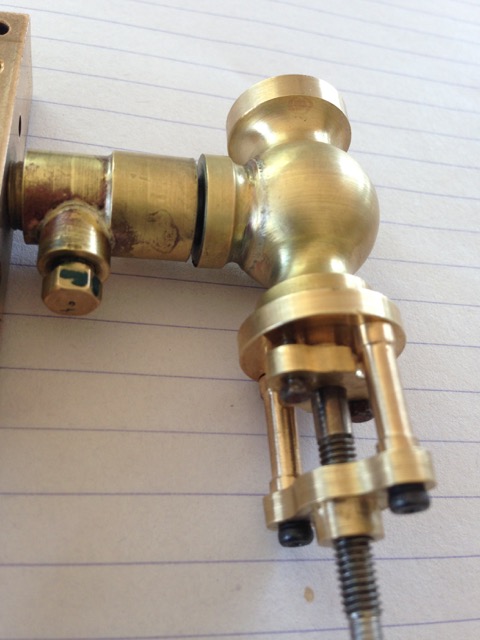
Watch this space….   there will be a video when it is going.  

Steam Chest Uncovered

I removed the steam chest cover in order to attach the steam supply pipe.
The photo shows the sliding valve (gunmetal) and the valve rod which is moved by the silver coloured rods at the sides.
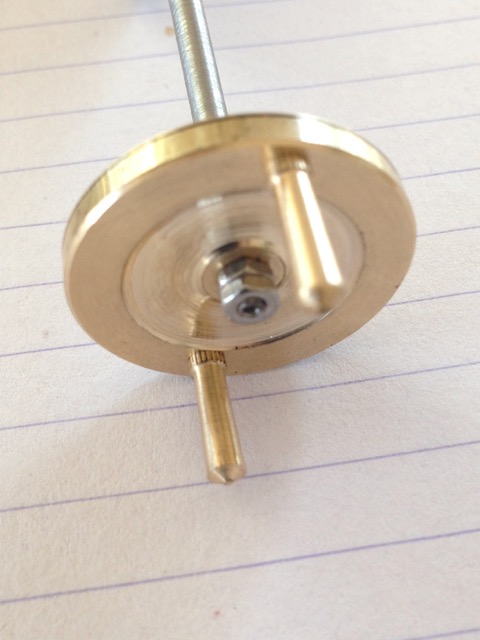
One of the steam ports is visible underneath the sliding valve.
The photo also shows the 6 steam chest studs which hold the whole thing together.

Beam Engine steam pipes made and installed

Steam Cock and valve. Making the handle.


The steam control cock and butterfly valve.

The steam control cock and butterfly valve.

The brass and redgum blank joined with M3 threaded rod

The brass and redgum blank joined with M3 threaded rod

The brass-wood handle after turning

The brass-wood handle after turning

Milling the squared section

Milling the squared section

Drilling the square hole

Drilling the square hole

Filing the square hole corners.  (you didn't really believe that iI would drill a square hole did you?)

Filing the square hole corners. (you didn’t really believe that I would drill a square hole did you?)

Finished handle
Finished handle

Bolton 7 working with live steam

This is the first run of this engine using steam. I have previously had it going on compressed air, but there is nothing like real, live, hot steam!!

It did show up a few problems which I will have to fix. A few minor leaks, need for a displacement oiler, and need to adjust the length of the piston rod. You will hear a knocking sound in the video. I think that is due to the piston just touching the cylinder cap at the end of each stroke. Not difficult to fix, but will require a complete teardown of the cylinder=piston.

to see it click on the link below.

Machining the flywheel

Almost Finished Beam Engine

Beam Engine castings

shipment 1 of 3

The castings and plans were supplied by E&J Winter, Sydney, which is now owned and managed by Kelly Mayberry. He has a well established web site with catalogue, prices etc, and he is very interested and helpful with queries during the machining of the castings.
I believe that the castings come from various small foundries around Sydney.
The plans for the 2 engines which I have made so far were drawn up many decades ago, and are rather frustratingly in imperial measurements. So the first task when I receive a new set of plans is to convert all of the measurements into metric units. Then I have the plans laminated, because they get a lot of handling in the dirty greasy conditions of the workshop. Another item on the plans agenda is to make photocopies of the intricate details on the plans, and magnify them x2. I find this is a great help for my rather dodgy eyes.

Beam Engine Governor Gears

The bevel gears on the plans looked rather difficult to make. Finished gears were available from the castings supplier, but on ordering, no, they had not had them in stock for a long time, and even if they were available the cost would be $a254.
So, I tried another option which was successful.
I ordered some angle grinder gears from China, cost $5 per pair, machined new centre holes for brass inserts which fitted the shafts, used Loctite to glue the inserts, and broached the keyways into the brass inserts.

The photo shows the larger gear unmachined at top, and bored ready  for the brass insert at bottom.
The gears were too hard to machine initially, so I put them through a couple of cycles of heat to red hot and slowly cooling, and then my carbide cutters worked…. just. I did not want to risk my expensive broaches however, and that was one reason for the brass inserts. The other reason was to remove some of the angle grinder features from my antique looking model.
The angle grinder bevel gears have curved teeth, which would not have appeared in 1880, but you can’t have everything. It does make them very silent.

Beam Engine Parallel Motion

A close up shot of the parallel motion apparatus which I made for the beam engine. Designed and patented by the famous James Watt in the 18th century. A complex apparatus which is fascinating to watch in action. Its function is to keep the piston rod precisely centrally in line with the cylinder, despite the circular motion of the beam end.

IMG_1458

I am currently making this engine. It has actually progressed beyond this photo, and is now complete except for the steam connection, installation of control valve, and painting. It is a Bolton No 12. Based on an engine and pump from near Maitland NSW. The original was rated at 16hp. This small version has a […]

Boiler and engine incomplete

Gas fired 4″ boiler Bolton No 7, double action, single cylinder stationary steam engine. I will download  a video of the engine operating on steam, soon.  Keep watching.

Backhoe grabber

OK. so this is a photo of a gadget which I made few years ago. It is a mechanical grabber which bolts onto a backhoe arm and bucket. Seen here picking up a 5 meter I beam which must weigh 200-300 kgs.
The grabber is very useful for picking up heavy, big, prickly, dirty, rubbish and other farm stuff. Good for grabbing fence posts and pulling them out of the ground.
I wish I could say that I invented the idea, but alas….