johnsmachines

machines which I have made, am making, or intend to make, and some other stuff. If you find this site interesting, please leave a comment. I read every comment and respond to most. n.b. There is a list of my first 800 posts in my post of 17 June 2021, titled "800 Posts"

Category: Uncategorized

Model Engineers have Other Interesting Hobbies.

When I visited York, UK recently, I met up with a reader of the blog, Jennifer Edwards.  Jenny had set aside 2 days, and we visited the Kelham Island industrial museum in Sheffield, and the York Railway Museum, both of which have featured in recent posts, and both of which were wonderful.  It was made much more enjoyable by having a kindred spirit as company.  And fortunately both of these sites were new to Jenny also, and equally enjoyed by her I believe.

P1011015.JPG

Jennifer at the 12000hp steam engine, Kelham Island.

This post is about one of Jenny’s many interests.   Metal detecting.

I am not sure what attracted Jenny to this activity, but she joined a local detecting club, and spent many days checking English fields with the club, searching for interesting metal objects.   With fairly limited success.

Then one day she had the idea of checking a local rugby pitch.  Surprisingly, the rugby club agreed, with some stipulations I am sure, about replacing turf, minimal disturbance etc.

Within a short time, Jenny was getting positive signals, then carefully cutting out a square of turf, then digging out the ground, in most cases no deeper than about 150-200mm (6-8″).  And finding coins, rings,  (gold, platinum, some diamond), musket balls and other interesting objects.  Obviously, the field had never been previously scanned.  And research later revealed that the area had been the site of a village fairground.   And before that a walled area for defence against sea raiders.  Very old apparently, because some of the coins were Roman.  Others were of later vintage, medieval, Victorian etc.  About 200-300 objects of interest were found by Jenny.

The find was unusual, and was written up in a metal detecting magazine. (The Searcher, September 2018).

Jenny showed me some of the oldest coins, and I was flabbergasted when she said that I should keep one, as a memento.  I did say that I couldn’t possibly… but I confess that holding something so old, much less being given it, was overwhelming.  I accepted.

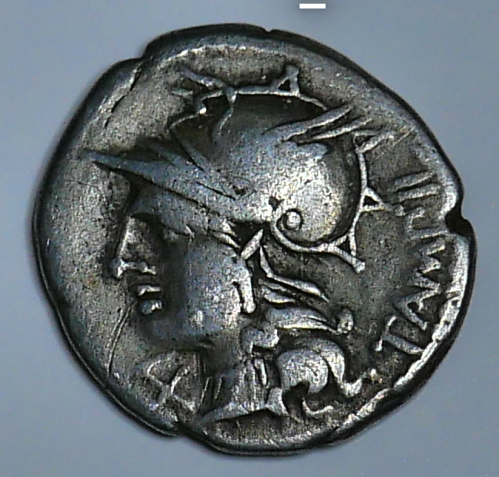
Here are some photos of the coin.  It is a silver denarius, minted in Rome in 137BCE.  i.e. it is 2156 years old.  Minted in the Republican era, before Julius Caesar, before Christ.

Tampil.png

The image is of Apollo.  “Tampil” is the family name of the minter.

Baebius.jpg

The reverse shows Apollo on a 4 horse chariot, holding a laurel branch in one hand and a bow and arrow in the other.  The words “Roma”  and “Baebilius” (part of the minter’s name) are clear.

The coin is small (about the size of an AUD 5 cent piece), silver, and the images are amazingly clear.  The Tampilius family was well known, having provided senior officers for the Roman infantry, and at least one consul of Rome.    The right to mint coins was granted to some high status private individuals in ancient Rome.  The value of the coin was roughly equivalent to its value in the silver it contained.

It says heaps about Jenny’s  generosity that she gave the gold and platinum rings to the rugby club.


Modelling Jeeps and Tiger Tanks (books)

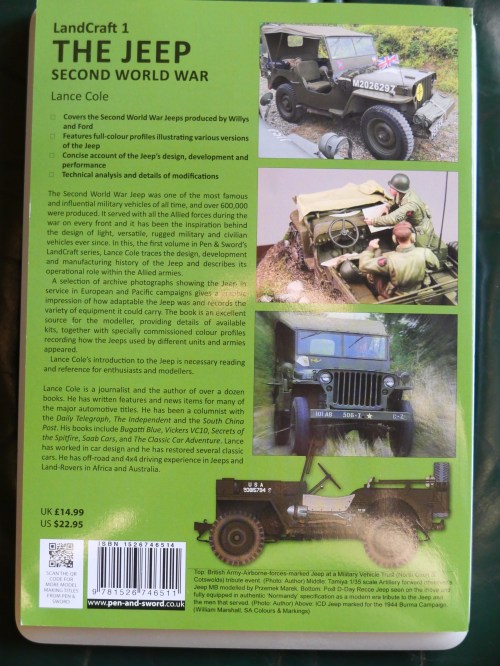
I received 2 more books from Pen & Sword  for review, and these are both directed squarely at modellers.  They both contain interesting information about their use in WW2, but are mainly about the external appearances, and configurations.  Not much information about manufacture, strategic importance, or mechanical aspects.

p1032765.jpg

THE JEEP

Second World War

by Lance Cole


This large format, 64 page book is written for Jeep enthusiasts, Jeep modellers, and Jeep restorers.

This reviewer is an experienced 4×4 driver and owner, and interested in WW2 vintage Jeeps from an historical perspective, and for technical comparisons.

The book will have enormous appeal to its target audience, but less so to the casually interested reader like me.  It does include some general historical notes and comments, but these seem incidental to the main subject matter, which is about modelling of the body work and weapons.

There are many photographs of Jeeps in wartime configurations, and mounting various weapons.  Also lots of photographs of model Jeeps.

Modelers and restorers will love it.

p1032766.jpg

P1032770.JPG


TIGER 1 AND TIGER 11 TANKS

German Army and Waffen-SS

The Last Battles in the West 1945

by Dennis Oliver

p1032767.jpg


This is another of the series of Tank Craft books which aims to provide model-makers and enthusiasts with photographs and line drawings of battle tanks which are popular subjects for modelling.

The 64 page , large format book has many such images, as well as notes about the military actions, as far as is known, of the German Tiger tanks in 1945.

The illustrations are of the tank exteriors only.  They are detailed, colour and of high quality.

A 15 page section lists and assesses commercially available kits from various countries.

Tiger Tank modellers and illustrators will love it.

p1032768.jpg

P1032769


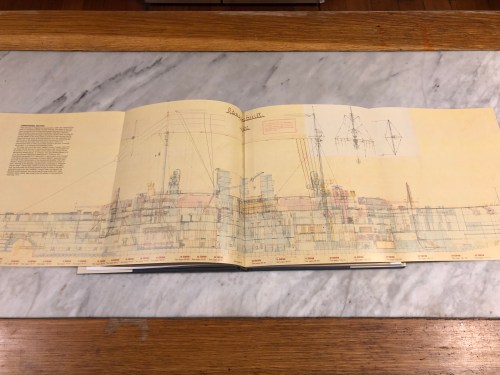
Large Scale Warship Models (a book review)

LARGE SCALE WARSHIP MODELS

From Kits to Scratch Building  by Kerry Jang

IMG_7994.JPG


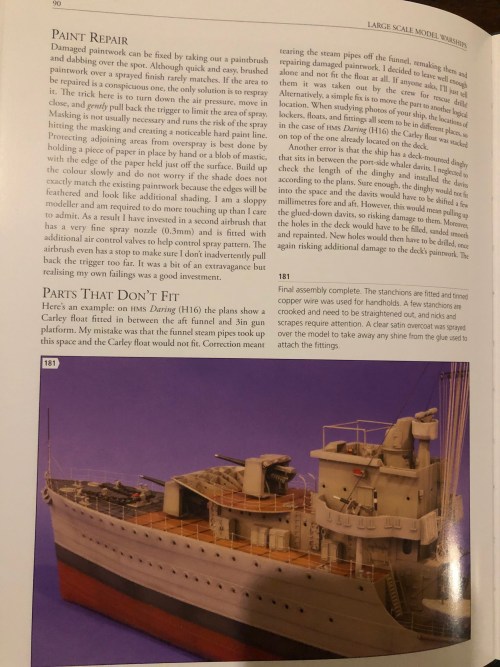
This 110 page, hard cover book is aimed squarely at the model ship builder.  The title is slightly misleading because the book is more about methods of modelling, rather than models, per se.

The author, an expert and award winning modeller, describes the methods he uses to make superb, large scale ship models.  The methods include up to date techniques including 3d part printing, rubber mold making,  and use of modern adhesives, paints, materials etc.  There is a very interesting section on the why’s and wherefores of large scale ship modelling, including intriguing references to Zen and Nirvana.

The book is lavishly illustrated with many photographs of works in progress and techniques.  The text is clear and concise.

Although I am entranced by ship models in museums, my own interest in modelling is with stationary steam engines.  I found much of the advice and techniques in the book to be of interest and relevant to my own modelling efforts, particularly the sections on assembly, painting and finishing.

A handsome, useful book, which I am pleased to add to my library.

johnsmachines.com

img_8001.jpg

IMG_7996

“parts that don’t fit”. Now that will be useful.

img_7998.jpg

A handy painting technique which had never occurred to me.

img_7999.jpg

img_7995.jpg

A lavish, quality production. £25.


London Museum of Science Revisited

I am back in oz as of a few hours ago.  Freezing and wet.  Was 26c in London today.

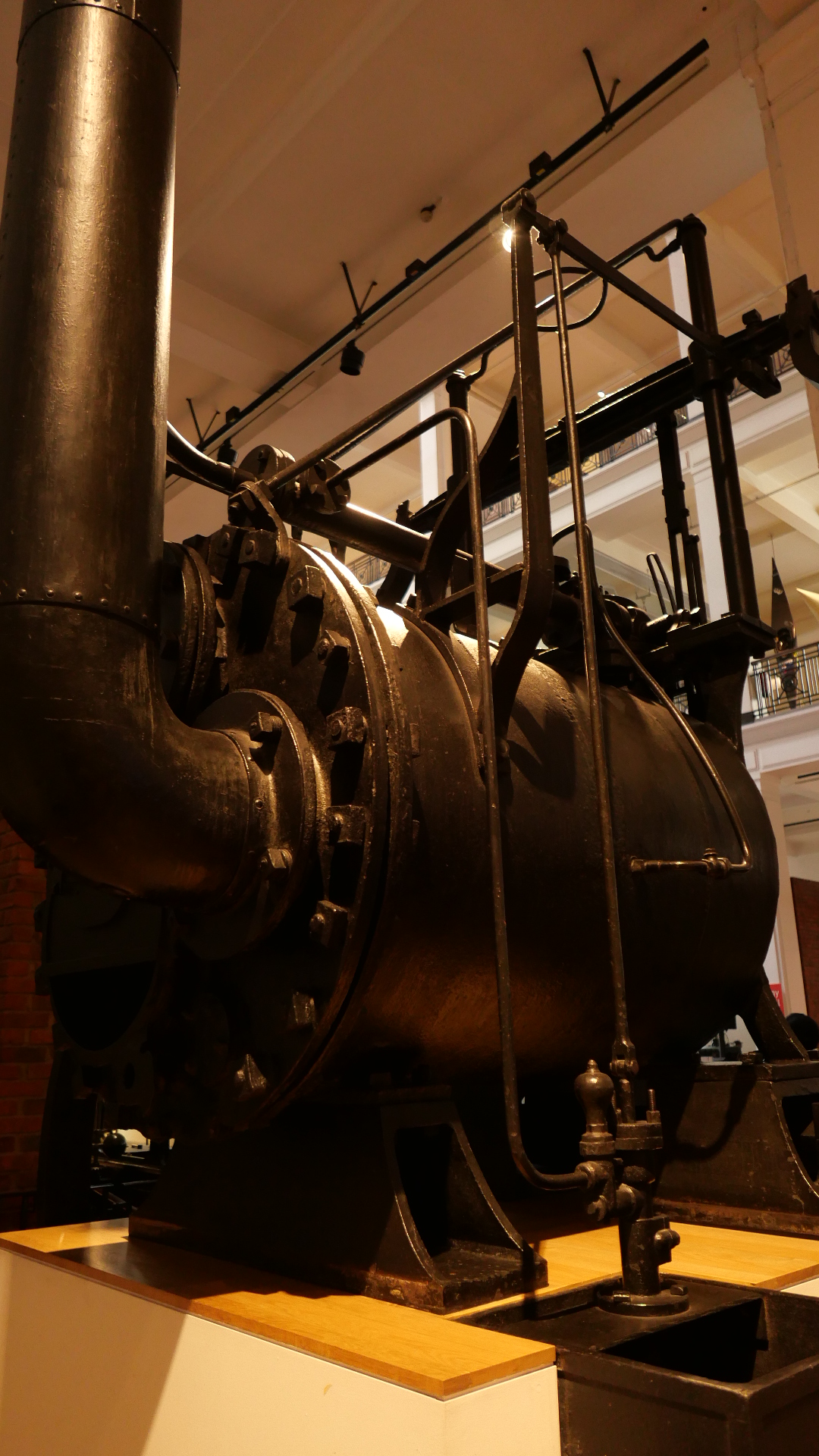
On my last afternoon in London I had a few hours spare.  So I caught the tube to have a final farewell to the Trevithick dredger engine and to reshoot some photos which I had messed up at my visit 3 weeks earlier.

P1032708.JPG

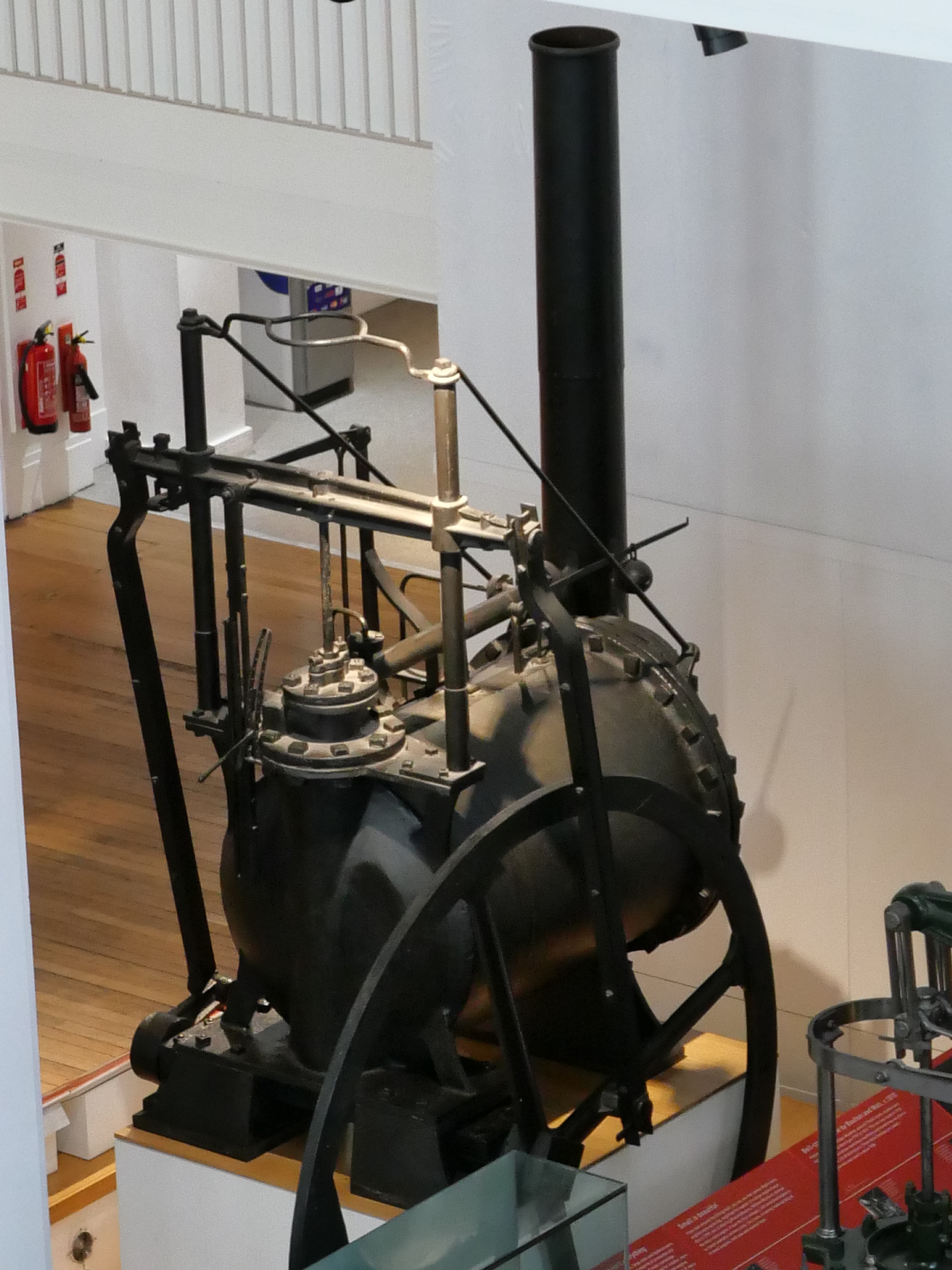
Trevithick dredger engine in the LSM.

…and I spent a very pleasant hour photographing the engines in the Energy Hall again.

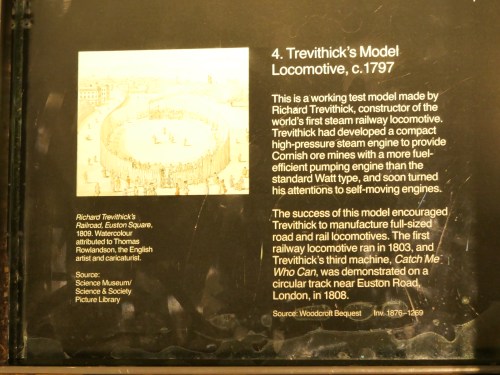
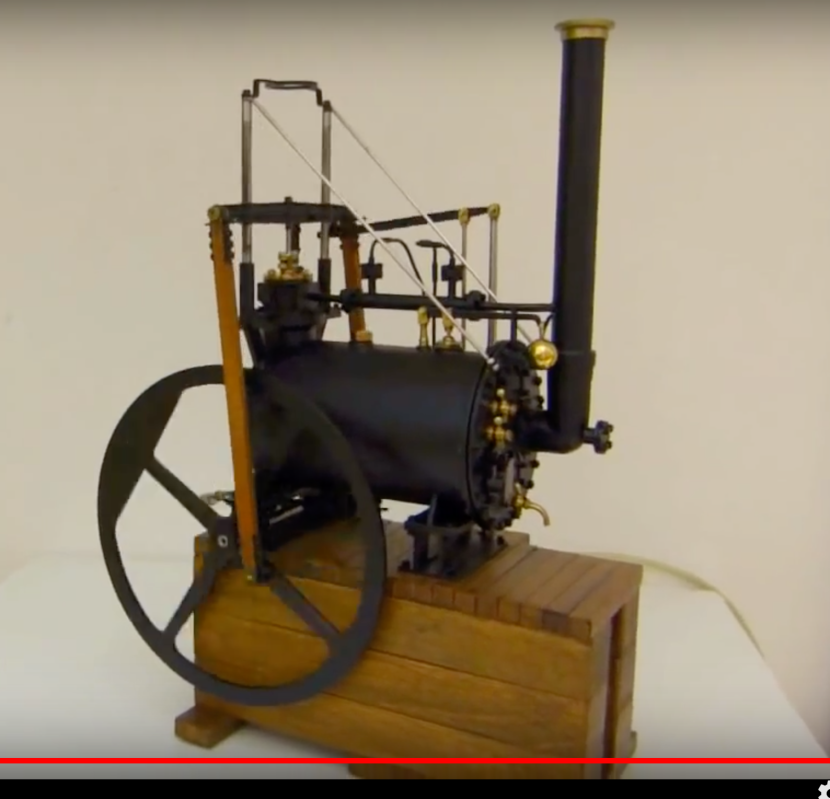
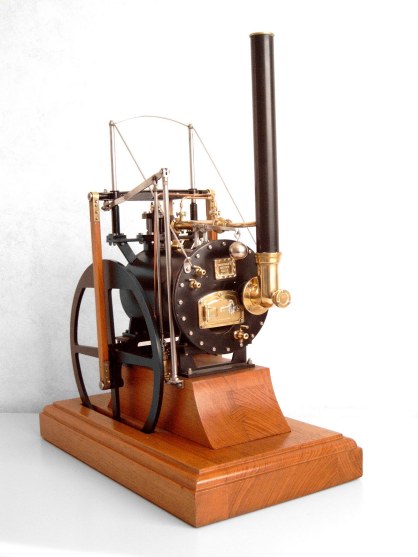
And on wandering further into the building I discovered that on the previous visit I had totally missed about 2/3 of the entire museum, including the model of the Trevithick road vehicle which had been made as a concept model by Trevithick’s brother in law, a clock maker.

Unfortunately it was bottom lit and behind glass, so very difficult to get good photos.

P1032563.JPG

From above

P1032569.JPG

From the side.

P1032571.JPG

The model is more akin to his road vehicle “Puffing Devil” than the rail locomotive.

P1032576

Quite modern looking lathe by Richard Roberts 1807.  With lead screw and outboard gears for threading.

P1032500.JPG

Beam engine designed by James Watt 1797.


P1032605.JPG

Model of a steam powered workshop, with many tiny exquisitely modelled lathes, shapers, presses, saws, and a steam engine.  Those lathes are about 3″ long.

P1032508.JPG

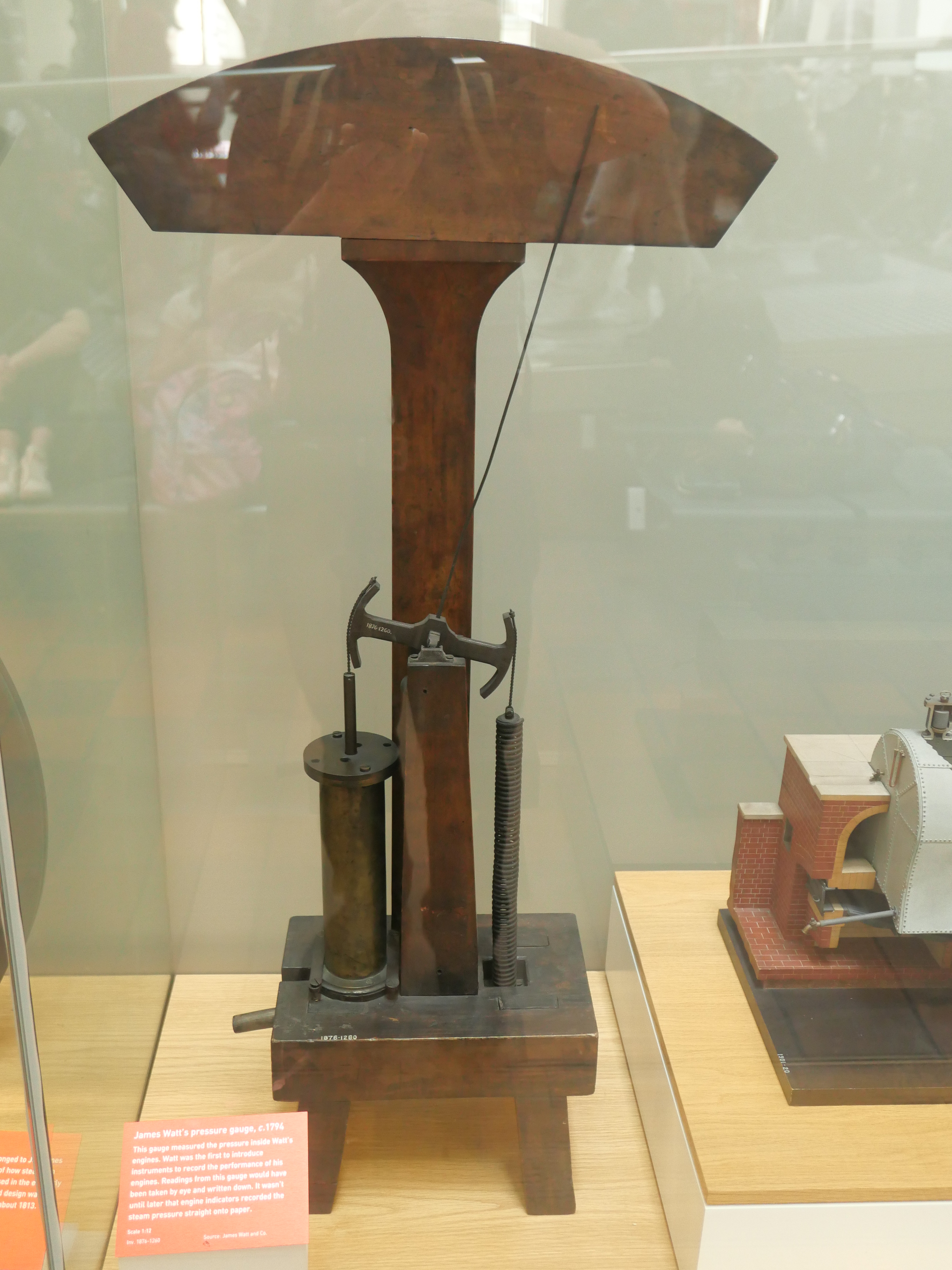
And a 1:12 model of a pressure gauge of James Watt, 1794.  60 years before the invention of the Bourdon tube.

P1032664.JPG

And this one amused me.  It is a 1987 Colchester CNC lathe, with Fanuc controller.  It is 2 years newer than my Boxford CNC lathe.

This really was the finale of my adventures in the UK.


Final Day in UK. 2 more museums.

First, I was avoiding posting photos because I was at 99.9% of my allowed storage at WordPress.  So I have deleted a lot of old videos, and now have some headspace.  If you search my old posts you will find some blanks.  If they are crucial, message me and I will get them to you some other way.

Today was my final day of sightseeing.  Beautiful sunny weather in Portsmouth.  I am mentally gearing up for home and family, who I have missed.  But frankly, this tour of museums and engines and mines and ships could not have been done with wife/family in tow.  I consider myself incredibly fortunate to have been able to do just what I felt like, for the past 3 weeks.  And I have enjoyed making these posts in the evenings.

So today, I visited 2 more museums in Portsmouth, on the Gosport side of the harbour.  Smaller, specialist  museums.  Not for everyone, but I thought that both were terrific.  They were 1. The Explosion Museum and 2. The Royal Navy Museum of Submarines.

The explosion museum was quite close to my BNB.  A walk along the waterfront, past many, many leisure yachts, and the odd hulk.

P1022309.JPG

Fighting off the crowds on the waterfront, Gosport, Portsmouth

P1022368

The “Explosions Museum” is located in an old set of buildings, built as you can see, in1771.  The walls are 8′ thick.  

P1022310.JPG

And as I entered, I noticed this lump of steel, weighing 1.5 tonnes.  That is my tape measure.  I don’t trust OP’s measurements.  It is armour plating from the German battleship “Tirpitz”, sunk by British airplanes in a Norwegian fiord in WW2.   I measured it at 450mm 18″ but the notice says 15″.  Whatever.  

P1022317.JPG

Cutaway of a WW2 magnetic mine.

P1022319.JPG

The breech of a 15″ naval gun.  Massive.

P1022364

One of the buildings.  Those walls are 8′ thick!

There were many more exhibits, mainly of WW1 and WW2 vintage.  But a few more frightening, modern ones too.

P1022315.JPG

Where the gunpowder was stored.  Now used as a wedding reception venue!  Hence the balloons.

I noticed this as I walked back.

P1022371.JPG

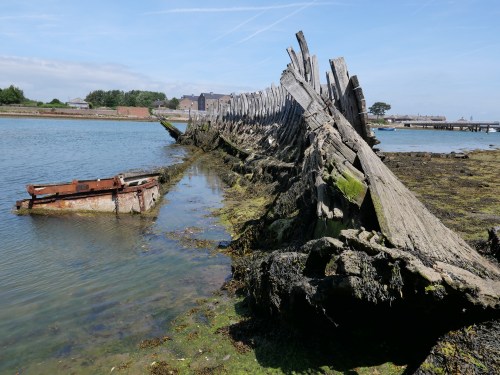
Rotting away to nothingness.

P1022373.JPG

I have to protect my knees these days, so I drove the  2 miles to the Royal Navy Submarine Museum.

P1022394.JPG

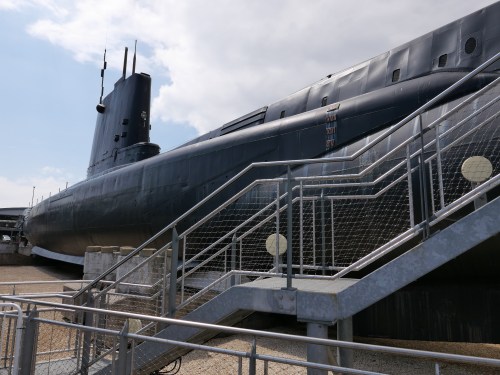
This is a cold war, diesel powered sub.  I was surprised how big it was.  1600 tons.

P1022395.JPG

P1022393.JPG

The bow (pointy end)

P1022385.JPG

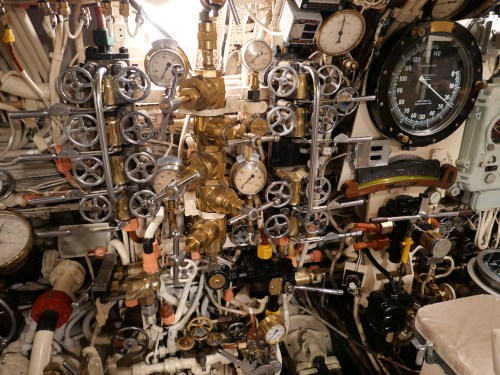
And it is probably pretty obvious, but it is still just another boat.  With lots of pumps, valves, 2 engines, nav gear, torpedoes, and crew facilities.

P1022382.JPG

and dedicated volunteers, in this case an ex-submariner.

P1022377.JPG

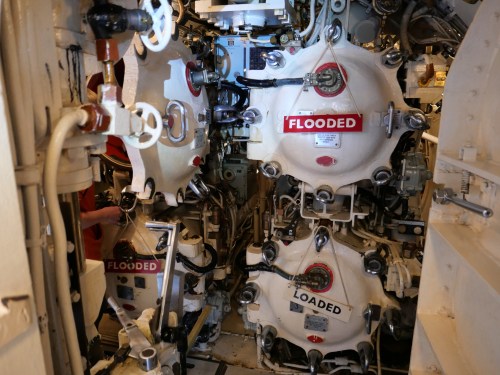
Forward torpedo room.  The 1.5 tonne torpedoes were basically manhandled into the launching tubes shown, using a gantry (not seen).

P1022378.JPG

Torpedo stored against the wall, and the gantry above.

P1022380.JPG

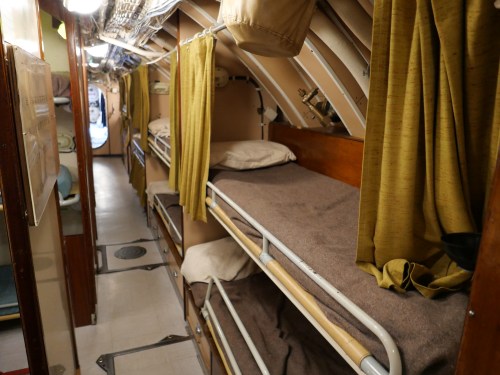
There is not much room.  Crew bunks.

P1022387.JPG

Plenty of interest in the loo

P1022390.JPG

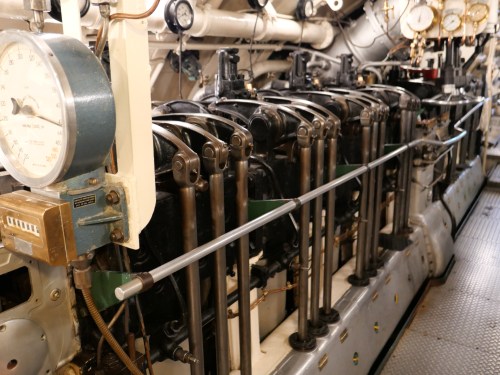
One of the twin diesels

P1022389.JPG

and the machine shop.  No brand.  About the size of a Myford.


The guide’s final comment was that this 1980-90’s technology is obsolete.  It is all about nuclear submarines these days.

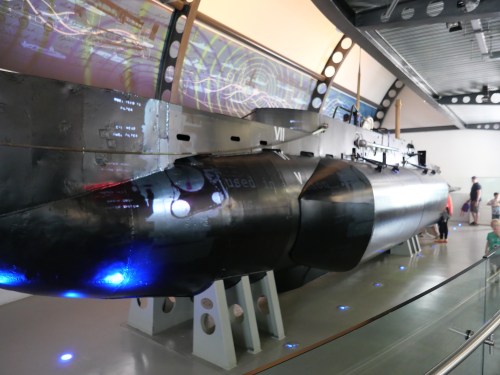
Then into the actual museum, where there was a mini sub, and the first submarine in the Royal Navy.  And a lot of simulation games to amuse the kids.

P1022399.JPG

The mini sub.  British.  Used in WW2.  A six man crew from memory.

P1022414.JPG

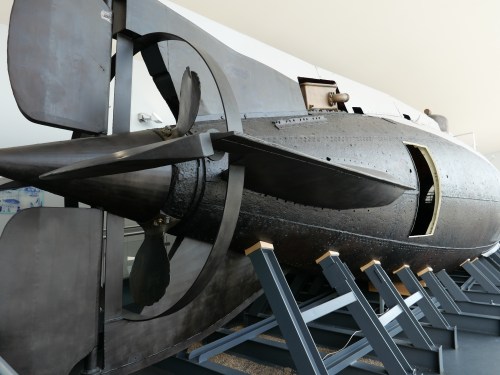
1900.  9 man crew.  Canaries were actually rats.  Enlarge to read the details.

P1022410.JPG

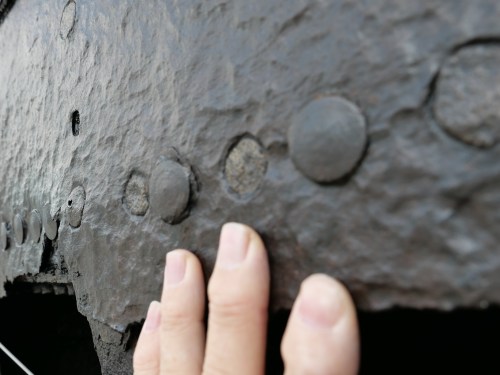
Riveted hull.  Circa 1900. 

P1022411.JPG

Petrol engine when on surface.

P1022425.JPG

Single forward torpedo tube.

P1022426.JPG

Looking aft past the petrol engine

P1022430.JPG

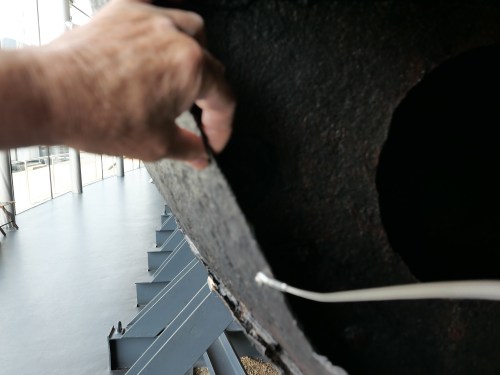
The outer skin was about 3mm thick.

P1022431.JPG

No welding.  Entirely riveted.

P1022433

P1022434

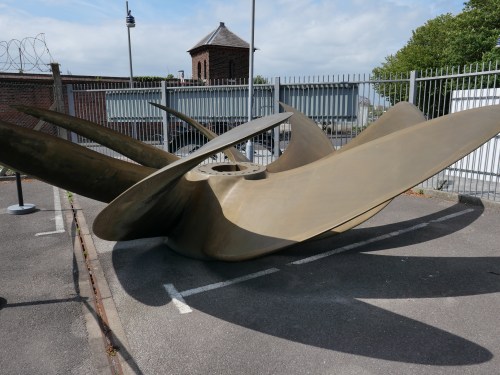
In the car park was an unlabelled, 7 blade bronze (?) prop.  ? off a nuclear sub.

P1022407

P1022408.JPG

Submariner officers were in “the trade”.  I bet that you did not know that one.


So, tomorrow a drive to London to drop off the rental car, and fly out the day after.  I am planning another quick visit to Fort Nelson, where I am hoping to use a tape measure on one or two aspects of the Ottoman Bombard.  Maybe a model bronze version of the bombard in my future, hey?

So, I hope that you have found some of these posts of interest.  My usual workshop posts will reappear soon.  And maybe an occasional one about UFO’s and Antarctica.  See ya.
Portsmouth UK. 2 more great museums.

Not strictly museums.  Ships actually, but displayed as museum pieces.  Both incredibly interesting.  And I am not including Nelson’s “Victory”.  I had seen it 40 years ago, and after 5 hours of walking, my knees told me that enough was enough.

P1022298.JPG

“Victory” as seen today.  Still the biggest crowd pleaser.  Now sitting on props in a dry-dock.

My main targets today were “Warrior” and the “Mary Rose”.

Warrior was built in 1860.  The age of steam was well underway.  But to date, warships were still sailing ships.  However the French were rebuilding their navy after their humiliating defeat at Trafalgar, and they had built the first propeller driven, steam powered, iron clad (wooden ship with steel plate cladding).  The Brits were not going to stand for that, so they built “Warrior”.  The most powerful, fastest battleship afloat, and more than a match for anything else in the world.  By the time it was built, the French and the Brits were allies, for a while.  Warrior was destined to never fire a shot in anger.

Today it sits moored at Portsmouth’s Historic Dockyard, and is a fascinating mixture of steam and sail, muzzle loaders and breech loading guns, Steel and wood.  It is a big ship, 127.5m (418′) long, and 9210 tons.  It looks a little odd to our eyes because it has no superstructure, except 2 funnels, and the foremast and mainmast are widely separated.

P1022124

Steel framed, 18″ of oak lined, plus 4.5″ of steel plate.   The masts are steel, with wooden upper sections.  The figure head is a Greco-Roman warrior.   706 crew.

This ship could make 14.4 knots (27.7kph) under steam, 13 knots (24kph) under sail, and 17.2 knots (31.9 kph) with sail plus steam.  Not as fast as a clipper, but much faster than any other warship.

P1022125.JPG

4.5″ (114mm) armour plating, plus 18″ (460mm) teak planking.

P1022155.JPG

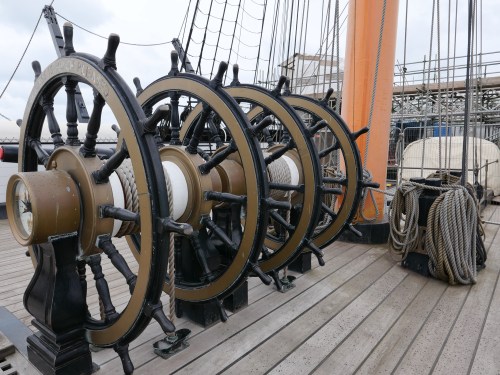
Traditional spoked steering wheels were duplicated on 3 decks.

P1022172.JPG

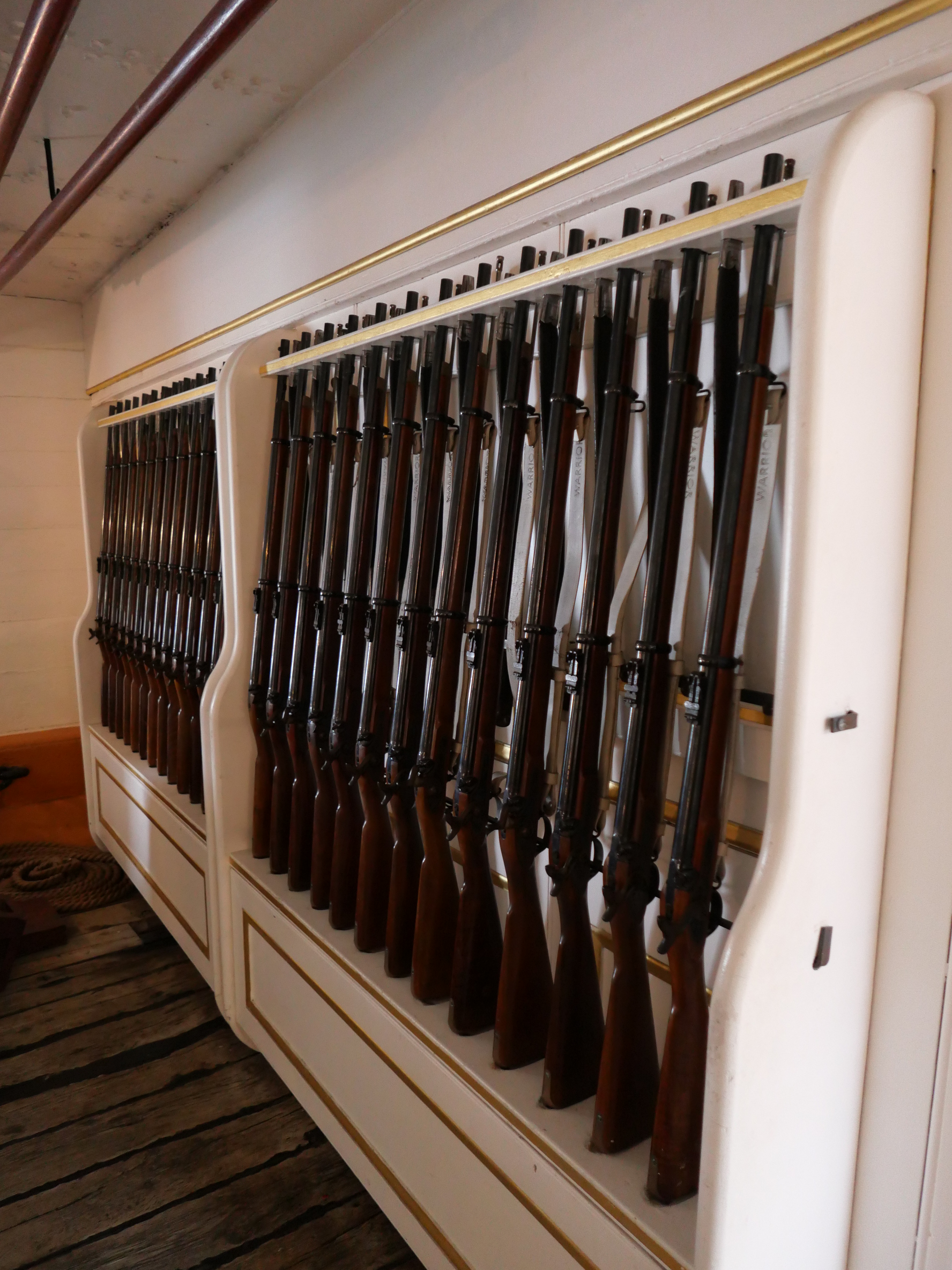
Hundreds of Lee-Enfield percussion cap rifles were available.

P1022186.JPG

And cutlasses, to repel boarders.  Muzzle loading cannon tools to left.

P1022205.JPG

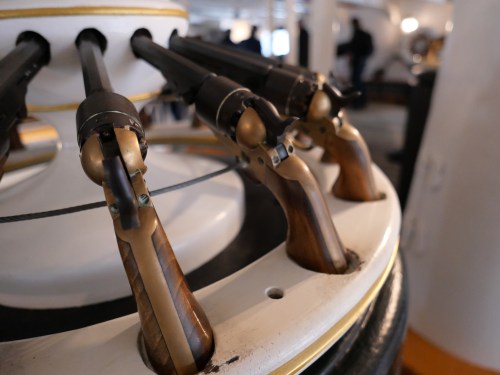
And Colt 45’s for the officers.

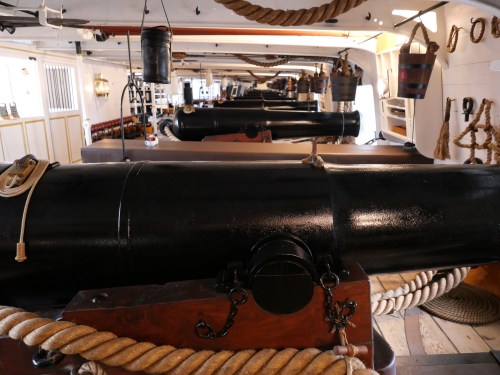
But the main armament was of course the big guns.

P1022196.JPG

The gun deck was similar to that of the 120 year older Victory.   except that these are huge 68 pounders.  19 man gun crew for each.  A mixture of 10 x 110lb breech and 26 x 68lb muzzle loaders.

P1022200.JPG

And the crew still slept in hammocks on the gun deck.  And ate there.

P1022207.JPG

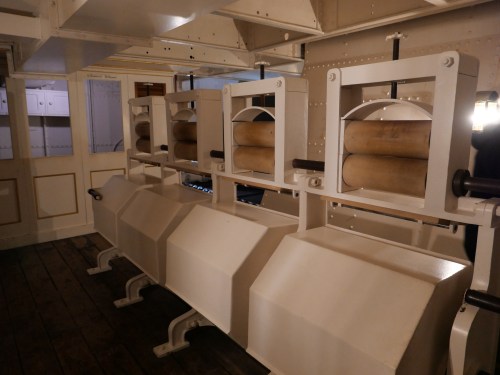
But they had washing machines  and lavatories (first ever warship with these)

P1022208.JPG

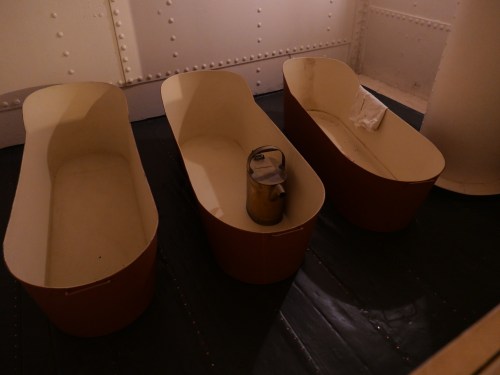
and baths!

P1022215.JPG

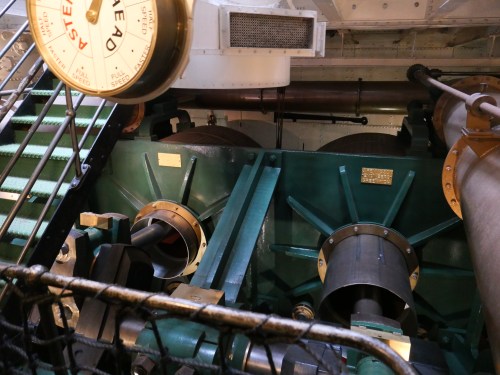
The steam engine, surprisingly was a relatively primitive, but powerful twin cylinder, single expansion, horizontal trunk engine of 5469hp, driving a single propeller.  The 10 boilers were box shaped, double firebox, no fire tubes.   22 psi only.

P1022228.JPG

Coal was delivered in small coal trucks on rails, and shovelled into the firebox’s.  No gauges,  except in engine room.   853 ton coal stowage.

I have many more photos of Warrior, but I am down to my last few megs of storage, and I want to show some pics of the Mary Rose, which is probably the most stunning museum display I have ever seen.  I know that I keep saying that, but this really is…..

Mary Rose was a 35 year old warship which sank in 1545 during the battle of the Solent, against a huge French invasion fleet, while Henry 8 was watching.  No-one really knows why it sank, but the most popular theory is that bigger cannons had been installed, requiring low gun-ports to be cut into the the hull, and that after firing a broadside the ship had turned and the open gun-ports shipped a lot of water, which sank the ship.   Whatever, the ship was unable to be raised. Most of the hull gradually rotted and broke away.  But the parts which were under silt did not rot, and were still there when discovered over 3 centuries later.  In 1985 the remains were raised, and painstakingly preserved.  A museum to house the remains was specially built.  And it is stunning!  No other word for it.  Here are a few pics from today.

P1022234.JPG

Mary Rose.  Pride of the English fleet.

P1022235.JPG

and you know who.

P1022283

About 1/3 of the hull remains, including most of the keel.

P1022248.JPG

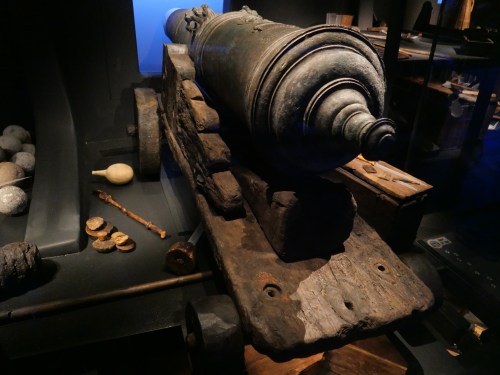
The bronze cannons are in fairly good shape.  Only real remains are displayed.

P1022253.JPG

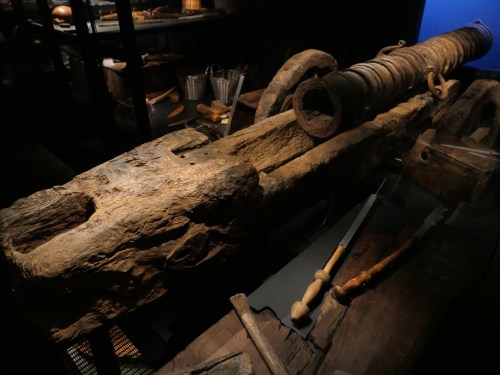
This is a breech loading iron cannon, made of strips and hoops of iron.  The ancient wood and iron has been treated for years with PEG (polyethylene glycol) before going on display.

P1022294.JPG

Hundreds of ewe long bows were found, many still in their storage boxes.

P1022278.JPG

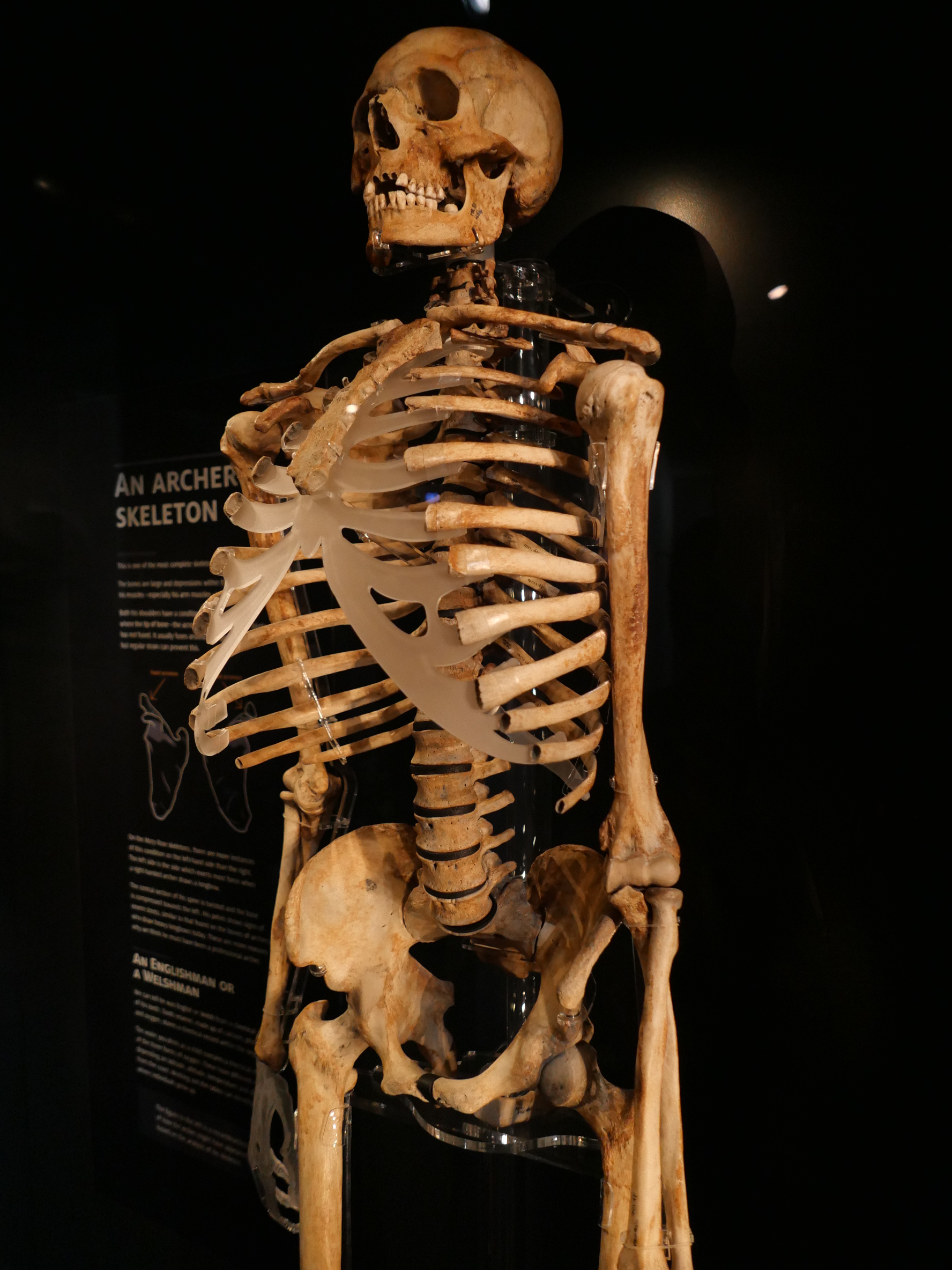
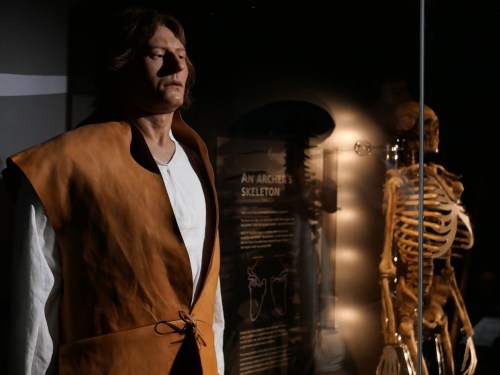
And many skeletons.  This one was a bowman.  That humerus (upper arm bone) is massive.  There were 35 survivors out of the many hundreds of men on board. 

P1022281.JPG

And a reconstruction of the bowman.

P1022265.JPG

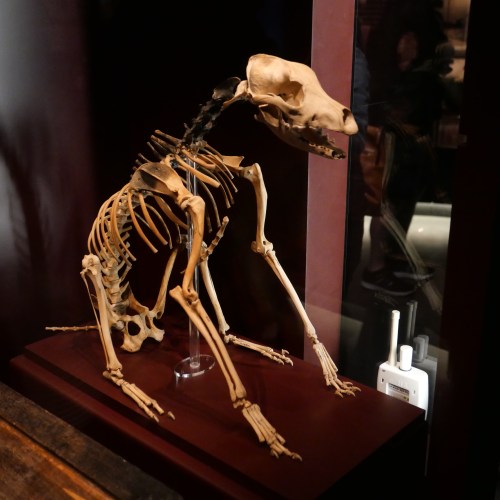
And sadly, a dog.

A most remarkable museum.  Add it to your bucket list.  Allow at least 2 hours.


Fort Nelson. The Ottoman Bombard revisited.

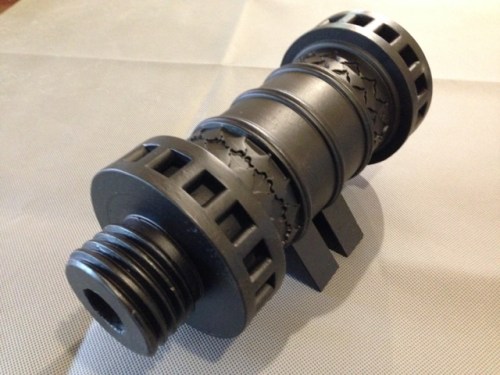
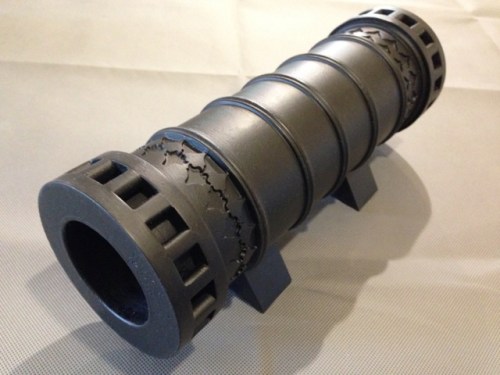
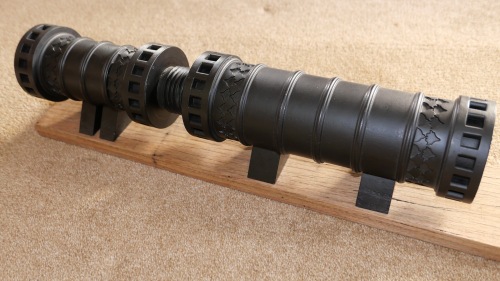
Just to refresh your memory, if you are a long term reader of johnsmachines.com, this is the model of the Ottoman Bombard which I made several years ago …

bombard - 19bombard - 20bombard - 21

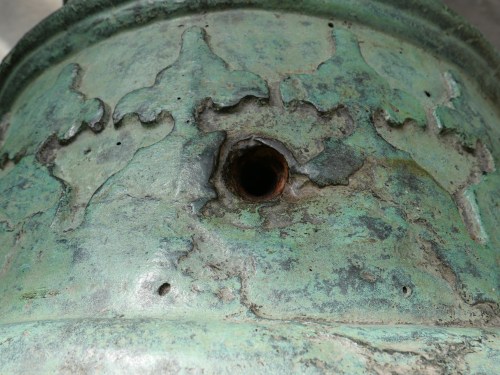
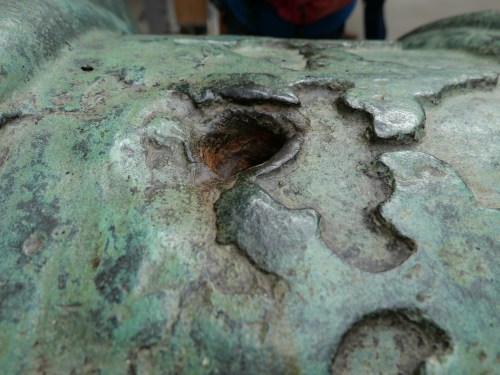
…but it is not finished.  I could not find a picture or drawing of the touch hole anywhere.  Requests to the museum drew no response.

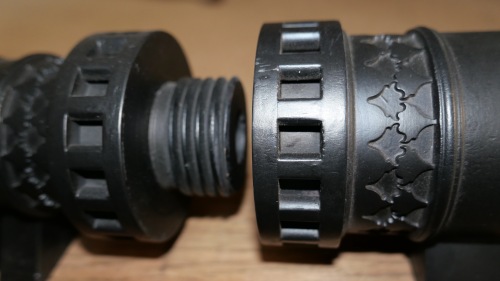
Plus, I had some questions about how the square holes were made.  These were designed for levers to be inserted so the cannon segments could be screwed together.  But were the round pegs cast with the barrel and breech, or were they somehow added later?

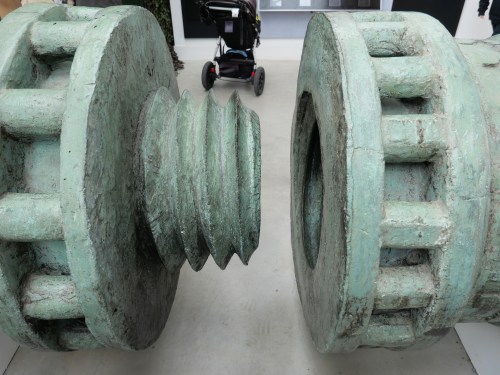
Also, I wanted to take a close look at the huge V threads to see if I could work out how they made them.

And frankly, I just wanted to touch it.

It is currently on display at The Fort Nelson Royal Armories Museum near Portsmouth UK.  And I visited it today.  I allowed an hour to inspect the bombard and have a quick look around the rest.  4 hours later I staggered out.  This museum is another fantastic place to visit.  I will do a more complete report in another post. For the moment I will deal with the bombard.

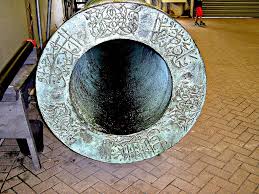
Firstly the touch hole.  Save these photos.  They do not appear anywhere else!

P1021867

P1021882

Not much design finesse there!  The wide opening becomes narrower about 25mm in (just visible).

P1021881

Next, the bombard as it was today..and I touched it!

P1021906.JPG

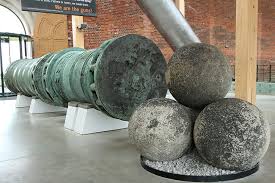
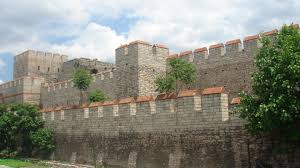
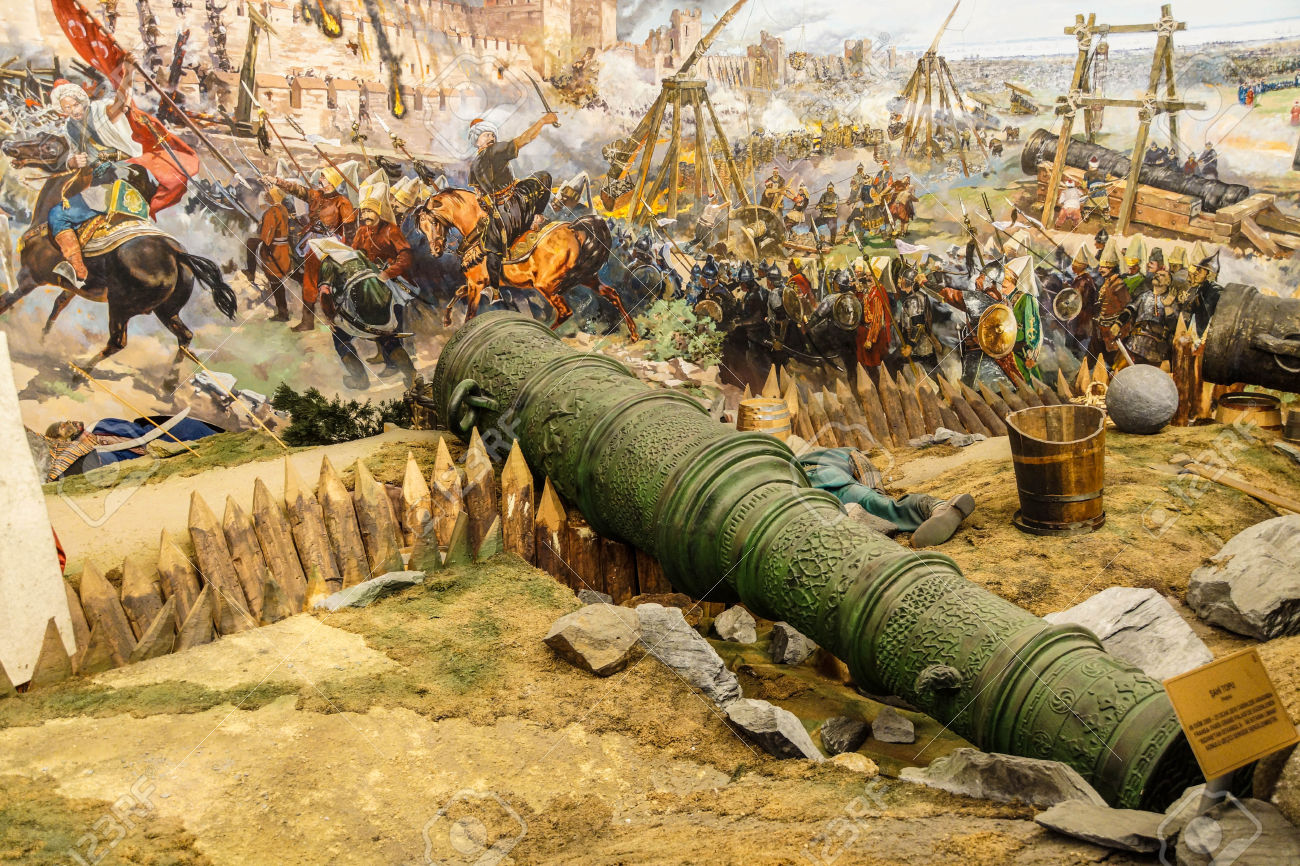
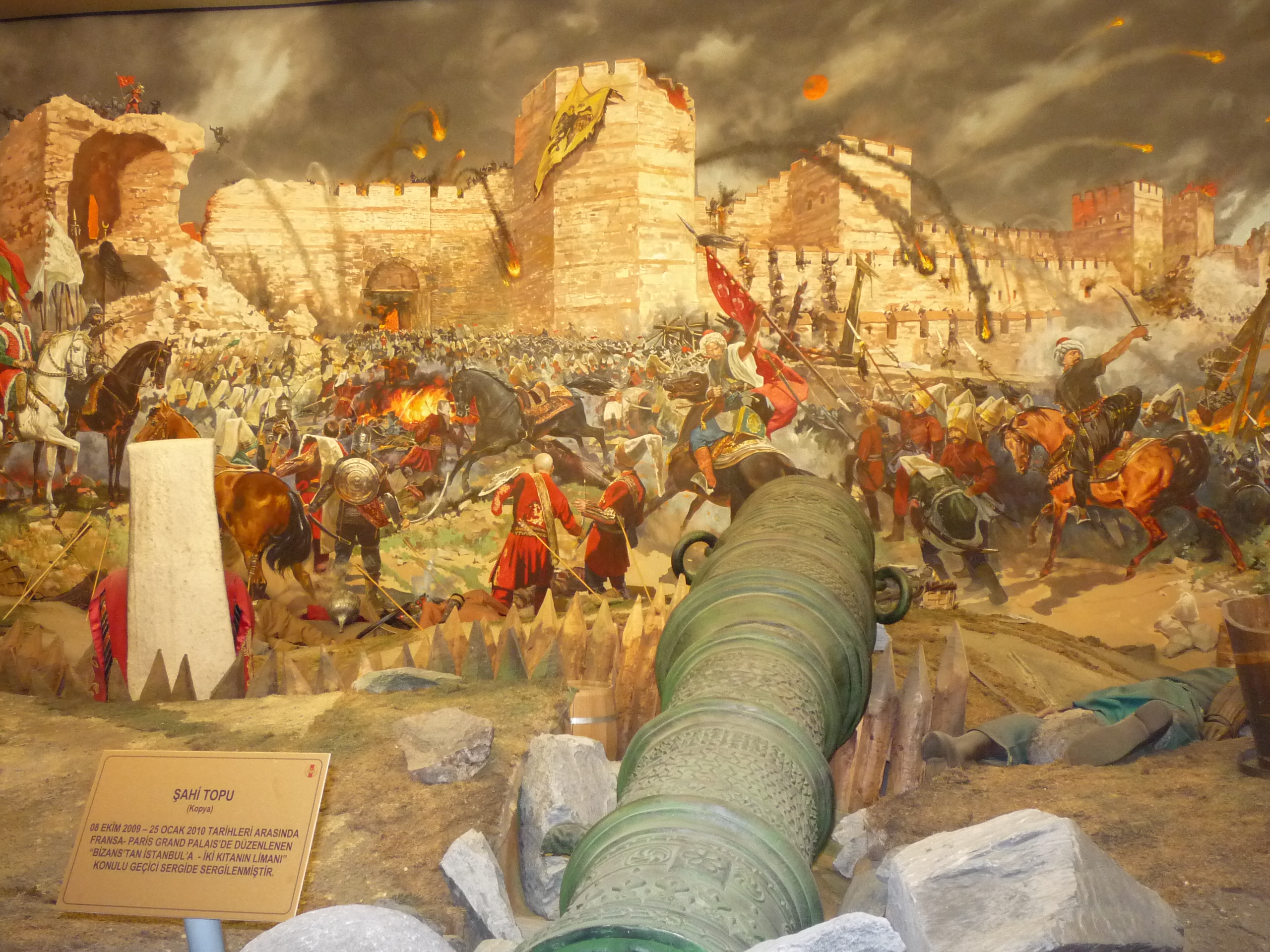
It is 17′ (5.2m) long, weighs 16.8 tons (17000kg).  It was made in 1465 by Munir Ali, as a copy of the bombards made by Orban, a Christian (Hungarian? German?) for Mehmet 2, the conqueror, who took Constantinople in 1453 on 29 May, (today in Oz).  Orban’s biggest bombard, named Basilica reportedly was 27′ (8.2m) long!

P1021880.JPG

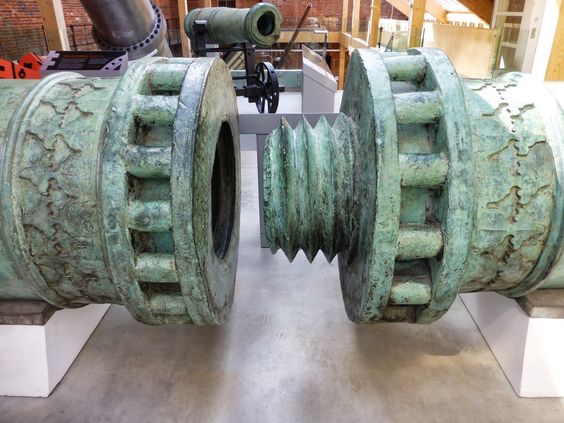
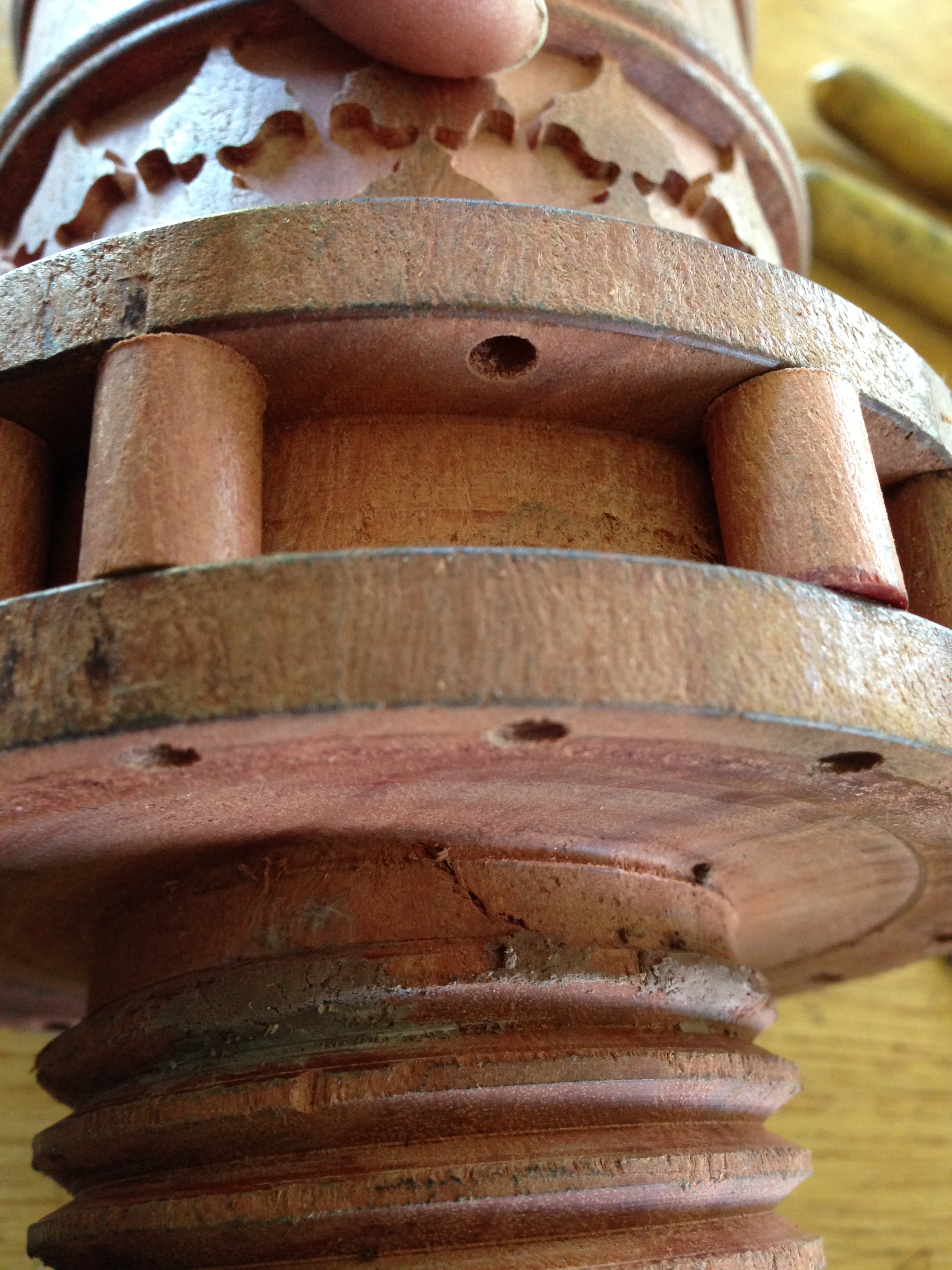
That’s my hand underneath the “pins”.  Actually levering braces, cast integrally with the breech and barrel.  You can see dents, probably made by the levers.  In doing this I realised that the “pins” are not cylindrical, they are half a cylinder (split lengthwise).  The half cylinders allowed clay or something similar to be placed around the mold, under the half cylinders, and for the gaps between the half cylinders to be filled with clay pieces, to be broken out after the cannon casting.

And the huge threads…

P1021902.JPG

Well, I am no closer to understanding how these were made.  They are rough and irregular.  I would guess that they were carved in wood, then a clay mold made from the wooden model and baked, then the clay shape used in the final casting, and broken out afterwards.  Any other ideas?

I really enjoyed this visit.  If I have any WordPress storage remaining I will post some photos of some of theother artillery pieces later.

When I finally run out of space, I am afraid that will be the end of my posts.  Thankyou all for following.  It has been great fun posting, and answering comments.

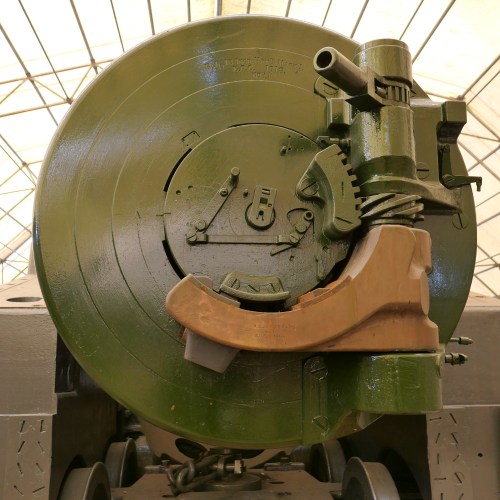
Just in case this is the last post, I have to post these pics of the WW1 British rail gun.  It is truly awesome.

P1021962P1021963P1021964P1021965

P1021967

Cannon caliber 18″.  The Yamato (Japanese WW2 battleship) had 9 guns of this caliber.

P1021961

The breech OD  is at least 5′- 6′


BT. Before Trevithick.

Before Trevithick were Savery, Newcomen and Watt.  And way before them, Hero of Alexandria (1st century AD)

Thomas Savery, a military engineer from Devon, took out a patent in 1698 for a steam operated pump.  It had no moving parts, except some valves.

Savery-engine 1698

It had 2 low pressure boilers.  Steam from one boiler was introduced into one chamber, and water was then introduced which condensed the steam, forming a partial vacuum, which sucked up water from below.  Steam from the other boiler was then introduced, which pushed the water upwards.  As a pump it was a failure, and it is not known if any were made.  Modern reconstructions have also been unable to pump water successfully. But the patent lasted, and forced Newcomen to involve Savery with his invention in 1712.

Thomas Newcomen was an ironmonger and Baptist lay-preacher from Dartmouth, Devon, and he is the reason that I am currently in this pretty Devon town.  There is an original Newcomen “atmospheric engine” in Dartmouth.

P1021850

(taken at an angle to avoid window reflections)

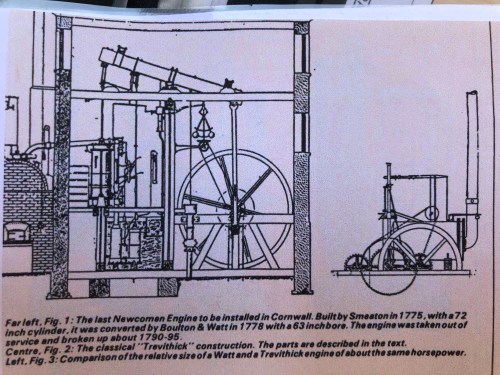
The Newcomen pump, (for pumping water from the mines was its purpose) also used the condensation of steam creating a partial vacuum, as its principle of action, and it was quite successful.   So successful in fact, that more than 600 of them were built, and they continued to be built well after the improvements of Watt and Trevithick, into the nineteenth century.  In the diagram above, the 22″ power cylinder is on the right, and the pump cylinder is on the left.  The genius of this design is that the pump can operate in the depths of the mine (or canal or military trench) while the engine remains above ground.

It is incredibly inefficient in thermal terms, converting only 1:200 of the energy from burning coal into the mechanical energy of the pump, but it was by far, more powerful than any pumps driven by man, horse, wind or water at that time.

The room in which the Dartmouth engine is housed is just bigger than the 15′ high engine, so pictures are difficult.

P1021830.JPG

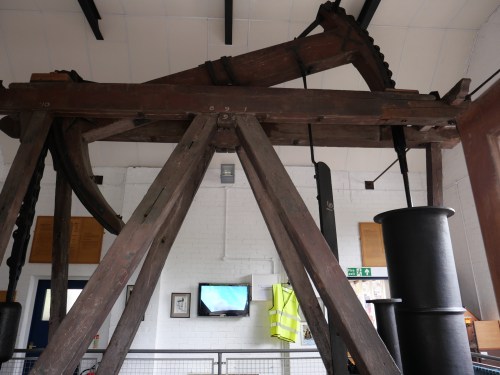
All wood, except the power cylinder on the right, and the pump and pipes (not seen).  The curved ends of the big wooden beam keep the piston rod and pump rod vertical.  Cylinder boring had not been introduced yet, so the gap between piston and cylinder was up to 1/4″.

P1021837

The valves to admit the steam and water were originally operated by hand, but later some automated simple levers were introduced.  Note the square nuts (original).  It appears that the woodwork is mostly original, albeit repaired in places.

P1021842.JPG

P1021834.JPG

The pump connection

P1021852.JPG

This power piston has a bore of 22″ (560mm), but they were built increasingly bigger, up to 80″ (2032mm).

The Newcomen engines were simple, and effective.  Their main problem was that they consumed vast quantities of coal.  They were widely used, but there was/are no coal deposits in Cornwall, and transporting coal from Wales was costly, and taxed.

James Watt‘s big contribution to steam engines was to add a condenser to the engine, which was separated from the power cylinder.  That doubled the efficiency.  He also sealed the top of the cylinder, so both strokes of the piston rather than just the down stroke, were power strokes.  But it was still a vacuum powered engine, and therefore had an absolute limit of working pressure of something less than atmospheric pressure (15psi).

Richard Trevithick‘s main contribution in 1800 was to increase the steam pressure available, by inventing the “Cornish boiler” which produced steam at 50psi, and even up to 145psi.  This more than doubled again the thermal efficiency of the steam engine, and made it much more compact, leading to his applications of steam engines in road vehicles, railway locomotives, ship engines, and industrial stationary engines (like my model dredger engine).

IMG_7135.jpg

Watt modified Newcomen engine on the left, Trevithick dredger engine on the right. Size comparison.

Tomorrow I am driving to Portsmouth.  So I will leave the west country inventors of steam engines.  It has been a fascinating journey.

First stop, Fort Nelson.  To renew my acquaintance with the Ottoman bombard, which was the subject of my blogs several years ago.


Bolton Steam Museum

I was a bit unsure about visiting this one.  A smaller museum, and I knew from the web site that it was not a steaming day.  But it was only a half hour drive, so off I went.  I arrived at the address, and there was a supermarket, but in a corner of the supermarket block there was a tall, old,  sizeable red brick building with no windows.  And a sign… “Bolton Steam Museum”.

In I wandered, and a gentleman in overalls approached.  This was a volunteer working day.  But Ian (apologies if I got the name wrong), stopped his task and spent over an hour showing me around, explaining the finer points of his babies, starting some of them on electric motors to demonstrate the movements, then invited me to a cuppa with his mates, where there was further discussion, mainly about rope drives and stone engine bases.

No parking or entry fee on a non steaming day, (but a donation was appreciated).

The machines were not the monsters of Kewbridge or Kempton pumping stations.  They were mostly from the industrial age of the midlands 1840-1930, powering textile mills, sawmills, and factories.  Some were quite big.  All were beautifully restored and presented, and for once, the descriptive labels had lots of information about the physical characteristics and histories of the engines.  A nice aspect was the elevated walkway down the centre of the room, allowing a good view above the engines.

Some photos follow.  Not as many as the museum deserves, because I am nudging my  Wordpress limits.

P1021411.JPG

P1021391.JPG

P1021410.JPG

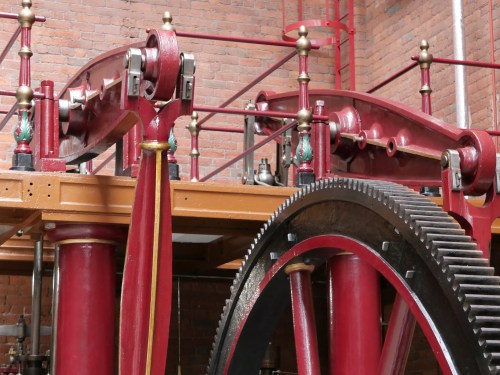
The twin beam engine of 1840 is the oldest engine in the museum. It started life as a twin, but when higher pressure steam became available it was converted to a compound twin.  Note the non identical con rods.  That happened during the conversion to compound.  Partly seen is an excellent collection of engine lubricators.

P1021386.JPG

This is a “non dead centre” engine.  It has 2 con rods, one for each piston, but only one crank.  Watch the video below and see if you can figure it out.  It ran 100 looms in a textile mill.


P1021429.JPG

P1021440.JPG

Two of the barring engines.  These were small steam engines which were used to rotate the flywheel of a much bigger engine, to its correct starting position.

P1021425

P1021427

For the first time ever, I saw rope drives in action.  Rope made of cotton was preferred, but these days sisal is usually used.  Each rope could transmit 54hp if made of cotton, 30hp if sisal.  They worked in V shaped grooves, and hung rather loosely between the pulleys, the weight of the rope wedging the rope into the groove.  The splices, joining the rope into an endless loop were made by specialists, on the engine, and unlike marine splices, barely increased the diameter of the rope.  The splices which I saw extended over about 2 meters of the rope. 

This museum is another gem.  I have described only a few of the 24 major items on display.  There are many more, including engine lubricators, gauges, and valves.  It was well worth the stay in Manchester, and more than made up for my disappointment at the  Museum of Science and Industry.  Try to see it on a steaming day.  The dates are published on the website http://www.nmes.org

Also, the 36 page “Souvenir Museum Guide” is the best guide of its type I have encountered and contains detailed descriptions and colour photographs of the major exhibits.  It is a steal for £2.  The History of the Bolton Steam Museum is 64 pages, crammed with photos, and after a quick browse I am looking forward to reading it.  Also IMO, a steal at £3.

Sincere thanks to the volunteers who shared their enthusiasm for steam engines with me today.  I do hope to return one day to see the engines running on steam.


Museums Have Changed. “Rocket”.

I visited the Manchester Museum of Science and Industry today.

As I entered I had to remove my hearing aids.  The noise was deafening.  It sounded like a rock concert with someone screaming into a microphone, as they do.

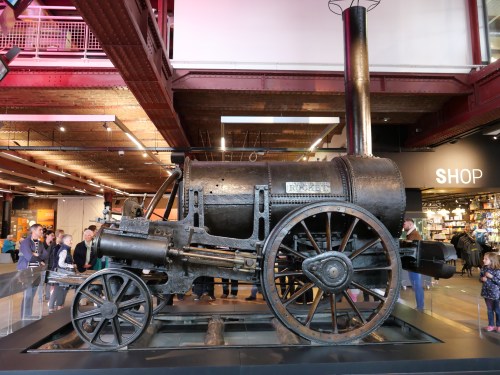
At the same time, I could see in front of me, Stephenson’s “Rocket”, and that was exciting.  Better still, there were only 1 or 2 people looking at it, so it was possible to get up close or more distantly, to examine it and take photos.

But there was a large crowd on the other side of the room, where the noise was originating.  I was informed that it was “a history of industry in Manchester” lecture, with sound effects and a live performance directed at kids.   Fair enough I suppose.  That sort of presentation might introduce kids to science and museums.  But I am skeptical.  More likely it is an introduction to entertainment, and not much to do with science or industry.

So, I made the most of it and spent quite a while examining Rocket and taking photographs from every angle.  Photos later.

Then I changed buildings to see the Power Hall exhibition of industrial steam engines.  This was the second major reason for my visit to Manchester.   But the Power Hall was closed!  “Temporary” said the sign.  “For one year” said the attendant.  Bummer.

Had a look in the “Air and Space Hall” and was impressed by the size of the twin rotor helicopter, and some other interesting old string and rag airplanes, but that is not really my thing.

Anyway, back to “Rocket”, which you know was the winner of the 1829 Rainhill trial, to pick a locomotive design which would be used to power a railway line between Manchester and Liverpool.  I had seen a replica of Rocket at York.  But this is the real one.   It is almost 200 years old, and it looks the part.  The timber bumper slab has partially disintegrated, and it is likely that some parts have been upgraded.  But those changes are now part of history.

Rocket side.JPG

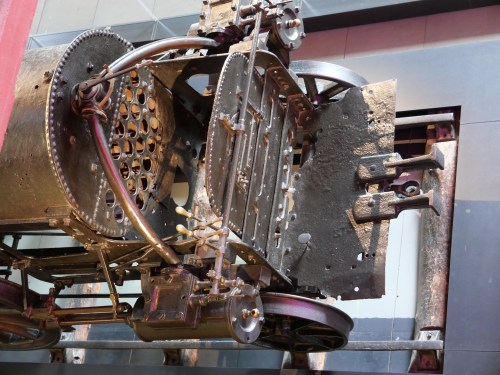
The firebox water jacket is missing, causing the incomplete appearance.  Wooden front wheel, with iron rim.  Cylinder is horizontal so this is mark 2 or later.

Rocket firedoor.JPG

Rocket firedoor

Rocket firebox top.JPG

Firebox without copper water jacket, from the top

Rocket side2.JPG

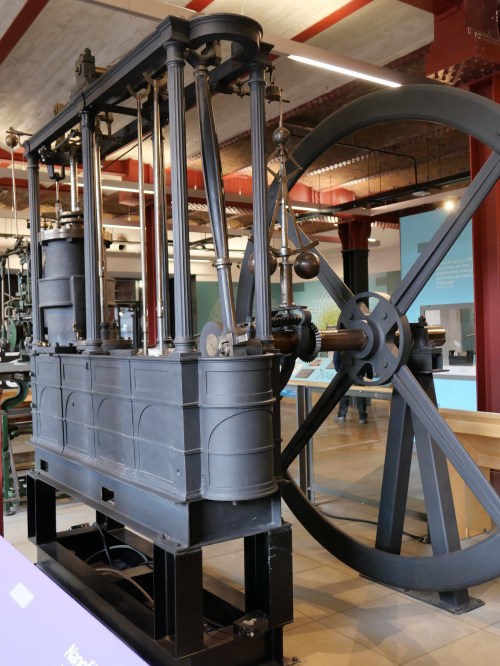
The only other steam engine on display, (because the Power Hall was closed), was this very elegant beam engine.

Beam engine unlabelled

The flywheel must be 8′ diameter, which makes it a tall, thin machine.  I do like the fluted columns, and symmetrical entabulature.

Beam engine cylinder end

Now, that would make for an interesting model.


Pontefract. Where playing around can cost your head.

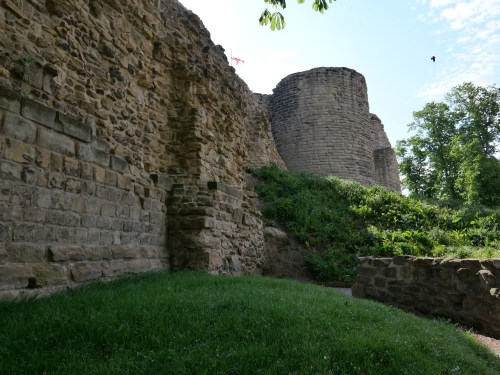
Catherine Howard, Henry VIII’s 5th wife was beheaded in 1542 because she had an affair with Thomas Culpepper in this castle.

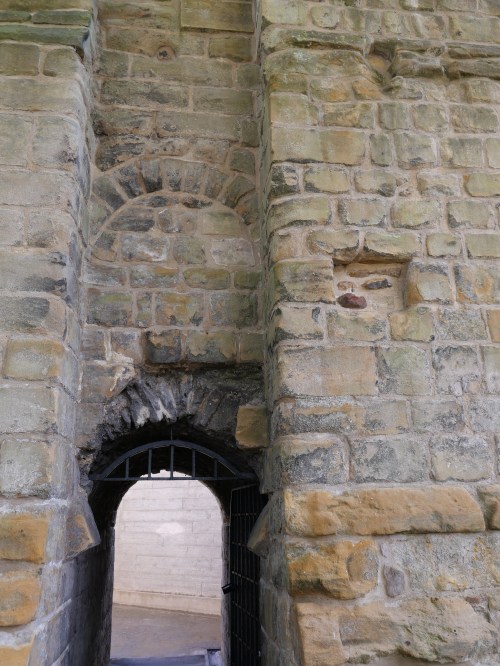
The castle, the second strongest in England, after the Tower of London, and considered impregnable, because it is built on rock at the top of a hill, was actually captured during the civil war by the roundheads.  The roundheads had learned that officers of the castle garrison were trying to buy beds.  So some of the roundheads got access to the castle by pretending to be bed merchants, and the castle was taken.

After that the castle was demolished, encouraged by the locals who were fed up with being the target of many armies.

P1011233

Not much of the huge castle remains

P1011234

There are 3 cannon ball impact craters in this photo.

P1011237.JPG

Is that a nuclear power plant?

Pontefract is mainly infamous because Richard 2 was murdered here.  A red hot poker allegedly.

Then, after this cheery history lesson, I drove on through the beautiful country of the Derbyshire Dales.  Winding roads.   Deep rocky gorges.  Open fields with stone fences.  To my destination of The Anson Machinery Museum.  This is a smallish museum, recommended by a Melbourne colleague (thanks Ian, if you are reading this), but containing some absolute machinery gems.  Many photos, but I will show just a few.

P1021311

It must be 5-6meters long


P1021312

Ah.  This looks like my sort of museum!

P1011259.JPG

WTF?  ” A single cylinder, double acting wall engine of 1800.  Note the parallel motion bars, designed to (successfully) circumvent James Watt’s patent.  The gothic arch surrounds are actually steam pipes.  About 5″ tall, plus a large flywheel (partly seen).


P1021304.JPG

The beam engine stands about 5′ high.  Made by Fowlers of Leeds 1872.

P1011270.JPG

And my personal guide for an hour or two,  an expert steam head, Geoff Baker.

P1011284.JPG

And just feast your eyes on this beauty!  It is a compound twin, about 3’6″ – 4′ tall.  The propulsion engine for a 63′ torpedo boat 1880.  Not yet formally displayed.

P1011291.JPG

This is a compound twin from a paddle steamer,  a rich man’s toy.

There were many more engines, including a huge atmospheric engine, a very large compound twin horizontal mill engine, which was difficult to adequately photograph, many oilers, diesels, a steam driven workshop, a steam driven hammer.  A really interesting smaller museum in a beautiful country location.


National Rail Museum, York, UK.

I am not really “into” trains.  More a stationary engine enthusiast.  But so many readers and friends advised me to not miss the Rail Museum at York that I went today, with my local guide and blog reader, Jennifer Edwards.  To my surprise, Jennifer had not previously visited the museum either.

The museum is located outside the city walls, (the longest city walls in UK), and next to the railway station.  Parking was easy, but not cheap.  $AUD20, which seems to be the standard parking fee in many UK places.  But entry to the museum was free!

There are 3 big halls and an outside area.  The first hall contained a number (didn’t count, but maybe 8) of complete trains with carriages, including a couple of royal trains, with monogrammed carriages, double beds, elegant dining tables with fine china and silverware.  The paintwork gleams.  The metal surfaces are polished.  Altogether a magnificent spectacle.

P1011097.JPG

Express passenger locomotive nicknamed “Spinner”, 1890-1920.  Average speed 60mph, maximum 90mph.  (we could use some of these in Oz)

For some inexplicable reason I did not photograph the royal trains.

The next building housed the interesting locomotives.

P1011112.JPG

This is KF7, the largest loco in the collection.  Designed for use in an area of China with steep hills and weak bridges.  The weight was spread over many axles.  Jennifer is 5’6″ 

P1011124.JPG

This is a replica of Stephenson’s Rocket 1.  It is particularly interesting because many covers have been sectioned or removed, showing the innards.

P1011130.JPG

This section shows the internal structure of a power cylinder and D valve.

P1011126

And the multitube boiler.

I took many photos.  This is showing just a tiny fraction of them.

P1011154.JPG

And, of course all steam engine buffs will recognise the fastest steam locomotive in the world.  Mallard could reach speeds of 126mph (203kph), towing a full complement of carriages.  Not bad for 1938

P1011149.JPG

Guided tour of Mallard controls

P1011165

Magnificent green livery.  Did not record engine details.

P1011182

And this was a full size locomotive, found in a scrap yard and beyond restoration, so it was sectioned to display the workings.  Quite fascinating.

P1011191.JPG

The “Agenoria” 1829, reminded me strongly of Trevithick’s designs.  The info says that the designer,  John Rastrick, had worked with Trevithick.

P1011194.JPG

That boiler end, firebox door, water level taps and square nuts could be straight off the Trevithick dredger engine.

We did not see the last areas, because after 4 hours or so, we two seniors had aching joints.   Nice to leave something for the next visit.

Thanks guys, for a wonderful recommendation.

If you have not seen this museum, definitely add it to your bucket list.

And sincere thanks to Jennifer Edwards, fellow model engineer,  for being great company over the last 2 days.

P1011088

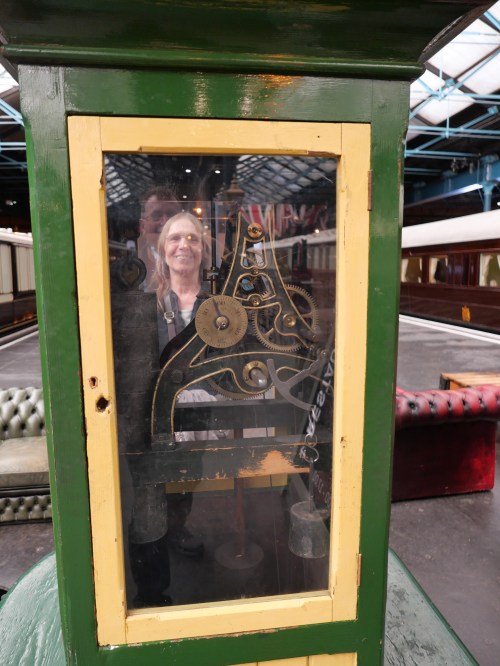
Jennifer collects clocks, as well as boilers and steam engines.  Here she is admiring a railway station pendulum clock.


The Most Powerful Steam Engine in the WORLD (?).

Excluding nuclear powered steam turbines and some others.  But 12,000hp is not to be sneezed at.

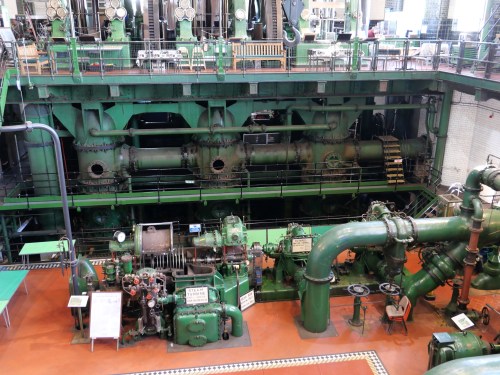
At Sheffield’s  Kelham Island Museum  we (Jennifer Edwards, a blog reader of johnsmachines.com, and I), saw a steam engine which was big, but not as big as the triples at Kempton.  So how can it be “the most powerful etc”.

Well, it is a triple, but not a compound triple.  It is a simple triple.  Double acting.  so each cylinder puts out power like it is the HP cylinder of a triple expansion engine.  It must be a prodigious consumer of fuel and energy.

Why so much power requirement?  Well this engine was used to power a rolling mill, to curve the armour plating of battleships.  Plates up to 16″ (400mm) thick.  The steel was red hot while this was being done, and the plate was rolled back and forth until the desired curve was reached.  Several re-heatings of the plate was required until the desired curve was achieved, so it was important that as many passes as possible were done in the shortest time.  So this engine is capable of full power reversals, very quickly.  Unfortunately there was insufficient room in the museum to fit the rolling mill.

P1010985.JPG

This large crucible sits at the Museum entrance.  (Jennifer for scale.)

And we saw that happening today.   It was very impressive, and apart from some clanking of the huge spur gears, very quiet.

P1011023.JPG

Cylinder bores 40″,  stroke 48″, installed 1905, used until 1976.

P1011059.JPG

50 ton flywheel

P1011011.JPG

And pinion

P1011024.JPG

Reversing gear

P1011003.JPG

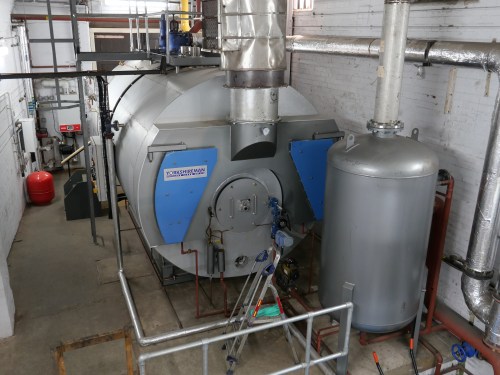
Current modern boiler is no match for the original 10 Lancashire boilers.


The demonstration lasted only 3 minutes, before the large gas fired boiler ran out of steam at 100psi.  And they had been heating the boiler since yesterday.  Under industrial use, 160psi was used.

Jennifer is trying to obtain some plans to model the engine.  Hmm…I might have discovered my next model too…

Harrison’s Clocks

I have seen these famous clocks in the past,  before I had read “Longitude”.  But now, knowing how incredibly important it was to have an accurate marine chronometer, and knowing the story of how a carpenter, John Harrison, invented, developed, and made the world’s first accurate marine chronometers in the early eighteenth century, I could not miss the opportunity to revisit the Royal Greenwich Observatory, on my visit to Greenwich.

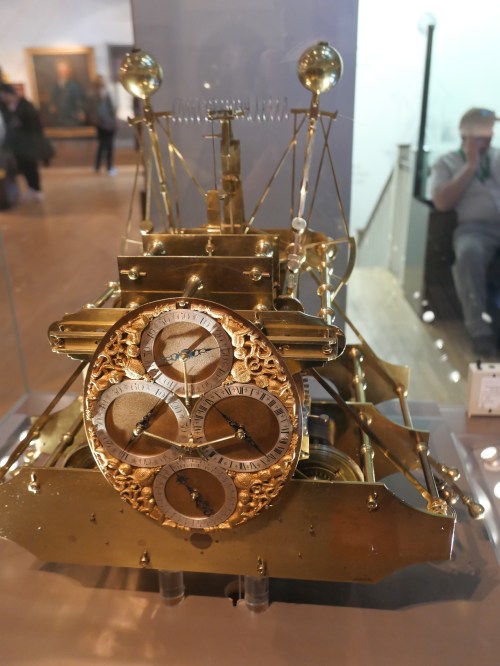
Amazingly, 3 of the 4 clocks are still working accurately.  I am not sure why the final, wonderful, Harrison 4 is not working.  That is the clock which finally made Harrison a wealthy person.

P1010903

Harrison 1.  Intriguing mechanism, but had wooden gears and other wooden parts, and was not quite accurate enough.  It weighs 30kg.


P1010901.JPG

Harrison 3.  More compact.  All brass gears and shafts. No bobbing pendulums.   Still heavy, but a bit less bulky.  19 years in development, and still not up to scratch according to Harrison, who was probably a bit OCD.  One aspect which really impressed me with these clocks, was the incredibly high standard of metal work and metal finishing.

P1010908

Harrison 4.   Like a big pocket watch. But won him the prize, and made him a very rich man.  Unfortunately Harrison died not too long after winning the prize.

P1010907

John Harrison with his final chronometer.  And a picture behind him of number 2 (I think).  (Actually H3)

The board which was determining whether his chronometer (number 4) was worthy, dallied and prevaricated to avoid paying Harrison the 20,000 pound prize.  Fortunately, King George 2 intervened and took up Harrison’s cause, and eventually he was paid a total of 23,000 pounds, which made him the equivalent of a modern multi millionaire.

His Harrison 4 kept time on a moving, rocking ship, within 1 minute in 90 days, which was a quantum leap in accuracy, and resulted in vastly more accurate navigation, and saving sailors lives.

“Longitude” is an excellent read.  And seeing these timepieces in reality, was an experience which I will not forget.

Another 1000 ton Machine

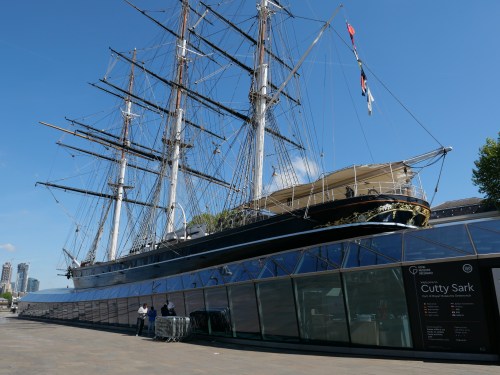
I saw Cutty Sark for the first time 40 years ago, and was transfixed by its beautiful lines and fine workmanship of construction .

Like most people I was devastated when it was severely damaged by fire in 2002 (or was 2007?  I can’t remember.  Anyway, they spent a lot of money and time repairing the damage.  And I revisited it today.

What the Cutty Sark Trust has achieved is nothing short of remarkable.

P1010809

Today, when I first saw it again, I thought “what is that strange glass structure around the hull?  Are they trying to do something modern and arty?”   The masts, rigging and hull otherwise appeared to be unchanged.

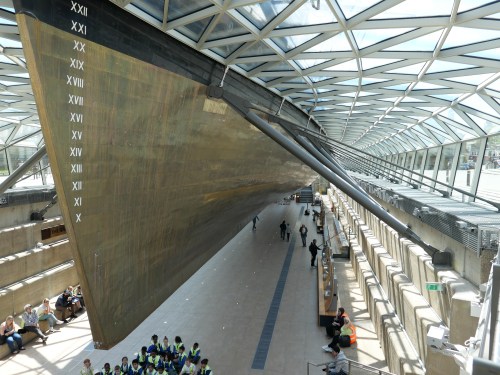
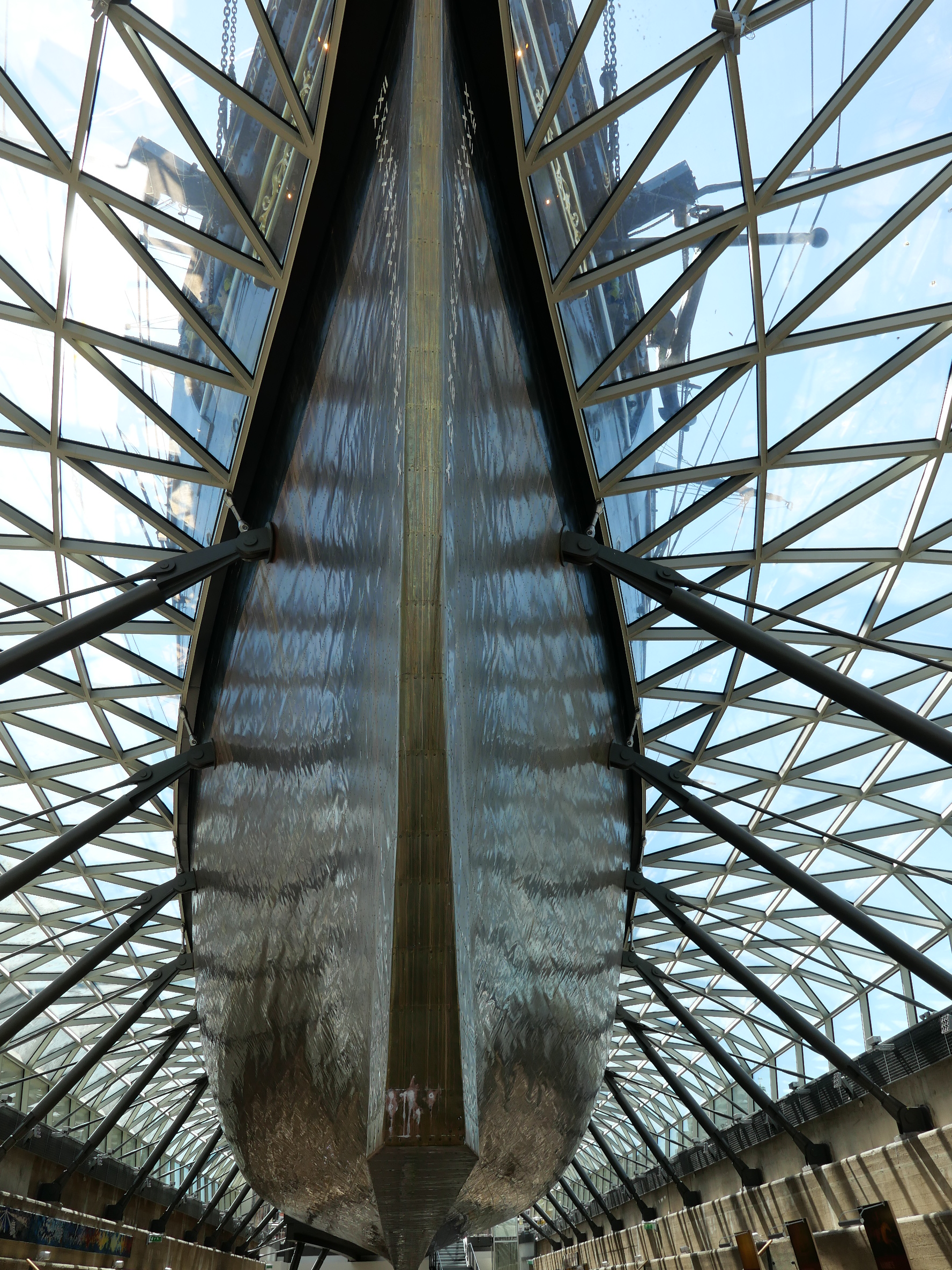
Then when I paid my money and went through the entrance… 1. I felt poorer.   The entrance fee was $AUD 54 for Cutty Sark and the Greenwich Observatory.  2. I was astounded to see that the entire ship has been lifted off the ground by ~2.5 meters, and is supported by 24 large steel props.

P1010836

P1010837

P1010838.JPG

It really is spectacular.  The fine lines of the hull are absolutely stunning from beneath.  And it has removed pressure from the ageing hull structure, which was sagging from its own weight.   The metal sheathing is Muntz metal, an alloy of copper, used to prevent barnacles and algae from attaching to the hull and slowing the ship speed.  I am unsure whether it has been renewed, or just polished, but as you can see it is gleamingly beautiful.

And speed was what this tea carrying cargo ship was all about.  Each ship load of tea was worth about 6 million pounds, and there was huge competition between the clipper ship captains to be the first home to England with the precious cargo, to get the best prices.

This greyhound of the seas regularly hit 20 knots, and on one voyage from China, averaged 17 knots. (20 knots = 23 mph = 37 kph).  Remember, this is a sailing ship.  Many modern cargo ships would struggle to reach that speed.

P1010813.JPG

The hull consists of 4″ thick planks, sheathed with Muntz metal, attached to steel ribs.

P1010814.JPG

Inside the hull, showing the iron frame.

P1010817

The lowermost section of the masts is rolled and riveted steel.  Wood above that.

P1010824

The masts and rigging are as I remember.  Extremely complex and purposeful.

The intricate woodwork in the captain’s cabin and officers areas, the precisely made steering mechanism, the brass fittings are all as I remember.   This really is a beautiful machine.

P1010827.JPG

The steering mechanism.  Left and right hand square thread.  Precision metal work.

P1010830.JPG

And there is a working model of the steering mechanism to demonstrate how it works, for those people who cannot figure it out for themselves. (like me).


Big Triple Expansion Steam Engines

I knew that the triple expansion engine at Kempton Pumping Station would not be steaming today, but I wanted to see it anyway.

P1010794

It is sited next to the Thames, and pumped water from the river up to a holding reservoir.

As I walked to the building I could see the outlines of the huge engines through the windows.

But it was closed!  Damnation!

But, a kind volunteer, hearing how far I had travelled, let me in, and gave cart blanche to wander at will.

P1010716

There are two of these 63′ high monsters.  This one has been restored, and is run on steam occasionally, after the boilers have been lit for 48 hours.  The other engine is currently being restored.  The crankshaft of the second one was rotated with the barring engine about half a revolution, after no use since 1985.  Of course it is a triple expansion steam engine, and it now is run on a newish boiler which is gas fired.  Unfortunately the old Lancashire (?) boilers were scrapped.

The interior of the building is also interesting.  The walls are glazed bricks which look like tiles, and there is a 20 ton gantry crane.  The engines weigh 1000 tons each, so must have been assembled on site.

P1010736.JPG

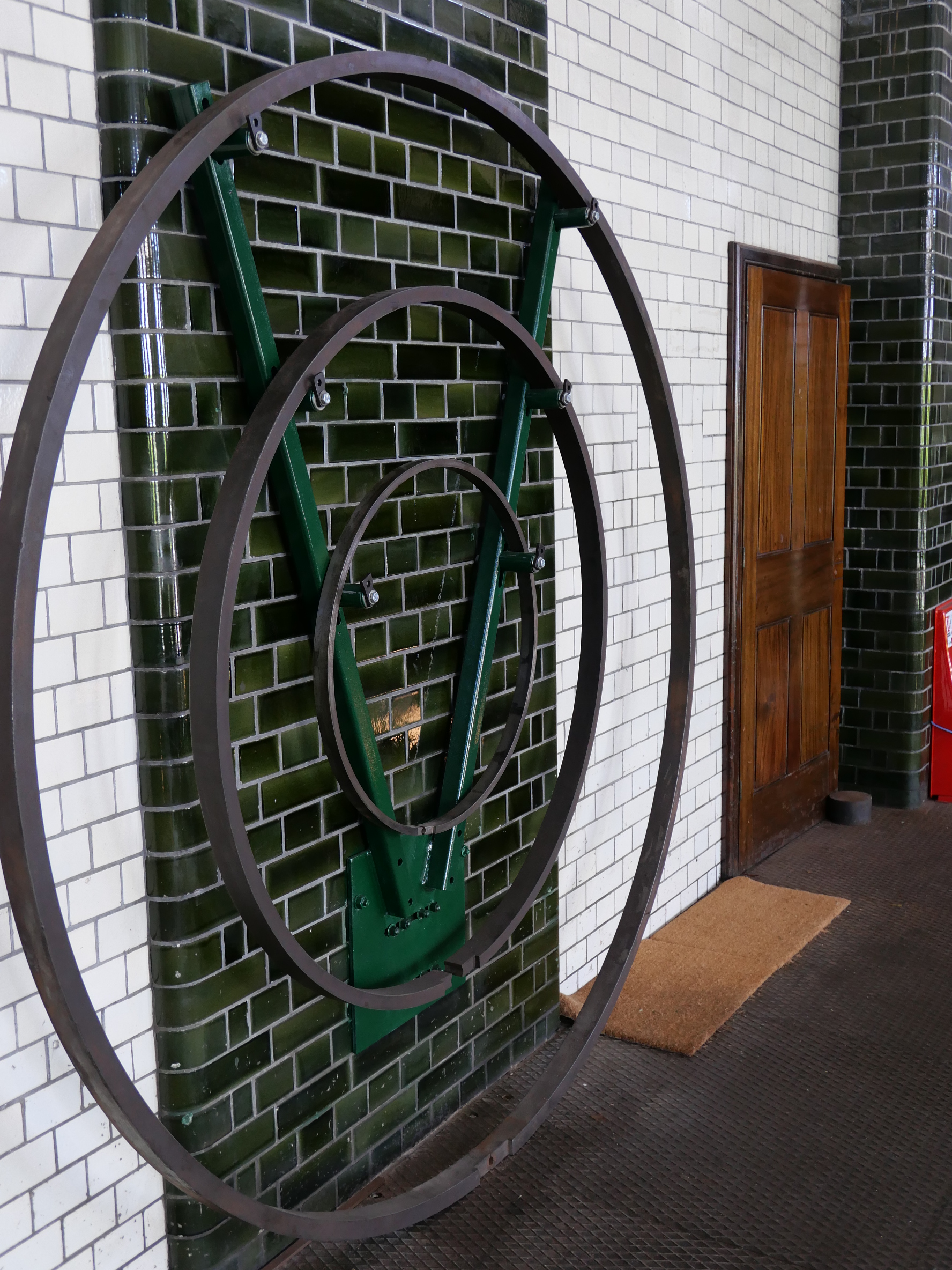
The walls are glazed bricks.  Note the piston rings on the walkway.

Below the engines are huge water pipes, pumps and valves.

P1010734

The space between the triples is occupied by two steam turbine driven pumps, about which more in a later post.  The space was originally intended to be occupied by another triple, which never occurred.   Interestingly, the triples are mirror images of each other, rather than identical, which means that a lot of components cannot be interchanged.  It probably made the plans more symmetrical and elegant.  Very British I suspect.

P1010740

Hey, that’s me.  In my tourist hiking gear

P1010743

Overall engine height 62 feet (18.9 meters)


P1010725.JPG

Monster big ends and cranks

P1010731

HP gauges.  Beautiful artwork hey Frank?!

P1010722.JPG

And aren’t those column bases works of art?

P1010726

Barring engine.  Steam powered

P1010733.JPG

Those are my fingers against the flywheel, and teeth for the barring engine.

P1010751

One of many oil distibutors

P1010758

Right on top of the LP

P1010745.JPG

Piston rod and crosshead

P1010778.JPG

On top of the world

P1010776

Looking down to a big end and the crankshaft

P1010771.JPG

Big machines need big nuts

P1010747

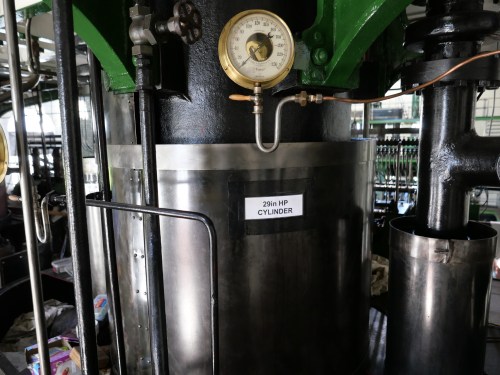
The HP cylinder

P1010741.JPG

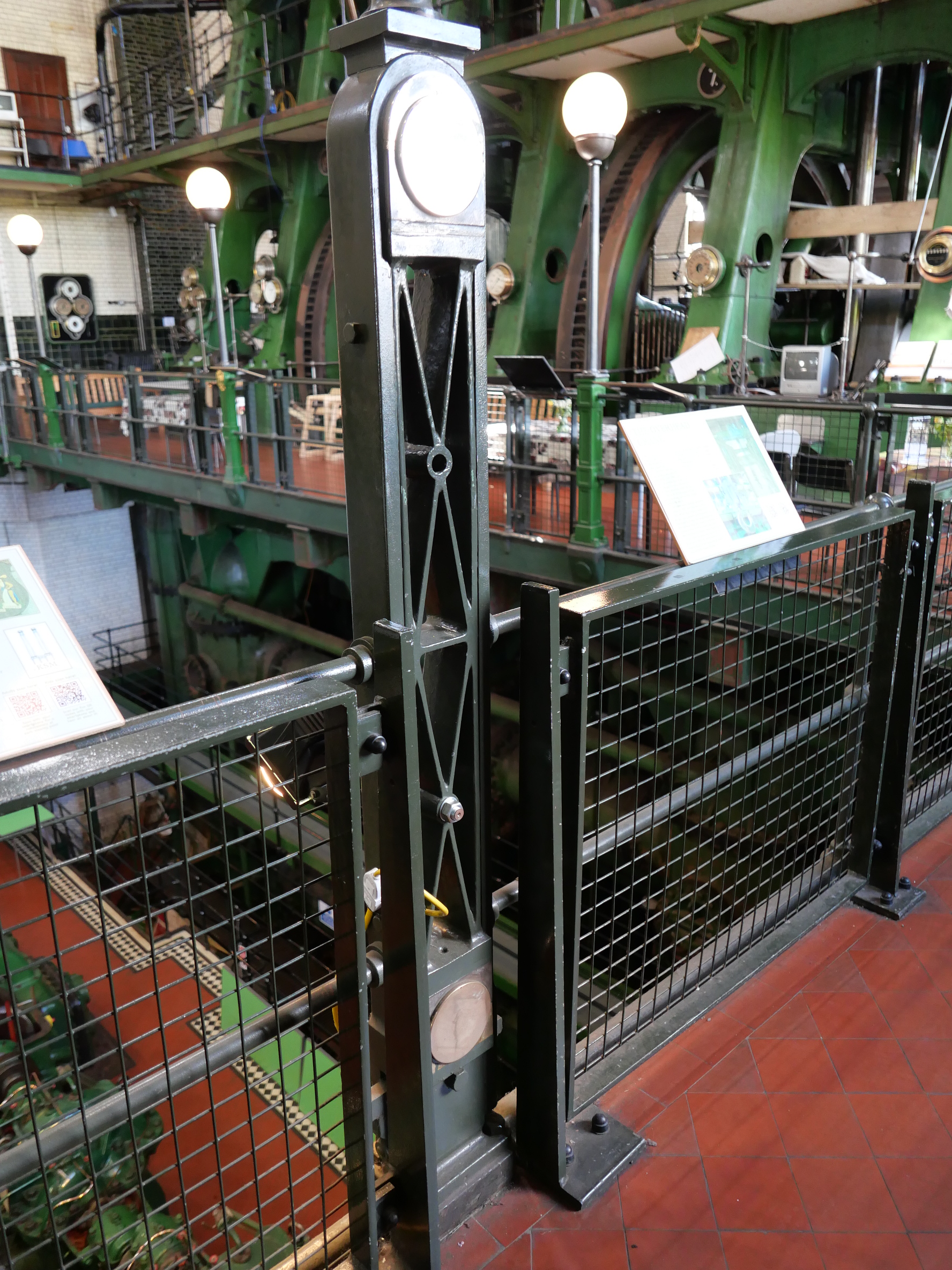
A volunteer pointed out that some of the safety fence posts are recycled Boulton and Watt parallel motion bars!

P1010728.JPG

check out those cylinder diameters and clearances!

P1010763.JPG

Spare piston rings

P1010766.JPG

Piston ring, my finger

P1010764.JPG

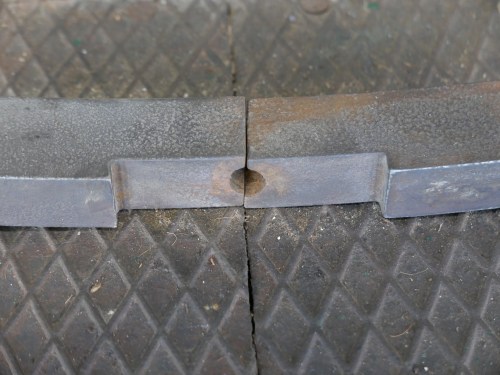
Piston ring join.

I am rapidly running out of posting space, despite many more pics.  So I had better pause.  I didn’t get to the turbine engined pumps.  But I have many more photos…

Let me thank the very kind volunteers who spent time with me to talk about their engines at Kempton.  A marvellous experience.  I must return one day to see them under steam.

Trevithick Dredger Engine at The London Science Museum

I landed at Heathrow at 6am, dropped my bags at the BNB, then caught 2 buses to the Science Museum.  Not jet lagged, but on a high, to see the only intact Trevithick Dredger Engine known to exist.

The room which houses the Trevithick, also contains 4 large beam engines, a Parson’s turbine (of “Turbinia” fame), and a very large 2 cylinder compound.

Disconcertingly, the first atmospheric beam engine, with wooden beam, was partly obscured by a souvenir stall and racks of clothes for sale.  WTF!   Don’t they realise the historical importance and rarity of these engines.  And 3 further moans, to get them out of the way.   The descriptive labels on all items had minimal information.  Nothing like dimensions, power, etc.  The attendants knew virtually nothing about the engines.  And often, items were behind glass or perspex which was reflective, and prevented good visualisation or photography.   To be fair entrance was free, but to get past the entrance desk it seemed pretty clear that a “donation” of 5 pounds was expected, (which I was happy to contribute).   Those complaints aside, I have to say that the collections were fabulous.

I could see the Trevithick at the far end of the room, so to curb my mounting excitement, I forced myself to not rush up to it, but to try to look at every exhibit on the way.

Eventually I was there and it was there in front of me.

P1010346.JPG

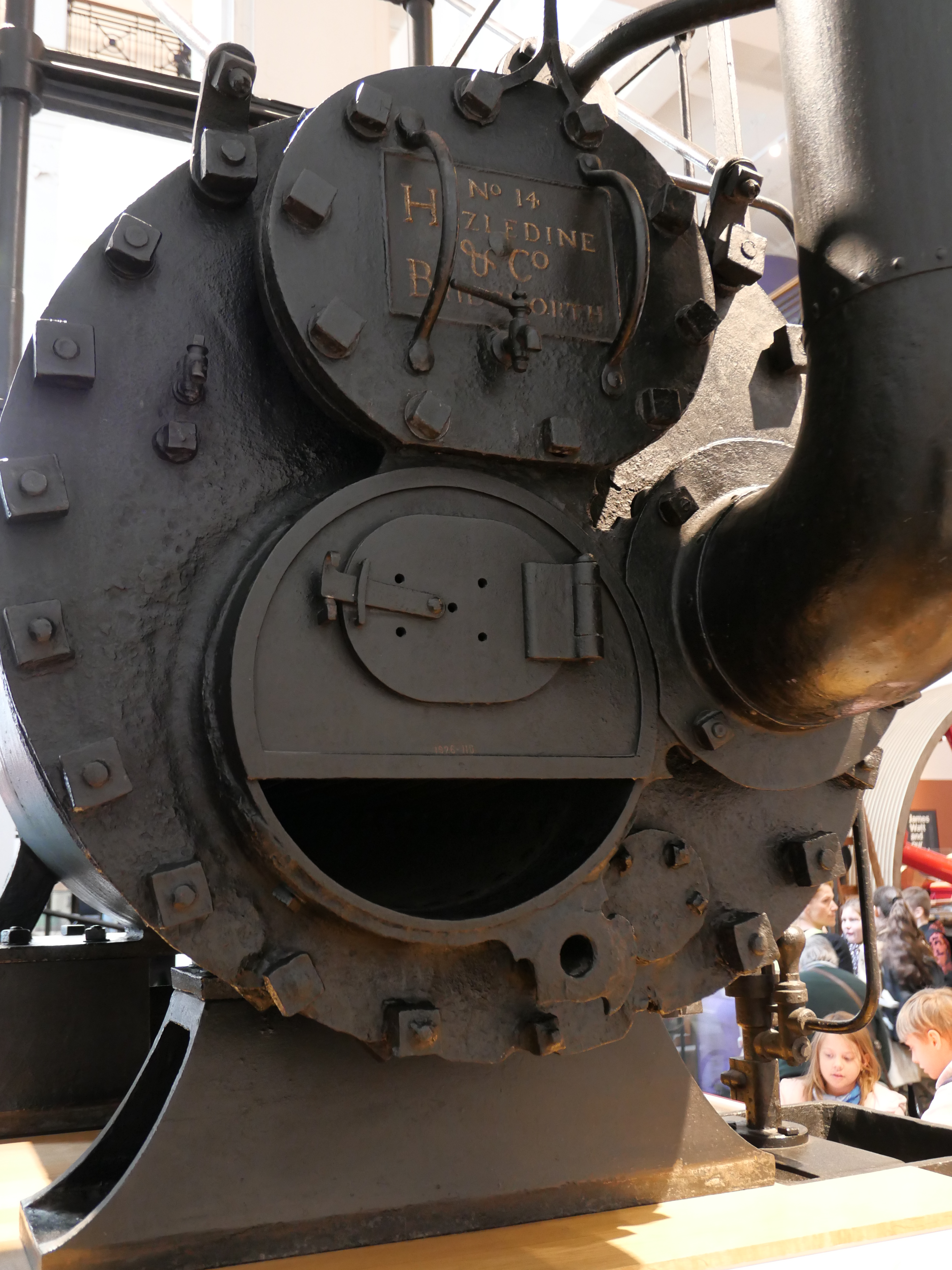
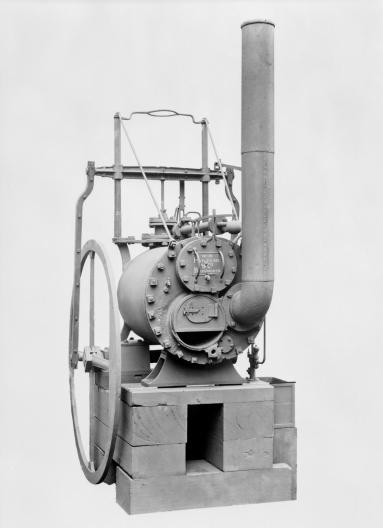
It was one of the smallest engines in the room (The “Energy” hall).  The older beam engines were many times larger, but that was a major reason this engine was so successful..  more power, lighter, smaller, and several times more efficient at converting coal to rotative motion.  No one could tell me why there is a huge divot in the cast end of the boiler.

The con rods, stands, standard cross tie, and chimney are not original, but were added when the engine was restored in ~1875.  But that is now part of its history.

P1010330.JPG

P1010339.JPG

P1010341.JPG

From that side it was apparent that the main shaft was square over its entire length, something not previously known to me.

P1010335.JPG

The boiler feed pump was relatively tiny.  I do not know if it is original.

P1010331.JPG

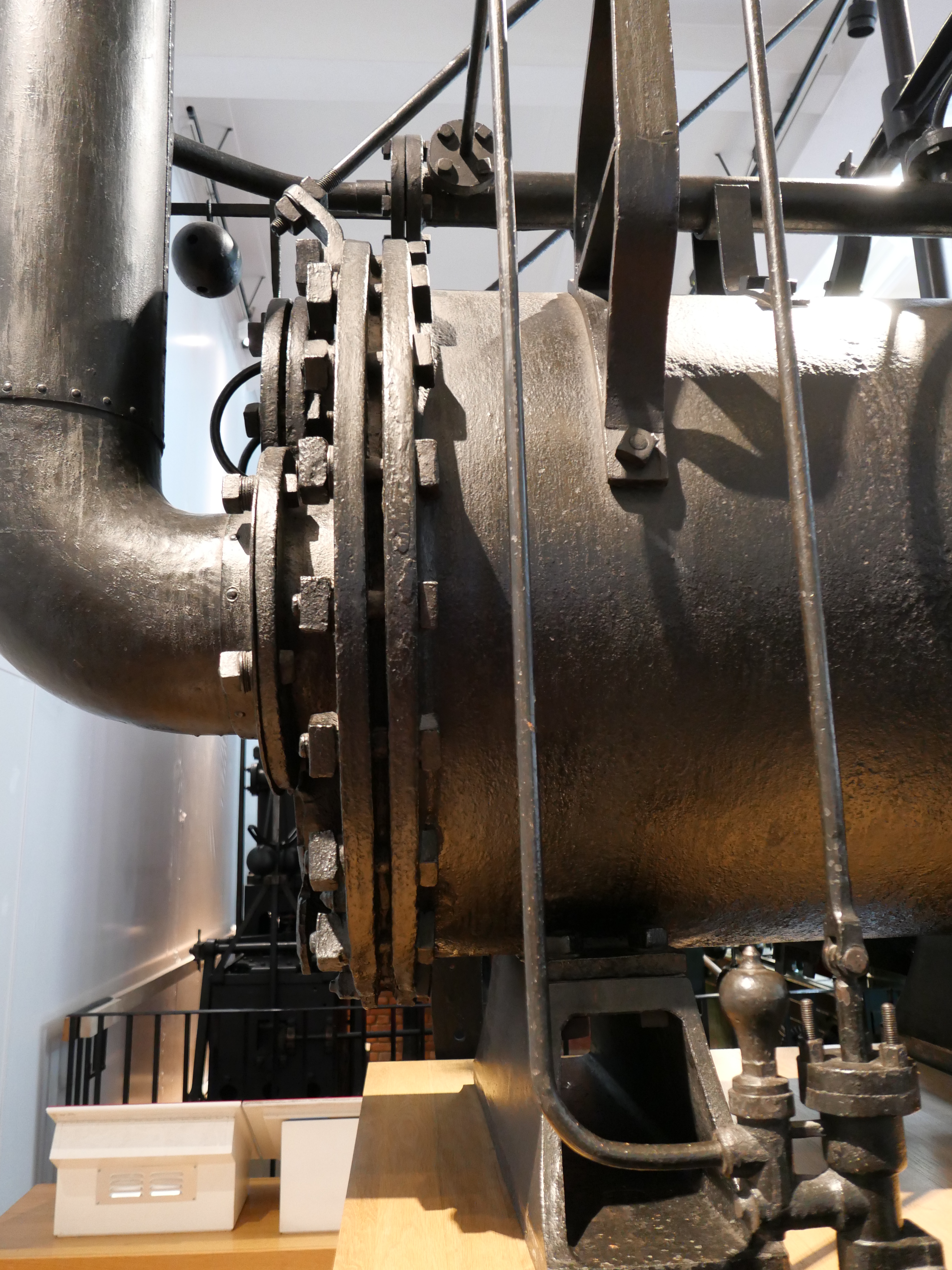
The firebox has been re-sleeved.  The chimney mount is part of the end plate casting.  And I think that I got most of these items pretty close to right on my model.  Does anyone know what the incomplete flange at 5 0’clock would have been for?

P1010332.JPG

Note the odd bolt pattern around the inspection hatch.  I got that wrong.  My change to the oblique slide rod stay angle brackets was correct.

P1010333.JPG

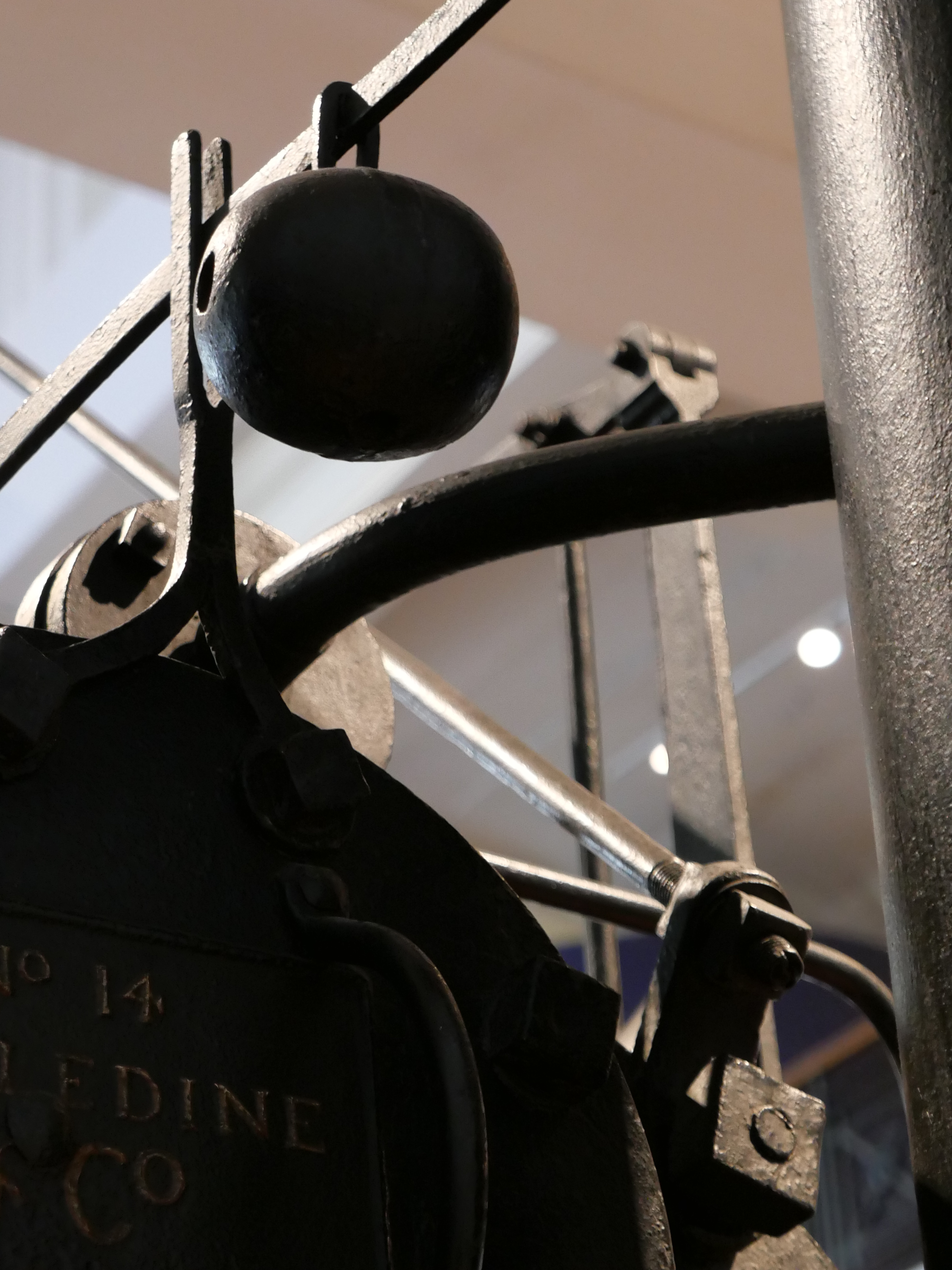
safety valve weight is adjustable.

P1010338.JPG

Water preheater pipe detail.  Aren’t the square nuts great!

P1010350.JPG

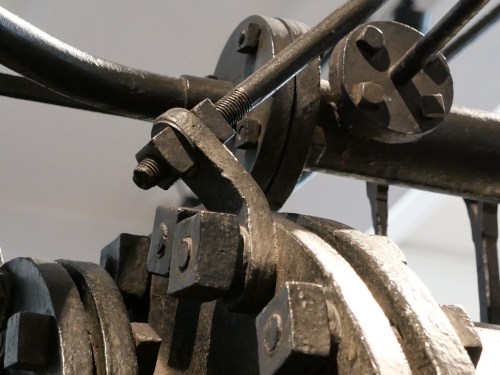
The throttle restraints are curved, and have fixed position holes for pins.

P1010336.JPG

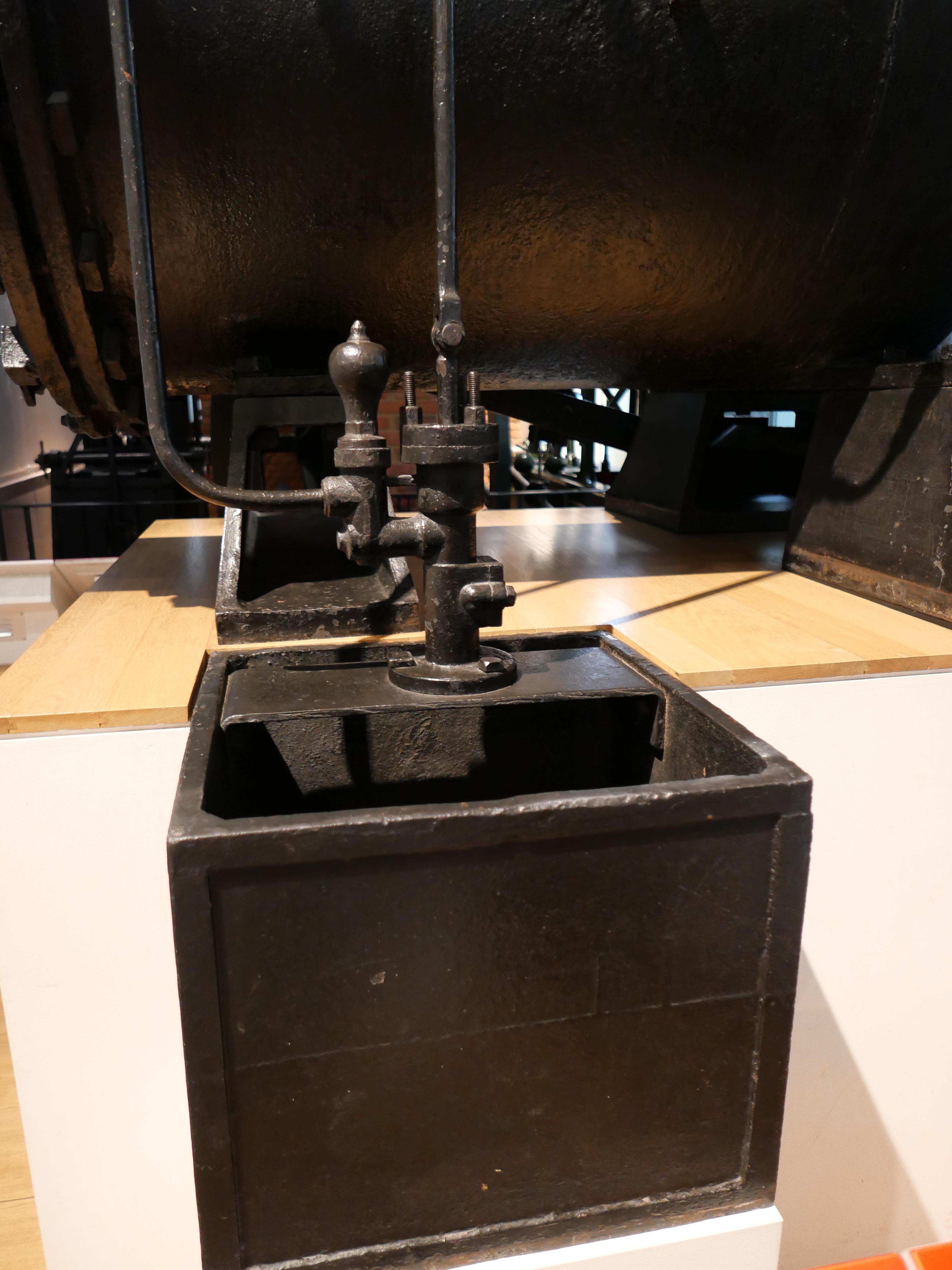
Boiler feed tank.  Cast iron.

P1010356.JPG

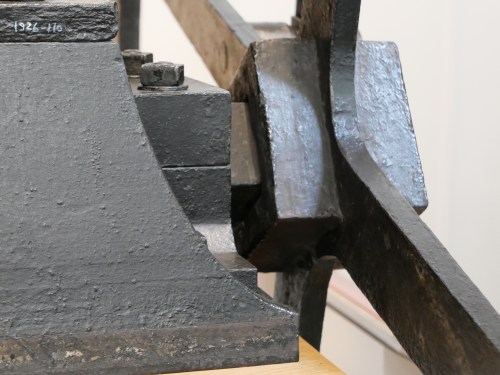
Engine supports appear to be cast integrally with the boiler.

P1010354.JPG

Flywheel hub

P1010362.JPG

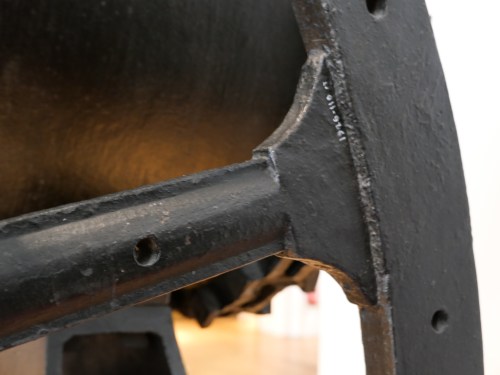
Flywheel spoke detail.  Likely original.

P1010370.JPG

Chimney mount detail

P1010462.JPG

Finally (although I do have more photos), a nice view from above.  I do like the crosshead shape.  I wonder if it is original.  Remnants of another Trevithick dredger engine  not currently on display, reveal a wooden crosshead beam.

So there you are.  Fascinating to me.  Interesting enough I hope to you.  I could see no evidence of wooden lagging at all, but i still intend to install some on my model to slightly improve its efficiency.

i have heaps more photos of other exhibits which I may post later.


Broken Lathe Gear – Update.

I searched the lists of stock spur gears from international suppliers but I could not find a supplier of a 77 tooth, module 3 gear.  77 teeth is apparently unusual.  Plenty of suppliers for 76 and 78 tooth gears, but none for 77.

I did find an Ebay seller who had some old new stock of rotary HSS gear cutters and I  considered making a new gear.

But meanwhile, after airing the situation at a GSMEE meeting, I had a recommendation to try a local gear maker.   Well, fairly local.   He is 1 hour up the freeway.   But the phone calls were unanswered, repeatedly.  Another fellow GSMEE member also required a gear cut, for a telescope mount (a BIG telescope…. another story), and it was on his route home, so he called in, prepared to bang on the gear maker’s door.    Despite the industrial turn down in Australian manufacturing, the gear maker is so flat out with work, that he has stopped answering the phone.  But he received Frank very cordially, and was also very friendly and helpful to me when I turned up 2 hours later.

I took the broken gear and its shaft, and he is preparing a quote.  His initial recommendation is that the gear be replaced entirely, rather than repaired, or a toothed ring shrunk on.  So I am waiting for the quote.  But frankly, the lathe is unusable the way it is, so I cannot imagine rejecting the quote, unless it is so high that I am pushed back to making a gear myself.  I will post this when I get the quote.   Meanwhile, a photo, and a plug for the gear making business.

IMG_7875.JPG

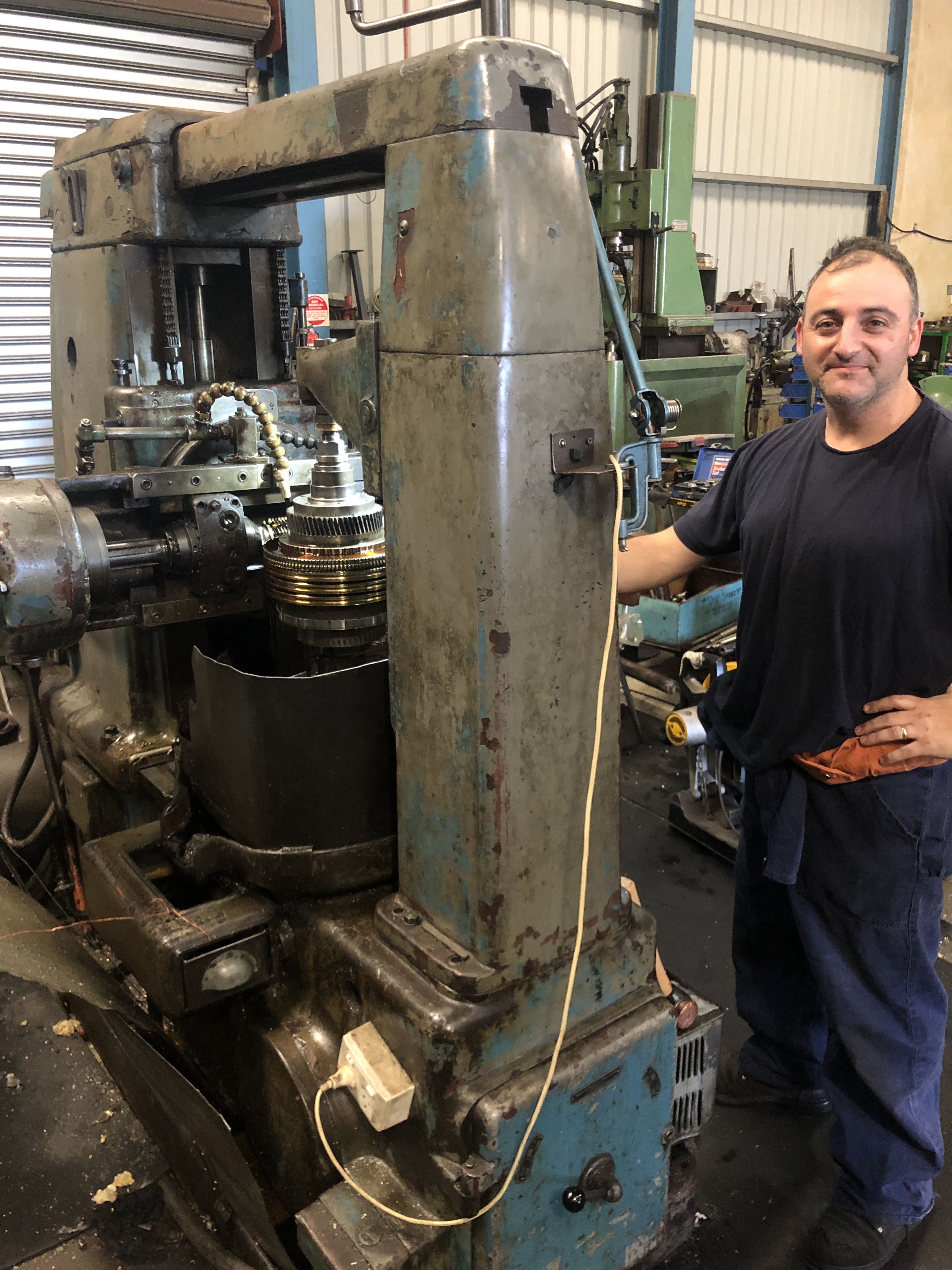
This is Johnny, the owner manager of Sunshine Gears

Johnny proudly showed me around his factory, and we discussed the options for my job in detail.  He has many (~40) gear hobbing machines, lathes, mills, and jobs in progress.  He is just about to get his first CNC machine, a lathe.  The  machine in the photo was making a gear cluster of 6 or 7 different sized gears.

Sunshine Gears is at 14 First Avenue, Sunshine, Victoria.  Telephone 0393117152.   Probably best to just call in rather than telephone.

Post script.   After considering the quotes I have asked Johnny to make me a gear which I will attach to the original hub.  It should be ready for me to pick up when I return from my UK trip.   It saves several hundred dollars to do it this way, rather than getting the entire gear with hub made from scratch.

By the time this post is published I should be in the air…..


OZ to UK

Well, I am off to Blighty tomorrow, to check out the originals of some of the models which I have made in recent years, and to pay homage to Richard Trevithick.

First stop London.  And the first stop in London is the Science Museum, where I will head straight for the Trevithick Dredger Engine.  This particular engine was made in 1806, but was designed by Trevithick several years earlier.  It was used to power a dredger on the River Thames.  Later the design was used to make steam engines to power the mills and factories of industrial England.  About 600 were made altogether, but this is the only surviving intact example, having been found in ~1878, and restored, albeit with some non authentic features.

I am due to arrive at Heathrow at 6am, and I cannot book into my accomodation until 2pm, so I will front up at the museum and put my case into storage while I spend some happy hours with the Trevithick, and browsing some of the rest of the museum.  I believe that the museum also houses a model of the road steam vehicle, which was built by a clockmaker for Trevithick as a proof of concept model.

So my next post here will hopefully include some photos of the above.    It is planned that this will all follow a 22 hour flight from Oz, via Singapore.  Not sure what shape I will be in, but hopefully I will have something to show you.

The next few days in London are planned to include The London Water and Steam Museum at Kewbridge, the pumping station at Kempton, The Crossness Engine at Abbey Wood, HMS Belfast, and maybe a return visit to pay my respects to the Harrison Clocks at Greenwich.  Busy busy!

Then a 4+ hour drive to York.  If I leave early enough I should reach York with enough time to visit the viking museum, and maybe even fit in a visit to the glorious minster.

The next day is scheduled for the National Railway Museum, which I have never seen before, and has been recommended by many bloggers.  And I will be meeting a reader of this blog, who will be showing me around the rail museum, and other interesting sites around York.

And so on.

I hope to be able to post some photos as I progress, but that will depend on Internet connections at my booked accomodations.  All Air BNB.

Later stops will include Manchester, Coventry, Leicester, Swansea, Merthyr Tydfil, Camborne, Dartmouth, Portsmouth.  Each place has been chosen so I can see outstanding museums, engines, mines, historic ships and places significant for Richard Trevithick.

The final stop at Portsmouth was mainly to visit the Fort Nelson Museum so I can see the Dardanelles Cannon close up.  But I will not miss the opportunity to see the Henry 8’s Mary Rose, HMS Victory, HMS Warrior, the submarine museum  etc etc.    Ben L, I will be in Portsmouth Tues 28 May pm until Fri 31 am if you are able to meet, perhaps one evening?

If you are getting the impression that I am very excited about this trip, you are absolutely correct!     John.


MASADA

IMG_7878.JPG

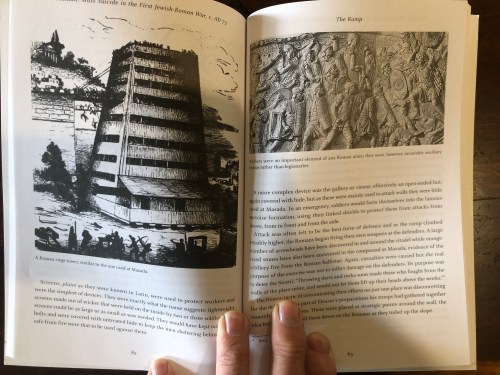
Cover.  Looking down on the modern remains of the Roman camp from the Masada plateau.

MASADA by Phil Carradice

Mass Suicide in the First Jewish-Roman War, c. AD73

This is another title from Pen & Sword in the “History of Terror” series.  128 pages, soft cover.

Masada, in case you are unaware, was a mountain top fortress in Judea, where Jewish men, women and children fought off veteran Roman legions for 2 years.  The traditional story is that facing defeat, the 960 defenders committed mass suicide.

There is only one source for the story, and that was Josephus Flavius, a contemporary Jewish general who was captured by, then joined the Romans.  His information, veracity, motives and biases are therefore suspect; however, some aspects of the story have been validated by modern archeological evidence.

The account of the siege, the defences, the huge ramp which was constructed by the Romans, and the details of the ultimate Roman victory, is compelling, riveting reading. The dissection of the available evidence is thorough, and various alternative possible scenarios are weighed.

Modern use of the Masada story by the nation of Israel is also discussed.

Australia’s worst military defeat (Gallipoli) is our national Remembrance Day. It is telling that Masada, also a defeat, has become the source of national pride for Israel.

An excellent read.

Dr  John Viggers.

IMG_7879

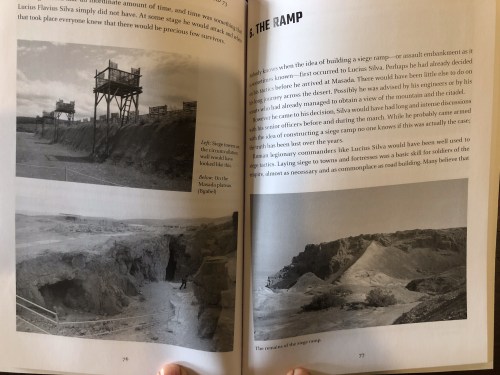
Rear cover photo. Modern remains of the Roman ramp.

img_7880.jpg


img_7881.jpg

And just for some perspective of the site, watch this superb video

A Fraternal Photo

IMG_6836

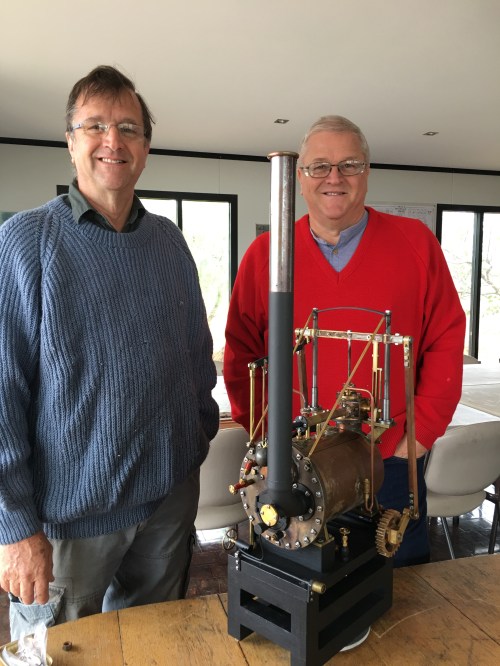
Me and my brother Peter.  No doubting the genes.

My brother also makes steam engines, but he prefers the ones which move on steel rails. Unfortunately he lives a long way away, in the deep north of Australia, so we see him and his wife only once a year or so.

Free History Books

I received this notice from Pen & Sword Publishers today.  I have not tested the offer, but I can vouch for its authenticity.  So if you are into Napoleonic history, and would like some free books (ebooks actually), then go for it!

Good Morning!
This Sunday marks the anniversary of Napoleons death, to coincide with this anniversary Pen and Sword will be giving away four eBooks for free from Amazon. I wondered if you would be able to share this with your readers, if you are doing a post around this anniversary. It’s not often we give away eBooks for free, so I am keen to spread the word as far as possible! Here’s the four eBooks that will be free on the day and the Amazon link to download the titles.
Have fun on Sunday (UK or US timezone I presume)
John

A New Hobby for Metalworkers (a book review)

You guys could consider a new hobby, to balance your personalities, and develop the artistic side of your brains.  (can’t remember which side of the brain that is, but here is my suggestion…)

P1010258.JPG

Hard cover, 120pp, from Pen and Sword Publishers.

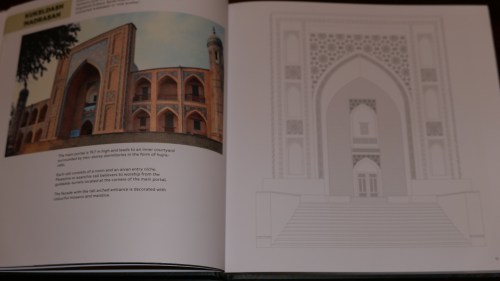
UZBEKISTAN.  AN EXPERIENCE OF CULTURAL TREASURES TO COLOUR

This book was surprising.

I was expecting wonderful pictures of Islamic art from Bukhara, Tashkent, Samarkand and other central Asian cities of the Silk Road.  And indeed, every second page is a full page colour picture of the amazing tile work, mosaics, ornaments, paintings and fabrics from Uzbekistan.

Every other page is a fine line drawing of the corresponding colour page.  What was most surprising to me, is that this is actually a COLOURING BOOK.   The drawing pages are there to be coloured in.

SWMBO tells me this is a common adult hobby, used for relaxation and stress relief, and making beautiful artistic pictures.  Well I don’t see myself swapping steam engine making for colouring-in exercises, but horses for courses.

Whatever, this is a beautiful, large format book, and will be enjoyed by anyone who enjoys the superb, stylistic, Islamic decorative arts.  If stress relieving colouring-in is your thing, well, so much the better.

Dr  John Viggers.

P1010265.JPG

The right hand page is for colouring-in, probably after scanning to art paper.  (might make interesting patterns to CNC engrave too.)

P1010264.JPG


ps.   No luck finding spare gears for the big lathe, but lots of suggestions from my readers.  Thanks bloggers.  I will let you know what happens.


Back in the workshop, a Lathe Problem…

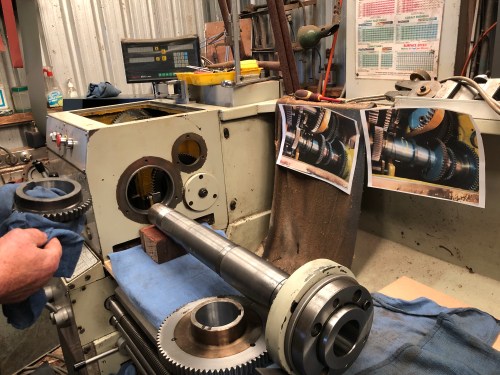
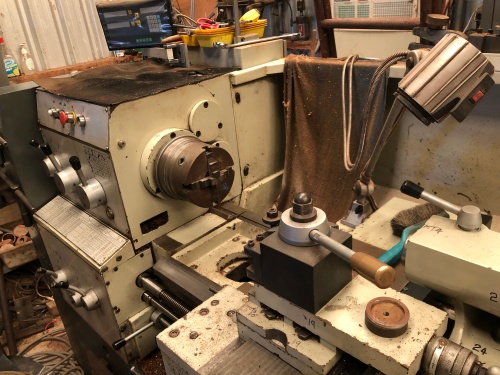
I have a problem with my big Chinese lathe.  I was hearing a KNOCK-KNOCK-KNOCK as the main spindle was revolving at low speeds with one setting of the gears.

It is a GBC 1000-400 lathe, meaning that it has a maximum of 1000mm between centres, and it will turn a 400 mm disk.  It weighs 2 tons.  Has been quite useful when turning flywheels, big lumps of metal, large pieces of wood and so on.

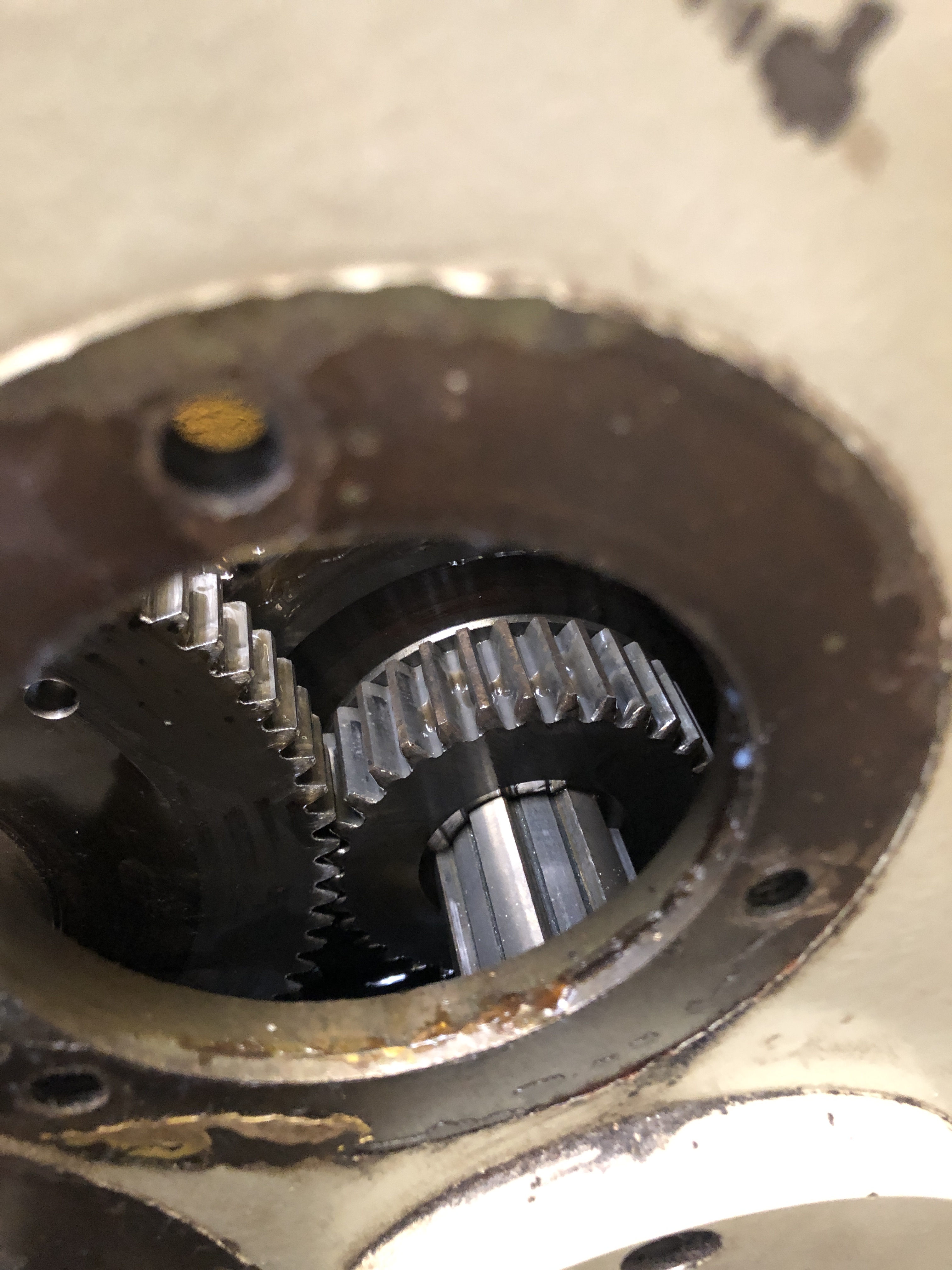
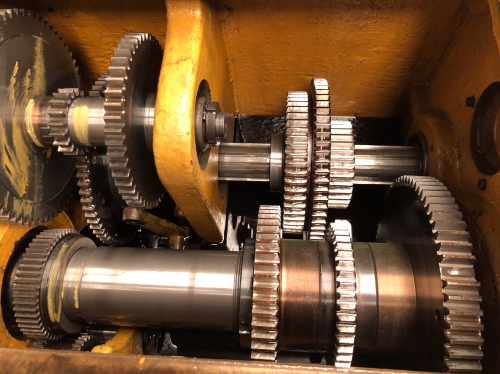
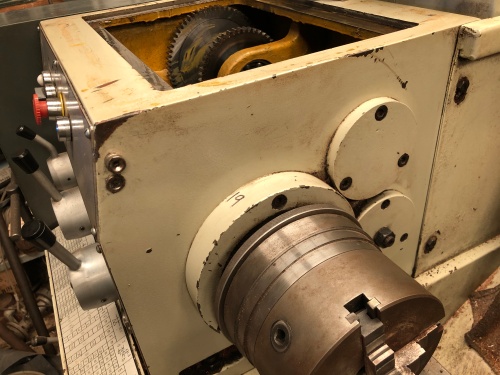
So today I removed the cover from the headstock and had a look.   The cause of the knock was quickly obvious.

IMG_7828.JPG

The headstock of the GBC 1000-400

img_7825.jpg

The big gear on the main spindle at bottom.   See the broken tooth?  The meshing gear is intact.

So, what do I do about this?   I need some suggestions, people.

Thoughts so far….

  1. remove the spindle, remove the gear and bronze braze a replacement piece of steel or bronze, then machine a new tooth.
  2. same as 1, except use silver solder.
  3. same as 1 or 2, except do the job insitu (after draining all of the gearbox oil, and screening off the other headstock parts).  Unfortunately the missing tooth is close to the headstock case, so filing or grinding a new tooth would be tricky.
  4. leave it as is, and just avoid using that gear.  I can do that.  It removes 3 of the 9 gear ratios, including the slowest speed (40 rpm), and is not an elegant, or desired solution.

So what do you think?   The gear is most likely made of steel rather than cast iron, from its appearance.  The base of the break is shiny, smooth and not porous.

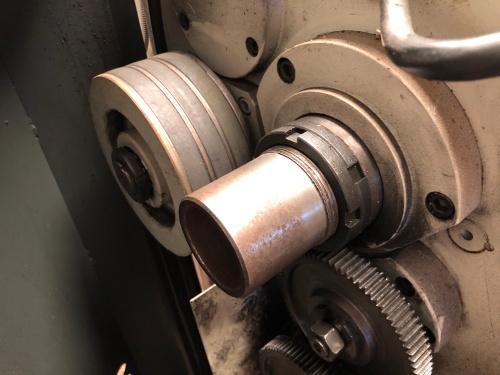
Here are some pics of the ends of the main spindle.   It does not look too complicated to remove the main spindle, but what would I know.

IMG_7827.JPG

The main spindle is the one in the centre.

IMG_7826.JPG

And the other end, with a self centering 4 jaw in place.

I imagine that the main spindle bearings will be pre-loaded, tapered, roller bearings.  I certainly do not want to damage them.  And how difficult will it be to reinstall the bearings and main spindle?   I imagine that it will involve some careful and precise work.   Am I taking on a job which is way beyond my abilities?   If anyone has experience of this task I would be delighted to hear your views.   I have no drawings or plans of the headstock to assist.

(In parentheses, when I was a teenager, I remember my father pulling a Toyota Crown automatic gearbox to bits, identifying a fault, and fixing it.  There were bits of the gearbox everywhere.  But he fixed the problem.  He was not a mechanic, but he had a go at things, and usually managed the task, as in that case.  Similarly, I dont mind having a go at this lathe job, but I would prefer not to risk destroying the lathe, so any expert opinions will be welcome.   Option 4 above remains a possibility.)


The Trafalgar Chronicle

Another terrific read from Pen and Sword!  Particularly relevant for me, as I will be visiting “Victory” at Portsmouth, UK, in a few weeks.

TRAFALGAR CHRONICLE edited by Peter Hore

This is the first volume of articles on the subject of the Georgian period navy, ie. The epoch of Trafalgar, Nelson, Napoleon, 1812 war etc.    The volume contains 17 individually authored articles, maps, quality black and white and colour plates, notes and contributors’ biographies.

p1010181.jpg

For this general reader, most of the articles were very interesting, but some contained a level of detail which would be more of interest to researchers.

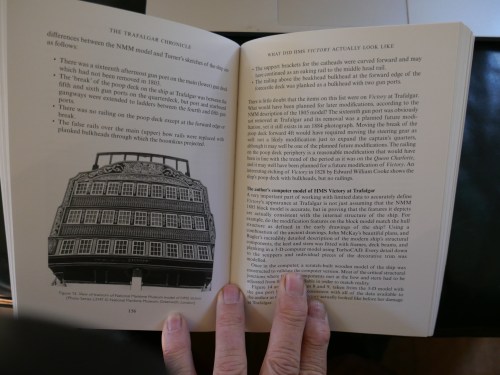
I particularly enjoyed the articles about  the American in The Royal Navy, Frederic Rolette, and Nelson as a junior officer.   I am certain that “Victory” modelers will find invaluable, the analysis in “What Did HMS Victory Actually Look Like?”

The crucial role of James Cook in the conquest of the French in Quebec was fascinating to this antipodean, who was not previously  aware of this period of Cook’s career.

I look forward to further volumes in this series which are intended to be published annually.  (This review covers Book 1 of the new series.  Since I wrote this review Books 2 and 3 have been published.  I hope to review 2 and 3 soon.)

Dr John Viggers

p1010183.jpg

P1010184.JPG

p1010186.jpg

p1010187.jpg

My readers might be wondering why most of the books which I am reviewing in johnsmachines.com are “highly recommended”.  The reason is simple.  The books which I read and decide are crap do not get reviewed by me at all.  The ones which you will see in the blog also exclude those which I have decided are just OK.  The ones which you will read about here are those which I have really enjoyed, like “The Trafalgar Chronicle”.


How the world’s greatest navy was defeated by beginners. A book review.

p1010177.jpg

ROME SEIZES THE TRIDENT by Marc G. DeSantis

This oddly titled book is a most interesting retelling of the three Punic wars, with an emphasis on the contest for naval supremacy.

Carthage was the naval superpower of the Mediterranean, and Rome had almost no seafaring history or capability.  Yet Rome won the naval contest.  This book explains how.  It also explains how the destruction of Carthage was the single most important event in the forging of the Roman empire, yet also planted the seeds for Rome’s eventual fall.

The author includes fascinating information about the design and construction of  galleys, and the financial and manpower implications of the massive undertaking of building a navy from scratch.

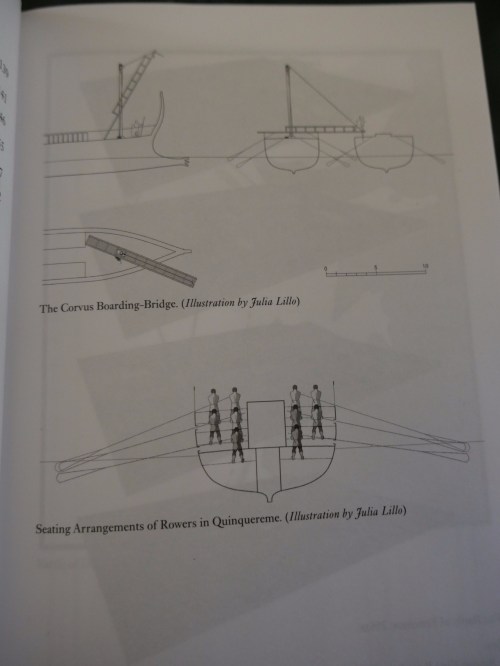
I particularly enjoyed chapter 4 which explained the technology,  capabilities and limitations of galleys, and the implications and risks of various strategies such as ramming.  Rome’s use of the corvus, which permitted the use of its famed infantry in sea battles, provided a technological edge for a few years but was ultimately discontinued, probably due to a resulting reduction in seaworthiness of the galleys caused by the heavy corvus.

p1010179.jpg

The book includes a few maps (too few in my opinion, and not all locations in the text are on the maps) , and diagrams of the likely appearance of the corvus.  It is well written, and appealed to this general reader. It should particularly appeal to students of ancient history, military history, naval history, and ship construction.

Hardback, 253 pages, including notes and references, bibliography, index.  Pen & Sword.

Highly recommended.    Dr  John Viggers.

P1010180.JPG

p1010178.jpg

Early Railways…A Guide for the Modeller (a book review)

When I saw this title from Pen and Sword, I thought “wonderful”.  Anticipating information about the Pen-y-darren railway, for which Richard Trevithick designed the world’s first useable steam locomotive.  I will be staying at Pen-y-darren near Merthyr Tidfil, Wales,  in a few weeks.  I know that little of the coal mine railway remains, but I just want to soak up the ambience of the area.

But to my disappointment, there is no mention of Trevithick or Pen-y-darren in the book.  An astounding oversight IMO.

Otherwise, the book is excellent, although I do feel unqualified to comment about model railways.

P1010060.JPG

P1010061.JPG

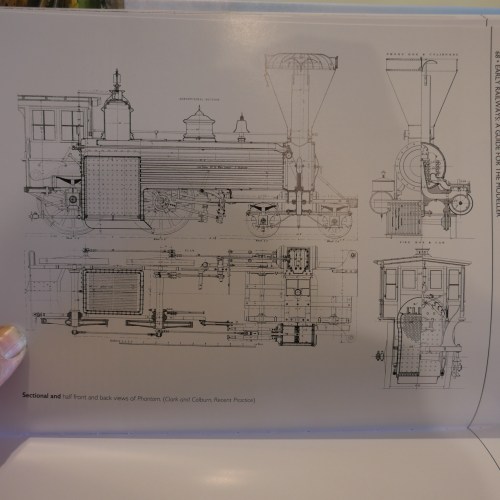
It is hard cover, 120 pages, richly illustrated with photos, diagrams, and plans of railway locomotives, carriages, tracks, signals, uniforms, tunnels, stations etc etc from 1830-1880.

The chapters are:   Introduction (which should not be skipped) 1. Mike Sharman – pioneer modeller of early railways, 2. Infrastructure, 3. Locomotives 4. Carriages  5. Waggons  6. Layouts and models  Appendix of sources of supply for modellers, and a brief index.

This book is a quality production.  Carefully and articulately written, and beautifully illustrated.

I have had no previous particular interest in model railways, but after reading this book, I do wonder what I have been missing.

Here are a few pages chosen at random.

P1010064

P1010157

The illustrations are profuse, well chosen, high quality and interesting.

This book will be enjoyed by anyone who is interested in railways 1830-80, and especially modellers.

Dr John Viggers


Trevithick Engine by Lumix, and an Ottoman cannon.

Some more photos with the Panasonic Lumix LX100M2.

P1010115.JPG

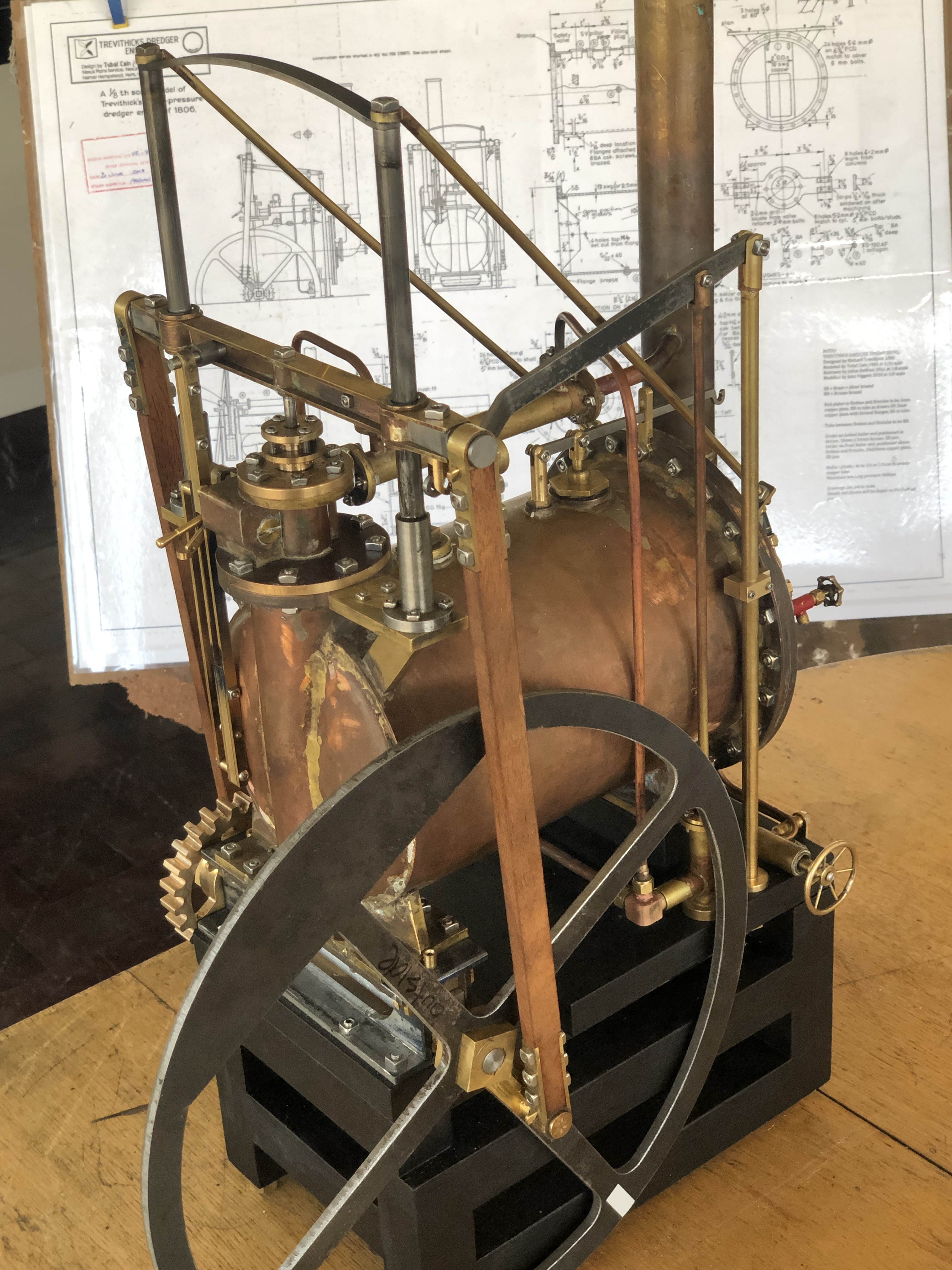
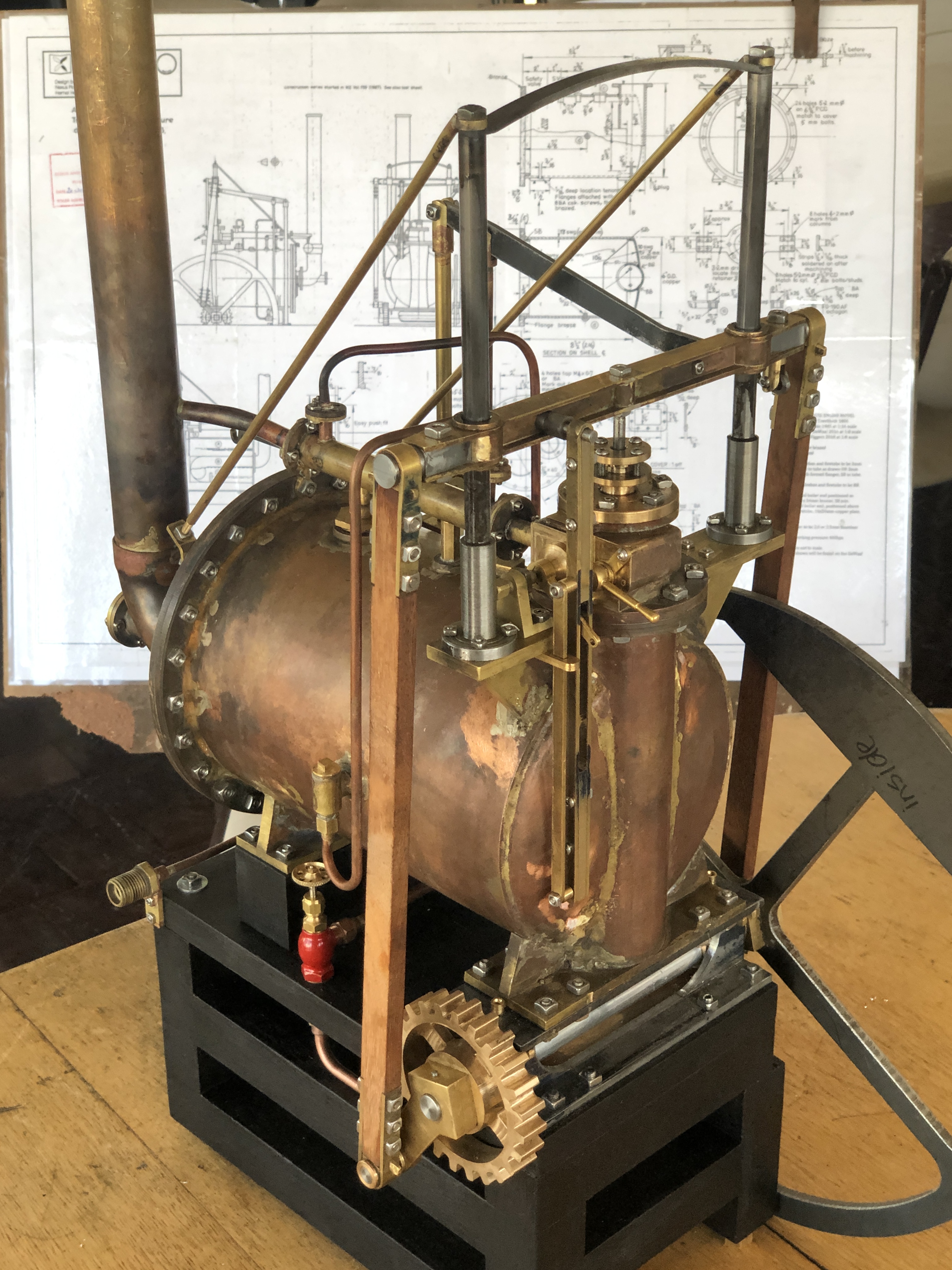
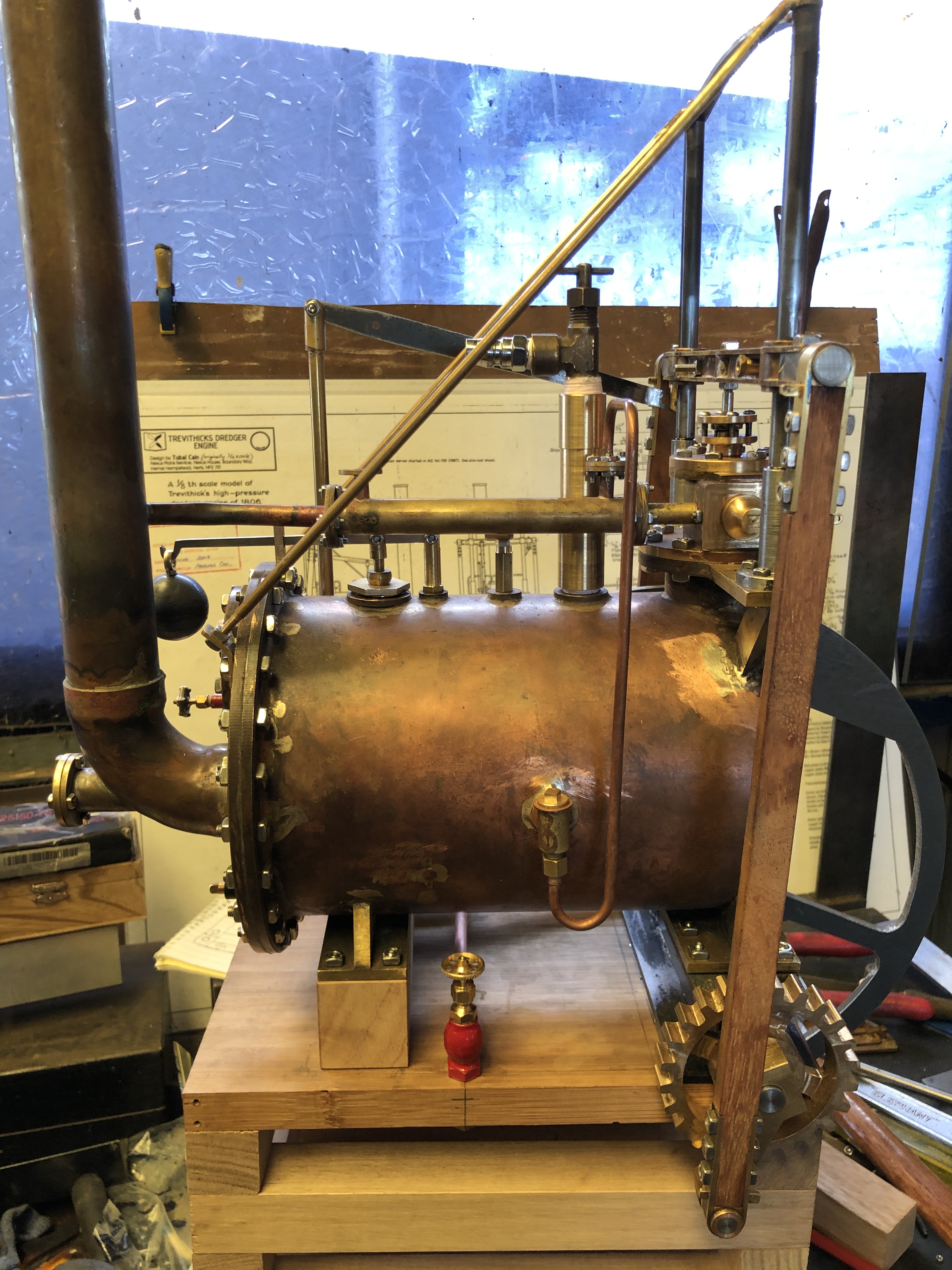
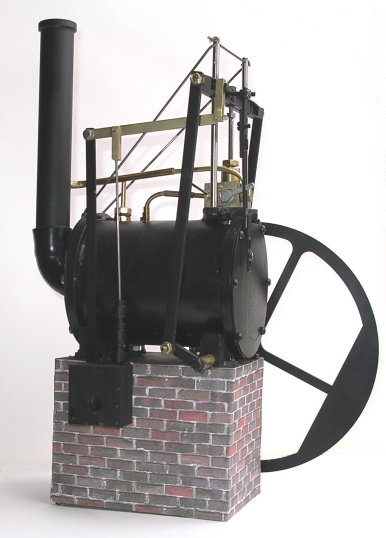
The Trevithick dredger engine, still lacking lagging and paint.  The chimney has a chimney extension connector, sitting a bit crooked.

P1010119.JPG

I am very impressed by the quality of these photos.

And some shots of the 1:10 model Ottoman Dardanelles cannon, which I made a few years ago.  It was intended as a practice run in wood, before making it in bronze.  The wooden model is 600mm (2′) long, and since finishing it I have not felt the need to make a bronze example.  I plan to visit the original at Fort Nelson, Portsmouth, in a few weeks. Watch out for a video/photographs on johnsmachines.com

P1010107.JPG

P1010102.JPG

P1010112.JPG

P1010109.JPG

I think that you will agree that the quality of these photos is excellent.  The photographer is still learning.

Travel

Hi bloggers!

Sorry about the intervals between posts lately.  I have been busy with other stuff.  Mainly to do with planning my trip to UK in May.  But also doing jobs for SWMBO as she requires (part of the price for going on my own to UK).

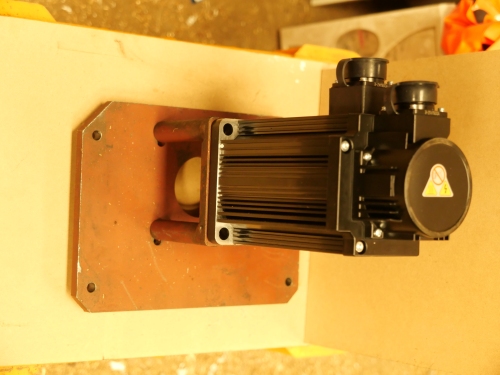
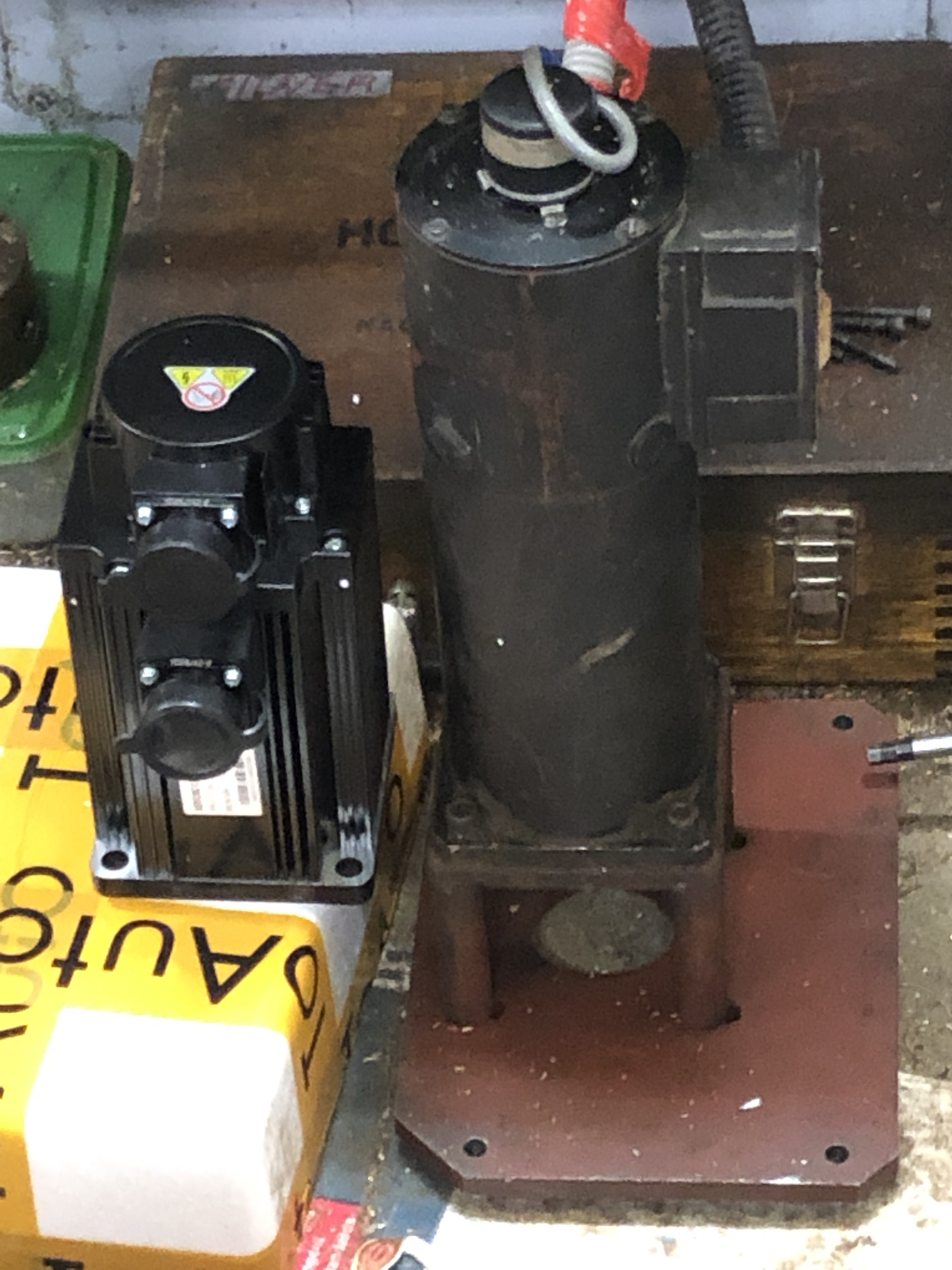
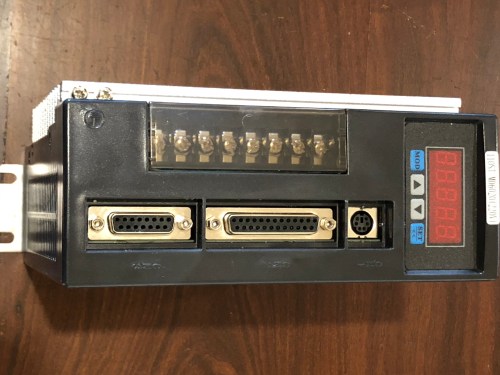
Also, my CNC mill is not working.  The Y axis suddenly stopped functioning.  I pulled out the servo motor, a heavy, awkward job, and Stuart discovered a broken wire leading to the encoder.  That was fixed.  Reinstalled the servo and the mill seemed fine.  Then the same fault recurred.   So later today I will pull out the servo again, and take another look.

This post will be mainly about a new camera which I have bought, instigated by my forthcoming trip.


It is a Panasonic Lumix LX100M2.  And although small, its capabilities are astounding (at least to me, who has not bought a camera for almost 10 years- except for the iphone camera, which is also astounding.)

And this the reason I bought it.

IMG_7817.JPG

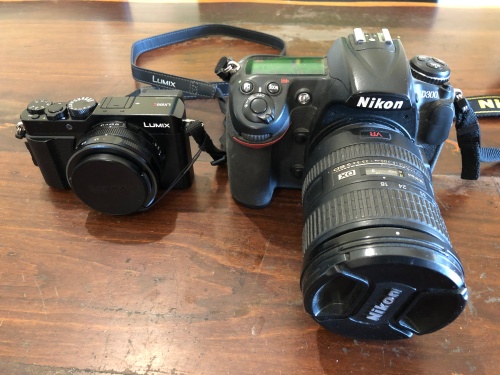
The Nikon D300 is still a great camera, and I have some excellent lenses and other gear for it, but it is just so big and heavy.

The Lumix does not quite fit into a pocket, but the cameras which are that bit smaller,  have other limitations… like controls which are too close together for my older, fatter and clumsier fingers.

It is also a video camera, and Panasonic do excellent video cameras.  One major minus is the absence of a microphone jack.  The built in mike is ‘OK’.

I am still learning how to use this technological marvel.  It has a few surprises.  One was a feature which takes multiple photos of single object at different focus points.  This allows picking the frame which has the best part in focus.

It has Bluetooth, and Wi-Fi, but I have been unable to get them to connect with my iphone or computer, despite following the instructions.  Need some help on that one.

I wont list all the features.  Look it up if you are interested.  Instead, I will show you some of the first shots which I have taken.  These are all taken at 8 megapixels rather than the maximum 17-20, to reduce uploads and storage space.

P1010039.JPG

This is a shot where I chose the focus point after shooting.  I could also have amalgamated all of the shots so every point was in focus.

P1010032.JPG

I am very pleased with the picture quality, but wish that it did not show the machining mistakes.  Must get around to bogging and painting.  It has a fixed  zoom lens, 17-20 megapixel, mirrorless.  This is 3:2 format.  The previous picture was 1:1 format.

P1010049.JPG

Victoria Geelong.jpg

Bronze statue in Geelong’s Botanic Gardens.  One of only a few of these of Queen Victoria in existence.  The Lumix does not have a cropping facility (that I have found), so this was cropped after loading onto the computer.  (21/4/19- found the cropping facility, and heaps of other options buried in menus.   My admiration for this camera grows as I am becoming familiar with it.)

The video capability also seems very good, and you will see evidence of that as I post stuff on my trip.


Sir Ding Dong.

Not much happening in the workshop.  Visited by my middle daughter and family this weekend.

The boys are now 3, and responsive enough to not touch hot or moving parts and to watch out for wriggly pets.  I have seen 3 so far this season.

So we decided to give the boys some exposure to live steam.  They were intrigued by lighting the fire in the boiler, then adding wood and coal, and building up steam.  Nervously then enthusiastically operating the whistle.

Then the fun bit.

56331017_10155878660711901_6634981610481516544_o.jpg

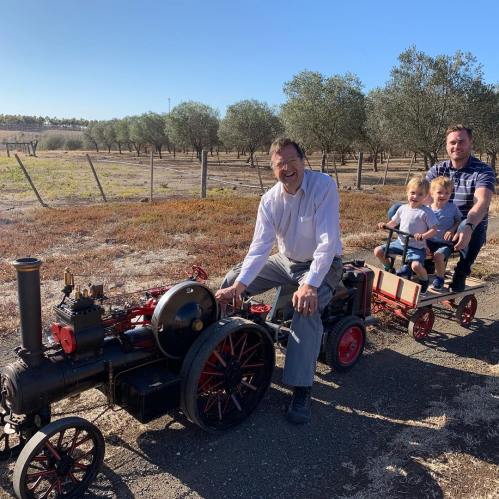
Sir Ding Dong is a 3″ scale 2 cylinder compound steam traction engine.  It will tow this load easily.

We have had virtually no autumn rain yet, and the ground cover is very dry.  But it was a sunny and windless day, so it seemed safe enough to operate the steam engine.  No problems.  The kids, aged 3 to 69, loved it.


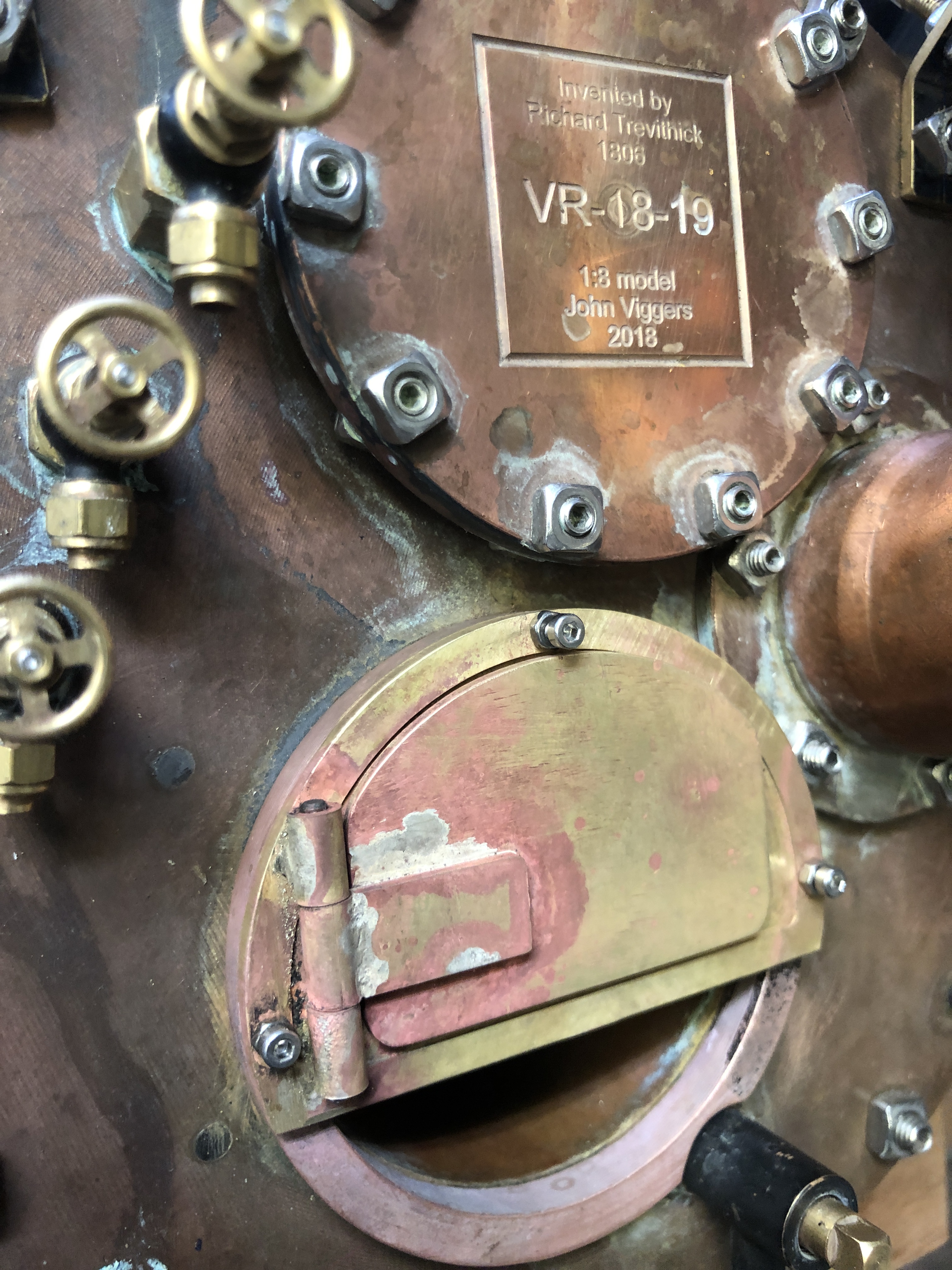
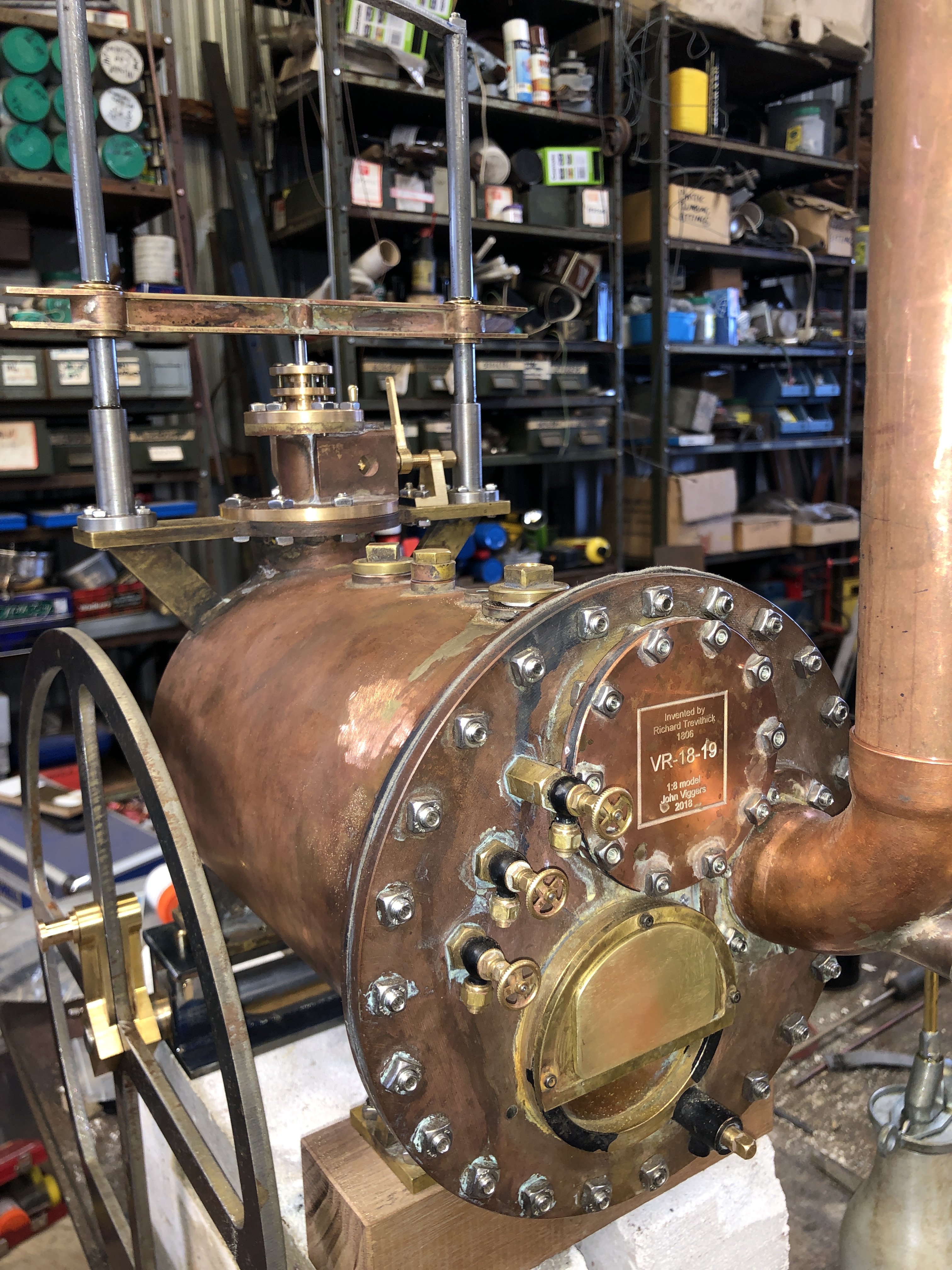
Oh, and by the way, the Trevithick dredger engine boiler passed its final inspection!  WooHoo!


At Last, a burner which does the job!

You are probably fed up with my burner trials.  I certainly was.

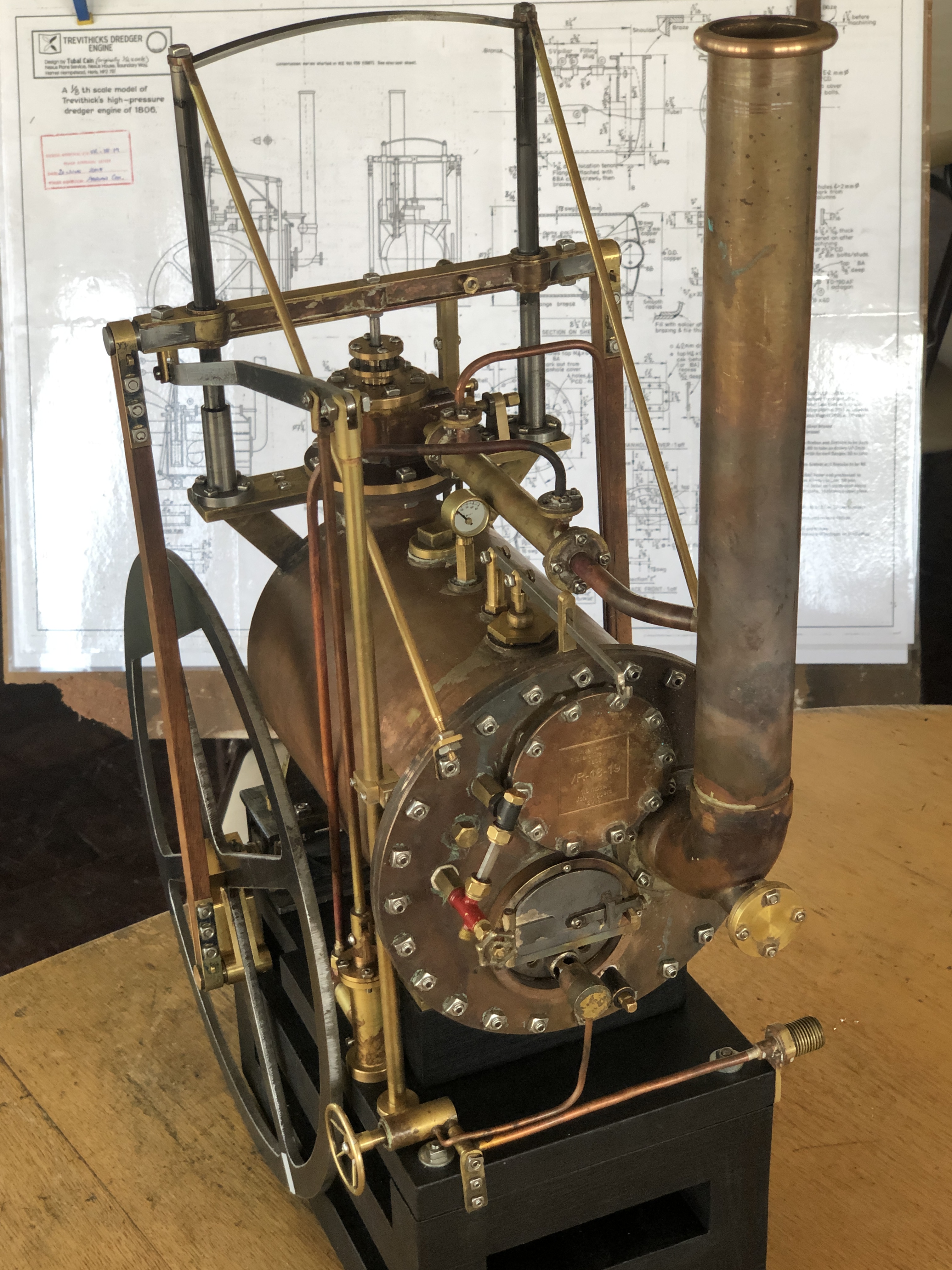
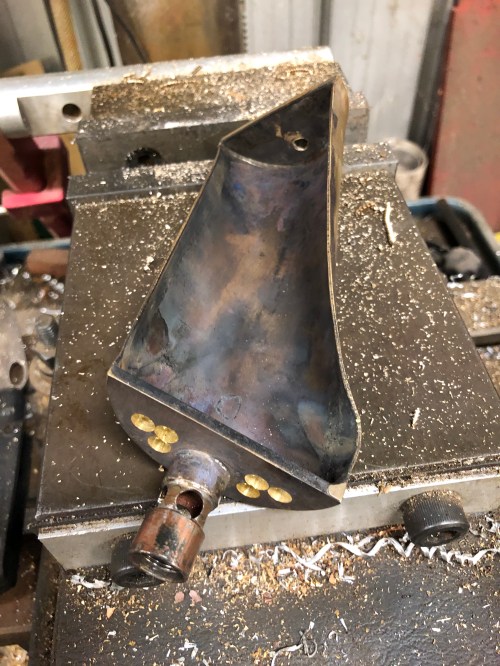
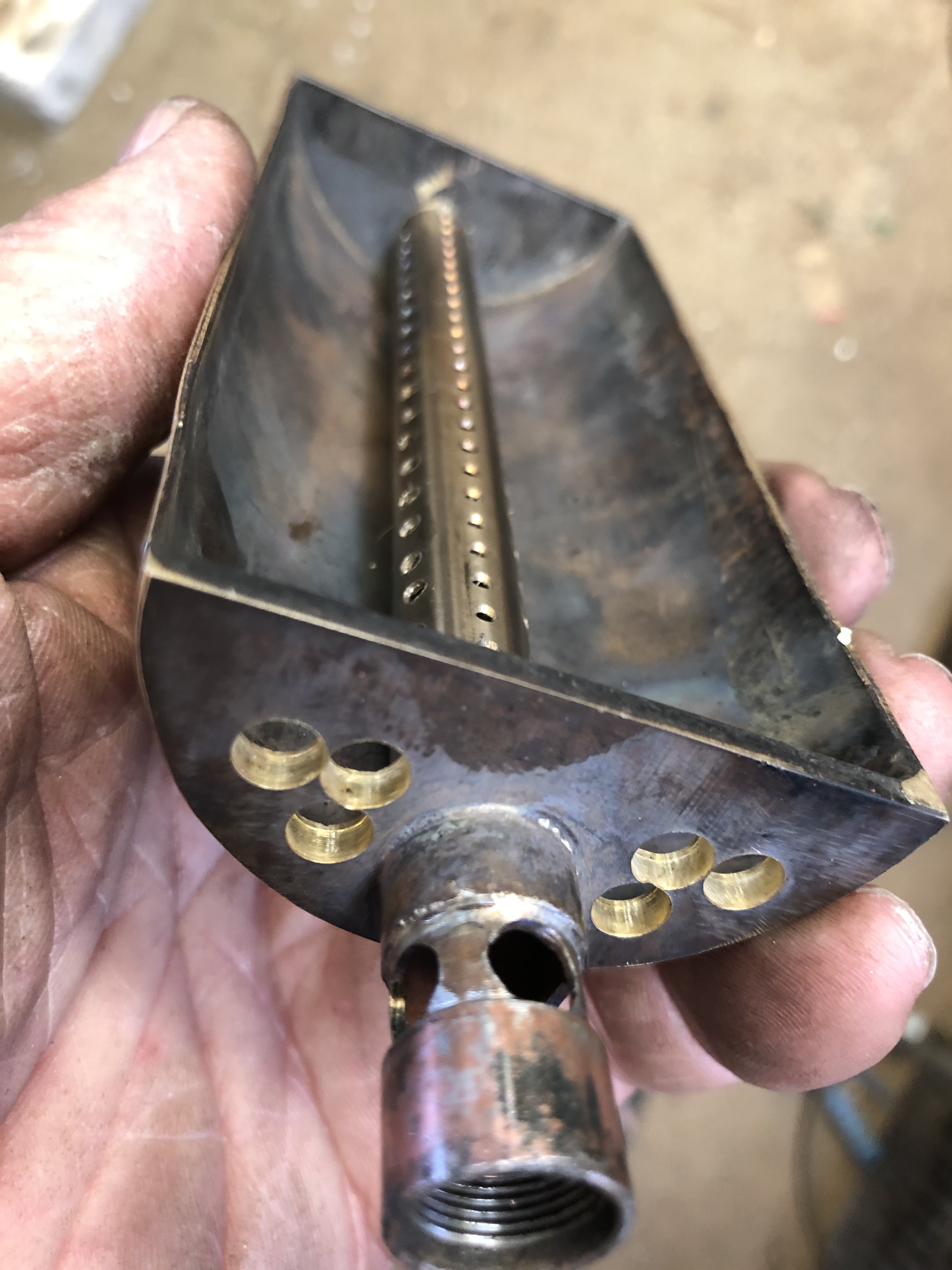
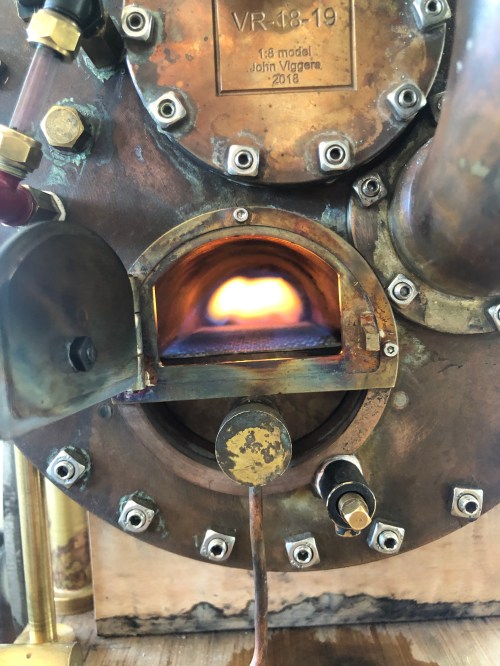
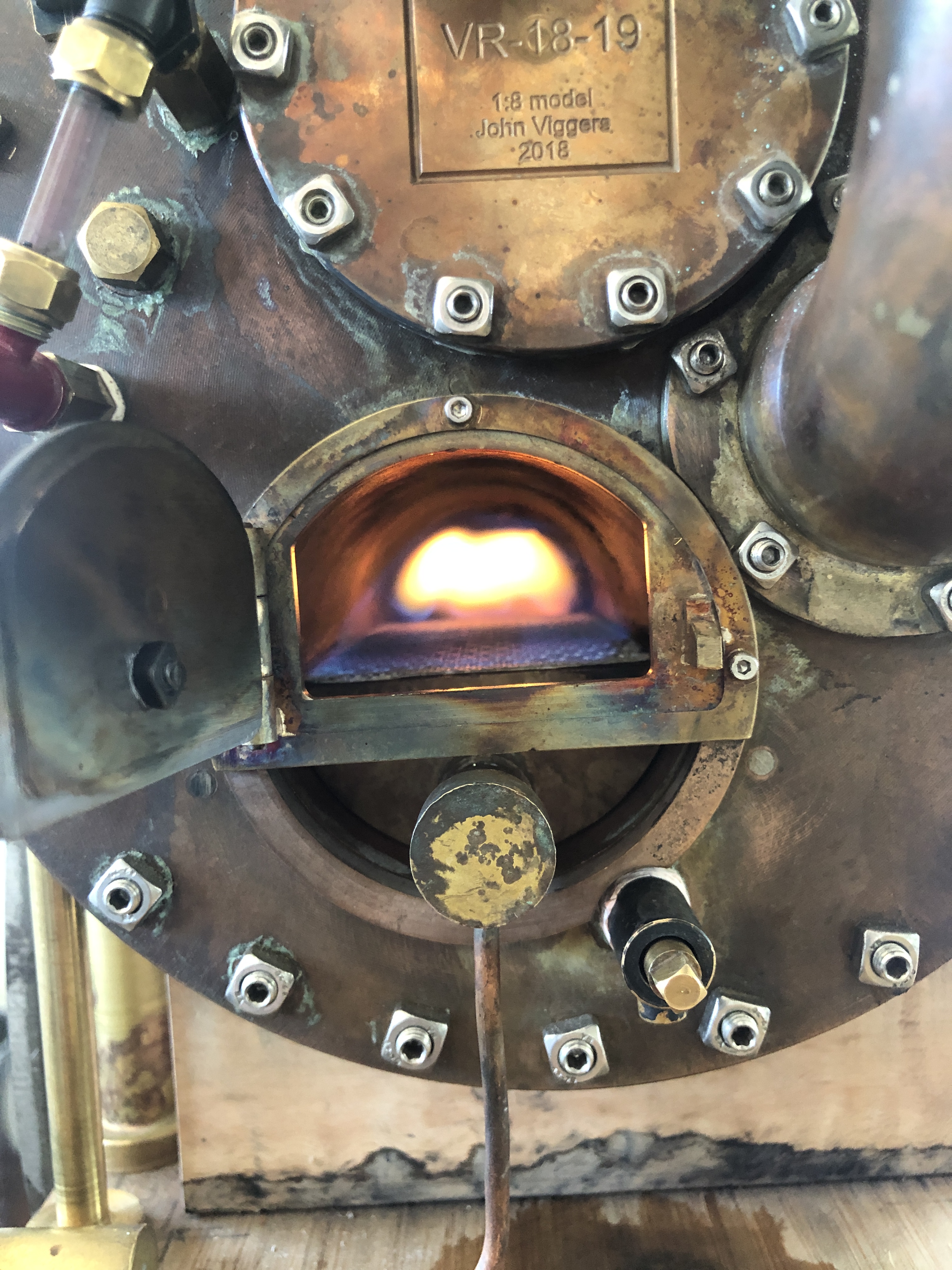
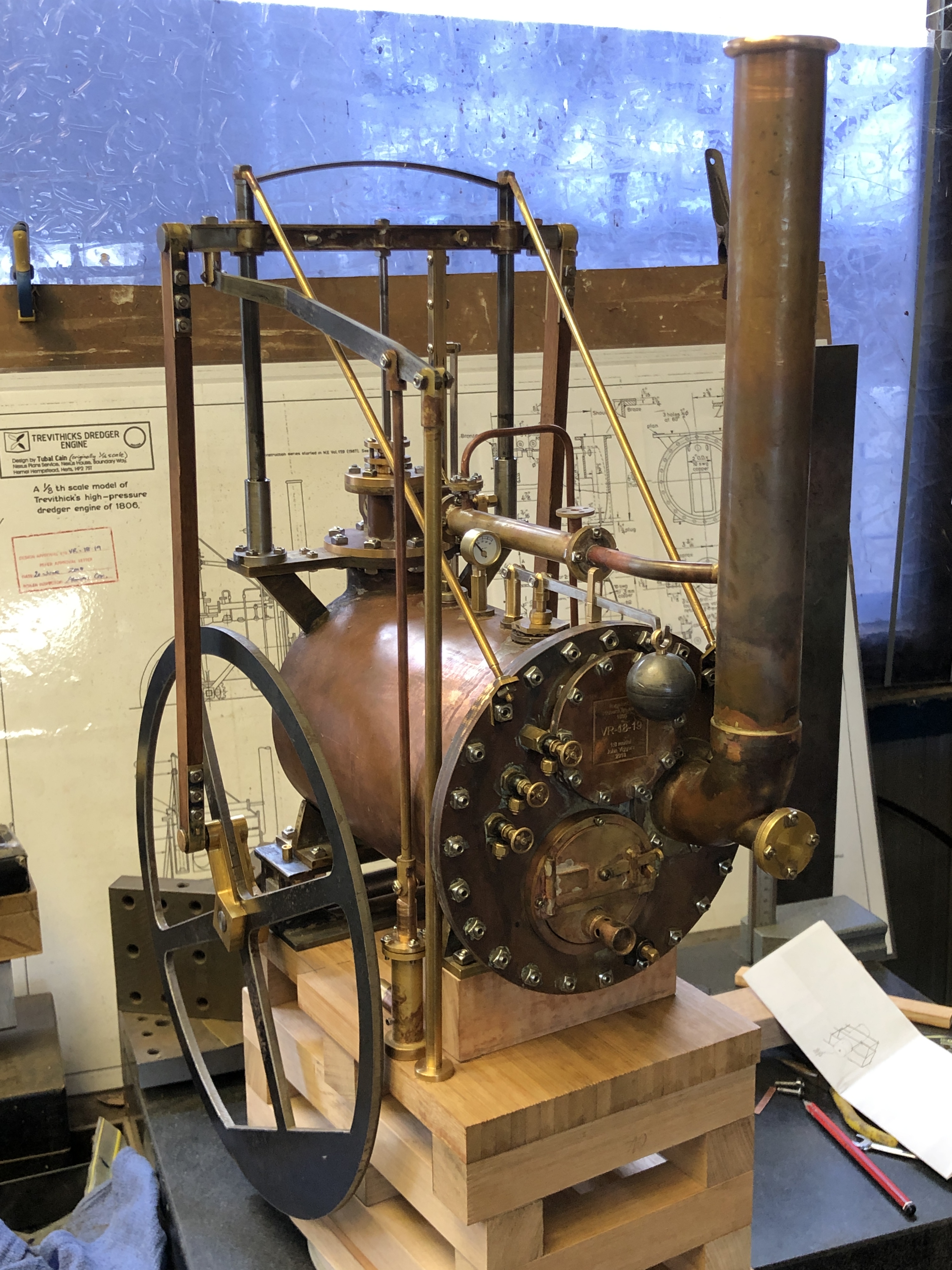
Fundamentally, I was trying to get enough heat into the Trevithick model dredger engine boiler, and just not managing it.  My boiler is a scaled down version of the original, in copper.  It takes a lot more heat than the 6″ vertical boiler which I made last year and I think that the reasons are…

  1.  The Trevithick design, although revolutionary for 1800 was and is a very simple, primitive, relatively inefficient design by later standards.   No water tubes and only one fire tube (the flue).
  2. The linear dimension is scaled down 1:8.  The surface areas (heat exchange surfaces) are scaled down 1:64.  The volumes, representing power output, are scaled down 1:512.  So the scale is a major factor.
  3. The firebox is 60mm diameter.  I had no success burning coal or wood, although I gave up on that one quickly after one attempt.
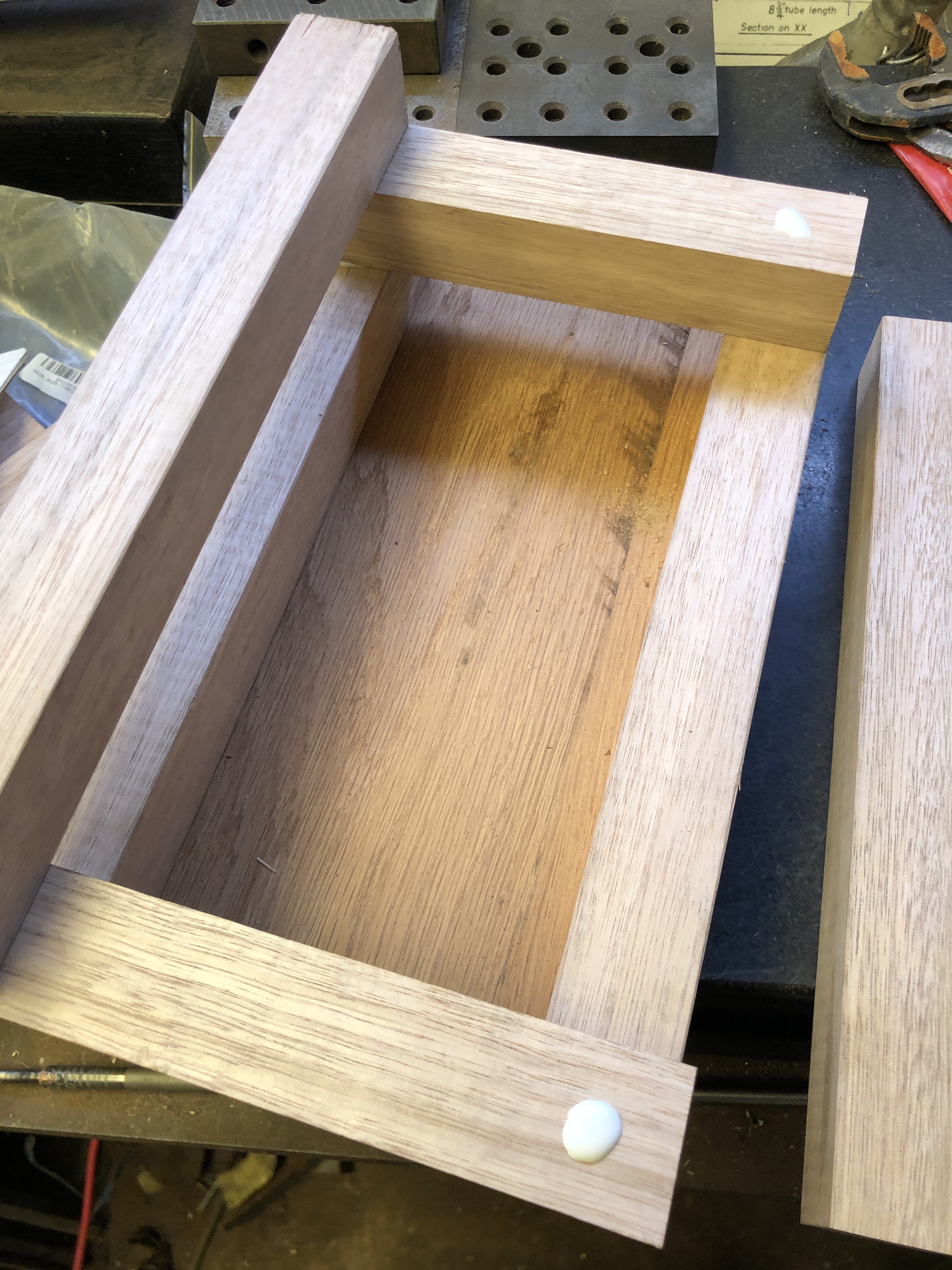
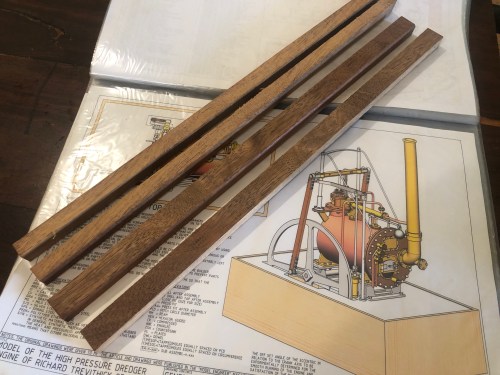
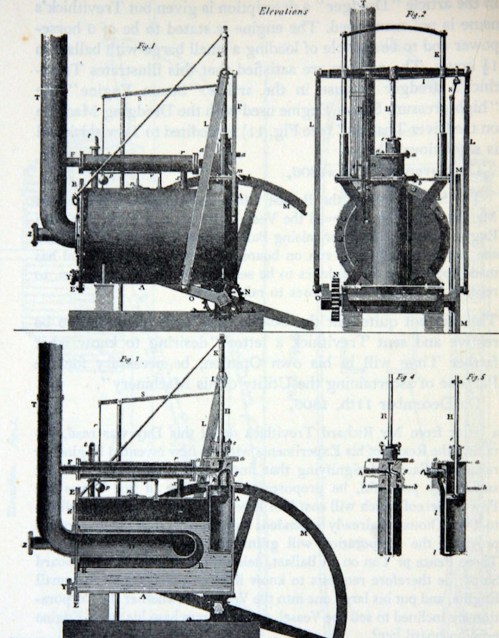
  4. Absence of lagging.  Reproductions of Trevithick’s engines have wooden lagging, but there was no indication of lagging on the LSM engine, or in the 1819 drawing.  I do intend to install wooden lagging, in fact I have cut and prepared the strips ready to install.

So my colleague Stuart suggested that I try his Sievert burner…

IMG_7794.JPG

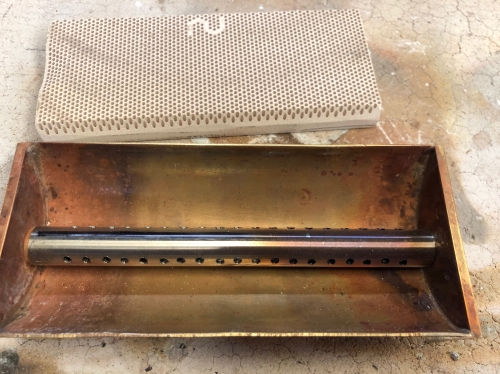
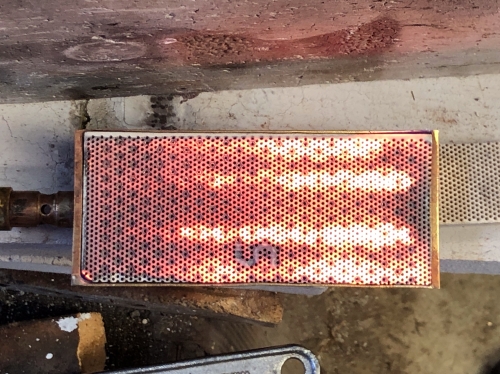
This is a Sievert 2954.  Stuart tells me that at full blast it puts out over 40kW!   The ring is steel, machined to fit the firebox, and a close fit to prevent cold air being sucked around the edges.

IMG_7785.JPG

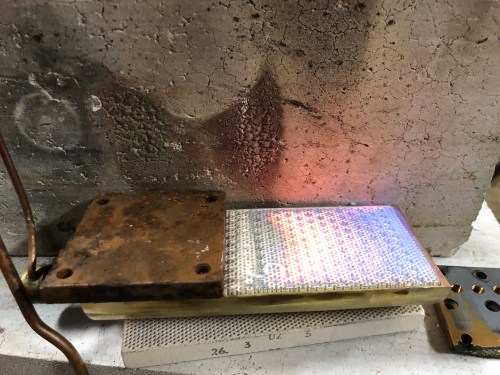
Fitted into the firebox.  It coped reasonably well with the back pressure at about 1/2 strength. 

This unit raised steam from 2500cc of cold water in 10 minutes, and got to 20psi in 14 minutes.  The target of 40psi was reached in 18 minutes.

At 40psi the safety valve operated, and despite continuing to pour in the heat, the pressure did not rise above 40psi.  So I am expecting that the boiler inspector will be happy with the safety valve.

I then ran the engine for 45 minutes, turning the boiler feed pump on and off to keep the boiler water level up.  All went well.  I have made a video of the event, but the upload failed last night, so I will try again later.

Next, to contact the boiler inspector for the final (I hope) inspection.


Travel Appeal

Relax.  this appeal is not asking for money.

I have been wanting to see  1. the Trevithick dredger engine in the London Science Museum  2. The Dardanelles cannon at Southampton  3. The Musee des Artes Et Metiers (Paris)   4. The York train museum   …. for ages.   And waiting for months and months for SWMBO to agree to set aside the time to do so.  Finally, today, I had a frank discussion with her.

And she has agreed!  I am going alone.   Considering my aims, that suits both of us.

There is a price to pay (of course), but more about that some other time.

The appeal is for recommendations of what to see.  I lived in UK for almost 2 years, 1979-80.  But I was working hard, and sightseeing was brief and of the traditional tourist variety…  stately homes and countryside mostly.  Beautiful and interesting.

But this trip will be for me only.  And I daresay that my readers will get some reports too.  I want to see industrial England.   Probably wont get to Wales, Scotland or Ireland this trip.     Going early May to early June.  Will probably be mainly London, Southampton, Cornwall, Manchester, Birmingham, York areas.

So, if you know of a particular engine, museum, ship, or industrial history site, or other industrial/scientific “must see” in England or Paris, please leave a comment.

I am also considering a new camera.  I dont fancy carting around my excellent and reliable, but large and heavy Nikon with lenses and flash guns, but I want something a bit more versatile than the iPhone, and something that will take videos.   I have not looked at cameras for a couple of decades, and suspect that the options might have changed somewhat.  Recommendations welcome, please.

Another Good Read. “The Mongol Art of War”

I will not be in the workshop for a few days, so I will post some more reviews of books which I have really enjoyed.  (you don’t want to hear about the ones which I thought were crap do you?)

IMG_7776.JPG

Paperback, 211pp, Pen & Sword Military.

THE MONGOL ART OF WAR  by Timothy May

In the thirteenth century the Mongol armies, led by Chinggis Khan and his successors, swept out of the depths of central Asia to conquer China, most of Asia, and much of  Eastern Europe to form the largest contiguous empire which has ever existed.

It was probably only the death of the Khan which prevented the Mongols from conquering all of Europe, in their quest to rule the entire world.

The Mongols rarely lost a battle. 

Dr Timothy May is an expert in Mongol history , and in this eminently  readable book he analyses the available evidence to explain how armies of horse archers took walled cities and defeated heavily armored European knights.   Much of the history of the Mongol conquests is described, but the book is more about how and why the Mongol armies were so successful.

As usual with successful warlords, the Mongol characteristics described are intelligent and ruthless leadership, terror, adoption of new technologies, effective organization, and disciplined soldiers. 

There is finally a most interesting description of the legacy of the Mongol “art of war”, including how the tactics and high degree of mobility of the horse archer armies has been studied and copied by more modern armies, including the panzer forces of the Germans in WW2.

As expected in a book written by a respected academic, there is an extensive glossary, and extra notes for each chapter, select bibliography, and index.

This book will appeal to the general reader, as well as students of the era.

Another excellent read from Pen and Sword.  Highly recommended.

Dr JCL Viggers.

img_7777.jpg

Some basic, but quite useful line drawn maps

img_7778.jpg

IMG_7779.JPG

More Gas Burner Experimenting

First I tried the Sievert 2943.  I tried different gas settings, and different positions of the burner in the fire box.  I quickly discovered that an opening had to be present next to the supporting flange.  Despite that, steam was produced in 10 minutes, and 20psi was achieved in 15 minutes.  My aim is to obtain 40psi, and maintain 40psi during engine operation.

Unfortunately this burner does not work if there is any significant back pressure in the system.  Stuart has advised me to try the Sievert 2954 which he says will cope better with back pressure.  The Sievert 2954 has a similar appearance to the 2943, so I have not photographed it.

I have borrowed a Sievert 2954, but it needs some setting up, so I thought that meanwhile I would try a burner style which had been mentioned earlier.  It is a tube with multiple transverse slots.  Despite being constructed rather roughly and quickly, it produced a good hot flame.  Perhaps a bit small, but promising.

IMG_7775.JPG

If the next Sievert is not satisfactory I will come back to this style, and experiment with different slot numbers and sizes.

If you are becoming a bit bored with all of these gas burner experiments, I understand.  When the burner is finally sorted I will be delighted and relieved.

I have machined some wood to be used for lagging.  It is West Australian Jarrah.  A dark coloured wood which is often used for exterior flooring.  I will apply it to the boiler soon.
 

Experiment Failure

Sometimes information derived from a failed experiment is just as useful as a successful experiment.  Several readers predicted that burning coal would not not work in my dredger engine boiler, but I had to be convinced.

So, I removed the gas burner.

I have 3 types of coal.  One is Welsh steaming coal in 25-30mm lumps.  It has an attractive shiny appearance.  The other is coal lumps which were picked up next to a local railway line and are probably from Newcastle NSW.  I also have some brown coal, but it is in the form of briquettes, and I did not attempt to use them.

IMG_7760.JPG

Welsh steaming coal top, railway line droppings bottom.  All too big. 

Both black coal types were too big for the ~60x40mm diameter firebox in the dredger engine.  How to make them smaller?

Smash them up with a hammer and pass them through a sieve?  That would leave a lot of unusable tiny fragments as well as bigger bits.  And be very messy.  And require making a sieve.   If my experiment was successful that is what I would do in future.  Did not happen.

Meanwhile, I tried a hammer with a splitter edge.  The Welsh coal had definite layers, and split fairly predictably, with not too much dust or tiny fragments.   The Australian coal crumbled unpredictably into many fragments with a much lower usability fraction.

I started the fire with newspaper, then pine and hardwood kindling.  I should have paid more attention to the wood sizing, because it was problematic getting the wood alight.  Also, I had not set up a blower for the chimney.  I was relying on a really long chimney extension to provide enough draught.

IMG_7764.JPG

Chimney extension.  worked well.  Now what is that black circular patch on the ceiling?

Got the fire going with the assistance of a gas torch.  When the fire got going the draught seemed adequate.

IMG_7768.JPG

The wood fire at its best

Tried to add coal lumps, but they would not fit the firebox while the wood lengths were in place.  Firebox is just too small.  So I persisted with wood.  Soaked some in mineral turps.

I was not impressed with the appearance of the fire, but surprisingly, eventually, steam was produced, but never enough pressure to run the engine.  And the fire did require constant attention.  The front of the boiler was quite dirty after all of this.  I am glad that I have not yet painted it.

I will give the wood + coal fire another attempt, but size the pieces better (smaller).  The Sievert type burner is looking more likely.

Later in the day…..

…after a further discussion with Stuart I have decided to try the Sievert burner.   Made some steel rings which are a press fit on the burner, and an easy sliding fit inside the firebox.

IMG_7771.JPG

IMG_7773.JPG

This is the new burner inside the firebox.  Not exactly @Trevithick, but I bet that he would have used it if it had been an option.

I still need to make a fitting to hook up a valve and the propane hose.  And try it out maybe tomorrow.  Another experiment.  I hope to not see flames shooting out of the chimney.


A Coal Grate. And Monster Emperors of Rome.

Firstly, the book review.  It is short, because I did not enjoy it.  Not that it is badly written, or poorly researched.  But it is really shocking.

IMG_7757.JPG

EMPERORS OF ROME.  THE MONSTERS.  by PAUL CHRYSTAL

From Tiberius to Theodora.  AD 145-548

This book is one of the series published by Pen & Sword on the architects of terror. Other volumes include Al-Qaeda, The Armenian Genocide, Bloody Mary, Einsatzgruppen, to give you an idea of the scope of the series.

Now that I have finished with the book, I am examining my own motives in choosing it.  I have read many books about ancient Rome, and find the era fascinating; the personalities, the reasons for the rise and fall of the empire, why the military was so spectacularly successful etc etc.

But to be truthful, I did not actually finish the book.  I had a similar reaction when I read about the Nazis and the concentration camps.  Just too horrible to contemplate.  And I closed it after reading about half.  And will not reopen it.

Paul Chrystal is a well-respected author who has written many books about ancient Rome. He states an aim to use primary sources, and to balance the horror with the mitigating aspects of the monsters. The book is 127 pages long, and it covers 10 emperors, so there is not a lot of space to give a balanced view. Mostly, despite its aims, the book is about rape, murder, treachery, nasty and insane men and women with absolute power doing whatever they felt like doing.

And to be realistic, even the “good” emperors started wars, executed rivals, instigated massacres and mass maimings.  That was the way things happened in ancient Rome. And twentieth century Germany, China, Cambodia etc etc.

So, if you enjoy seemingly endless descriptions of sadistic torture, rape and mass murders, with many illustrations, this book might be for you.

Not for this this reviewer though.

John V.

Now, back to getting enough heat into the 1:8 Trevithick Dredger Engine.

I have made a grate to place into the firebox, and which will replace the gas burner, which has proved to be inadequate, despite many, many experiments with improving it.  So here is the grate.

IMG_7759.JPG

Putting a rather unpleasant book to good use.

The holes in the grate are tapered, with the smallest part of the holes uppermost.  The fold at the back is to prevent coal being pushed off.  The taper is to prevent clogging the holes with clinker, and possibly to improve the velocity of air flow through the fire.

And how did I drill so many small holes so neatly?

IMG_7756.JPG

CNC of course.  Took about 45 minutes.

But after that I had a conversation with Stuart Tankard.  He reckons that I will do no better with coal than I have with propane to date.   Hmmm.   Might give it a go anyway.

Stuart’s suggestion is to try one of these….

Sievert-2944-90

It is 50mm diameter, has a large jet (0.81mm diameter) and has a fearsome flame.  Looks more like a silver soldering torch.  If I use it I might get a flame coming out of the chimney.  Hope that it does not melt the silver solder.


Trevithick Dredger Engine. Gas or Coal?

Despite my best efforts, and good advice from experienced modellers, I have not been successful with using propane as fuel.  The engine runs, but I cannot get the boiler pressure over 20-22 psi, and that is not adequate.  Partly the problem is that the Trevithick boiler is the FIRST high pressure boiler ever, and is rather simple and primitive.  I do have alternative propane solutions, but they involve redesigning and remaking the burner.  I might end up doing just that, but meanwhile I am going to try coal.

I use coal to fire my 3″ scale traction engine.  It is messy, dirty, and a bit of a pain to get fired up.   But once going it is HOT.  And smells good.  But needs constant attention, observation, and skill.  Not just a matter of adjusting a gas knob.

But, the original Trevithick dredger engines used coal.  Or wood.  Or dried alpaca dung.

So I intend to build a coal grate.  The firebox is only 65mm diameter, so the coal lumps will need to be small, about 1cm diameter I guess.  I will make some sort of crusher to reduce the size of the traction engine coal.

I have made a start on the grate.    Again, it is all experimental.  And I will need a blower of some sort.  Maybe a small computer fan on the chimney.   All fun.   Wait and see.

No book review today!   And Antarctica and moon not mentioned!  I do have  a review in the wings about the Roman emperors who were monsters.  But another day for that one.

Not Another Book Review!

Yup!

I am still experimenting with the gas burner on the Trevithick, and frankly, totally over it.  So much so that I am considering scrapping the gas burner, and seeing if coal will get better steam pressures.

But nothing to show yet.   So another book review.

This one is another ripper!  I bet that most of you have never heard of Mithridates The Great!  That is because of our Rome-centric ancient history.  Everyone knows a bit about Julius Caesar.  And maybe even heard of Spartacus, Hannibal, and Attila.

But Mithridates has been described as Rome’s deadliest enemy, with good reason.   Here is the book review….

IMG_7751.JPG

MITHRIDATES THE GREAT by Philip Matyszak 


(or GAME OF THRONES minus dragons and nightwalkers).

Why bother with fiction when real history is as dramatic and complex and shocking as this story?

Mithridates the Great was arguably the greatest threat to republican Rome in its pre common era history, even taking into account Hannibal,  Spartacus etc.  That he did not finally succeed was not due to lack of resources, military skill, wealth or intelligence.  He faced the awesome might of the best infantry in the ancient world, and some of the best generals that Rome ever produced.  As the king of Pontus, a small country on the Black Sea between Rome, Parthia (Persia), and the barbarian tribes of central Asia, he fought Rome intermittently for over 50 years.  And, according to this book, he came very close to winning.

Matyszak describes a man of intelligence, imposing stature, commanding personality. Generous and loyal to his friends, utterly ruthless to his enemies, and guilty of treachery, mass murder, fratricide, matricide, filicide and every other “cide” in the dictionary.  He arranged the murder in one day of 80,000 civilian Romans, to bind certain cities to his cause.  He ordered his entire harem to suicide rather than let it fall into the hands of his enemy.

He returned from hopeless situations many times, but as an old man, following treachery by a son, he took his own life, and his kingdom was added to the Roman empire.  The reader knows that it will not end well for Mithridates, but I found myself hoping against hope that it could somehow be different.

This book is a terrific read.  Even though it is only 180 pages long, (plus references, maps, picture section etc), I found it richly rewarding.  It is not quick reading.  It kept me going for almost 2 weeks, where I normally devour a book in 2-3 days.  I often needed to re-read sections, to adequately grasp the details.  The language is mostly precise and articulate, peppered with humorous but appropriate modern jargon.  (e.g. p155 “Mithridates had left several juicy castles stuffed with treasure” )

Incidents which are based on less reliable sources are identified, and the author offers personal interpretations which seem quite believable.   The summing up of the epilogue was particularly useful. 

One aspect, which I found annoying, was the paucity of place names and total absence of scale on any of the maps.  Many places are mentioned in the text which do not appear on the maps.  

The book is intended for the general reader rather than the academic but I suspect that it might be confusing if the reader does not have some familiarity with the history of late republican Rome. Eg. It would be an advantage if the reader knows something of characters such as Sulla, Pompey and Sertorius.  The 13 page introduction is an excellent summary of the situation of the Mediterranean world in the first century BC and should not be skipped over.

J. V.

IMG_7752.JPG

IMG_7753.JPG

Good maps, except no scale.


The Battleship Builders (another book review)

This one is just to demonstrate to reader Stan that some of my book reviews are positive.

IMG_7745.JPG

Hard Cover,

UK £30.00 Seaforth Publishing,  available at Pen and Sword Military.


THE BATTLESHIP BUILDERS  Constructing and Arming British Capital Ships

By Ian Johnston and Ian Buxton

I am writing this review less than 24 hours after opening this book.  It is a gem!  I admit to so far reading only 5 of the 13 chapters, and those almost at random, in preference to a night’s sleep, and I am greatly anticipating devouring the remainder.

The subject is the making of battleships 1863-1945.  320 pages, triple columns, and a cornucopia of photographs, tables, plans, diagrams and maps. 

I like history, engineering awes me, and I appreciate thoroughness and detail.  This book has it all. 

Despite the mass of detail, the writing style is clear and articulate and easy to read.

At this time I have read the chapters on armament, armour, money, and the introduction and conclusions.  I will soon go back to the powering, the facilities, the building, etc.  I was wondering just how they did make, shape, and attach steel armour up to 12 inches thick to the sides of ships*.  And how did they make those huge guns?  It is all there, including detailed descriptions and photographs of the manufacturing processes, the factories, the work forces, the costs, the materials, the physical handling of the huge pieces, the testing.  And the corruption, and the cost to the national economy. 

A fascinating story.   Absolutely, thoroughly recommended.

*spoiler alert!  The armour plates were bolted from the inside, into threaded holes, using bolts 3-4 inches diameter.  The holes were made and threaded before the plates were hardened.  The plates had tongue and groove edges.

After writing this I read the remaining chapters, and I confirm that this is an awesome book.  Well written, plenty of pictures diagrams and tables, and thorough.   So there Stan!

img_7746.jpg

IMG_7747.JPG

img_7748.jpg

If you have ANY interest in battleships and their construction, buy this one!


M1 ABRAMS TANK (a book review)

One of my interests is history, particularly military history, and I have been writing book reviews for an English Publisher, Pen and Sword Military, for several years.

Activity in my workshop is not particularly photogenic at present, so my posts have become less frequent.   I wonder if my readers might be interested some book reviews to fill the gaps.

So here is a review of a recent read.  I will be interested in any feedback, positive or negative.   Please be assured that my primary interest on this blog remains making and using machines, and any book reviews will only be used to plug gaps.  Might make a change from my obsession with Antarctica?

IMG_7733.JPG

UK. £14.99    US $24.95   Paperback, with a quality texture.  Glossy paper, 184 pages.

M1 ABRAMS TANK  by Michael Green

As an uninformed but curious reader, I was interested to find out about this, the world’s best known Main Battle Tank (MBT).

 “MBT” is one of the many, many, acronyms used in tank parlance.  Indeed, at times I felt that that the main purpose for the text of the book was to list and explain the meaning of the acronyms.  But that is a bit unfair.   The Abrams tank has been in use for almost 40 years, and is projected to be in use until 2050, so it is not surprising that it has seen multiple versions and revisions, and those do need to be explained.

The history of the development of the tank is well explained.

At the end of the book I found myself unsatisfied however, and felt the need for some perspective.  Of just how the M1 Abrams compares with other modern tanks.  Of how much it costs.  Of how governments finance it.  And how it will be used in future conflicts with increasing use of unmanned weapons. I got answers to those questions from Internet searches.  I suppose that the author is to be congratulated for being the stimulus to such searches, but I feel a little disappointed that the information was not included in the book.  I was also rather disappointed that there was no recounting of battle tales and experiences. Just what was it like to be a tanker, in the desert wars in an Abrams tank?

The 184 pages are crammed with excellent, large, colour photographs, and some diagrams. Perhaps the excellent photographs are the main justification for the book.

img_7734.jpg

So that is the review.  What is your reaction?


A Visit to The Boiler Inspector

My colleague and friend Swen is building a 1″ scale traction engine, and he is about to commence the boiler.  He wanted to discuss some issues regarding the plans with the club boiler inspector.  I had some questions regarding the Trevithick Dredger Engine final inspection, so I tagged along.

IMG_7730.JPG

Swen (purple T shirt) and Adrian discussing the traction engine boiler plans.

The boiler inspector is a marine engineer, currently working on tug boats, but with a lifetime of experience in ocean going ships.  His personal interest is mainly with steam and other trains.  But he is very happy to watch the progress of older, more historic models, like the Trevithick.  But always the emphasis is on safety.   Safety over historicity, authenticity, etc.   As it should be.

I was interested to note that Australia’s model steam regulations are widely used as the bench mark in other countries.

My current obstacles to final boiler certification are

  1.  The boiler feed pump is not working.  When I described the situation to Adrian he diagnosed the problem as the suction ball valve.  So afterwards I was working on that.  I have attached a sacrificial ball to a brass rod, and given it a firm whack to the seat.
  2. The difficulty getting the boiler pressure up to the pressure to demonstrate that the safety valve is working. Using propane, I can get the pressure up to 22psi, which is adequate to run the engine, but not high enough to make the safety valve release.  Adrian suggested that I reduce the mass of the lead weight, so it releases at 35psi rather than the current 40-45psi.  And to consider lagging the boiler.   The picture from 1819 shows the dredger engine boiler unlagged.  But the Pen-y-darren engine and the “Catch-Me-Who-Can”  and the Cambourne Road loco are all lagged.   So I suspect that Trevithick would have approved if the dredger engines were lagged.   So guess what?   I am going to lag my dredger engine, and I hope that if Richard Trevithick is watching that he will approve.   I will use Australian hardwood, and paint or stain it black.  Or maybe some English oak, if I can find some in my workshop.   The lead ball in my model is much bigger than shown in the 1819 drawings, so I will have no hesitation in making a smaller one.
  3. What is the water volume of the boiler?  I knew that I had to use 2000ml to get the water half way up the water gauge, but I did not know the actual volume of the boiler.  So today I measured it.   Surprisingly, it was 2750ml.   Almost 3 litres!   No wonder it takes 20 minutes to get it steaming!

So, very close to the final inspection.

Meanwhile, there is very little of pictorial interest for this blog.   So I decided to show some of my workshop(s).

Next, in response to reader Tim, I will show my silver soldering and brazing setup.   Then maybe some of my lathes.  Please note that I am not claiming any expertise.  Just interested amateur stuff.  Might be a change from Antarctica hey?


Somebody is responding to my Antarctica Posts

Look at the blocking graphics today, over the area of my interest in Antarctica.  The blocking pattern has changed, but it still extends 1985 through all years to 2016.  The sea ice changes every year, but the blocking pattern, and the clouds, stay unchanged.

Some of the odd shapes in 2006 are visible again.

And the big black rectangle is visible again.

This is not cloud, not natural features.  It is deliberate blocking.  The co-ordinates are at the bottom of the screenshot if you want to check it for yourself.  Use the timeline in Google Earth Pro to check out 2006.

Why has the area of blocking changed?  No idea.  Maybe whoever is responsible is embarrassed to have been called out.

Screen Shot 2019-03-14 at 9.44.19 am.png

P.S.   appointment with the boiler inspector next Monday.

Antarctica Again, Again

Some of you might remember my posts about Antarctica from December 2018.  I believed, and still believe, that something has been going on down there that is being kept from us by “someone”.

Do you remember the odd 300mx200m rectangular shapes of which I took screen shots and posted?  And how most of those areas were later blanked out on Google Earth Pro?

Well today I looked at the area again on Google Earth Pro, and the entire region has now been thoroughly blanked out, including ALL of the previously visible rectangular shapes.

Screen Shot 2019-03-13 at 6.09.53 pm.png

The grey splodge in the middle of the above picture could be mistaken for cloud, but it is not cloud.  Look how it includes ALL of my markers which I placed on the rectangular shapes.   And it is present on every year from 1985 to 2015.   It is deliberately obscuring the area of interest.

Screen Shot 2019-03-13 at 6.09.03 pm.png

That is NOT cloud, or any other natural feature.  It has suddenly appeared.  So please excuse my paranoia, but I believe that the purpose of the blanking is to hide the objects which I showed in my posts about Antarctica last year.

The area includes the HUGE BLACK RECTANGLE which is no longer visible.

Just to refresh your memory, and hopefully to piss off those who are trying to conceal these images, I am reposting them today.

Firstly the huge black rectangle.  21kmx7km

Screen Shot 2018-12-21 at 10.47.58 am

Then a few of the scores or even hundreds of 300mx200m, and 300m x150m shapes which I had taken screen shots of, from approx 5km

Screen Shot 2018-12-21 at 10.36.45 am

Screen Shot 2018-12-13 at 8.10.32 am

Screen Shot 2018-12-13 at 8.14.48 am

Screen Shot 2018-11-02 DF-C

A colour enhanced view of one of the “objects”.

I do not know what these objects are, but they are NOT natural features, they are visible only 2005, 2006, 2007, and someone does not want people using Google Earth Pro to be able to see them.

I have 25-30 screen shots of different but similar objects.

To be sure, you would prefer to be looking at photos of my engines, but this “other stuff” category is compelling.

Next Project

The Trevithick dredger engine model is almost finished.  Currently applying some paint.  And getting it ready for the final boiler inspection.  I am guessing about 2 weeks.

I have chosen a spot in the house where it will sit, and will post a photo in due course.

A few people have been asking if I have decided what to make next.  In terms of a major build, the answer is no, I have not decided.  I have considered a few possibilities.  Those possibilities include a model of Stephenson’s “Rocket”, Trevithick’s “Catch Me Who Can” or “Pen-y-darren engine”, a Shand-Mason fire engine, or even another cannon.

What I will do, is to complete several unfinished projects, and if a major project becomes obvious, imperative, then anything is possible.

The unfinished projects include…

  1.  An Arduino controlled rotary table.  The mechanicals are made.  Just need to dive into the electronics.
  2. The Southworth steam powered boiler feed pump for the vertical boiler.
  3. The CNC controlled tool post milling attachment for the Boxford CNC lathe.
  4. Paint the Bolton beam engine.  Lag the cylinder.  Install a cylinder oiler.
  5. Finish the triple expansion model marine engine.  The lagging, the piston rings, the gaskets, the oiler and oil pipework, and painting.

Looking at that list, I really do not need to start another major project.

And sometimes it is nice to sit back, and enjoy the glow and satisfaction of previous projects.  It does sound rather self satisfied, no?  So here is a selection of videos, mostly first runs of newly completed projects.  Most are YouTube links, but one or two will run directly.

This was the first model steam engine which I made about 5-6 years ago.  It is a Bolton 7 single cylinder mill engine, and this was the first occasion I had run it on steam.  It was a very exciting moment, seeing it actually running on steam.

Next came the Bolton 12 Beam Engine.  Still a crowd favourite.  The beard was ordered off by SWMBO not long after this.

Then a couple of Stirling engines.  How they work is still a mystery to me.


Then the problematic, difficult triple expansion engine, which took 3 years and several extended breaks to get to the working stage.  Still not finished completely.  Stuart Tankard’s boiler.  Since then I made a vertical boiler.

And somewhere in there I made this little reversing engine for the club competition.  Alas, it failed in action.

And 3 cannons came out of left field.  They started as a CNC project, but then took on a consuming interest of their own.  About this time I saw the necessity of learning how to put together a video.  Still learning.

IMG_6859

The 6″ vertical boiler.

And finally the Trevithick dredger engine.  The historical aspects of this engine, the genius of Trevithick, the fact that the engine works…. has been marvellous.  The engine is looking quite different with some paint applied.  And the propane burner is significantly better than appears in this video.

So, if you are still with me after all of those videos, congratulations on your stamina.  It is  therapeutic to take stock sometimes, and to wonder about where making all of these engines is going.  It was not to any plan.  Still no plan.  Just enjoying the moments, the days.

Painting the Dredger Engine

OMG!

You are not painting?

You know that…

1. You always get runs

2.  You always get hairs in the paint

3.  You have NO artistic sense of colours

All of the above is true.

So I have relied heavily  on opinions from my readers about how to put some paint on the Trevithick dredger engine and the colours.

Firstly, yes, I got some runs, and sandpapered them out between coats.

Secondly, yes, some brush hairs ended up in the paint on the engine, but I was on the lookout for them, and removed most of them.  The few remaining were sandpapered out.

Thirdly, yes, I have no artistic sense of colour, but neither did Trevithick so I am in good company.  Most of my readers said to paint it black, so that is what I am doing.  Matt black.  (SWMBO says that matt hides a multitude of painting sins.)

But, I am leaving most of the brass unpainted, so that I can polish it up for special occasions.   I will paint the boiler.


IMG_7688.JPG

So here I am painting the chimney.  Note that I have found a good use for the 4 jaw chuck.  Apart from holding the Xmas tree steady. 

I am brushing on the paint.  I have an air brush, but there are a lot of surfaces which I do not want to get paint on, so I am brushing.

I am using matt black epoxy enamel for most surfaces, and pot belly stove black for the hot surfaces.  No primer (except on the base).  2-3 coats.


Housekeeping

G’day readers.

The videos which I have been adding to these posts recently have been gobbling up my WordPress storage space, and there is less than 10% of my 13Gb allocation remaining.  Before it runs out altogether  my options are:

  1. Upgrade my payment plan to a business plan.  230% more expensive.
  2. Delete the older video files.  These would no longer be visible.  The rest of the blog would be visible (text and photographs).  Shoot future videos at a lower resolution.
  3. Monetise the site.  There would be advertisements, over which I would have no control.  
  4. Ask for reader contributions.  No, that is not an option. I will not be going there.
  5. Put all future videos onto YouTube.  There would be a link from the johnsmachines.com post to YouTube for each video.

None of these options are appealing.  Wordpress does not offer an option of simply increasing storage space at a lower cost than migrating to the Business Plan.  This is not a business for me.  It is just a bit of fun.   And a portal for communicating with other model engineers.  And a diary.

For the moment, I will carry on, but will probably delete some of the previous videos, and shoot future videos at a lower resolution, to hang on as long as possible.  Option 5 would look like this…….(an old video, you have probably seen it.  Just as an example of a YouTube link.  You will need to be subscribed to YouTube to see it.  It’s free.)

I need some feedback on this.

The rather noisy popping sound is coming from Stuart Tankard’s IC “Farm Boy” engine.  The beam engine is almost silent.


Trevithick Blower

I am sure that my readers will have gathered by now that I am not an expert.  At least in matters of metalworking, model engineering etc.  I am, or was, an expert in my profession, some years ago.  But this blog is about how a non expert copes with  problems in model engineering.  It aims to be entertaining, occasionally helpful, and a diary of my workshop doings.

When Trevithick designed his revolutionary engine, (“revolutionary” in all senses), he arranged for the exhausted steam to be funnelled into the chimney, after pre-heating the boiler feed water.

It was a matter of convenience apparently.   Rather than ejecting the spent steam directly  into the air, it would go up the chimney, away from the operator.

But almost immediately it was noticed that the fire in the firebox was more vigorous, hotter, more efficient  Thus was born, the steam engine blower.

So I made the junction between the exhaust and the chimney as per the plans, at an angle of 90 degrees.

But, I noted that on the exhaust stroke, the fire in the firebox spluttered, and occasionally went out altogether.

In more modern steam engines, the exhausted steam is inserted into the chimney, but parallel with the chimney, not at a right angle.

So, I thought, do I stay with the Trevithick design, or the more logical more modern design.  I was having problems with my fire, so the decision was easy.  I would pretend that Trevithick would adopted this design.  Maybe he did.

But that meant breaking the silver soldered join, inserting a new angled copper tube, and rejoining it all.


img_7674.jpg

As Trevithick designed it on the left and on the right as I remade it today

IMG_7665.JPG

Right is the exhaust piece between the preheater and the chimney.   Left is the new blower tube, which must be joined end to end, and then poked up the chimney.

This was going to be tricky.  And end to end join of 2 pieces of 9.5mm copper tube, and the join being right where the tube enters the chimney.  But then I remembered a tool which had sat unused for several years…

Error
This video doesn’t exist

OK,  This is probably very old hat to most of you.  But it was exciting to me.  First I had to assemble the tool.   Sorry I missed the camera.

Error
This video doesn’t exist
Error
This video doesn’t exist


IMG_7672.JPG

I decided to solder the pipe join first.  Rested the end with the flange on a lump of scrap brass, to act as a heat sink, and protect the flange join.

IMG_7673

That worked well.

Then I soldered the assembly into the chimney, after bolting all of the parts into their positions.  Sorry.    Forgot to take a photo.    But it all worked well.   I like the tube expander, but it needs some extra fittings so it works on smaller tubes.


Trevithick Dredger Engine. Almost There.

Firstly some pictures.


IMG_7660.JPG

IMG_7661.JPG

IMG_7662.JPG

So, I have reassembled the engine and the burner and the base.

Did you notice the base?

No?   Excellent.  That is the idea.  A nondescript matt black base which is barely noticed.

Yes?  OK,  well it must be OK.

Then a trial of the burner inside the firebox, using the changes which have evolved over the past few days.

During the video I am constantly changing the propane flow, and there is a clear “sweet spot” point where it looks really good, and feels very hot.  I have not yet tried to steam with it.

Oh Shit!

PART 1

I was drilling a hole in the end of the Trevithick burner today.  The burner was securely held in the vice, but the heat annealed brass was not as strong as the torque in the 6mm drill bit.

IMG_7651

After the initial self hatred at misjudging the situation, I thought …oh well, I will have to make another one.    Then I thought, …I wonder if I can repair it…..

I still have the wooden forms which I used to make the burner originally, so, roughly twisted the part back into shape.  It was pretty malleable still.  Then forced it into the wooden form.  And beat it into shape with the copper hammer.   This was looking promising.

IMG_7652


IMG_7653.JPG

Then forced in the other part of the form, and applied the 20 ton hydraulic press.

IMG_7655.jpg

The curved shape was pretty good, but there was still some twist.

IMG_7654.JPG

I still had to drill an 11.5mm hole, so this time I used the form, successfully.   Then removed the twist by hand after knocking out the form.

Tapped a 1/2″ x 26tpi thread, and assembled the burner.

IMG_7657.JPG

All beautiful again.  And now the burner tube is properly secured.   The bulge under my thumb was pushed straight.


PART 2

My reader/advisor Huib, suggested filling the tube with stainless steel scouring wool, in order to improve the flame.

I asked SWMBO, and was directed to the appropriate supplier.. the local supermarket.

IMG_7650.jpg

Bought 3 types of stainless steel scouring pads.  The finest grade was available only impregnated with soap.  I am not sure how soap burns, probably pretty well, but I do not need that added complication.  Fortunately it mostly came out when tapped.   All very inexpensive.

IMG_7636.JPG

Then I experimented with all 3 grades, various degrees of packing it in, and using various lengths.  I even tried mixing the different types of steel wool.  It cuts easily.  Eventually I decided the best way was to have a loose wad of the fine mesh in the first 1-2 cm of tube, then a very light piece of the fine mesh in the distal 10cm.

It has improved the flame;   there is no back lighting of the jet itself, and there is a more even flame along the length of the tube.   I think that I will be able to improve the flame further, but will wait until I can test it inside the boiler itself.  In the video the roaring of the flame drowns out my voice somewhat.  You will not miss much.    I am varying the gas control.

Error
This video doesn’t exist

So, sorry about the voice track.  The stainless steel stuff is interesting.  It is like swarf, but not sharp.  I wonder how they make it.  I imagine that it works in the gas-air tube by creating swirls and eddies, and better mixing the gas and air, without impeding the flow much.

Back in the workshop tomorrow.  A few connectors to make, check the feed pump, then make an appointment with The Boiler Inspector.

By the way.  The parcel opening post was apparently not very interesting, so I wont bother with that format again.  I am aware that my video technique was pretty ordinary, but I am not inspired to try that one again.  Pity.  I enjoyed making that one.


Beware of Greeks Bearing Gifts

Well, this one is OK because it came from a Hollander.

One of my blog readers, Huib, decided that I would be the recipient of some of his workshop items which he says were surplus.  This was as a thank you for johnsmachines.com.

So, a parcel arrived yesterday, and after a quick look inside, I decided to make a video of opening the items, and showing you.   It was great fun for me, and I hope that it will be entertaining for you.  It is the biggest file which I have uploaded, so give it a few minutes to open.

Oh, any other readers who would like to send me surplus tools or other interesting bits and pieces….  please feel free.  If Haas, or Hardinge would like a review on one of their machines please send it and I would be happy to do a review.

Experiments With Propane and Paint

The gas burner on the modelTrevithick dredger engine has been more problematic than anticipated.  In the absence of published information about gas jet sizes, air hole sizes and numbers, the effect of a ceramic cover, and firebox size and shape, I have resorted to trial and error.  Having read many of the comments on the subject in Model Engineering web sites, I can see that most other builders adopt the same approach.

I have lost count of the number of changes which I have tried.  These are the ones which I can remember.

  1. Burner surround made from brass, as per the blog on Feb 5,6 8.   Ceramic top.  Burner difficult to light, and only the end distal from the jet would light.
  2. Fitted a tube with about 40 2mm holes beneath the ceramic plate, to better distribute the gas-air mixture.  The entire ceramic plate lit up, but the heat output was poor, and the the time to boiler steaming was very slow at 25″.  Also the flame contained lots of yellow, indicating inadequate air.
  3. Drilled holes in the end of the burner surround, to increase the air flow.  Some improvement.
  4. Tried 3-4 different gas jets.  Problems with obtaining jets.  Lack of published info.  Different threads and jet body sizes.  Used the CNC lathe to recut some threads to fit the Primus jet enclosure.  (0.5mm pitch, 4.5mm diameter).  This was all trial and error.  Air is admitted through the 4 holes next to the jet, using a venturi effect, which relies on the velocity of the propane coming out of the jet.  Important factors are the diameter of the air holes, the number of the air holes, the velocity of the propane, and probably the diameter of the propane cone of gas.
  5. In order to further increase the supply of air, I drilled the air holes progressively from 4mm to 6.5mm.   6.5mm was the limit due to available metal.  In the video which follows, you will see the effect of reducing and increasing the number of air holes.
  6. Drilled an extra 20 holes in the distributor tube, but the flames from the initial 2mm holes were too big.  Then made another distributor tube, with 60 holes, about 1.5mm diameter.  Better size flames.  See the video.
  7. Each variation has been tried with and without the ceramic plate.  I have decided to not use the ceramic.  It seems to restrict the flow of gas-air mixture, and causes flames to shoot out backwards through the burner surround air holes, sometimes setting the jet alight.
Error
This video doesn’t exist

Concurrently while experimenting with the burner, I have been applying some paint.  SWMBO insists that I am a hopeless painter, but I think that it is going on OK.

Error
This video doesn’t exist


Trevithick Engine. Tweaking the gas burner. Winning?

Looking at yesterday’s photo, the yellow flame indicates inadequate air for the amount of gas going in.  The air holes at the gas jet level were already at maximum size, so I drilled some holes in the burner base itself.

IMG_7600

Yesterday’s photo.  Feeble flame.  Not enough air.   So I drilled holes in the burner end, next to the gas inlet.  (thanks for the suggestion Huib!).  Unfortunately, the improvement was minimal.  And gas flames shot out backwards towards the operator and gas jet.  A bit disconcerting.  And, I wondered, could the ceramic burner itself be restricting the flow?

So the next step was to remove the ceramic burner, and make changes to the spreader tube beneath.

The ceramic burner broke in pieces during the removal.  Possibly still useable.

But I thought, maybe I will see what the flame is like without the ceramic burner altogether.

And this is what the flame looked like…

Error
This video doesn’t exist

Now, that is more like it!  (you can see the holes which I drilled in the end of the burner to increase air intake)

Admittedly, the flame will change when the burner is back inside the boiler, but this is the most encouraging flame yet.  Minimal yellow.  The gas flow will need to be reduced.

Next session, I intend to experiment with the hole sizes and number and angles.  I do not expect to be using the ceramic insert in the final version.

Model Trevithick Dredger Engine on Steam. Fail. Well, maybe a bare pass.

Well, I was really not expecting this.

After all, the engine was running well on compressed air at 30psi, and the burner appeared to have a good flame.

And Stuart was coming to be involved with the big event.  So nothing could go wrong!

I set up the iphone on a tripod.  Checked the light.  Oiled the bearings and slides.  Filled the boiler.  It takes 2 litres of water.  And hooked up the propane.  when Stuart arrived I lit up the burner, and sat back to see how long it would take to raise steam.

Some steam leaks were expected, on this first steam run.  Leaks don’t show on compressed air, unless they are severe.  As the water heated up, some leaks appeared.  The water feed clack valve and the sight glass were bad.  The clack valve just needed some goo.  Later I disassembled the sight glass, and cleaned the valve, with some improvement, but more work needed.  Or a new sight glass valve.  A couple of other trivial leaks were easily fixed.

So we watched the clock, and checked the temperatures.  Ot took 20 minutes to start raising steam.  That is a bit slow.  Eventually it reached 20psi, but the pressure refused to go any higher, despite fiddling with the gas and air controls.

At 20psi, I opened the throttle and gave the flywheel a swing.  You can see the result.

After that, we let it cool down and fixed the clack valve leak.  The sight glass valve leak was looked at later, but could not be fixed simply.

IMG_7600.JPG

The burner flame.  A bit feeble.  A bit yellow.  And occasionally blown out by the cylinder exhaust gas puffing into the chimney.  Stuart says that I need to angle the cylinder exhaust gas upwards in the chimney.  Apparently Trevithick did not do that on the full size models, but perhaps he should have.

The burner was definitely not up to the job, so in this last video, it got some assistance.

It does go!   Just needs a few tweaks.  Lovely sound.

Workshop Tidy

I bet that a few of you grimaced at my before and after bench tidy photos yesterday.  I was expecting some howls of outrage, but surprisingly none.  I must have very polite readers.

But in anticipation, I spent 3 hours today, tidying up the workshop….   keeping an eye out for tiger snakes….  but to my great relief no snakes made themselves visible.   Maybe my swarf laden floor is having an effect!

After 3 hours, I stepped back and looked at the result.  I was pretty buggered.  And you know what?  The workshop looked virtually the same.   I could actually see some of my workbench.   And all of the end-mills, drill bits, parallels, and fasteners were in their appropriate receptacles.   But it still looked messy!

So I went and had a cup of coffee, and some biscuits and cheese, and came back and looked again.   It still looked really messy.  I needed some therapy, not more tidying.

So I pulled out my next project, and made a start.  I am making a CNC controlled tool post spindle for the CNC lathe.  I used the CNC mill to machine and mount the spindle in the tool post.  Photos soon.  I felt much better.
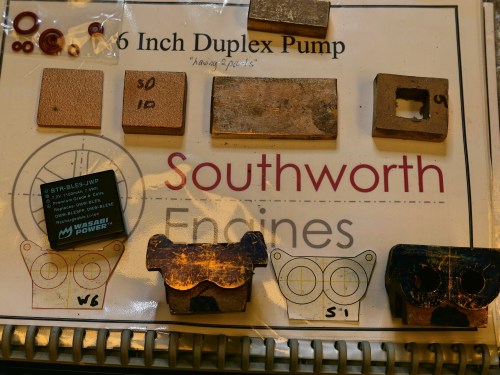
I did have to ring my advisor and friend Stuart, for some advice, and he asked after the Trevithick.  I am planning to fire up the boiler, and run it on steam on Sunday.  Stuart indicated an enthusiasm to be present, an offer which I gratefully accepted.    Tomorrow is committed to a book launch by my cousin Karen Viggers, who has written 3 or 4 books.  She wrote “The Lightkeepers Wife”, and “The Stranding” (my favourite).  I am looking forward to reading her latest book.

So Sunday night, all being well, you will see a video of the Dredger Engine running on steam.

Drilling is not boring

Firstly the base.  I wanted to drill all of the wooden pieces together, to make sure that they aligned, even if the lengths weren’t absolutely accurate.  Wood is like that.

So, using the bottom piece as a pattern, and squaring each piece as it was placed, I glued them together using PVA glue.

IMG_7571.JPG

And squaring each piece as it was placed.

IMG_7572.JPG

Those angle blocks made handy glueing weights.  The short bits are intentional.  That allows the flywheel crank room to rotate.

img_7573.jpg

My workbench.  I needed some room, so I tidied it.

IMG_7574.JPG

That is better!

Now some short videos of the drilling.  Sorry the videos are so short.  If my Internet connect was better I would have stitched them into one video, but alas…

I was intending to show making a 5mm drill bit longer, by silver soldering a piece of 5mm drill rod to the bit, end to end.  I have done this before, quite successfully.  Silver solder is very strong.   Almost as strong as the parent metal.  But in this case it was unnecessary, as the videos will show.


Error
This video doesn’t exist
Error
This video doesn’t exist
Error
This video doesn’t exist


Error
This video doesn’t exist
Error
This video doesn’t exist
Error
This video doesn’t exist
IMG_7582.JPG

With the base complete and bolted to the engine, I made the last pipe connection joining the feed pump to the pre-heater.

IMG_7584.JPG

Ready for the first run on steam next session!

A Long Drill Bit

I have not been looking forward to attaching the Trevithick Dredger Engine to its base.

I needed to drill through the steel plinth and the wooden plinth, and then through the top part of the base.  Trouble was that the boiler and engine were in the way.

And it was not feasible to tip the whole assembly upside down and drill from underneath.

Ahah! what about a long drill?   I measured it.  The drill would need to be 450mm long!  Even a long drill bit, ferociously expensive, comes at a maximum length of 150mm.

So, I made a long drill bit, 5mm diameter, 600mm long

IMG_7565.JPG

That is a new 5mm cobalt drill bit, silver soldered into some 8mm drill rod.  Could have been a bit shorter, but it was long enough.

IMG_7567.JPG

Using the long drill bit, I was able to drill through the steel support, and through the top wooden layer of the base.   Then bolted the parts together.   And was then able to place the engine and the wooden layer on their ends, and to drill the remaining holes from below, confident (fairly confident anyway), that nothing could go wrong.   As in the above picture.

IMG_7568.JPG

Meanwhile, I had added the valve which controls the boiler feed pump output, and connected it to the boiler feed pump.

IMG_7569.JPG

Boiler feed pump valve.  This valve was left over from the vertical boiler project.  Just right, when I have repainted it.

IMG_7570.JPG

Next I must drill a 5mm hole through all layers of the base.   150mm!  4 holes, one in each corner.   The long drill made today will not do because the 8mm shank is too thick.   I must make another long drill, with a 5mm diameter shank.  Watch this space!


Moon

I know that this blog is titled “johnsmachines”, but I do get interested in “other stuff” too.

I came across this video on YouTube yesterday.  It runs for 4 hours.

The footage was shot by an amateur astronomer, through telescopes which anyone can buy.  A 9.5″ Celestron  reflector (Schmitt Cassegrain I think),  and an 80mm Orion refractor.

I used to be an amateur astronomer, and still retain an interest.  One of my worst decisions ever was to give away an Orion 10″ reflector about 10 years ago.

Anyway, back to the video.  It shows the surface of the moon, concentrating on some interesting areas.  Following are some screen shots.  It is titled “Live Moon Surface Observation”.  Worth a look.  Suggest jumping to 28minutes and watch maybe 5 minutes, zooming in and out.

Screen Shot 2019-02-20 at 6.53.00 am.png

80mm refractor.  Look at the protruberance in the top left crater.  Looks like a clenched fist.  That is really unusual.  Impact craters often have a central spike, and it is thought that the moon has had volcanic activity in previous aeons.  But there is no atmosphere to cause wind erosion, and no surface water.  Just traces of ice in the depths of craters at the poles.  So how could that shape have arisen?   And look at the bottom right crater…. that rectilinear shape.   Circular shapes are meteor impacts, in many case impacts upon impacts.  So how do you explain straight lines like these?

Screen Shot 2019-02-20 at 6.39.51 am.png

The same craters through the reflector scope.  Image reversed.   Look closely at the areas surrounding the craters.  Do you see the other rectangular and square shapes?

Screen Shot 2019-02-19 at 7.35.54 am.png

Close up of the fist.  Pixellation appearing.

Screen Shot 2019-02-19 at 7.42.50 am.png

Enter a caption

Earth’s moon is strange.

It is the largest moon in the solar system relative to the parent planet.

It is much less dense than earth. (why? if it is made of the same rock).  (5.51g/cm vs 3.34g/cm.  Thought to be due to Earth’s metal core.)

It almost exactly blocks the disk of the sun during a lunar eclipse.  Coincidence?

The other side of the moon always faces away from earth.  Until the space program, no human had ever seen the other side of the moon.  The other side, incidentally, is quite different from the side which we see.  Much more cratered, no large flat areas.  Presumably most meteors come from the direction away from the sun (because they are scooped up by the gravitational field of the sun).
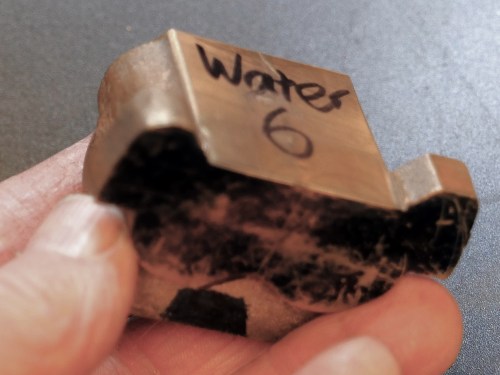
One moon day is exactly the same length as a lunar month.  It is the only moon in the solar system where this applies.  That is why the other side of the moon always faces away from earth.  Another coincidence?  (correction.  Pluto – Charon also exhibit this behaviour, so it is not unique, just unusual.  Thought to be due to “tidal locking”- thanks Gene).
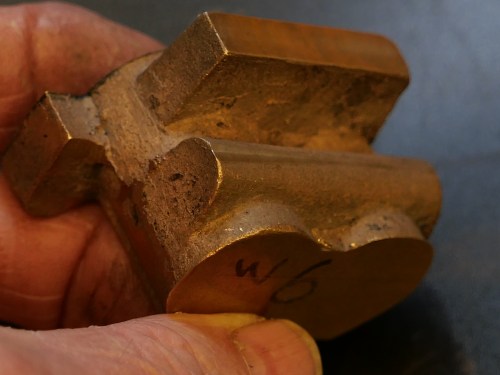
OK.  I know.  You came to this site to look at my machines, particularly the Trevithick dredger engine.   I am still fiddling with small details which are not very photogenic, but necessary before I run it on steam.  Currently hooking up the boiler feed pump.

IMG_7560

IMG_7561.JPG

I was intending to pull apart the pump to show you the components.  It is more complicated than the exterior shows.  Piston, O ring, 2 stainless steel balls, one spring.  I machined that 3 way junction box from a gas fitting, adding the delivery union to the top.   Nothing tested yet.  I hope that it works!


Sight Glass on the Trevithick Boiler

Not real happy about this one, but it is necessary if I am to run the dredger engine in public, at club meetings etc.

The original dredger engine had 3 taps to check on the boiler water levels,  like this.

IMG_7162

An earlier stage of construction, using taps to reveal the boiler water level.

Unfortunately that setup is unacceptable for boiler certification, so I have installed a sight glass using the same penetrations.

IMG_7556.JPG

The red colour does not help.  But when I run the engine on steam, this is what will be seen.   Functional, but nothing like the original.  If I use compressed air, or steam from an outside boiler (i.e. my burner not being used), I can reinstall the taps.

The sight glass is a bit short, but it should comply with the regulations.

I have spent another half day experimenting with different spring configurations, so that the safety valve releases at 40-50psi.  Eventually I decreased the coil pitch of the spring, and the valve now releases at 45-50psi.  That will do.

Trevithick Dredger Engine. The Dredger

I have no intention of modelling the dredger, but in making decisions about the engine base have gone back to the sources to find out about the gun ships.  These are referred to as “gun brig”, “bomb-ship”, “hulk of a dismasted ship”, in letters by Trevithick and others.

The first three of these dredgers were recorded by Trevithick as being 80, 120 tons and 300 tons.

Trevithick dredger on Thames - Rees

This diagram is probably of the dredger “Blazer”, with a 6hp Trevithick engine powering the bucket chain and winch. The cylinder diameter was 14.5″ and the stroke was 4′.  Trevithick recorded that his dredger would lift 100 tons of mud per hour.  Rock and gravel 180 tons per 6-8 hour tide.  It must have been impressive enough for him to obtain a contract to lift 500,000 tons per year from the bottom of the Thames at 6 pence per ton.   Other dredgers had Trevithick engines of up to 20hp. (ref. “The Life of Richard Trevithick” by Francis Trevithick 1872)


Screen Shot 2019-02-16 at 6.06.32 pm.png

Magnified view of the engine house on the dredger.  Note the relative sizes of the flywheel and the bucket chain driving gear.


And this is the diagram of a cross section of a bomb-vessel from a century before Trevithick.  It is mounting a 13″ bore mortar.  Note the massive supporting beams.  You can see why Trevithick chose this type of vessel to mount his steam engine and dredging machinery.  IMG_7452 2.JPG

A Tour of the Model Dredger Engine

Now that I have a tripod for my video camera (an iPhone), I have become a bit more enthusiastic about making videos.  Terrible standard of video compared with Joe Pieszczynski, and This Old Tony, and Stefan Gotteswinter, but maybe better than just text and photos.  I will be interested in your responses.

The Dredger Engine is still not quite fully made, but while I had the video set up for the spring making exercise yesterday, I added the following.   It is totally unscripted, and unedited, so there are errors.  “pressure valve” instead of “pressure gauge” for example.  Have fun counting the errors.   The final 30 seconds is me having difficulty turning off the camera!

Error
This video doesn’t exist


Making Springs and Other Stuff

Other stuff first.

MOVING STEPS

SWMBO has always considered that having a winch on a vehicle is a bit of a wank, but I have used it many times getting out of bogs, getting other people out of bogs more often, moving machinery, pulling down/moving trees, straining fences etc etc.   SWMBO was intending to replace these concrete steps, because they were crooked with respect to the house which she is fixing up.  I said that I could straighten them.

IMG_7511.JPG

This is after straightening.  I jackhammered the path slab, lifted the floor slab with the 4WD high lift jack, and pulled the steps with the Landcruiser winch.  Easy as.  Took 30 minutes.  SWMBO was delighted!   

MAKING SPRINGS

And I used my new spring tool.  Brilliant!  Recorded on videos.  Again, apologies for my lousy video technique.  I had forgotten to bring the spring making instructions, so it was all trial and error.

IMG_7488.jpg

This was my first effort.  Aluminium wire, just to try the tool.  As you can see, there were multiple errors.   Feed rate too slow for the RPM, forgot to enter a stop command at the end, feed rate much too slow at the beginning on the left.

So I started with aluminium, making many mistakes, sometimes repeatedly, but eventually learning.  Progressed to soft iron wire, and eventually to stainless steel spring wire.

Following is a series of pics and videos.


The mandrel was 4mm diameter, and there was a bit of spring back, with the final ID of 4.4-5.0 mm.

IMG_7489

Initially I secured the end of the wire by catching it in the collet, but quickly replaced that method, and drilled a 1.5mm hole in the mandrel.  Again, I forgot to issue a stop command in time.   The starting coils were hand wound by manually turning the spindle and jogging the feed.  If I was making multiples of the same size spring that would be simple to program on the CNC.

IMG_7492

Ah!  Getting the hang of this!  That one looks good!

In the next video, a good spring is made.  The mandrel wobble is occurring because I had bent the mandrel, when the steady was not hard enough against it.  Bend straightened afterwards.


Error
This video doesn’t exist

And the safety valve with its new spring…


Error
This video doesn’t exist

But screwing in the safety valve was a bit of a struggle…


Error
This video doesn’t exist

And re-installing the safety valve lever was almost comic..


Error
This video doesn’t exist

So, that’s it for this post.

How did you like the videos?  I suppose that I should have stitched them together into one long video.  Maybe I will do that later for YouTube.   And to edit out all of the errors.

Later today I will post another video, this time a longer one, a tour of the Trevithick engine.

Well, what a nice day!

Wednesday is always a good day.  That is when our model engineering group has its weekly meetings.  Mostly a 2-3 hour informal gathering around a large table, chatting about current projects, new tools, the weather, rarely politics or religion.  Coffee.   And once each month a more formal evening meeting, involving discussion of club business, “models on the table” and usually a guest speaker.   Today was the informal 2-3 hour chat variety.

I used the opportunity to ask about methods of making a rectangularish water tank for the Trevithick dredger engine, riveting, folding brass, caulking with solder, etc etc.    And Stuart T, knowing that I had to make a stainless steel compression spring for the safety valve of the Trevithick, brought in his tools for making springs.

This is one of the tools.  It was designed by Dwight Giles, and made by Stuart.

IMG_7486.JPG

Published in Model Engine Builder 2007.

The tool is mounted in the lathe tool post.  The V supports the chuck mounted mandrel, and the brass washers apply drag to the spring wire.  The lathe threading gears supply the pitch to the spring.  Looks excellent, and I was hoping that Stuart was intending to lend it to me.  Otherwise I would make one of these tools.   But why were there two of the tools?   “Oh, one is for you!  I was making one for myself, and it was just as easy to make two.”

Not the first time have I been the recipient of Stuart’s generosity.  When I make the spring (soon) I will take some pics, and post them here.

Later in the meeting, Swen Pettig, recently returned from a fabulous trip to Scandinavia and UK, called for shoosh, and stood up to make a presentation.  Some people knew what was coming.  I didn’t.  But in “recognition for writing about his model making” (now my ears pricked up), Swen had picked up an item in the UK which he thought I might find interesting.  Knowing of my current interest, some might say obsession, with Richard Trevithick, he had looked for and found the following item.

IMG_7484.JPG

A Two pound coin.  I did not get the significance, until I looked more closely.  Holy Shit!  That is a Trevithick engine on the coin.  The Pen-y-Darren railway engine if I am not mistaken.  Made in 1804.  And using many recognisable features which are in my slightly later dredger engine.  The coin was minted in 2004, 200 years later.  Wow!!

I did not even know about the coin until today.  But I am honoured and very grateful for this lovely gift and thought, Swen.

One wag suggested that I should make another gas knob for the engine, and mount the coin in the knob. (thankyou for the suggestion, President Brendan.  I will do no such thing).  It will be a  valued possession.

Incidentally, the reverse of the coin has an image of the Head of State of Australia.

img_7485.jpg


Gas control on an historic model?

Well, no likes and no comments on this morning’s post… no picture the problem????   hmmm???

So, this afternoon, the weather was windy and wet, and unsuitable for winching concrete steps, so I retreated to the workshop.  Much to SWMBO’s disapproval.

And did a bit more with the gas supply and control.

IMG_7479.JPG

And that is what it looked like.

IMG_7480

OK, except that Primus knob does not appeal.  And the wooden base is looking decidedly wonky.  More about the base later.  I have some improvements in mind.

IMG_7481.JPG

This wheel was a reject from my triple expansion steam engine model.  I wondered if it would look OK on the Trevithick.  It certainly looks better than the Primus knob Yes/No?

Possibly not historically accurate, but maybe yes for 1850-60?


Historic Model Compromised?

I was attempting to model the Trevithick Dredger Engine as true as possible to the original.  But, I also wanted it to run, so the flywheel would spin and the crosshead move up and down and the unusual valve control lever flick up and down.

There are several problems with this approach.

  1. The 1 in 8 scale.  This is the biggest problem with making a model.  Since the scale applies only to linear dimensions (e.g. the boiler is 6″ diameter compared to 48″ for the original), surface areas are at a scale of 1 in 8×8 (1:64) and volumes and weights are at a scale of 1 in 8x8x8 (1:512).  So my little model weighs a few kilograms (not actually weighed it yet) compared to 4 -6 tons for the original.   It does mean that there is a safety advantage in scaling down, in terms of boiler explosion risk, despite the fact that the model will be run at roughly the same boiler pressure as the original (50 psi).
  2. Some components do not scale well.  For example, the square nuts.  To my eye, they look too big.  If I was to make another of this model, I would make the fasteners smaller.
  3. The requirement of the model actually running.  The original was fired with coal, or in some situations wood, and even dried animal dung (in Peru, look it up.  There was no coal and no trees in the silver mines area).  I have made my model so that it could run on coal, but to be honest, that is unlikely to happen.  So I have made a gas burner.  And that involves gas pipes and regulator valve, which are impossible to conceal, and detract, IMO, from the appearance.
  4. Boiler regulations.  I want to run the model at club exhibitions, which means that the boiler must be certified.  The boiler certification regulations make no special allowance for historic models, so several compromises have been made.  For example a pressure gauge has been installed, and the water level taps must be replaced by a glass sight tube.  Not a biggie I guess, but it all adds up.  I will keep a separate set of parts which can be used when it is displayed as a static model, which will be most of the time.
  5.  Is this a model dredger engine or a model factory or mine engine?  I still have not decided.  Hence the rather ambiguous base.  I do not intend to build a dredger or section of a dredger, or a factory or mine or parts thereof.  But I have to admit that the base which is appearing in the photos so far does not look “right”.  Still pondering that one.
  6. And finally the colours.  Although Trevithick was a brilliant engineer, he was no artist.  I doubt that beauty, or attractiveness of line, ever entered his thoughts when he was designing.  If his engines were painted, the colour was probably utilitarian black.  Not that we know.  I can find no reference to colour in any of the works about Trevithick and his engines.  And there is not a skerrick  of original paint on the original engine in the London Science Museum, as far as I know.  Later engines, in the Victorian era, were painted in gorgeous colours, and I am tempted to paint my model as if it were a Trevithick engine which was being used in the Victorian era.  That is not so silly.  It is known that Watt engines, and even Newcomen engines were still being made in the 19th century, and Francis Trevithick records that many of his father’s engines were in use in the mid 19th century.  That little subterfuge could also explain why my model has a pressure gauge and sight glass!

I had a full day in the workshop yesterday, so I had better front up and straighten those steps for SWMBO.   Actually, it will an interesting job.  I will use a 4WD high lift jack(s) under the house to free the steps, then use the Landcruiser winch with a snatch block to pull the concrete steps into position.  Might be worth a photo.  How the steps ended up out of position is a mystery.


Fitting the Boiler Feed Pump to the Trevithick Dredger Engine.

The feed pump is attached to the base, and since I had not decided on the final form of the base I had to leave the pump sitting all alone on my messy bench.

But I have now decided to proceed with a wooden base, made of 32x32mm hardwood beams, and a solid wooden top to which the engine and the feed pump are attached.

So today I attached the feed pump.  The engine itself is still just sitting, not attached.  And the bits of the base are still a loose pile of beams of wood, not bolted glued or screwed together.

One minor problem was that there were incomplete dimensions on the plans for the feed pump and its supporting column.   Fair enough.  I assumed that the dimensions would be measured on the job.

First I had to make the steel beam which attaches to the cross head, and the column at the other end, and the pump… 3 attachment points.  I had cut out the beam last week, but it needed a couple of bends.   It was 4mm thick steel, so I did the bending in the workshop press.

IMG_7476.JPG

Bending the feed pump beam.

Of course one of the bends was too angular, so a bit of cold blacksmithing to flatten it.

And fitted everything to the engine sitting on the base.

IMG_7478.JPG

The holes which were drilled in the top of the base were a bit of a guess, because the distance between them was not on the plans.  I drilled them 28mm apart, but it was clear after assembly that they were too close together.

Then the penny dropped.  The holes in the base should be the same as the corresponding holes in the steel beam… 32mm.  so I filled one of the holes with epoxy filler, redrilled it, re-tapped it and reassembled everything.

IMG_7477.JPG

The re-drilled hole and filler are hidden beneath the feed pump.  The space in front of the boiler face is now occupied by gas piping and a gas control knob.  Not quite finished so no pics yet.  Notice the boiler pressure gauge on top of the boiler.  Not as per R Trevithick, because the Bourdon tube type pressure gauge was not invented until 1849, but it is required for boiler certification.   Maybe I will label this as a model of a Trevithick engine which was updated in 1850.

Next to make the pipe between the feed pump and the boiler feed pre-heater, and a bypass tube with valve.   I have not decided on the size or form of the water supply tank. A riveted squarish tank, or even a riveted cylinder would be nice.   Probably make do with a plastic bottle for the time being.

I also need to fasten together those base beams.  Have still not decided how to do that.

There are 4 types of wood in the base.  I might have mentioned one or two of them.  One is the top, one is the beam under the front of the boiler, the base beams is another, and there is a sizeable block underneath everything.  I doubt that anyone will be able to identify all of the wood types.  2 are Australian, one is European, and one is Asian (I cut up a breadboard for that one).

And thinking about a colour scheme.  Flat black is the favoured colour in most other models, but I want to include some Georgian reds blues greens or yellows.  And leave a bit of brass and copper for polishing.

Oh, and I made a ring for the top of the chimney.  Seen in the second pic.

A Day In The Workshop.

One of those days.

Warm night.   Restless sleep.  Woke at 4:30am.  Got up.  Dressed.  checked the emails, blog, Facebook.  Dozed until 8am.

Went to workshop. (15km drive).   SWMBO a bit peeved because she assumed that I would install some laundry cupboards and straighten some outside steps at the property which she is preparing for sale.  Baby sitting yesterday was fun, but I was thinking about the burner on the Trevithick.   So I told SWMBO that I would do an hour or two at her job at the end of the day.

So I went to my workshop, and started mounting the permanent pressure gauge on the Trevithick dredger engine.   It was fiddly, not totally satisfactory.  I dropped things.  I burnt my fingers several times.  I could not remember where I had put things 5 minutes earlier.  The workshop is really in a mess and I should have just tidied it up.  But I didn’t.  I had not had breakfast because the bread was mouldy and my normal cereal was empty so I skipped breakfast.  Except for coffee of course.  I cannot skip that.

Eventually the pressure gauge was mounted.  I thought about running the engine on steam and making a video for the blog, but I was just not in the right mood.

I packed up, and went to where SWMBO wanted me, and installed some cupboards.  Oddly satisfying.  Only took an hour or so.  SWMBO was happy.  I made some lame excuse why I could not straighten the steps, and went home and had a few reds.

Shit day in the workshop.  But sure beats working.

Trevithick Dredger Engine Burner

Reader Huib suggested that I would need to modify the gas burner for my model steam engine even before I had tried it.

He was absolutely correct.  The burner was difficult to light and keep going, unless I blocked off at least half of it. (see previous post).

So, today, I modified the burner along the lines suggested by Huib.

img_7463.jpg

I added this stainless steel tube with drilled holes to the bottom of the burner, underneath the fire clay burner.  It is wedged into position.

And this was the result.  The burner li up easily when gas was admitted.

img_7461.jpg

From above you can see that the fireclay burner is red hot over most of its surface.  And hottest at the end which is deep inside the boiler.

I measured the temperature of the burner, and it was 790ºc.  I think that it will do nicely. After that, I sealed the fire clay burner into the brass container with a high temperature boiler sealant.

Yesterday I received in the mail a tiny pressure gauge.  3/4″ diameter, 0-80psi.  from EJ Winter, Sydney.  Order was placed Wed, arrived Thurs.  Great service.  Thanks Ben deGabriel.

Trevithick would not have had a pressure gauge in 1803, but modern boiler regs insist on one, so I have bowed to the inevitable, and will install this gauge on top of the boiler.  Photos to follow.   I expect to be running the engine on steam next time I am in the workshop.   WooHoo!   Not tomorrow though.  Baby sitting.


Trevithick Gas Burner Problems

Today I connected the gas burner to a propane bottle, and it would not light.

IMG_7456.JPG

The jet, tubing, control knob, and connectors were removed from an old gas camping stove.  The camping stove burner is in the picture above.

The only way that I could get the engine burner to light up was to block off about half of the outlets in the ceramic burner.

IMG_7453.JPG

With half of the burner blocked, the other half produced a nice hot flame, but whenever I increased the open area the flamed spluttered, and died.

IMG_7454.JPG

The more area exposed, the worse the flame.

IMG_7455.JPG

..And eventually it died.  Adjusting the gas settings made no difference.  Blocking the other end of the ceramic burner resulted in being unable to light it at all.

It appears that that the gas air mixture is being blown to the distal end of the burner, where it will burn.  But if too many holes in the burner are exposed, it just will not function.

So, I came home to ask for advice from my readers, and lo and behold, before I even opened up the blog I checked my emails, and there was a message from reader Huib who predicted the problems after looking at yesterday’s post, and told me how to overcome it.

Huibs letter,

Hi John,

I have read your blog about the gasburner, I  suggest that you  make a brass pipe with small holes in it to spread the gas all under the ceramic stone, otherwise I think the stone will only fire up at the beginning of the stone.

Or as I did, fill the space unther the stone with stainless steel wool, this material will also ensure a spread of the gas under the stone, but not as much as a brass pipe with holes.

I have the stone sealed in the holder with stove kit, this kit is heat resistant.   I think that is available in your area.


Regards Huib

2019-02-06 07.47.18.jpg

There are some aspects of this blogging business that I really like!!  I will let you know how the suggestion works in a couple of days.   Thanks Huib!!!


A Gas Burner for the Trevithick Dredger Engine

Last post I asked if anyone could guess what the redgum pieces were going to be used for.

IMG_7429

Today I turned up another piece of the puzzle, which might be helpful..

IMG_7435.JPG

IMG_7436.JPG

And look where it fits..with a 1mm gap.

IMG_7439.JPG

IMG_7441.JPG

Just to bend a piece of annealed brass in the press.   Hmm.. I wonder where this will fit..

IMG_7443.JPG

Ah… now I see…

IMG_7448.JPG

Silver soldered.  Ceramic burner needs to be cut.  Diamond saw?  Maybe I will try the bandsaw..

IMG_7449.JPG

Well, that is surprising.  I expected that the ceramic material would laugh at the bandsaw blade.  But no problem at all.  Like a hot knife through butter.

IMG_7451.JPG

After sawing the burner roughly to size, the edges were given the curved contour with a belt sander.  Again, easy as.  It is sitting in position, but needs the edges sealed with some heat resistant goo.   Any suggestions?

The gas burner will be easy to remove if I ever run the Trevithick engine on coal.  I am still fiddling with gas jets, hoses and connections.

Trevithick Dredger Engine – Base -4

Reader Jenny asked about original mounting methods for the dredger engine.

This picture appeared in the Rees Cyclopedia of 1819, and as far as I know, is the only picture exisiting of the engine in its use as a dredger engine.

Trevithick dredger on Thames - Rees.jpg

Gun boats had no method of propulsion, so they were towed into position.  They were very strongly constructed to withstand the enormous forces of firing cannons, mortars and siege guns.  Often they carried only one very large blackpowder gun.  Trevithick chose one of these vessels to mount his steam engine to dredge the Thames.  Somewhere I have seen a drawing of the construction of one of these vessels, showing the massive oak beams and thick deck.  At this time I cannot relocate the drawing, but when I find it I will post it.

Many more of Trevithick’s “strong steam” engines were used to pump out mines, and operate factories and mills.  We can assume that those engines would have been mounted on a base of bricks, stone blocks, or large wooden beams.  The engines weighed about 4 tonnes, so it is possible that they just sat on the strongly constructed factory floor, with a slot for the flywheel and driving gear.

And in writing this I have come across another drawing from the Trevithick era of one of his engines mounted for use in a factory.  This layout drawing was by John Rastrick, an engineer at Hazeldines, who made the engine which is in the London Science Museum.  It shows a 4 hp Trevithick puffer engine, driving 2 “scouring barrels” and “a set of polishing lathes”.

Screen Shot 2019-02-04 at 5.55.27 am.png

Screen Shot 2019-02-04 at 5.56.25 am.png

This is very interesting to me.  First, the engine mounts are likely to be masonry, possibly topped with wooden beams.  The flywheel is mounted not on the crankshaft, but on a separate, extra shaft.  The connecting rods are straight, and rather too thin to be wood;  more likely steel or cast iron.  The safety valve weight is suspended on a long shaft, well away from the front of the boiler.  The front boiler support has angled ends, not squared. The crosshead has tapered edges, not parallel.  And the firebox door is approximately as I had guessed it, although rather smaller proportionately than the firebox than I have made it.

I am sure that this is not intended to be an accurate representation of the details of the Trevithick engine, but I suspect the engineer who drew it would have got the proportions approximately correct.

Wonderful!

Now I have to decide whether I have made a model dredger engine, or a model factory engine.


Trevithick Dredger Engine Base.- 3

Just a quickie.

One of our GSMEE members, Stuart Tankard, solved the base issue on his most recent engine build like this….

20190203_183226.jpg

Those bricks are CNC’d out of aluminium bar.

Reader Huib suggested that if I follow suit, I should program in some imperfections!

Maybe I will ask Stuart to make my base.  (relax Stuart.  I wouldn’t do it to you.)

Trevithick Dredger Engine Base -2

It is odd how the most trivial part of the model dredger engine, the base, seems to have occupied more consideration than any other parts of the entire boiler and engine.

Thankyou to those readers who have offered opinions about the base options.  The most common design preferred, including SWMBO,  was the brick base.  I am still thinking about that one.  Meanwhile, here is a photo of the engine sitting on the blocks of wood which I had cut yesterday.   Not joined yet.

IMG_7420.JPG

SWMBO opined that it looks a bit “bitsy” and clunky – (I always get an honest opinion from that one). To me it looks sturdy and believable and functional.  And it would be darker when finished.

Another really hot day here, so just an hour or so was enough in the workshop.  And this is what I made.    Can you guess what it is for?  It is made of redgum, a very hard dense Australian eucalypt.

IMG_7422.JPG

Held as firmly as possible in the 4 jaw, Center drilled, then 16 mm through drilled.  The check does not matter. 

IMG_7423.JPG

Then 30mm

IMG_7425.JPG

Then 49mm

IMG_7429.JPG

Then  bored to 60mm and split.   135mm long.

It will be used in the next workshop session.

Trevithick Dredger Engine Base

This may well not be the final version of the base for the model dredger engine, but of the alternatives it is the simplest to build, so I will put it together and see how it looks.  Most readers who responded to my query for opinions about alternatives opted for the model bricks base, and that remains a possibility.

But the wooden block base is attractive because it is simple, has a reminiscence of the gun boat origin of the dredger, and would be easy for me, a previous woodworker, to build.

This is how it would look..

Trevithick wood blocks.JPG

The top is European oak, chunky, simple.  Has some appeal.  Would look more appealing when fastened and polished.   The top would be grooved, to look like thick oak decking planks.

By no means committed to this option, but considering it.   The square section wood is Australian Mountain Ash, a superb furniture quality hardwood.

Trevithick Boiler Feed Pump, and a base.

Quite a few potential workshop days are being foregone because we in southern Oz are experiencing a very hot summer.  And the few more moderate temperature days are “lost” to essential jobs for SWMBO, and around the house.   Shouldn’t complain about the weather.   Townsville, Queensland, where my brother and family lives, has been declared a disaster area due to torrential floods…  1000mm (39″) rain in the last few days, with more on the way.  And the next ice age has apparently started in USA.

But,  back to the workshop for a few hours here and there, I have made the boiler water feed pump for the Trevithick dredger engine.   As usual, I grossly underestimated the time these few simple components would take to make.

IMG_7413.JPG

The pump is driven off the crossbar where the stroke is 100mm (4″).  At the pump, the stroke is ~17mm (~5/8″).  The suction side has an 8mm (stainless steel) non return ball valve and the delivery has a 6mm non return SS ball valve.  The plans specified a dummy pump, for appearance only, but I have made it functional.

IMG_7417.JPG

The 2mm ss cap screw is to limit the ball movement to 0.8mm travel.  Something less conspicuous will replace the cap screw.  Probably a ss grub screw.

The rod driving the pump piston is a piece of bronze brazing filler rod.  Just happened to be the correct diameter.

I will need to add a further pump, hidden somewhere, for boiler approval.  It will probably be a hand pump.

The next step is to design and make the stand for the engine.  The plans specify a large, and in my opinion –  ugly, wooden box.  So that is not on my option list.

Most of these “dredger” engines were used in factories and mills.  Some were used to drive mine pumps, and a few were used on dredgers.  In the factories and mills they would have sat on masonry or wooden bases, and on the dredgers they would have sat on the very solid decks.  (the dredgers in some cases were converted gun ships, designed to mount large black powder cannons,  mortars or seige guns, so they were very solid!)

Now, some pictures of other dredger engine models, and the reconstructed full size one, and their bases.  I have numbered the pictures, and I would be interested in my readers opinion about which would best suit my model.  Please leave a comment.


B002617|10280908

1. The engine as mounted in The London Science Museum, on large wooden blocks.

Dredger1.jpg

2. A Model Dredger Engine on a masonry base.  I could do something similar, but I would used aerated concrete.

images-6

3. A very simple wooden base.

Screen Shot 2019-02-01 at 10.39.21 am.png

4. A beautifully crafted model on a cabinet maker’s base.  Acknowledgement to fredyfredy42.                                              I like the colour scheme too!

Screen Shot 2019-01-30 at 5.30.56 am.png

5. Another simple wood block base, reminiscent of the gun boat decking and frame.

odellen 2 137 (69).JPG

6. An elegant wooden base

fullsizeoutput_f29.jpeg

7. And finally, the modern, aluminium base for the beam engine which I made a few years ago.  I like it on the beam engine, but I doubt that it would look OK under the Trevithick.  The dredger engine is shorter, taller, and narrower.


New Oxy-Propane Torch just watch!

Yesterday I took delivery of a tiny oxy torch.  I guess that most buyers would be jewellers,   but if you watched my post about silver soldering the tiny Trevithick dredger engine firebox door hinges, you will understand my interest in this Ebay offering for $AUD28.

I am experimenting with making videos for this post, so please excuse the amateurish faults in the following videos.

And here I am experimenting with the tiny torch.  Frankly, It is probably not up to the job here, but it was interesting trying it.  I can see that it will be very useful for other small jobs.

Please excuse the awful video technique.  I can see that I need a better camera, tripod, and technique.

This little oxy – propane/acetylene/MAPP gas/hydrogen/ etc is pretty awesome.

And BTW, the leak in the water pre-heater was fixed!

Brass Lust

Record hot temperatures in Australia today.  Highest temperature ever recorded in Adelaide 46ºc 114ºf.  And Alice Springs has now had 14 days over 40ºc.  Not so bad in Geelong 39ºc 102ºf,  but too hot for my workshop.

So I decided to celebrate the running of the Trevithick Dredger Engine 1:8 model, by driving to Melbourne and stocking up on round rod brass.

Geelong is 65km from Melbourne, freeway all the way, but the non ferrous supplier is the other side of Melbourne,  in Clayton, 100km away.   About a 2 hour trip.  But what better to do on a hot day.   And I had a new audio book to listen to.   (The book is “A.D   – After Disclosure”.  Yes, I am close to certain that UFO’s are real, of non terrestrial origin, and that their existence has been known to various militaries and governments for up to 70 years.  Another story.)

So I arrived at George White P/L in Clayton, and told the guy that I wanted a 3.6m length of every round brass section, metric and imperial, up to 22.11mm (7/8″) diameter, cut into 1.2m lengths so I could carry them in my car. (I had some 25.4mm 1″ already)

I had told SWMBO that I was going to spend a few hundred dollars, and she just responded “that’s OK, a lot cheaper than joining a golf club”.  So, without really doing a detailed calculation, and with that permission, I just sat back, and waited.

As the bundles of brass rod gradually accumulated on the bench, I was thinking….”Hmmm, that is a lot of brass”.

Then there was the offcuts box.  It was full of chunks of brass and bronze and copper.  At the flat rate price of $AUD6 per kg.   So, as I waited, I made a pile of all the bits that I thought would look good in my bits and pieces bin in my workshop.   It came to 34kg (75lb).   Eeeew.

Needless to say, the final bill came to more than a few hundred dollars.

But you know what?  I am really delighted that I can stop rummaging around and making do with wrong sizes, or machining little parts out of big bits of brass.

I do wonder if I will ever use up all of this round stock.  Some will probably be used by friends and members of my model engineering club.   Some will probably be there when there is a “clearing sale” after I snuff it.

Reminds me of a sign which I saw at a steam meeting   “When I am gone, I hope that my wife does not sell my engines for what I told her I paid for them”.

Timing the Trevithick Dredger engine-4

Success!!

After the debacle of the valve sleeve rotating because I had not secured it, I secured it with a grub screw, and had another attempt at running the engine today.

But before that I shortened the valve lever blocks by 2-3mm.  I had noticed that air was entering the cylinder well before top and bottom dead centre.  Shortening the bars delayed the entry a bit.   Still a little bit before TDC and BDC, but watch the videos to see the result.


So, it is still not finished, and the timing will need some fine tuning.  But it works!   Phew..

It works in forward and reverse, depending on piston position when it starts, or if the flywheel is given a initial swing.

In the above videos the engine is not bolted to the box, and some of the noise is the cranks hitting the box.  The valve arm being hit by the striker is also contributing to the noise.

I will work on the gas burner next.


Timing the Trevithick dredger engine-3. How embarrassing….

As planned I removed the engine from the boiler, to discover why it would not work with compressed air yesterday.

IMG_7385.JPG

After yesterday’s failed attempt with compressed air, I removed the cylinder and piston and valve assembly from the boiler to check the steam passages, throttle and rotary valve. 

img_7383

These components were removed so I could see what was going on.

I wish that I had checked this before going into print yesterday.

I discovered that the bronze cylindrical insert with the steam ports had never been fixed/Loctited into position.  Clearly it had rotated with the first engine movements yesterday, causing all steam passages to be blocked.  No wonder I couldn’t get the engine to do anything!

And worst was that I had mentally made a note to secure the insert, when I inserted it, a month or so ago.

So today I drilled and tapped a hole for a stainless steel grub screw to hold the insert into position.  I decided not to Loctite it at this time, but will do so when I am sure that the timing is correct.  I might need to alter the shape of the ports, and the insert would need to be removed to do that.

IMG_7384.JPG

Tapping the thread for the grub screw using the shop built tapping head which I made to Mogen Kilde’s design a couple of years ago.  I have never broken a tap while using this tool.

After reassembling the components I ran another test with compressed air.

Somewhat to my surprise, at 20psi the engine ran for a few revolutions, before  settling down into a back and forth motion.  It still needs to be timed, but hey, it moves.  But by this time it was becoming hot in the workshop, so I left the timing for another day.  Maybe tomorrow pm.   Not Thursday because it will be HOT.  42ºc  (107.6ºf)


Timing the Trevithick Dredger Engine_ 2 making the fittings

Today I made the fittings which would enable timing the dredger engine…

IMG_7381.JPG

I needed access to the boiler for compressed air, and a temporary installation of a pressure gauge.  I decided to add a valve, so that I could shut off or adjust the compressed air.

I had made a safety valve, with a lead weight, but I had no idea of what pressure the valve would release, hence the gauge.  A spring had been specified in the plans, but I did not know whether it was actually required, so initially I left it out.

So, with the above setup completed, I turned on the compressor, and waited to see when the safety valve would vent.

It vented at about 20psi, a bit low.   So I added a spring.   That pushed the venting pressure up to 30psi.   At 30psi, the engine was still not turning over.

I was expecting that the engine would move at 30psi, but that the timing would need adjusting.   After an initial movement back and forth…. nothing.

The engine is still a bit tight, so maybe more pressure required, so I installed a heavier spring.

Nothing.

So I installed a heavier spring.  Pressure rose to 50psi before venting.  Still no movement in the engine.   Something is wrong.

Possibilities…

  1. The throttle is not working properly.  Maybe the plans are back to front, or I have made the throttle back to front.  I have made both of those errors in previous builds.
  2. The steam valve is back to front.  Yes, I have done that before too.
  3. There is a blocked steam-air passage.  Yes, I have managed that one before too.

Next steps…   re-examine the plans.    Do a tear down of the throttle and steam valves.   If no obvious cause for the failure of movement…. call for expert help.   Yep.  I have done that before too.

Timing the Trevithick Dredger Engine – 1. theory.

The plan is this…

  1. Finish constructing and installing all of the components, including gaskets, seals.
  2. Install a pressure gauge, in a temporary position.  Trevithick did not have pressure gauges available, but the current model boiler regulations insist on one.  So my plan is to have one installed eventually on the base, out of the viewing public sight, but where the operator (me) can see it.  For the purposes of the timing, which requires some pressure in the boiler, the gauge location will be on top of the boiler, but moved to its final position later.
  3. Install a fitting to admit compressed air to the boiler.  And a valve to adjust the flow and turn the air on and off.

IMG_7284

The lever with the hole controls the entry and exhaust of steam into each end of the cylinder. (The other handle is the throttle.)

The timing is adjusted by removing material from the blocks above and below the lever.  The blocks were made, deliberately, a few millimeters too long.

I will put some compressed air into the boiler, at about 20psi, and slowly move the lever until I hear air entering the cylinder at each end.  The lever position at which  air enters each end of the cylinder will be marked and measured.  Then the blocks will be machined or filed to the correct length.  I will assume that if the entry point is correct, then the exhaust will automatically be correct.

That’s the theory.

I have started making fittings for the pressure gauge and air couplings, and hope to get to the timing in the next day or so.   I will also be checking the pressure at which the safety valve lifts.  I will be aiming for 55-60psi.

Trevithick Dredger Engine. The con rod bearing wedges.

Well, if the comments and likes drop off again, I will threaten to take my bat and ball and shut down again.  10 comments so far on this mornings post (I Give in)!  Thanks everyone.  It is very encouraging.

So here is a Trevithick dredger engine update.

Yesterday and today I have been making and installing the wedges which secure the connecting rod bearings.  The wedges are only 2mm thick, and have a 3 degree taper.  They sit in slots also 2mm wide.

The 4 wedges were fairly simply milled out of 2mm thick brass sheet.  Steel would probably have been preferable, but if the brass wedges ever wear out I will make steel ones then.

The slots were milled manually.  I have some 2mm end mills, and I used them in the accessory high speed spindle at 18,000rpm, taking 0.3mm depth each pass.   Even so I managed to break 2 end mills.

This is the end result.

img_7379

The wedge is below the 3 square nuts.  It pushes on the split bearing.

IMG_7380.JPG

And similarly the wedge at the cross head end of the con rod.

The wedges have tightened up the con rod bearings, removing slop and noise.   They look a  bit rough in the magnified photo, but in reality are OK IMO.   Each wedge is individually fitted to its slot, so I have engraved them to identify the position for when they are removed later on.

Next job…. make a fitting to admit compressed air so the steam valve opening and closing timing can be adjusted.

I GIVE IN

I had decided to cease my WordPress subscription, and cease writing these blogs, recently, and a few readers have very kindly expressed regret about the impending demise of johnsmachines.com.

The annual WordPress fees increased by 23% a year or two ago, and this year they added a domain name charge which amounted to another 25%.  It adds up to about $aud160 each year, not a fortune, but it would buy a handy supply of end mills.  And the price increases are way in excess of inflation levels, and show no signs of slowing.

But more importantly, I do wonder just how much interest there is in the blog.  Roughly 150 people log in each day, and look at one or two entries each.  The “like” button is pressed maybe once each day.  And a comment is entered about once each day or less.  Not very encouraging.  I do wonder if I am wasting my time and money.

So those are the reasons I had decided to stop.

Then yesterday, a friend who I shall call Les, told me that he was very disappointed that johnsmachines was stopping, and how much he had enjoyed it.  He said that he was always pleased to get the notification of another johnsmachines entry, and reading what was going on in my workshop.

Les is paralysed from the waist down, the result of polio when he was a teenager.  He was a champion athlete when he was struck down with the then dreaded disease.  In those days, vaccination against polio was not widely available.  (If you would enjoy a highly articulate tongue lashing, just make critical comment about vaccination to Les.)  Despite the disability, Les worked full time, and was very active in the workshop, and at our model engineering club.  In fact he was one of the founding members of GSMEE, 30 years ago.   He has an incisive intellect, and when he speaks, it always pays to listen carefully.

So when he made that comment about johnsmachines.com, I listened, and reflected.

And I have decided to continue for another year.

(thanks also to Huib Hoogendoorn, Tim Gee, Brendan Wallace, daredesign, someone, Peter, Jenny, johnf, Ben, and others, who encouraged me to continue).


Another axis for the Boxford 125TCL

Watch the video of Stuart Tankard making tiny valve handles on his CNC lathe.  Changing the old Boxford spindle motor to a new generation servo motor allows him to use Mach3 to control the spindle to turn very slowly and to a set number of degrees, producing the very attractive handle cut-outs and rim dimples.  i.e. he has added the functionality of an indexing head to his CNC lathe.

It required adding a small milling head and motor to the toolpost.

I can see one of these on my Boxford 125TCL in the near future.

Trevithick Dredger.. attaching the flywheel and driving gear to the mainshaft.

The flywheel and driving gear both are attached to cranks which join the connecting rods to the mainshaft.  It is important that both cranks are attached with the same angularity.   Seems simple.  The cranks are identical.  But small taper holes, through brass and silver steel.

Drilling the 2 holes took most of the day.

Figuring the setup was the biggest challenge.

IMG_7329.JPG

This is the setup on the milling machine.  The mainshaft is cramped on parallels, and ends of the cranks are resting on smaller parallels.   The square sections of the cranks have been centered.

First problem was that the 2.5mm drill bits were not long enough for the chuck to clear the gear.   I did not have adequately small ER collets (would have required ER8’s), but I did have a Dremel chuck which was small enough.  But no spindle for the Dremel chuck.  The Dremel chuck has a really odd thread.  I measured it at 40tpi, and 7.05mm diameter.

So I made a spindle.   Thank goodness for CNC threading.

IMG_7331.JPG

The Dremel chuck and the shop made spindle.

IMG_7330.JPG

Dremel chucks are convenient, but they are not very accurate.  Fortunately, once the hole was centred, the drill bits and reamer seemed to follow the centred start.   Here I am about to ream the hole which has 3 steps   2.5mm, 2,8mm, and 3mm.   The shop made spindle is held in the milling machine drilling chuck.

I took the reaming very gently, not wanting any broken bits of high speed steel stuck in the workpiece…. and all was well.

IMG_7333.JPG

And here is the gear crank pinned to the mainshaft.

IMG_7334.JPG

And this is the setup for the flywheel end.   Fortunately, by good management or good luck, I was able to remove the flywheel, leaving half of the crank insitu, for drilling reaming and pinning.

IMG_7328.JPG

I spent some time assembling the cranks and testing the rotation movements.  It does rotate, but there is still some sticking on the guides, the cause of which I have not identified/isolated.

So I sat back and enjoyed one of my Xmas presents.   Ah!   Bliss!

Making a Lead Ball for the safety valve

The deWaal plans for the Trevithick Dredger Engine call for a 30mm diameter lead ball for the safety valve.

I considered substituting steel or brass, and turning the ball, but lead is almost 50% more dense than the other metals, and that could be detrimental to the functioning of the safety valve, so I worked out how to make the ball in lead.

I have previously cast lead balls 14mm diameter, but this is significantly bigger.  I did briefly consider making a plaster of Paris mould, but I could find no balls of the correct diameter for the POP mould, so I decided to mill the mould.

On rummaging through my big milling cutters, I discovered that I have a ball nose cutter, 31.75mm diameter.  It was part of a package of cutters which I had purchased years ago, and almost forgotten.  I had bought the cutters BY WEIGHT.  I think that I paid $US5 per pound, and I bought 20lb.  Mostly the cutters were resharpened end mills, but one of them was an unused 31.75mm ball nose.  Pretty close to perfect for this job!

IMG_7302.JPG

First I cut off two 25mm lengths of 40mm square solid alu bar.

IMG_7305.JPG

Then milled them pretty close to square and identical.

IMG_7308.JPG

Then used the 31.75mm end mill to make a hemisphere in each alu blank and drilled and tapped for a 5mm cap screw in each corner. 

IMG_7309.JPG

On the left is the mould, screwed together, with a hole drilled into the spherical cavity.  Here I am heating it in a frypan, ready to accept the molten lead, which is being prepared in the cast iron saucepan on the right.  I hasten to add that SWMBO knows nothing about this.  Those utensils are part of my workshop gear, and will never be used for human consumption.  SWMBO does not read this blog, so I am safe.  I hope.

IMG_7312.JPG

From my previous experience with lead castings, I have decided that the mould should be 250-300ºc so the lead will not solidify in the small entry hole, and also to minimise the formation of voids in the casting.

IMG_7313.JPG

Here is the molten lead after pouring.  It is still liquid.

IMG_7315.JPG

And after cooling and splitting the mould.  The hemispheres were not exactly aligned.

IMG_7319.JPG

And there was a big void.  I could have filled it.  But I decided that if I made the mould even hotter, it might work better, so I made another lead sphere.

IMG_7325.JPG

The next one, on the left, worked perfectly.  I heated the mould to 300ºc, and no voids at all.   I also reversed the bolting positions which removed the hemispherical misalignment. Drilled and tapped for the supporting ring.

IMG_7326.JPG

And here is the weight in its final position.   I dropped it, resulting in a Death Star indentation, which I kind of like.  A little bit of polishing will remove the latitude lines.

Only one part for the day’s work again.  But it was a LOT OF FUN!


How Many One Off Parts Can You Make Per Day?

Obviously it depends how many machining operations are required per part, but these days I find that one or two parts per day is about all that I can manage.  That includes deciding on then finding the material,  drawing up the part in CAD, mounting the material and the cutter(s), then machining and finishing time.

Take today for example.  My aim was make a steam pressure valve for the Trevithick Dredger Engine.   It consists of a lead ball weight 30mm diameter, a lever arm with a hook, a simple stand with a M6 male thread, a movement restrainer, and the seat and valve.  6 fairly simple parts.  I thought that I might get it all done in one day.

But at the end of the day, all that I had made was the arm, stand and restrainer.  3 simple parts.

IMG_7299.JPG

The pressure valve arm, stand and restrainer in place.

Admittedly the arm is stainless steel of unknown grade.  I broke 2  (4mm) cutters before I had slowed the milling feed rate to a snail’s pace 40mm/minute.  Machining time for that part was over an hour!  Then at least another hour of hand filing and finishing.

It is just as well that the worst day in the workshop is better than the best day of working!

And next will the interesting job of making the 30mm diameter lead ball weight.  Still thinking about that one.

Boxing Day in Oz

So, Xmas day was great.  Perfect weather, middle daughter’s home and vegetarian cooking thanks to her husband and all guests, and limitation rules for presents so that aspect was not gross.  And SWMBO agreed to be designated driver home.   So I could freely partake the lovely Aussie big reds.   And whiskeys.   And best of all… cigars.

Don’t remember much about the trip home.   But apparently we made it because I woke up with a dry throat but no headache. Must have been good reds and single malts.

Then best of all…. Boxing day!   Means that it is all over for another year.

A slow start to the day, then a half day in the workshop.

I spent several hours measuring various dimensions of the build to date.  Although I had been careful to keep the dimensions correct, the cross head was sticking and jamming on the slides.   Some dimensions were out by up to a millimetre…   mainly due, I suspect, to movements during the big silver soldering sessions.

So I tried various permutations and commutations to minimise the aberrations.  And started introducing brass shim strips to remove the aberrations.

And It gradually started to improve the situation.

IMG_7283.JPG

Shims under the base, and between the base pieces and the boiler.

Then I installed the valve timing mechanism.

But…..  it fouls the domed end of the boiler.

What to do?     After a lot of messing around, trial and error, swapping components around, I have decided to remake a couple of components AND to ease the fit between a couple of the others.    At least the cross head has stopped jamming so I am winning.

IMG_7284.JPG

Close up shot of the valve switching mechanism.

IMG_7285.JPG

The photo shows a vertical mark where the mechanism is scraping along the domed boiler end.

IMG_7286.JPG

where I left it for the day.  Will give it a miss tomorrow…   very hot day predicted.


Trevithick Dredger Engine.. the steam valve operator.

IMG_7268.JPG

I did not know what to name this assembly.  It attaches to the cross head, and pushes the handle of the steam valve up and down each revolution to admit and release steam from each end of the cylinder.

It uses the U shaped metal strip which I cut out and bent yesterday.   It is 230mm long, and I made it from brass, including the filler strips which actually contact with the valve lever.  I made the filler strips a few mm longer than necessary, so I can file them as necessary when the engine is timed.

Trevithick Dredger Engine.. the firedoor fittings. Or silver soldering tiny pieces.

Another day in the workshop.

Yesterday I  bolted the latch to the door.  But how to attach the catch to the surround, and the restraint to the door.  The plans call for tiny screws, but that method did not appeal.  I decided to silver solder them in place.  Silver solder is immensely strong, and does not require tapping and threading minute screws into position.  The problem with silver solder is that some parts of the firedoor are already silver soldered, and I did not want to risk undoing that previous solder.

So, I used a heat sink.

IMG_7260.JPG

The catch is held in position by pressure from the latch.  I did NOT want to melt the solder of the hinge, so I rested a sizeable block of brass on the hinge.  Pure copper would have been even better.  Then, as I was soldering the catch, any heat travelling toward the hinge would have been absorbed into the brass heat sink.

IMG_7261.JPG

A staged shot, after soldering the catch was finished.  I was careful to keep the flux just in the joint which was to be soldered, to avoid the solder running into other areas.

IMG_7262.JPG

A close up of the soldered catch.  The iphone camera is pretty good hey?  That catch is only 3mm wide.   A bit of filing and finishing needed.

IMG_7263.JPG

And the finished door.  Looks OK IMO.

The next job for today was to machine a strip of metal 6mm wide, 2mm thick and 600mm long.  I decided to make it from brass because I have a sheet of brass the correct thickness, and I was already thinking about the tight bend which was going to be required.

IMG_7265.JPG

So, I bandsawed a strip of brass from the sheet, about 50mm wide.  Then removed the milling vice and universal divider from the milling machine.  I am amazed at how those items are becoming heavier with age!    Then cramped the brass strip to the table and machined the sawn edge with a 6mm end mill which protruded into the milling table slot.  Fortunately I managed to not enlarge the T slot during this procedure.

IMG_7266.JPG

Then moved the brass strip, and indicated it parallel.  Then used the 6mm endmill to cut off the 6.5mm strip.  Probably not very efficient, but it worked, and the strip was correctly sized and dimensioned.

IMG_7267.JPG

Finally, annealed the middle of the strip, and bent it around a 5mm thick piece of steel, with a rounded edge.   This will become the fitting which operates the steam inlet/outlet valve.

Trevithick Dredger Engine ….Con Rods

I had previously bent the brass U pieces which hold the split bronze bearings to the wooden connecting rods.  I had also made the con rods and the bearings.  Today’s job was to fit them all together.

IMG_7180

Bending the U pieces on my shop made bender.

IMG_7182

And the Jarrah con rods.  The U pieces need to be shortened.

IMG_7250.JPG

With the bearing in place, measuring the amount of shortening required (approximately).

IMG_7251.JPG

Using an end mill to shorten the U piece arms.  Note the paper between the workpiece and the vice jaws.  That reduces the chance of the work moving.  How do I know?  Dont ask.

IMG_7254.JPG

The holes are carefully drilled M4 through the U piece and the wood.  Stainless steel square nuts on SS threaded rod.   Then the bearing was reamed again to the finish dimension.  I have yet to make the wedges which hold the pieces in position.

IMG_7257.JPG

The (almost) finished connecting rods.

IMG_7258.JPG

And a test installation on the engine.  A bit of workshop clutter to add to the atmosphere.

IMG_7259.JPG

And I had a bit of daylight on this beautiful summer day, so I made and installed the firedoor latch.

I am hopeful that I will have this engine running before I say goodbye as my subscription to WordPress finishes.  Not exactly sure when that will happen, so if I suddenly disappear, do a search on YouTube for the video of it running on steam.    Still a fair bit to do before that happens, but things are progressing!


Trevithick Dredger Engine… hinges for the fire door.

No big deal?  This “little” task caused me quite a bit of heartburn.

I had redesigned the flat face of the boiler, including the door and had not really thought through the door design and hinges.

Needless to say, the original hinges as designed by Tubal Cain and Julius deWaal, were quite incompatible with my redesign.

There are NO original drawings of Trevithick’s original designs of this face.  The Rees Cyclopedia drawings do not include this face, and it is hard to tell if the London Science Museum reconstruction is original in this respect.  I did read somewhere that the firedoor in his engines was a casting, so I did not feel bad about silver soldering components to build up the final parts.

In the end, after a failed effort at making a hinge, I decided to wing it, and make something which would work.

IMG_7243.JPG

This is my interpretation of a Trevithick fire door hinge.  No idea if it approximates Trevithick reality, but I suspect that no-one else knows either.

The tricky bit was silver soldering the 5mm brass tube bits to the appropriate base, and not getting silver solder into the hinge itself.

It was tricky, but it works!!


IMG_7247.JPG

The latch, the catch, and the movement restrainer come next.  The hinge pin is the cobalt drill which I could not release after the soldering.  Oh well…  cobalt steel should work well.   Incidentally, the stainless steel cap screws will be replaced with studs and square nuts when I around to it.    Now thinking about the propane burner and tubing.


Antartica Again!

Large sections of Antarctica have been suddenly hidden from view on Google Earth Pro, using fake clouds and checkerplate patterns.

They ARE fake because 1. they appeared suddenly (just a day after I had posted photos of strange objects, with coordinates, and the “clouds” neatly covered the areas about which I had posted.   2. the “clouds” are present, despite turning off atmosphere in GEP.  3. the “clouds” are present in all dates of the timeline, extending back 20-30 years, and the cloud pattern is unchanging over those decades.

Well, the fake clouds are still there, obscuring the interesting area, so I spent some time looking at a nearby area beyond the clouded area.

Screen Shot 2018-12-21 at 10.41.11 am.png

The red and yellow placemarks are those which the “clouds” and the “checkerplate” neatly cover.  The blue placemarks are those placed by me today.  They are not obscured, yet.   Take a look at what they are showing in the following photos.

Screen Shot 2018-12-21 at 10.40.38 am.png

Zooming in a bit, still 665km above the surface, showing the position of the blue placemarks.  The checkerplate line zigzags across the screen and everything to the left is deliberately (IMO) obscured.    Scale is bottom left, and compass top right.

Screen Shot 2018-12-21 at 10.37.38 am.png

Look at that straight line of odd objects.  I counted 28 of them, at about 1 km intervals.  From 14km above the surface.   Maginot Line?

Screen Shot 2018-12-21 at 10.36.45 am.png

Zooming in closer.  Same again!  300m long, 200m wide, black centre, grey objects surrounding.   Still 2006.  They appeared in 2004 and disappear 2008.  2006 is the clearest year.   From 5km above surface.

Screen Shot 2018-12-21 at 10.33.47 am.png

And another.   Dozens of them in this area.  These are NOT natural features.

And the huge black rectangular object which is still showing in Google Maps…

Screen Shot 2018-12-21 at 10.47.58 am.png

 A Google Maps image said to be taken in 2018.

Open your eyes people.  There is stuff going on, and we are not being told.

More Trevithick, and Xmas

The last 20% of the build takes 80% of the time.  Someones law.  But SO true.

I should be Xmas shopping.  But frankly, buying stuff which costs money, is not wanted or appreciated, takes time, and should be donated to people who really need it….  irritates me.

At least the adults in my family have taken a sensible decision to randomly allocate one person to buy a present, for one person only, to a maximum amount.

But it does mean that the one present should be meaningful.

I decided on something that my allocated recipient might like.  A bit unusual.  Something they (he or she) would never normally buy, and should make an impression.  But there was a catch….  I had to drive to the shopping centre, park, find the shop, and buy.

So I looked up the shop on the computer, noted the address, drove there, parked, paid parking, walked several hundred meters, and could not find the shop.  Walked for about an hour.   The shop no longer exists.  It has closed and they have not changed the Internet info.  Bummer.

But at least I actually own one of the items.   It is a bit old.  Actually about 40 years.  But it is in good condition.  so I will wrap it and give it.  And hope that its aged condition is not  detrimental.

My allocated recipient is the au pair, from Italy, aged 19, who lives with and looks after some of my grandchildren.  She is a lovely girl, and I believe that she is really enjoying her stay in Australia, with my youngest daughter and her family.

The present is an Australian flag.  I hang it on out front gate every Australia Day.  I hope that she sees it as a compliment, and a memory of her stay in in Oz.

I will buy a replacement for myself.  It will probably be made in China, but so what?

So today I had a few hours in the workshop after wasting a half day in the shopping mall.

Preheater tube 2.JPG

And made and installed the water feed tube from the pre-heater to the boiler.  I had made the clack valve in my previous session.

Preheater tube.JPG

I find that it is actually quite tricky to make the bends in exactly the correct place, with exactly the correct angular bends, and to silver solder the flanges at the correct angles.   This one worked out well.   I usually bend a piece of aluminium wire to roughly the correct dimensions, on which to base my copper tube bends.

Finally, normally, I detest Christmas (actually it is Saturnalia, a pagan roman festival).  The commercialism, the waste on presents, the killing of turkeys, pigs, sea life.   It is all gross, and I hate it. Yes, I am a grinch.  Once, I just refused to take part in it, but the fall out was immense, and I am not strong enough to repeat that protest.  But this year, my adult children have made a decision which makes me immensely proud.  They have decided to limit adult presents to one per person, (the grandchildren still get heaps), and the meal will be vegetarian.  A step in an wonderful direction.


Trevithick Dredger Engine… No more aliens, just a gear

Another few hours in the workshop, and I made the spur gear which transmits power to the dredger bucket chain.

I chose bronze, because 1. It will not rust 2. It machines fairly easily 3. I had some in the correct size!

I did think about whether to CNC mill the gear, or make it on my lathe and form the teeth with a custom built cutter.  In the end, I decided to CNC mill the entire part.   The plans called for a tooth shape which looked like an Acme threaded part.  I decided that Trevithick would NOT have made it like that, nor would he have known about pressure angles, and parabolic tooth shapes, so I winged it and drew a shape on the CAD which was a bit between both.

Gear blank.JPG

As you can see it is a blank of bronze which I bought at scrap price from a local supplier.  Here centering it on the CNC mill using a Starrett wobbler.

Roughing the shape was with a 6mm 4 flute carbide cutter.


And finishing, to impart the fine fillets, was with a 3mm carbide cutter, taking 1mm depth bites.  I broke one, but the next one, new, finished the job intact.


And here is the gear, still attached  to the bronze rod.  Now, how to detach it?

Gear 0n blank.JPG

The blank gear still attached to the bronze rod.

Gear parting.JPG

So I started by using a parting blade, but I chickened out when it had plunged about 12mm.

Gear bandswing.JPG

So then I parted the gear from the bronze rod on the bandsaw.  It was a bit tricky… became quite hot.

Gear bandsaw result.JPG

After bandsawing, I counted my fingers, 9, hang on there’s another, so 10.

gear surfacing.JPG

Then I surfaced the back of the gear on the mill.  Actually, I tried gluing the gear to a silver steel rod, and turning the back face, but the glue did not survive.  So I resorted to this solution which worked fine.

Gear with crank1.JPG

And this is the gear, with the crank push fitted.  pretty neat hey!

gear with crank2.JPG

And the inside face.  Some filing required to remove sharp edges.  Or maybe I will put it in the gemstone tumbler for a couple of hours.

Hey, no aliens!  But watch this...

Trevithick Dredger Engine.. connecting the water pre-heater

A few more hours in the workshop today.

IMG_7224.JPG

The steam exhaust from the engine passes through a tube to the chimney.

Since this was the worlds first “strong steam” (high pressure) boiler, the water level in the boiler needs to be constantly replenished.

Trevithick thought that the water coming into the boiler could be preheated by the exhausted steam.  So he conceived a double tube, with the exhausted steam exiting through the inner tube, and the water being pumped through the outer tube….  A heat exchanger.  It was awkward to make using modern heat sources and silver solder.  I can only imagine how it was made 200 years ago, using castings and black-smithed iron panels.

The users noticed that the steam which was injected into the chimney improved the coal fire.

IMG_7225.JPG

The cap screws are temporary, until I replace them with square nuts and stainless thread.

The hardest part of these connection pieces was keeping the flanges square to the 1/4″ copper tube while silver soldering them.    Any clever methods out there?

Back to the Trevithick Dredger Engine. No aliens… promise.

OK, it is not just the fascination with Antarctica and whatever it is that is going on down there, and that they are NOT TELLING US!

But SWMBO has insisted that I assist with the renovation currently going on with an investment property.  Unfortunately, I am very handy with all sorts of skills which she finds useful, like assembling flat pack kitchens and laundrys, and welding broken windows, and winching crooked concrete steps, and removing rubbish in my ute (which is now fixed after the failed thieving attempt).

But I managed to grab a few hours in the workshop today, so I made the pre-heater for the boiler water feed.

This was another Trevithick invention, using the exhausted steam  to heat the water before it is pumped into the boiler.

It is a tube within a tube, and the inner tube (copper) has separate inlet and outlets, each with its own flange.

IMG_7223.JPG

IMG_7221.JPG

It looks simple, but it has 10 parts.  All silver soldered.  Too many to solder in one heating session.  It needed several redos before it was satisfactory.  But seems good.

IMG_7220.JPG

There!  Did not mention aliens once.  But did you see this video…just watch it!

Antarctica Again. Bear with me. This is so weird.

OK, I will get back to the metal working soon.  I promise.

But this is so odd that I have to record it.

Reader Richard  thought that I would be interested in this Antarctic site, which was recorded on YouTube a few years ago.  The original YouTuber, thirdphaseofthemoon,    was lampooned in the comments on his post,  having called the site a “mega alien city” but I believe that this site could be significant for a different reason.

Go to 75ºS 0ºE (not exact but close enough.  The exact coords are in the screenshots which follow.)

And the following screen shots go back in time.  Just bear with me.


Screen Shot 2018-12-14 at 11.06.29 pm.png

Note the fake cloud cover which appeared a few days ago.


The area of interest today is at the centre of the screen, and is marked 75ºS0ºE.  Note that it is in the middle of the shapes which I posted yesterday.

Zooming into this spot using the most recent Google Earth photos shows this..

Screen Shot 2018-12-14 at 10.54.06 pm.png

Now you have to admit, that is unusual!  A flat, snow covered plain, with a bit of a hill, and a straight row of somethings, at regular intervals, about 2km long.  And a hole of some sort to the NE.   Stay with me!!

Screen Shot 2018-12-14 at 10.56.13 pm.png

These images are from 2016.  Close up, each “something” appears to be a hole.  The V shaped patterns to the SW I believe to be snow patterns, formed by the prevailing wind.  Note the reddish discolouration.   (Please check this out in Google Earth yourself!)

Screen Shot 2018-12-14 at 10.54.55 pm.png

And this is the big hole/cave mouth/whatever to the NE.   All a bit puzzling.   So let’s go back in time.   Google Earth does not make this exercise easy, because images disappear, and you have to zoom out, then in, but it can be done with persistence.

Screen Shot 2018-12-14 at 5.07.38 pm.png

Well, look at that.  2013.  The same spot.  An airstrip, some well travelled tracks,  excavations in the region of the big hole/cave mouth, and if you zoom in, you can see some machines.  Note the red discolouration again.  I have no idea what that colour is caused by.

Now we go back through some years….


Screen Shot 2018-12-14 at 5.12.12 pm.png

2012.  Before the excavations.  Look at the shape of the mound under the snow.


Screen Shot 2018-12-14 at 5.09.20 pm.png

Closer, 2012


Screen Shot 2018-12-14 at 5.12.31 pm.png

2011.  Note the shape before the excavations.  What does it remind you of?  Possibly a V shape or a chevron?  Does it remind you of some of the UFO’s which have been video’d in YouTube lately?    Hang in there, it gets better!  The chevron appears first in the satellite pictures of the area in 2001.

The oldest Google Earth image which I could obtain of the area was from 1984.  It is slighly north of the 75ºS 0ºE area of the later chevron and the excavations.  What do you see?   I see lots of coloured objects, with the same shapes, and differing orientations.  I do not believe that these are natural features or swamp gas.

Screen Shot 2018-12-14 at 5.17.16 pm.png

1984, close to where the chevron shaped mound later appears.


And close up

Screen Shot 2018-12-14 at 11.39.02 pm.png

These “objects” are about 60 x 150 meters big.  Pinks, yellow, green.   And they are located around the region of the chevron shape, and nowhere else that I can find!  What are they?

So, what have they found, and are excavating in 2013?  Dare I say it?  Well it looks like a UFO shape to me.  The 2013 regular row of holes and the big hole, I suspect are human efforts to investigate whatever is buried, without obviously displaying it to observers like us.

And I have no idea what the 1984 coloured objects are.


Why the SECRECY about ANTARCTICA?

Google Earth has suddenly obscured the area in Wilkes Land Antarctica with “cloud” cover.  Turning off “atmosphere” in the Google Earth settings does not remove the “cloud” cover.  Scanning back and forth over the years 1954 – 2016 does not remove it either.  It remains unchanged over the years 1954-2016.

The cloud cover has a checkerplate edge.  It does not have a realistic appearance.

Also, it conveniently and almost exactly covers the placemarks on the map of Antarctica which I posted a day or two ago, which show the location of the odd rectangular shapes.

But, today, I have scanned other areas of Antarctica and found a lot more of the rectangular shapes in a non obscured area.   See the screenshot below.

Screen Shot 2018-12-13 at 10.48.02 am.png

The odd shapes appear only in the years 2003 to 2006, so if you want to check this yourself, use the timeline.

In the picture above, the unobscured area is at the 12 o’clock position.  It is south of the South Atlantic ocean if you are looking for it.   The co-ordinates are in the screen shots which follow.    The huge black rectangle and surrounding shapes are in the area which is now hidden by the “cloud” and checkerplate. (at the 4 o’clock position in the picture above).

I am certain that these shapes are not natural features for the following reasons…  1. they appear only in the years 2003-7; 2. they do not have a similar appearance to other natural features such as non snow covered mountains;  3.they do not appear in any other snow covered areas that I have searched such as Greenland, Novaya Zemlya, Alaska; 4. they have remarkable consistency of size and similarity to each other of shape;  and the fact that someone appears to have attempted to stop other Google Earth users from seeing them.  So take a look before the next cluster is covered with “cloud” or checkerplate.

For the public record I have taken screenshots of 30-40 of the shapes, and I am posting some of these below.   The coordinates of each one is at the bottom of the screen in each case.  The are mostly taken from a height of about 4000 meters.

The first 4 shots are of the same location, over 4 years.


Screen Shot 2018-12-13 at 10.42.44 am

2003 nothing to see


Screen Shot 2018-12-13 at 10.42.04 am

2004  Hello! WTF is that?


Screen Shot 2018-12-13 at 10.39.51 am

2006  A bit clearer


Screen Shot 2018-12-13 at 10.41.02 am

2007 gone.  Never to be seen again.

Now some more, but only in 2006, which was the clearest year.


Screen Shot 2018-12-13 at 10.30.25 am.png

They are all close to north-south orientation.  Note the projections from the central black area and the barely visible grey shapes in the white rectangular surrounding area.  The white area usually measures 300m x 150m or 200m.

Screen Shot 2018-12-13 at 10.28.17 am.png

Screen Shot 2018-12-13 at 10.19.20 am.png

Screen Shot 2018-12-13 at 10.12.43 am.png

Screen Shot 2018-12-13 at 10.10.11 am.png


Screen Shot 2018-12-13 at 9.14.55 am.png

This group are natural features, from the same altitude and of a similar size.


Screen Shot 2018-12-13 at 8.55.41 am.png

Some of the rectangles are in close clusters, but most are are separated by many kilometers.


Screen Shot 2018-12-13 at 8.50.50 am.png

And this group (from a higher altitude) forms a straight line.


Screen Shot 2018-12-13 at 8.14.48 am.png

Some are in more rugged terrain


Screen Shot 2018-12-13 at 8.10.32 am.png

Different sizes

Screen Shot 2018-12-13 at 7.50.51 am.png

Screen Shot 2018-12-13 at 7.48.20 am.png

There are hundreds of these over the surface of Antarctica 2003 – 2007.

Why did Admiral Byrd of the USN take an invasion fleet and 4700 soldiers to Antarctica in 1947, 2 years after the end of WW2?  Look up Operation Highjump.

Why did President Obama visit Antarctica just before his presidency finished?  (unconfirmed)

Why did Buzz Aldrin visit Antarctica just before his death?

Why did Prince Harry,  and Patriarch Kirill of the Eastern Orthodox church visit Antarctica?

Why did John Kerry (US Secretary of State) visit Antarctica on election day?

Why are we not being told what is going on down there?


Paranoia

I realise that most of you who look at this blog do so to watch the progress on my steam engines, and lately you have been getting a lot of weird stuff about Antarctica.

Well, this is another one about Antarctica.

Suddenly, the Google Earth images of the area of Antarctica which I have found very interesting, have been blotted out with a crude graphic which blots out the items of interest.

The crude graphic looks a bit like cloud cover from a distance, but it does not change over the years timeline and close up it is obviously not real cloud..  Look at the screenshots below, and notice the relation of the graphic to my placemarks, which were inserted by me before the blotting out graphic appeared.


Screen Shot 2018-12-12 at 8.42.19 am.png

The blotting out graphic is the two “checkerplate” strips and the area between and nearby.  See how it neatly includes my placemarks.

Screen Shot 2018-12-12 at 8.43.11 am.png


Screen Shot 2018-12-12 at 9.04.54 am.png

The “Atmosphere” setting in Google Earth is off.  But it persists in some areas.  And look how it neatly includes all of my placemarks. 


Come on guys!  This is beyond coincidence.  Someone does not appreciate my posts about the odd shapes in this region.

Either that, or I am really going a bit pararoid.


WTF!

I subscribe to a YouTube site named secureteam10.  It collects many odd videos and photos  mainly about UFO’s and other unexplained phenomena.  A lot is total rubbish, but his post for today caught my eye.

This is a screen shot from today’s secureteam10  post  of a Google Earth view which includes clouds.

Screen Shot 2018-12-11 at 8.18.16 am.png

Notice the straight line cloud (?) between Perth, WA, and Antarctica.

It might be a natural cloud formation, but it does look unusual.

Then I thought, “I reckon that the Antarctic end is somewhere near the area of Antartica where I located the huge reflective black rectangle, and the other scattered odd shapes which I had placemarked”

Well, guess what….

Screen Shot 2018-12-11 at 9.10.43 am.png

Do you see my yellow and red placemarks?


Read this response to Antarctic Weird

I received this email today.  I am posting it with Jennifer Edwards’ permission.  Just reading it made the hairs on my neck stand up!   
BTW, I will continue posting until my current subscription runs out in a couple of months.
John,

sorry to see you go. I was enjoying your wit as well as great machining skills. I have the same issue with a web site I maintain for my partner. The bastids nickel and dime mw to death, send me renewal notices a year in advance, and try to sell me security crap with e-mails spouting fearful phrases that always seem to include the words “haters, Spammers, and internet thieves. I do not blame you for pulling out.

When reading about your Antarctic pictures it reminded me of an experience I had when I was about 18 years old. I have not told this to many people over the years simply because every time I do they look at me like I am crazy, however you seem to have an open mind so I will risk never hearing from you again….
 
The event occurred over forty six years ago. There were three of us present, and unfortunately I am the last surviving member of the group.
 
It was Late October 1972,  the Friday evening before Halloween in Southern New Jersey. My future X, my little brother, and I were on our way from our home town of Cinnaminson to our family cabin on Bamber Lake, in the Southern New Jersey pine lands. I was driving. Our route took us on unimproved two lane back roads that normally only see farm traffic. The weather was a crisp and clear October evening with unlimited visibility.
 
About a mile east of  Vincentown I rounded a bend and there it was in the north west corner of a small rectangular field of maybe three possibly four acres. The road ran the length of the field. The field was surrounded by large old oak trees along the West and the North. The road ran along the south boarder and then curved along the eastern boarder. The field was long and narrow.
 
As I rounded the bend a brilliant light caught my eye. There in the north West corner of the field was a large object hovering. It was shaped like a bell, about 40-50 feet high and maybe 70-80 feet in diameter. Only an oval dome at the top of the bell was above the tree line. 
 
Upon later reflection we realised that the location of the object was less than three miles to McGuire AFB. It would have been a great vantage point to observe the airfield.
 
I noticed that there was a berm along the edge of the field which I drove up on to put my headlights on the object. We sat in awe for maybe 20 seconds at which time the three of us exited the car to get a better look. Please note, to this day whenever I think of that evening the hair stands up on my neck, it was that profound an experience.
 
The object was hovering, maybe ten feet off the ground. It was shaped like a bell with a convex bottom. It was a dirty whitish grayish in colour. The apex had a brilliant white light which radiated beautiful, quickly pulsing, beams of light in pure crystalline colours, vivid blue, violet, red, and green. The beams seemed to come from a brilliant blue white point just below the oval disk on the top of the “bell” to a row of the same colour of white lights evenly spaced along the rim, then from those white spots to another white light in the centre of the convex bottom of the craft.
 
Maybe ten years later I saw my first laser light demonstration, it was that type of pure crystalline single wavelength light that instantly reminded me of that object. In fact the hairs on the back of my neck and on my arms stood straight up.
 
As it hovered it made a sound akin to a very large saw mill blade swinging. I cannot find other words to describe that whirring sound other than a saw mill blade spinning.
 
The three of us were standing in front of the car, headlights on the object just gawking at the objet. This went on for maybe a minute possibly a minute and a half. 
 
BTW I am a licensed pilot and also a highly experienced sea captain, I am a good observer, with an eye for size and distance. We were maybe 175-200 feet away from the object.
 
At that point I alone started walking towards it, my x and brother were too awestruck to move. When I got extremely close, less one hundred feet, probably more like seventy five feet away. The size of this thing sank in. It was the size of a small house! I started smelling that lightning storm ozone odour,  began getting a strong metallic taste in my mouth, and felt tingly on my skin. This scared me so I made a slow retreat back to the car never taking my eyes off the object.
 
When I rejoined the other two we stood there for maybe two more minutes, just looking, listening to the whirring, not speaking beyond a few “wows” and “oh my gods”. Then it hit me, I had a Yashica 35mm camera loaded with asa 400 film and sporting a 200mm lens on the front seat. 
 
I reached into the car, grabbed it and began fumbling trying to remember how to focus  it when you could not see thru the view finder. It was one of those old 35mm cameras with all manual controls. I was unfamiliar with the camera and fumbled around. I never did get a shot, something I truly wish I had done, as anyone I related this story to since that day some forty six years ago has either thought I was crazy or simply humoured me.
 
Any way, as soon as I aimed the camera at the object it seemed to immediately react to the threatening move of pointing what may have been perceived as a weapon at it. 
 
iI’s sound began to change. It got higher and higher and higher in pitch and volume until it was just a deafening hiss, like high pressure steam being vented thru a small aperture. 
 
Some years later in San Diego I had another hair standing up moment when I went to work with a fixed hard disk manufacturer. We had tanks of liquid freon that were huge ultrasonic cleaners used to clean the 18” stainless steel disks before transferring them into the clean room for final assembly. The first time I turned one on and heard that hissss there went the hair standing up again. That was the frequency of the sound. This had to be around 1982.
 
Sorry to digress, any way the sounds frequency went up, the pulsing lights became gradually brighter and more brilliant until the entire craft was one very bright white fuzzy bell. The craft slowly rose to an altitude of maybe 150 feet. It slowly went on paralleling the road heading northeast about 100 feet to the west of the road.
 
We jumped in the car and followed. We were able to keep up with it for maybe a mile and a half  while it slowly accelerated until it finally had a good lead of maybe several hundred yards. It’s altitude was increasing as was its rate of climb. Slowly at first, but obviously steadily accelerating in what settled in at about a 30 or 40 degree climb.. The road ended in a “Tee” intersection. So again we got out of the car and stood in the middle of the itersection watching as it continued its climbing. We were able to keep an eye on it due to the exceptionally clear sky and the fact that we were way out on the country, so light pollution was not a factor..
 
Finally after another five or more likely six minutes the thing was just another one of the stars in the sky. It grew fainter and fainter, until it was indiscernible from all the other stars.
 
At that point we got back in the car and continued on our way.
 
One interesting point is that from the point where that craft was to the runways of McGuire AFB is only a couple of miles. Back in 1972 the area of the jersey pines we were in had many Cold War installations,Nike missile installations, the Space Track “ golf Ball” and others. There had been a nuclear warhead on a missile that had caught fire and contaminated a very large area with plutonium, the active air base was there as well. Plenty to look at if you were interested In the military capability of a civilisation.
 
For the rest of our lives whenever either of the three of us met, right up to the ends of their lives, we always said ” hey remember the flying saucer”. I have only told this story to four or five others over the years. The blank stares or that look like you are some kind of nutter shut me down.
 
Any way there you have it. I wish you luck with your build, and YES please post a video when it is complete, and send me a link.
 
Thanks again,
Jenny


Jennifer Edwards

Bye Bye

WordPress has increased their annual fees by another 30%.  under the guise of a “domain name” fee.

Sorry guys and gals, but I am not wearing it.

Thankyou for following.  And a big thank you  for those who have commented or liked my posts.

But I am not forking out another 30% per year, on top of a similar increase a year or so ago.  They are just, fucking, greedy.  too expensive.


.

So bye!    ….John.

p.s.  when the Trevithick dredger engine is running on steam I will post a video on YouTube and maybe Facebook.

pps.  If you want to visit old johnsmachines.com posts, I believe that you will be able to open them by including “wordpress” before the johnsmachines.com

ppps.  if you think that this stinks, don’t tell me.  Tell WordPress.

pppps.  my email is jviggers@iinet.net.au


Trevithick Dredger Engine- the stays


IMG_7189.JPG

The stays appear simple but they took several hours to make and adjust.

When I arrived at my workshop today I discovered that someone had attempted to steal the Toyota Landcruiser tray which I leave parked there.   A window had been smashed, the doors were unlocked, and the cowling over the steering column had been removed and broken. (presumably in an attempt to access wires to start it.)  The driver’s door lock showed signs of being jemmied.   The ignition lock also showed signs of being forced.  The thief must have been an amateur, unable to get the vehicle started.

The police arrived soon after being telephoned.

Fortunately the vehicle is drivable, but repairs are required.  I am relieved that it was not actually stolen.  The police told me that these vehicles are in demand by thieves.  They are built like tanks, and useful in ram raid thefts.

So the dredger engine will be put aside while I install video cameras at my workshop.

(I have deleted a paragraph here.  It was written with exaggeration caused by anger.)

After the police left, I made and installed the stays which are visible in the photos.


IMG_7190.JPG


IMG_7191.JPG

The lower end of the stays attach to the boiler flat plate end.


More Antarctic Weird – 2

Harking back to the Google Earth photos which I posted on Jan 6 2018.  “More Weird Stuff”.   The photo was from 1999 satellite imagery.  Why am I so obsessed with this?  I am not sure.  Please read on.


Antarctica 6 Jan 2018 #2

This 21x7km black rectangular shape/object in Antarctica.  With the white reflections? white-out?.  And the track(?) leading from the south -east.     I occasionally re-open Google Earth Pro to look at it, and wonder what it was.  I have scanned all over Antarctica, and have never seen anything else, remotely like this.

Google Earth Pro has a feature which allows the viewer to scan back and forth over the years to see how a site changes.  Guess what.  The above shape does not show up on the yearly images even 1999. 

Then in the 2006 imagery I noticed a tiny black dot on my screen, near to where the big black rectangle was previously.  The tiny black dot would not brush off my screen, so I zoomed in.  This is what appeared.


Screen Shot 2018-11-01 at 11.07.48 am

That black dot is sited in a white rectangle which measures 300m x 150m.  A pixellated natural feature I thought.  But scanning other areas of Antarctica does not show any pixellation anything like this.


Then I searched the vicinity.  And found dozens and dozens of similar objects.  Nearly all 300m long, and either 150 or 200m wide.  All with a central black area.  All with smaller grey shapes in the white areas.  Scattered around an area of 300 x 300 kilometers (~200 x 200 miles).  Some areas clearer than others, probably due to atmospheric conditions.  I started to count them, but stopped at 100.  Most of them were oriented close to North-South.

They only appear in the years 2004 to 2007, and they are stationary.  2006 is the clearest.

Then recently, I purchased a photo editor, and played around with settings on some of the screen shots which I had taken of the “objects”.


Screen Shot 2018-11-02 at 10_Fotor.png

Unedited Google Earth photo.  The coordinates are there if you want to check for yourself.  The white rectangle surrounding the black area is different from the surrounding snow-ice.


Screen Shot 2018-11-02 DF+C.png

Defogging turned up, with compensation

Screen Shot 2018-11-02 DF-C.png

Defogging turned up, without compensation.


These do NOT look like pixellated natural features.

There are too many, and too big to be man-made.

And they are scattered around the area of the 1999 image of the  26km x 7km black rectangle.

DOES ANYONE HAVE ANY IDEA WHAT THEY ARE?

p.s. The parallel lines which I puzzled about previously are probably artifacts arising from the Landsat photography.  Thanks to reader Brendan for the technical article which lists various anomalies in pictures which are stitched together from multiple passes of the satellite.   Still no explanation for the 300m x 150m rectangles shown in this post.


Trevithick Dredger Engine Progress

First day of summer in southern Australia today.  And it was very warm and windy.  Keeping my eyes open for snakes, but none seen.

I was pondering how to attach the crankwebs to the flywheel.  I had decided that I would not silver solder them together, because the heat would likely distort the thin flywheel.  And pressing them was not feasible because I had machined them to a sliding fit.  Whatever method was used, I wanted it to be reversible i.e. future disassembly possible.  So, in the end, I used small brass screws which will not be visible when the engine is painted.


IMG_7187.JPG

countersunk brass screws holding the assembly together.


I made 2 more U shaped bearing retainers to fit on the ends of the connecting rods (same as shown in last post).

Then made 2 shafts which will be attached to the cross head bar, to join to the con rods.  These are made from silver steel.


IMG_7185.JPG

The concave end had a radius of 10mm.  Fortunately, I had a 20mm end mill which worked well to produce the curve.  A bit of finishing required for these parts.  I will probably run them for a while in my gemstone tumbler to knock off the sharp edges and polish them.


IMG_7186.JPG

They will be pinned in place at the ends of the cross head bar.


Woodworking for the Steam Engine

The connecting rods on the Trevithick dredger engine were wooden, presumably to save weight.  I used to do a lot of woodworking and still have radial arm saw, bandsaw, thicknesser and planer, etc, and too many scraps of wood and left overs from previous furniture projects.

The con rods are 16x10mm and about 320mm long.  Lignum vitae was recommended by Tubal Cain, and “hard wood” by Julius deWaal.  I looked through my piles of offcuts, and eventually settled on West Australian Jarrah.


IMG_7172.jpg

There are 2 con rods, but I cut enough sticks for 4, just in case.  One was immediately rejected due to a split.

Jarrah is hard, remains stable during machining, is dark and becomes darker with aging, and is relatively resistant to rotting and warping with water.  In Oz it is often used for outdoor decking.  The figuring tends to be quite wavy rather than straight, so very sharp tooling is required to avoid teatouts.


IMG_7174.JPG

Using a shell end milling cutter to make the end rebates.  It is really sharp and heavy, and quite scary to handle.  But does leave a beautiful finish.

I try to avoid machining wood on my metalworking machines.  The dust gets everywhere, and if not removed attracts moisture, and rust.

But, the metalworking machines are far more accurate, so that is what I used after the initial roughing cuts.

Next was the metal U shaped metal strips to hold the bearings at each end.  I chose brass, because I had some 2mm sheet, which was the specified thickness, and I imagined that it would be easier to machine and bend than steel.


IMG_7178.JPG

This is my bender, with a test strip of annealed brass.  I made this bender last year to bend copper pipe, and my advisor, Stuart, suggested using it to bend the brass ends for the Trevithick.  So I turned up some aluminium cylinders and a brass pusher to the appropriate diameter, leaving a 2mm gap for the brass strip.


IMG_7180.JPG

Worked like a charm.


IMG_7182.JPG

I will make the bearings before I trim the U strip to final length.

So that all went very nicely.

Hang on.  There are 2 connecting rods, with 2 ends each.  I need FOUR U pieces, not TWO.  Shit.

No time to make the other 2 today.  Got to get home to clean up before visiting my hearing specialist.  Should see a brain specialist too.


Dredger Engine- Crankweb and Firebox Door

Power is transmitted from the dredger engine to a cog on the crankshaft which is held in place with a crank-web.  It is similar to the crank-webs which secure the flywheel.  Similar, but more complex and more difficult to make.


IMG_7165.JPG

More finishing required, but the basic shape is done.  Note the 2º wedges securing the bearing housing and the oil tube.


IMG_7162.JPG

The firebox door is shaped.  Hinge, catch and latch coming soon.  The wooden front support is also seen.
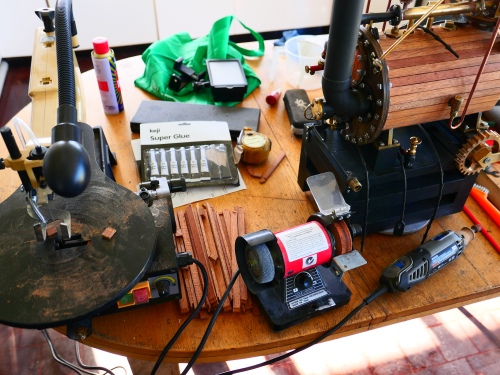
The engine is really taking shape.  I am looking forward to seeing it run.


Scale Trevithick Dredger Engine- the Supports, and crank-webs.

Some photos of progress.  I have been busy, but the results are not particularly photogenic.

The support under the chimney end was in the plans as this:

Trevithick front support.jpg

…and many models of the dredger engine are made along these lines.

…but the rescued Trevithick engine in the London Science Museum is different..

LSM Dredger.jpg

The shape of the front support is appealing, but it is unlikely to be original.

….and this is the drawing of the dredger engine from the Rees Cyclopaedia of 1819..

Rees Pic of dredger engine.jpg

Look.  The front support is a block of wood!  And the rear support is quite open, showing most of the mainshaft.

The Rees drawing was made at a time when many Trevithick engines were operating, and it is likely that the drawing is representing an actual engine.  So that is what I have based my scale engine supports on.

IMG_7158.JPG

This is the rear support for my engine.  5mm thick steel, silver soldered.  Quite a bit of tidying up to come.  And you can see the wedges which hold the bearing housings in position.  The bushes are bronze.  And the vertical tubes just visible are oilers.

IMG_7140.JPG

The rear support before I milled out the middle section.  It was supposed to be 5mm mild steel, but the carbide end mill became red hot while plowing through, then broke.  Something really hard encountered there!

Then the bearing housings were made, and the main bearing bushes.  Straight forward machining.  Inserted the mainshaft (12mm silver steel).

The flywheel had been previously water jetted from 6mm steel plate.

flywheel flat

I chose water jetting in preference to laser cutting, in order to minimise heat distortion of the rather thin piece of steel.  Even so, it required some cold pressing to flatten it.  No olive oil appeared.

Then made the crankwebs.

IMG_4732.JPG

CNC milled from a chunk of brass.

IMG_7151.JPG

IMG_7157.JPG

The crank webs sitting in position.  I have not yet decided how to fasten them.  Soldering is specified by Tubal Cain, pressing by deWaal.  I will probably use Loctite and a taper pin.

Next are the wooden connecting rods, and the driving spur gear.

Still thinking about the stand.  Wooden box? open metal structure similar to my beam engine? masonary block?  Wait and see.

Note that there is now an option to “like” these ramblings, at the end of each post.  Up to you the reader of course, but a tick of approval would be nice.  Your comments are always appreciated.


Trevithick Dredger Engine Guide Bars

I was discussing the guide bars with a very experienced modeller, and he finished with some advice….  “make them either very accurately, or very sloppy, otherwise you will have problems!”

The guide bars and cross-head

Well, I decided to shoot for “very accurately”.

I made the cross-head bar, and silver soldered it together.

All seemed good.  Just the guide bar bushes to be made and Loctited into position.  After a soak in sulphuric acid and tidy up.

So I made the bronze bushes, drilled them in the lathe to 9.5mm, then reamed them to 10mm.  Or so I thought.

But when I fitted them to the 10mm guide rails, they were very, very sloppy.   Checked the guide rail diameter… 9.99mm.  Checked the reamer 10.07mm!!  Chinese reamer.

So I searched my reamers and found 2 more.  Another Chinese one measured 10.04mm.  Another was a Sutton, made in Australia.  It measured 10.00mm.  I reamed a test piece, which fitted the guide posts perfectly.   So which reamer did I use?   Guess.

I made some more bushes and Loctited them to the cross-head.  Then drilled and reamed them, carefully, accurately.  This time the fit on the guide bars was snug, perfect.

Is there a point to be made here?  You better believe it.

Home Invasion

We had just finished dinner and I was gathering the dishes for washing, when suddenly, very noisily, the broom cupboard door burst open, and two possums fell into our kitchen-living room area.

Possums are in most Australian roof spaces.  They are protected by law.  Not that that would make any difference to my Dr. Doolittle wife…. she actively feeds them, and they come to the broom cupboard from somewhere in the attic space, when she calls them.

But this is the first time that they have entered our living space while we were present.  I suspect that they were having a fight and fell against the broom cupboard door, then fell onto our kitchen floor.

Once before, when we away on holidays, they found their way into our pantry.  Obviously, they thought that they had gone to possum heaven, because every cardboard package had been ripped open and the nice contents were eaten.  The less nice ones were on the floor!

So why do we encourage them?  Normally they are shy and cute and timid.  They have babies.  And they keep stranger possums out of our attic, which is their territory.  And they are not dangerous.  And they are interesting.  That’s why.

So I took a video for a few minutes.  One eventually ran out of the open back door.  I decided to leave the room, because they are a bit more nervous about me, and I thought that my wife would have a better chance of coaxing them outside.

Enjoy the uncut, uncensored videos.


Error
This video doesn’t exist

The possums are a bit nervous about me, so I went to bed, leaving my wife to cope with the problem.  I think that she sat there with the outside door open until about 2:30am.  The recalcitrant possum had climbed up the curtains onto a pelmet, and would not come down, despite tempting titbits from my wife.  At 2:30am she came to bed and left the outside door open.

I was the first one out of bed at about 7am.  No sign of any possums, even up on the pelmets.  But he/she/it had been all over the kitchen living room TV area, shitting at every step.   There was a pile of liquid crap on the pelmet.  Poor thing must have been really anxious.  I decided that Dr Doolittle could clean it up.


Trevithick Dredger Engine….progress

IMG_7100.jpg

Finishing bits on the engine assembly.  The stuffing box, the gland, and a threaded plug in the throttle cylinder.  Throttle valve, stem direction valve,  piston and piston rod next.

Antarctic Weird.

Some of you might remember the Google Earth photos which I posted on Jan 6 2018.  “More Weird Stuff”.   The photo was from 1999 imagery.

Antarctica 6 Jan 2018 #2

This 21x7km black rectangular shape/object in Antarctica.  With the white reflections? white-out?.  And the track(?) leading from the south -east.   The satellite image was taken in 1999.  And I occasionally re-open Google Earth Pro to look at it, and wonder what it was.

Well guess what.  It has disappeared off Google Earth.   Nowhere to be seen.  Replaced with featureless white.

Suspicions aroused, I turned on the feature of Google Earth which allows the viewer to scan back and forth over the years.   I had place-marked the spot so I knew that I was in the correct place.  The “staircase” away to the north is still there.

While scanning the “spot” from December 2006, I noticed some odd lines.  Odd in that they were exactly parallel, exactly 1 km apart (you can measure things in Google Earth), and varying lengths, covering 1000’s of square kilometers.  then I noticed a little black dot on the computer screen.  It would not brush off.  Zooming in, it seemed to have a geometric shape, not at all like a natural feature, even pixellated.

Screen Shot 2018-11-01 at 11.02.40 am.png

I zoomed in and out.  If you look carefully (or better still, check this out on Google Earth yourself), you will see a white rectangular shape about 300m x 150m, irregular outline but quite angular and geometric, a black central shape, and a number of smaller grey shapes.  It is aligned almost exactly north-south.  It is bigger than an aircraft carrier.   Buildings?   Artifact?  Natural feature pixellated?

Buildings?   Well it is there, but whited out in the images Dec 2004 and 2005 but not after Dec 2006.

Artifact?  I thought maybe.  Then I looked around the vicinity.

Screen Shot 2018-11-01 at 11.27.23 am.png

Every one of those placemarks pinned by me, represents a similar but not identical object.  Some are clearer than the first one which I saw, particularly in the group under the “Leopold and Astrid Coast” label.  There are at least as many again, less clear, which I did not mark.

If you zoom into the above photo you will get the Google Earth co-ordinates to check this out for yourself.   Make sure that you bring up the December 2006 images.  The centre of the above cluster is the location my original “More Weird Stuff” object, but it is nowhere to be seen after 1999.

I have scanned around the rest of Antarctica and I cannot find anything else remotely like this.  Nor is there anything like this in other years/dates.

Screen Shot 2018-11-01 at 11.06.04 am.png

So, what do you think?  The images show 50-100 of these objects.  It appears to me that someone might have attempted to disguise the objects in the images by applying the thick parallel lines.

I have my own theory, but I will keep my ideas to myself.  For the moment…

Screen Shot 2018-11-01 at 11.07.48 am.png


Hydrostatic Trevithick Boiler Test

This is a video showing how I performed the hydrostatic test on the boiler.

The engine is currently being made, but not at the time of the video.

The test is to hold water at double the working pressure of the boiler, for 20-30 minutes, checking for bulging or distortion of any of the components, and any significant leaks.  Any leaks would need to be fixed, but for the boiler certification, as long as the pressure can be maintained for the duration of test, that is OK.

The working pressure of this boiler will be 50psi, but the minimum pressure in the AMBSC code is 60psi, so the hydrostatic test will be done at 120psi.   As you will see in the video, the pressure reached 140psi at times.

In fact, the AMBSC code is formulated in terms of materials and design to cope with 8 times the working pressure, so the safety margin is generous.

The video is taken over 20 minutes.  I ran the actual test for over an hour.

I am afraid that my very messy bench and workshop are evident in the video.  No apologies.  That is just the way that I work.


Why I Don’t Sweep Up Swarf.

Yesterday I spent some time spreading metal swarf around my workshop floor.

Why?

The weather is warming up as we enter spring in Australia.

My workshop is on a farm, and we have tiger snakes.  The authorities have warned us to expect more snakes than usual, due to the particular weather conditions this year.  I saw 2 snakes on the road leading to the farm.  And my neighbour visited me to inform me that he had spotted a 2 meter long, fat tiger disappearing into the freestone wall at the front of my property.   That is a very big tiger, even allowing for a bit of exaggeration!  Even baby tigers can kill.

And in recent years I have encountered tigers twice – IN my workshop.  Both times were after I had swept the floor.

So now, I spread the sharpest, nastiest swarf that I can find, all over the workshop floor.  To make the snakes feel unwelcome.  So far, so good this season.

How does a 6″ vertical boiler enhance house decorating?

When I was making the 6″ vertical boiler, SWMBO commented, “you needn’t think that is staying in the house!”

Well, she did say,  after the boiler bands went on “Hmm.  That looks quite interesting”.

So I took that as my invitation to put it somewhere….  in the house….


IMG_6863

This desk is just inside the front door.  The boiler sort of melts into the background, don’t you agree?   SWMBO has not spotted it , yet.


6″ Vertical Boiler.Spearhead Superheater

Some more progress on the 6″ vertical boiler.  Not much to show, but here it is.

Actually, I have been wondering whether to continue with this blog as a “what I have done today” type diary, or whether to post less often, but when a significant milestone has been passed.  Your feedback would be welcome on this decision.

The superheater is a copper item, which steam passes through, and is located in or just above the furnace.  As a result the steam becomes hotter and drier and more energetic before it is passed through the engine or whatever it is being used for.

IMG_6708

This is a lump of copper, 10mm thick which I have cut off a bar which I had in stock.  It will be machined into the superheater spearhead.

IMG_6709

The copper spearheads machines into shape.  Copper is soft, but it grabs the cutters.  Not nice to machine.  Expert Stuart said that I should have used lubricant.  Next time. 

The sperheads are bronze brazed to copper pipes, but the difficult bit was bending the 1/4″ copper pipe to fit.

IMG_6711

The spearhead is bronze brazed to the copper pipe.  Tricky, but seemed to go OK.  Don’t know yet whether the bronze join is steam tight.

The tricky bit is the 2 x 90º bends, really close to each other.   Does anyone have any good method for doing this?  I ended up with this result, but it is not pretty, and I am sure there must be a better method for creating the bends.

The silver soldered joins are yet to be done into the brass fittings shown.  I ran out of time in the workshop.

This is getting exciting!  I am not too far off firing up this boiler!

Then a visit to the boiler inspector.

A Nice Day!

First was a trip to the boiler inspector, to inspect the first silver braze on the 6″ vertical boiler.  Passed!  And quite complimentary about the quality of the build so far.

And….  he has OK’d my plans for the Trevithick Dredger engine boiler.   Which is nice because I have already started it, and was going to build it in any case.  Only requirement is that I have to add a pressure gauge.  As far as I know, none of Trevithick’s engines used pressure gauges, just weight based safety valves.  So a pressure gauge will not exactly be in keeping with the historicity of the model, but it seems a small price to pay to get the boiler certified.   Now I am trying to work out where to place the pressure gauge so the operator can see it, but not the viewing public.

Then a late entrance to our GSMEE day meeting.  (Geelong Society of Model and Experimental Engineers).   I showed my progress on the 6″ vertical boiler.  And took some pics of some of the other items brought in by members.

IMG_6604.JPG

A very nice lagged boiler and engine by Neil

IMG_6605.JPG

and that firebox door is titanium!  And check out the screws in the base….  no-one is going to be able to unscrew this model!

IMG_6602.JPG

The steam control valve for Neil’s engine.  He used a solder with which I was unfamiliar…. “StayBrite” which is said to have a melting point above soft solder, but not as high as silver solder.   Bought at JayCar.   The cap screws have BA threads… unusual!

IMG_6606.JPG

And finally, a small steam driven pump brought in by our senior member Laurie, made decades ago by a friend.  Laurie is a club treasure, being a great raconteur, especially about his WW2 experiences in the Australian army, and having made superb models when younger which are still regularly run and exhibited.   The coin for scale is an Australian 50 cent piece; large, heavy, and it takes about 10 of them to buy a cup of coffee; much disliked.


Trevithick Dredger Engine- the flat end

Trevithicks_engine

The 6″ vertical boiler has had its first brazing session, and has been put aside while I wait for the boiler inspector to give the “go ahead” so I can proceed to the next brazing session.  I am told that the first braze is the most difficult.   The next braze is bigger, but the components are all on or near to the surface, and it is consequently more straightforward.

So, while waiting, I pulled out the Trevithick Dredger Engine, and decided to make the flat end plate and flange.  These are machined from LG2 bronze disks 13mm and 8.5mm thick.

bronze blanks

204mm diameter.

IMG_6575.JPG

An aluminium sacrificial plate was made and held in the milling vise.  The bronze disks were CNC drilled.

IMG_6576.JPG

The disk which will become the flange is tapped.

IMG_6595.JPG

The holes in the end plate were CNC’d on the mill, which died during the procedure.  The Z axis went crazy.  Fortunately I managed to hit the panic button and the end plate was not destroyed.   Currently Stuart & I are trying to determine the cause of the robot madness, but that looks like being a lengthy process.   The rebate being completed on the lathe in the pic would have been an easy CNC mill process, but the workpiece was quite thin to be held in the lathe chuck.

IMG_6597.JPG

Showing how the end plate was held in the lathe chuck, with double rare earth magnets holding the plate away from the chuck jaws permitting the tin workpiece to be turned.  A bit tricky, but went well.

IMG_6598.JPG

The flange on the left will eventually be brazed to the boiler shell.  The end plate on the right will be bolted to the flange. 

IMG_6599.JPG

The end plate and the flange mated together

IMG_6600.JPG

The big tube 65mm diameter will become the firebox,  the smaller one 38mm dia will be the firetube exhausting to the chimney.

IMG_6601.JPG

None of the tubes are yet cut to length, but starting to take form. 


Timing a Stuart Triple Expansion Steam Engine

Reader Steve kindly sent me these notes which detail how to time a Stuart model Triple Expansion Steam Engine.   The notes are quite clearly written, and I recall that a few readers had an interest in the subject.  Thanks Steve.

Easier to read if you enlarge the picture of the text.

Triple Timing

6″ Vertical Boiler. Ideal soldering set-up block. Concrete!

OK.  My non machinist readers will have no idea what I am talking about.  And I suspect that my machinist readers wont either.

I need some precisely machined and measured blocks to set up the soldering for the boiler.  I want them to not suck up my soldering heat (so no metal), and to not stick to my silver solder (so not steel, copper, etc).

How about concrete?  More specifically, aerated concrete.  Hebel.

Look at the pics……  I need a cylinder, about 100mm high and 110mm diameter, which will not absorb heat and not stick to silver solder.

IMG_6566.JPG

This is a 600x400x75mm Hebel block.   Cost $AUD4.60.  It is part of my forge, but will be replaced easily.

IMG_6567.JPG

Marked out the bit I want.

IMG_6568.JPG

So I cut it on the bandsaw.  It is aerated concrete.  Hebel.

IMG_6569.JPG

Cuts quickly and easily.  Probably not good for the blade.  But we will see.

IMG_6570.JPG

How accurate is the thickness??   Pretty amazing IMO.  within 0.1mm.  The second measurment is after a quick touch up with emery paper on a flat plate.

IMG_6571.JPG

And this is the first setup, ready for soldering.   Watch this space.  soldering in 2 days.


Trevithick Boiler End

The first part to be made for the Trevithick dredger engine is the domed end of the boiler.  It is formed from copper plate which is 3mm thick.  first a circle is marked out, then bandsawn from the copper plate.

I decided to make a wooden form.  Fortunately I have a CNC lathe (see earlier posts about the CNC conversion of a manual lathe), so drawing the profile and generating the G code using Ezilathe was, well, easy.

IMG_6390 2.JPG

CNC’ing the wooden form for the boiler end plate.  The roughing steps.  Carbide tip which has been sharpened to a cutting edge, suitable for wood.

Error
This video doesn’t exist

This is the final roughing cut, and starting the finishing cut.

IMG_6393 2.JPG

CNC turning.  Light sanding required to remove the fur.  The wood is European oak.  Central hole for a locating pin.

IMG_6416.JPG

The oak form was attached to a red gum block which was held in a 6″ vise.  I have already commenced shaping the copper disk here.  The copper is cramped to the oak form after annealing, and gradually hammered to shape.  Tapped rather than hammering.

IMG_6421.JPG

My “forge” is a few fire bricks in a steel shell, and a roof of steel to help retain the heat.  The torch is fuelled with propane.  It was originally a weed flamer, used to burn serrated tussock.

IMG_6424.JPG

Red heat was achieved in 90 seconds.  This is 600 degrees centigrade.  copper melts at 1084c, so there is a good safe margin.  I quenched to cool, for speed.

IMG_6419.JPG

This welder’s clamp proved to be the most effective method of holding the copper disk to the form.  I fitted  copper and  brass heads to the tapping hammer to minimise the chance of “bruising” the copper.

IMG_6426.JPG

Progress

IMG_6430.JPG

About 10-12 heating-hammering cycles in 1.5 hours to get to this stage.

IMG_6431.JPG

Getting close.  I will finish it tomorrow.  Might wash up before cooking dinner.

Bolton 7

For reader Timothy, I hope that these photos answer your query.

Bolton7 flange 2.JPG

Bolton7 flange1.JPG

The Bolton7 was my first attempt at engine building.  As you can see, the finish leaves a lot to be desired.

Another Use for Magnets

I purchased some bronze disks for use in the model Trevithick dredger engine.  The disks 204mm diameter had been bandsawn off rod.  I had specified minimum thicknesses of 7mm and 12mm.  One disk was 9.2-9.7mm thick and the other was 12-15mm thick.

bronze blanks.JPG

The bandsawn blanks of LG2 bronze.

In preparing the disks for machining I filed off a few protrusions, and using a straight edge, identified the valleys and ridges.

The thicker disk was held in the 3 jaw chuck and both faces were turned flat with no problems except avoiding the needles which were thrown off in a wide arc around my lathe.  Final thickness 12.5mm.  A persisting divot should be able to be avoided in the final part.

The thinner disk needed to be packed out from the jaws of the chuck by 4-5mm in order that the lathe tool  cleared the jaws during machining.  In the past I have used machined packing pieces, but it is always a fiddle to hold the workpiece, the 3 packing pieces and the chuck key in only 2 hands.  Today I had a brainwave.

chuck magnets.JPG

I used rare earth magnets!

I tried to measure the thickness of the magnets, but they are so powerful that I was not confident that I was getting accurate readings.  So I just used them and measured the thickness of the finished workpiece.

I am sure that this idea is not original.  But it is to me.

bronze in 3jaw.JPG

Here is the thin workpiece held in the 3 jaw, and packed away from the chuck by rare earth magnets.  Of course the magnets are attracted only to the jaws, and not the bronze workpiece, which helps, but I will try this on steel later.  Should work for magnetic metals also.

After machining both faces I took various measurments of the workpiece thickness.  The measurements in mm were 8.73, 8.68, 8.69, 8.72, 8.70, 8.72.   Not perfect, but not too bad at all.   I wonder if I might have improved the measurements by surface grinding the magnets.  I wonder if the chuck and its jaws are contributing to the variation.  It was certainly an easy method.

If the workpiece had been thinner I could have increased the thickness of the packing by doubling up the magnets.

For those who are following the Trevithick Dedger Engine build, the bronze was not cheap.  The 12-15mm disk was $AUD90 and the 9mm disk was about $AUD80.  From George White P/L, Melbourne.  I will be nervously trying to not muck up the machining.

A New (to me) Tool

One aspect of our weekly GSMEE meetings (Geelong Society of Model and Experimental Engineers) is that I learn something new at every meeeting.  The exposure to new information is not too surprising considering that our group has members who are or were a machinery designer, mechanical engineer, CNC operator, marine engineer, aircraft mechanic, a quarry operator, gun enthusiasts, a fireman and various other areas of expertise.  Even a bee keeper.  And even a retired gynaecologist.

Recently Neil brought in a boiler which was assembled but not yet soldered.  And it was held together with spring loaded clamps the like of which I had never before seen.  Some other members were also very interested in the clamps, which are, apparently, extensively used in aircraft panel assembly and repair, and also in car body work repairs.

boiler clecos

31856056_10216930893251437_4083847603039502336_n.jpg

Neil’s boiler end plates, clamped together.

The clamps are called CLEKOS or CLECOS.  They are easily applied and removed and are reusable.  They are used for temporary joining of materials to facilitate marking, drilling, riveting, soldering, welding or gluing.  Exciting to me because I can see many applications in model engineering and wooden toy making.

The Clecos come in a variety of sizes and configurations.

IMG_6311

This Cleco requires a 1/8″ hole, and will join materials up to 1/2″ total thickness.  This type joins 2 or more pieces of material which have a hole drilled as small as 2.5mm up to 5mm.  The range of hole sizes may be larger than I am aware.   Only one face of the materials needs to be accessible, so the Cleco can be used to fasten material to a closed container such as a boiler.   It is spring loaded and requires a tool to apply and remove it.  Application and removal is very quick.  Any materials which will accept a drilled hole can be used-  metal, wood, cardboard.  It would not work with easily compressed material such as foam rubber.  The application pliers are available on Ebay and are inexpensive.

IMG_6315

This spring loaded Cleco looks particularly interesting.  The clamps are small, have clamping thickness of 20mm and a reach of 1/2″ to 1″.  Again, they are not expensive ($AUD7-11), and very quick to apply and remove.  Surprisingly powerful grip would be quite adequate for gluing or riveting or soldering.

IMG_6317

Some Clecos do not require the application pliers but use a wing nut.

IMG_6316

And others use a hex nut.  Anyone know why there is a copper surface coating?

The Clecos are surpisingly inexpensive.  On Ebay I have seen the spring loaded fasteners as cheap as $AUD1 each, and the pliers at $AUD15.    I bought a kit comprising pliers and 20 fasteners for $AUD49.  Ebay UK has the best selection and many have free postage.  The range on US sites is good, but postage costs assigned by Ebay are astronomical.

(A reader has commented……

The Clecos and other skin pins are colour coded, silver 3/32, copper colour 1/8; Black 5/32′ gold 3/16 brown 1/4…..     thankyou “someone”.)


Trevithick Dredger Engine Flywheel

You must forgive me for rushing this blog.  I do feel rather pleased to have made a start on the Trevithick Dredger Engine.

The first part for the TDE was waterjet cut from 6mm mild steel.  I emailed the DXF drawing Tues, it was cut out Wed and picked up today.  Impressive service from Colin and Sandy at Waterjet Geelong.    340mm diameter.  The finish of the cut is so good that some light filing and rounding the sharp edges is all that will be required.  I will machine the bore hole after the shaft is made.  The magazine article is my workshop copy.  It will not remain this pristine for long.

flywheel flat.JPG

flywheel edge.JPG

The thinness of the flywheel is a Trevithick characteristic.

Buying Copper Pipe for Model Boilers

My next 2 projects require 150mm (6′) copper pipe for the boilers.  The Trevithick dredger engine will operate at only 30psi so the wall thickness needs to be only 2mm thick to comply with the AMBSC regulations.  But the other project, the vertical test boiler will operate at 100psi and the copper needs to be a minimum of 2.5mm thick, or preferably 3.0mm or 3.2mm.

I had purchased a 350mm long x 2.8mm wall thickness piece of 6″ copper pipe at an engineering club swapmeet, so I thought that would be OK for the test boiler, but when I examined it closely I noted some scribed lines from the previous owner’s intended project.  There were also some drilled holes, but they can  be used or filled.  The scribed lines were unacceptable, so thinking that they were not very deep I carefully skimmed the cylinder surface on the lathe.

Copper tube skimming 2.JPG

The headstock end is held lightly in the 3 jaw chuck.  The tailstock is centered in a piece of fitted Delrin.

Taking off 0.05mm per pass, and using a sharp Diamond lathe tool (from Eccentric Engineering), when the marks finally were removed, the wall thickness was down to 2.45mm, just below the minimum thickness for the test boiler.  Bummer!  I can use that piece for the lower pressure Trevithic engine, but what to use for the test boiler?

So I contacted every Australian copper pipe supplier that I could see on the Internet, every model engineering vendor, and visited every plumbing supplies vendor in my region.  2mm thick pipe is available but nothing thicker.  Then to overseas suppliers.  Eventually I located some at MaccModels Engineering Supplies in the UK.  £7.67 per inch for the 3.2mm x 6″.  So my 12″ piece will be almost £95 ($AUD190) plus postage.  I took the opportunity to stock up a few other sizes which I will need for the 2 projects.  Postage came to $AUD170.   A bit painful.

So, to end this expensive story, my 3.2mm thick copper pipe is on its way.  I do feel a bit guilty about the Avgas being burnt to get it here, the kilogram x kilometers of air pollution and CO2.  And the annoyance that it is quite possible that the copper ore was mined in Australia, but I had to go to the other side of the world to buy a bit of the manufactured product.  Or is copper still mined in the UK?

Copper collection.JPG

Gradually accumulating the materials.  The copper sheets and disks are 3mm thick.  The square section rod is for the boiler foundation ring.  I don’t want to start cutting until I have all of the materials.

The OTHER NEXT PROJECT

In the previous post I showed the boiler which I am intending to build.

In this post I will show you the steam engine which I also intend to build when I have AMBSC approval and I have accumulated the materials.  I have discussed the plans with the boiler inspector, and am in the process of redrawing the plans taking into account the required modifications so it can be run at public exhibitions.

It is the TREVITHICK DREDGER ENGINE, at 1 in 8 scale.

This was designed by Richard Trevithick, and made in 1806,   It was the first high pressure steam engine.  It also employed a steam blower, cylindrical boiler, safety valve, and many other innovations.  Incredibly, the engine worked in its first iteration.   Richard Trevithick was indeed a genius, although relatively unrecognised in his own lifetime, and for almost 2 centuries since.

Here is the earliest drawing which I could locate of the dredger engine.

It is from an encyclopedia which was published in 1818.

trev_1


Trevithick_High_Pressure_Steam_Engine_-_Project_Gutenberg_eText_14041

This is a drawing of a Trevithick dredger engine which was reconstructed in 1885, with some errors, including the bent connecting rods..   Of particular interest is the piston-cylinder assembly which is partly encased by the boiler to minimise heat loss. The large, thin, flywheel is a characteristically Trevithick feature.

Trevithic JD_SciMus1

The Trevithick engine as reconstructed, and as it is displayed in the London Science Museum today.  The blacksmiths who formed the domed boiler end, pentrated by the cylinder assembly must have been incredibly skilled.  (ps.  note added 10/4/19.  The domed end was a casting which included the cylindrical sides, and the flange at the chimney end.  It was not forged by blacksmiths.)

The Trevithick Dredger Engine was drawn at 1:16 scale by Tubal Cain in 1987, and modelled by him. His plans were published in “Model Engineer” magazine.

It was redrawn by Julius Dewaal at 1:8 scale and published on the Internet in 2016.  The plans are currently freely available on Google Images, as 9 pages of A3 plans.  The plans are beautifully drawn, but require some modification to comply with current AMBSC regulations.  I am currently redrawing the Dewaal plans with the necessary modifications.  When they are approved I will detail the modifications.  A 1:8 scale the flywheel is 340mm diameter (13.4″).

Trevithicks_engine

A schematic drawing of the engine, as it was reconstructed.

So, watch this space.  Getting the plans finalised and the boiler approved will take some time, as well as gathering the materials.  From my preliminary discussions with the boiler inspector I will need to learn how to braze in bronze, and I will document that process.  Finding a supplier of phosphor bronze in the required sizes is proving difficult, and I might have to settle for the nicer to machine, but weaker, LG2 bronze.  If any reader knows of a supplier of cold rolled phosphor bronze sheet 200mm wide and 6-8mm thick, I would be delighted to hear about it.

Triple retrospective

This post is for reader Roy, who asked how the triple expansion engine columns and base and cylinder blocks were aligned, and also about joint sealants.

To be honest, I did not really remember the details, but the posts on or close to Feb 2015 include the following photos.  The aluminium plates were precisely machined keep the column faces exactly separated by the final width.  The plates were bolted to the columns, then to each other.   I lined up the join in the plates with the center of the main bearing housings in the base plate.

The longitudinal alignment with the cylinder bores was determined by the precise drilling in the tops of the columns, and the cylinder base covers.  And a little longitudinal movement in the crankshaft allowed for a few thou discepancy.

IMG_2495


And this is what I used to steam proof the joins.  I used no gaskets.  The Loctite 567.  It was recommended by an expert friend who uses it on full size steam engines (thanks Tom!).  The Loxeal 58.11 is also excellent but it sets very hard, and is very difficult to separate later.


FullSizeRender 17.jpg

BOILER FOR MODEL STEAM ENGINES

Now that the model triple expansion engine is working on steam, I feel able to put it aside, again, and move onto the next project.  The triple is not quite finished.  It needs cylinder lagging, control rods for the cylinder drain cocks, drain tubes for the cylinder drains, and an extra pump for the condenser cooling, and some paint, possibly.

It also needs a boiler.  I would like to exhibit the triple at club demonstrations and public exhibitions, but for that I need a boiler which is certified by our boiler safety authority.  So I intend to make a boiler to AMBSC code, and big enough for the triple or any other engines which I might make in the foreseeable future.

This is what I have in mind….

boiler assembly

This is a copper boiler with a 152mm (6″) diameter barrel, a superheater, gas or coal fueled, and firetubes (most not shown).  The plans call for a 5″ barrel, but I have been unable to find any suitable copper tube, and I have some 6″, so that is what will be used.  I am currently drawing up the plans.

The certification process here in Australia requires the following steps:

  1. Preliminary discussion with the boiler inspector (done)
  2. Submission of 2 sets of plans to the boiler inspector.  If acceptable, one set is signed off and stamped and returned.  The other set is held by the inspector.
  3. Inspection of the prepared components by the inspector prior to soldering/brazing/welding.
  4. Inspection of the firebox and tube assembly after soldering/brazing/welding.
  5. Inspection of the barrel and outer wrapper after soldering/brazing/welding.
  6. Testing the boiler after completion.  This involves a hydrostatic test, at double working pressure for 20 minutes, then a steam test at 10% above working pressure.

If it passes, the boiler is certified for 12 months, after which it must be retested.  If it passes the retest it is certified for 3 years.

The certification process is performed by volunteer inspectors attached to model engineering clubs, and is done at no cost.

However the materials for a boiler like this are quite costly.  I managed to obtain some  copper tube for the wrapper, and bought some copper plate for the firebox and boiler ends on Ebay.  Bronze for the bushes from a local bearing supplier (LG2), and firetube copper tube from local plumbing supplies.  All up, so far, is approaching $AUD1000.  And yet to be factored is the safety valve, various cocks, sight gauge, hand pump silver solder.  And I intend to make and fit a steam driven feeder pump, and possibly a steam injector.

If there is any interest in this project I will post progress notes and photos.  Let me know.

Small Tube Bender


I have recently been busy installing a steam powered water injector on the 3″ Fowler traction engine.  Involved quite a few bends in 1/4″ copper pipe.

IMG_6205

Some of the new pipework on the traction engine.  Since this photo, I have also made the winch functional.  (pics of that in future post)

FullSizeRender 8.jpg

Hand pipe benders.

I was not totally satisfied with the regularity in the bends, or the straightness of the runs in the pipe.  That provoked some discussion at our model engineering group, and one member (Stuart T) showed us the pipe bender which he had made some years ago.

IMG_6209.JPG

Pipe bender designed and made by Stuart Tankard.


As you can see it has a  heavy duty frame,  shoulder bolts holding the rolls with machined slots for various sized pipe, and a 19mm hex connector for the driving battery drill.  A demonstration of pipe bending on this machine convinced me of its superiority to the hand held benders

Fortunately for me Stuart still had the plans which he had drawn up, so I made my own bender.  I made a couple of changes to Stuart’s design.  I made a 1/4″ hex on the driving screw, to accept the commonly used connector for battery drills.  And I did not have any suitable bronze for the main bush, so I made a brass bush, which incororated  a thrust ball bearing which engages during the bending procedure.  Probably unecessary but it was there in my junk drawer so I used it.

IMG_6231

The radius of the bend in the tube is determined by the radius of the roll.  1″, 3/4″ and 1.5″.  Each radius has grooves for 1/8″ 3/16″ 1/4″ 5/16″ 3/8″ and 1/2″ tube.  Since then I have also made 2″ rolls.

FullSizeRender 14.jpg

Aluminium rod for the rolls.  

FullSizeRender 16.jpg

Using a bearing to centralise the tailstock end before center drilling.

Groovetools

The lathe tools used to make the grooves.

IMG_6243 3

3 rolls turned from each length, with an allowance for parting.  Then drilled and reamed, and parted in a lathe big enough for the 2″ bar to be securely held.


IMG_6232

Completed bender.  The wooden box keeps the components organised.  Not a tribute to the craft of wood working but it will do.   The vacant pegs are for 2″ rolls which are yet to be made.

IMG_6221

The raw materials for the tool.  1″ X 3″ and 1″ square mild steel, and 1/2″ silver steel.

The bender is held in a bench vice.  The bending process is quick and controllable using a variable speed battery drill.

The symmetry of the rolls (as opposed to the asymmetry of the hand held tools) means that the centre and the mid point of the bend is totally predictable.

Since then, I have made some further changes in the design of the pipe bender.

  1. I have added some feet so it sits squarely on the bench and does not require a vice for support, although it can be held in a vice if preferred.  The tool is quite heavy, so small jobs can be managed without a vise.
  2. I drilled and threaded some extra holes, to accept 2 rows of 3 rolls.  See the photo below.  That pipe bender has now become a pipe straightener.  I made some extra rolls, so now there are 6 rolls of the 2″ size.  As long as the 3 rolls in each row are identical, the rolls in the 2 rows can be different for the straightening process, but ideally there should be 6 rolls for each pipe diameter.  Straightening copper pipe is easy, as long as there are no kinks or very sharp bends, and the copper must be annealed.  The pipe should be approximately hand straightened, cut to length plus about 2″, then pulled through the rolls which have been adjusted so the rows  are almost touching.  3 or 4 passes, with some rotation of the pipe each time results in a near perfect straight pipe.   Any slight residual bend can be eliminated by rolling the pipe on a flat surface.

in box.JPG

Some extra threaded holes added pipe straightening to the tools functionality.

straightening 1.JPG

Two rows of rolls are needed to straighten bent pipe.  So I made 3 extra wheels in 1/4″ and 3/16″ sizes.  Later I realised that the extra three rolls do not have to be identical diameter to the first three, as long as each triple are identical.  The tool straightened this bend quite nicely, although with some experience, I would now probably hand straighten it a bit before putting in the tool. 

straightening 2.JPG

After 2 or 3 passages.

straightening 3.JPG

And some rotation with each pull through

straightening4.JPG

The copper does have to be annealed to get a good result.

bend start.JPG

And to put a bend in that nice straight tube…  some shuffling of the roll positions….attach the drill (slow speed setting)

bend end.JPG

And a quick and easy bend. 

Bent copper.JPG

Pretty good


underside.JPG
The underside.  Substituted cap screws for grubscrews, so the tool sits flat on the benchtop.  quite adequate for light bending jobs, but straightening needs a vise.


Model Triple Expansion Steam Engine. First taste of steam tomorrow!

I was very excited to see my triple running reasonably well on air recently.  But it was tight, and required a decent gutful of air pressure to turn it over.  But it did go!

Then it seized.

The cause was the intermediate cylinder valve rod seizing in its guide.  Probably a bit tight,and not getting any oil.

So I have loosened the gland, installed a displacement oiler, and made and installed a flywheel.  I also finished the pipework around the condenser.

IMG_6173.JPG

Displacement oiler top left, brass flywheel, and pipework.  The condenser on a marine engine would have been cooled with seawater, pumped with a separate pump, but I have used the 2 pumps on either side of the Edwards air pump.  In future I might install another pump.  The book “Marine Steam Engines and Turbines” has been been very useful.  

IMG_6179.JPG

I just like all of the brass and copper and components in this picture.

IMG_6170.JPG

The flywheel is too big for the scale, but my model does not have the weight and momentum of a propeller shaft and propeller, so a sizeable flywheel seemed appropriate.  Later I will add some gear teeth on the flywheel and a cranking handle on a removeable pinion, which some medium size engines had to assist with cranking to a starting position.  

So, tomorrow I will hook my triple up to Stuart Tankard’s vertical boiler, and see what happens.  I am sure that steam leaks will be revealed.  Hopefully there will be a video worth posting!

TRIPLE EXPANSION MODEL ENGINE- FIRST RUN (air)

This is a short video of the first run of the Bolton9 Model Triple Expansion Steam Engine, which I have been building on and off over the past 3 years.

The video is a bit shakey, because it is taken on my hand held phone while I am using he other hand to operate the controls.  I really did not expect the engine to work!

It runs a bit roughly, and is still quite tight, but settles down in the final few seconds.

It is not running very smoothly, because it is on air rather than steam, and because it is probably only powered on the high pressure cylinder, and maybe a bit on the intermediate, and not at all on the low pressure cylinder.

The next day it would not run.  Very frustrating.  I suspect that one of the eccentrics slipped on the crankshaft, and threw the timing out.  Not the easily accessible low or high pressure valve, but the intermediate one, which needs another teardown to get to it.

But Hey!  It will work.  I can see the light at the end of the tunnel.

One of my readers has requested a description of the triple engine timing procedure, so that will appear on this blog soon.  Unless you have a particular need for the timing info I suggest that you give that post a miss.
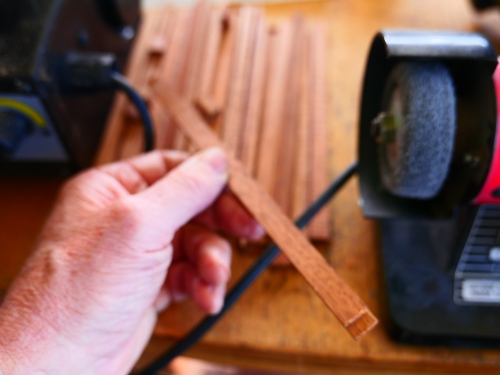
Geelong Vintage Machinery and Classic Truck Show – day 2

The oiler on my traction engine failed today, so I did not run the teaction engine, and I had some time to look around the other displays.  The oiler failed due to some grit in the non return valve, easily fixed when I got it back to the workshop.

As always at this annual show, the trucks and classic cars are fabulous.

Ford truck & traxcavator.JPG

Ford truck, with Caterpillar Traxcavator as load.

mercedes truck.JPG

Mercedes truck with a startling colour scheme.

truck lineup.JPG

Must have been more than  50 magnificent trucks in the lineup.

Liberator engine.JPG

This is an original engine from a WW2 Liberator bomber.  It was run for a few minutes twice daily.  Must have been heard by the entire city.  Absolutely awesome sound.  I cannot imagine what 4 engines on a plane would sound like.   1300HP!   An entire Liberator airplane is currently being restored nearby.


All weekend, tractors were competing in a tractor pull test.  The load gradually increases, with the tractor pulling with all it its might, until it runs out of either power or traction.

The smell of diesel fumes, and the noise,  was magnificent.

Error
This video doesn’t exist


And my favourite, of course, was the mighty R3 Fowler.  In this instance effortlessly powering a large pump.

More Wierd Stuff

Since my “Strange Lights over Geelong” experience I have been looking at all sorts of weird posts on YouTube.  UFO’s, crop circles, megalith structures, evidence of buildings on the moon and on Mars.  There is a mountain of information out there, and while a lot of it is lies and rubbish, some is harder to dismiss.   It is not inconceiveable that Governments have information which they are witholding from the general populace, about aliens, UFO’s, ancient civilisations and so on.  Indeed, there are YouTube interviews with ex astronauts about UFO’s on the moon, and ex government ministers and officials about UFO’s and aliens, and Rothwell.  It may well be that the current increased talkativeness is due to a recognition by governments that they can no longer keep a lid on the previously secret information, so they are gradually allowing people to talk.
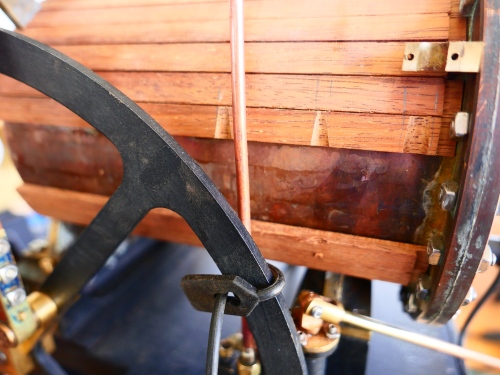
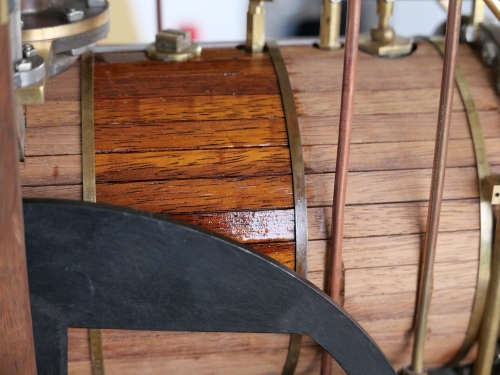
One line of posts which I have followed is evidence that something is going on in Antarctica.

And one source of information is Google Earth.  One post related to a strange set of giant “steps”.  I checked on the post information by checking the coordinates in Google Earth.

staircase.jpg

Look at the middle of the photo.  That series of “steps” does look unusual.  You can check on this yourself by entering the coordinates on the photo into Google Earth.   The “staircase is about 2.5km long, with each step about 250 meters.

Anyway, to continue with my story, as I was zooming out from this point, I noticed a bright shape about 138km towards the south.

Antarctica #4.jpg

The object which caught my eye was the white rectangle above the word “Coast”.  This section of Antarctica is directly south of Western Australia.  The rectangle is about 380 km from the coast.

And this is what shows up on Google Earth as I zoomed in.

Antarctica 6 Jan 2018 #2.jpg

The image is from 1999.  The black rectangle is 21 x 7km…  Quite a size!   I am unsure what the bright white is.  Possibly sunlight reflecting off a shiny surface.  Or a rough attempt at concealing the rectangular area?    This is at latitude 70.2 S, longitude  87.2 E.

Antarctica 6 Jan 2018.jpg

Also, there is a faint streak from the rectangle heading about 100km to the east.  It is also 7km wide.     The staircase area is also visible to the north.

So that is it.  I can find no reference to this structure, but if anyone knows anything about it, please enlighten me.   If you have any interest in this weird stuff, you might the posts on YouTube by SecureTeam10 worth watching.

I am heading back into the workshop tomorrow.  Installing a steam powered boiler water injector on the Fowler traction engine, and bit by bit, finishing the triple expansion engine.

I have installed the new AC Servo motor to replace the spindle motor on the Boxford 125TCL CNC lathe, my expert friend Stuart Tankard has wired it up and reconfigured Mach3.  I am delighted to report that it has vastly improved the CNC lathe.  Will post some pics in a day or two.

Steam Trains in Colour

4 months ago I made 2 wooden trains for my identical twin grandsons.  I handed the trains to SWMBO for painting, and despite frequent proddings of the verbal type, she got around to painting them only a few days ago, just in time for the twins second birthday.

IMG_5996.JPG

The fuel in the coal tenders is chocolate.

IMG_6003.JPG

The twins are really into “diggers”.  Check out the birthday cake!  Chocolate icing and chocolate Smarties.   I want to be a kid again.

IMG_6009.JPG

The “coal” was a hit.  SWMBO knows the way to the male heart.


New Mechanical Oiler for Fowler Traction Engine

The oiler on my 3″ Fowler compound traction engine was working only intermittently.  I bought a new Foster Lincoln oiler, and today installed it.

The old oiler flange which attaches to the engine, was flexing, so I made a new one from 3mm stainless steel plate.  That will not flex.

The oiler is powered off the high pressure cylinder valve rod.  Different geometry was required.  I could have modified the original valve rod clamp and arm, but just in case I wanted to revert to the old configuration I made a new clamp and arm.

It all fitted nicely and the ratchet wheel clicked over as required when the engine was turned over.  So I completed the installation by silver soldering an oil delivery pipe to the valve chest.

Fowler pistons oiler safety valves.JPG

The original oiler

IMG_5992.JPG

The new oiler

IMG_5993.JPG

Hmm…  that delivery pipe needs to be straightened.  Sacks of coal in the background.

Recycling Leather

I am a fan of Stefan Gotteswinter’s You Tube blog, amongst others. (the others include This Old Tony, Abom79, ClickSpring,  Joe Pieczynski, AVE, NYC CNC, mrpete, ……   you should know all of these if you are interested in metalworking).

But back to Stefan.   One of his hints some time back, was to use a piece of leather to protect his lathe bed under the chuck.   I adopted his idea, and I found that it was very effective.  It does protect the bed from dropped chuck keys, parted chunks of metal etc.  It is also handy for preventing small parted work pieces from disappearing into the swarf which hangs around under the bed.

Only problem was that the best piece of leather which I could find was from an old overnight bag, and it really was old, and thick, and stiff.

Some time ago, SWMBO gave me the job of dealing with a couch which had seen better days.  We were quite fond of the couch, as it had been used by our family for at least 3 decades.  But our beagle was also fond of it.  Sleeping on it,  digging holes in it, and it had become pretty disgusting, despite repairs.  So it became my workshop couch for midday naps.  But that change of environment did not improve its condition either.   In fact I decided to take it to the tip (landfill).

But here we pay for landfill by volume, so I decided to break up the couch to reduce the volume, and maybe use the frame to fuel my workshop heater.

IMG_5975.JPG

Me.  Removing the leather upholstery.  

IMG_5973.JPG

Where the beagle liked to sleep.   Yuk.

So I now have quite a lot of supple leather.  Some will end up covering my lathe ways, held in place with magnets.

Any suggestions for using the remaining leather?

MAKING A PROTRACTOR for TRIPLE EXPANSION ENGINE VALVE TIMING

Just a quickie.

I am close to running my triple expansion steam engine, and I am thinking about what will be required to set the valve timing.

The high and low pressure cylinder valves can be visualised by removing the valve steam chest covers and should not be too much of a problem to set.

However, the intermediate valve steam chest is buried in the middle of the engine, and can be visualised only by close to totally dismantling the engine.

So I have made a protractor which has the 360 degree circle divided into 120 degree sectors, and single degrees, with 5 and 10 degree markers for easy counting.

The protractor will be mounted on the end or the crankshaft using 6 bolts located into 6 precisely drilled and tapped holes.

IMG_5875.JPG

The protractor.  100mm diameter aluminium plate.

When the high pressure cylinder valves are set, the degrees of rotation of the crankshaft will be noted, the crankshaft rotated 120º, and the intermediate cylinders valves set to the same settings.  At least that is the theory.  I am sure that it will be more complex than that.

IMG_5876.JPG

The triple expansion engine with the protractor attached.

I just wanted to show the completed protractor.  I have not stamped or engraved the degree numbers, because they would need to be in groups of 120º, and the protractor would therefore be a single use item.


TRACTION ENGINE (update)

Finally found someone with enough speed to upload a video.  Stuart filming.

Shot near Geelong.  Tom driving.  SWMBO and me on the kids’ cart.  Ange supervising.   The safety valves blowing off some steam.  Not much smoke from the Welsh steaming coal.


Compound Traction Engine

A few of my readers will have no idea what a “traction engine” is, much less a “compound traction engine”.

I have recently bought one of these machines, so here it is….

IMG_5498.JPG

To be accurate, it is a miniature traction engine.  1/4 size.  A full size one would weigh between 14-18 tons, and a bit beyond what SWMBO would have agreed to me spending.  I see ads in the English sites offering them for between 250 and 400 thousand pounds.

This one weighs about 250kg, and it cost me a bit less than a full size one.

It is powered by lighting a coal fire in its belly, and producing steam.  The engine sits on top of the boiler.  You can see the cylinders, connecting rods, crankshaft and gears in plain view.   The steam is under a pressure of 100lbs per square inch.   It passes through the high presssure cylinder (the small one) then through the low pressure cylinder to convert the heat energy of the coal into kinetic energy of motion.   The fact that the two cylinders are powered by the same bit of steam is the reason it is called a “compound” steam engine.

Steam traction engines were the predecessors of modern diesel tractors.

As road locomotives, they pulled loads of many tons, at low speeds, from 1869 to the end of WW2.  This one was a scale model of a road loco of circa 1918.  Other types were used on farms as tractors (not terribly effectively, because of their weight), in saw mills to power the saws, and as stationary engines to power some factories.

Rather surpisingly, they are a quiet machine in comparison to more modern diesel and petrol powered ones.  They sound a bit like a steam train, puffing and chuffing along.  I fine the sound is very appealing.  I also like the exposed mechanicals.

The coal smoke is not quite so pleasant, but the Welsh steaming coal which I am using, produces very little visible smoke.   Most of the white stuff which is seen is esacaping or exhausted steam which has been cooled to become water vapour.   Steam, as I have discovered, is invisible.

So back to my traction engine….    It was made by a gentleman in Adelaide, commencing in 1984, and completed in 2016.   He also made quite a few steam train engines and traction engines over the same years.  He told me that the compound engine was difficult to make due to its complexity, and the tight squeeze of all of the components.

IMG_5503.JPG

The square box with the brass lid is the mechanical lubricator,

The boiler is constructed from copper sheet, 4mm thick, riveted and silver soldered.    It has been tested, and certified to 100psi.  Re-certification is due, and is planned to be tested again in a couple of weeks.

I have found a few issues with the engine, and am gradually attending to those issues.   The piston rod glands, valve chest, main throttle, and starting valve were leaking steam.  Those leaks have been reduced to a level that is acceptable.

One of the big ends is noisy.  I noticed that the plans called for adjustable wedges, and they have not been used.  So at some stage I plan to make them and install them.  That should tighten up the noisy bearing.  The valve eccentric straps are a bit loose, with noticeable movement, but they should be fairly simple to tighten.

The mechanical lubricator is not working.  I have cleaned and adjusted it, but to no avail.  There does not seem to be enough movement in the driving arm to click the gear over.  Might need a re-design or a new lubricator altogether.

Some of the water supply pipes are modern flexible types and look totally wrong, so they will be replaced with rigid copper pipes.

The painted colours are appropriate for a working road machine, but I am planning a more fancy appearance with brass belly strips, polished steel cylinder covers, some pin striping, and a name plate.   Also a Fowler coat of arms.  (It is a Fowler Class R3).

Still contemplating the name.  Traction engines seem to be named after girlfriends wives or mistresses, famous people, Lords and Earls.   There is a nice movie from the 1960’s about a traction engine named “The Iron Maiden”.  Its rival was named “England Expects”, a name which resonates.   I have long been an admirer of Sir John Monash, so that is quite a possibility.  Monash was the leader of the Australian Army 1916-18, and he was so effective that the British Prime Minister of the day said that WW1 would have been a year shorter if Monash had led the allied forces.  Monash was also my university.  And we share first names.  But still considering.

So you can see that I intend to place my own stamp on this machine, and have lots of interest and fun doing it.

IMG_5534.JPG

Boiler fire started, extractor fan on the funnel to increase the draft through the firebox, Ange, Tom and Stuart waiting for steam pressure to rise.

I attempted to upload a 2 minute video, but just too slow.  Might try later.

Steam Trains

Two of my grandchildren are identical twins.  Here is a recent photo of one of them.  Not much point showing a photo of the other one.  He is identical.

IMG_5259.JPG

Not sure which one this is.  They really are identical.  He is planning to join a circus.

Anyway, I had made a wooden train set for my other grandchildren, and my other daughter, the mother of the twins, suggested that the twins should have one also.   I decided to CNC most of the parts, and it was not much more time to make two compared to one, so here they are.

IMG_5467.JPG

The design, slightly modified,  is from a book by Jim Makowicki “Making Heirloom Toys”.  The trains are ready for painting by SWMBO.   She is planning to use wood dyes, and finishing with a clear laquer.

The materials are whatever I could find in my workshop, so there is an eclectic mixture of Australian hardwoods, plywood, and pine.   The panels were all CNC milled, and the chimneys and domes were CNC turned.

It has been a fun project.  I will post a photo when they are coloured.

BAND SAW WELDER

Some posts ago I described my method of making band saw blades by silver soldering the join.

My band saw does have a German brand welder attached, but I have never been especially succesful with the results, so I have continued to silver solder, and very satisfied with those results.

But a friend asked to use the welder because that was the method which he was used to, so I watched.

IMG_5437.JPG

Colin, examining the welder, after clamping the blade ends.

In the meantime, I had used fine emery paper to clean the electrical contacts, and Colin had cut the bandsaw blade ends square, then used emery to clean up the blade ends for a distance of 25mm.   Then the ends were clamped into position.

IMG_5439.JPG

The appropriate current was selected and the button was pushed.  The current lasted only a second or so.

IMG_5443

Then the weld was annealed.  Heated red hot and slowly cooled.  Repeated several times.  The annealing makes the weld less brittle, and softer, easier to file or grind flat.

IMG_5445

The join before grinding flat.

Colin made 2 blades, then I made 4-5.  Very quick.  Much quicker than silver soldering.  Time will tell whether the joins last longer.


INSTALLING LATHE LEAD SCREW COVERS

I decided to install lead screw covers on my Colchester Master 2500 lathe.  The lathe is about 50 years old, so you might say that it is a bit late in its life to install covers now, but I really like my Colchester, and the lead screw appears to be in good condition, like the rest of the lathe.   And lately I have been turning some cast iron, which is quite abrasive.  And I occasionally use a tool post grinder.  So, protect the lead screw I bought some covers from DY-Global in South Korea.

To give DY-Global a free plug, the covers arrived at my home in Australia, from Korea, 48 hours after I paid for them.   With a hand written thank you note.  Fantastic service.

Anyway, back to the installation.  I had installed covers on another lathe a few years ago, and I was not looking forward to repeating the experience.   If past experience is anything to go on, the installer is lucky if afterwards he (or she) does not require skin grafts and a blood transfusion.

Handling the covers is like handling an oiled snake, which bites.

So this time, I thought about the job in advance.

And I made mental notes, which I am now setting down, for your benefit.  And mine, if I ever have to repeat the task.  I might add that the covers do not come with any installation instructions.  Nor could I find anything on the web which helped.  So this is how I managed.

IMG_5419

The unprotected leadscrew

IMG_5420

With the carriage moved to the tailstock end

Firstly, clean and oil the leadscrew.  This can be done after the cover installation, but it is a lot easier if done beforehand.

Also, take note of the dimensions of the lathe hardware where the covers will sit, to make sure that the covers will fit, and not obstruct the leadscrew nut or anything else.

IMG_5421.JPG

There are 2 covers for each leadscrew.  Take note of the outside and inside diameters, and the compressed length of the cover.

Then, wearing eye protection and gloves, compress the cover with one hand, while removing the metal clip with the other hand.  Then very carefully, allow the cover to expand to its full length.  WARNING:  the cover is under considerable tension (correction…  Should read “compression”).  Do not allow it to explosively expand.  How do I know this?   Do not ask.

The alternative method is to disassemble the lead screw, half nuts, leadscrew bearing mounts and most of the carriage.  It might be easier to do this, but I did not,  so I will press on with my chosen method.

The expanded cover will be about 1 meter long, depending on specifications.  It will be oily and slippery, and attract whatever dust and crap you have lying around your lathe.  I suggest that you wipe the exterior surfaces clean, to make subsequent handling a bit more like handling a dry snake than an oily one.   Re-oil it after installation.

Lay the cover near the leadscrew, in its intended position.  The carriage should be at one extreme end of the lathe.   You will note a big diameter end and a small diameter end.  In my case I decided that the small diameter should be at the carriage end.

The next instruction is the pearl in the description.  Read it carefully.

Using fingers, prise open the big diameter end of the cover and slip it over the lead screw about half way long the exposed length.  It will resist you, but be forcefull.

Then twist the cover to screw on the rest of it.   Simple!

I found that 95% of the cover went on in a few seconds, but the final 3 or 4 turns of the cover would not go on by twisting.  To get those last turns on, I used small flat screw drivers to lever them on.   Even better, I realised later, would have been to use bicycle tyre levers.

The cover then snaps into place, in a most satisfying manner.

IMG_5423.JPG

The big diameter end of the cover slipped over the leadscrew.

IMG_5424.JPG

Screwing the cover on.   Make sure to keep the small diameter coils inside the big diameter ones.

IMG_5429

One of the covers in place.  The one on the other side of the carriage is mirror reversed of course.

The compressed cover occupies about 50mm, so the carriage movement is slightly reduced.

The first time I installed these covers took me several hours.  And skin grafts and a blood transfusion.   Now that I have this technique it takes me about 5 minutes.

Traction Engine Disappointment

I had inspected a 20 year old traction engine, 3″ scale so about 1.5m long, never been fired, just run on compressed air, and appeared to be in excellent condition.

The seller did not have a price, so after discussing with SWMBO who was surprisingly supportive of my passion, I rang the seller with an offer.  I did not really know what it was worth, but I made what I thought was a reasonable offer.

The seller immediately accepted the offer.

Had I offered too much?

Oh well.  I would press ahead.  I made an arrangement to pay and pick up the engine 4 days later.  I needed some time to get the cash and there was an unavoidable baby sitting day in between.

So 4 days later I hitched up the trailer and set off.  Just as I was driving out the gate, the phone rang once, then a message came through.

The seller had woken up with a bad feeling, and decided to not sell after all.  Asked for a return call.

I was feeling very disappointed and a bit cross, so I did not ring him, but acknowledged the call with a message.

Had I offered too little, and the seller had second thoughts?

Did he really intend to sell in the first place?

A susbsequent email from me has not been answered.

I did consider consulting a lawyer about breach of verbal contract, but there was nothing in writing.  So I am moving on.  Just pissed off.

Now I am looking for another traction engine, preferably requiring completion or repairs.

Wood Heater Paint

Some readers opine that I should paint my workshop wood heater.

Well, I will probably not do that.  Reasons~

1. I quite like that rusty brown look

2. I have a lazy streak

3. I dont have the stove paint, although a friend has offered some free.

4. With use it is changing colour to a darker brown.  Interesting.  Is it a chemical reaction of the rust to heat?

5. Would paint stand up to these temperatures?

IMG_5398.JPG

Heat in the workshop. Heaven!

Today I fired up the pipe heater which I have welded up over the past few days.

Fantastic!!

I was so keen to get warm on this 10 degree celcius day, that I deferred water proofing the flue.

And of course it rained!

heater fire 2.JPG

I forgot to bring some newspaper or kindling, so I used a propane torch to get the wood burning.

Within 5 minutes the temperature of the burner was over 200c, and in an hour it was 350 degrees celcius/ 660 fahrenheit.  Heaven.

heater finished.JPG

The shape of the furnace accepts wood up to 1400mm long.   The handle at the bottom is the ash tray.  The hefty looking handle above is for the furnace door.   The bit of RHS on the floor is so I can open the door when it is hot.

spacer for 2 layer flue.JPG

This is the external sheath of the flue.  The strip of corrugated iron is to separate the hot internal flue from the cooler external layer.

And then it rained!   And I had not installed the waterproofing fitting to the roof.   So water poured down onto the heater, and filled my workshop with steam.!!

Error
This video doesn’t exist

Despite today being only 10 deg celcius, I happily machined away until 6pm.  2 hours later than I usually stop due to the cold.

Then I had to go home to cook dinner.   SWMBO was getting hungry.

Oz is hot. Right? Bloody Cold just now.

It is the depths of winter here in southern Oz.  I know that is difficult for you northern hemisphere types to realise, but here at present we have frosts when we get up, and the workshop is just too cold to do anything productive after about 4pm.

And the tooling surfaces rust up in front of my eyes.

So I decided to make a wood burning heater for my workshop.

The workshop is 7m x 13m.  Not lined or insulated.  Just a tin shed.

Electricity supply is dodgy and expensive.  And I dont want to suck power away from my CNC machines.  Bottled gas is very expensive… about $AUD20-25 per day.

But I have plenty of trees dropping dead branches.

So I decided to make a wood burning heater.

Parameters…..

Not occupying much floor space.  No wall space available.

Able to be removed in warm-hot months (it gets up to 110 fahrenheit  / 45celcius in summer.

So this is what I have come up with.  I had some 220mm dia pipes left over from a building job.  That would be the body of the heater.

IMG_5348.JPG

The footprint is 300x400mm.  It is 1600mm high.  There is an ash pan under the grate.  The air intake (hidden) and flue are placed to encourage swirling in the pipe, and maximise heat transfer to the body of the heater.  The top is closed with a heavy plate.  I plan to add a proximity rail.

The heater is now finished, and I will do a test burn tomorrow.  If it works as hoped, I will post a video.

And totally unexpectedly, I have bought a model traction engine.  It feels a bit strange to buy rather than build, but here it is.

IMG_5363.JPG

1500mm long.  Deceased estate, never run on steam.  Beautifully made.   based on a steam engine which was used to power a sawmill.  ? 3″ scale.  Needs boiler re-certified. 

I will make a ride on driver’s trailer, and a kids ride on trailer.   I really have caught the steam disease.

Model Ship’s Cannon

I spotted this model cannon at the Townsville Maritime Museum, Townsville, Queensland, Australia.  The barrel is cast and bored.  Nicely detailed, particularly the barrel decorations.  My understanding is that such exuberant decorations on the original cannons would have been very costly, and not used on naval ships.  But they were sometimes commissioned by pirates who were spending their ill gotten gains.

The staff very kindly allowed me to reposition it for the photographs, and I am very happy to give the museum a thumbs up for some most interesting displays.

MMcannonobl

MMcannon top

MMcannonfront

Harold Hall Grinder Rest – modification; and triple expansion update.

Harold Hall has written many articles and several very useful books about metalworking, using a lathe, using a mill, and much more.

Recently he has been posting videos on YouTube.

He is a very knowlegable, dignified, elderly gentleman.  His books are precisely, beautifully written, and the plans and projects are excellent.  I have made quite a few of the project pieces in my quest to learn as much as I can about machining metal.

I came across his Youtube videos quite recently, and have been enjoying them.  One of them was about his grinding rest.

I made 2 of the HH grinding rests from plans in his book, and they have proved to be useful, reliable, and compact.  Here is a photo of one of them.

IMG_4883.JPG

The original HH plans specify that the footprint of the base is much smaller than I made it.  This one is 200 x 100mm.   The larger footprint adds some extra stability (IMO), and the slots permit the grinder to rest distance being easily adjusted.  It is a bit grimy because it is used frequently.  Polishes up quite nicely.

In HH’s video he mounts the rest on a metal plate, joined with a couple of switchable magnet bases.  Here is a link to HH’s Youtube video.

And in case you are wondering what has happened to the triple expansion engine, I have been working on the reversing mechanism.  The intermediate cylinder reversing curved slide would not fit into the available space, so I removed it, silver soldered in a new end, and ground it several millimeters shorter.  Then reinstalled it.   It is still a mm or so too long but I think that it will do.

IMG_4878.JPG

The high pressure reversing mechanism on the right, and the intermediate hiding behind, on the left of the pic.

IMG_4880.JPG

The intermediate cylinder valve rods and eccentrics.   Rather difficult access.

The Robert the Bruce approach to turning problems.

Robert the Bruce was watching a spider making a web in the cave they were sharing, so the story goes.  The spider tried 6 times to make a difficult connection, and on the 7th attempt, it succeeded.  Robert, who had tried many times to become king of the Scots, was inspired to try yet again, and he did indeed become King Robert 1 of Scotland, eventually.

I thought of Robert more than once recently, when I was making an ER40 collet chuck for my CNC lathe.  The particular  collet chuck involved making a 2.25″ x 8tpi internal thread, a 50mm x 1.5mm external thread, and cutting an 8 degree internal taper.   Not too complicated you say.  I agree, but for the chuck to be useful, each step had to be extremely accurate.

I made 4 successive collet chucks until one was adequately accurate.

CNC lathe - 3.jpg

CHUCK 1, 2 and 3

Chuck 1 actually went very well.   Nice tight spindle thread, taper good, and external thread just right.  But the chuck did not quite seat firmly.  Could it be that the spindle thread (the internal one) was not quite long enough?   So I cut a deep distal groove.    Wound out the carriage.   Oh shit!   Forgot to clear the spindle thread.   Totally destroyed it.   The chuck actually fitted the spindle quite nicely, but with only 10% of the thread remaining, it was useless.

Chuck 2 was made in 2 pieces, on suggestion from Stuart T.  The idea being that if there was any inaccuracy in the lateral runout, the piece with the taper could be adjusted.  OK.   Sounded sensible.  Again all went well, but the spindle thread was not correct.  For some reason the thread cutter seemed to make a new path about half way through making the thread.   So the spindle thread was thinned  excessively.   But still tight.   So I made the tapered half, and joined it all together.  Fitted it to the lathe and measured the runout and taper.  All good.  Less than 0.01mm runout and perfectly parallel to 100mm from the chuck face.   But.   The next day I removed the chuck, replaced it, and did the runout measurements again.  I did not need a gauge.  I could see the wobble.  Chucked the chuck  into the rubbish bin.  That thinnned out spindle thread was hopeless.   But what caused the problem?  The thread was CNC cut, and it should have been perfect.

So chuck 3.   One piece again.    All seemed to go well, but again the big spindle thread was wrong.    Again there seemed to be 2 thread paths.

Then the penny dropped.   The spider made the web connection.   Robert got the throne and John saw the light.

The tool post had moved slightly during the threading!  It had twisted a little, as a result of the T piece in the carriage slipping.  F**K    F**K  F**K!!!

I replaced the T piece grub screws with more solid cap screws, and really tightened them.  Then made another chuck.    I must point out that each chuck was about 6-8 hours of machining, normally a very pleasant time.  But by this time, I felt like that  bloody spider in the cave.

cnc-lathe-5

ER40 Chuck Number 4.

One advantage of making 4 chucks is that each one was made faster, and with more confidence.   This one was made in about 5-6 hours, including painting with selenium oxide to give it a black appearance.

It has a runout at the chuck face of 0 – 0.01mm (which might have been due to inaccuracy in the rod which was being measured), and a taper of 0.02mm at 50mm from the chuck face.  It feels nice and tight when being screwed on.   OK,  Success.   Eventually.

Next job, the throne of Scotland.

But obviously that slipping top slide on the CNC lathe has to follow chucks 1,2 and 3 into the rubbish bin.   It will be replaced by a fixed, immoveable tool post.

New Steppers for an old CNC Lathe

My Boxford TCL125 CNC lathe was missing steps in the cross slide, with resulting inaccurate work.  Obvious causes, like cutters not sharp, or gibs too tight were excluded.  Changes in the stepper motor settings maybe helped a bit, but not enough.

Stuart T suggested replacing the stepper motor, since the machine is a 1985 model, and the steppers look original, and therefore the 32 year old stepper permanent magnets are probably not as strong as they were originally.

We had changed the electronic controls in the lathe 3 or 4 years ago, so it would work with a Windows PC, and Mach3.  Mostly I use “Easylathe” for generating the G codes.

Stuart had a spare stepper motor in his junk box, and it was the correct size (Nema 23), but more powerful than original.  So I swapped it, and missing steps disappeared.  Hooray!  A minor problem was that Stuart’s stepper had shafts at both ends, and I was not comfortable about cutting off the unwanted shaft end, and I had decided to change the Z axis stepper also , so I ordered some new stepper motors.

A carton of 3 motors arrived a few days after placing the order.  They are made in China, and are nicely finished.  Each new motor had 4 wires, whereas the originals had 8 wires each, but reference to the wiring diagrams quickly determined the connections.  Total cost for the 3 motors was $AUD90, including postage, and now I have a spare.

A big advantage of the NEMA mounting system is that the motor mounting dimensions are fixed, so swapping motors is simple.  More powerful stepper motors are longer, but the dimensions are all available online, and can be checked before ordering.

cnc-lathe-1

The black and silver new stepper motors fitted to the Boxford TCL125.  One cover waiting to be reinstalled.

cnc-lathe-2

The old steppers on the right.   

A simple CNC turning test worked well, so I am hopeful that this problem is fixed.


Swap Meet Bargains

Yesterday I travelled to Ballarat, (Victoria, Australia) to a swap meet which was held on 22 acres at the airfield.

Most of the stuff in the thousands of sites, was junk from shed and farm cleanouts.  However, despite rapidly walking up and down the rows, I did not quite cover all of the sites.  My Apple watch indicated that I had walked 18km (11.2 miles) and much of that was carrying a backpack full of bought items, so it was no wonder that my ankles were aching at the end of it.

I was really only interested in the few sites which had tools from factory closures.  But my eye was drawn to the very old Caterpillar crawler tractor, a 2 tonner, not too derelict except for a broken exhaust manifold and some rusted growsers.  $AUD9500, so I kept on walking.   Lots of elderly, old and antique cars, motor bikes, and vehicular bits and pieces.

The following photos show most of the stuff which I bought, and some prices (except for the ones which SWMBO must never discover).

ballarat-swap-meet-2

A Japanese woodworker’s chisel.  9 mm wide.  Razer sharp, oak handle.  I buy one of these at each Ballarat swap meet from the same seller, a lovely Japanese woodworker who lives and works in Victoria.  These chisels are a pleasure to use.  $AUD25

Ballarat Swap Meet - 4.jpg

This was a bargain.  A set of good quality English BA open ender spanners, probably unused, for $AUD8

ballarat-swap-meet-3

I dont know what this is called, but it has an INT40 taper, and bolts to the workbench or mill for inserting and removing cutters from the toolholholder, and avoiding the cutter dropping down and being damaged.  Is it a tool setter?  Anyway, $AUD40

Ballarat Swap Meet - 5.jpg

Used but sharp, quality brands.  Carbide ball nose end mill, countersink bit, T slot cutter, and 1/4″ BSP spiral tap. $AUD30

ballarat-swap-meet-6

A new, interesting woodworking cutter, carbide, with left and right hand spirals to avoid surface furring.  $AUD10

Ballarat Swap Meet - 7.jpg

3 Mitutoyo telescoping gauges.  $AUD10

I mulled over a Mitutoyo 1000mm vernier caliper in perfect condition for $AUD300, but decided that it was a wanted rather than needed item, and walked on.

ballarat-swap-meet-12

A box of 12 brand new quality Wiltshire triangular files. $AUD12

ballarat-swap-meet-13

2 very nice Moore and Wright thread gauges, which have BA and Acme threads as well as metric and Imperial angles.  $AUD6

Ballarat Swap Meet - 14.jpg

A box of metric counterbores.  Not cheap, but good price considering the German quality, and condition.  $AUD55

Ballarat Swap Meet - 15.jpg

Small die holder, Sidchrome 10mm spanner, tiny Dowidatadjuster and new box of inserts.  All useful.  About $AUD45

ballarat-swap-meet-11

Chesterman vernier height gauge.  Unusual triangular column. Beautiful condition, complete range of accessories, in a lined box.  Metric and Imperial.  Price not to be dislosed to SWMBO.

ballarat-swap-meet-1

These are brass wick type oilers which I will give to the local Vintage Machinery Society.  No markings.

ballarat-swap-meet-8

My brother was a navigator in the Australian Air Force many years ago, before the age of satellite navigation.  He would sight the stars using a sextant something like this to calculate the plane’s position, while standing in a glass dome in the roof of the aircraft.  (I think that I got that description approximately correct).   He once told me that he would like to have a sextant again, so when I spotted this at the swap meet, and the price was OK, I decided to get it for him.  Maybe it will make up for all of those forgotten birthdays.  So little brother, leave some room in your suitcase when you next visit.  I will leave the clean up and renovation to you.

ballarat-swap-meet-9

Elliott Bros London.

ballarat-swap-meet-10

It looks fairly complete and intact.  Of course I have no idea how it works.

The Steam Supply Valve

This valve is the one which opens the steam supply from the boiler to the engine.  Triple expansion sgeam engines require a minimum of 100 psi, and preferably 120-200psi.  But amteur built boilers are rarely certified above 100 psi.

But compressed air gets to 120 psi with no drama.  So guess what will power this engine until I get around to making a high pressure boiler.

So the on-off valve needs to be pretty solid, so it does not explode and send hot fragments of metal in all directions.

Here is the main supply valve as specified and built for my triple expansion steam engine.

triple-expansion-engine-2-7

The lines in the background are a ruled exercise book, just to give a sense of the scale.  There are 9 components of precision machined components in this picture.  And about 2-3,  8-12 hr very happy days in the workshop to make.  This is all made from bar stock.

triple-expansion-engine-3-5

And this is the handle which controls the on – off steam supply.  Pretty sexy hey?

It all attaches to the high pressure steam chest and cylinder.

triple-expansion-engine-1-35

Hey!  I like this shit stuff .  Even if most of the rest of humanity is yawning.


Reversing Gears and Handwheel

Another 2 days in the workshop.  Heaven.

I had made a worm drive and gear using an M14 x 2 tap, but it did not look the part, despite being functional.   The problem was that the threads were sharp triangular and they did not look correct.

So I made a worm drive and gear using Acme specifications.  The teeth have a chunkier squarish look.  More authentic.

I ground a lathe cutter and used it to make the worm drive in gunmetal, and another identical thread in 14mm silver steel (drill rod).   The steel thread had cutting edges formed, and when finished it was hardened by heating red hot and quenching.  After hardening, a file would not mark it.  I did not bother to anneal it, since it would be used only to cut cut brass or gunmetal.  The hardened tool was used to make a gear in gunmetal.  Unfortunately I did not take pictures of those steps.

triple-expansion-engine-1-29

Showing the handwheel, worm drive and gear.  the shaft is mounted in gunmetal bearings which are bolted to the columns with BA8 bolts.    The thread is Acme. 2mm pitch.  The handwheel will control forward-reverse of the triple expansion steam engine.

triple expansion engine - 1 (25).jpg

In order to determine the position of the bearing bolt holes for the worm drive, I used SuperGlue to tempararily join the worm and gear.  

triple expansion engine - 1 (27).jpg

When the position of the bearings was determined, the holes were drilled 1.8mm and tapped.  the taps were BA8, about 2mm diameter.  The engine is held vertically on the milling table, being cramped to a large angle plate.  The holes were drilled accurately on the mill.  The threads were made using a tapping head made by me from plans published in “Model Engineer” by Mogens Kilde.   The double parallelogram of the tapping tool keeps the tap vertical.  The tap did not break.

triple-expansion-engine-1-28

Close up photo of tapping the BA8 threads.  Showing the bearing, shaft, worm drive and gear.  Note the Acme thread.  The bearing is Super Glued into position to facilitate the drilling and tapping procedure.  The Super Glue will be removed later.

triple expansion engine - 1 (31).jpg

The final step for today was to make the handwheel.  It is 1.5″ diameter.  The rim is 1/8″ brass and the spokes are 1/16″ brass.  I made 4 of these, with each being better than the last.  I softened the 1/8th brass before winding it around a 32mm pipe to form the rim.  The join in the rim was silver soldered.  Then the rim and the hub were drilled using a tilting indexing head on the mill.  I soft soldered the spokes on intital handwheels, but the final (and best) examples were glued with Loctite.  Loctite allows a few minutes for adjustment of the spoke lengths, whereas there is only one go with the soldering.

It is looking interesting, Yes?  And there are 3 spare handwheels.  The rest of the reversing mechanism components were made several months ago.  Almost ready to install them.

Drag

Not what you thought.

Today I made the rest of the drag links for the triple expansion steam engine, and just for fun I made one spare.

I ran out of BA10 nuts.  Ordered more.  1.6mm thread, 3mm overall diameter, 200 of them weighs nothing.  But if I drop one, that is another 25 cents down the drain, because individually they are invisible.

triple-expansion-engine-1-5

The final 20% takes 80% of the time

IMG_4623.JPG

The weighshaft, supported on its brackets.  It will be pinned with taper pins to the shaft.  Also finished the reversing lever and reversing arm.  The reversing arm has gunmetal bushes.  About 2 x 8 hour days in the workshop to make these bits.  Just as well it is a fun hobby.

Turkish Bombard – the barrel mouth

IMG_4572.JPG

Except for a name plate I have finshed the bombard.  The floral design at 12, 4 and 8 is not as clear as I wished, and the Arabic script at 2, 6 and 10 is even worse.  But it is cut in wood, and it is a first effort at such work, and it is not easily seen in a model only 106mm 4.2″ diameter, so I am reasonably satisfied.

Also, this was always a prototype, in wood, and I have not totally dismissed the idea of making it in cast iron or brass.  In metal I am sure that the detail work would be a lot finer.

Turkish Bombard. The Barrel Script

Well, I bought a pair of NSK bearings for the Z axis of my CNC mill, and removed the old ones and inserted the new ones.  Cost $AUD 200.  Plus 2 or 3 half  days of  dirty heavy work.    And the problem persisted!!@!@

OK.  Time to get an expert opinion.  Here comes the cavalry.  Thank goodness for my expert friend Stuart T.

Very puzzling.  Even for Stuart.  There was some unwanted movement in the Z axis (about 2mm), despite being apparently properly installed.  Not a problem with the ballscrew or ballnut.  Even Stuart was puzzled.

“have you got any left over bits and pieces?  Is it all installed the way it was before?”

To cut the story short, we installed a thicker washer below the locknuts, and it seemed the problem was fixed.  Or was it?

Today I did another test run of the bombard mouth Arabic script.  Worked fine.  OK.  Time to finish the bombard.

IMG_4559.JPG

Here is the finished result, ready for painting.  I have used a 20 degree engraving carbide bit with a 0.2mm flat end.  There is some loss of fine detail but it is I think, adequate.  When it is painted, the filling putty above the pin screws (the white circles) will be invisible.  The engraving took a total of about 60 minutes, at 500mm/minute, 15,000 rpm.

IMG_4554.JPG

The setup.   A large angle plate clamped to the table.  The work clamped to the angle plate.

The translation of the Arabic script is “Help O God the Sultan Mehmet Khan son of Murad. The work of Munir Ali in the month of Rejeb. In the year 868.”

Turkish Bombard. The Arabic Script.

A little unfinished business on my model bombard is the Arabic script and floral decoration around the barrel mouth.

bombard-mouth

XIX.164 / 19-00164 Detail of muzzle of a great bronze gun. Turkish, dated 1464 Royal Armouries Museum, Leeds LS10 1LT Transparency tr-1185 Imacon Flextight Precision II

This is what I have managed so far….

IMG_4529.JPG

It is a practice run in scrap wood.

Some of the detail has disappeared because I used a milling cutter with an end width of 0.5mm.  Next time I will add another step using a cutter with a sharp point, and a lot more of the fine detail will appear.

That pattern took a total of 80 minutes to CNC mill, with the feed rate set at 500 mm/min.

Unfortunately my CNC mill developed a problem with the Z axis, probably due to a worn out end bearing.  I am hoping that it is not the ball screw nut.  Now in the process of removing the bearing. A heavy, awkward, dirty job.

When the mill is working again I will mill the actual bombard model and post some pics.

Computer graphics is not my strong point.  To get the CNC mill to cut that pattern I did the following..

IMG_4531.JPG

  1. Enlarged the photo, outlined the tracery and the script, then traced the outline onto tracing paper.  That 550 year old pattern is worn and hard to define in many places.  Quite a bit of guess work.  Lucky that almost no-one can read ancient Arabic script these days.
  2. Scanned the tracing and loaded the scan into Corel Draw
  3. Used Corel Draw to smooth the curves, and make 3 copies in an array of the floral design
  4. Converted the drawing to bitmap file (bmp)
  5. Used V Carve Pro to convert the bmp file to vectors
  6. Used V Carve Pro to generate the CNC G codes
  7. CNC milled the scrap wood at 16000rpm, using a 3.2mm carbide cutter

After the triple

I am back onto the triple expansion steam engine, after putting it aside for most of 2016.  I am guessing that it is about 75% completed.  I have been struggling with this project due to poor plans, no instructions and some lack of skill and knowledge.

When I was well into the project, a colleague pointed out that detailed instructions existed in some articles published in 1985 (Model Engineer, Bertinat).  I obtained the articles, and subsequent progress has been greatly assisted, but unfortunately some errors had already crept into my work, and these have not been easily or completely rectified.

So now I am back into it.  And I would hope to have it finished and working by the end of the year.  Watch for pictures when there is something to show.

I am already thinking about what will follow the triple.  Maybe a Harrison 1 clock? (of “Longitude” fame.)  Looking for some plans.

h1

Or maybe some more artillery?  How about a working  model  trebuchet?  Now that does have some appeal.  There are some plans on the Net, but they look over simplistic.  I am thinking of a more historically accurate model.  The following picture is from an old French encyclopaedia.  But I might have to abandon my preferred scale of 1:10 because the original was about 12 meters long.  But on the other hand……

trebuchet1.jpg


It does have some interesting features.  The ratcheted windlass, the travelling pulley, the trigger mechanism (“pulling the pin”), and the projectile release mechanism (trying to avoid the projectile going up vertically).


img_4485

More Scale Stuff

IMG_4482.JPG

There is the 1464 Turkish bombard (black), 17 tons, 307kg granite ball;  the 1779 long naval gun off USS Constitution or HMS Victory 24lb balls; and a 32lb carronade.  All 1:10 scale.  Interesting to see them together on my kitchen table?

Model Ottoman Bombard – Painting

I would have preferred that the title of this blog was “Finishing the Ottoman Bombard”, but I am still waiting for the vectors of the barrel mouth decorations and Arabic (?) writing, and the touch hole.

But I have at least painted the bombard, and the pictures follow.  You will notice that I have not attempted to reproduce the bronze or copper colours of the orginal in Fort Nelson.  Partly because I doubted my ability to make painting such variegated patterns realistic, and partly because the cannon would not have looked like that in its heyday of 1464.  It would probably have been either black, like most SBML cannons (smooth bore muzzle loading), or possibly gaudy golds and reds and blues like other medieval items.  So I painted it black.  I like it.  If I get evidence that it should be more colourful I can change it later.

IMG_4429.JPG

First coat – Primer.  Hmmm… interesting colour.

IMG_4434.JPG

Next coat – matt black brushed on, to fill the hairline wood cracks.  Incidentally, the (dirty) parquetry floor is also made from the red gum house stumps from which the cannon is made.

IMG_4447.JPG

final two coats –  matt black, from a spray can. 

IMG_4458.JPG

So there it is, finished except for the barrel mouth engraving, and the touch hole.  Now what to do with it…   SWMBO says it might be useful as an umbrella stand.

IMG_4460.JPG

The breech.  25mm diameter explosion chamber.  1:10 scale

IMG_4461.JPG

The barrel, 63mm bore.

IMG_4462.JPG

Assembled.  The model is 520mm long.

IMG_4464.JPG

It does need some decoration

turkish-bombard-plan

Ottoman Bombard Photo to Vector

Bombard mouth.jpg

This is the low res photo from Fort Nelson.  High res photo on its way.

In the meantime, I have contracted with a US firm to convert the picture to vectors.  More $US.  ($US50 to be exact).

I am not sure that this is going to work.  But I will report to you.

I do wonder what that the Arabic/Turkish writing means.  Does anyone know?  I am pretty sure  that it is not complimentary to Christians/Westerners/Non Muslims.  Maybe it is just an instruction not to look before the touch hole is touched.  Or “do not stand here”.

PS.  Note added 17 Oct 2016.    The translation is   “Help O God the Sultan Mehmet Khan son of Murad.  The work of Munir Ali in the month of Rejeb.  In the year 868.”

868 = 1464 ce.


TURKISH BOMBARD- HELP!

Does anyone have a decent photograph of the writing on the muzzle?

I have repeatedly hunted through every picture which I can find on the net, but they are either taken at an angle, or too poor quality to be useable.

Does anyone have a photograph which I could beg buy or borrow?

I also need a photo of the touch hole.

I have contacted the Fort Nelson Armoury Museum, but not too surprisingly there was no response.

Is there someone in the Portsmouth UK area who could pop in and take some pics for me?

POSTSCRIPT:  October 5.   I have had 2 excellent and positive responses to my appeal.

First, reader Richard sent me a connection to a Turkish Dr/Professor, who has made a 1:25 model of the bombard using 3D printing.  (at least that is how I think he has done it.  My Turkish is non existent).  I am following this lead.

Secondly I have had a response from Fort Nelson Armoury, with a good photo of the barrel mouth, and a high res photo on the way, after payment of a significant, but not unreasonable fee.  Isn’t the Internet wonderful!!


TURKISH BOMBARD – the real thing

I have found this video to be particularly useful in my modelling of the Ottoman bombard. The subject of this video is the gun that the Turkish sultan gifted to Queen Victoria when the Brits and the Turks were allies.  It might be one of the guns which fired on the British fleet in 1807, when it (the gun) was 343 years old!

Notice the colour.  It is aged bronze.  I am thinking about how to reproduce that colour on my model.


Length of the assembled gun 5.2m (17′)

Bore 635mm

Breech weight 8942kg

Barrel weight 8128kg

Average weight of shot 307kg

the model is at a scale of 1:10.  photos soon.  being painted.


Modelling A Turkish Bombard- The Pins

b281d1ba4455df20d7b832411bb00443

There are 16 pins at each end of each section of the cannon.

These were certainly used as leverage points, for very strong men with large levers to rotate the 8-9  tonne segments against each other to engage and tighten the screw.

I cannot see how the pins would have been cast with the breech and barrel.  For my model I decided to make separate pins and fit them into the gap between the big rings, then insert a grub screw through both rings and the pin.  The holes are then filled.

I wonder if a similar method was used in 1464.  I would love to have a close look at the original cannon to figure this out.  From the photographs, I can see no evidence of later insertion of pins, but neither can I see how it would have been done any other way.

IMG_4373.JPG

Drilling the holes for the grub screws

IMG_4395.JPG

In order to continue with red gum, I made my own pins.  This is the setup.  The blank is held approximately centre in a 4 jaw….

IMG_4396.JPG

…and the pins are turned, centre drilled, drilled, cut to length,  and tapped M4.  64 altogether.

IMG_4421.JPG

The M4 x 25mm grubscrew is screwed into the pin.  The wood join is super glued.  Also, I am attempting to patch the worst of the thread tearouts.

IMG_4423.JPG

Using a battery screwdriver to insert the grub screws.  The pins protrude above the ring surface for a reason..


IMG_4424.JPG

Sanding the pins flush with the rings.  Check the photo of the original 1464 model.  There is also some wood filler in other splits.  Not surprising after holding up a house for 70 years.

The holes are now filled with wood filler, and will be sanded flush.  They should be invisible after painting.

Next the painting, the stands, and some cannon balls.  How to reproduce that aged copper colour…


Modelling a Turkish Bombard -4 Decoration

The decoration around the barrel is formed by a repeating pattern, which when milled, very cleverly forms 2 identical patterns.  One is excavated and one is the original barrel surface.  You will see what I mean if you look at the pictures in the earlier blog, and the video below.

It took me an evening of experimenting on the computer to work out the system and draw it.

bombard-pattern3

Then I measured the diameters of the 2 gun components, calculated the circumference, (OK it is not rocket science.   3.142 times diameter), then working out the number of identical shapes which would fit around the 2 different diameters, at the same size and spacing.   Amazingly, it took 18 shapes to fit almost exactly around the barrel, and 16 of identical size almost exactly around the breech.  the angular spacing was 20 degrees and 22.5 degrees.

Then the shape was imported into V-Carve Pro, and G codes were generated.

My CNC mill does not have a 4th axis, so I used a dividing head to move the workpiece at the precise angles.  See the setup in the video.  That meant that the pattern was engraved into 16 and 18 flat surfaces, rather than a continuous cylinder as on the original.

It worked very well.  There were minor compromises due to the shapes being milled with a fine end mill but when you look at the pics I hope that you will agree that it is effective.

I calculated that the milling had to be at a maximum depth of 2mm in order to cope with the curvature, but if I do it again,  I would reduce the depth by 25%.

The first part of the video is a shot of CNC drilling.  Then the CNC routing of the repeating patterns.  Each angular setting of the pattern took 4 minutes to complete.  136 minutes altogether.  In reality, it took a whole day, most of which was spent doing the setups.


Bombard Model-3 turning the barrel

Another session or two, and this project is complete.

Now how do I make a cannon ball 62-63 mm diameter?  In wood will be ok?  Does not have to be granite.  I could make a mould and cast it in aluminium or lead, but stone would be authentic…..   thinking.

ps.  Re cannon balls.  I will cast them, in cement!   Now, how to make a mould.

Bombard Model -2. Big Thread

The breech and the barrel are joined with a very large thread.  On my 1:10 scale model it is 60mm diameter, and has a pitch of 6 mm.  These dimensions are measured off Internet photos of the original bombard, so they might not be faithfully accurate to the original bombard.  If anyone has accurate plans of the bombard I would be very interested to hear from them.

I experimented with various spindle speeds, feed rates, depth of cut, and finally decided that red gum wood is not the ideal material to be cutting a thread with sharp points.  However, at 200rpm, and taking 50 cuts to reach the full depth, and using a very sharp tool, the end result was OK.  I will fill the tearouts.

In order to make a functional join in the wooden cannon, I truncated the apex of the thread.  In the gunmetal version I will attempt a more faithful to the original, sharp look.

For some reason, the wood held together better during the internal thread cutting than the external.


The male thread was cut on my newly CNC converted lathe,  between centres, but the fixed steady on that lathe was just too small to hold the barrel, so the internal thread was cut on my bigger Chinese lathe.

Next I will bore the barrel to 63mm, then turn the exterior of the barrel.


Bombard Model. Turning the Breech


So if you watched the video, you can see that I have a problem with the big thread between the breech and the barrel, at least in the wooden prototype.  It might work better in brass or gunmetal.

The thread has a pitch of 6mm and a diameter of 60mm.   It is big.

My plan at this time, is to make a brass male threaded section, and glue or screw it into the breech.  Then to make a steel tap using the same G code, and cut a thread into the wood of the barrel.  (p.s.  note 30 Sep…  I continued to experiment with feeds, speeds, and cutter shapes in the wood.  The final result was OK so I did not make  metal threads.  That will have to wait until I do this project entirely in gunmetal or brass…  maybe never)

Turkish Bombard 1:10 scale

Just for fun I will use my newly converted CNC lathe to make a 1:10 bombard.  The original was cast in 1464 and was thought to be a close copy of the bombards which Mehmet 2 (“the conqueror”) used to breach the walls of Constantinople in 1453.  There are several of these bombards still in existence, including one in UK, which was given to Queen Victoria by the then Turkish Sultan.

These bombards were last used, against the British, in 1807, when a British warship was holed with substantial loss of life.  Pretty amazing for a 340 year old weapon.

images

5.2 meters long, 1.060 meter diameter. 16.8 tonnes.

b281d1ba4455df20d7b832411bb00443

The large thread connected the halves.  Easier transportation, and casting.


images

Is this Turkish or Arabic?

images

Granite balls are 630mm diameter.


tembokkotakonstantinopel

A reconstruction of the walls of Constantinople, with moat.  Almost 1000 years old in 1453  

walls-of-constantinople

And as they are today.  Massive.  High.

29962555-Huge-siege-the-final-assault-and-fall-of-Constantinople.jpg

Huge siege cannon used in the final assault and fall of Constantinople in 1453. Diorama in Askeri Museum, Istanbul, Turkey.  The bombards were probably dug in, to manage the massive recoil, and concentrate the aim at a particular wall section.  There is a wooden structure built around the cannon in the background of this modern picture.  As far as I know there are no surviving  wooden structures like this.  Nor have I come across any old pictures, but if anyone knows of any I would be very interested.  The bombards took about 3 hours to cool, cleanout and reload.  

p1090990.jpg

My model will be about 520mm long.  I would like to make it from bronze, or gunmetal as in the original.  Any mistakes will be costly.

So I have decided to make a prototype in wood.  That will test my drawing, the machining procedure, and the final appearance.  Not to mention how the CNC lathe will handle the task.

I will use a very dense, tight grained Australian hardwood (red gum).  The wood was salvaged when my house stumps were replaced with concrete.  Some was used to make parquetry, and the rest was put aside for possible future use.  Such as this.

IMG_4313.JPG

About to cut off the below ground section of a 70 year old house stump.

IMG_4320.JPG

A 5hp metal lathe with a tungsten bit chomps through the hard dry wood.

IMG_4322.JPG

I turned 6 lengths before I found 2 that were satisfactory.  The rest had sap holes or splits.

I have used Ezilathe to generate the G codes.

to be continued….


CNC Lathe Conversion- final

Before I am hung, drawn and quartered, for operating a lathe without guards, here is the proof that I have been sensible.

IMG_4292.JPG

Guard over the X axis pulleys.  I like to watch the wheels going round and round, hence the transparent top.   Also note the cover over the exposed ball screw.

IMG_4293.JPG

Cover over the Z axis pulleys and belt, again transparent.  If I wore a watch it would be transparent.

IMG_4295.JPG

I also installed an ER40 collet chuck.   I will be using this for all work with diameters under 26mm.

A Matter of Scale

Before I get onto a brief reflection about scale, the photo below shows 2 cannon barrels.

The big one was what impelled me to converting a manual lathe into a CNC lathe.  That time consuming, costly, and ultimately very satisfying project, started because the CNC lathe which I used to turn the big barrel could only handle the job by doing it in two stages…. doing the breech first then the muzzle.  That was due to the big barrel being too long for the lathe, at 300mm (12″).

The small barrel was a test for the CNC converted lathe just finished, being the first complicated shape which I have made.   To save on material, I made it at exactly half the scale of the big one, ie 150mm long (6″).

IMG_4291.JPG

Comparing the two barrels reminded me, that if an object is twice as big as another, in all 3 dimensions (height, width, depth), it is 8 times as heavy.   And any projectile, and weight of black powder, would also be 8 times the weight.  But the wall thickness of the explosion chamber is only TWICE as thick.

My point is, that if scale is maintained, the smaller the cannon, steam engine, boiler, whatever…..  the less likely it is to explode.

Not that these cannons will ever be fired.  Just hypothetically.

CNC Lathe Conversion – 17

First Test Run

After some test runs without tool or material, I performed some measurements.

500mm movements along the Z axis were reproduced multiple times with a deviation of 0.00mm!  (the Z axis has a ground ball screw)

100mm movements along the X axis deviated 0.02mm.  (the X axis has a rolled ball screw).

I was delighted to note that the lathe is extremely quiet and smooth.  The only noise is some belt slap from the very old belts, and from the stepper motors.

The video below was taken from my iphone, while I was operating the lathe controls, so please excuse the erratic movements.

The steel is 27mm diameter.  750rpm, 50mm/min feeds.

And the guards will be made next step, without fail.

The G code was generated using Mach3 for these very simple shapes.  For more complex items I use Ezilathe.


The lathe is 600mm between centres.  38mm spindle bore.  Swing about 300mm.

Steam Engine Oilers

Knowing that I have an interest in CNC machining, Tom, from the Vintage Machinery Club in Geelong asked me to make a pair of oilers for a very old Wedlake and Dendy steam engine.  The engine is a large (to me anyway) stationary engine, which is run on steam several times each year.  The oilers for the cross slides were missing.

We searched the Internet for pictures of W&D steam engines, but could find no pictures or diagrams of the oilers.  So Tom sketched a design, and I drew a CAD diagram.  The dimensions were finally determined by the materials which I had available…  some 1.5″ brass rod and some 1.5″ copper tube.

This is the almost finished product.

IMG_4250.JPG

Just needs 1/4″ BSPT fittings and and oil wick tube so they can be fitted to the engine.

IMG_4222.JPG

The copper tube silver soldered to the brass cylinders (top), the brass blanks for the lids (bottom) and the mandrel to hold the assembly (bottom centre) during CNC turning and drilling.

IMG_4246.JPG

The mandrel to hold the body (left) and the mandrel for the lid (right).  The cap screw head and hole in the mandrel have a 2 degree taper.  The slits were cut with a 1mm thick friction blade.

IMG_4243.JPG

Rough turning the base.

IMG_4231.JPG

Turning the lid.  The mandrel is held in an ER32 collet chuck

IMG_4245.JPG

Engraving the lid.  Using a mister for cooling and lubrication.  16000rpm, 200mm/min, 90 degree TC engraving cutter.

IMG_4251.JPG

The oilers work by wicking the oil from the reservoir into a tube which drains through the base onto the engine slide.  When the wick tubes are fitted the oilers can be fitted to the engine.

IMG_3196.JPG

The 1865 Wedlake and Dendy

IMG_3195.JPG

1865

My lathe is a Boxford TCL125, using Mach3.  The G code is generated using Ezilathe.

Below is a link to an oil cup from “USS Monitor”, of American civil war fame.   One of the first ironclads, powered only by steam.

http://www.marinersmuseum.org/blog/2010/04/one-oil-cup-down/

(ps. The  lathe which I was converting to CNC was the subject of previous posts and is now working, but needs some guards fitted and a bit of fine tuning.)

MORE ANCIENT GREEK TECHNOLOGY, THE ANTIKYTHERA MECHANISM

This mechanism was discovered in 1901, in a Roman era shipwreck, off the Greek island of Antikythera, which is a bit north of Crete.

It has been dated to between 100BCE and 205BCE, with the older date considered the best estimate.  ie, about 2200 years old.  Experts believe that its makers were Greek.

It is currently housed in the Greek National Archeological Museum in Athens.

IMG_4180.JPG

Not much at first glance, but when it was examined with modern scanning and X ray techniques…

Look it up on Wikipedia..

https://en.wikipedia.org/wiki/Antikythera_mechanism

According to the Wikipedia entry the gear teeth are too irregular to have been machine cut,

but watch the computer reconstruction.   Could you make this machine without a lathe and gear cutters?

How much more technology did the ancients have that has not survived the ravages of time?   A lathe for example.

CANNON BALLS FLOAT IN THIS LIQUID

OK,  so I am not quite ready to post my pics of the scale model carronade, and the number of hits and likes on this site is plummeting, so I am re-posting someone else’s video to retain your interest.  This is interesting!


Mercury has a melting point of -38 celsius, and a boiling point of 356 celsius.  It is 13.6  times as dense as water.  It is the only metal which is liquid at room temperature.

Mercury is very poisonous.  However it is a component of dental amalgam, used in tooth fillings, but it is calculated that you would need 490 fillings to reach toxic levels.  I hope so.

CARRONADE 1

It has been a while since I posted, but I have been busy.

Some of that has been in the workshop making a scale model carronade.

A carronade, in case you are wondering, was a muzzle loading cannon, made 1776-1852 in the Scottish town of Carron, by the Carron company.  And subsequently much copied elsewhere.

It is a cannon which is short, squat and ugly.

Weighs about 1/3 as much as an equivalent bore long gun, (see previous posts), requires only 3 men to operate (compared to 9-11 for a long gun), and can fire balls or other nasties at 3 times the rate as long guns.

2 carronades, 68 pounders,  were on the foredeck of Nelson’s “Victory”, and they caused huge damage  at Trafalgar.   Can you imagine loading a 68 pound cannon ball into the muzzle of a hot cannon?   Many actions proved the killing power of carronades, and the British Admiralty were so impressed that they replaced long guns with carronades on many of their ships.

The French, and Americans were less rapid to  access this new technology, although Napoleon, who was an artillery officer, was adamant that the French navy should have the carronades installed as quickly as possible.

The British equipped some of their ships almost exclusively with carronades, and at close quarters they were devastating and they won some notable victories.

Unfortunately, although they were devastating at close quarters, they did not have the accuracy or range of long guns beyond about 500 meters.

So in the war between the Brits and the Yanks in 1812, the Americans found that all they had to do to win at sea and on the Great Lakes, was for their frigates to remain beyond the carronade range, and shoot their long guns, with many victories, and great frustration of the Brits, who were not used to losing naval battles.

Carronades were commonly installed on merchant ships, privateers, pirate ships, and small naval vessels, due to their relatively light weight, and small gun crew. But the Royal Navy stopped using them from 1852, when breech loaders were the latest new technology being installed wherever possible.

I decided to make another 1:10 scale model cannon.  A 32 pounder carronade, the same scale as the previously blogged 24 pounder long gun, to put them side by side for comparison.

It is almost finished.  I will post some photos soon.  Look forward to squat and ugly.


24 Pounder Naval Cannon

A half day in the workshop today, and the naval cannon carriage is taking shape.

cannon - 1.jpg

The pieces at this stage, just push together.  A few more bits of ironwood to be machined, then for the fun time… machining the cannon barrel.

cannon - 2.jpg

Ironwood cannon carriage, sitting on an ironwood kitchen table.  SWMBO is impressed! “it is looking interesting!”  Wait until she sees the brass bling.

BACK TO THE TRIPLE

It seems months since I made any progress on the triple expansion steam engine.  It is such a complicated build, at the limits of my abilities (or maybe beyond the limits), and many  components have been partly made and put aside to be completed later, that I was unsure just where I needed to resume.

But, Xmas/Saturnalia, New year, several exhibitions, several competitions, and an intervening Stirling engine build all conspired to “force” me to put aside the difficult triple build.  Then it was just too bloody hot to venture into the workshop.  But we now have some milder weather, and I have some free time, so back into the workshop to inspect the triple and see where to resume.

I decided to do some easier components, to ease back into the build.  So I started by making some of the steam pipes,  CNC’d the flanges, and silver soldered them.  Only to discover that there was inadequate access to tighten some of the flange bolts.   So a quick redesign of the flanges to use only 2 bolts per flange, CNC’s some more flanges, removed the bad’uns, and silver soldered the new ones.   All good now, except that I need to fill some unused threaded holes in the cylinder castings, and drill and tap some new ones.

IMG_3426.JPG

Checking the fit of the copper pipe, prior to machining and soldering the flanges

IMG_3429.JPG

The pipes with flanges all made and ready to be fitted.  Except that these 4 hole flanges had to be replaced with 2 and 3 holers.

IMG_3428.JPG

Inadequate clearance to fit the bolts.  So the flange was replaced with a 2 holer.


Today I made the bearings for the yokes on the Stephenson’s reversing mechanism.  These are made of gunmetal, quite small (9.5x8x4.7mm), need some precision drilling and reaming, and there are 12 of them.

After considering the “how to” options, I decided to use the recently installed 5C collet chuck on the lathe, having machined the gunmetal to fit neatly into a 3/8″ square collet.

The following pics were uploaded and the order was totally mixed up in the process.  From previous experience I know that trying to re-sort them will result in chaos and losses, so I will leave them as is.

Bolton 9 - 5

This is the final photo.   The 14 bearings (including 2 spares) are threaded onto a bright steel rod and the side decorative waist is milled.

Bolton 9 - 8

Showing one of the reversing mechanisms, with 4 new gunmetal bearings bolted into position.

Bolton 9 - 3

The square 3/8 x 3/8 lathe collet, about to accept the bar which has been accurately sized, drilled and reamed.   I used a parting tool to cut off the bearing at the correct thickness.

Bolton 9 - 4

Parting.  The blade is only 1.5mm wide.

Bolton 9 - 6

One of the yokes, with bearings bolted in place, and 2 loose bearings about to be fitted to the other yoke.

Bolton 9 - 2

precision drilling the bolt holes (1.8mm diameter) using the high speed spindle on the mill, at 6000 rpm.

Bolton 9 - 7

The three pairs of valve eccentrics, and reversing mechanisms.

Bolton 9 - 1

This should be the first photo.  It shows the gunmetal bar machined to size, drilled and reamed, ready to be drilled for the bolts, then parted on the lathe.

2015 in review

The WordPress.com stats helper monkeys prepared a 2015 annual report for this blog.

Here’s an excerpt:

The concert hall at the Sydney Opera House holds 2,700 people. This blog was viewed about 14,000 times in 2015. If it were a concert at Sydney Opera House, it would take about 5 sold-out performances for that many people to see it.

Click here to see the complete report.

December Heat

The temperature outside my workshop is 43 degrees centigrade in the shade.  For readers in our antipodes, ie the northern hemisphere, that is 109.4 degrees fahrenheit.

I remember working on a farm when it was 45.5/114 degrees.  I was hoeing vegetables.  And coping quite well, with frequent and copious water intakes.   But I was age 17.  I could do a lot of things at age 17 that I would not consider now at age 65.  My workshop is not heated or cooled, so when the temp exceeds 35/95 I give it a miss.

We have had a very dry spring, so the grass and the undergrowth in the bush is tinder dry.  There is a hot gusty wind.  I can smell smoke in the air.  There are bushfires somewhere.   We  have had the warnings from the authorities about dehydration, and fire plans.  Those who live in fire risk areas were advised to activate their fire plans yesterday, and leave homes, farms, and go to safe areas.  No longer are residents advised to fight fires and protect their homes on days like this.  It is just too dangerous.

I live in a city (Geelong) about an hour drive from Melbourne, and today I am babysitting in Melbourne.  When we go home this evening, we drive on a 6 lane freeway to get to Geelong.  I remember some years ago,  a grass fire swept across that road, incinerating cars and motorists, with many deaths.   On the freeway!  

So add bushfires to that lovely list of Australian nasties.  Along with venomous snakes, spiders, great white sharks.  But hey, only the police and crooks carry guns here.  If your neighbour gets cross with you, it is very unlikely that he will be back with an automatic weapon to take out you and your family.

Hopefully it will be a bit cooler tomorrow, so I can do something interesting in the workshop to write about.


Centering the Mill using Video Camera

My expert friend Stuart Tankard suggested that I try a digital video camera to locate work on my milling machine.

I have various gadgets  for finding edges and tool heights, and I find that the electronic edge and height finders are the most accurate.  But, I have never been satisfied with accurately locating other points in workpieces.

So I purchased this small video camera which is attached to a shaft for attachment to a collet or chuck which is held in the spindle.

Mill Camera - 7

The camera on the left is as supplied.  It needs to be adjusted so that the camera is pointing exactly to the centre under the spindle.  The adjustment is made to the 3 grub screws in the metal disk shown.  When the unit is inserted into the collet, the screws are inaccessible unless only a fraction of the shaft engages in the collet.  Also, the setting which is eventually determined seems quite precarious and liable to be altered with a slight bump.  A very unsatisfactory arrangement.

So Stuart came up with the modification on the right.  A CNC’d perspex disk replaces the back of the camera case.   The new camera back is attached to  a larger, more solid, steel disk.   The screws are now accessible when the shaft is fully engaged in the milling machine spindle collet.  Altogether, a superior setup.

Mill Camera - 4.jpg

This is the computer screen view on Mach 3 showing the magnified scribed lines (thick white lines), the “smooth” workpiece surface, and the centered crosshairs.  I have not worked out the degree of magnification. (note added 1/1/16:  the centre circle is 1mm diameter so the scribed lines are about 0.2mm thick)

Lining up cross hairs with the centre of the spindle is still fiddly and time consuming, but with the new, more solid setup, it should need to be done only once.  It is done by loosening the cap screws and nudging the camera laterally.

Any slight angulation in the camera lens, or the chip, or the steel backing plate or shaft is compensated by fixing the focal distance.  This is accomplished by making a small sleeve to fit between the lens and the camera body.  It is the brass bit in the photo.

The following photos show some of the steps in making the modifications.

Mill Camera - 1.jpg

Opening the original camera case.  The security label needs to be removed.

Mill Camera - 2.jpg

Freeing the camera cable from the case without damaging the cable, using a Dremel.

Mill Camera - 6.jpg

The new camera back was CNC’d from perspex (thanks Stuart!)

Mill Camera - 3.jpg

Turning the backing plate.  I chose to use a silver steel shaft 12mm dia, silver soldered to a disk, which I then turned in a collet chuck.

Mill Camera - 5.jpg

Testing the altered unit.  Those scribed lines are probably 0.25 of a millimeter wide.  They are shown on the pic of the computer screen earlier.  The camera has LED’s which are not well aimed for close distances.  In use the camera lens is only 5mm above the workpiece.


The camera is a TP-03 Machining Camera, purchased from Homann Designs.  It cost $AUD88 plus postage plus GST.

The software to put the fine cross hairs on the screen was downloaded from http://www.kd-dietz.de and it is version 3.02 of “WebcamPlugin”   for Mach3.

Check out the following link suggested by reader Hamish.  It is a more complete discussion of the process and the technology.    It is in the comments section below.


A Matter of Scale

One picture tells a thousand words.

My daughter’s twins were born prematurely a few days ago.  The baby boys and my daughter are doing fine.

Colchester  - 1.jpg

The finger belongs to my son in law.  The little fella weighs 3 lbs.

COLCHESTER LATHE BADGE REPAIR

Colchester  - 1.jpg

The corners had broken off and were lost.  The plastic badge was quite bent and distorted.  There were traces of silver paint on the surface of the lettering.

The two plastic badges on my Master 2500 were in a sorry state.

the Master 2500 label had corners broken off at the attaching screws, and the “World Turns On Colchester Lathes” round emblem had broken into multiple pieces, with some of the pieces missing.  The plastic material of both badges was quite crumbly.

I removed the badges, retrieved the larger pieces and wrapped them in packaging tape until I could deal with them.

Colchester  - 3.jpg

When I removed the disc it fell apart into multiple fragments

I considered my options…

  1.  Buy new badges.  None available from Colchester suppliers.  I have never seen any on Ebay.
  2. Scan the badges and print new ones with a 3D printer.  No one that I know has a scanner which would do this.  Also, the round badge is in pretty bad condition even for scanning.
  3. Draw up new badges and CNC them in aluminium or MDF.  I might end up doing this.  I have drawn up the round badge, but I cannot exactly reproduce the graphics.  I will keep this method in reserve.
  4. Patch the existing badges.   This is what I did.  It might not be the permanent solution, but it will do for the time being.  Read on.

Firstly   I glued the round badge together as accurately as possible.  This was difficult because the plastic was crumbly, and the plastic was distorted, not flat.

Then I cut some 3mm aluminium sheet slightly larger than the existing badges.

Then I used 5 minute Araldite to glue the original badges to the aluminium sheet.  I do not know what the plastic type is, so I am not sure that the plastic will adhere with the Araldite to the aluminium, but I did score both surfaces.

Colchester  - 4.jpg

Gluing the badges to the aluminium backing plates.  I used a generous volume of Araldite to fill the gaps.

After the Araldite set, I used a linisher to reduce the aluminium edges level with the plastic edges.

I used epoxy metal repair to fill the gaps.

Colchester  - 6.jpg

I used a sharp knife to trim to shape, before the epoxy set hard.  After it set hard, I used a file to shape it further.

Colchester  - 8.jpg

Epoxy filler.  The aluminium backing adds to the security of the repair.

colchester - 7.jpg

Some of the letters were missing.  I used a sharp knife to shape the replacement letters.  Not perfect, but not bad?

colchester - 10.jpg

After a couple of hours of delicate work, it is not looking too bad?

I decided to paint the entire badges.  I had found some traces of silver colouring on the letters, so I suspect that the originals were painted.  Maybe just the raised surfaces were painted.  However I decided to paint the entire surface, thinking that the paint would add some integrity to the patches.  ie…  held together with paint.   Hey, if it doesn’t last I will go to plan B,   OK?

colchester - 11.jpg

The badges with some primer.   I quite like this colour.  It does go quite well with the lathe.    Some of the cracks still show, but it is not too bad. Yes??

I will post some pics of the badges on the lathe next time.

SOFT JAWS FOR LATHE

I have recently made two sets of soft jaws, and tested them.  One set was successful and the other set was not.  Read on to see what made the difference.

The purpose of soft jaws is that the jaws themselves are turned to the exact size and shape of the workpiece,  and the workpiece should therefore be held perfectly concentrically.  It should be possible to remove the workpiece from the lathe, and to replace it accurately.  It should also be possible to hold very thin disks, which was what I aimed to do in this exercise.

The first set of soft jaws was made for a 200mm 3 jaw chuck.  The aluminium cylinders were bored to fit snugly over the last step of the jaws, and held in position with cap screws.   I cannot remember where the idea originated.

IMG_3360

These soft jaws fit onto existing jaws, and are held in place with cap screws.  Here shown clamped onto a brass cylinder, ready to have the rebates turned.

IMG_3361

Showing the turned rebates in the soft jaws, ready to accept the workpiece.

IMG_3362

The workpiece is a 3mm disk, 38mm diameter.  The rebate is only 0.5mm deep.

The method was successful, allowing the workpiece to be faced, but during a second pass, one of the soft jaws came loose, and the workpiece dropped out.

I suspect that the cap screws did not allow enough purchase on the hardened jaws of the chuck.  Also, the workpiece was positioned beyond the end of the chuck jaws, and it acted as a lever on the soft jaws, working them loose.

I think that this method would work if the workpiece was held closer to the face of the chuck.

The second set of soft jaws was made for an 80mm 3 jaw chuck on my Boxford CNC lathe.

IMG_3367

The aluminium soft jaws are bolted to purchased, non hardened, jaw bases which fit the chuck grooves and have teeth to engage the chuck scroll.  Here shown after turning the rebates ready to accept the workpiece.  The rebates were turned while the jaws were tightened against an appropriately sized cylinder.

IMG_3364

The workpiece held securely.  The face has been skimmed, and the edge bevelled.  The engraving was CNC’d on the mill, earlier.  Subsequent turning produces a very clean, sharply defined engraving.   The workpiece is held in a 1mm rebate.

It can argued that aluminium is not ideal for soft jaws, because it is too soft.   I do intend to make another set of soft jaws from mild steel, for use with steel workpieces, but I will continue using the aluminium soft jaws when machining soft metals such as brass.

And here is another idea which I spotted on you tube.  Not soft jaws, but soft covers.  Click on the arrow to watch the video.

BOXFORD CNC LATHE (4)

Some videos and pics of some stuff made on the Boxford.

IMG_1389.jpg

CNC is great for multiples.  These are oil cups with ME threads.

IMG_1354.jpg

Steam engine link

IMG_2438.jpg

Ball end handle for a small lathe

IMG_2444.jpg

The finish on the distal end was suboptimal.

IMG_0991.jpg

First step in making Watts parallel motion links for the beam engine. 

IMG_1990

Base for a Jan Ridders Stirling engine

Error
This video doesn’t exist

Error
This video doesn’t exist

IMG_1534

The steam control cock and butterfly valve.  The body of the top valve and both handles were CNC’d.

If you have found this little series of blogs about the lathe CNC conversion interesting, and would like to see a similar blog about how I got an ancient CNC mill working, let me know.  Leave some feedback.

BOXFORD CNC LATHE (3)

Some more photos of the Boxford, after the conversion.  Sounds like the Damascus Road doesn’t it.  Going CNC is almost an epiphany.

IMG_3342

This is the wireless MPG controller.  The lathe can be controlled from across the room, using the MPG and the wireless mouse and keyboard.  The MPG even has an Estop kill button, along with the one on the lathe.

IMG_3341

The new setup.  Normally the keyboard and mouse sit under the screen to avoid swarf.  Note the multitude of LED and halogen lights.  I need those these days.

IMG_3343.jpg

The old Dell sits underneath, along with other bits and pieces.  The trolley has been very useful, as the lathe is progressively expelled from different rooms by SWMBO.

IMG_3338.jpg

One drawer of tool holders, collets, inserts etc.  The other drawer is not so tidy.

IMG_3339.jpg

The Dickson toolpost, and Diamond tangential tool.

IMG_3340.jpg

The ER32 collet chuck.  Much more accurate than the Burnerd 3 jaw chuck.  The mounting plate and backing plate were made by me to a design by Stuart Tankard.

If this conversion is of interest to you, look out for a technical description of the process in an article by Stuart Tankard to be published next year in Australian Model Engineer.

BOXFORD CNC LATHE (2)

This is the list of components and prices (AUD 2013) which was required to update the electronics so the Boxford 125 TCL would run on Mach3 and Windows.

Breakout board  C11  $129

Index pulse board  C3  $26

Gecko stepper drivers G251  $68 x2

Relays, relay bases, parallel port cable, Estop button   ~$80

Power supply  $30

Wireless MPG   from China  Ebay  $129

Heat sinks and adhesive   $20

Other cables, connectors, power sockets  ~$100

PC (an old Dell, running XP Pro, perfectly adequate for Mach 3)   free

Flat screen     free,  wireless keyboard and mouse  free.

Support arm for Screen  $60

Trolley  $200

It all adds up to $AUD910.   Plus the original $1500 for the lathe.  That is pretty inexpensive for a quality CNC lathe.  I am told that the Boxford retailed for about $30,000 in 1985!

Some before and after photos of the conversion…


IMG_0985.jpg

The back of the lathe opened, showing the old electricals  The spindle motor is top right.


The electricals after the conversion.

The electricals after the conversion.  Some of the old components were retained.  The lights are on the breakout board. 

BOXFORD CNC LATHE

About 3 years ago I decided that I wanted to see what CNC was about.  I had read some beginners guides to CNC, and CNC programming, but it was obvious that I would need to buy a CNC machine and actually start machining if I was to make any real progress.

Initially I bought a second hand lathe which had been converted to CNC.  It was a Seig C3, and stepper motors had been installed on the lead screw and cross slide screw.  Some low end electronics connected to a PC, and the setup was controlled with Mach3.

Needless to say, this machine gave poor results.  Poor finish, and poor reproducibility of dimensions.  The lathe was low quality to start with, and the CNC components were low end.  I was inclined to blame the lack of ball screws, but in retrospect, that was only one of the many problems.  It did however give me a taste of the process of CNC programming, and finishing with a CNC turned item.  I also developed some familiarity with Mach 3, and became a licensed user of the excellent software.

IMG_1009

Seig C3 converted to CNC. Not up to scratch.


IMG_1011

Then I saw a Boxford CNC lathe, owned by a friend in my engineering club (GSMEE).  It was 30 years old, and had started life as a technical school teaching lathe.  The original electronics and operating system were based on a CPM computer, pre-dating Windows, even pre-dating DOS.  It ran on software which was loaded each session from a 5.25″ floppy disk, with a capacity of 180 kilobytes.

My friend had changed the operating system to  Windows and Mach 3.  That involved changing many of the electronic components in the lathe, and hooking up a PC.

The lathe was an English Boxford TCL 125.  The swing is only 125mm (62.5mm above the bed), and the maximum length which can be machined is also 125mm. The spindle is belt driven, and spindle speeds range up to 3000 rpm.  The tool post is a very nice quick change Dickson.  The spindle bore is 19mm.  The whole machine has a quality appearance and feel.   My friend was producing work with fine finishes, and consistent dimensions.

It was clearly a quality lathe, and I asked him if he was willing to sell.  The answer, not surprisingly, was no.  However, he did know of an identical machine which might be for sale.  To get on with this story, I did buy the second machine.  It had also been a training lathe in a technical school, and was 30 years old.  It was not running, but the owner said that it had been in use until recently.  Since I planned to replace most of the electronics I was not too concerned that it was not working.  My friend, Stuart, had indicated a willingness to manage the upgrade-conversion, which was just as well, because it really did require a level of expertise with electronics which I do not possess.  Stuart had been through the process, knew exactly what was required, and is indeed, an expert.

IMG_0990

Boxford 125 TCL.  The yellow item is the tailstock which swings up into position. 80mm Pratt Burnerd chuck.  The control panel lower right was removed and replaced with a wireless pendant control.

IMG_0989

It cost $AUD1500, which was a bit much, but the seller probably realised that I really wanted it, and priced it accordingly.  I took the lathe, and the computer, and the 5.25″ floppy drive, and 6 tool holders home.  I immediately put the computer and floppy drive on Ebay, and amazingly they sold for $AUD150 (to a  collector of obsolete computers I presume).

IMG_1053

This old CPM computer with a tiny memory originally ran the Boxford CNC lathe.

We collected the various new electronic components over the next few weeks.  I will list the components in the next post for your interest.  Total cost of these was approximately $AUD800.

Under Stuart’s direction I removed the obsolete electronics, then in two half day sessions he installed the new ones. After some adjustments in the electronics, and in Mach 3, it was up and running.

In the subsequent 2-3 years I have replaced the ball screws (probably unnecessarily), and increased the number of tool holders to 30, and installed an ER32 collet chuck, and soft jaws on the 3 jaw Pratt Burnerd.

I have made many items and become increasingly comfortable with Mach3.  I also use a very useful program called Ezilathe, which I will describe in a later post.


A Collet Chuck for the Colchester Lathe

I recently bought a blank chuck backing plate on Ebay, hoping that it would fit my Colchester lathe.  It was $AUD110 plus postage, which, if suitable, would be an excellent price, but it was a gamble.  It was old new stock.

When it arrived I cleaned off the old, hard grease, and nervously presented the backing blank  to the lathe headstock.  It fitted perfectly!  The seller had another identical blank backing plate, so I bought that one too.  Components for the Colchester are not readily available, so I was very happy with this find.

I had a use in mind for both of the backing plates, and a few days ago I machined up the first one as per the following photos.


IMG_3330.jpg

The cast iron backing plate blank had a tough skin which a high speed steel cutter would not penetrate. So I use a carbide insert tool cutting 1mm deep to break through the skin. I finished the contact surface with a HSS tangential tool. (A diamond cutter from Eccentric Engineering)


IMG_3331.jpg

The C5 collet chuck.  I have had this chuck for a few years, purchased from CDCO Machinery (USA), but rarely used it because I was not satisfied with the accuracy.  I was very interested to see whether a very careful installation on the Colchester lathe might be more satisfactory than on the previous lathe (a Chinese lathe).  


IMG_3332

Checking the runout off the newly installed collet chuck. With a piece of 10mm diameter silver steel, the total measured runout was about 0.005mm. Good enough.  The backing plate is larger than required, but I will leave it as is in case I ever use it for another, larger chuck.   C5 collets will hold round stock 2-26mm diameter, and some common square and hexagonal sizes.   Very useful.

ACUTE TOOL SHARPENING at GEELONG MODEL ENGINEERS’ EXHIBITION

One of the tool displays at our exhibition last weekend (see previous post) was by ECCENTRIC ENGINEERING.  Eccentric Engineering is well known for the Diamond Tool Holder, which is a favourite lathe tool holder for most of us who use metal working lathes.

However I was more interested in Gary Sneezby’s (Owner-engineer of Eccentric) new tool, which is a tool sharpening system for use with a bench grinder, named “The Acute Tool Sharpening System”.

IMG_3305

Gary demonstrating the Acute Tool Sharpening System at the GSMEE exhibition.


IMG_3319

The Plans and assembly diagrams, in a bound booklet.

The system is available as a complete working unit, or a kit of semi machined parts and plans, or plans only.

See the Eccentric Engineering Website for a complete description of the system and prices.  eccentricengineering.com.au

I bought the kit of semi machined parts, and the booklet of plans.  Cost (show price, no postage) $AUD250.  This is an excellent price for the 50 or so laser cut parts, quality die cast handles, all fasteners, Allen keys, detailed plans.


IMG_3321

2 of the 33 pages of plans and diagrams.

The plans are excellent.  They are clear, easily read, and large.  There are no instructions, but a DVD is planned.  Gary is contactable by phone for construction advice, if needed.

After 4 half day workshop sessions I am well into the construction.  The laser cut parts are accurate within 1mm, and drilling points are accurately centre drilled.  Gary pointed out that the drilling points are more accurately positioned than the laser cut part perimeters.  That necessitates drilling centre holes (and the other holes) and using a mandrel to enable accurate turning of circular components.  He also advised that HSS cutters be used in preference to carbide tipped tools.

I found the parts to be very closely dimensioned to the finished parts.  The table top measures 150x150mm, and I found the flat hardened steel to be mildly bowed, to the extent of 0.38mm.  That is probably due to heat distortion from the laser cutter.      Some attention on the press straightened out the plate to less than 0.05mm bowing.   I might touch it up on the surface grinder, but that is probably unnecessary, given the way the system functions.

I had a machining accident with one part.  It is useable, but will need to be replaced.  I rang Gary, and the new part is in the mail.  Now that is service.

Progress to date….

IMG_3326

The sharpening system is starting to look serious.  It consists of a base, top plate which is adjustable for tilt and height, parallelogram arm, slide and toolholder.


IMG_3323

It looks interesting. Not sure how it works yet (Much clearer since watching the YouTube video at the end of this blog). Still some parts to be made-machined. The notch at the top is where the grinding wheel fits.


IMG_3322

The underside. Nice use of O rings to lock the adjustments into position. The cast handles are good quality.


Another session or two in the workshop should see this project completed.  I will report on how it performs  in a week or two.  I expect that it will be a lot quicker and simpler to use than the Quorn.

Watch the YouTube video by Gary to see how it works.

Steam Powered BBQ Rotisserie.

I want one of these on my back verandah to run the BBQ rotisserie.

Seen in the Vintage Machinery Shed, at The Geelong Show.

Click on the arrow to see the driving mechanism.


Model Marine Boiler and another Koffiekop.

At the recent Geelong Society of Experimental and Model Engineers (GSMEE) meeting, several interesting models were presented, including my Koffiekop engine.   And another Koffiekop, this one by Stuart T.

IMG_3146

Stuart T is an expert engineer and machinist. He CNC’d most of the components in his engine, and has enough spare parts to make another 6 of them. He says each part takes a couple of hours to draw and program, then 5 minutes of machining to spit out half a dozen.

Another most interesting model is the marine boiler by Rudy pictured below.  Rudy was a marine engineer, and some of his ships were steam powered.  This model is made from his memory of one of those.  The odd external shape is to conform with the ship’s hull, starboard (right hand) side.

Model ship's boiler. it is approx 300-400mm high. The fire box is stainless steel. The copper boiler and water tank and superheater were TIG welded. The water tubes are silver soldered.

Model ship’s boiler. it is approx 300-400mm high. The fire box is stainless steel. The copper boiler and water tank and superheater were TIG welded. The water tubes are silver soldered.

The water tubes, super heater and boiler.

The water tank, water tubes, super heater and boiler.

The water gauge was scratch built by Rudy. The pressure gauge was bought.

The water gauge was scratch built by Rudy. The pressure gauge was bought.

Not sure what these attachment points are called, but they look interesting coming off the hemispherical ends of the boiler.

Not sure what these attachment points are called, but they look interesting coming off the almost hemispherical ends of the boiler.

Rudy made the nameplate on an engraving machine, then formed the domed shape.

Rudy made the nameplate on an engraving machine, then formed the domed shape.

Rudy has pressure tested the boiler to 100psi.  He reckons that it would be good for 200psi.  He tested it with compressed air, submerged in a barrel of water.  That would show any leaks.  And if it did happen to blow, the force would be diffused by the water.

Stephenson’s Link Yokes

Several more sessions in the workshop, and the yokes for the Stephenson’s links have taken shape.

The following photos detail the steps.

IMG_3042

The finished yokes. 6 of them, each about the size of thumbnail. The time taken to make these tiny parts is not related to their size, except that the small size and delicate strength made the task more difficult. The time taken depends more on the number of setups and the number of machining processes. In this case, it took about 4-5 workshop sessions.


IMG_3036

Drawing of the yoke, to measure the angles.

IMG_3035

CNCing the end curves, 6mm end mill, 1mm cuts, 12000rpm, 600mm/min.

Marking out the angle cuts. These are straight cuts, in a different clamping position, so it was quicker to do them manually.

Marking out the angle cuts. 

IMG_3038

Milling the angles (not CNC)


Using angle plates to get as close to 12.6 degrees as possible. I used a 10, a 2, and a 1/2 degree plate to end up with 12.5 degrees. Close enough.

Using angle plates to get as close to 12.6 degrees as possible. I used a 10, a 2, and a 1/2 degree plate to end up with 12.5 degrees. Close enough.   The other side was 30 deg, easy with one angle plate.

Beam Pump

Check out the pictures and description of the steam driven beam pump, and the really nice pics of wainwrighting.

Stuart's avatarStu's Shed

The beam pump is one of those really simple mechanisms that have been around for donkey’s years.  They are in heavy use in the American South.sxo0redqpl_oil_and_gas5a9b9-wideopenoil

The beam engine takes the rotary motion from the prime mover, and transfers it into a linear motion.

mediumThinking about it, a piston in a combustion engine is just a beam engine in reverse.

In the goldfields, a beam engine is one way that was used to pump water out of the mines (one of the disadvantages for mining below the water table).  A steam engine makes a good prime mover, and a counterweighted beam engine can have a significant stroke to draw water up from the deep.

At Sovereign Hill there is a working beam engine which you could almost miss, given how big it is!

SH-47SH-64

Should have gotten some video of the beam engine itself in operation – slowly shunting back and…

View original post 28 more words

More Other People’s Machines

One of my readers, Albert De Witte, kindly sent me some pictures of his stationary engines.

I hope that you enjoy these pictures as much as I did.

6BILayout1

Img_1262

Lovely paint job.

INJECTION of INSPIRATION

Today I visited a fellow member of our local model engineering club, Hamish L.  The models he has built in his 4-5 years of model engineering just about blew me away.

Vertical boiler, twin cylinder engine,  condensing tank, and boiler pump.

Vertical boiler, twin cylinder engine, condensing tank, and boiler pump.

IMG_2781

Hamish is well into building a 2″ scale Burrell Traction Engine

IMG_2782

The slide valve is completed. The base of the valve and ports could almost be used as a mirror. Many many hours of polishing there.

IMG_2783

The steering gears were pre-machined.

IMG_2784

The rubber tyres were vulcanised to the rims by a company in Queensland.   The spokes were laser cut.  The rivets are actually bolts with nuts, disguised to look like rivets. Very clever.

IMG_2785

Forget what this is, but it is substantially machined. Some finishing required.

IMG_2786

Fantastic attention to detail.

Hamish is building this traction engine, to entertain his grandchildren (and probably infect them with the “Model engineering virus”.  It certainly inspires me.

Thick Skulls

DSC_7904

CNC Mill 11

CNC.  That is what started this post.  Today, I fired up the CNC mill, and made a simple fitting for my Bolton 7, which involved some accurate deep drilling in aluminium.  I LOVE CNC!!  Drilling 3mm diameter holes through 16mm material, automatically, centre drilling, then deep drilling  1mm peck at a time and automatically clearing the chips, with positional accuracy of  0.001mm.  Fantastic!  Cannot wait to get more into this.

IMG_2383 IMG_2384


TRIPLE EXPANSION MARINE ENGINE 2

Reducing the width of the aluminium plate to 140mm, so it will fit into my milling vice

Reducing the width of the aluminium plate to 140mm, so it will fit into my milling vice.  The plate is clamped to an angle plate.

Squaring the ends.

Squaring the ends.

IMG_2153

The base plate bolted to the aluminium plate. Care was taken to fix the brass base centrally and parallel to the aluminium. The fixing bolts are 3mm cap screws, and the holes through the brass plate are 3mm, so even if the brass base is removed, it will go back on in exactly the same position.

IMG_2154

I finished the day by making a spur gear for my brother’s lathe.


The gear attached to the shaft using Loctite.  If the Loctite is inadequate, the gear can be pinned to the shaft.   In the post tomorrow, to Townsville QLD.

The gear attached to the shaft using Loctite. If the Loctite is inadequate, the gear can be pinned to the shaft. In the post tomorrow, to Townsville QLD.  The photo shows why metalworking is an unsuitable hobby for a gynaecologist.

NEXT LAKE GOLDSMITH STEAM RALLY Nov 1-2

The next Lake Goldsmith Steam Rally is on November 1-2, near Ballarat, Victoria, Australia.  Google it for information and directions.

As well as the usual cornucopia of all styles and sizes of steam and other antique engines, including the massive 90 ton working steam shovel, and the working steam sawmill (see older posts on this site for videos), the rally is making a feature of CATERPILLAR machines.

I will be there.  Along with many many other machine addicts.

RIDDERS “BOBBER” HEAT ENGINE

As you can see from the picture, the Ridders “bobber” is quite a pretty engine.
If it works perfectly it develops just enough power to revolve, but not enough to do any work or to overcome any perceptible internal friction.
Unfortunately, my Ridders does not even turn over with the heat applied. It revolves freely by hand, so I do not see where the problem is. In any case, now that I know how powerless these machines are, I have lost interest in spending more time on it, and I am returning to paint and finish the beam engine.
The pictures are for interest only.

(ps.  Note made April 2017.   About a year after I originally posted this, I returned to the Bobber.  I made a new piston from graphite, replaced the 3 steel balls with ceramic balls and retried it.   It still did not work.  Then I tried varying the number of ceramic balls.   With 2 balls, it ran perfectly!   Smooth and fast.  There is a video of the feat in a later post.)

This is the first engine which I have made which does not function.

Almost fully machined Ridder “bobber” heat engine.
With heat applied.
Unfortunately it does not work.

IMG_2107

BEAM ENGINE COLUMN CASTING

I still have not got the hang of this blogging stuff.
I tried to post 3 photos together, but wordpress accepted only the last photo posted.
So here is the first one in the series.
This is the casting of the beam engine column.
As you can see, it is roughly the shape desired. It was quite heavy, and had a very tough external skin which required carbide tooling to break through.

BIGGEST WORKING STEAM SHOVEL IN THE WORLD

BIGGEST WORKING STEAM SHOVEL IN THE WORLD.

LAKE GOLDSMITH STEAM RALLY

Today I attended this steam rally near Ballarat Victoria Australia.

The weather was cold and wet, and accompanied by my brother Peter and friend Stuart S, we drove the 2 hours from home.

I had only a vague idea about what to expect, but it was so fantastic that I will be definitely going to future events there.

To explain, Lake Goldsmith is farm land, in pretty undulating countryside.  38 acres have been set aside for steam enthusiasts, and dozens of sheds of various sizes have been put up and filled with workshops and machines.  Many of the steam engines were outside, so we were grateful for the shed displays whenever the rain set in.

There were hundreds and hundreds of steam engines, boilers, traction engines, early kerosine farm engines, vintage tractors, model engines.

There was a working timber mill, cutting huge pine slabs, powered by a superb steam engine.  See the videos.

The star of the displays, is a working 90 ton steam shovel

MORE LAKE GOLDSMITH MACHINES

There are 2 “rallies” at Lake Goldsmith each year.
This collection of pics and videos is from some of the 65 sheds containing exhibits.
I thought that I would remember the details but there were so many……
Also, just iPhone pics. Next time I will take my Nikon.

INCREDIBLE LAKE GOLDSMITH PARADE OF STEAM ENGINES

This grand parade deserved more than my iPhone video. The battery failed after only about 1/4 of the parade. It was amazing and inspirational, and uplifting.
Absolutely must see.
Next grand parade in Nov 2014. 1st and 2nd. I WILL BE THERE.

STEAM POWERED SAWMILL, looks bloody dangerous to me!

at Lake Goldsmith Steam rally. 6 May 2014.
This must be the best value for the steam head, mech head, metalworker. male in the world today. I even saw some female types enjoying the show.
More vidoes to follow as my incredibly slow ADSL will upload them.
Next rally Nov 1 and 2 2014

BIGGEST WORKING STEAM SHOVEL IN THE WORLD

At Lake Goldsmith near Ballarat, Victoria, Australia

It is awesome!
Fantastic steam rally, held twice yearly.
Tractors, steam engines, saw mill (working), steam cars, and a profusion os steam experts.

Redgum steel press

Showing the 80 degree steel knife edge, and the 90 degree V groove in the redgum.
The folded steel is in the foreground

THE NICKEL PLATED WORKSHOP

The stainless steel tank was welded up using a mig welder with stainless wire ($150 for 5kg of wire… ouch).  I had some stainless steel leftovers from some benches which I made a few years ago.  The stainless was cut with an angle grinder.  That was easy with the correct blade in a 9″ grinder.  Like cutting butter with a hot knife, well sort of…

The folds in the steel were 400mm long and the steel was 1.6mm thick.  I wondered whether my 20 tonne press would manage.  I made an anvil out of redgum and the blade from a lump of 45 x 45mm steel 450mm long.  The hydraulic press managed to push the fold with some grunting from me.   The wooden anvil did its job superbly, with not a mark or a dent.  Redgum is amazing.

My MIG welding of stainless steel was very ordinary indeed.  I was using gas for ordinary mild steel.  And it is a while since i have done any welding.  The last time I welded stainless I used TIG with the correct gas, and it was OK.  But this was just a quick job and I did not want to spend on a TIG gas cylinder for this one job.  So I just MIGged it and try not to look at the end result.  I am not proud of it.  Also I had to go back a few times to reweld areas which leaked.  In the end I have a useable but not pretty tank 400x200x150mm which will hold 12 litres of electrolyte.

See the next slide show post of the electroplating setup.  

My friend Phil who had done the zinc plating came around and together we followed the Jane instructions.  Our first effort was not perfect.  The plating was nice and shiny, but it was not even. See the lathe tool in the slide show.   Reason?   Amps too high?  Temperature too high?  Electroplating too long?  Work not well enough prepared? All of the above???   Anyway, next time, I was scrupulous with the degreasing, held the temperature to 50-55c, kept the current below 2 amps, and the result was much better, although still not perfect.   More pics later.  A quick rub with Scotchbrite resulted in a lovely smooth silvery finish.

I cant wait to get back into the workshop.


Electroplating

A friend recently purchased a kit for electroplating small metal items with zinc.  I was a bit skeptical about the value of such a kit, but after some urging I gave him a small tool which I had de-rusted by soaking in “Evaporust”, for him to demonstrate the effect of zinc plating.

Well, was I impressed!  The tool, ( a multi pronged punch) came back gleaming silver, and the brand which previously was indecipherable, was now quite clear.  And being zinc, it will not rust again, for a very long time.

Now I was looking at many items in my workshop, with which I was/am fighting a losing battle to prevent rusting, and which I could electroplate.  Also, various steel components on my engines, which were showing early signs of rust.  Of course they could be painted, but I like the metal look.

My friend had bought the zinc plating kit, so I ordered the nickel plating kit.  Nickel plating is also rust proof, but is is very hard with anti wear properties, and can be polished to a high shine, similar to chrome.  It is also used to increase the dimensions of parts (by tiny amounts, but often that is all that is required).   

The kit has arrived,  and I am currently welding up a stainless steel tank.  To make the tank I first had to make a sheet metal folder.  I had searched the net and Ebay for a suitable tank, but could find nothing the right size.  I even went to the local tip shop, because they have a lot of dumped stainless steel sinks, but nothing in the size I wanted.  

The folder is made, the tank is almost finished, and first nickel plating to happen today.  Photos to follow.  Watch this space. 

Beam Engine steam pipes made and installed

Originally posted on johnsmachines:
As you will see in the later pictures of the beam engine, I have changed the steam delivery pipe arrangement 3 or 4 times, and I am still not entirely happy. I do like the copper pipe, smooth bends, and brass flanges. But getting the path locations so they look correct and functional is quite […]

MUSIC

Check out the music in “Making the model beam engine” video, under the Bolton 12 Beam Engine category.

It was composed and performed by Lis Viggers.

I asked her for some more music to attach to my blogs, and she directed me to her old web site lisviggers.com

I had never seen this site before and it has blown me away. Check it out yourself.

Bolton 9 Triple Expansion Steam Engine

My next steam engine project will be to make from iron and gunmetal castings and bar stock, a steam engine which will have similarities to the engines of the Titanic.  It will have 3 cylinders, increasing in size, so that steam passes from the smallest to the intermediate to the biggest, thus being used 3 times before being exhausted.  It will be much more complex than the other engines pictured to date on the blog.  My other engines have taken about a year each to build, so I predict that this one will take a similar time.  We will see.  There will be no rush.  My aim is to enjoy the build and end up with a working engine.  It might even end up in a boat.

I have the plans, and the castings are on order.  The supplier (Kelly Mayberry at E&J Winter, Sydney) had to order new castings, so they are currently being cast and collected.  My next post will be when the castings arrive.  If you are interested, go to the E&J Winter web site and browse the catalogue.  I am not exactly sure about the final cost of the castings but it will be approx $A1500.  Not cheap, but SWMBO says that it keeps me off the streets, and is probably less than belonging to a golf club.

This is how I spend my Saturdays

John and John having fun.

BEAM ENGINE, FIRST RUN

Bolton 7 working with live steam

This is the first run of this engine using steam. I have previously had it going on compressed air, but there is nothing like real, live, hot steam!!

It did show up a few problems which I will have to fix. A few minor leaks, need for a displacement oiler, and need to adjust the length of the piston rod. You will hear a knocking sound in the video. I think that is due to the piston just touching the cylinder cap at the end of each stroke. Not difficult to fix, but will require a complete teardown of the cylinder=piston.

to see it click on the link below.